

By Md. Kafil, Founder & CEO of Zapro | Reviewed for accuracy 24 August 2026 | 27 min read
What is procurement?
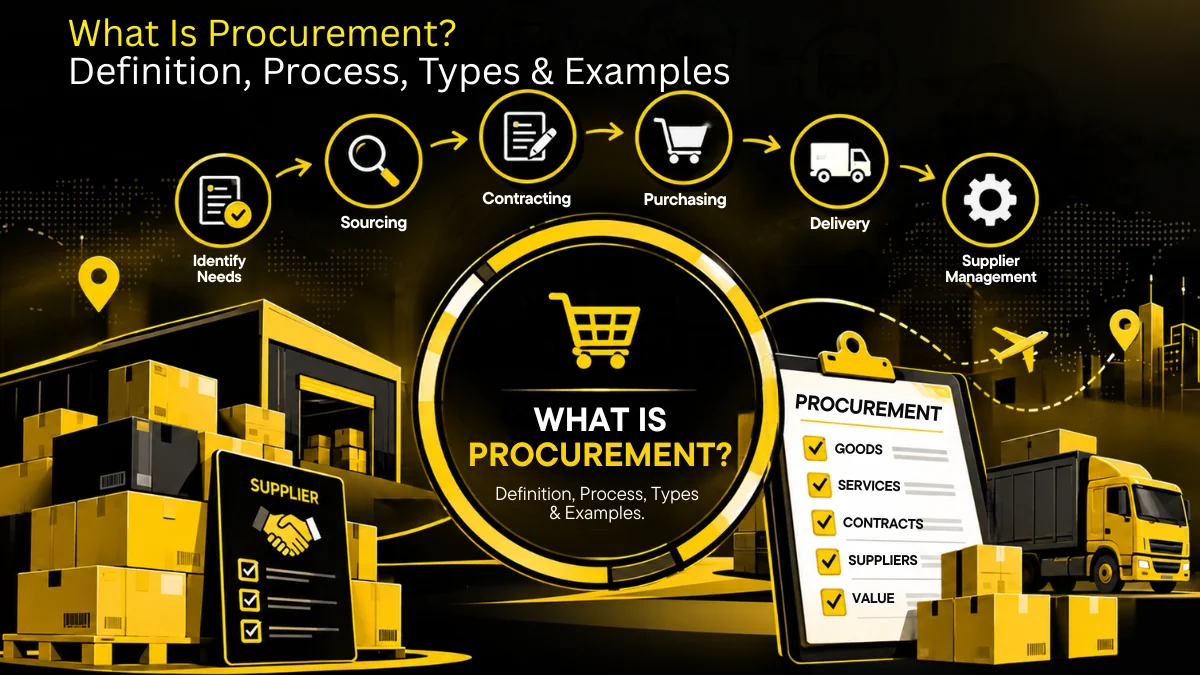
Procurement is the process a business uses to get the goods and services it needs from outside suppliers. It covers identifying a need, finding and selecting suppliers, negotiating contracts, placing orders, receiving goods, and paying invoices. Purchasing is one step inside procurement, not a synonym for it.
In simple terms: procurement is everything that happens between “we need this” and “the supplier has been paid.”
For most companies, spend with outside suppliers is the largest single cost: more than 60% of revenue in manufacturing and about 30% in services, according to Kearney. That is why procurement is run as a governed function with its own policy, approvals, and metrics, not as an admin task.
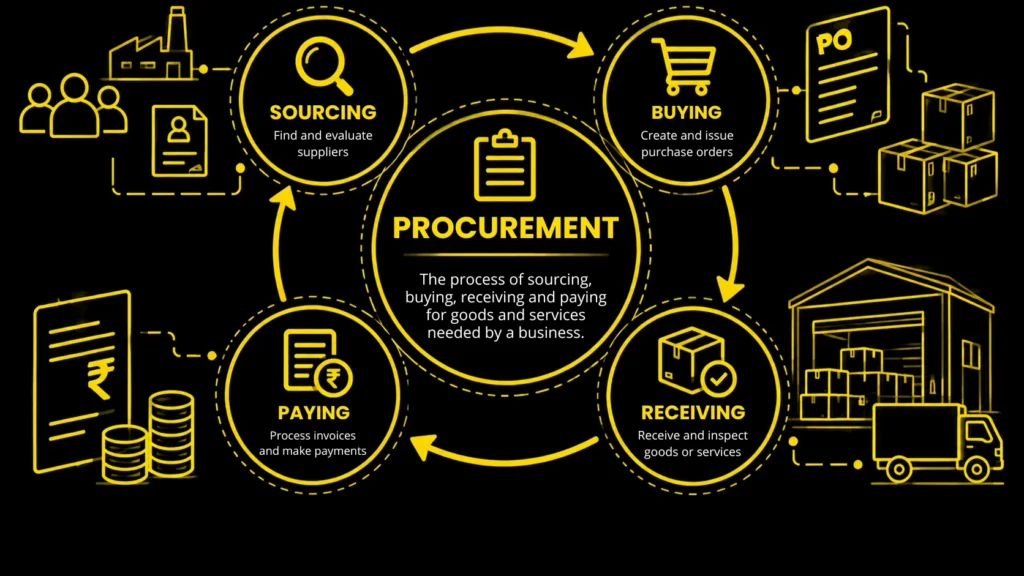
Procurement at a Glance
Procurement is the process of identifying business needs, sourcing products or services, evaluating suppliers, negotiating terms, purchasing goods or services, and managing supplier relationships. The goal is to obtain the right products or services at the right quality, cost, and time while controlling risk and improving business value.
Key Takeaways
- Procurement covers the full purchasing process, from identifying a business need to selecting suppliers, placing orders, receiving goods or services, and managing supplier relationships.
- The main objective of procurement is to secure the right products or services at the right quality, price, and time.
- Procurement includes strategic and operational activities, such as sourcing, supplier evaluation, negotiation, purchasing, contract management, and supplier performance management.
- Modern procurement uses technology and automation to streamline approvals, manage suppliers, control spending, and improve visibility across purchasing activities.
- Procurement differs from purchasing: purchasing is primarily focused on the transaction, while procurement covers the broader process of sourcing, supplier management, purchasing, and spend control.
- Effective procurement helps businesses reduce costs, manage supplier risk, improve compliance, increase spending visibility, and support better business decisions.
In between those two points the work usually includes scanning the market, finding and qualifying possible suppliers, requesting quotes or proposals, negotiating price and terms, issuing purchase orders, checking that deliveries match what was ordered, and managing the supplier relationship over time.
It is rarely a one-off transaction. Most organisations treat procurement as an ongoing strategic function whose job is to control cost, reduce supply-chain risk, protect quality and build reliable long-term relationships with vendors rather than scrambling every time a new need appears.
Procurement touches almost every category of spend: raw materials, equipment, office supplies, consulting, logistics, software subscriptions, and large construction or infrastructure projects. Complexity scales with the size of the organisation and the nature of what it buys.
That is the formal description. In day-to-day practice procurement answers a simpler question every business faces repeatedly: how do we get what we need, from someone we can trust, at a price we can stand behind?
Procurement meaning, in plain English
Someone on a team realises they need something: new laptops, a software subscription, raw steel, a marketing agency. Procurement is everything that happens between that realisation and a paid, reconciled invoice:
- Confirming the need is real and budgeted.
- Checking whether an approved supplier already covers it.
- Finding and comparing suppliers if not.
- Agreeing a price, contract and service terms.
- Placing the order.
- Confirming what arrived matches what was ordered.
- Paying the bill against that evidence.
The word comes from the Late Latin procurare, meaning to manage or take care of, built from pro (on behalf of) and curare (to care for) (Etymonline). That description still holds: procurement handles acquisition for the whole organisation so individual teams do not have to negotiate their own contracts.
What is procurement in business?
The Institute for Supply Management (ISM) describes it as an organisational function that spans specification, value analysis, supplier market research, negotiation, buying, contract administration and inventory control. US federal law takes the same end-to-end view: 41 U.S.C. § 111 says procurement covers every stage of acquiring property or services, “beginning with the process for determining a need” and running through contract completion and closeout. It exists to guarantee five outcomes:
- Availability – the business has what it needs, when it needs it.
- Value – the organisation pays a fair, competitive price.
- Reliability – suppliers can be trusted to deliver, especially under pressure.
- Control – spend stays inside budget, policy and approval limits.
- Risk management – supply, financial, legal and compliance risk is identified before it becomes a crisis.
A company without a formal procurement function still buys things. It simply does so inconsistently, at inconsistent prices, with little visibility into total spend and limited leverage in negotiations.
What is procurement in supply chain management?
Procurement is the inbound half of supply chain management. Procurement decides what to buy and from whom. Supply chain then plans, moves, stores and delivers those goods through the rest of the network.
Procurement owns the supplier relationship and the commercial terms. Supply chain owns the physical flow of goods once those terms exist. In a small company one person or team often handles both. In a large enterprise they are separate functions that hand off at the purchase order. For the full breakdown, see procurement vs. supply chain management.
Procurement definition vs. procurement management
Procurement is the function. Procurement management is the discipline of running that function well: governing the process, controlling spend, measuring supplier performance and keeping the underlying data clean and current.
A procurement management system is the software layer that turns procurement management from an aspiration into something enforceable. Policy that lives only in a document gets ignored. Policy built into a workflow gets followed.
Procurement Meaning in Business
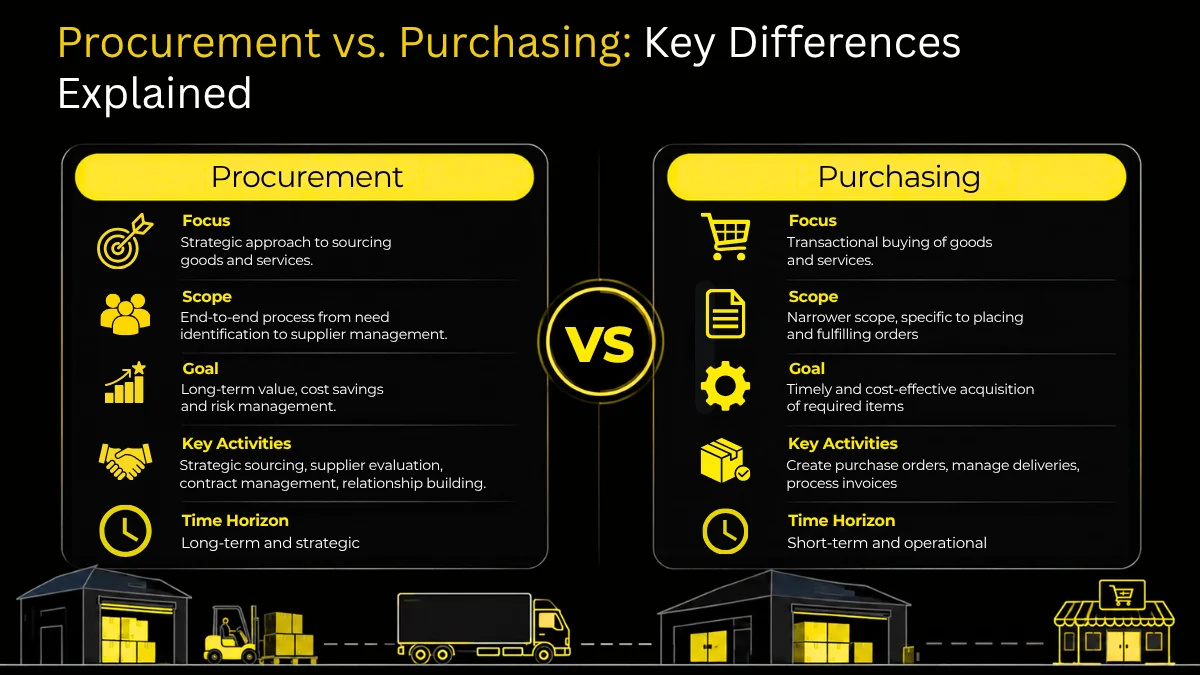
In business, procurement means the whole commercial function that secures external goods and services: supplier strategy, sourcing, negotiation, contracting, ordering and payment. Purchasing is only the transactional part of it. Procurement is measured on savings, supplier performance, cycle time and policy compliance, not just on orders raised.
| Procurement | Purchasing | |
|---|---|---|
| Scope | Strategic and end-to-end | Transactional |
| Activities | Category strategy, sourcing, negotiation, contracting, supplier management | Raising orders, receiving goods, paying invoices |
| Time horizon | Long term | Per transaction |
| Measured by | Savings, risk, supplier performance, compliance | Order accuracy, processing speed |
What Is Procurement Management?
Procurement management is the discipline of planning, controlling and improving how an organisation buys. It sets purchasing policy and approval thresholds, manages the supplier base and contracts, tracks spend against budget, and measures savings, cycle time and compliance across every category of purchase.
What Procurement Management Covers
- Purchasing policy, approval thresholds and delegation of authority
- Category strategy and supplier segmentation
- Contract lifecycle management and renewals
- Spend analysis and savings tracking
- Supplier performance and risk management
- Procurement systems, data quality and reporting
Why Procurement Matters for Your Company
Once people understand the definition, the next question is usually why procurement deserves dedicated attention, headcount and budget. Five reasons stand out.
It controls the largest cost line you can actually influence
Third-party spend, everything procurement touches, is the biggest cost element for most companies. Kearney’s 2026 Assessment of Excellence in Procurement puts it at more than 60% of revenue for the average manufacturer and around 30% in services (Kearney). Unlike payroll, it is negotiable line by line. In banking, McKinsey estimates that 40 to 50% of operating expenses flow through external vendors, and that leading procurement teams save 7 to 10% of addressable third-party spend. Every percentage point saved flows straight to operating margin, which is why procurement performance increasingly appears at board level rather than buried in an operations update.
It protects the business from supply disruption
A procurement function identifies and reduces supply risk before it turns into a stalled production line or an empty shelf. Supplier financial health checks, dual-sourcing strategies and contract contingency clauses all sit here. The dominant planning model has shifted from “just-in-time,” which optimises for cost, to “just-in-case,” which optimises for resilience. Teams deliberately broaden the supplier base and hold contingency capacity even when it costs slightly more.
It turns suppliers into a competitive advantage
Good procurement is not adversarial. Strong supplier relationships produce better pricing, earlier access to constrained capacity, and joint innovation that a purely transactional buyer never sees. Those relationships rest on predictable payment terms, clear specifications, honest feedback and professional conflict resolution. A supplier who trusts your process gives you their best terms. A supplier chasing unpaid invoices does not.
It enforces compliance and creates an audit trail
A governed procurement process creates a documented trail from the original requisition through to the paid invoice. That trail is what satisfies internal audit, external audit and tax authorities. Without it, organisations accumulate maverick spend: purchases made outside agreed contracts and approval workflows that are invisible in forecasts and unenforceable in supplier disputes. See procurement compliance and procurement audit.
It is the primary lever on sustainability and responsible sourcing
Procurement decides which suppliers get funded. That makes it the biggest single lever an organisation has over its supply chain emissions, labour standards and supplier diversity.
In short, every dollar you spend with a third party either strengthens your margin, your resilience and your reputation, or quietly erodes all three. Procurement is the function that decides which outcome occurs.
For a practical view of how teams measure and report those gains, see procurement cost savings strategies.
Types of Procurement
Most procurement activity falls into four core types, plus a fifth distinction (public versus private) that changes the rules rather than the categories.
| Type | What it covers | Who usually owns it | Example | Typical contract |
|---|---|---|---|---|
| Direct | Materials and components in the finished product | Manufacturing / operations | Steel and tires for a car manufacturer | Long, often multi-year |
| Indirect | Goods and services that keep the business running | Central procurement or finance | SaaS licenses, facilities, consultancy | Short, often annual |
| Goods | Physical, storable items across direct and indirect | Procurement plus inventory | Laptops, machinery, office equipment | Varies by item |
| Services | External labor and expertise | Category or sourcing managers | Legal counsel, IT contractors, marketing agencies | Governed by MSA and SOW |
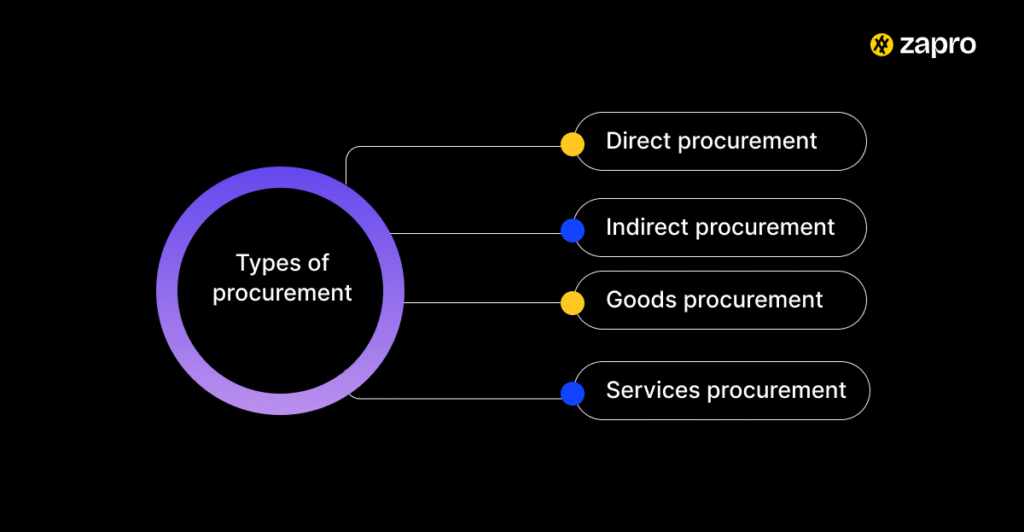
1. Direct procurement
Direct procurement acquires the materials, components and outsourced labour that go straight into a company’s product or service. These are the supplies that feed the production line and directly shape the quality of what the business sells. A car manufacturer buying steel and tires, or a food producer buying raw ingredients, is doing direct procurement.
The business literally cannot operate without it. A disruption here stops production and hits revenue the same day. That is why direct procurement runs on larger budgets, longer contracts and closer supplier partnerships than any other type. Planning has to line up tightly with production schedules and demand forecasts.
2. Indirect procurement
Indirect procurement covers everything that keeps daily operations running without ever becoming part of the finished product: IT services, software subscriptions, maintenance, marketing, real estate and professional services.
Indirect spend behaves very differently from direct spend. It arrives in smaller, more frequent transactions, across a far larger and more fragmented supplier base, on shorter contracts. That fragmentation is exactly why it leaks: nobody owns the full picture, so duplicate subscriptions and off-contract spend accumulate quietly. The category itself has also shifted. Traditional cleaning contracts and office supplies still exist, but the fastest-growing share is SaaS, cybersecurity and specialist software. See indirect procurement and the direct comparison in direct vs. indirect procurement.
3. Goods procurement
Goods procurement covers physical items, both direct materials that become part of a finished product and indirect items that support operations, such as laptops, machinery and facility supplies. Because goods can be counted, stored, inspected and sometimes resold, quality inspection and inventory control sit at the centre of the process. The buying cycle typically runs through specification, supplier comparison, price negotiation and delivery logistics.
4. Services procurement
Services procurement brings in external expertise: consultants, contractors, IT and marketing agencies, legal firms and facilities providers. Services suppliers typically work under a Master Service Agreement (MSA), with Statements of Work (SOWs) defining specific deliverables and timelines, and Service Level Agreements (SLAs) defining the performance standard they are held to.
Services are harder to govern than goods. Requirements are harder to specify precisely, quality is harder to inspect on delivery, and outcomes are harder to measure objectively. Most mature organisations track contingent labour (temporary staff and independent contractors) separately from other services procurement because the payment models and legal classifications differ.
Public vs. private procurement
Public procurement is spend by government bodies and publicly funded organisations, bound by statutory rules on competitive tendering, transparency, publication thresholds and formal appeal rights. The process exists partly to prevent favouritism with taxpayer money. It is also enormous: the OECD notes that healthcare alone accounts for roughly a third of public procurement spending, which is why governments treat procurement efficiency as a public-finance issue rather than an administrative one (OECD, Public Procurement).
The scale is global. The World Bank estimates public procurement at about $11 trillion a year, roughly 12% of world GDP. Across OECD countries, procurement accounted for 29.9% of total government expenditure in 2023 (OECD, Government at a Glance 2025).
Centralized vs. decentralized procurement
A related operating decision is whether procurement sits in one central team or is distributed across business units. Centralised procurement concentrates buying power, standardises contracts and makes compliance easier to enforce, but can slow down category-specific decisions. Decentralised procurement moves faster for local needs but fragments supplier leverage and makes spend visibility harder.
Most large organisations run a hybrid model: a central team owns strategic and high-value categories while business units retain authority over low-risk, local purchases inside a defined policy. This is covered in more depth under procurement organizational structure.
The Procurement Process: 7 Steps Explained
The procurement process runs in seven connected steps. Skipping or weakening any one of them breaks the financial control at that point, and at every point after it.
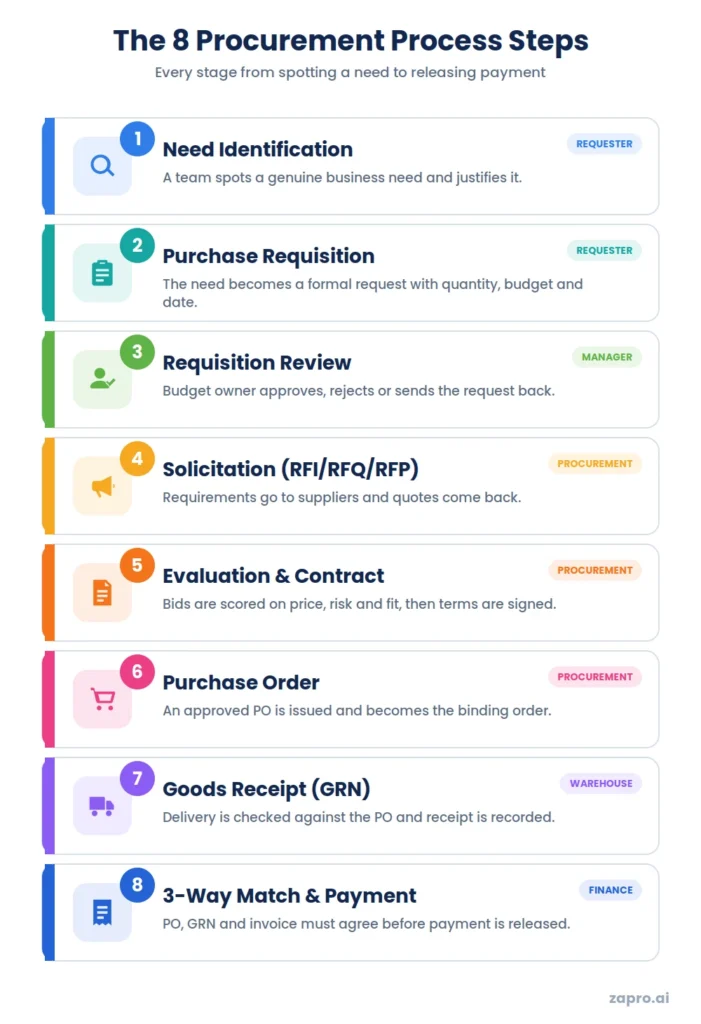
Step 1 – Identify the need. A team defines what it requires, specifies quantity and quality, and confirms budget availability before anything else happens.
Step 2 – Check existing supply. Procurement checks whether an approved, contracted supplier already covers this need before going to market. This single step prevents the majority of maverick spend.
Step 3 – Source and shortlist suppliers. If no contracted supplier fits, procurement issues RFIs, RFPs or RFQs to potential vendors and builds a shortlist based on capability, price and risk.
Step 4 – Evaluate and select. Shortlisted suppliers are scored against defined criteria (price, quality, capacity, financial stability and risk) and a winner is selected with a documented rationale.
Step 5 – Negotiate and contract. Commercial terms, service levels and payment terms are agreed and formalised in a contract, protecting both sides and setting the standard the relationship will be measured against.
Step 6 – Raise the PO and receive the goods. A purchase order is raised and approved against the agreed terms. On delivery, a Goods Received Note (GRN) confirms that what actually arrived matches what was ordered.
Step 7 – Match and pay. The purchase order, GRN and supplier invoice are matched three ways before payment is released.
Three-way matching (PO, GRN and invoice) is the single most important financial control in procurement. If any one of the three is missing, the organisation is paying on trust instead of evidence. In practice the break in this chain is almost never the purchase order. Teams raise and approve POs diligently. It is the goods receipt: delivery gets confirmed informally over email or not at all, which leaves accounts payable with nothing to match against, and invoices either get paid on faith or stall in a queue.
How these seven steps route through approvals and systems in your organisation is defined by your procurement workflow. For a deeper walkthrough of each stage with examples, see the full procurement process guide. For how the ordering and payment half connects end to end, see procure-to-pay process and procurement lifecycle.
Procurement vs. Purchasing vs. Sourcing vs. Supply Chain Management
These four terms get used interchangeably in casual conversation. They are not the same, and the difference matters operationally. Misusing them is usually a sign that responsibilities in an organisation are not clearly split either.
Is procurement the same as purchasing?
No. Purchasing is a subset of procurement. Purchasing places the order and settles the invoice. Procurement decides what to buy, which supplier to buy it from, and on what contractual terms, then governs that relationship over time.
| Aspect | Procurement | Purchasing |
|---|---|---|
| Definition | Complete approach to acquiring goods and services, including supplier selection, negotiation and relationship management | Subset of procurement covering order placement, receipt and payment |
| Scope | Full vendor lifecycle, from identifying a need to managing supplier performance | Day-to-day buying once needs are already defined |
| Timeline | Can run over months or years | Usually completes in days or weeks |
| Focus | Long-term value across cost, quality and supplier performance | Immediate cost and delivery date |
| Approach | Strategic and cross-functional | Tactical and reactive |
For a deeper breakdown with examples, see procurement vs. purchasing.
Procurement vs. sourcing
Sourcing sits early inside the procurement process. It is the activity of finding, evaluating and selecting suppliers. Procurement manages everything from identifying the need through to paying the invoice, including sourcing as one stage within it.
| Aspect | Procurement | Sourcing |
|---|---|---|
| Definition | End-to-end process from identifying needs to paying suppliers | Process of finding, evaluating and selecting suppliers |
| Main goal | Control cost and maintain process efficiency | Build long-term value through reliable, competitive suppliers |
| Core work | Negotiates, issues purchase orders, manages vendor relationships | Studies markets, benchmarks suppliers, develops partnerships |
| Time horizon | Transactions move quickly once suppliers are selected | Decisions shape relationships lasting years |
Procurement vs. supply chain management
| Aspect | Procurement | Supply Chain |
|---|---|---|
| Definition | Buying the goods and services the organisation needs | Managing the full journey of goods, from raw materials to final delivery |
| Responsibilities | Selects suppliers, negotiates contracts, manages vendor risk | Plans production, manages inventory, oversees logistics and delivery |
| Focus areas | Spend, supplier performance, contract compliance | Efficiency, reliability and speed of product flow |
| Goals | Cost savings, risk reduction, supplier reliability | Fast delivery, optimal stock levels, customer satisfaction |
Read the full comparison at procurement vs. supply chain management, and the closely related procure-to-pay vs. source-to-pay breakdown for how the two process models differ.
Procurement Strategy and the Procurement Lifecycle
A procurement strategy is the organisation’s plan for how it will use procurement to create value, not just how it will process transactions. It typically covers category strategy (which suppliers and approaches fit each spend category), risk tolerance, sustainability commitments, and the balance between cost savings and supplier relationship investment.
A well-built strategy answers three questions for every major spend category: Should we consolidate suppliers or diversify them? Should we optimise this category for cost or for innovation? And what is the acceptable level of risk for this category if a supplier fails? Category strategy differs sharply between, say, single-source critical components and commoditised office supplies. See the full framework in procurement strategy.
The procurement lifecycle is the strategy made operational: the repeating cycle of planning, sourcing, contracting, ordering, receiving, paying and reviewing supplier performance that a category moves through continuously, not just once. Understanding the lifecycle is what separates procurement teams that manage suppliers proactively from teams that only react when something breaks.
Who Does Procurement? Roles, Titles, and Org Structures
Procurement is delivered by a defined set of roles. Team size scales with spend complexity, not headcount. A fast-growing 200-person company can have more procurement complexity than a stable 2,000-person one.
- Buyer / purchasing officer – raises and expedites orders against agreed contracts.
- Category manager – owns strategy for a spend category such as IT, logistics or facilities.
- Sourcing manager – runs RFPs, evaluates suppliers and leads negotiations.
- Contract manager – drafts, stores and enforces supplier agreements.
- Procurement manager – owns process, policy and team performance across categories. See the full role breakdown at procurement manager.
- Chief Procurement Officer (CPO) – owns total third-party spend, supplier risk and the operating model at board level.
In small organisations, one or two people cover all six roles at once. In enterprises, each is a separate team with its own budget and targets.
How the CPO role has changed
The CPO role has changed materially over the past decade. It began as a back-office, cost-reduction function reporting several layers below the CFO. It now sits alongside the CFO on supply resilience, sustainability reporting and regulatory compliance, and increasingly reports directly to the CEO or board in organisations where third-party spend is a strategic risk, not just a cost line. See our full guide to the procurement leader role and how procurement and finance increasingly operate as one function rather than two.
Organizational structure
Where a procurement function sits in the org chart shapes how much authority it has. The three common models (centralised, decentralised and hybrid or “centre-led”) trade off speed against control differently. Most companies past a certain spend threshold converge on a hybrid model.
Procurement Methods: RFI, RFP, RFQ, and Tendering
When a need cannot be met by an existing contracted supplier, procurement uses one of a small set of standard methods to go to market, chosen based on how well-defined the requirement is and how much competitive tension is needed. This stage sits at the heart of strategic sourcing.
- RFI (Request for Information) – an early-stage market scan to understand what suppliers are capable of, used when the requirement itself is still being defined. Need a starting point? Use our free RFI Template.
- RFP (Request for Proposal) – a structured invitation for suppliers to propose a solution and price against a described problem, used for complex or services-heavy requirements.
- RFQ (Request for Quotation) – a price request against a fixed, fully known specification, used when the requirement is simple and suppliers are essentially competing on price alone.
- Competitive tendering – a formal, often legally required process (especially in public procurement) where suppliers submit sealed bids evaluated against published criteria.
- E-auctions – a live, often reverse, bidding event used for commoditised categories where price is the dominant decision factor.
Choosing the wrong method is a common source of wasted cycle time. Running a full RFP for a low-risk, well-specified purchase slows the business down for no benefit, while using an RFQ for a complex services requirement produces bids that cannot be meaningfully compared. See procurement methods for a full decision framework. Software built to manage this whole shortlisting and evaluation cycle is covered in our roundup of the 10 Best eSourcing Tools.
How Procurement Performance Is Measured (KPIs)
Procurement performance is measured across five KPI families. Measuring savings alone hides the real picture. A team can cut unit price while destroying delivery reliability, and the savings figure will look great right up until a stockout happens.
| KPI family | Example metrics |
|---|---|
| Cost | Realised savings, cost avoidance, purchase price variance |
| Cycle time | Requisition-to-order time, sourcing cycle time, invoice processing time |
| Compliance | Contract compliance rate, maverick spend %, PO coverage |
| Supplier performance | On-time delivery rate, quality rejection rate, SLA attainment |
| Risk | Single-source dependency, supplier financial risk score, contract expiry exposure |
The risk family is the one most teams measure informally. The international reference point is ISO 31000:2018, which sets out principles and guidance for identifying, analysing, evaluating, treating, monitoring and communicating risk across an organisation. Worth knowing before anyone claims otherwise in an RFP: ISO 31000 is guidance, not a certifiable standard. You can align to it, but no organisation is certified against it (ISO 31000:2018).
Spend data is the foundation for all five KPI families. Without clean, categorised and current spend data, sourcing strategy and supplier negotiation are guesswork. You cannot negotiate leverage you cannot see. For definitions, formulas and benchmarks, see procurement KPIs and spend analysis in procurement. To understand how mature your measurement practice is relative to peers, see procurement benchmarking.
Common Procurement Challenges – and How Teams Solve Them
Every procurement team, regardless of size, tends to run into the same handful of recurring problems.
Fragmented data across systems. The PO lives in one system, the delivery confirmation in an inbox, and the invoice in a separate finance queue. Nobody has a single view of a transaction end to end, which makes three-way matching a manual, error-prone exercise instead of an automatic check.
Maverick spend. Purchases made outside contracted suppliers and approval workflows are invisible in forecasts and unenforceable when a supplier underperforms, because there is no agreed contract to point to.
Slow cycle times. When requisitions sit in email inboxes waiting for manual approval, sourcing and onboarding take weeks longer than they need to, and internal customers start working around procurement rather than through it, which only makes the fragmentation worse.
Supplier risk blind spots. Without continuous monitoring, a supplier’s financial distress, capacity constraint or compliance lapse surfaces only when it becomes a delivery failure, not before.
Tail spend sprawl. The long tail of low-value, high-volume transactions, often the majority of supplier relationships but a small share of total spend, consumes disproportionate administrative effort relative to the value it delivers.
These challenges are largely solvable with process discipline and the right technology. See procurement challenges and procurement best practices for the detailed playbook.
Procurement Technology: E-Procurement, Automation, and AI
Manual procurement fails at scale for a predictable reason: the controls depend on documents that live in different systems. The category of tools built to fix this splits along a fairly predictable line. Some platforms run one step of the process well; others run the whole chain on a single record. The breakdown of procurement tools by type (source-to-pay, e-procurement, spend analytics, vendor management, contract lifecycle management and AP automation) is the fastest way to work out which shape your team actually needs. If vendor management is the piece you’re evaluating separately, see our roundup of the Best Vendor Management Software for a side-by-side comparison of the leading platforms.
E-procurement and automation
E-procurement software moves requisitions, approvals, orders and receipts onto a single platform, removing the paper and email handoffs where approvals stall and audit trails break. The measurable gains show up in cycle time and compliance rather than headcount. Approvals route automatically, spend classifies itself, and contracted suppliers appear in catalogues so buyers do not accidentally go off-contract. See e-procurement software and the deeper e-procurement guide, plus how these platforms connect into procurement automation and procure-to-pay automation.
AI in procurement
AI now handles work that used to be manual and slow: classifying spend into categories, reading and extracting invoice data, flagging supplier risk signals, and surfacing contract terms coming up for renewal. Data quality decides how far AI gets. In its 2025 Hype Cycle, Gartner placed generative AI for procurement in the trough of disillusionment, naming fragmented, low-quality data across procurement systems as a main reason outputs fall short. AI processes routine transactions automatically and escalates only the ones that break a rule, which is exactly where human judgment is worth paying for. Read more in AI in procurement and how AI agents are starting to run entire sub-workflows in procurement agent.
Choosing procurement software
Where platforms differ most is how much of the cycle each one actually covers on a single record: sourcing, ordering, receiving and invoice matching together, or three separate tools stitched together after the fact through integrations. Our comparison of the best procurement software evaluates the leading platforms on exactly that question.
Team size changes what “best” means. Our guide to purchasing software for small business narrows the evaluation criteria to what actually matters at that scale.
Zapro is an AI-powered procurement and accounts payable platform that runs the full procure-to-pay cycle (vendors, contracts, requisitions, orders, receipts, invoices and spend analytics) on a single record. Because every document lives on one record instead of three disconnected systems, three-way matching happens automatically rather than as a manual reconciliation task at month-end.
See also AP automation and how teams evaluate platforms in how to choose the best procurement software.
In practice, the break in the P2P chain is almost never the purchase order. Teams raise and approve POs diligently. It is the goods receipt. Delivery gets confirmed informally over email rather than logged as a Goods Received Note, which leaves accounts payable with nothing to match the invoice against, and the invoice either gets paid on trust or sits stalled in a queue waiting for someone to chase down proof of delivery.
Procurement by Industry
Procurement fundamentals stay the same across industries, but the risk profile, regulatory pressure and category mix change significantly by sector.
Healthcare procurement deals with compliance-heavy categories (pharmaceuticals, medical devices), patient-safety-critical supply continuity, and complex group purchasing organisation (GPO) contracts. See hospital procurement, healthcare procurement strategy, healthcare procurement challenges, healthcare procurement solutions and digital transformation in healthcare procurement.
Construction procurement manages long, capital-intensive projects with volatile material pricing, subcontractor risk and tight scheduling dependencies. See construction procurement software, project procurement management, and engineering, procurement, and construction management.
Manufacturing procurement is dominated by direct materials, just-in-time and just-in-case tradeoffs, and tight integration with production planning. See procurement in manufacturing.
IT procurement manages software licensing, cloud spend and vendor security review as its dominant categories, often with the fastest-growing budget line in the company. See IT procurement and SaaS procurement.
Retail procurement balances seasonal demand volatility, high SKU counts and thin margins against supplier lead times. See retail procurement.
Procurement Maturity: From Manual to Autonomous
Procurement functions typically progress through recognisable stages of maturity: reactive (manual, email- and spreadsheet-driven, no visibility into total spend), defined (documented processes, some system of record, basic compliance controls), managed (integrated systems, proactive supplier management, KPI-driven decisions), and strategic or autonomous (AI-assisted exception handling, predictive risk management, procurement embedded in company strategy).
Most organisations dramatically overestimate their own maturity level, particularly around spend visibility and supplier risk monitoring. An honest maturity assessment is usually the fastest way to identify which investment (process redesign, a new system, or better data) will actually move the needle. See the full procurement maturity model for a stage-by-stage self-assessment.
Sustainable and Responsible Procurement
Procurement decides which suppliers an organisation funds, which makes it the single biggest lever most companies have over their supply chain’s environmental and social footprint. Companies disclosing to CDP reported supply chain (Scope 3) emissions averaging 26 times their operational emissions in 2023, yet only 15% had set a Scope 3 reduction target (BCG and CDP, 2024). Sustainable procurement blends environmental, social and economic criteria into supplier selection, not as a separate initiative bolted onto the process, but as another scored dimension alongside price and quality.
In practice this means lifecycle assessment of a product’s environmental impact, modern slavery and labour-standards due diligence on suppliers and their sub-tier suppliers, and reporting against recognised disclosure frameworks for investors and regulators. As reporting requirements tighten across major markets, procurement teams that already track supplier-level emissions and labour data have a significant head start over teams trying to reconstruct that data retroactively under deadline pressure.
Procurement Trends to Watch in 2026
A few shifts are reshaping how procurement teams operate right now. AI-assisted exception handling is moving from pilot projects into daily workflow for invoice matching and spend classification. In a July 2024 Gartner survey of 258 procurement leaders, 72% said they were prioritizing generative AI in their strategies (Gartner). Supplier risk monitoring is becoming continuous rather than an annual review exercise, driven by geopolitical and financial volatility. Embedded procurement controls are replacing standalone approval chains, so policy is enforced automatically inside the requisition rather than checked after the fact. And procurement and finance are converging operationally, sharing systems and data rather than reconciling two separate versions of spend. For the full analysis, see procurement trends and digital procurement transformation.
Procurement Glossary: 30+ Terms Defined
- RFI – Request for Information. An early-stage market scan of supplier capability.
- RFP – Request for Proposal. A structured invitation for suppliers to propose a solution and price.
- RFQ – Request for Quotation. A price request against a fixed, known specification.
- PR – Purchase Requisition. An internal request to buy, raised before any supplier is contacted.
- PO – Purchase Order. The buyer’s binding commercial commitment to a supplier. See what is a purchase order.
- Blanket PO – A single purchase order covering multiple deliveries over an agreed period at a pre-set price, used for recurring needs instead of raising a new PO each time. See What Is a Blanket PO? Meaning, Uses & Blanket vs Standard PO.
- GRN – Goods Received Note. Confirmation that delivered goods match what was ordered. See goods received note.
- Three-way match – Automated check that the PO, GRN and invoice agree before payment.
- MSA – Master Service Agreement. The umbrella contract governing an ongoing supplier relationship.
- SOW – Statement of Work. The specific deliverables, timeline and acceptance criteria under an MSA.
- SLA – Service Level Agreement. The measurable performance standard a supplier commits to.
- P2P – Procure-to-Pay. The chain from requisition through to supplier payment.
- S2P – Source-to-Pay. P2P plus the upstream sourcing and contracting stages.
- MRO – Maintenance, Repair and Operations. Indirect spend that keeps facilities running.
- Tail spend – The long tail of low-value, high-volume transactions across most of the supplier base.
- Maverick spend – Purchases made outside agreed contracts and approval workflows.
- Category management – Grouping spend into categories and managing each with a dedicated strategy.
- Spend analysis – Classifying and analysing historic spend data to inform sourcing decisions.
- Purchase requisition vs. purchase order – A requisition is an internal request; a PO is the binding commitment sent to a supplier. See purchase requisition vs. purchase order.
- PO invoice vs. non-PO invoice – Whether an invoice has a matching purchase order behind it. See PO invoice vs. non-PO invoice.
- Purchase order vs. invoice – A PO is a commitment to pay; an invoice is the supplier’s request for payment against it. See purchase order vs. invoice.
- Sales order vs. purchase order – A purchase order is what a buyer sends to a supplier; a sales order is what the supplier’s own system generates in response to it. See Sales Order vs Purchase Order.
- Catalog management – Maintaining approved supplier items and pricing inside a buying platform. See catalog management in procurement.
- Procurement orchestration – Coordinating multiple procurement systems and workflows as one connected process. See procurement orchestration.
- Procurement integration – Connecting procurement systems to ERP, finance and inventory platforms. See procurement integration.
- Digital procurement – The broader shift of procurement processes onto connected digital systems. See what is digital procurement.
- Agile procurement – Applying iterative, flexible sourcing approaches to fast-changing requirements. See what is agile procurement.
- Operational procurement – The day-to-day execution of buying activities, as distinct from strategic sourcing. See operational procurement.
- Procurement collaboration – Cross-functional coordination between procurement, finance and requesting teams. See procurement collaboration.
- Purchase order financing – Short-term financing secured against a confirmed purchase order. See purchase order financing.
- Sourcing optimization – Systematically improving supplier selection and category strategy over time. See sourcing optimization.
- B2B procurement platform – Software that connects business buyers with suppliers for transactions at scale. See B2B procurement platforms.
Frequently Asked Questions
What is procurement in simple terms?
Procurement is everything a business does to get what it needs from outside suppliers: deciding what to buy, choosing who to buy it from, agreeing the price and terms, placing the order, checking what arrives, and paying the invoice.
What are the 7 steps of procurement?
Identify the need, check whether an approved supplier already covers it, source and shortlist suppliers, evaluate and select one, negotiate and sign the contract, raise the purchase order and receive the goods, then match the invoice to the order and receipt before paying.
What are the types of procurement?
There are four main types. Direct procurement buys materials that go into the product. Indirect procurement buys what keeps the business running, such as software and facilities. Goods procurement covers physical items that can be counted, stored and inspected. Services procurement covers external labor and expertise, usually under a master service agreement. Some frameworks group these into three by folding goods into direct and indirect.
What is the difference between procurement and purchasing?
Purchasing is the transactional part: raising orders, receiving goods and paying invoices. Procurement is the whole function, including sourcing, negotiation, contracting, supplier management and compliance. Purchasing sits inside procurement.
What does a job in procurement mean?
A procurement job means owning how a company buys. Buyers raise and expedite orders, sourcing managers run RFPs and negotiations, category managers set strategy for a spend area, and the Chief Procurement Officer owns total third-party spend and supplier risk at board level.
What is procurement in business?
In business, procurement is the governed function that secures external goods and services at the right price, quality and risk level. It is measured on savings, cycle time, contract compliance and supplier performance, and it creates the audit trail from requisition to paid invoice.
What is P2P in procurement?
P2P stands for procure-to-pay: the connected chain from purchase requisition through approval, purchase order, goods receipt, invoice matching and supplier payment. It is the operational half of procurement; sourcing and contracting sit upstream of it.
Is procurement a good career?
Procurement gives direct exposure to company margin and supplier strategy. Typical paths run from buyer to category manager to procurement director to Chief Procurement Officer. Demand has grown as companies treat supply risk and third-party spend as board-level issues.
Next Steps
Zapro AI unifies procurement, vendors, contracts, inventory, accounts payable, and analytics on a single record, so three-way matching, approvals, and spend reporting happen without manual reconciliation.
Once the concepts on this page are clear, the natural next step is seeing them applied. See procurement software in action with a full walkthrough of the procure-to-pay cycle, or explore the Zapro procurement platform directly.
Sources
- 41 U.S. Code § 111, Procurement (Cornell Law School LII)
- Institute for Supply Management
- Etymonline, “procure”
- Kearney, 2026 Assessment of Excellence in Procurement
- McKinsey, A new era for procurement in financial services
- World Bank, How large is public procurement?
- OECD, Government at a Glance 2025: Size of public procurement
- OECD, Public Procurement
- ISO 31000:2018 Risk management
- Gartner, Hype Cycle for Procurement and Sourcing Solutions (2025)
- Gartner, Three advancements in GenAI for procurement (2024)
Don’t miss our weekly updates
We’ll email you 1-3 times per week—and never share your information.
Let’s Streamline Your End-to-End Procurement
We’ll unify your P2P process and empower your team to work smarter.
About the Author

Md. Kafil


About the Reviewer

Zapro is dedicated to helping businesses of all sizes make informed decisions. We adhere to strict editorial guidelines to ensure that our content meets and maintains our high standards.
Our editorial standards help keep every article accurate, useful, and trustworthy.
Related Blogs
Wait! Don't Leave Without This Free Guide
How AI Is Replacing Manual Procurement And What Your Team Should Do Next