

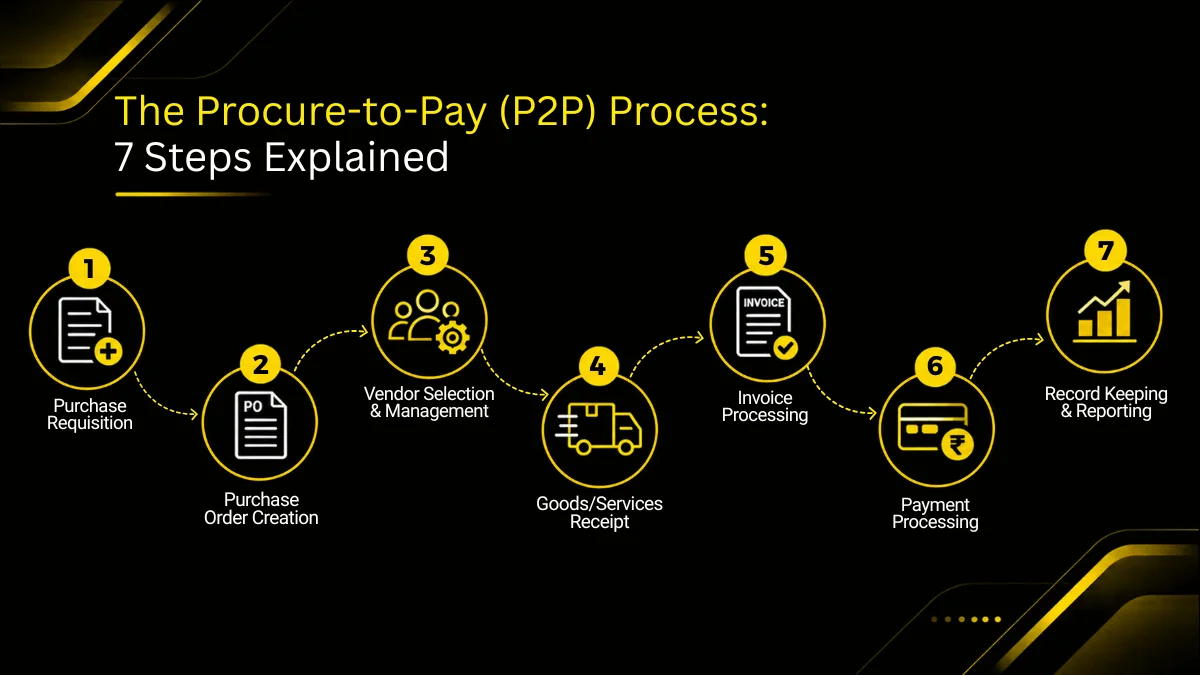
The procure-to-pay (P2P) process is the end-to-end cycle for buying goods or services and paying the supplier: purchase requisition, approval, purchase order creation, supplier fulfilment, goods or services receipt, invoice processing with three-way matching, and payment recorded in the financial system.
It typically covers the purchase request and every step through to payment. An integrated P2P workflow keeps all these activities connected through one system and audit record.
In finance and procurement, P2P means procure-to-pay, an efficient system that helps businesses track expenses, control spending, and maintain accurate data.
Key Takeaways
- The procure-to-pay process covers the full journey from identifying a business need to paying the supplier.
- A detailed and organised P2P roadmap includes requisition, approval, purchase order, receipt, invoice generation, three-way matching, and payment.
- P2P (procure-to-pay) is a more limited version of source-to-pay, as it does not include the steps from sourcing to contract negotiation.
- Discrepancies and disruptions are identified by the three-way matching method.
- Automation reduces delays, risks, and fraudulent activities.
- Key procure-to-pay data include requisition-to-PO duration, invoice exception rate, touchless rate, and more.
What Is The P2P Process
The P2P process is the transactional roadmap for buying goods or services and paying the supplier. It connects procurement activities with AP so that each purchase can be done in a controlled environment.
The process starts when a department or employee identifies a business need and ends with the supplier getting paid. This transaction is recorded for financial reporting and auditing.
A modern procure-to-pay system maintains a continuous transactional record and, instead of storing details across disconnected systems, connects everything in one unified platform.
The 7 Steps of the P2P Process
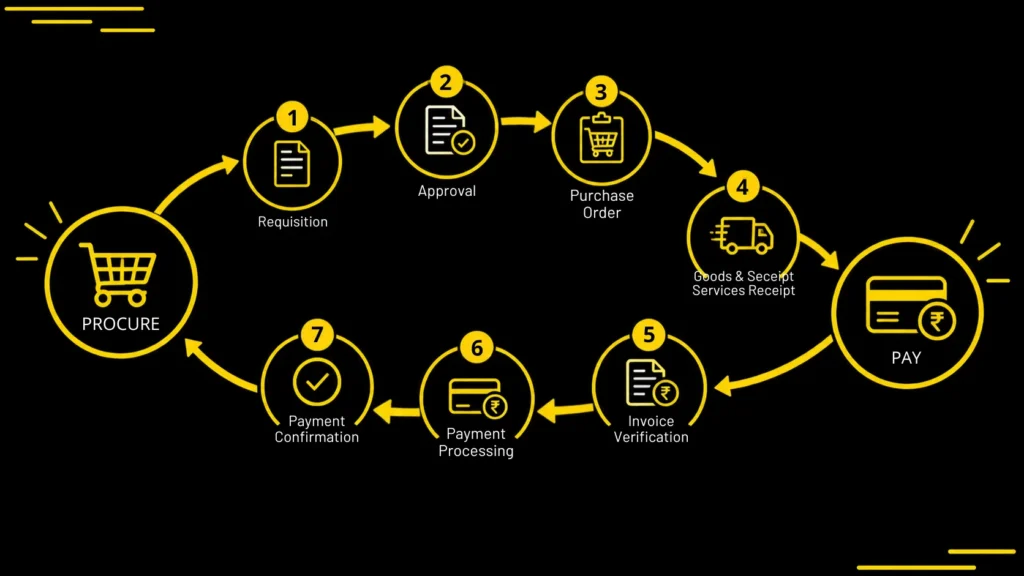
The procure-to-pay cycle can be divided into seven steps, and some stages include additional controls such as separate approvals, invoice matching, and authorisation steps.
- Purchase requisition: A department or employee submits a request that identifies what the business needs and other relevant details.
- Approval: After the requisition is issued, it is reviewed against the protocols and availability rules and approved.
- Creating the purchase order: After the requisition is approved, procurement creates a purchase order and sends it to the supplier.
- Fulfilment: Once the supplier receives the order, the fulfilment process starts, and it is delivered.
- Goods/services receipt: The business verifies the delivery and generates the receipt against the purchase order.
- Invoice processing: The supplier sends the invoice, and it is matched against the purchase order and receipt.
- Payment and Log: After the invoice is approved, the payment is processed, and the transaction is recorded in the financial system.
This format protects the centre procure-to-pay cycle while letting businesses add controls based on their approval policies and systems.
What Is The Procure-To-Pay Process
The procure-to-pay business process is an organised method to manage purchases and payments from beginning to end.
P2P links procurement and finance activities through specified systems, unlike ad hoc purchasing.
The process can use all the steps involved to create better visibility into structured expenses and make it easier to identify where disruptions occur.
Procurement teams can review purchasing activity, while finance teams can authenticate invoices using the same transaction record.
The Complete Procure-to-Pay Process Flow
The end-to-end procure-to-pay process follows a structured pathway, although the exact method varies from business to business.
Some organisations add different controls/levels to different steps if required.
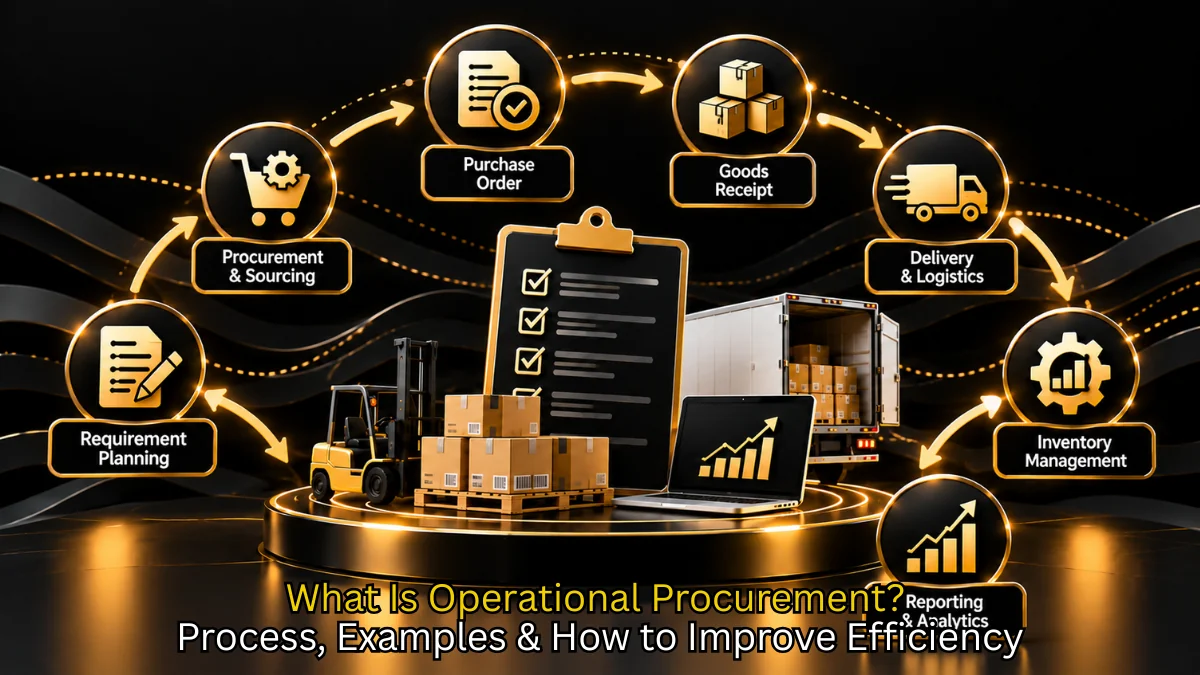
1. Purchase Requisition
The process begins with an employee identifying and requesting a purchase, which starts with recording the needs, quantity, budget information and other details needed to approve the purchase. The requisition is then directed to the necessary department according to the rules of the business.
2. Approval
Once the purchase requisition is raised, procurement reviews the details against the needs and checks whether the organisation can accommodate it and then proceeds to approve it.
3. Creating The Purchase Order
Once the requisition is approved, procurement proceeds to create a purchase order with the required goods/services and terms. This purchase order is then provided to the supplier and becomes the ideal reference document for the purchase.
4. Fulfillment
After the supplier has been chosen after careful evaluation, procurement hands off the purchase order to the supplier, and the supplier works toward fulfilling it. Supplier information can then be maintained within the procurement system for future purchases and performance monitoring.
5. Goods/Services Receipt
After the purchase is fulfilled, the business verifies it and checks whether everything is correct. In case of physical goods, the receipt can be recorded as a GRN and for services, the service confirmation or another approved receiving record can be used.
6. Invoice Processing
The supplier submits an invoice after the order is fulfilled, and accounts payable matches it against the PO and receipt. This is usually done through the three-way match; if the information is correct, the invoice is sent for approval and payment processing. Exceptions are routed for investigation instead of being paid automatically.
7. Payment and Log
Once the invoice is approved, the finance department processes the payment as per the terms, and it normally stays within the AP process until the liability is resolved. If an overdue supplier obligation is replaced by a signed promissory note, it is handled differently from the normal AP payment queue. The accounting impact of purchasing, receiving, invoicing, and payment also creates different entries in the general ledger.
8. Report and Record
The final stage is maintaining records of the transaction for audit, compliance, reporting, and analysis.
A connected P2P system allows organisations to trace a purchase from its original requisition through the PO, receipt, invoice, approvals, and payment.
Significance Of Effective Procurement In Supply Chain Management
An efficient procurement process assists organisations in maintaining control and a reliable operational process. A well-organised procure-to-pay business process offers procurement and finance departments a consistent way to handle the entire process, as poor management can lead the organisation to face greater risks and disruptions, ultimately struggling to maintain a good rapport with suppliers.
These complications can also delay projects or the development of products, directly impacting business performance and revenue. If procurement is not managed properly, it can create several problems like missed opportunities, greater risks, damaged supplier relationships, and revenue loss.
With a connected P2P system, finance and procurement teams can control purchases and gain better visibility into issues.
Instead of relying on broken, disrupted systems, businesses can use a streamlined procurement solution to handle the full purchasing process.
Complete Overview Of A Comprehensive Procurement Solution
Comprehensive procure-to-pay solutions bring together payment and purchasing activities into a unified platform that connects all the steps with each other.
The main benefit is continuity, as procurement does not hand over a transaction to finance with incorrect or missing information, while accounts payable does not have to search through multiple systems for supporting documents.
A streamlined platform can offer visibility into different stages of procurement and issues in a transparent way.
Businesses choosing procurement technology should also get a better grip on understanding the difference between procure-to-pay and source-to-pay. P2P manages the transactional purchasing cycle, while S2P extends further upstream into sourcing and contracting.
Key Components of Procure-to-Pay
A P2P procure-to-pay system usually includes many connected features:
1. Purchase Requisition Management
Requisition management collects purchase requests and directs them through the proper approval method before placing an order.
2. Supplier Management
Supplier management handles supplier information and can review supplier performance and relationship management.
3. Contract Management
Contract management helps businesses monitor agreements and other factors to maintain a smooth workflow.
4. Processing Invoice
Invoice processing features handle the creation, generation, approval and completion of invoices.
5. Payment Processing
Finance teams handle payments with the payment processing feature after the invoices have been approved.
6. Analytics and Reporting
Analytics provides visibility into spending, supplier performance, process delays, exceptions, and other P2P metrics.
Concurrently, these elements turn separate activities into one continuous flowchart. Businesses can compare and evaluate different procurement tools to determine whether an integrated platform is needed or not.
Benefits of Procure-to-Pay
The benefits of a procure-to-pay cycle are endless, as it gives businesses better control over purchasing and payment activities, such as:
- Approval rules and purchasing policies prevent unauthorised purchases, as they provide better spend control.
- Since repetitive manual work across procurement and accounts payable is reduced, processing costs also decrease.
- Streamlined and centralised systems reduce mistakes or duplicates in processing data.
- A systemic approval and audit record makes it easier to demonstrate policy compliance.
- Since invoice processing is automated, unnecessary delays are prevented, resulting in faster payments.
- Since payments are accurate and made on time, supplier relationships also improve.
- Connected purchasing and financial data make spending easier to monitor and analyse.
S2P vs P2P: Understanding the Difference
| Procure-To-Pay (P2P) | Source-To-Pay (S2P) | |
|---|---|---|
| Starts At | Purchase Requisition | Category Strategy And Sourcing |
| Includes Sourcing Events? | No | Yes, Including RFI, RFP, RFQ, And E-Auctions |
| Includes Contracting? | Usually No | Yes |
| Ends At | Invoice Payment | Invoice Payment |
| Primary Focus | Transactional Procurement and AP | Strategic Sourcing Through Payment |
Common P2P Challenges and Solutions
P2P processes also break down frequently when procurement and finance rely on too many manual workflows or disconnected systems. Some common challenges are:
- Manual requisition and approval processes
- Limited visibility into purchase status
- Duplicate or unnecessary purchases
- Delayed invoice approvals
- Invoice exceptions that require manual investigation
- Supplier data stored across multiple systems
- Difficult ERP and accounting integrations
- Incomplete audit trails
The biggest mistake is automating one task in isolation. A better approach is to connect tasks so information moves smoothly from one stage to the next without repeated manual data entry.
How Automation Improves The Procure-To-Pay Process
Automation turns a manual procure-to-pay system into a more uniform, data-driven process where every step is connected to the others.
A modern platform can automate every step from start to finish with complete ease, and automation also helps provide better visibility.
The goal is not to remove or replace employees with machines but to reduce and automate repetitive work, enabling finance and procurement teams to focus on better work and higher-value activities.
This approach can also support requisition-to-pay cycle optimisation by identifying where transactions spend the most time waiting.
Best Practices for P2P Implementation
Successful P2P implementation starts with a clear understanding of the organisation’s current process. Organisations should establish what the main goals are, document everything from solutions to errors, create approval paths, evaluate systems and train employees and suppliers as well.
You can compare the best procurement software to help businesses evaluate available platforms against these requirements.
How Zapro Transforms Your Procure-to-Pay Process
Zapro offers a standardised procurement platform built to connect purchasing systems with finance workflows.
The platform can handle all steps of procurement in a centralized system while providing options for compliance checks, reviews, and supplier management.
By linking procurement and finance data, Zapro can reduce the need for manual work between different departments. Businesses can use the platform to streamline purchasing workflows while maintaining visibility into the transaction history.
Organisations comparing P2P systems can compare procure-to-pay software pricing and capabilities to choose whether automation can help them manage their processing costs.
Conclusion
A well-structured procure-to-pay process connects purchasing and payment into a unified solution, giving procurement teams better visibility over requests and orders while finance teams can better manage the budget.
The next stage of P2P automation is highly focused on connected systems and smart handling of purchasing.
If your current process relies on manual effort, the first step is to map the complete procure-to-pay workflow and start your P2P Journey with Zapro
FAQs About The Procure-to-Pay Process
1. What is the difference between procure-to-pay and procurement?
Procurement is the broader business function covering activities such as sourcing, supplier selection, negotiation, purchasing, and supplier management,while the procure-to-pay process focuses specifically on the transactional cycle from purchase requisition through supplier payment.
2. What is the difference between accounts payable and procure-to-pay?
Accounts payable primarily manages supplier invoices, liabilities, and payments, and P2P is broader because it begins before the invoice exists and ends with payment.
3. What does P2P mean in business?
In business, P2P means procure-to-pay. It describes the standardised process used to request, purchase, receive, verify, and pay for goods or services. The process connects procurement and finance while creating an audit trail for each transaction.
4. How does Zapro help automate the procure-to-pay process?
Zapro connects procurement activities in a centralized workflow, and automation can reduce repetitive manual work.
5. Is purchase-to-pay the same as procure-to-pay?
Purchase-to-pay and procure-to-pay are commonly used to describe the same general purchasing-to-payment cycle.
Don’t miss our weekly updates
We’ll email you 1-3 times per week—and never share your information.
Bring Order to Your Vendor Chaos
Centralize vendor data, clear the chaos, and empower your team to act fast.
About the Author

Md. Kafil


About the Reviewer

Zapro is dedicated to helping businesses of all sizes make informed decisions. We adhere to strict editorial guidelines to ensure that our content meets and maintains our high standards.
Our editorial standards help keep every article accurate, useful, and trustworthy.