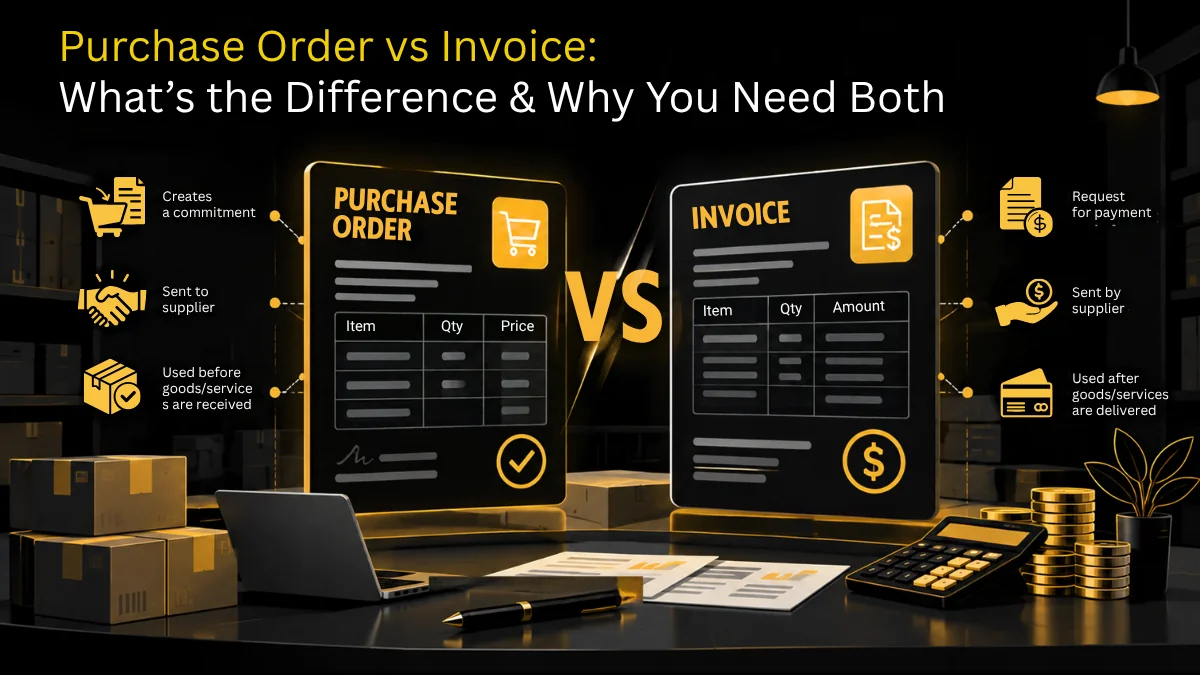
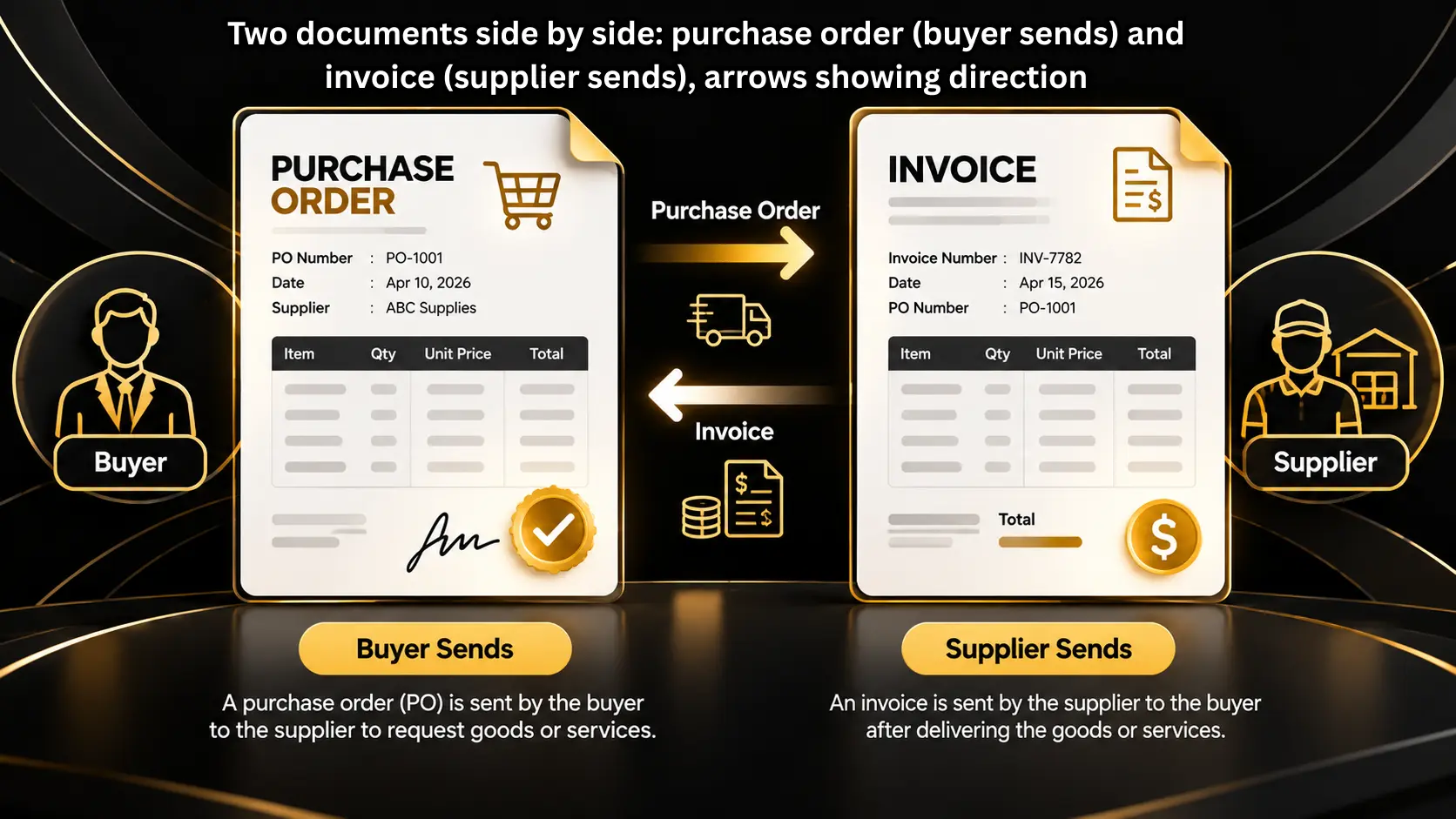
A purchase order is the buyer’s request to buy, sent before delivery. An invoice is the vendor’s request to be paid, sent after delivery. A purchase order vs invoice comparison comes down to that one distinction: who issues the document, and when.
Accounts payable then compares the two before it releases payment, which is where most of the real work in this comparison lives.
Key Takeaways
- A purchase order is created by the buyer before a purchase. An invoice is created by the vendor after delivery.
- A PO authorizes spending. An invoice requests payment for spending that already happened.
- A purchase order creates a commitment or encumbrance in accounting terms, not a liability. The invoice is what creates the liability on the books.
- When a PO and an invoice do not match on price or quantity, accounts payable holds the invoice for review rather than paying it as billed.
- The share of invoices that arrive with a valid PO attached is one of the clearest early signals of how disciplined a company’s purchasing process is.
Purchase Order vs Invoice at a Glance
What Is a Purchase Order?
A purchase order, or PO, is a document that a buyer sends to a vendor in order to get approval for a purchase prior to any delivery taking place. It includes the items or services, the quantities, the agreed prices, and the delivery date. The purchase order becomes a binding agreement to supply the items as described at the price stated once the vendor has accepted it. It is one of the core control documents in procurement, the function responsible for buying goods and services on a company’s behalf.
- A PO no., used to track the order and link it to the eventual invoice.
- Item descriptions, quantities, and unit prices
- Delivery date and shipping address
- Payment terms agreed in advance.
Our guide to what a purchase order is covers the full document and process in more depth.
Know the Difference. Streamline Both.

What Is an Invoice?
An invoice is a bill. The vendor sends it to the buyer after delivering the goods or services, and it states exactly what is owed. Where the PO says what the buyer intends to buy, the invoice says what the buyer now has to pay.
- An invoice number, separate from the purchase order number
- This PO no. is referenced, which is how accounts payable links the two documents.
- A breakdown of costs: subtotal, tax, shipping, and any discounts
- Payment due date and accepted payment methods
Comparing Purchase Order vs Invoice
| Attribute | Purchase Order | Invoice |
|---|---|---|
| Issued by | Buyer | Vendor |
| Issued when | Before delivery | After delivery |
| Purpose | Authorize and commit to a purchase | Request payment for a completed purchase |
| Key contents | Items, quantities, agreed prices, delivery date | Items delivered, amount due, payment terms |
| Legal effect | Becomes binding once the vendor accepts it | Evidence of a debt already owed |
| Accounting entry | Records a commitment, not a liability | Records a liability in accounts payable |
| Reference number | PO number | Invoice number, which quotes the PO number |

By automating the processing of invoices based on purchase orders (POs)… AP clerks were enabled to process about 50% more invoices.
What Happens When a PO and an Invoice Do Not Match
That is the point at which the distinction between a purchase order and an invoice goes from being merely definitional to one that actually has financial consequences. To make the process clear, consider the following example.
The buyer orders 500 boxes at $18.50 each ($9,250 total). The vendor ships the boxes, but then sends an invoice for $19.75 each ($9,875 total). That’s $625 more than was agreed.
Accounts payable will not simply pay the invoice as billed. The invoice gets held as an exception, and one of three things typically happens next:
- The buyer approves the variance
If the price change is legitimate (a vendor surcharge, for example), someone with authority signs off, and the invoice is paid at $9,875.
- The invoice is paid against the PO amount
A number of companies pay only the amount stated, which is $9,250, and ask the vendor to submit a credit or an amended invoice for the difference.
- The invoice goes back to the vendor
Accounts payable will reject the variance if it appears to be an error rather than an accepted change and will request an amended invoice before making any payment.
This is an illustrative example to show the mechanics of a price variance, not a reference for how often mismatches occur at any particular company.
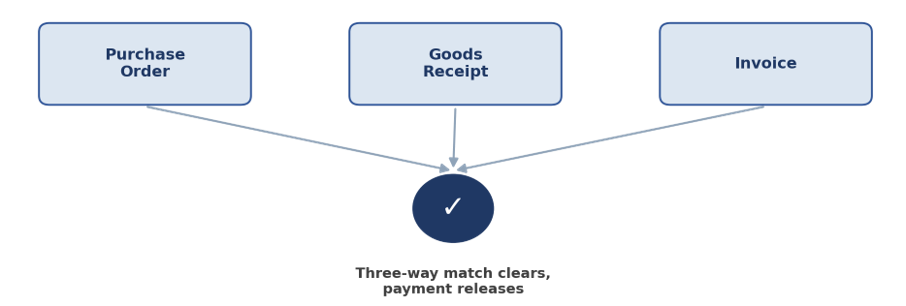
When a goods receipt confirms quantity too, this becomes a three-way match: the PO, the receipt, and the invoice all have to agree before payment clears. Our AP automation page covers how that matching runs when it is not done by hand. If you are evaluating tools, compare the best procurement software on how each handles three-way matching.
How the Accounting Treatment Differs
The comparison table above says a PO “records a commitment” while an invoice “records a liability,” and that distinction is worth spelling out, because it is precise and it is often glossed over.
A PO doesn’t result in an accounting entry; it merely serves as a note indicating that money has been set aside. It is only the invoice that is recorded in the books: you debit expenses or inventory and credit accounts payable for the amount owed.
Take the packaging example mentioned above, which had been approved at a cost of $9,875; the entry is stated as: debit Inventory (Raw Materials) by $9,875 and credit Accounts Payable by $9,875. It is only when the invoice arrives that something is entered in the ledger. That is also the reason why a purchase order by itself is not proof of an expense for tax or audit purposes; it is the invoice that is.
How Mature Is Your PO Discipline?
One useful, underused diagnostic: what share of your invoices arrive with a valid purchase order already attached? APQC, the benchmarking organization, tracks the percentage of purchases made outside the formal procurement process as one of its core Open Standards Benchmarking measures, precisely because purchases made without a PO are the ones most likely to turn into invoice-matching problems later.
A company that constantly fields invoices with no PO on file is not looking at an accounts payable problem. It is looking at a procurement governance gap upstream, and a “No PO, No Pay” policy, refusing to process any invoice that does not reference an approved PO, is the most direct way companies close that gap. Procurement software that requires an approved PO before an invoice can be processed makes that policy far easier to enforce.
Why You Need Both Documents
- They create a paper trail
If a vendor delivers the wrong quantity or bills the wrong price, the PO and invoice together settle the dispute without a guessing game.
- They support financial control
Companies are able to forecast their committed spending before it occurs, while invoices display the amounts that have actually been spent, allowing budgets to be verified against reality.
- They protect the audit trail
To verify that a purchase had been authorized, had been delivered, and had been paid correctly, the auditors trace the link from the purchase order to the invoice.
How Zapro AI Helps With Purchase Order vs Invoice Management
Most of the problems this guide covers, a price that drifts between the PO and the invoice, a missing PO reference, a liability recorded twice, come from treating purchase orders and invoices as two separate records instead of one connected one.
Here is where Zapro AI fits into the sections above.
- Automated PO and invoice creation: Both documents draw from the same vendor and item data, so a typo made once in the PO does not get repeated when the invoice is keyed in separately.
- AI-powered three-way matching: Zapro AI’s agentic layer, Z1 reads incoming invoices and checks them against the original PO and the goods receipt, flagging only the kind of price or quantity exception worked through earlier in this guide, instead of routing every invoice through a person.
- Real-time PO status: Every purchase order is visible from approval through delivery to payment in one dashboard, so checking whether a purchase ever had a PO on file is a lookup, not an email search.
- Direct accounting sync: Once an invoice clears matching, the liability posts to the connected accounting system automatically, the same debit-to-expense, credit-to-accounts-payable entry described above, instead of someone re-entering it by hand.

Power Your Procurement with Zapro
Take control. Cut costs. Scale smarter.
Frequently Asked Questions
What is the difference between purchase order and invoice?
A buyer draws up a purchase order before the goods are delivered in order to authorize the purchase. After the goods have been delivered, the vendor produces an invoice to ask for payment. The purchase order specifies the items being bought; the invoice specifies the amount owed.
Why do companies need both purchase orders and invoices?
With purchase orders, you can control your spending beforehand, while invoices indicate how much you owe after you have received the goods or services. The fact that you have both of these options makes it simple to verify your purchases, match up the records, and keep all the details clear for audits.
Can you have an invoice without a purchase order?
Yes, non-PO invoices are frequently encountered in cases involving recurring expenses such as utilities or software subscriptions, since it is not practical to require a formal PO. Companies pursuing tighter control usually put non-PO invoices through an extra approval stage before making payment, as there is no PO on file to match them against.
What comes first, the PO or the invoice?
The purchase order should come first since it grants authorization for the purchase before any goods or services are actually transferred. The invoice comes after delivery and asks for payment for the items that had already been approved in the purchase order. If a purchase order appears after the invoice has already arrived, then it is an indication that the purchase had gone beyond the normal approval process.
Do a purchase order and invoice have to match exactly?
Not always, but any difference has to be resolved before payment. Three-way matching checks the PO, the goods receipt, and the invoice together; price or quantity mismatches get flagged as exceptions and either get approved, short-paid to the PO amount, or sent back to the vendor for correction.
What to Do First
From ten recent invoices, check how many reference a purchase order number that was approved before the goods arrived. That quick audit tells you more about your purchasing discipline than any policy document.
See how AP automation handles PO-to-invoice matching automatically, or book a demo to see how Zapro AI ensures three-way matching. You can also review Zapro pricing to see which plan fits your invoice volume.
Sources / References
- APQC, “Percentage of Total Purchases Procured Outside of the Procurement Process”: https://www.apqc.org/resources/benchmarking/open-standards-benchmarking/measures/percentage-total-purchases-procured
- Zapro AI, “What Is a Purchase Order?”: https://zapro.ai/procurement/what-is-a-purchase-order/
- Zapro AI, “AP Automation”: https://zapro.ai/ap-automation/
- Zapro AI, “Procurement Software Demo”: https://zapro.ai/procurement/procurement-software-demo/
Don’t miss our weekly updates
We’ll email you 1-3 times per week—and never share your information.
Ready to streamline your procurement?
Connect with our experts to see how Zapro can simplify your procurement.

About the Author

Md. Kafil


About the Reviewer

Zapro is dedicated to helping businesses of all sizes make informed decisions. We adhere to strict editorial guidelines to ensure that our content meets and maintains our high standards.
Our editorial standards help keep every article accurate, useful, and trustworthy.