

Procure-to-pay (P2P) and source-to-pay (S2P) focus on the same general steps of a transaction, but differ on the extent of the process. With P2P, the focus is on the steps to purchase and pay. S2P includes the entire P2P process and further extends to the steps to source the supplier, negotiate the contract and other related processes.
Key Takeaways
- Source-to-pay contains procure-to-pay, so it’s a matter of choosing which part of the buying lifecycle you want to control more
- P2P safeguards the cash you spend, while S2P also influences which prices and terms you agree to.
- Maverick spend and manual invoice processing are the two leaks a CFO can plug most quickly.
- Most finance departments should prioritize P2P control before working their way up the supply chain into sourcing and contracts.
- A single data layer connecting both processes is more important than the labels on either software
What is the difference between S2P and P2P?
Processes vary from one organization to another. Procure-to-pay processes begin once a supplier is chosen. Source-to-pay processes begin before a supplier is sourced. Every S2P process includes a P2P process.
A simple way to remember it is, “P2P: How do we buy and pay efficiently? S2P: Are we buying the right things from the right suppliers at the right value?”
Some view procure-to-pay and sourcing as competing priorities. In reality, they work best as complements to one another. Certain levels of sourcing and payment controls need to be in place in order for the benefits of negotiated savings to be realized. Conversely, if a strong sourcing process is in place and payment controls are lax, savings can erode.
How the Procure-to-Pay Process Works?
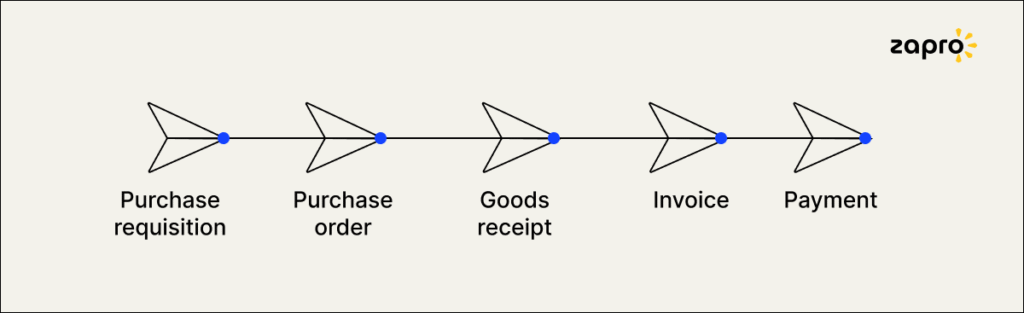
The procure-to-pay (P2P) process converts an approved business need to a purchased and paid-for service. The P2P process occurs within the framework of existing supplier relationships and contracts.
The Key Steps
- A staff member submits a purchase requisition.
- A manager reviews the requisition against budget and policy and grants approval.
- A purchase order is issued to the supplier.
- The goods or service is delivered to the organization.
- The accounts payable (A/P) team matches the supplier invoice with the purchased order and good or service received, a process also known as three-way match.
- Finance releases payment to the supplier.
The procure-to-pay process does not include sourcing and/or supplier evaluation. The procure-to-pay process concentrates on the controls and the timely nature of the transaction.
Where Procure-to-Pay pays off?
The best measure of the results achieved by an organization’s procure-to-pay process is the cost to process an invoice. The average cost to process an invoice for an organization is $10.18. Best-in-class organizations achieve a cost to process an invoice of $2.36.
The average cost to process an invoice for an organization is expected to decline to $9.84 by 2025. The APQC median cost is $5.83. Since various sources use different samples and methodology to generate their cost estimates, it is important to compare your cost to a range of values, not a single value.
The End-to-End Source-to-Pay Process
The end-to-end source-to-pay process incorporates the procure-to-pay process within a larger process of sourcing, evaluating, selecting and contracting suppliers, and extends the sourcing and contracting process for the organization.
Sourcing establishes the terms, and the procure-to-pay process ensures the terms are adhered to.
Stage One: Source
Sourcing begins with spend analysis, transitions into supplier discovery and assessment, flows into competitive bids, and ends in contract negotiation. Simultaneously, teams establish the business rules that P2P will enforce, i.e., pricing, payment terms, service levels, etc.
Stage Two: Contract and Onboard
Contracts reside in a system of record that purchasing can see and influence. Negotiated prices in a PDF that no buyer opens are of zero value to the budget. Likewise, the onboarding of a supplier, including appropriate tax and bank information, belongs here. Bad vendor information creates payment exceptions.
Stage Three: Procure and Pay
This is the P2P workflow previously described. In a complete S2P set up, it closes the loop by measuring and assessing the negotiated contracts against spend and supplier performance.
Stage Four: Measure and Manage
The cycle repeats. Spend data feeds the next sourcing round, and supplier performance scorecards impact renewal decisions. Amazon Business’s Insight, for example, provides KPIs such as contract compliance, maverick spend, and contract utilization rate, to name a few.

Organisations utilising Source-to-Contract automation witness an average of 25–30% reduction in procurement cycle times.
– Gartner
Procure to Pay vs Source to Pay: Side-by-Side View
| Factor | Procure-to-Pay (P2P) | Source-to-Pay (S2P) |
|---|---|---|
| Starting point | After supplier and contract exist | Before a supplier is identified or vetted |
| Primary focus | Fast, accurate transactions | Strategic cost and supplier strategy |
| Core steps | Requisition, PO, receipt, invoice match, payment | Spend analysis, sourcing, contracting, plus all P2P steps |
| Main CFO benefit | Cash control and lower processing cost | Better pricing, lower risk, and visibility into total spend |
| Typical owner | Finance and accounts payable | Procurement, with finance as a partner |
| Biggest risk if missing | Duplicate payments and unapproved buying | Overpaying for years under weak contracts |
What the Numbers Say for CFOs?
Two leaks demonstrate the value in each layer: maverick spend in the sourcing layer and cost of processing invoices in the P2P layer. Both can be quantified with numbers the finance organization already tracks.
Maverick Spend Erodes Negotiated Savings
“Maverick spend” occurs when employees make purchases outside of approved procurement policies, contracts and/or preferred supplier lists. Esker reports that 10%-50% of negotiated savings are lost to Maverick spend.
Using some illustrative rates, assuming no exact cases are available, we can calculate what would happen to negotiated savings at the low and high ends of the cited ranges. Let’s say a company negotiates $8 million in annual savings. At the low end, it loses $0.8 million. At the high end, it loses $4 million.
A negotiated savings is only a forecast until purchasing behavior confirms it.
Manual Invoices Add up Quickly
A second illustrative example, using assumed volume, demonstrates the cost associated with an accounts payable (AP) department that processes many invoices manually. Let’s say a company processes 100,000 invoices a year. Closing the gap between the $10.18 average reported by Medius and $2.36 best-in-class figure reported by AP Automation saves $7.82 per invoice, or about $782,000 a year.
Stampli’s report also points in the same direction. It reports that 6,082 invoices are processed per employee per year using manual entry, versus 23,333 invoices when there is full automation. In simple terms, automation allows an AP employee to process four times the volume.
A CFO who funds sourcing without payment controls pays twice: once to negotiate the price, and again to lose it.
A Practical Test
Find the ratios and analyze. Calculate your maverick spend rate by taking your noncompliant spend and dividing it by your total spend and then multiplying it by 100. Calculate your cost per invoice by dividing your fully loaded AP costs by the number of invoices. With those ratios in hand, procurement software pricing can be weighed against current AP processing costs to estimate a realistic payback period.
A high first ratio means your spend management program needs stronger contracts and catalogs. The second ratio means your program needs to automate your P2P process.
How to Decide Which Option to Choose?
Most companies should start working on their P2P process and extend to the sourcing process as spend and the sourcing process increase in complexity. S2P is most applicable to companies who have sourcing processes that are extremely complex and require a large number of suppliers. Companies with simpler sourcing processes are most applicable to P2P.
Signs P2P is First
- Invoices come via email as PDFs.
- Approvals are stuck in an inbox.
- There are frequent duplicate or late payments.
- Finance has no committed spend visibility until the bill is received.
Signs S2P is Next
- Suppliers charge different prices for the same item.
- Contracts are stored in a shared folder and are rarely reviewed.
- Renewals happen automatically.
- Category managers cannot access spend data to prepare for negotiation.
Phased Approach
- Digitize the requisition, approval and invoice processes.
- Clean and categorize your supplier master.
- Move contracts to an electronic location linked to purchasing.
- Renew contracts based on performance.
- Add supplier performance review to renewals.
Source to Pay Procure to Pay Solutions: What to Look For
Look for procure to pay solutions that integrate source to contract, sourcing, procure to pay, and spend analysis into a single data model. Separate solutions can work, but there will be discrepancies between contracts, POs, and payments at each of the handoffs.
Questions to Ask Vendors
- Do negotiated contract prices automatically flow into purchase orders and invoice-to-order matching?
- Can the finance team see committed spend (even if it’s not yet paid)?
- How does the system flag purchases outside of approved suppliers?
- Can customers start with the P2P module and add sourcing modules later?
Where Does Zapro AI Fit?
We are a procure-to-pay procurement platform for the finance team. It integrates procure to pay and sourcing. Review and test the product against your processes and evaluate the potential of Zapro AI to control maverick spend and reduce cost per invoice. A Zapro AI demo can walk your finance team through that workflow using sample purchase orders and invoices from your own process.
Transform your procurement strategy with Zapro.

FAQ
1. What is the main difference between source to pay and procure to pay?
Procure to pay (P2P) begins when a supplier is contracted and ends with payment. Source to pay (S2P) includes the entire procure to pay process and begins before suppliers are sourced and contracted.
2. Is procure to pay part of source to pay?
Yes, procure to pay is part of source to pay.
3. Which is better for a mid-sized company?
Neither option is dominating in every case. P2P tends to work well for companies with simple purchasing and less-than-perfect payment controls. For example, a company could benefit from S2P if it has a large and complex supplier base.
4. What KPIs should a CFO track?
Track the rate of maverick spend, compliance to contracts, and utilization of contracts on the sourcing side. On the P2P side, APQC lists the total cost of an invoice, first time error-free disbursements, and the invoice to payment cycle time.
5. How much does it cost to process an invoice?
It varies. The $10.18 average was reported by Medius, and the best in class was reported to be $2.36. HighRadius reports that $12 to $40 is the average cost of processing an invoice manually, and $1 to $5 is the average cost of end-to-end invoice processing through automation.
References
- Source-to-Pay (S2P) vs. Procure-to-Pay (P2P): Key differences, Zip
- What Is Maverick Spend & How Do You Prevent It?, Esker
- How To Calculate Cost Per Invoice in Accounts Payable, HighRadius
- Source-to-Pay vs. Procure-to-Pay: Key Differences, Ivalua
- How to Calculate the True Cost of AP Automation, Stampli
- Source-to-Pay vs Procure-to-Pay: What’s the Difference?, Jiga
- How Should Procure-to-Pay and Accounts-Payable Performance Be Measured, APQC
- How Much Does It Cost To Process an Invoice? 2026 Benchmarks, Medius
- Source-to-Pay: Definition, Process, & Procurement Benefits, Amazon Business
- Procure-to-Pay vs Source-to-Pay: Key Differences, Ramp
- Source-to-Pay vs Procure-to-Pay: Understanding the Difference, Opstream
- Source-to-Pay vs Procure-to-Pay: Clearly Explained, Procurement AI Agents
- What it costs to process an invoice, by source, Adelpo
Don’t miss our weekly updates
We’ll email you 1-3 times per week—and never share your information.
Let’s Streamline Your Procure-to-Pay Journey.
Connect with Zapro Sales and discover how to cut costs, save time, and boost efficiency.

About the Author

Md. Kafil


About the Reviewer

Zapro is dedicated to helping businesses of all sizes make informed decisions. We adhere to strict editorial guidelines to ensure that our content meets and maintains our high standards.
Our editorial standards help keep every article accurate, useful, and trustworthy.