

Cloud procurement is the use of cloud-based software to manage requisitions, approvals, purchase orders, supplier records, invoice matching and spend analysis in one internet-accessible system, with the provider running the infrastructure so procurement and finance teams share one live record of every purchase.
Procurement is no longer limited to purchase orders, supplier negotiations, and invoice approvals. As businesses operate across locations, adopt AI-powered SaaS applications, and manage increasingly complex technology spend, procurement teams need faster, more connected ways to manage purchasing.
Cloud procurement brings purchasing, approvals, supplier management, invoices, and spend visibility into a connected digital environment. Instead of relying on locally managed systems, spreadsheets, and manual workflows, teams can access procurement processes through cloud-based software that supports cross-department collaboration.
Key Takeaways
- Cloud procurement moves purchasing workflows from locally managed infrastructure to an internet-accessible environment.
- A modern cloud procurement platform can connect requisitions, approvals, purchase orders, supplier data, invoices and spend analytics.
- The right cloud procurement system should improve visibility without creating another disconnected data silo.
- Security, data portability, integration and total cost should be evaluated alongside features.
- A cloud native procurement platform can support automation and AI more effectively when procurement data is structured and accessible.
- Cloud purchasing requires ongoing governance. Moving a process to the cloud does not automatically make that process efficient or compliant.
What Is Cloud Procurement?
Cloud procurement is the use of cloud-based software to manage purchasing activities such as requisitions, approvals, purchase orders, supplier management, invoice processing and spend analysis. Instead of running the application on locally maintained servers, users access the system through an internet connection while the provider manages much of the underlying infrastructure.
A cloud procurement platform can keep purchase requests, approvals, POs, supplier records and invoices connected in one environment. This gives procurement and finance teams a clearer record of what was requested, who approved it, what was ordered and what was ultimately invoiced.
Cloud Procurement vs. E-Procurement
E-procurement and cloud procurement may sound similar but they are different in definition. E-procurement refers to the digital management of the purchasing processes. Cloud procurement refers to the method of service delivery for the above process.
An e-procurement system can be installed locally, whereas a cloud-based solution can deliver e-procurement functionality through a SaaS model. This matters when considering deployment, maintenance, scalability, security, and integration needs.
Industry Snapshot: Recent market studies from Precedence Research show that global adoption of cloud-based purchasing platforms is surging, with the overall procurement software market projected to pass $22 billion in the coming years.
What Features Should a Cloud Procurement Platform Have?
A cloud procurement platform should do more than digitize an existing approval form. It should connect the major stages of purchasing while providing the controls needed to manage spend.
The following capabilities can make a significant difference in adoption, control and efficiency:
- Guided Request Intake: Simple request forms and easy-to-use catalog search help employees find approved products and services without extensive procurement training.
- Dynamic Approval Matrices: Rule-based workflows can route requests to the right approvers based on factors such as purchase value, category, cost center and supplier risk. This helps avoid unnecessary approval steps while maintaining control over higher-risk purchases.
- Supplier Self-Service Portals: Supplier portals allow vendors to submit tax documents, update business information and banking details, check purchase order status and send invoices electronically. This reduces back-and-forth communication with procurement and Accounts Payable teams.
- Automated Audit Logging: A detailed audit trail captures all relevant actions, including approvals, comments, line-item modifications, and budget adjustments. This ensures an audit trail is captured that will be useful for future audits.
- Native Mobile Apps: Mobile access allows managers and executives to review requests, check budget information, and approve purchases when they are away from their desks. This can help prevent time-sensitive requests from sitting in approval queues.
Key Benefits of Cloud Procurement Software
A cloud native procurement platform can simplify day-to-day purchasing while giving finance and procurement teams better control over spend. Instead of depending on spreadsheets, emails and manual approvals, teams can manage key procurement activities through one connected system.
1. Real-Time Budget Visibility
With manual and spreadsheet procedures, budget problems may not be discovered until after expenses have been entered and reconciled. This happens at a stage when the purchase has already been made.
The cloud-based procurement system provides visibility into both the budgeted and spent amounts as the purchase progresses through the approval procedure. When a requisition is raised by an employee, the system will be able to compare it against the budgeted amount and detect any budget overruns prior to the purchase order approval.
2. Automated 3-Way Invoice Matching
Invoice processing can involve a significant amount of manual work, especially when teams have to compare invoices with purchase orders and receiving records. Manual checks can also lead to duplicate payments, data entry errors and missed payment terms.
Cloud procurement platforms can use Optical Character Recognition (OCR), automation and machine learning to compare three key records:
- Purchase Order: What was approved for purchase.
- Goods Receipt: What was actually received.
- Vendor Invoice: What the supplier charged.
If the quantities, prices and other details fall within predefined tolerance limits, the invoice can move through the approval process automatically. This reduces the need for manual data entry and allows Accounts Payable teams to focus on exceptions rather than checking every invoice individually.
Data Point: Research from the Institute of Finance and Management (IOFM) reports that automated three-way matching can help organizations process invoices faster while reducing invoice processing costs.
3. Reducing Maverick Spend
Unapproved purchases can make it harder for businesses to control costs, enforce contracts and maintain accurate procurement records. Employees may buy from unfamiliar suppliers or use personal payment methods when the approved purchasing process is difficult to follow.
Cloud procurement software can address this by directing employees toward approved suppliers, negotiated contracts and predefined catalogs. Guided buying workflows also make it easier to select the right products or services and follow the required approval process. This helps organizations increase policy compliance without making routine purchases unnecessarily complicated.
4. Seamless Integration with Core Financial Systems
Procurement works closely with finance, so information needs to move accurately between purchasing and financial systems. Modern cloud platforms can connect with ERP and accounting systems through APIs and other integration methods.
Examples of integration include applications like Oracle NetSuite, SAP, Microsoft Dynamics 365, Sage Intacct, and QuickBooks. After these two systems are integrated, approved purchase orders, supplier details, and invoices can seamlessly be moved from one system to another with minimal manual effort.
Cloud Procurement vs. On-Premise Procurement
The difference between cloud and on-premise procurement extends beyond hosting.
| Factor | Cloud procurement | On-premise procurement |
|---|---|---|
| Infrastructure | Managed by the provider | Managed by the organization |
| Access | Internet-based access | Usually internal network or VPN |
| Updates | Generally managed by the provider | Managed internally |
| Scaling | Usually faster to expand | May require additional infrastructure |
| IT Maintenance | Lower infrastructure burden | Greater internal responsibility |
| Deployment | Often faster | Can require extensive implementation |
| Data Control | Shared responsibility | Greater direct infrastructure control |
| Cost Model | Usually subscription-based | Often includes licenses and infrastructure costs |
Neither model removes the need for governance. Cloud systems transfer some responsibilities to the provider, but organizations remain responsible for choosing appropriate vendors, configuring access and managing how the system is used.
How Does Cloud-Based Purchasing Work?
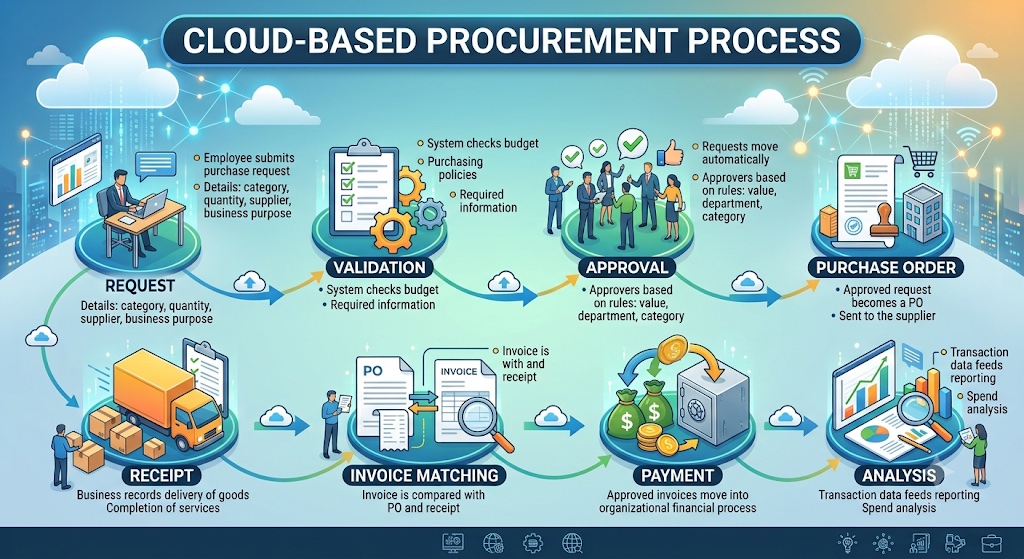
Cloud-based purchasing typically follows the same core procurement process as traditional purchasing, but digital workflows connect the individual steps.
A typical process looks like this:
- Request: An employee submits a purchase request with details such as category, quantity, supplier and business purpose.
- Validation: The system checks budget, purchasing policies and required information.
- Approval: Requests move automatically to the appropriate approvers based on rules such as value, department or category.
- Purchase order: An approved request becomes a PO that is sent to the supplier.
- Receipt: The business records the delivery of goods or completion of services.
- Invoice matching: The invoice is compared with the PO and receipt where applicable.
- Payment: Approved invoices move into the organization’s financial process.
- Analysis: Transaction data feeds reporting and spend analysis.
This connected workflow creates an important advantage: procurement data does not have to be reconstructed after a transaction occurs. The request, approval, PO and invoice can remain connected throughout the lifecycle.
What Is a Cloud Native Procurement Platform?
A cloud native procurement platform is designed around modern cloud architecture rather than simply moving an older application to hosted infrastructure.
A genuinely cloud-native design can use APIs, scalable infrastructure, continuous delivery and connected services to support flexible procurement workflows. This can make integrations easier to maintain and allow organizations to expand workflows as requirements change.
The difference is particularly relevant as AI becomes part of procurement operations. The 2026 Hackett Group and GEP research found that 89% of procurement leaders expect high to extensive change in information and analytics over the next five years, while 77% expect similar levels of change in technology across source-to-pay.
The lesson is straightforward: modern architecture alone does not create procurement maturity. Clean data, connected systems and clear governance are still necessary.
How Is AI Changing Cloud Procurement?
AI is moving beyond basic reporting and into activities such as request classification, invoice processing, supplier analysis, contract review, risk monitoring and purchasing recommendations.
The FinOps Foundation’s 2025 survey covered organizations responsible for more than $69 billion in public cloud spend. It found that 63% of respondents were already managing AI spend, up from 31% the previous year.
This matters to procurement because AI, SaaS and cloud services can create variable or recurring technology costs. Procurement teams need visibility into what is being purchased, who owns the spend, how usage changes over time and whether contracts reflect actual requirements.
Quick Tips Before Choosing a Platform
- Map the request-to-payment process before evaluating vendors.
- Check whether the product is genuinely a cloud native procurement platform rather than simply hosted legacy software.
- Compare vendors using the same real purchasing scenario.
- Test ERP integration and data export during the evaluation rather than after implementation.
- Evaluate cloud based procurement software based on implementation, support, security and future pricing, not subscription cost alone.
Best Practices for Implementing a Cloud Procurement System
A successful cloud procurement system implementation requires more than software configuration. Procurement, finance, IT, legal and business teams should agree on processes, data, controls and measurable outcomes before deployment.
- Start with high-value workflows: Begin with frequently used processes such as requisitions, approvals, purchase orders and invoice matching. Expand automation after the initial workflows are stable.
- Build approval rules around business needs: Define approval paths by spend threshold, category, department, entity and risk level.
- Clean procurement data before migration: Standardize supplier records, categories, cost centers and other master data to improve reporting and automation.
- Involve stakeholders early: Include finance, IT, legal, security and business teams during planning so integration and governance requirements are identified early.
- Plan integrations before deployment: Map how supplier, purchase order, receipt, invoice and payment data will move between procurement and ERP or accounting systems. Integration should be tested before the system goes live.
- Build governance into the process: Define user permissions, supplier controls, data ownership, security requirements and responsibilities from the beginning. Cloud environments require clear accountability because security and operational responsibilities are shared between the provider and customer.
- Track adoption and business outcomes: Measure requisition cycle time, approval time, purchase order compliance, invoice exceptions, spend under management and user adoption. A defined KPI framework makes it easier to identify gaps and demonstrate business value.
- Improve the system continuously: Review workflows, approval rules, integrations and supplier data regularly. As purchasing volumes and business requirements change, the system should evolve with them rather than becoming another source of manual work.
What Are the Risks of Cloud-Based Purchasing?
Cloud adoption reduces some infrastructure burdens but introduces new considerations.
Security Risk
Sensitive supplier, financial and employee information may move through the platform. Vendor security controls and customer access configuration both matter.
Integration Risk
A procurement platform that cannot exchange reliable data with the ERP can create another silo rather than eliminate one.
Vendor Concentration
Strong reliance on the provider makes switching hard. For instance, the European Commission’s 2026 sovereign cloud procurement initiative took several providers into account to facilitate diversification and decrease dependence on one provider.
Cost Management Risk
The cloud service providers have a tendency to change their expenditure from upfront costs to recurring ones. According to Google Cloud’s cost estimation information, the best approach is to estimate the cost of provisioning, managing, and indirect costs, not just upfront expenses.
Governance Risk
Easier access may encourage more purchases if the policies are poor. It is important that organizations set up approval levels, preferred vendor rules, budgeting limits, and exceptions prior to increasing user access.
How Does Zapro AI Support Cloud Procurement?
An advanced cloud procurement platform should bring purchasing, supplier management and financial controls into a single digital environment. Zapro AI is an enterprise-grade SaaS procurement platform built for mid-market businesses that want to automate procurement while maintaining control over company spend.
Here’s how Zapro AI supports the cloud procurement lifecycle:
- End-to-End Procurement Automation: Manage purchase requests, approvals, purchase orders, goods receipts and invoice matching through one streamlined workflow.
- Intelligent Invoice Processing: Automate invoice data capture and matching to speed up processing and minimize errors caused by manual entry.
- Flexible Approval Controls: Set approval rules based on spend limits, departments, categories and business requirements to keep purchases within policy.
- Supplier Management: Simplify vendor onboarding, maintain compliance documentation and monitor supplier performance from a single supplier record.
- Contract Management: Keep supplier agreements, obligations and purchasing activities aligned so teams can manage contracts throughout their lifecycle.
- Real-Time Spend Analytics: Track budgets, committed spend and purchasing trends by department, category, supplier or location to support better financial decisions.
- ERP & Financial Integrations: Align procurement information with current ERP and accounting systems to ensure consistency of financial information.
Together, these capabilities give procurement and finance teams greater control over purchasing while making day-to-day processes easier to manage.
Cloud procurement costs vary by users, vendors and transactions. Explore Zapro AI pricing to find the right option.
Make Cloud Procurement Work for Your Business
Cloud procurement brings purchase requests, approvals, supplier records, purchase orders and invoices into one system that every team can access. As companies spend more on SaaS, cloud infrastructure and AI tools, they need clear controls over who buys what and a real-time view of where the money goes.
The right cloud procurement system does more than move purchasing online. It sends every request to the right approvers, keeps supplier information in one place, matches each invoice to its purchase order and receipt, and connects with the finance systems you already use.
Zapro AI does all of this on one procurement platform, from the first purchase request to the matched invoice. Every purchase leaves a full audit trail, and small one-off purchases that usually go untracked stay visible. Book a demo to see how it works.
Frequently Asked Questions
What is cloud procurement?
Cloud procurement is the use of cloud-based software to manage purchasing activities such as requisitions, approvals, purchase orders, supplier management, invoice processing, and spend analysis.
Are cloud procurement platforms secure enough for financial data?
Yes. Leading cloud software providers use enterprise-grade security protocols. Look for solutions that feature SOC 2 Type II certifications, ISO 27001 compliance, multi-factor authentication (MFA), and end-to-end data encryption (AES-256 and TLS 1.3).
How long does it take to implement cloud-based procurement software?
While legacy on-premise deployments often took up to a year, modern cloud procurement solutions can typically be configured, integrated with your accounting software, and rolled out to employees in 2 to 6 weeks.
Is a cloud procurement system practical for mid-sized businesses?
SaaS delivery models make modern procurement tools highly accessible for mid-sized organizations. Because there are no physical servers to buy or maintain, smaller teams can access enterprise-grade spend controls, automated invoice matching, and live budget tracking without needing a large IT budget.
How does cloud-based purchasing reduce procurement costs?
Cloud-based purchasing can reduce costs by automating repetitive tasks, improving approval control, increasing spend visibility and reducing manual reconciliation. Actual savings depend on adoption, transaction volume, process design and the organization’s existing technology environment.
What should be included in a cloud procurement checklist?
A practical checklist should cover workflow automation, approval controls, supplier management, purchase orders, invoice matching, analytics, integrations, security, data portability, implementation requirements, support and total cost of ownership.
Does cloud procurement replace an ERP?
Not necessarily. A procurement application can manage purchasing workflows while the ERP remains in the financial system of record. Integration between the two systems keeps procurement and finance data connected without requiring one platform to manage every business process.
Don’t miss our weekly updates
We’ll email you 1-3 times per week—and never share your information.
Your Procurement Goals, Our Shared Mission
Partner with us to simplify, safeguard, and succeed.

About the Author

Md. Kafil


About the Reviewer

Zapro is dedicated to helping businesses of all sizes make informed decisions. We adhere to strict editorial guidelines to ensure that our content meets and maintains our high standards.
Our editorial standards help keep every article accurate, useful, and trustworthy.