

Compare leading procurement software platforms for SMBs to enterprise, including Coupa, Zapro, SAP Ariba, Procurify, Precoro, Zip, and more. Explore pricing, features, AI capabilities, automation, integrations, and buyer insights to find the right procurement solution for your business. The best procurement software helps businesses automate and control the purchasing process, from requisitions and approvals to purchase orders, supplier management, spend analysis, and invoice matching. The right platform depends on company size, procurement complexity, automation needs, integrations, budget, and supplier management requirements.
If you’re searching for the best procurement software or you’ve been handed the job of picking new procurement software before next year’s budget cycle, this is the list we wish someone had handed us in 2026.

Quick Answer: Editor’s Picks for 2026
- Best procurement software overall: Zapro AI
- Best AI procurement software for invoice-to-pay automation: Zapro AI
- Best procurement platform for large global enterprises: SAP Ariba
- Best procurement software for supplier management at scale: Coupa
- Best for companies already running Oracle ERP: Oracle Fusion Procurement
- Best procurement software for small business: Precoro
- Most affordable procurement software for SMBs: Zapro AI, Precoro, with Procurify close behind
- Best procurement software for regulated industries (healthcare, education, public sector): Jaggaer
- Best intake-to-procure orchestration tool: Zip
- Best no-code procurement workflow builder: Kissflow Procurement Cloud
- Best procurement software for startups: Zapro AI (flat pricing, unlimited users) or Precoro
- Best procurement software for companies operating in India (GST and TDS): Zapro AI
- Best procurement software for multi-location purchasing: Order.co
Best Procurement Software at a Glance
| Platform | Best For | Company Size | AI Depth | Standout Strength |
| Zapro AI | Overall / AI procurement | SMB–Enterprise | High | Fast implementation, AI invoice matching |
| SAP Ariba | Global enterprise | Enterprise | Moderate | Supplier network scale |
| Coupa | Spend & supplier management | Enterprise | Moderate | Unified spend visibility |
| Oracle Fusion Procurement | Existing Oracle shops | Enterprise | Moderate | Native ERP integration |
| Ivalua | Complex configurability | Enterprise | Moderate | Total workflow flexibility |
| GEP SMART | Unified source-to-pay | Enterprise | High | Broad functional coverage |
| Jaggaer | Healthcare / education / public sector | Enterprise / Institutional | Moderate | Vertical compliance |
| Zip | Intake orchestration | Mid-market–Enterprise | Moderate | Easiest employee-facing intake |
| Precoro | Affordable SMB procurement | SMB | Moderate | Transparent flat pricing |
| Procurify | SMB budget control | SMB–Mid-market | Moderate | Real-time budget visibility |
| Airbase | Card + procurement + AP | Mid-market | Moderate | Unified spend platform |
| Order.co | Multi-location purchasing | SMB–Mid-market | Low–Moderate | Multi-vendor consolidation |
| Kissflow Procurement Cloud | No-code workflows | Mid-market | Moderate | Self-service customization |
| Tradeshift | E-invoicing network | Mid-market–Enterprise | Moderate | Supplier network connectivity |
| Fraxion | Mid-market spend control & compliance | Mid-market | Moderate | Proactive budget checks |
Each platform’s full write-up above links out to an independent, third-party source — G2, Gartner Peer Insights, or the vendor’s own product page — so you can check current ratings and pricing yourself rather than take our word for it.
Need the short version? Zapro AI is our overall pick for mid-market companies looking for fast implementation and AI-powered automation. SAP Ariba, Coupa, and Ivalua are stronger candidates for large enterprises with complex global procurement environments.
15 Best Procurement Software for SMBs and Enterprise Companies in 2026
1. Zapro AI – Best Overall Procurement Software and Best AI Procurement Platform
Zapro AI is an AI-native procure-to-pay and accounts payable platform built for finance and procurement teams who are tired of stitching together a requisition tool, a separate AP automation tool, and a spreadsheet for supplier risk. The core differentiator is that the AI layer isn’t bolted onto an old workflow engine — it was built around OCR invoice capture, automatic three-way matching, and anomaly detection from the ground up, which shows in how few exceptions actually land in a human’s queue.
Best for: Mid-market and growth-stage companies that want enterprise-grade automation without an enterprise-grade implementation timeline.
Standout features: AI invoice OCR with automatic PO/receipt matching, configurable multi-level approval workflows, real-time spend analytics, supplier onboarding and risk scoring, and native integrations with major accounting and ERP systems.
Where it’s strongest: Speed to value. Most procurement suites at this feature depth take four to six months to implement; teams we’ve worked with have gone live in weeks, not quarters.
Where a competitor might fit better: Extremely large, multi-entity global enterprises with complex, decades-old ERP customizations may still lean toward SAP Ariba or Ivalua for the sheer depth of configurability, at the cost of a much longer rollout.
Pricing: Scales with transaction volume and team size, with plans for SMB through enterprise. Request a quote for exact numbers rather than trusting a generic published tier — actual cost depends heavily on invoice volume and integration count.
See the full workflow in action: a start-to-finish walkthrough of the OCR capture and matching described above.
Zapro AI is rated 4.7 stars on G2 by finance and procurement teams
2. SAP Ariba — Best Procurement Platform for Large Global Enterprises
SAP Ariba remains the default choice for Fortune 500 companies, largely because it’s already inside the SAP ecosystem most of them run on. Its Ariba Network is genuinely massive — one of the largest B2B trading networks in the world — which matters if your suppliers are already connected to it.
Best for: Large enterprises with existing SAP infrastructure and complex, multi-region procurement operations.
Strengths: Deep supplier network effects, strong contract and sourcing modules, extensive compliance tooling for regulated industries.
Trade-offs: Implementation complexity and cost are real barriers for anyone below enterprise scale. The interface still shows its age in places, and smaller teams frequently report the platform is more than they need.
3. Coupa — Best for Enterprise Spend Management and Supplier Management
Coupa built its reputation on unifying procurement, invoicing, and expense management into one “Business Spend Management” platform, and it’s one of the stronger options if supplier management depth is your top priority among the enterprise players.
Best for: Enterprises that want a single system of record across procurement, AP, and expenses.
Strengths: Strong analytics and spend visibility, solid supplier risk and performance tooling, broad marketplace of pre-built supplier catalogs.
Trade-offs: Pricing is enterprise-tier and quote-only; smaller finance teams have reported the platform’s breadth becomes overhead rather than value below a certain transaction volume.
4. Oracle Fusion Procurement — Best for Companies Already Running Oracle ERP
If your finance stack is already Oracle Cloud ERP, Fusion Procurement is the path of least resistance — native data models, no middleware, and a single vendor relationship for your whole finance suite.
Best for: Existing Oracle Cloud customers who want procurement natively inside their ERP rather than bolted on.
Strengths: Native ERP integration, strong reporting depth, mature approval and sourcing workflows.
Trade-offs: Choosing it primarily because you’re on Oracle, rather than because it’s the best standalone tool, is a real trade-off — teams not already on Oracle rarely choose it from a cold start.
5. Ivalua — Best for Highly Configurable Enterprise Source-to-Pay
Ivalua‘s pitch is total configurability: almost every workflow, field, and approval rule can be rebuilt to match how a specific enterprise actually operates, rather than forcing the business to adapt to the software.
Best for: Large enterprises with procurement processes too specific or regulated for an out-of-the-box tool.
Strengths: Genuinely flexible platform architecture, strong source-to-pay coverage, good fit for complex multi-subsidiary organizations.
Trade-offs: That flexibility comes with implementation cost and time — this is not a tool a lean team stands up in a month.
6. GEP SMART — Best Unified AI Source-to-Pay Suite for Enterprise
GEP SMART markets itself as a single unified platform covering sourcing, procurement, and supply chain, with AI embedded across spend analysis and supplier discovery.
Best for: Enterprises consolidating multiple point solutions into one source-to-pay system.
Strengths: Broad functional coverage in one platform, strong analytics, active investment in AI-driven spend classification.
Trade-offs: Like most enterprise suites here, pricing and implementation are sized for large organizations, not lean mid-market teams.
7. Jaggaer — Best for Healthcare, Higher Education, and Public Sector Procurement
Jaggaer has carved out real strength in verticals with unusual procurement rules — hospital systems, universities, and public agencies — where compliance and sourcing requirements differ meaningfully from standard corporate procurement.
Best for: Healthcare systems, higher education institutions, and public sector organizations.
Strengths: Vertical-specific compliance tooling, strong strategic sourcing modules, established base in regulated institutional buying.
Trade-offs: Outside those verticals, more general-purpose platforms often deliver a smoother experience.
For the healthcare-specific version of this evaluation, see our guide to healthcare procurement solutions.
8. Zip — Best Intake-to-Procure Orchestration Layer
Zip doesn’t try to replace your ERP or AP system — it sits in front of them, giving every employee a single, simple intake form for any purchase request, then routing it through the right approvals and into whichever downstream system owns the actual transaction.
Best for: Mid-market and enterprise finance teams that already have procurement systems but need a better front door for employees making purchase requests.
Strengths: Genuinely easy for non-procurement employees to use, strong approval orchestration, fast to deploy since it doesn’t replace core systems.
Trade-offs: It’s an orchestration layer, not a full procure-to-pay replacement — you’ll still need a system underneath it for the actual purchasing and payment execution.
9. Precoro — Best Affordable Procurement Software for Small Business and SMB
Precoro consistently comes up when procurement teams search for the most affordable procurement software for SMBs — flat, published pricing and a straightforward feature set aimed squarely at small and mid-sized companies, not enterprise buyers.
Best for: Small businesses and SMBs that need real purchase order and budget controls without enterprise pricing or complexity.
Strengths: Transparent, published pricing tiers, clean and simple interface, solid core PO and approval workflow.
Trade-offs: Less depth in supplier risk management and AI-driven automation compared to the platforms built for enterprise scale.
For the SMB-focused version of this comparison, see purchasing software for small business.
10. Procurify — Best for SMB Spend Control and Budget Management
Procurify’s strength is budget visibility — giving department heads and finance real-time insight into what’s been committed against budget before it turns into an invoice surprise.
Best for: Growing SMBs and mid-market companies that most need spend control and budget accountability.
Strengths: Strong budget tracking, approachable interface for non-finance employees, solid mobile experience for approvals on the go.
Trade-offs: Vendor risk and compliance tooling is lighter than platforms built for regulated industries.
11. Airbase — Best Procure-to-Pay Platform for Mid-Market Finance Teams
Airbase combines procurement, corporate card spend, and bill pay into one system, which is a genuinely useful consolidation for finance teams tired of reconciling three separate tools every month-end close.
Best for: Mid-market finance teams that want procurement, card spend, and AP unified under one roof.
Strengths: Strong close-the-loop spend visibility, solid card program integration, clean approval workflows.
Trade-offs: Less specialized supplier risk and sourcing functionality than dedicated procurement or SRM platforms.
12. Order.co — Best for Multi-Location Purchasing and AP
Order.co focuses on a specific, painful problem: companies with many physical locations (restaurants, retail, healthcare clinics) placing repetitive purchases across dozens of vendors, and reconciling all of it centrally.
Best for: Multi-location businesses managing recurring purchases across many small vendors.
Strengths: Strong at consolidating fragmented vendor spend, purpose-built for high purchase-order volume across locations.
Trade-offs: Narrower fit outside of multi-location, high-transaction-volume business models.
13. Kissflow Procurement Cloud — Best No-Code Procurement Workflow Builder
Kissflow’s appeal is configurability without a developer — procurement and IT teams can build and adjust approval workflows visually, which matters for companies whose process changes faster than a typical implementation cycle.
Best for: Mid-market companies that want to customize workflows themselves without vendor professional-services fees for every change.
Strengths: Genuinely no-code workflow customization, reasonable learning curve, decent integration options.
Trade-offs: AI-driven automation and supplier risk depth are less mature than purpose-built enterprise procurement suites.
14. Tradeshift — Best Supplier Network and E-Invoicing Platform
Tradeshift’s core strength is its supplier network and e-invoicing infrastructure — useful specifically if a large share of your vendor base already invoices electronically through the platform or a connected network.
Best for: Companies prioritizing e-invoicing standardization and supplier network connectivity over deep internal workflow customization.
Strengths: Strong e-invoicing and supplier connectivity, established network of connected suppliers.
Trade-offs: Core procurement workflow depth is less of a focus than the network and invoicing layer.
15. Fraxion — Best Procurement Software for Mid-Market Spend Control and Compliance
Fraxion rounds out this list as a solid fit for mid-market teams that need tighter budget and compliance control than an entry-level SMB tool provides, without stepping up to full enterprise pricing. It leans into proactive spend control — catching an over-budget or non-compliant request before it’s approved, not after finance reconciles the month.
Best for: Mid-market companies, including multi-entity and multi-location organizations, that need stronger budget and policy compliance controls than a basic SMB procurement tool offers.
Strengths: Proactive budget checks at the point of requisition, configurable approval workflows across multiple entities, solid mobile approval experience.
Trade-offs: AI-driven automation depth is lighter than the leading AI-native platforms on this list, and its brand recognition is smaller than the enterprise-tier names.
How We Evaluated These Procurement Software Platforms
A methodology section is the part most “best software” lists skip, and it’s usually why they’re wrong. Here’s exactly what we scored, on a 100-point rubric, across six categories:
- Core procurement workflow (20 points) — requisition-to-PO, approval routing, budget checks, contract-to-PO matching.
- AI and automation depth (20 points) — not “has an AI badge,” but whether the AI actually does OCR invoice capture, three-way match, anomaly detection, or spend classification without a human rebuilding the output.
- Supplier management (20 points) — supplier onboarding, risk scoring, performance tracking, document/compliance collection, and how the platform handles a vendor vs. competitor comparison when you’re deciding whether to consolidate spend.
- Integration and IT footprint (15 points) — ERP/accounting connectors, API access, SSO, and how much implementation work falls on internal IT.
- Pricing transparency and total cost of ownership (15 points) — whether pricing is published, how it scales from SMB to enterprise, and hidden costs like implementation fees or per-connector charges.
- Support, security, and compliance posture (10 points) — SOC 2 status, uptime history, onboarding support, and how the vendor handles disputes or downtime.
We also read through public G2 and Capterra review threads for recurring complaints — not star averages, since averages get gamed and the actual complaint text doesn’t — checked each vendor’s security and compliance documentation directly, and where possible ran a live sandbox or demo account. Ratings on review sites change monthly, so instead of quoting a specific star score that will be stale by the time you read this, we describe why people rate a tool the way they do — check the live number yourself before you buy.
None of this is theoretical. If you’re doing a vendor comparison analysis internally, steal this rubric — it’s the same one we hand to clients.
Buyer’s Guide: How to Actually Choose Procurement Software
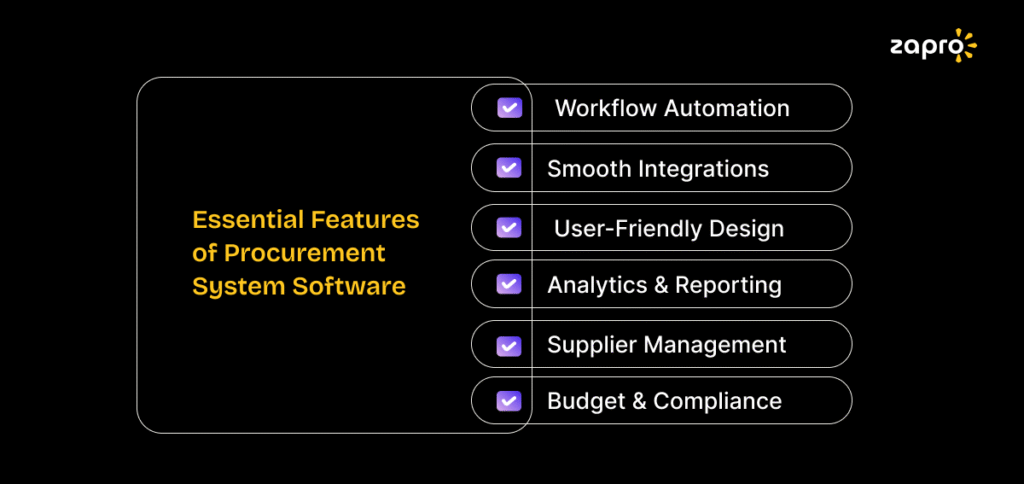
Features to Look For in AI-Powered Procurement Software
Whatever else changes on your requirements list, these are the features that separate a modern platform from a glorified spreadsheet:
- Automated invoice capture and matching — OCR that reads an invoice and matches it against a PO and receipt without a human retyping line items.
- Configurable approval workflows — routing that adjusts by spend threshold, department, or category, not one rigid chain for every purchase.
- Supplier risk scoring — ongoing monitoring, not a one-time onboarding checklist that goes stale within a quarter.
- Real-time spend analytics — dashboards finance can actually use in a board meeting, not a static monthly export.
- Integration depth — native connectors to your accounting/ERP system, not a “custom integration available on request” that turns into a six-month IT project.
Procurement Software for Startups
A startup with fewer than 50 people rarely has a procurement team, so the tool has to work for founders, finance leads and office managers who approve spend between other jobs. The first problems are card spend with no approval trail, SaaS subscriptions that renew without anyone noticing, and a finance lead who cannot see what the company has committed to before the invoice arrives.
Look for three things at this stage: approvals that happen in Slack, email or on a phone, pricing that does not charge per user (because everyone who requests needs access), and a clean sync with QuickBooks, Xero or Zoho Books. Skip sourcing events, catalogs and supplier risk scoring for now. You will need them later, so pick a platform that lets you switch them on without migrating.
Procurement Software for Small Business and SMEs
Most SMBs don’t need SAP Ariba’s supplier network or Ivalua’s total configurability — they need clean PO controls, budget visibility, and an invoice matching process that doesn’t eat a full-time employee’s week. Zapro AI, Precoro and Procurify were built specifically for this segment, and Zapro’s SMB tier targets the same need with more AI automation baked in. The mistake we see most often is an SMB buying enterprise software because a competitor’s sales team scared them into it — you’ll pay for configurability you’ll never use.
Procurement Software for Large Enterprises
At enterprise scale, the calculus flips: configurability, global supplier network reach, and multi-entity/multi-currency support matter more than simplicity. Zapro AI, SAP Ariba, Coupa, Oracle Fusion Procurement, Ivalua, and GEP SMART are built for this, and the implementation timeline and cost reflect it — budget six months minimum, often longer for a global, mature procurement transformation rollout.
Procurement Software Pricing: What SMBs and Enterprises Actually Pay
Pricing comparison is where most “best procurement software” content gets vague on purpose, so here’s the honest shape of it, based on what we’ve seen in actual RFP responses:
- SMB tier: Typically per-user or flat monthly pricing, often published on the vendor’s website, usually landing in a low-hundreds to low-thousands per month range depending on transaction volume and user count.
- Mid-market tier: Usually a mix of per-user and platform fees, frequently requiring a sales conversation, with implementation costs starting to appear as a separate line item.
- Enterprise tier: Quote-only, negotiated, and heavily influenced by transaction volume, number of integrations, and services/implementation scope — the platform fee is often the smaller half of true first-year cost once implementation is included.
- EMEA and multi-region pricing: Watch for currency handling and per-entity licensing when benchmarking procurement software pricing across US and EMEA operations — several enterprise vendors price per legal entity, which can meaningfully change total cost for multinational structures.
Always ask for total first-year cost including implementation, not just the recurring license fee — it’s the single most common gap between the number in the sales deck and the number on the actual invoice.
How to Run a Vendor vs. Competitor Comparison
When you’re comparing a vendor against its competitors — or deciding whether to consolidate two existing vendors into one — resist the temptation to compare feature checklists side by side. Feature lists lie by omission; a checked box doesn’t tell you whether the feature is native or a bolted-on afterthought. Instead:
- Score each vendor against your own weighted rubric (steal ours above if you don’t have one).
- Run the same real purchase order and the same messy invoice — one with a partial delivery and a pricing discrepancy — through each finalist’s demo environment.
- Ask each vendor for two reference customers of your approximate size and actually call them.
- Compare total first-year cost, not sticker price.
That process is slower than reading a comparison page, and it is also the only version of a vendor comparison analysis that reliably predicts what year two will actually look like.
The Best Way to Pay Vendors
Once a platform is selected, how payments actually get executed matters as much as the software. The most reliable approach we’ve seen combines: PO-matched invoice approval (nothing gets paid without matching a PO and receipt) as the last step of the procure-to-pay process, a scheduled payment run rather than ad hoc one-off payments, and a mix of ACH for domestic recurring vendors with virtual cards for one-off or lower-trust purchases to limit exposure. Avoid paying any vendor manually outside the system “just this once” — that’s how duplicate payments and fraud slip through, and it’s the single most common process failure we see in AP audits.
Best Procurement Software by Industry
The core purchasing workflow is the same everywhere, but each industry puts pressure on a different part of it. Use this table to see which platforms on this list to shortlist first.
Industry | What matters most | Shortlist from this list | Read more |
|---|---|---|---|
Healthcare | Contract price compliance, supplier credentialing, clinical vs non-clinical approvals | Jaggaer, Zapro AI | zapro.ai/industry-healthcare/ |
Financial services | Third-party risk reviews, audit trails, segregation of duties | Coupa, Zapro AI | zapro.ai/industry-finance/ |
Technology and SaaS | Software sprawl, renewals, security review before purchase | Zip, Zapro AI | zapro.ai/procurement/best-saas-procurement-software/ |
Manufacturing and distribution | Direct materials, goods receipt, three-way match at volume | SAP Ariba, Coupa, Jaggaer | zapro.ai/procurement/direct-vs-indirect-procurement/ |
Construction | Job-site requests, cost codes, subcontractor compliance | Zapro AI | zapro.ai/procurement/construction-procurement-software/ |
Multi-location (retail, restaurants, clinics) | Per-location budgets, repeat orders, vendor consolidation | Order.co, Procurify | zapro.ai/procurement/best-purchase-order-software-for-small-business/ |
VC and PE portfolio companies | The same controls rolled out across many small entities | Zapro AI, Airbase | zapro.ai/industry-venture-capitalists/ |
Public sector and higher education | Formal bidding rules, vertical compliance | Jaggaer | zapro.ai/procurement/nonprofit-procurement/ |
Procurement Software Requirements by Region
If you buy or pay suppliers in more than one country, check that the platform handles local tax and invoicing rules natively. Workarounds in spreadsheets defeat the point of buying the software.
Region | Rules that affect procurement | What the software must support |
|---|---|---|
United States | SOX internal controls (public companies), W-9 collection and 1099 reporting for contractors, state sales and use tax | Approval audit trail, segregation of duties, vendor tax ID capture, 1099 flags on vendors |
United Kingdom and EU | VAT, UK Making Tax Digital, country-by-country B2B e-invoicing mandates (Germany, Belgium, France and others), GDPR | VAT codes per line, reverse-charge handling, structured e-invoices (for example Peppol), EU or UK data hosting options |
India | GST (CGST, SGST, IGST), GST e-invoicing with IRN above the turnover threshold, TDS, MSME 45-day payment rule | GSTIN validation at onboarding, GST code mapping, TDS on invoices, MSME vendor flags and payment ageing |
Multi-entity companies should also ask how the platform handles several legal entities, base currencies and tax registrations in one instance, because several vendors license per entity.
What Makes Procurement Software “AI-Powered” in 2026?
Every vendor on this list now puts “AI” somewhere on its homepage, which makes the label almost useless on its own. The honest test isn’t whether a platform mentions AI — it’s whether the AI actually removes work a human used to do, end to end, without someone quietly fixing its output afterward. Here’s what that looks like when it’s real, versus when it’s a feature checkbox:
- Invoice capture and OCR — the software reads a scanned or emailed invoice and extracts line items, totals, and tax correctly on the first pass for the large majority of documents, not just clean PDFs from a handful of friendly suppliers.
- Three-way matching — PO, receipt, and invoice are reconciled automatically, and only genuine exceptions (price mismatch, quantity mismatch, missing receipt) land in front of a person.
- Anomaly and duplicate detection — the system flags a duplicate invoice, an out-of-pattern price increase, or an unusual approval request before it’s paid, not after an audit finds it.
- Spend classification — transactions get categorized against your chart of accounts or spend taxonomy automatically, so your spend analytics dashboard is trustworthy without a quarterly cleanup project.
- Predictive approval routing — the workflow engine learns which requests need escalation and which don’t, instead of running every purchase through the same fixed chain regardless of risk or size.
When you’re evaluating the best AI procurement software for your team, ask each vendor to run one of your own messy invoices through their live system in the demo — not a sanitized sample file. That single test separates platforms with real AI procurement automation from the ones that added a chatbot to an otherwise unchanged workflow engine. Gartner’s own market research tracks the same split — see Gartner Peer Insights on procurement orchestration platforms for how buyers rate the gap between marketing claims and delivered automation.
If you’re new to the category, our B2B Procurement Platforms guide walks through how these systems fit into a broader purchasing stack before you compare specific vendors below.

The global procurement software market is projected to grow from USD 7.9 billion in 2025 to USD 21.9 billion by 2035, at a CAGR of 9.7%.
— Future Market Insights, Procurement Software Market Size, Demand & Forecast 2025 to 2035
FAQs
Q1. What is the best procurement software in 2026?
Based on our evaluation across workflow depth, AI automation, and total cost of ownership, Based on our 100-point evaluation across workflow depth, AI automation, supplier management, integrations, pricing, and compliance, Zapro ranks highest for mid-market and growth-stage companies in our assessment. SAP Ariba and Coupa are stronger fits for large global enterprises with complex, multi-entity procurement environments.
Q2. What is the best AI procurement software?
The strongest AI procurement platforms in 2026 combine automated invoice OCR, three-way matching, and anomaly detection without heavy manual review. Zapro and GEP SMART both lead here, though Zapro’s automation is generally faster to implement for teams under enterprise scale.
Q3. What is the best procurement platform for large enterprises?
SAP Ariba, Coupa, and Ivalua consistently handle enterprise-scale complexity best, particularly for multi-entity, multi-currency, multi-region organizations with mature procurement operations.
Q4. What is the most affordable procurement software for SMBs?
Precoro and Procurify are among the more SMB-focused options, with pricing structures designed around smaller teams and transaction volumes. Actual costs vary by users, modules, transaction volume, implementation, and contract terms.
Q5. How much does procurement software cost for a small business?
SMB pricing typically ranges from low-hundreds to low-thousands of dollars per month depending on user count and transaction volume, usually billed per user or on a flat platform fee. Always confirm whether implementation is included or billed separately.
Q6. What features should I look for in AI-powered procurement software?
Prioritize automated invoice capture and matching, configurable approval workflows, ongoing supplier risk scoring, real-time spend analytics, and native integrations with your existing accounting or ERP system — see our full breakdown of procurement tools by category.
Q7. What’s the best way to pay vendors?
A PO-matched invoice approval process with scheduled payment runs can improve auditability and reduce payment errors. ACH can work well for recurring domestic vendors, while virtual cards can be useful for controlled one-off purchases. Payment controls, segregation of duties, approval thresholds, and vendor verification are also important for reducing fraud risk.
Q8. Is procurement software different from an ERP’s built-in purchasing module?
Yes. A built-in ERP purchasing module is usually limited to what that ERP vendor prioritized, with slow release cycles and weak intake/approval flexibility. Dedicated procurement systems are purpose-built for requisition-to-pay workflows and typically integrate with your ERP rather than replacing it, which is why most companies past a certain size run both.
Q9. How long does it take to implement procurement software?
SMB-focused platforms like Precoro or Procurify can go live in a few weeks. AI-native platforms like Zapro typically implement in weeks rather than months. Enterprise suites like SAP Ariba, Coupa, or Ivalua generally require a minimum of several months, and often longer for a global, multi-entity rollout.
Q10. What is the best procurement software for a mid-sized company?
Mid-market buyers should weigh five things: intake and approval workflow that non-procurement staff will actually use, purchase order and receipt handling, supplier records with compliance documents, invoice matching, and native integration with the existing ERP or accounting system. Implementation effort and admin overhead matter as much as feature depth, because mid-sized teams rarely have a dedicated systems owner. Zapro is designed for this segment, combining AI-native sourcing, approvals, and procurement management with real-time visibility in a modular suite.
Q11. Which procurement software is best for my industry?
Start with the part of the workflow your industry stresses most. Healthcare and public sector teams should weigh compliance tooling, financial services teams should weigh third-party risk, manufacturers should weigh goods receipt and three-way match, and technology companies should weigh SaaS renewals and security review. The industry table above maps each one to a shortlist.
Q12. Does procurement software support GST in India?
Some platforms do and many do not. Check for GSTIN validation during supplier onboarding, automatic CGST, SGST and IGST mapping, TDS deduction on invoices, and GST e-invoice (IRN) handling if your turnover requires it. Zapro AI supports these natively.
Our Editorial Standards
This list is reviewed and updated at least quarterly as pricing, features, and market positioning change — procurement software moves fast enough that a “best of” list older than six months should be treated with skepticism. We disclose our own product’s inclusion above rather than hiding it, we don’t accept payment for placement or ranking position, and where we haven’t had direct hands-on access to a feature, we say so rather than guessing. If you find something on this page that’s out of date, tell us — we’ll fix it.
Ready to see how Zapro compares for your team specifically? Request a live walkthrough — we’ll show you the platform against your own purchase orders and invoices, not a canned demo dataset.
Disclosure: Zapro AI is our own company’s product, and it appears on this list. We built the ranking against the same criteria our team uses when we run an RFP for a client — deployment speed, AI depth, supplier tooling, and total cost of ownership — and we say plainly where Zapro is strong and where a competitor is the better fit. If you only want the independent picks, skip to the comparison table.
We’ve sat on the buying side of nine procurement software RFPs over the last fourteen years — twice as a Director of Procurement Operations at a mid-market industrial distributor, and more recently helping portfolio companies at a private equity shop evaluate source-to-pay platforms before add-on acquisitions. The RFP process is where every vendor’s marketing site falls apart, because a demo environment loaded with clean data can’t hide what happens when your AP team is matching a 4,000-line PO against three partial deliveries and a supplier who invoices in a different currency than the contract.
This list is built from that experience, not from a press release roundup. Every platform below has either been through a live evaluation on our team, been used day-to-day by a company we’ve advised, or been demoed against a written scoring rubric within the last two quarters. Where we haven’t had hands-on time with a feature, we say so.
Don’t miss our weekly updates
We’ll email you 1-3 times per week—and never share your information.
Your Smarter Procurement Journey Starts Here
Our experts are here to help you simplify POs, engage suppliers, and boost efficiency.

About the Author

Md. Kafil


About the Reviewer

Zapro is dedicated to helping businesses of all sizes make informed decisions. We adhere to strict editorial guidelines to ensure that our content meets and maintains our high standards.
Our editorial standards help keep every article accurate, useful, and trustworthy.