


Procurement has moved beyond simply finding suppliers and negotiating lower prices. Modern procurement teams are expected to control spend, reduce risk, improve supplier performance and support wider business goals while operating with greater speed and visibility. Yet many organizations still depend on disconnected spreadsheets, manual approvals, inconsistent purchasing processes, and limited supplier data.
The right procurement best practices can help close these gaps. The focus should not be on adding more rules or technology for its own sake. It should be on creating a procurement function where data supports decisions, processes guide employees, suppliers are managed strategically and technology removes unnecessary manual work.
Key Takeaways
- Align procurement priorities with financial, operational, and business objectives.
- Build reliable spend visibility before introducing advanced analytics or AI.
- Standardize purchasing workflows without creating unnecessary complexity.
- Treat strategic suppliers differently based on business value and risk.
- Strengthen the entire procure-to-pay cycle from request through payment.
- Use technology to improve execution rather than replace sound processes.
- Track a focused set of KPIs that demonstrate measurable business impact.
- Review procurement practices regularly as business needs, suppliers, and market conditions change.
What Are Procurement Best Practices?
Procurement best practices are proven approaches for improving how an organization plans, sources, purchases, manages suppliers and controls spend. They cover the full procurement lifecycle, from identifying a business need to selecting suppliers, approving purchases, receiving goods or services and processing invoices.
The best practices always connect procurement activities to corporate objectives. While cost continues to be significant, procurement affects the resilience of suppliers, working capital, compliance, quality, efficiency and innovation.
Why Do Procurement Best Practices Matter?
Problems with procurement often occur slowly. The fact that some procurement occurs off the books does not seem to matter at first. A spreadsheet might seem to be adequate when there are only a few people involved. Supplier evaluations can also be done manually when there are not many suppliers.
The challenge becomes visible as the organization grows.
More suppliers create more data. More departments create more purchasing variations. More contracts create more renewal dates. More invoices create more opportunities for errors and delays.
Strong procurement practices create uniformity within this complexity. They help organizations:
- Improve visibility into organizational spending
- Reduce unnecessary or duplicate purchases
- Strengthen supplier accountability
- Improve compliance with purchasing policies
- Reduce manual administrative work
- Identify sourcing and savings opportunities
- Create clearer audit trails
- Improve approval and purchasing cycle times
- Support better financial planning
- Manage supplier and supply continuity risks
According to McKinsey’s study in 2025, procurement usually comprised over 20% of the total financial contribution of transformation programs. This finding reveals the connection between procurement performance and business transformation and why the former cannot be considered in isolation from the latter.
10 Procurement Best Practices for Modern Businesses
The following practices focus on the areas where procurement teams can create greater control, visibility and business value.
1. Align Procurement With Business Objectives
Procurement should start with business priorities rather than purchasing activity alone.
If the organization is focused on improving margins, procurement may prioritize category savings and supplier negotiations. If resilience is the priority, supplier concentration and alternative sourcing may require greater attention. If growth is the goal, procurement may need to improve purchasing speed and supplier scalability.
Start by identifying the business outcomes procurement needs to influence. Then translate those outcomes into category priorities, supplier requirements, process improvements, and measurable targets.
This approach also gives procurement leaders a stronger basis for communicating value to finance, operations and executive leadership.
2. Build a Reliable Spend Data Foundation
Good procurement decisions depend on reliable information.
Start by compiling your purchase data from relevant sources, such as purchase orders, invoices, contracts, suppliers, and expenses. Ensure that your suppliers and categories, among other things, are consistent so that you can analyze your spending.
Avoid jumping into complex analyses too early, since there will be no point doing so when your data is still flawed. Duplicate supplier entries and inconsistent categorization could make even the best analysis inaccurate.
Strong procurement knowledge comes from understanding what the data represents, where it comes from, and how it supports business decisions. Once that foundation is reliable, procurement teams can use procurement insights to identify supplier consolidation opportunities, unusual spending patterns, and categories that require deeper analysis.

A solid procurement strategy maps supply risk, internal needs, and value opportunity—then aligns them.
– Andrew Bartolini
[Founder, Ardent Partners;]
3. Standardize Purchasing Workflows
A consistent purchasing workflow gives procurement better control while making the process clear and easy for employees to follow.
Define how purchases should be requested, what information is required, which approval levels apply to different spending amounts and when procurement should be involved. The aim of standardization is to create clarity and accountability without adding unnecessary steps or bureaucracy.
A strong procurement processes the best practice design to workflows around actual purchasing behavior. If the approved process takes significantly longer than an informal workaround, employees may bypass it.
The process should be made easy for low-level transactions but with increased controls in place for higher-risk transactions. This provides a fine balance between efficiency and governance.
4. Strengthen the Procure-to-Pay Process
The procure-to-pay process connects purchases to finances, thus making each step critical for the next. Mistakes or problems encountered at an earlier stage will definitely have an impact on future steps such as invoice processing and payment.
A practical procure-to-pay best practice is to connect requisitions, approvals, purchase orders, receipts and invoices wherever possible. This creates a clearer transaction record and reduces the need for manual reconciliation.
Key areas to review include:
- Purchase request and approval
- Supplier selection
- Purchase order creation
- Goods or service receipt
- Invoice validation
- Two-way or three-way matching
- Exception handling
- Payment processing
A connected process gives finance and procurement a clearer view of what was requested, approved, purchased and invoiced.
5. Segment Suppliers Based on Value and Risk
Not every supplier requires the same level of oversight.
A strategic technology provider can have a far greater impact on business continuity than a low-value office supplies supplier. Applying the same level of oversight to both can divert procurement resources from critical areas while leaving higher-risk supplier relationships without the attention they require.
Segment suppliers using factors such as spend, business criticality, switching difficulty, supply risk, performance and regulatory requirements.
Then define appropriate management approaches for each segment. Strategic suppliers may require executive reviews, performance scorecards and continuity planning. Transactional suppliers may need simpler monitoring.
This segment supplier management is another important procurement processes best practice because supplier segmentation helps allocate time and resources according to business impact.
Let’s Transform Procurement Together

6. Manage Total Cost Instead of Purchase Price Alone
The lowest quoted price does not always produce the lowest total cost.
Supplier quality, freight, implementation, maintenance, payment terms, service levels, contract commitments and operational disruption can all influence the real cost of a purchasing decision.
Procurement teams need to consider total cost of ownership where necessary. Assess vendors in relation to the total cost and long-term value, rather than what is actually paid for at the point of purchase.
This also creates room for better procurement ideas, such as supplier consolidation, specification changes, demand management, contract renegotiation and alternative sourcing.
Cost optimization should remain an ongoing process rather than a one-time savings exercise.
7. Build Supplier Performance Management Into the Process
Selecting a supplier is only the beginning of the relationship.
Define performance expectations before or during contract negotiations. Depending on the category, these may include delivery reliability, quality, response time, service availability, issue resolution and contractual compliance.
Use regular supplier reviews to compare actual performance against agreed expectations. When performance falls below requirements, document the issue and establish corrective actions.
Strategic suppliers may also offer opportunities for collaboration. Joint planning, process improvements and innovation discussions can create value that a transactional supplier review would miss.
Strong supplier management helps procurement move from reactive issue resolution toward proactive relationship management.
8. Use Technology to Make Good Processes Easier to Follow
Technology can centralize purchasing information, automate repetitive tasks, route approvals, improve reporting and make procurement data easier to analyze. But technology works best when it supports a clearly defined operating model. Platforms such as Zapro’s AI procurement platform can automate intake, approvals, purchase orders and invoices once that model is in place.
As per the findings of the Deloitte 2025 Global CPO Survey, the Digital Masters spent up to 24% of their procurement budget on technology. Moreover, the findings clearly show that technology can only be efficient if accompanied by the right talent and capabilities and not stand-alone.
When evaluating procurement technology, consider the following capabilities such as:
- Spend visibility
- Workflow automation
- Approval management
- Supplier management
- Purchase order management
- Contract visibility
- Invoice processing
- Analytics and reporting
- ERP integration
- Audit trails
A procurement processes best practice is to define the problem first and select technology based on that requirement, then compare procurement software options against it.
9. Measure What Matters
A long KPI list does not automatically create better procurement performance.
Choose measures that help procurement leaders and business stakeholders understand whether the function is achieving its objectives. Relevant metrics may include realized savings, spend under management, contract compliance, supplier performance, purchase cycle time, invoice exception rates and process adoption.
The right metrics depend on the organization’s objectives and procurement maturity.
For example, a procurement function focused on resilience may need stronger supplier risk indicators. A team focused on working capital may place greater emphasis on payment terms and inventory-related measures.
Use procurement insights to identify performance trends and decide where intervention is required.
10. Review and Improve Procurement Continuously
Procurement should not operate from a policy document that remains unchanged for years.
Business priorities shift. Supplier markets change. New regulations emerge. Technology evolves. Internal purchasing behavior also changes as organizations grow.
Set a regular review cycle to assess procurement performance, supplier risks, category priorities and process effectiveness. Use the results to update policies, workflows, sourcing plans and technology requirements.
A practical procurement idea is to review the highest-volume or highest-risk categories first rather than attempting to redesign the entire procurement function at once.
Continuous improvement makes procurement more responsive without requiring constant large-scale transformation projects.
How to Improve Procurement Processes Without Adding Complexity?
Optimization does not mean adding more approval layers, forms or software tools.
A better approach starts with identifying where the current process creates friction. Review how purchases actually move through the organization and compare that reality with the documented process.
Look for:
- Repeated manual data entry
- Approval bottlenecks
- Duplicate supplier records
- Purchases outside approved channels
- Unclear ownership
- Invoice exceptions
- Contract renewals that lack visibility
- Reporting that requires manual spreadsheet work
From there, prioritize improvements based on business impact.
This approach turns procurement ideas into practical initiatives rather than a long list of disconnected projects.
What Does a Modern Procure-to-Pay Model Look Like?
A modern procure-to-pay model connects the purchasing and payment lifecycle through a consistent flow:
Request → Approval → Sourcing → Purchase Order → Receipt → Invoice → Matching → Payment → Analysis
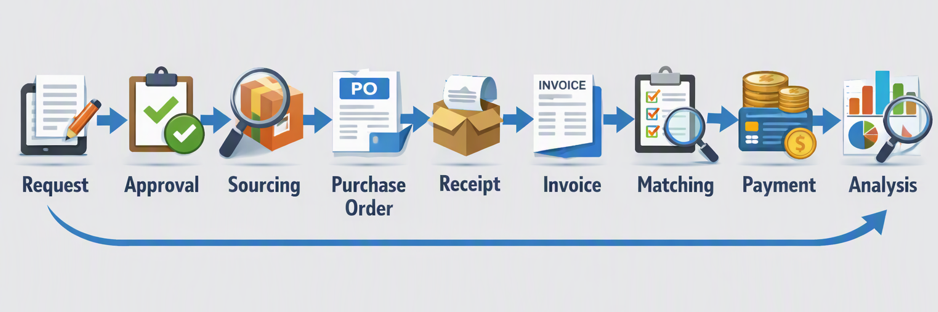
Each stage should capture information that supports the next stage.
For example, an approved purchase request should provide the information needed to create the purchase order. The purchase order should support receipt verification and invoice matching. Transaction data should then feed reporting and spend analysis.
This connected approach reflects a core procure-to-pay best practice: capture information at the source to maintain accuracy and avoid reconstructing it later.
Organizations can also use automation for repetitive activities while keeping human oversight for decisions involving significant spend, risk or supplier relationships.
How Can Zapro AI Support Better Procurement?
Zapro procurement software helps procurement teams bring data, workflows and intelligence into a more connected operating model.
Instead of relying on scattered information and manual analysis, teams can use procurement technology to improve spend visibility, streamline workflows and support faster decision-making.
Zapro AI can help procurement teams:
- Improve visibility across organizational spend
- Automate repetitive procurement activities
- Analyze spending patterns
- Categorize spend using AI-powered intelligence
- Improve supplier and purchasing visibility
- Build configurable procurement workflows
- Support data-driven procurement decisions
- Reduce manual effort across procurement operations
The goal is not to replace procurement expertise but to support it with good data and improved processes. By automating some of the functions and providing timely access to accurate data, procurement people would have more time to focus on their core competency.
Procurement 101: Where Should a Business Start?
For organizations building their procurement function, procurement 101 starts with a simple question: how does money move from a business need to an approved supplier and ultimately to payment?
Map that journey first.
Identify who requests purchases, who approves them, how suppliers are selected, where purchase information is stored and how invoices reach finance. Then identify the areas where the process lacks visibility, consistency or control.
From there, establish basic policies, supplier standards, approval thresholds and reporting requirements.
The goal at this stage is not to build a complicated procurement operation. It is to create a reliable foundation that can scale as the organization grows.
As the function matures, procurement knowledge becomes increasingly valuable because teams can use historical purchasing data, supplier performance and category information to improve future decisions.
The Next Step: Turn Procurement Improvements Into Action
Strong procurement cannot be accomplished through just one process or software tool alone. Instead, it comes from better data, improved processes, stronger vendor management, measurement, and continual review.
For procurement leaders, the next step is to identify the two or three areas creating the greatest operational or financial impact. Map the current process, establish a baseline and define measurable improvements. Then use technology to make the improved process easier to execute and monitor.
Zapro AI can help organizations bring procurement workflows, spend intelligence and automation into one connected environment. You can review Zapro pricing to see which plan fits the scope of your improvements.
Ready to see what that’s worth to your team? Run your numbers in the Procurement ROI Calculator, then book a free demo to see how Zapro AI builds procurement best practices into every request, approval, and invoice.

Build Your Winning Procurement Strategy Today
Frequently asked questions
What is the most important procurement practice for a growing business?
Start by ensuring visibility and process consistency. Create an effective purchasing process flow, consolidate the required spending data and establish defined approval processes. Once that is done, the procurement team will be ready to adopt analytical tools and automation for strategic sourcing.
How can procurement teams reduce costs without compromising quality?
Assess each supplier based on their total costs, not just the cost of purchasing from them. Construct a basic evaluation that will encompass quality, service, delivery, contract terms, cost of switching and other risks. Use your spending data to discover overlaps between suppliers and opportunities for consolidating demand.
What is a procure-to-pay best practice that improves efficiency?
Procure-to-pay best practice standardizes all processes between the procurement request and payment process. Procurement requests should be clear, with automated approvals, purchase orders, goods receipt, and invoice verification.
How can procurement improve supplier performance?
Set measurable expectations, segment suppliers by business value and risk, monitor performance regularly and establish corrective actions for recurring issues. Strategic suppliers can also participate in reviews focused on collaboration, resilience and continuous improvement.
How does procurement technology support business growth?
Technology can centralize procurement data, automate routine workflows, improve spend visibility and provide faster access to performance information. The right platform also helps organizations apply consistent purchasing processes as transaction volumes and supplier networks expand.
What are some practical procurement ideas for improving spend visibility?
Start by consolidating supplier records, standardizing spend categories, connecting purchasing and invoice data and reviewing transactions by supplier, department and category. These steps can reveal duplicate spending, unmanaged suppliers and opportunities for sourcing improvements.
Don’t miss our weekly updates
We’ll email you 1-3 times per week—and never share your information.
Talk to Our Procurement Experts
Get personalized insights to optimize your procurement strategy.

About the Author

Md. Kafil


About the Reviewer

Zapro is dedicated to helping businesses of all sizes make informed decisions. We adhere to strict editorial guidelines to ensure that our content meets and maintains our high standards.
Our editorial standards help keep every article accurate, useful, and trustworthy.