

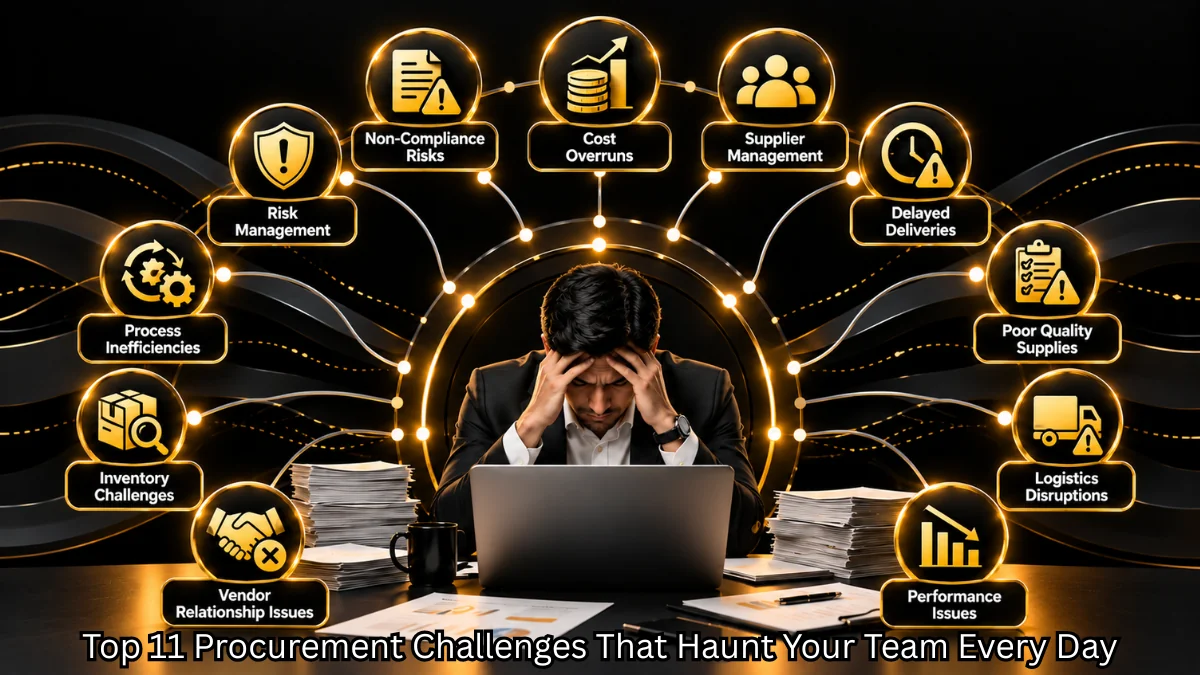
Running a supply chain requires attention. You have to manage suppliers, track down missing invoices, and make sure internal teams are happy. It is not surprising that procurement teams feel like they are always putting out fires of focusing on long-term growth.
When basic workflows break, even small tasks take longer. Unclear spend numbers, typing mistakes and missed delivery dates pull procurement away from the work that matters, such as negotiating and planning categories.
To address these challenges in the procurement process, teams first need to identify where the problems begin. Here are the eleven procurement challenges that drain your team every day, with steps to overcome them before they slow procurement down.

Key Takeaways
- Better spend visibility helps procurement control costs and make informed decisions.
- Supplier risk management can prevent disruptions, compliance issues and unexpected losses.
- Streamlined processes reduce manual work, delays and purchasing errors.
- Strong supplier and contract management improves performance and protects business value.
- Connected procurement systems give teams better data, control and time for strategic work.

Visibility, risk, talent—these aren’t problems to solve once; they’re continuous muscles procurement must build.
[Chief Procurement Officer, Merck; coverage in Harvard Business Review]
1. Poor Spend Visibility Makes Every Decision Harder
The Challenge: Procurement cannot control spending without a clear view of where the money goes.
When purchase information is spread across spreadsheets, corporate cards, ERP systems and individual department records, getting a complete picture of company spending becomes difficult. Procurement may know what has been purchased through the official process but have limited visibility into other transactions.
This can lead to:
- Duplicate purchases across departments
- Missed opportunities to negotiate volume discounts
- Unnecessary supplier relationships
- Difficulty tracking departmental budgets
- Inaccurate spend reports
For example, two departments may purchase similar software from different suppliers simply because neither knows the other already has a contract.
How to Overcome It:
Create a centralized source for purchasing and supplier data. Bring POs, invoices, supplier records and spend information together so procurement can see where money is going.
Regular spend reviews can then answer practical questions such as:
- Which suppliers receive the most spend?
- Which categories are becoming more expensive?
- Where are purchasing patterns changing?
- Which purchases could be consolidated?
Better data gives procurement a stronger basis for everyday decisions, budgeting and supplier negotiations.
2. Supplier Risk Can Become a Business Risk
The Challenge: A supplier may look reliable when the contract is signed but become a problem later.
Procurement teams often manage dozens or hundreds of suppliers. Keeping track of financial stability, delivery reliability, compliance documents, certifications, cybersecurity concerns and other risk factors can become difficult, especially when supplier information is scattered across different systems.
The risk becomes more serious when the business depends heavily on a single supplier for an important product or service. A supplier failure, regulatory issue or major disruption can quickly affect business operations.
Common warning signs include:
- Expired certifications or compliance documents
- Repeated delivery delays
- Declining product or service quality
- Heavy dependence on a single supplier
- Unresolved supplier risk issues
- Limited visibility into critical suppliers
Gartner’s recent procurement research emphasizes the need for structured supplier risk management, ongoing supplier monitoring and clearer differentiation between critical and less critical suppliers.
How to Overcome It:
Treat supplier risk as an ongoing process rather than a one-time onboarding check.
- Classify suppliers based on business criticality and risk.
- Track certifications, insurance and compliance documents.
- Monitor delivery, quality and service performance.
- Review high-risk suppliers more frequently.
- Maintain alternative suppliers for critical categories.
- Keep supplier information updated in one central location.
The goal is not to eliminate every supplier risk. It is to identify important risks early enough to overcome procurement problems and enable business teams to act before they become costly disruptions.
3. Manual Purchase Orders Create Delays and Errors
The Challenge: Purchase orders are routine, yet they can consume a surprising amount of procurement time.
A typical manual process might involve copying information from an email into a spreadsheet, checking supplier details, confirming pricing, preparing the PO and sending it to several people for approval.
One wrong figure can cause trouble later.
A quantity entered incorrectly can result in an incomplete shipment. An outdated price can create an invoice dispute. A PO sitting in an approver’s inbox can delay an order that the business needs immediately.
How to Overcome It:
Automate the repetitive parts of the PO process.
- Convert approved purchase requests into POs.
- Pull supplier information from existing records.
- Apply predefined approval rules.
- Send automatic reminders for pending approvals.
- Keep the PO, supporting documents and approval history together.
This reduces manual entry while giving procurement a clear view of every request in progress.
4. PO and Invoice Mismatches Keep Finance and Procurement Chasing Answers
The Challenge: Invoice discrepancies are one of those problems that can consume far more time than expected.
Suppose a company orders 20 monitors at $200 each. The supplier delivers 20 monitors but sends an invoice for $220 each. Someone now needs to determine whether the supplier made an error, the agreed price changed or the PO was incorrect.
Similar issues occur when quantities, delivery charges or taxes do not match.
Without an efficient matching process, teams may spend hours going through emails and documents to find the source of the difference.
How to Overcome It:
Use three-way matching to compare:
- The purchase order
- The goods receipt
- The supplier invoice
Invoices that match can move through the process with minimal intervention. Exceptions can be sent to the right person for review.
This lets finance and procurement focus their attention where it is actually needed.
5. Unreliable Suppliers Can Disrupt the Rest of the Business
The Challenge: Supplier performance has a direct impact on business operations.
A late supplier is not a procurement issue. If a manufacturer doesn’t get parts when needed, the whole production line can shut down. If an IT supplier holds up laptop deliveries, new hires might not be able to start working away. If a service provider keeps missing their SLA other teams have to step and pick up the slack.
The difficult part is identifying a deteriorating supplier relationship before it becomes a serious problem.
How to Overcome It:
Track supplier performance consistently instead of relying on occasional conversations.
Useful measures include:
- On-time delivery
- Order accuracy
- Quality issues
- SLA compliance
- Response times
- Invoice discrepancies
Procurement can use this information to discuss recurring issues with suppliers, negotiate corrective actions or identify alternative vendors when necessary.
For critical goods and services, having a qualified backup supplier can also reduce the impact of unexpected disruptions.
6. Software Sprawl Is Becoming a Procurement Headache
The Challenge: Software is easy to buy and surprisingly easy to forget.
Marketing may subscribe to one design platform. Sales may purchase another. HR may have its own recruitment software. IT may already have a tool that provides similar functionality.
Over time, businesses can end up paying for:
- Duplicate applications
- Unused licenses
- Excess user seats
- Automatic renewals
- Services that employees no longer need
This is one of the major procurement challenges in 2026 and teams need to take seriously as SaaS spending continues to spread across departments.
How to Overcome It:
Treat software subscriptions like any other business spend.
- Keep a central record of subscriptions.
- Assign an owner to each application.
- Track the usage of license.
- Set renewal reminders.
- Review monthly usage before renewing.
- Remove inactive users.
- Check for existing tools before approving new ones.
A renewal should be a decision, not an automatic event.
7. Supplier Risk Can Extend Beyond Price and Delivery
The Challenge: A supplier may offer a good price and reliable service while still creating significant risk.
Third-party vendors can have access to company systems, confidential information, customer data or financial information. A weakness at one supplier can therefore affect the wider organization.
There is also the risk of payment fraud. For instance, a fraudulent request to change a supplier’s bank details could result in a payment being sent to the wrong account.
How to Overcome It:
Supplier evaluation should consider more than commercial terms.
Procurement needs to look at a few things when choosing a vendor:
- Security controls
- Compliance certifications
- Data access
- Financial stability
- Business continuity plans
- Insurance coverage
- Geographic and regulatory exposure
High-risk suppliers need closer and more detailed checks, while critical vendors should be reviewed regularly rather than only during onboarding.
8. Disconnected Systems Make Procurement Data Hard to Trust
The Challenge: Procurement teams often work across several systems that do not communicate properly.
Supplier information may be stored in one application. POs may sit in another. Finance manages invoices somewhere else, while employees maintain spreadsheets to track their own purchases.
This creates unnecessary work and makes it difficult to follow a transaction from request to payment.
It can also lead to:
- Duplicate data entry
- Outdated supplier information
- Conflicting reports
- Manual reconciliation
- Delayed reporting
How to Overcome It:
Connect procurement with the systems finance and other business teams already use.
A connected procurement environment should allow teams to move information through the purchasing cycle without repeatedly entering the same data. A single procurement platform that carries data from request to payment removes the need to re-enter details at each handoff between teams.
The result is a cleaner audit trail and less time spent checking whether two systems contain different versions of the same information.
9. Poor Communication Turns Simple Purchases Into Long Processes
The Challenge: Procurement depends on several teams, but everyone may have different priorities.
An employee wants the purchase quickly. Finance wants budget confirmation. Legal wants to review the contract. IT needs to check the technology requirements. Procurement needs complete information before moving forward.
When all of this happens through email, a simple purchase can turn into dozens of messages.
How to Overcome It:
Create a shared workflow where each person knows what is expected.
- Clearly define approval responsibilities.
- Ask requesters for required information upfront.
- Route requests automatically to the right teams.
- Keep contracts and supporting documents attached to the request.
- Show the current status of each purchase.
- Send reminders when an action is overdue.
When everyone can see the same information, there is less need to ask, “Who is waiting for this?”
10. Market Price Changes Make Budgeting More Difficult
The Challenge: Last year’s price is not always a useful benchmark for this year’s negotiation.
Changes in inflation, exchange rates, transportation costs, commodity prices and supplier capacity can affect purchasing costs. This can make it difficult to determine whether a supplier’s proposed increase is reasonable.
For example, a supplier might ask for a 12% price increase when renewing a contract. Procurement must have up-to-date information to determine if this increase is due to market changes or if it simply means the supplier is trying to boost their profit.
How to Overcome It:
Add price details into your category reviews.
- Compare the price quotes with the historical price data.
- Track the price changes of suppliers.
- Review the market conditions that affect the categories.
- Benchmark major purchases where possible.
- Start renewal discussions early.
- Get competing quotes when appropriate.
Procurement does not need perfect market data for every purchase. It needs enough information to identify unusual increases and negotiate from a stronger position.
11. Too Much Administrative Work Leaves Little Time for Strategic Procurement
The Challenge: Procurement teams often know what they should be doing, but routine administration gets in the way.
Following up on approvals, updating spreadsheets, checking invoices, answering purchase-status questions and preparing reports can take up a large part of the workday.
That leaves less time for activities such as:
- Strategic sourcing
- Supplier negotiations
- Contract reviews
- Category planning
- Supplier development
- Cost reduction initiatives
How to Overcome It:
Look for repetitive tasks that can be handled through automation.
Start with processes such as:
- Approval routing
- PO creation
- Invoice matching
- Supplier notifications
- Renewal reminders
- Routine reporting
People should still handle decisions that require judgment, negotiation or context. Automation should take care of repetitive coordination and data movement.
How Zapro AI Can Help Address Procurement Challenges?
Zapro AI brings procurement, vendor management, contract management, spend analytics and AP automation into one platform.
The platform supports the purchasing process from purchase requests and approvals to purchase orders, goods receipts and invoice matching. This gives teams a structured way to manage purchasing activity without relying heavily on disconnected spreadsheets and email conversations.
Zapro AI also helps teams manage supplier information, contracts and spending data. By bringing these areas together, procurement teams can improve control over purchasing activity, monitor supplier relationships and make better use of procurement data.
For growing businesses, this can help reduce repetitive administrative work while giving procurement teams more time to focus on cost control, supplier relationships and risk. Growing teams can compare plans on the Zapro AI pricing page, where Spark starts at $699 per month and all plans include unlimited users.
Overcome Procurement Challenges With Zapro AI
Common procurement challenges are often linked together. Poor visibility can cause spending issues, and manual processes can create more mistakes and slow things down. Supplier issues and poorly integrated systems can make these challenges harder to manage.
If you are thinking how to overcome procurement challenges? Then the best approach is to find the bottlenecks and fix them. Use workflows, reliable data and practical automation. This helps procurement teams cut out work, get better control over spending and manage suppliers more effectively.
Understanding the right procurement challenges and solutions is the first step. With the right tools in place, teams can spend less time fixing routine issues and more time making better purchasing decisions. Watching a procurement software demo that follows one typical purchase from request to payment is a practical way to test whether a tool fits.
Ready to simplify your organization procurement challenges? Try Zapro AI to manage your procurement, sourcing, agreements, spending, and invoices from one platform. Start your free trial today.
Solve procurement challenges—simply and smartly.

Frequently Asked Questions
1. What are the main procurement challenges businesses face today?
Common procurement challenges include uncontrolled expenditure, inefficient approval processes, delayed suppliers, invoice issues and lack of visibility into the buying process. The process is made difficult when people rely on Excel sheets and email for communication.
2. How do challenges in procurement process workflows affect a company’s finances?
Slow procurement workflows can increase administrative costs and delay payments or purchasing decisions. Duplicate invoices, unauthorized purchases and missed savings opportunities can also affect cash flow. Supplier delays may create additional costs when businesses need to find alternatives or expedite orders.
3. What are the most common procurement problems in small and medium-sized businesses?
Small and medium-sized businesses often deal with manual approvals, limited spend visibility, inconsistent supplier management and time-consuming invoice processing. As purchasing volumes grow, these issues become harder to manage with spreadsheets and email. Simple automated workflows can reduce repetitive work and give smaller teams better control.
4. How can automation help address procurement challenges and solutions?
Automation can simplify several parts of the purchasing process. It can route purchase requests for approval, create purchase orders, match invoices with POs and goods receipts and provide real-time spend information. This reduces manual data entry, helps prevent errors and gives procurement teams more time to focus on suppliers and cost savings.
5. What procurement challenges in 2026 should supply chain leaders prepare for?
Procurement teams must be prepared for third-party cyber threats, more software subscriptions, changing trade rules, and continuing problems with supply chains. Businesses can deal with these issues by improving how they check the risks of suppliers, looking at how software’s used, making sure all legal papers are current and not depending too much on just one supplier.
Don’t miss our weekly updates
We’ll email you 1-3 times per week—and never share your information.
Need Expert Help Tackling Procurement Challenges?
Connect with our team to find the right solution for your toughest procurement problems.

About the Author

Md. Kafil


About the Reviewer

Zapro is dedicated to helping businesses of all sizes make informed decisions. We adhere to strict editorial guidelines to ensure that our content meets and maintains our high standards.
Our editorial standards help keep every article accurate, useful, and trustworthy.