


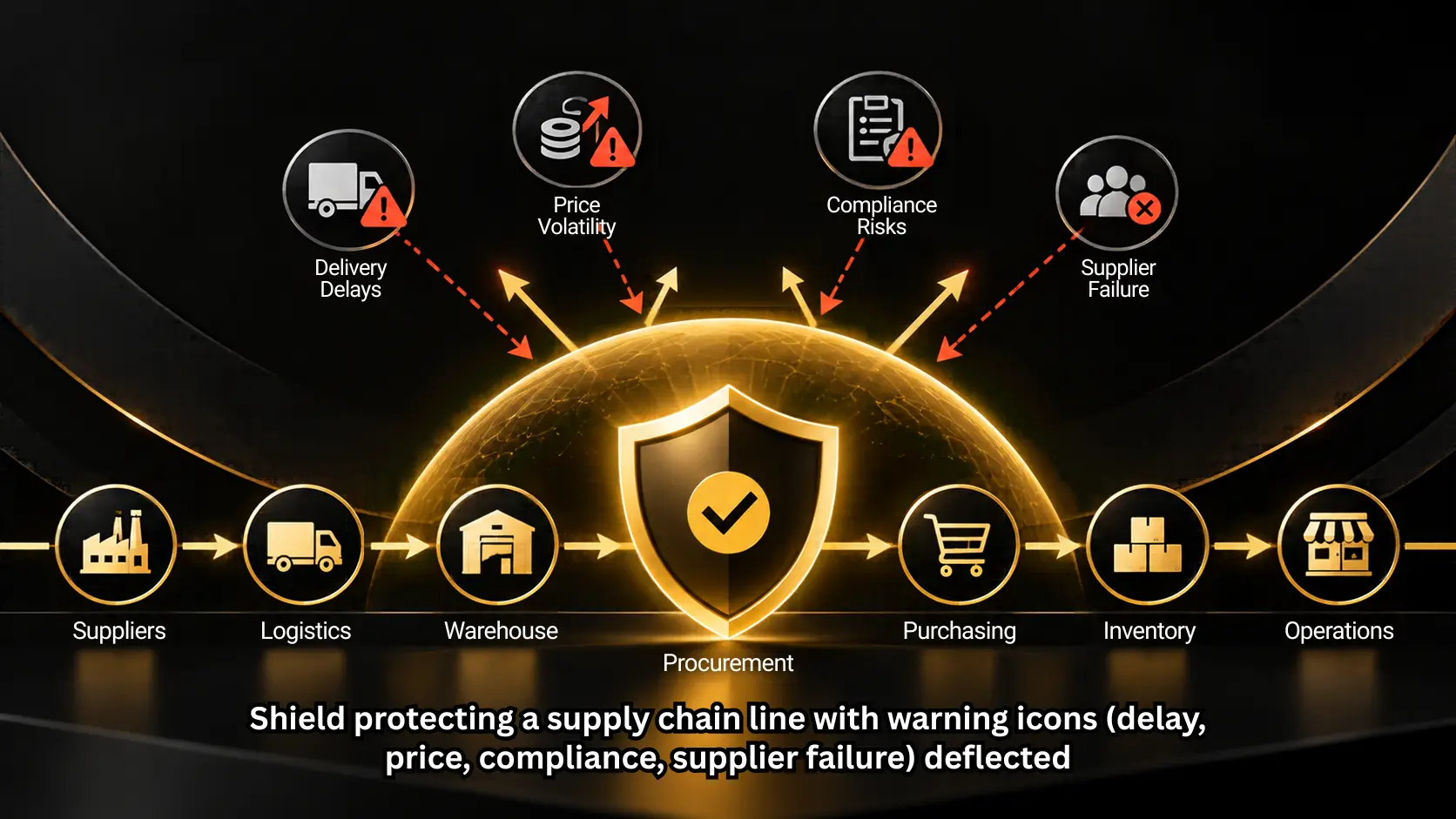
A supplier can miss a critical delivery. Raw material prices can rise without warning. A weak contract can leave the buyer responsible for costs that were never anticipated. Even a trusted technology vendor can expose the business to cybersecurity or compliance risks.
These risks can affect more than the procurement function. A single supplier failure can delay production, increase operating costs, disrupt customers or create regulatory exposure.
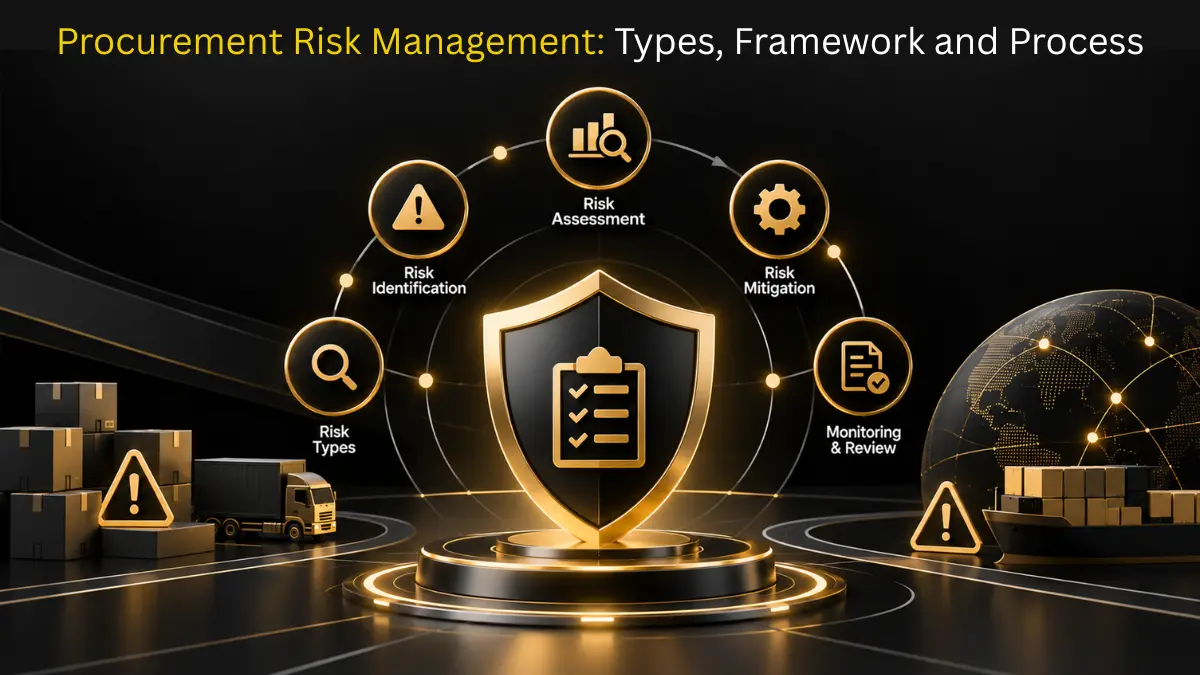
Procurement risk management gives procurement teams a structured way to identify these threats, assess their potential impact and put controls in place before they become costly disruptions. It brings together supplier due diligence, risk assessment, contract controls, ongoing monitoring and contingency planning to protect business continuity and supplier performance.
The focus is not on eliminating every risk. It focuses on understanding which risks matter most, who can manage them, and what action to take when conditions change.
Key Takeaways
- Procurement risks can originate from suppliers, internal processes, contracts, markets, regulations, technology and external events.
- Supplier dependency, price volatility, compliance failures, cybersecurity threats and maverick spending are among the common procurement risks.
- Effective risk management in procurement requires identification, assessment, prioritization, treatment, monitoring and review.
- A risk matrix helps teams focus resources on risks with the highest potential impact.
- Supplier due diligence should continue after onboarding because financial, operational and cybersecurity conditions can change.
- Automation can strengthen procurement controls by improving visibility, enforcing approvals and maintaining audit trails.
What Is Procurement Risk Management?
Procurement risk management is a systematic approach to identifying, evaluating, classifying, and controlling risks that could interfere with procurement activities. It covers risks across the procurement lifecycle, from sourcing and supplier selection to contracting, purchasing and ongoing supplier management. These risks may include supplier financial instability, delivery failures, quality issues, unclear contract terms, compliance violations, unauthorized purchases and market disruptions.
Effective procurement risk management combines due diligence, risk assessment, appropriate controls and continuous monitoring to identify potential problems early and reduce their impact on cost, continuity, compliance and business performance.
Why Is Risk Management Important in Procurement?
Procurement decisions can affect operating costs, supplier continuity, product quality, compliance and customer commitments. A relatively small procurement issue can become much larger when it affects a critical supplier or category.
For example, consider a company that depends on a sole provider for a unique part. The provider may be cost-effective and punctual in delivery. But if that provider has trouble, with production and no good substitute exists the company will have to pay more money.
This is where risk management in procurement becomes important. The purpose is not necessarily to replace the supplier. It may involve qualifying an alternative source, adjusting inventory levels, strengthening contract protections or increasing supplier monitoring.
What Are the Main Types of Procurement Risk?
Procurement risk can come from both internal and external sources. CIPS groups potential sources across internal organizational factors and external economic, technological, legal, environmental, social and other factors.
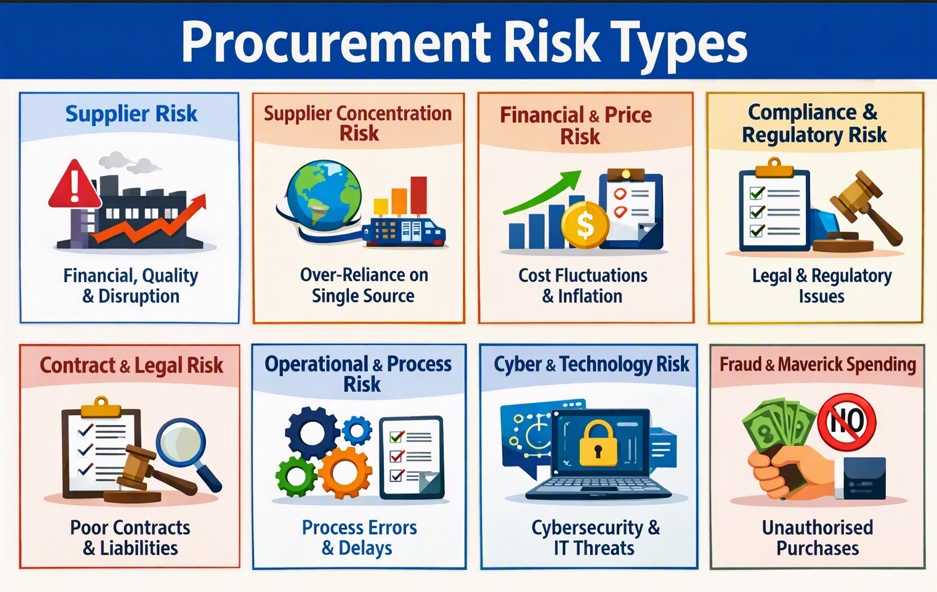
1. Supplier Risk
Supplier risk includes financial instability, limited capacity, poor performance, quality issues and operational disruption.
A supplier that performs well during onboarding may become less reliable later because of financial difficulties, ownership changes, workforce problems or increased demand.
Supplier segmentation can help address this problem. Critical suppliers can receive deeper financial, operational and compliance reviews, while lower-risk vendors can follow simpler controls.
NIST’s 2026 cybersecurity supply chain due diligence guidance similarly emphasizes researching suppliers before acquisition decisions are made and considering factors such as resilience, foundational cyber practices and supply chain tiers.
2. Supplier Concentration and Continuity Risk
Supplier concentration occurs when too much purchasing depends on one supplier, region or source.
This becomes particularly important when the product or service is difficult to replace. A single-source arrangement may simplify supplier management or offer favorable pricing, but it can also create a significant point of failure.
The appropriate action is to determine the key categories and assess whether other options are available. According to the 2025 research by Deloitte, having an alternate supply source was the strategy for risk mitigation that was most often recognized by CPOs.
3. Financial and Price Risk
Inflation, commodity prices, foreign exchange movements, transportation costs and supplier financial problems can affect procurement budgets.
Suppose a manufacturer purchases an important raw material whose market price changes frequently. A contract without appropriate pricing provisions can expose the organization to unexpected cost increases.
Procurement teams can reduce this exposure through appropriate contract structures, alternative suppliers, market monitoring and scenario planning. The right response depends on the category, market conditions and negotiating position.
4. Compliance and Regulatory Risk
Suppliers can create compliance exposure when they fail to meet legal, regulatory, environmental, labor or industry-specific requirements.
The risk becomes greater when suppliers handle regulated materials, sensitive information or critical operations.
Due diligence should therefore reflect supplier criticality. A vendor with access to customer data may require cybersecurity and privacy assessments that would not be necessary for a low-risk office-supply vendor.
5. Contract and Legal Risk
Even a trustworthy supplier can become a risk for a company, if its contracts are poorly written.
Such issues may include unclear specifications, undefined service level, unclear delivery, lack of clear exit conditions, automatic renewal, and unclear liability clauses.
Effective procurement and risk management link contract terms to the identified risk. If delays may seriously impact the company’s functioning, define all related conditions.
Contract reviews should also happen before renewal, not after an issue arises.
6. Operational and Process Risk
Procurement processes themselves can introduce risk.
Manual approvals, fragmented supplier records, spreadsheet-based tracking and poorly defined responsibilities can cause delays and errors. These issues also make it harder to reconstruct why a purchasing decision was made.
For example if a vital purchasing request hides in an email thread the approval process can delay delivery. Automated workflows and clear approval accountability can reduce this risk. Routing purchase requests through procurement software gives each one a visible approver and status, so it cannot stall unnoticed in an inbox.
7. Cybersecurity and Third-Party Technology Risk
Procurement departments often buy software and other technology-based products that could potentially connect to existing systems and deal with confidential data.
A supplier can therefore become an entry point for cybersecurity incidents.
NIST’s current guidance suggests doing research on suppliers as part of managing risks in the cybersecurity supply chain. The 2026 assessment guide it published points out areas such as ownership, control or influence where things come from how strong systems are, basic cyber security steps and different levels, in the supply chain.
For technology suppliers, security requirements should be considered before contract approval rather than added after implementation.
8. Fraud and Maverick Spending Risk
Fraud risk can involve false invoices, duplicate payments, unauthorized suppliers, conflicts of interest or manipulated purchasing information.
Maverick spending creates a related problem when employees purchase outside approved suppliers, contracts or workflows.
Clear approval thresholds, segregation of duties, supplier controls and automated purchasing policies can reduce this exposure. Procurement systems can also create an audit trail showing who requested, approved and processed a transaction.

“A McKinsey report found that supply chain disruptions—often rooted in procurement risks—can erase up to 45% of annual profits over a decade.”
– McKinsey
What Is a Procurement Risk Management Framework?
A procurement risk management framework refers to a systematic model through which risks are identified, evaluated, treated, and monitored within the procurement process.
A practical risk management framework can be built around six connected stages.
1. Establish the Risk Context
Start by identifying the organization objectives for procurement, key categories, suppliers, and associated risks.
Not every purchase needs the same level of control. A low-value office purchase and a supplier supporting a critical production process should not automatically receive identical risk assessments.
2. Identify Procurement Risks
Identify the risks across the entire purchasing lifecycle, including:
- Requirements and specifications
- Supplier sourcing
- Supplier evaluation
- Negotiation
- Contracting
- Purchase orders
- Delivery
- Invoice processing
- Supplier performance
- Contract renewal and exit
Cross-functional participation is helpful since procurement can recognize supplier risks, finance can identify financial risk, and IT can highlight cybersecurity risk.
3. Assess Likelihood and Impact
Once risks are identified, assess how likely they are to occur and what the consequences could be.
A simple approach is:
Risk Score = Likelihood × Impact
For example, an incident involving a supplier with a probability rating of 4 and an impact rating of 5 gives a risk score of 20.
The scoring scale can differ between organizations. Consistency matters more than choosing a particular numerical model.
4. Prioritize Material Risks
All risks do not warrant the same kind of action.
A risk that could shut down production or disrupt customer delivery usually requires more attention than a minor administrative risk.
A risk matrix can help procurement teams create a shared view of priorities. Ramp recommends assessing likelihood and impact, prioritizing risks by severity, assigning ownership and continuously reassessing the risk profile.
5. Define Risk Responses
Potential responses to risk may involve avoiding the activity altogether, decreasing the probability of its occurrence, lessening its effects, or transferring it.
For example, supplier concentration can be reduced by qualifying a secondary supplier. Cybersecurity exposure can be reduced through supplier assessments and contractual security requirements.
6. Monitor and Review
The level of risk does not remain the same after signing a contract.
Supplier’s financial position, market environment, geopolitical factors, cybersecurity risks, and compliance needs could vary.
A strong framework therefore includes regular reviews and trigger-based reassessments when major events occur.
What Is the Procurement Risk Management Process?
A practical procurement risk management process turns the framework into repeatable operational activities.
Step 1: Map the Procurement Lifecycle
Record the procurement process involved starting with the purchase requisition through to the supplier selection, contract, order, receipt, and payment processes.
This is done to determine the areas for manual transition, ownership problems, and control failures.
Step 2: Create a Risk Register
A risk register provides a central record of identified risks and planned responses.
Useful fields include:
| Risk register field | Purpose |
|---|---|
| Risk | Defines the potential event |
| Cause | Explains why it may occur |
| Likelihood | Estimates Probability |
| Impact | Measures business consequences |
| Risk score | Supports prioritization |
| Owner | Establishes accountability |
| Existing controls | Documents current safeguards |
| Mitigation action | Defines the response |
| Status | Tracks progress |
| Review date | Keeps the assessment current |
The register should be used during procurement reviews rather than treated as a document created only for compliance purposes.
Step 3: Segment Suppliers
Group suppliers according to factors such as spend, criticality, substitutability, data access and operational dependency.
A high-criticality supplier may require financial reviews, cybersecurity checks, business continuity information and more frequent performance monitoring.
A lower-risk supplier may require only standard onboarding and periodic verification.
Step 4: Develop Mitigation Plans
Every risk must be accompanied by an appropriate mitigation strategy.
- If the risk pertains to supplier concentration, seek out other options.
- If the risk is price volatility, evaluate suitable contract mechanisms.
- If the risk is associated with unauthorized expenditure, improve the process of workflow.
- If the risk involves cybersecurity, establish appropriate supplier security requirements.
Step 5: Assign Risk Ownership
Risk ownership should be explicit.
Procurement may own supplier performance, finance may manage budget exposure, IT may assess technology risks and legal may manage contractual risks.
According to CIPS, the process of effective risk identification is best served by involving a large number of individuals since procurement risks may emanate either internally or externally.
Step 6: Track Risk Indicators
Early-warning risk indicators can help teams act before a risk becomes an incident.
Useful indicators may include:
- Declining on-time delivery
- Increasing defect rates
- Supplier financial concerns
- Rising price variance
- Expiring certifications
- Increasing contract exceptions
- Unusual purchasing activity
- Cybersecurity incidents
Step 7: Reassess and Escalate
A risk assessment should be changed when the underlying conditions change.
A supplier considered low risk six months ago may require a new assessment after a change in ownership, financial position, operating region, or cybersecurity profile.
Continuous monitoring and reassessment are essential because risk profiles can change as organizations onboard new suppliers, enter new markets or respond to changing economic conditions.
How Can Businesses Improve Procurement Risk Management?
Managing risk in procurement requires a practical approach with controls built into everyday purchasing processes so employees can follow them without unnecessary friction.
Strengthen Supplier Due Diligence
Supplier information should be verified before important purchasing decisions are finalized.
Depending on supplier criticality, this can include financial information, certifications, ownership, operational capability, cybersecurity practices and business continuity arrangements.
NIST’s 2026 due diligence guidance specifically emphasizes obtaining relevant supplier information before acquisition decisions are executed.
Diversify Critical Sources
Additional suppliers can mitigate the effects of being dependent on a single supplier.
This does not necessarily mean dividing each procurement equally among many suppliers; instead, identify which categories would suffer if there is an interruption and whether feasible alternative sources exist.
Strengthen Contracts Around Identified Risks
The terms of the contract must accurately represent the risk.
An important supplier contract can include terms for services, reporting, security, business continuity, audit, termination, and remedies.
The important point is to connect each provision to a known business risk rather than adding clauses without considering their practical purpose.
Improve Spend and Approval Controls
Off-contract purchasing makes risk harder to see and manage.
Approval workflows can enforce spending thresholds, route purchases to the right decision-makers and prevent unauthorized supplier use.
Precoro’s current procurement guidance similarly highlights automated approvals, supplier controls, budget limits and audit trails as mechanisms for embedding risk controls directly into purchasing workflows.
Use Automation to Reduce Manual Risk
Manual procurement can lead to errors, delays and inconsistent application of purchasing policies.
Automation ensures approvals, supplier maintenance, invoice matching, exception management, and documentation. This becomes especially relevant when purchase volumes are high and manual review becomes impractical.
What Are the Best Software Options for Procurement Risk Management?
The right procurement software depends on factors such as workflows, supplier complexity, risk exposure, and the level of visibility and control an organization needs. Cost is part of that fit, and Zapro pricing starts at $699 per month for Spark and $1,999 per month for Growth.
Zapro AI
Zapro AI brings procurement, vendor management, spend analytics, contract management and AP automation in one platform. It also includes supplier risk monitoring, compliance tracking, and automated approval workflows. By combining these functions, procurement teams can catch problems earlier, maintain control over purchases, and keep supplier data organized.
SAP Ariba
SAP Ariba provides supplier risk management tools that help with supplier assessments, due diligence and ongoing monitoring. Procurement teams can use the data and risk insights, from SAP Ariba to spot problems before they upset operations. This approach works best for companies that have many suppliers and complicated procurement needs.
Ivalua
Ivalua combines supplier risk management with a source-to-pay platform. It gives procurement teams one place to manage supplier details, run assessments, track risk factors and monitor supplier performance. This allows teams to stay aware of supplier issues throughout the relationship, not just during the initial onboarding phase.
Precoro
Precoro unites supplier management, purchasing and approval workflows in one system. Teams can organize supplier documents, manage purchase requests and set approval rules based on their internal processes. These controls help reduce risks like unauthorized purchases, missing supplier records and buying from suppliers that are not approved.
Coupa
Coupa includes supplier risk management as part of its business spend management platform. It enables organizations to evaluate suppliers, track risk, and find areas that need review. This is helpful for companies working with suppliers who want better visibility into supplier risks and purchasing behavior.
How Does Procurement Risk Management Support Business Continuity?
The strongest procurement and risk management programs connect procurement decisions with broader business continuity planning.
Consider a company that relies on a single technology supplier for a critical customer-facing system. Replacing that supplier immediately may not be realistic. Instead, the organization can assess the supplier’s resilience, establish recovery expectations, strengthen contractual protections and document an alternative path if the supplier becomes unavailable.
This approach turns risk information into an operational plan.
The same principle applies to physical goods. If a critical material has limited sources, procurement can evaluate alternative suppliers, inventory requirements, geographic concentration and lead times.
The objective is to understand the consequences of disruption before the organization is forced to respond under pressure.
Turn Procurement Risk Into a More Resilient Procurement Function
Procurement risks can affect costs, supplier continuity, compliance and daily operations. Supplier disruptions, contract gaps, price volatility and weak purchasing controls can create larger problems when risks are not identified early.
A structured approach to procurement risk management helps teams identify critical exposures, assess their impact and establish practical responses. A clear procurement risk management framework creates consistency across sourcing, supplier management and purchasing activities. The right technology can further improve visibility, automate approvals and strengthen audit trails. A Zapro AI demo shows how approvals, supplier records, and audit trails work together on your own purchasing data.
Strengthen Procurement Controls With Zapro AI
Zapro AI connects procurement workflows, approvals, supplier information, spend visibility and invoice processing in one environment. Explore Zapro AI to strengthen procurement controls, improve visibility and build a more resilient procurement operation.
Take Control of Procurement Risks — Start Building a Safer Supply Chain Today!

Frequently Asked Questions
What is procurement risk management?
Procurement risk management is the structured approach to identifying, assessing, managing, prioritizing and responding to risks that could affect suppliers, purchasing, contracts, costs, compliance or business continuity.
What are the main types of procurement risk?
The main categories include supplier risk, supplier concentration, financial and price risk, compliance risk, contract risk, operational risk, cybersecurity risk and fraud or maverick spending risk.
What are the steps in risk management in procurement?
The process typically entails identification of the risks, analysis of the probabilities and consequences, prioritization of the risks, response definition, accountability assignment, and monitoring and reviewing of the risk profile.
What should a procurement risk management framework include?
A framework should establish the risk context, identify potential risks, assess and prioritize them, define mitigation measures, assign ownership and establish ongoing monitoring and review.
How often should procurement risks be reviewed?
The frequency should depend on the risk level. Critical suppliers and high-impact categories may require frequent monitoring, while lower-risk suppliers can be reviewed less often. A reassessment should also occur after significant supplier, market, regulatory or business changes.
Can procurement software reduce procurement risk?
Yes. Procurement technology can reduce certain risks by enforcing approval rules, controlling supplier access, improving spend visibility, monitoring contracts and creating audit trails. It does not eliminate risk, but it can strengthen the controls used to manage it.
Don’t miss our weekly updates
We’ll email you 1-3 times per week—and never share your information.
Let’s Take the Risk Out of Procurement
We’ll help you manage risks and keep your business running smoothly.
About the Author

Md. Kafil


About the Reviewer

Zapro is dedicated to helping businesses of all sizes make informed decisions. We adhere to strict editorial guidelines to ensure that our content meets and maintains our high standards.
Our editorial standards help keep every article accurate, useful, and trustworthy.