IT procurement involves sourcing, buying, and managing the hardware, software, and technology services that a business needs in order to function, such as laptops and servers as well as SaaS subscriptions and cloud infrastructure; it includes the assessment of vendors, negotiations regarding licensing, obtaining purchase approval, and the management of contracts and renewals.
This guide covers the five categories of procurement that fall under IT, the nine-step process, and the controls that stop technology spend from leaking.
Key Takeaways
IT procurement covers five categories: hardware, software and SaaS, cloud services, managed services, and hybrid mixes. Each needs different controls.
Technology buying continues long after the purchase: recurring fees, security reviews, and integration work need controls that general procurement lacks.
Run the nine steps in order, from needs and approval through negotiation, onboarding, and renewal planning, and score every vendor on the same matrix.
Total cost of ownership, not the quote, should decide the winner: implementation, migration, training, and support all add to the price.
A gated intake and a renewal calendar fix most leaks: every request is vetted before purchase, and every renewal is reviewed before the contract rolls over.
What Is IT Procurement?
Information technology procurement is the strategic process of identifying, sourcing, negotiating, and acquiring technology assets: physical laptops and data center hardware, software licenses, cloud infrastructure, and third-party technical services. The aim is to secure high-performing tools at fair market value while protecting the organization from security, legal, and financial risk.
How IT Procurement Differs From General Procurement
General procurement deals mostly with physical goods and standard services, where the transaction ends at delivery, as in procurement in manufacturing or retail procurement. Technology buying continues long after the purchase.
Continuous security risk
A set of office desks poses no data risk, and a new SaaS platform must have a security audit carried out before it deals with company or customer data.
Complex pricing
The costs build up and accumulate: there are per-user fees, charges based on API usage, implementation overhead, and ongoing maintenance retainers.
A missed termination date commits the business to multi-year terms for software it meant to drop.
Types of IT Procurement
It is advisable for teams to divide up their technology purchases into five categories since the control that is important in one category does not matter in another.
Category
What It Covers
What to Control
Hardware
Laptops, phones, networking gear, conferencing equipment, data center servers
Seat utilization, enterprise license terms, user access tiers, renewals
Cloud services
Infrastructure and storage from hyperscalers such as AWS, GCP, or Azure
Consumption and compute-hour monitoring to prevent overruns
Managed services and IT support
Security operations centers, development agencies, managed service providers
Service levels, scope, and contract terms
Hybrid
On-premise hardware blended with cloud
The balance between capital and operating expenditure
SaaS deserves its own governance, so see our guide to SaaS procurement for the process and our comparison of the best SaaS procurement software tools. The platform you choose shapes adoption: a clunky intake tool gets bypassed, which is how shadow IT starts. Our best AI procurement software ranking compares 15 platforms on ease of adoption, AI-assisted approval routing, and total cost of ownership. Because SaaS purchases become subscriptions, many teams track renewals, usage, and support quality afterward with an AI vendor management tool.
The IT Procurement Process: 9 Essential Steps
Turning a technical need into an integrated solution follows a structured procurement process.
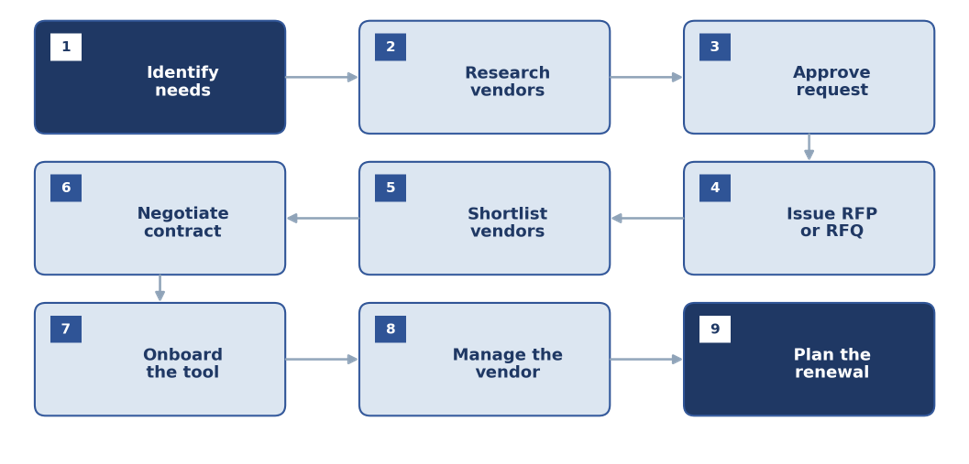
The nine steps of the IT procurement process
1. Identify business needs
Before looking around the market, IT and business analysts establish the technical requirements, the number of seats, the security standards, and the integration requirements.
2. Research vendors
Sourcing managers look at analyst reports, data sheets, and peer reviews in order to identify platforms that meet the requirements.
3. Approve the purchase request
A formal requisition goes through the approval stage to ensure that the budget exists.
4. Issue RFPs or RFQs
When it comes to high-value purchases, structured requests call on qualified vendors to put in competitive bids.
5. Shortlist vendors
The teams put forward their proposals against a single evaluation matrix which included features, security compliance, support terms, and implementation timelines before eliminating them down to two or three.
6. Negotiate the contract
Before it is officially approved by legal counsel, the procurement manager looks at the unit costs, the payment terms, the performance penalties, the data liability limits, and removes the auto-renewal clauses.
7. Onboard the tool
IT sets up single sign-on, establishes the data pipelines, and trains the users.
8. Manage the vendor
Scorecards monitor uptime and the speed at which support issues are resolved, and the vendors are held to their service levels during quarterly reviews.
9. Plan the renewal
Well before expiry, a utilization audit shows how often staff use the tool, which gives finance the data to right-size seats or negotiate discounts.
IT Procurement Best Practices
These IT procurement process best practices apply to every category above.
Use one evaluation framework
Don’t pick a software for your organization just because it looks good in a demo. You need to duly compare every option against the same standards for features, security, setup cost, and ongoing upkeep.
Stay objective with strong vendors
Good relationships assist when there are outages or during rapid scaling, but prices should be benchmarked against the market every few years.
Model total cost of ownership
The quote only represents the surface of the issue; if you add in implementation consulting, data migration, training hours, and support premiums, and then put everything into your financial forecast.
Connect purchasing to finance
Connect the workflows to the accounting platform and the general ledger so that the finance department can see the upcoming software liabilities before they affect cash flow.
Put every renewal on a calendar
Put the review trigger in place well in advance of the automatic renewal, since your bargaining power vanishes when the contract rolls over.
Common IT Procurement Challenges and Solutions
Challenge
Why It Hurts
Solution
Shadow IT and rogue spending
Creates security gaps and unapproved spend
Publish clear policy, keep a preferred vendor list, and automate intake controls
Lengthy approvals
Delays access to business-critical tools
Route approvals automatically with escalation rules by spend threshold
Poor spend visibility
Blocks forecasting and hides savings
Use a central platform with budget dashboards and mandatory POs
Vendor sprawl
Adds admin work and weakens bargaining power
Consolidate duplicate tools and assign a named owner per vendor
Security and compliance risk
Exposes the company to breaches and fines
Require an information security review for every vendor and audit routinely
Integration complexity
Delays deployment and raises maintenance cost
Document API and architecture needs early and involve IT in evaluation
Budget pressure
Technology costs outpace revenue growth
Right-size licenses with seat utilization data and negotiate multi-year discounts
IT Procurement Strategy: Building a Framework That Scales
An ad hoc approach cannot support a growing business. An IT procurement strategy needs five parts.
A central policy
Document how software and hardware must be requested, vetted, and approved, and publish a list of pre-approved vendors.
Clear roles
State when a request needs security engineering input, legal review, or finance sign-off.
Approval tiers
Link the approvals to dollar amounts in such a way that minor renewals are automatically approved while high-risk enterprise contracts are sent to the CIO and the CFO. The e-procurement system should apply these approval stages consistently.
Keep an eye on savings, how quickly requests get processed, and whether vendors stick to their contracts. You can find the formulas in our guide to procurement KPIs.
Tools and Technologies for IT Procurement
IT procurement software falls into five groups, and an IT procurement platform usually combines several of them.
E-procurement platforms capture requests, route approvals, and generate purchase orders in one system.
Vendor management systems contain the contracts, service-level agreements, and compliance documents.
Spend analysis tools are able to identify duplicate tools and savings by combining data from cards, invoices, and ledgers, as in spend analytics.
Contract lifecycle management tracks the dates of contracts and gives a warning several months before a software agreement renews.
The security and compliance tools retain the vendor risk assessments and SOC 2 reports for the purpose of audits.
Managing several software subscriptions, hardware orders, and vendor profiles in separate systems leads to financial leaks. Zapro AI is an automated source-to-pay platform built to remove that complexity from technology procurement and accounts payable.
The request is received via the intake process; the approval matrix is then used to check the budget; Zapro AI produces and keeps track of the purchase order; the vendor works through the portal; and the AI examines the invoice to carry out the three-way match and synchronizes with the ERP.
Centralized intake and shadow IT defense: Route all technology requests through a single place, making sure nothing gets missed and every tool is properly reviewed before you spend a cent.
No-code approval chains: You can set up approval paths based on department, cost, or risk, so requests go straight to the right team—whether that’s security, legal, or finance.
Renewal management: Software contracts are stored in one place, with alerts ahead of expiration so there is time to negotiate.
AI three-way matching:OCR reads technology invoices and cross-references them against purchase orders and fulfillment logs, flagging line-item discrepancies. It is the core of Zapro AI’s AP automation.
ERP and financial sync: Integration with platforms such as NetSuite and QuickBooks Online keeps technology spend matched to budgets without manual CSV handling.
What Is IT Procurement, and How Do We Control SaaS and Software Spend?
Start with an inventory: every subscription, its owner, renewal date, seat count, and annual value. Most organizations find duplicate tools and paid seats for people who have left. Put renewals on a calendar with a review trigger well before auto-renewal, and route new software requests through one intake with security and data-protection review attached. Zapro AI supports each step through contract management, vendor management, intake and approvals, and spend analytics.
What Are the Best IT Procurement Practices?
For each vendor, use a single scorecard, base your decision on the total cost of ownership rather than the quote, carry out a security review before making the purchase, link approvals to spending thresholds, and keep a record of each renewal date. Associate purchasing with your accounting system so that the finance department can see the commitments as early as possible.
What Is an IT Procurement Strategy?
It provides a framework that can be repeatedly applied when purchasing technology: it includes a main policy, clearly defined roles for IT, security, legal, and finance, approval levels based on spending, software for carrying out intake and renewal processes, and KPIs that demonstrate savings.
What Is the Difference Between IT Procurement and SaaS Procurement?
IT procurement covers hardware, software, cloud, and services. SaaS procurement is the subscription slice of it, focused on seats, renewals, and shadow IT. Hardware needs lifecycle planning, while SaaS needs usage tracking. Our SaaS procurement guide covers that slice in depth.
What Should IT Procurement Software Do?
The right procurement software makes it easy for teams to submit requests in one place, helps approvals move quickly according to budget and risk, creates purchase orders, keeps contracts organized with helpful reminders, matches invoices to orders, and keeps everything in sync with your ERP system.
Control IT Spend
IT budgets often slip through the cracks when requests skip review, renewals auto-renew without notice, or invoices go unchecked. Strengthen your intake process, track renewals on a clear calendar, and always reconcile invoices with purchases. When you do, managing the rest of the process gets much simpler.
Zapro AI pulls intake, approvals, renewal reminders, and invoice checks into one easy-to-use platform. This means every tech purchase is reviewed and approved before any money leaves your account.
Md.Kafil is the Founder and CEO of Zapro, an AI-powered procurement and spend management platform. With over 16 years of leadership experience in fast-growing technology companies, he has led product, customer success, marketing, and sales teams serving global enterprises across North America, Europe, and APAC. Kafil has successfully launched and scaled multiple businesses from early-stage to high-growth organizations. He specializes in enterprise data governance, intelligent automation, and AI-driven software and is passionate about helping companies simplify procurement, manage vendors better, and drive smarter decisions through technology.
Daniel is a procurement and vendor management expert with extensive experience in helping businesses build efficient, compliant, and transparent procurement processes. He specializes in spend management, supplier risk, and procurement technology, and regularly reviews content to ensure accuracy, relevance, and practical insights for modern teams.
Zapro is dedicated to helping businesses of all sizes make informed decisions. We adhere to strict editorial guidelines to ensure that our content meets and maintains our high standards.
Our editorial standards help keep every article accurate, useful, and trustworthy.