

E-procurement is the business-to-business purchasing of goods and services over the internet through integrated digital workflows. It automates requisitioning, purchase orders, sourcing, invoicing, and vendor management to control spend and speed up procurement, usually through e-procurement software. But what is e-procurement software, and how does it give your business more control over spending, clearer roles and responsibilities, quicker processes, and better insights than manual methods?
Let’s break it down below.
Key Takeaways
- E-procurement is the digital management of purchasing, from sourcing and requisition through ordering, receiving, invoicing, and payment.
- It reduces manual work and improves spend control, speed, and transparency because every request follows one auditable path.
- The main types are e-sourcing, e-tendering, e-auctioning, e-purchasing, e-invoicing, and e-payment, and most teams start with e-purchasing and e-invoicing.
- E-procurement is the approach, and e-procurement software is the technology that executes it, so set processes and KPIs before choosing a tool.
- Adoption succeeds or stalls on data quality, integrations, vendor onboarding, training, and workflow design.
What Is E-Procurement Software?
To understand what is e-procurement software, think of a system that runs purchasing digitally, from requisition and approval through purchase order, receiving, invoice matching, and payment. E-procurement is the practice, and the software is the technology that executes it. Because the software is only one part of the practice, process design and KPIs should come before tool selection.
Why Are Businesses Adopting E-Procurement?
Finance and operations teams are phasing out manual systems for three reasons.
- Cutting the cost of inefficiency: Digital workflows end repeated data entry and the errors that come with it.
- Stopping maverick spend: A structured e-procurement system acts as a gatekeeper, so staff stop buying off-contract on their own.
- Seeing commitments early: Finance gets real-time visibility into spending as soon as a request is made, instead of waiting weeks for invoices to arrive.
In telecom, where teams manage hundreds of vendors for equipment and services, e-procurement replaces spreadsheets with digital platforms that speed up sourcing and help prevent missed contracts.
Key Components of E-Procurement
Six components cover the buying cycle in three phases, and you can adopt each phase on its own.
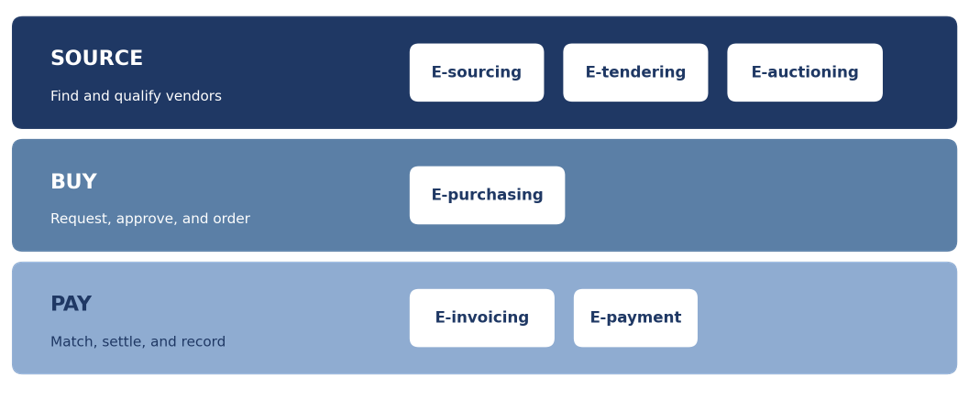
Six e-procurement components in three phases
Source: E-sourcing is responsible for finding potential vendors, assessing them, and organizing competitive digital bidding, using an objective method to evaluate the bids. Instead of using paper documents, e-tendering makes use of a secure upload facility, which makes it more difficult to tamper with the documents and easier to carry out compliance audits. E-auctioning involves conducting online reverse auctions in which qualified vendors compete according to established commercial rules.
Buy: E-purchasing includes the various aspects of operational buying such as selecting items or services, preparing requisitions, securing approvals, and placing orders.
Pay: E-invoicing lets vendors send invoices online, so the system automatically checks them against orders and delivery records. E-payments link approved invoices directly to payment and make tracking easier. The biggest hurdle is vendor readiness; just over half can send invoices this way. AP automation software helps by capturing invoices, matching them to orders, and flagging problems for review.

“There has been a continuous evolution of e‑procurement software… while adoption by businesses… still significantly lags behind the pace of adoption in our personal lives.”
-Simon Whatson
Types of E-Procurement
E-procurement solutions come in five configurations.
- Procure-to-pay systems cover the operational cycle from request through purchase order, receipt, invoice, and payment.
- ERP-based modules sit within a broader enterprise system, which suits teams that want purchasing data closely tied to finance, inventory, and accounting.
- B2B marketplaces connect buyers with catalogs and vendors, often with negotiated pricing, and our guide to B2B procurement platforms covers that model.
- Consortium platforms let several organizations combine demand to gain bargaining power.
- E-sourcing platforms concentrate on discovery, RFQs, RFPs, bidding, and evaluation rather than the downstream purchasing cycle.
A simple rule matches the type to the problem. If the pain is price discovery, start with e-sourcing. If it is off-contract buying, start with e-purchasing and a catalog. If it is invoice errors and late payments, start with e-invoicing and matching.
If the purchasing and finance teams use the same ERP system, use the built-in procurement tools first before looking for new software; you can enhance e-procurement by adding features such as catalog setup, vendor onboarding, or helpdesk support.
Zapro AI does not operate a group purchasing organization. Its catalog and spend-consolidation tools help a business pool purchase volume across departments and locations to negotiate better direct pricing, the software-side equivalent of a bulk purchasing program for a single company.
Transform Your Procurement Process with Ease

How Does the E-Procurement Process Work?
The specific stages vary by organization and depend on the e-procurement technology, but the typical workflow is a single, continuous digital process from need through payment. It begins when an employee submits a digital purchase requisition including item codes, quantities, and the department’s budget. The software then checks the request against the company’s spending rules, verifies the budget balance in real time, and sends it on to the appropriate approvers.
After it has been approved, the platform gives the goods a unique purchase order number and forwards the order to the vendor’s system. Upon receipt of the goods, the receiving team produces a digital goods received note confirming the goods arrived undamaged. The vendor then supplies an electronic invoice, after which the software compares the invoice lines with both the purchase order and the receipt to detect any price or quantity discrepancies. After the match is approved, payment runs on the negotiated terms, and the accounts payable and general ledgers update automatically.
E-Procurement Examples
These typical scenarios, not named customers, show how different organizations use e-procurement.
- Manufacturing: A company that produces auto parts links its purchasing activities to its production process; whenever the amount of steel stored in the factory reaches a certain level, the system generates and sends purchase orders to approved mills, thus avoiding production interruptions.
- Healthcare: A hospital network lets staff order supplies from custom catalogs on their tablets, a model covered in our guide to digital procurement in healthcare. Everyday items like gloves are shipped right away, while bigger requests go to facility directors for approval.
- Government: A city posts infrastructure projects online for bidding. Contractors upload proposals to a secure system that flags bids that don’t follow the rules and maintains a clear audit trail.
- Retail: A multichannel retailer connects its purchasing activities to the shipping logs relating to packaging, labels, and tape, ensuring that the materials arrive just as the volume of orders surges and at the same time keeping warehouse storage low.
Benefits of E-Procurement
Lower procurement costs.
Buying through one platform gives you more leverage and helps you get better deals. Sticking to an approved vendor list keeps spending in check, which frees time for strategic sourcing.
Lower administrative expense.
Digital POs, approvals, and invoices cut out repetitive tasks, speed things up, reduce errors, and help you avoid late fees.
Stronger control and transparency.
A digital record tracks requests, approvals, orders, receipts, and invoices. This makes audits easier and ensures approval policies are always followed.
Better data and collaboration.
Centralized records make vendor spend, category activity, and compliance easier to analyze, and vendor portals cut email exchanges, a topic our guide to procurement collaboration explores.
Challenges in E-Procurement Adoption
Resistance to change.
People who are used to relying on informal emails and carrying out approvals manually might be reluctant to make the change. However, intuitive tools, clear communication, and hands-on training can facilitate the transition by showing the software as a way to save time.
Integration complexity.
Attaching new software to an old system or to a complex ERP requires careful planning; native API connectors can make the process easier and help all the components function together with less need for manual intervention. Our guide to ERP procurement integration covers the options.
Vendor adoption.
Vendors aren’t always eager to use a new portal. Make it easy for them to sign up, let them manage their own info, and show them how faster payment makes it worth it.
E-Procurement vs Traditional Procurement
| Area | Traditional Approach | E-Procurement Approach |
|---|---|---|
| Purchase requests | Paper, spreadsheets, email | Digital requisition workflow |
| Approvals | Manual follow-up | Rule-based routing |
| Purchase orders | Manual creation | Automated generation |
| Vendor communication | Email and phone | Digital collaboration and portals |
| Invoice processing | Manual entry and checks | Electronic validation and matching |
| Reporting | Spreadsheets and manual reports | Centralized dashboards and analytics |
| Audit trail | Scattered records | Centralized transaction history |
How to Start an E-Procurement Program
Seven steps keep a rollout grounded in real process problems.
- Map the process: Follow your current purchasing process from when a request is made to when payment is made.
- Find the leaks: Look for slow progress, missing compliance, and instances where money is wasted.
- Set the rules: Draw up clear policies, set approval limits, define vendors, and make sure everyone knows who is responsible for the data.
- Prioritize workflows: Start with the ones that show the clearest operational value.
- Check the integrations: Evaluate the requirements for the ERP, accounting, AP, inventory, and identity systems.
- Plan adoption: Make sure that the vendor onboarding and employee training are carried out before the launch.
- Measure results: Monitor adoption, cycle time, compliance, exception rates, and spending visibility.
E-Procurement KPIs to Track
Nine KPIs show whether the program works: requisition-to-purchase-order cycle time, the share of purchases made through approved channels, maverick or off-contract spend, purchase order processing time, invoice exception rate, vendor onboarding completion rate, digital adoption among employees, spend visibility by category and vendor, and approval turnaround. Two have public yardsticks. APQC’s all-company median for issuing a purchase order for goods is 2.0 days, and its median share of purchases made through maverick buying is 1.2%.
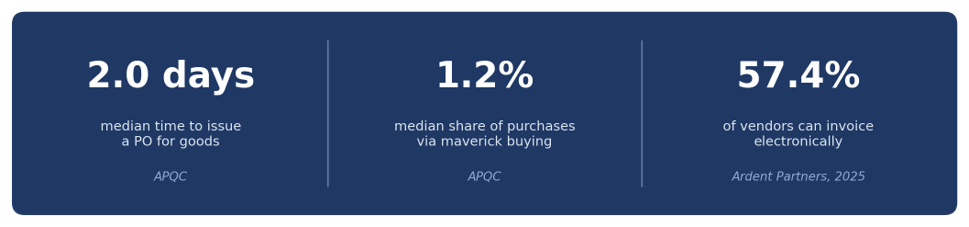
APQC Open Standards Benchmarking and Ardent Partners, The State of ePayables 2025
Use these as a first reference, then track your own trend each quarter. Our guide to procurement KPIs gives the formula for each measure.
How Zapro AI Supports Your E-Procurement Process
Relying on spreadsheets and manual tools to track spending can put your finances at risk. Zapro AI is an automated source-to-pay platform that cuts complexity by automating e-procurement and accounts payable, so finance teams can work faster and stay in control as they grow.
- Unified request intake: One portal for all internal requests, so finance can vet every purchase before committing capital.
- No-code approval matrices: For each department, cost threshold, or project risk, the process of routing requests does not involve email bottlenecks.
- Vendor collaboration portal: Through this, vendors are able to look after their own billing arrangements, upload their tax documents, and keep track of payment milestones in real time.
- AI three-way matching: An OCR engine, guided by an AI procurement agent, reads invoices and flags variations against purchase orders and fulfillment logs.
- ERP and ledger sync: Integration with platforms such as NetSuite and QuickBooks Online updates general ledgers as spending happens.
The last step in any evaluation is the annual run cost, so see published e-procurement software pricing to close that gap.
Frequently Asked Questions
What Is E-Procurement?
E-procurement means handling all your purchasing—requests, approvals, orders, deliveries, and invoices—online. Instead of juggling paperwork or emails, everything moves through a clear, trackable digital process between you and your vendors.
What Are the Main Types of E-Procurement?
E-procurement comes in a few main forms: e-sourcing (digital tendering and auctions), e-purchasing (ordering from catalogs or directly from vendors), e-ordering (sending purchase orders), e-invoicing (getting and matching invoices online), and e-payment. Most companies start with e-purchasing and e-invoicing.
What Are the Benefits of E-Procurement?
With e-procurement, you get faster ordering, lower processing costs, stronger policy enforcement, less off-contract spending, clear audit trails, and better spend data to help shape your strategy and negotiate with vendors.
What Are the Challenges of Implementing E-Procurement?
The main challenges are messy vendor data, slow vendor onboarding, users who prefer the old ways, complicated approval flows, and integrations that make people repeat work. Tidy up your vendor data and onboarding process before you tackle the technical setup. Most ERPs lump all vendors together, so start by sorting out raw-material vendors from one-off suppliers using this vendor classification rule.
How Does E-Procurement Improve Vendor Relationships?
Vendors get clear orders, can see when items are received, and know exactly when they’ll be paid, all through a self-service portal. With fewer disputes and less chasing for updates, both sides save time and money, and you have more leverage when it’s time to renew.
What Is E-Procurement Software, and How Does It Differ From a Purchasing System?
A purchasing system mainly creates and tracks purchase orders. E-procurement goes further. It handles everything from browsing catalogs and approving purchases to onboarding new vendors. If you only need to keep track of POs, a basic purchasing module will do. But if your business has more complex buying needs or worries about off-contract spending, e-procurement is the smarter choice.
Control Every Purchase
E-procurement works best when every purchase moves through a single digital process, with rules, approvals, and records built in from the start. Zapro AI makes this easy by combining request intake, simple approvals, vendor collaboration, invoice matching, and ERP sync so you always know where the money’s going, without holding up the team.
Sources / References
- APQC, “Cycle Time in Days to Issue a Purchase Order for Goods”: https://www.apqc.org/what-we-do/benchmarking/open-standards-benchmarking/measures/cycle-time-issue-purchase-order-goods
- APQC, “Percentage of Total Purchases Procured via Maverick Buying”: https://www.apqc.org/resources/benchmarking/open-standards-benchmarking/measures/percentage-total-purchases-procured
- Ardent Partners, “The State of ePayables 2025: AP’s Unfinished Journey” (via Bottomline): https://www.bottomline.com/resources/state-epayables-2025-aps-unfinished-journey
- Zapro AI, “What Is Procurement?”: https://zapro.ai/procurement/what-is-procurement/
- Zapro AI, “E-Procurement Software”: https://zapro.ai/procurement/eprocurement-software/
- Zapro AI, “What Is a Procurement System?”: https://zapro.ai/procurement/what-is-a-procurement-system/
- Zapro AI, “Digital Procurement in the Telecom Industry”: https://zapro.ai/vendor-management/digital-procurement-transformation-telecom-industry/
- Zapro AI, “AP Automation”: https://zapro.ai/ap-automation/
- Zapro AI, “B2B Procurement Platforms”: https://zapro.ai/procurement/b2b-procurement-platforms/
- Zapro AI, “Purchase Requisition Software”: https://zapro.ai/procurement/purchase-requisition-software/
- Zapro AI, “What Is a PO Number?”: https://zapro.ai/procurement/what-is-a-po-number/
- Zapro AI, “Goods Received Note”: https://zapro.ai/procurement/goods-received-note/
- Zapro AI, “Digital Transformation in Healthcare Procurement”: https://zapro.ai/procurement/digital-transformation-healthcare-procurement/
- Zapro AI, “The Expert’s Guide to Strategic Sourcing”: https://zapro.ai/ap-automation/the-experts-guide-to-strategic-sourcing/
- Zapro AI, “Procurement Collaboration”: https://zapro.ai/procurement/procurement-collaboration/
- Zapro AI, “ERP Procurement Integration”: https://zapro.ai/procurement/integrating-procurement-erp-financial-systems/
- Zapro AI, “What Is Purchasing?”: https://zapro.ai/procurement/what-is-purchasing/
- Zapro AI, “Procurement KPIs”: https://zapro.ai/procurement/procurement-kpis/
- Zapro AI, “Source-to-Pay Platform”: https://zapro.ai/sourcing/source-to-pay-platform/
- Zapro AI, “Procurement Agent”: https://zapro.ai/procurement/procurement-agent/
- Zapro AI, “Pricing”: https://zapro.ai/pricing/
- Zapro AI, “Automating the Requisition-to-Order Process”: https://zapro.ai/procurement/automating-requisition-to-order-process/
- Zapro AI, “Vendor vs Supplier”: https://zapro.ai/vendor-management/vendor-vs-supplier/
- Zapro AI, “Amazon Business Integration”: https://zapro.ai/amazon-business/
Don’t miss our weekly updates
We’ll email you 1-3 times per week—and never share your information.
Let’s Build Your Perfect Procurement Solution
We’re here to answer your questions and design the right plan for you.
About the Author

Md. Kafil


About the Reviewer

Zapro is dedicated to helping businesses of all sizes make informed decisions. We adhere to strict editorial guidelines to ensure that our content meets and maintains our high standards.
Our editorial standards help keep every article accurate, useful, and trustworthy.
Related Blogs
Wait! Don't Leave Without This Free Guide
How AI Is Replacing Manual Procurement And What Your Team Should Do Next