

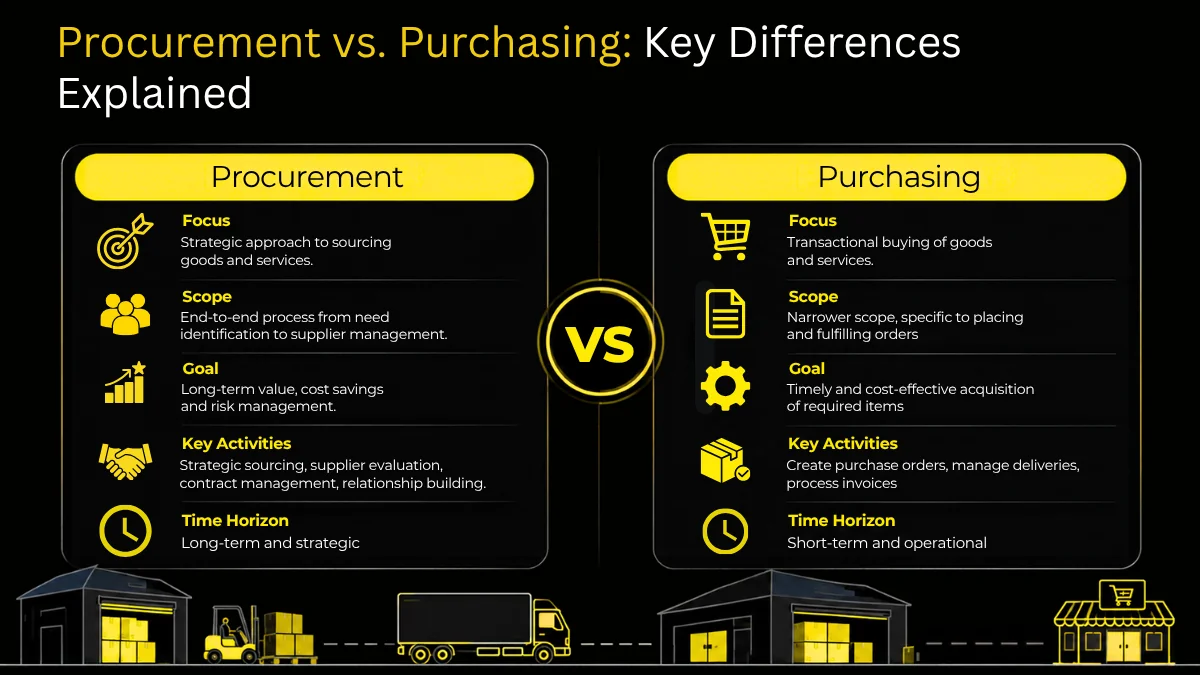
Procurement and purchasing are often treated as the same thing. They are closely connected, but they are not identical.
The simplest way to put it is this: procurement covers the wider process of getting what a business needs, while purchasing focuses on making the actual purchase.
Procurement can involve finding suppliers, comparing options, negotiating terms, managing contracts and tracking supplier performance. Purchasing usually comes later, with activities such as raising purchase orders, confirming deliveries and processing invoices.
The difference matters because a company can be good at placing orders and still have a weak procurement process.
Key Takeaways
- Procurement covers the wider buying process, from identifying a need to managing the supplier relationship.
- Purchasing is more focused on carrying out an approved purchase.
- Purchasing is usually part of procurement, although companies may divide the work differently.
- Sourcing is also part of procurement, but it is not the same as procurement.
- Procurement looks beyond the immediate price to factors such as risk, quality, delivery, and long-term cost.
- Good procurement and purchasing processes need to share information rather than operate as separate systems.
Procurement vs Purchasing
Imagine a company needs 500 laptops for its employees.
The procurement team may start by understanding what the business needs. It can then research suppliers, compare specifications and prices, negotiate discounts, review warranty terms and select the supplier.
Once that decision has been approved, purchasing takes over much of the execution. Someone raises the purchase order, confirms the agreed quantity and price, follows up on delivery and records what was received.
So the work is connected, but the questions are different.
Procurement asks: What should we buy, from whom, under what terms, and why?
Purchasing asks: How do we place and complete the order correctly?
The Chartered Institute of Procurement & Supply (CIPS) makes a similar distinction, describing procurement as a broader function that includes sourcing, negotiation, contracts and supplier relationships, while purchasing is more directly concerned with buying goods and services.
That is the basic difference between procurement and purchasing. The rest is about understanding where the two overlap.
What Does Procurement Include?
Procurement starts before someone creates a purchase order.
Depending on the company and what it is buying, the process may include:
- Defining the business requirement
- Researching the supplier market
- Finding and evaluating suppliers
- Requesting quotes or proposals
- Comparing bids
- Negotiating commercial terms
- Selecting suppliers
- Managing contracts
- Monitoring supplier performance
- Reviewing spend and future requirements
Not every purchase needs all of these steps.
Buying office stationery from an approved supplier is very different from choosing a five-year technology partner or sourcing a critical manufacturing component.
That is why procurement is about more than getting the lowest price. The right supplier may offer better quality, more reliable delivery, stronger service or lower costs over the life of the relationship.
Sourcing sits inside this wider process. CIPS describes sourcing as the work involved in developing requirements, identifying suppliers, requesting bids and evaluating supplier responses.
What Does Purchasing Include?
Purchasing is where an approved buying decision becomes an actual transaction.
Typical purchasing activities include:
- Creating or processing purchase requisitions
- Getting the required approvals
- Creating purchase orders
- Confirming quantities, prices and delivery dates
- Following up on orders
- Recording goods or services received
- Handling order issues
- Matching invoices with purchase and receiving information
A purchase requisition and a purchase order are not the same thing.
A requisition is an internal request to buy something. A purchase order is the formal order sent to the supplier after the required approvals are in place.
For example, an employee might request 20 laptops through a purchase requisition. Procurement may review the requirement and supplier. Once approved, purchasing can create the purchase order.
A structured purchase requisition process can make this handoff much easier to manage.
Procurement vs Purchasing: A Real-World Example
Consider a manufacturer that needs a particular component every month.
Procurement may negotiate an annual agreement with three approved suppliers. It may agree on prices, quality standards, delivery terms and payment conditions.
Purchasing then places monthly orders against those agreements.
If the supplier sends the wrong quantity, purchasing handles the immediate issue. If the supplier repeatedly misses delivery dates, procurement may need to review the supplier relationship.
If the supplier suddenly increases its price, the issue may move back to procurement. The team may check the contract, market prices and other supplier options before deciding what to do.
This is why procurement and purchasing work as a cycle rather than two completely separate functions.
The decisions made during procurement affect purchasing. The information generated during purchasing can affect future procurement decisions.
What Is the Difference Between Buying and Procurement?
Buying is a simple term for acquiring something.
Procurement is the wider process around that purchase.
If an employee buys a keyboard from an approved catalog, that is buying.
If the company decides which suppliers should be approved, negotiates catalog pricing, sets purchasing rules and reviews how much it spends on equipment, that is procurement.
This distinction becomes more useful as purchases become larger, more frequent or more important to the business.
It also explains why “procurement” and “purchasing” are sometimes used interchangeably. In a small company, one person may handle supplier selection, negotiation, purchase orders and invoice follow-up. There may be no reason to create separate roles.
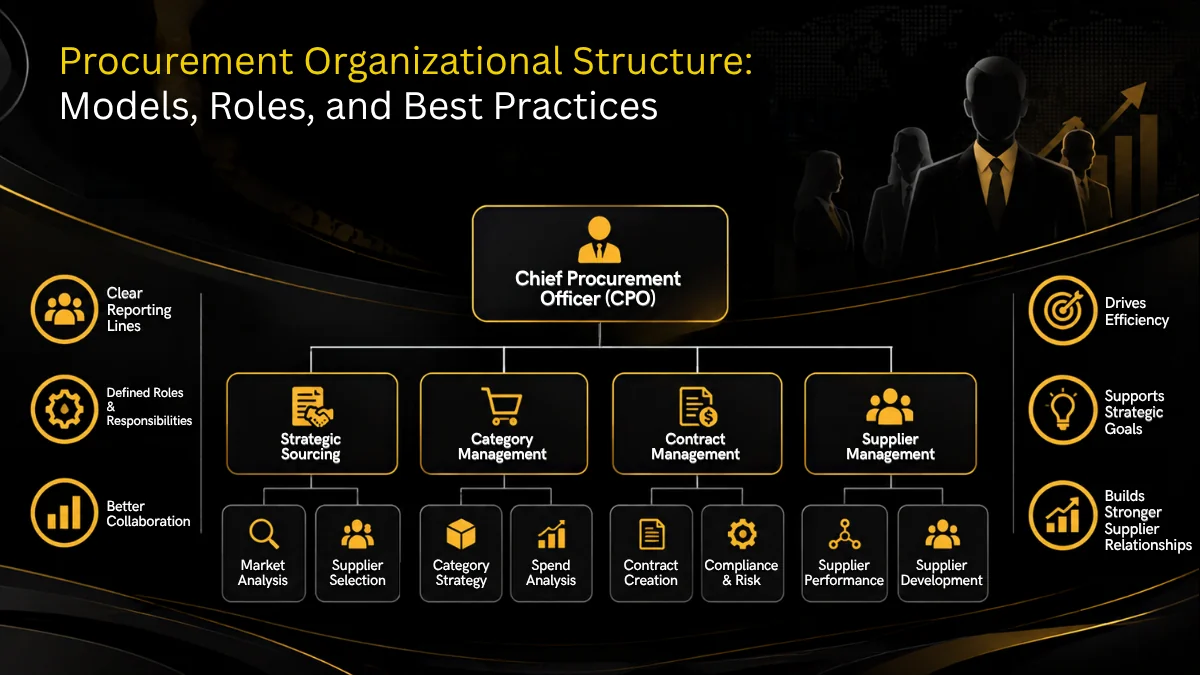
In a larger organization, those responsibilities may be spread across buyers, sourcing managers, category managers, procurement specialists and accounts payable teams.
The job title matters less than the work being done.
A 2026 discussion among procurement professionals on Reddit made the same point: companies use titles such as buyer, purchasing specialist and procurement specialist differently, so responsibilities are often a better guide than the title itself.
Procurement, Purchasing and Sourcing: How Are They Different?
These three terms are easy to mix up.
A useful way to separate them is:
Sourcing: Who could supply what we need?
Procurement: What is the best way to buy it and manage the supplier?
Purchasing: How do we execute the approved purchase?
Sourcing might involve sending an RFQ to several suppliers and comparing their responses.
Procurement can then negotiate the final terms, select the supplier and manage the contract.
Purchasing can use those agreed terms to place and track the order.
In practice, one team or even one person may handle all three. The important thing is understanding the different jobs within the process.

Procurement and purchasing are components of the same acquisition system but fulfill different roles. While purchasing focuses on transactions, procurement is rooted in strategic planning.
– Kafil Saleem, Chief Executive Officer, Zapro.
Why Does the Difference Matter?
The distinction matters because buying decisions have consequences after the purchase order is created.
Suppose a supplier offers a lower unit price but has long and unreliable lead times.
A purchasing team focused only on processing the order may not have enough context to challenge the choice. Procurement, however, can look at the supplier’s wider performance and ask whether the lower price is worth the delivery risk.
The same applies to contracts, quality, payment terms, supplier concentration and other risks.
This broader view has become more important in 2026. At ISM World 2026, procurement leaders discussed how geopolitical, technology, cybersecurity, and supplier risks are increasingly connected. One speaker described these risks as “starting to converge.”
That changes what procurement teams are expected to do. The job is no longer just about negotiating a lower price and sending the order.
An April 2026 ISM article on procurement metrics also noted that the function is being judged more broadly, including its effect on risk, resilience, and business value.
Where Procurement and Purchasing Meet
The two functions need to stay connected throughout the buying process.
A simple procure-to-pay flow might look like:
Need → Requisition → Approval → Supplier selection → Purchase order → Receipt → Invoice → Payment
Procurement may have more involvement in supplier selection, contracts and commercial decisions. Purchasing may take the lead on the order and fulfillment side.
But information needs to move between each stage.
If procurement negotiates a price and purchasing creates a PO using an old price, the negotiation has little value.
If purchasing sees that a supplier is repeatedly delivering late but that information never reaches procurement, the company may continue using a poor-performing supplier.
If finance only sees the cost after the invoice arrives, it has missed the opportunity to influence the purchase earlier.
This is why a connected procurement process matters more than simply deciding whether a task belongs to procurement or purchasing.
What Happens When the Process Is Disconnected?
This is where the distinction becomes a business problem.
A typical disconnected process might involve:
An employee sends a request by email. Procurement checks a spreadsheet for suppliers. An approval happens in another system. Purchasing creates the PO in an ERP. The warehouse records the delivery somewhere else. Finance receives the invoice separately.
Every individual step may work. The overall process still becomes difficult to track.
Teams end up chasing approvals, checking old spreadsheets, confirming prices and asking suppliers for information they have already provided.
That is not just an inconvenience. It makes it harder to know what the company has committed to spend and whether purchases are following agreed supplier terms.
A September 2026 study of 257 finance leaders found that even when finance teams felt confident about their visibility into committed spend, many still experienced situations where they saw the commitment too late to influence it.
The lesson is fairly practical: procurement, purchasing and finance need access to the same purchasing information early enough to act on it.
How Technology Connects Procurement and Purchasing
Technology can help by keeping the workflow together.
Instead of moving a request from email to spreadsheet to ERP to finance, a procurement platform can connect:
Request → Approval → Supplier → Purchase Order → Receipt → Invoice
That gives procurement a better view of what is being bought and from whom. It also gives purchasing a clearer process for executing approved orders.
The technology itself is not the main point. The process behind it matters just as much.
Deloitte made this point in its 2026 research on procurement modernization: simply putting an existing, complicated process into a new digital system does not automatically make it better. Organizations also need to simplify processes, clarify decision rights and remove unnecessary steps.
That is particularly relevant when deciding what to automate.
A company does not need AI to tell it that an approval email exists. It needs a workflow that sends the request to the right person, records the decision and moves the approved purchase forward.
Where Does AI Fit Into Procurement?
AI is increasingly being used to reduce the manual work around procurement.
That can include reading invoices, extracting information, classifying spend, comparing supplier information and helping teams work through large amounts of procurement data.
But AI does not replace the need for a well-designed process.
Gartner’s May 2026 survey of 101 chief procurement officers found that only 36% were very confident in their ability to redesign procurement roles and processes around AI. Gartner’s point was that individual productivity gains do not automatically become gains for the wider procurement function.
So the useful question is not simply, “Where can we add AI?”
It is, “Which parts of the procurement and purchasing process are taking time without adding much value?”
That might be manual invoice entry, repeated follow-ups, checking whether a request has been approved, matching invoices to POs or pulling together spend information for a review.
How Zapro AI Connects Procurement and Purchasing
Zapro AI brings procurement and purchasing activities into connected workflows, from purchase requests and approvals to purchase orders, vendor management and invoice matching.
A purchase can begin with a structured request, move through the required approval flow and become a purchase order without losing the information collected at the earlier stages.
That gives purchasing teams a clearer process to follow while giving procurement teams more visibility into what is actually being bought.
Zapro AI also supports tasks such as invoice reading, matching and spend analysis, helping reduce some of the manual work that sits between procurement, purchasing and finance.
For businesses looking to improve the full workflow rather than automate one isolated task, this creates a more useful connection between procurement software and the purchasing work that happens after a buying decision has been made.
Power Smarter Spend Decisions with Zapro

Frequently Asked Questions
What is the difference between procurement and purchasing?
Procurement is the broader process of deciding what a business needs, finding suppliers, negotiating terms and managing supplier relationships. Purchasing focuses more on carrying out the approved purchase through POs, delivery and related transactions.
Is procurement the same as purchasing?
No. Purchasing is generally part of procurement. However, companies may divide the responsibilities differently depending on their size and structure.
What is the difference between purchasing and procurement?
Purchasing is mainly concerned with executing purchases. Procurement covers the wider process, including sourcing, supplier selection, negotiation, contracts and supplier management.
What is the difference between buying and procurement?
Buying means acquiring something. Procurement covers the wider process behind that purchase, including deciding what to buy, selecting suppliers and managing the commercial relationship.
Is purchasing part of procurement?
Usually, yes. Purchasing is commonly treated as one part of the wider procurement process.
What is the difference between procurement and sourcing?
Sourcing focuses mainly on finding and evaluating suppliers. Procurement is broader and can include sourcing, contracts, purchasing, supplier management and spend management.
Can one person handle procurement and purchasing?
Yes. This is common in smaller businesses. One person may source suppliers, negotiate prices, place orders and manage supplier relationships.
How can procurement software help purchasing?
Procurement software can connect purchase requests, approvals, suppliers, POs, receiving, invoices and spend data. This reduces manual handoffs and gives teams better visibility into the full purchasing process.
Don’t miss our weekly updates
We’ll email you 1-3 times per week—and never share your information.
Let’s Transform Your Procurement Together.
Speak with our experts to unlock smarter, faster procurement with Zapro.
About the Author

Md. Kafil


About the Reviewer

Zapro is dedicated to helping businesses of all sizes make informed decisions. We adhere to strict editorial guidelines to ensure that our content meets and maintains our high standards.
Our editorial standards help keep every article accurate, useful, and trustworthy.
Related Blogs