

Purchase requisition vs purchase order comes down to who the document is for. A purchase requisition is an internal request to buy something, sent to approvers before committing any money. A purchase order is the external document sent to a vendor after approval, and it becomes a binding contract once the vendor accepts it.
Because both documents are part of the same procurement cycle, people often use the terms interchangeably. There are actual consequences to confusing them: these include budget overruns, unauthorized spending, delayed approvals, and disagreements with vendors.
Key Takeaways
- A purchase requisition is an internal request to buy something, while a purchase order is the external document that places the order with a vendor.
- The requisition comes first and creates no commitment, and the purchase order follows approval and, once the vendor accepts it, becomes a binding contract.
- Both documents share much of the same data, so a good system carries the requisition’s fields into the purchase order instead of requiring retyping.
- Skipping the requisition removes the main spending control, and skipping the purchase order leaves no record of what the vendor agreed to.
- Low-value buys can follow a lighter path, such as a purchasing card, but the policy should say so in writing.
What Is a Purchase Requisition?
A purchase requisition is a request to buy something. It is an internal document an employee or department raises when they need goods or services; its job is to ask permission to spend, not to place the order. You may also see it called a purchase request or a purchase order request. In practice, it serves as a request for purchase order approval: approvers check that the request fits the budget, aligns with business goals, and follows procurement policy. Procurement should issue a purchase order only after approval.
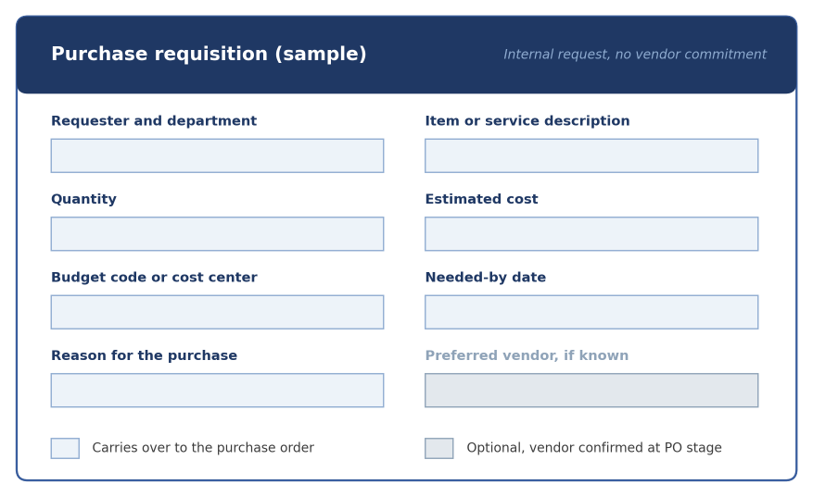
A sample purchase request and the fields it should capture
A purchase request sample needs only eight fields. Seven carry straight over to the purchase order, which is why retyping them is the clearest sign a process needs fixing. The vendor stays optional because procurement often chooses it after approval.
Why Purchase Requisitions Count
Requisitions bring order to the buying process by preventing expenses without prior approval and ensuring every purchase is reviewed before a decision is made. Without these requisitions, requests end up as emails and chat messages, approvals are likely to be overlooked, and no one knows who made each purchase or why. This leads to budget leakage. According to APQC’s Open Standards Benchmarking database, the median proportion of purchases made through maverick buying—that is, employees disregarding an existing contract—is 1.2% across the whole company. Monitoring your own figure will indicate whether informal buying is increasing.

Forrester expects global spending on order management system (OMS) software to reach $1.9 billion by 2026, up from $1.0 billion in 2021.
What Is a Purchase Order?
A purchase order is an external document the buyer issues to accept a proposal to buy certain goods or services at agreed-upon prices and delivery conditions. It usually includes the purchase order number, the names of the parties involved, descriptions of the items and quantities, prices, delivery dates, payment terms, and relevant taxes. Once the requisition is approved, the purchase order places the order with the vendor. Many teams switch to purchase order management software when the number of transactions becomes so high that physical tracking is likely to cause errors.
The status of binding warrants attention. In the United States, a purchase order for goods is normally considered an offer, and under UCC § 2-206, the vendor can accept it by either promising to ship promptly or by actually shipping the goods, making the purchase order binding even without a signed confirmation. This is general information and not legal advice. After acceptance, the vendor is required to provide the items as described in the purchase order, and the buyer has to pay according to the agreed terms. Also, the purchase order facilitates three-way matching, which involves comparing the purchase order, the goods receipt, and the invoice before making payment, a process that is discussed in detail in our guide on purchase order versus invoice.
How to Write a Purchase Requisition
To write a clear requisition, include five key elements: the item required, the quantity needed, the reason for the request, the deadline, and the name of the person who will pay. When explaining the need, use simple language. If you haven’t already selected a supplier, then describe what you require rather than just naming a brand or product.
This enables the procurement department to evaluate different options. If you have a quote, include it; fill in the correct budget code, and provide sufficient detail so that the person approving the request does not have to ask further questions. Vague requests slow things down and create back-and-forth communication that can easily turn a simple process into a lengthy one.
A Simple Handoff From Requisition to Purchase Order
Imagine a marketing team that has to obtain a subscription to design software. The person making the request submits a requisition stating the need, the budget code, and the needed-by date. The department head agrees the need exists, finance verifies that money is available, and then approves the request. The procurement department then selects the vendor, agrees on the price and the terms, and puts out a purchase order that includes all the details from the requisition. The vendor accepts this by confirming the order, thus creating the contract. When the invoice comes through, it is checked against both the purchase order and the receipt before any payment is made.
Who Approves a Purchase Requisition
Most policies involve three stages: the requester’s manager verifies the need, the budget owner or finance department confirms funds are available and coding is correct, and procurement ensures the request complies with policy and selects the vendor. The thresholds determine how far a request goes, meaning a small request is approved quickly, while a large one goes to more senior approvers. Relying solely on the amount is a poor criterion, since a low-value request that gives a vendor access to company data poses a greater risk than a bigger purchase of office supplies; therefore, better policies also take into account the category, data access, and the vendor’s status.
Simplify requests, speed up approvals, and gain full control of procurement.

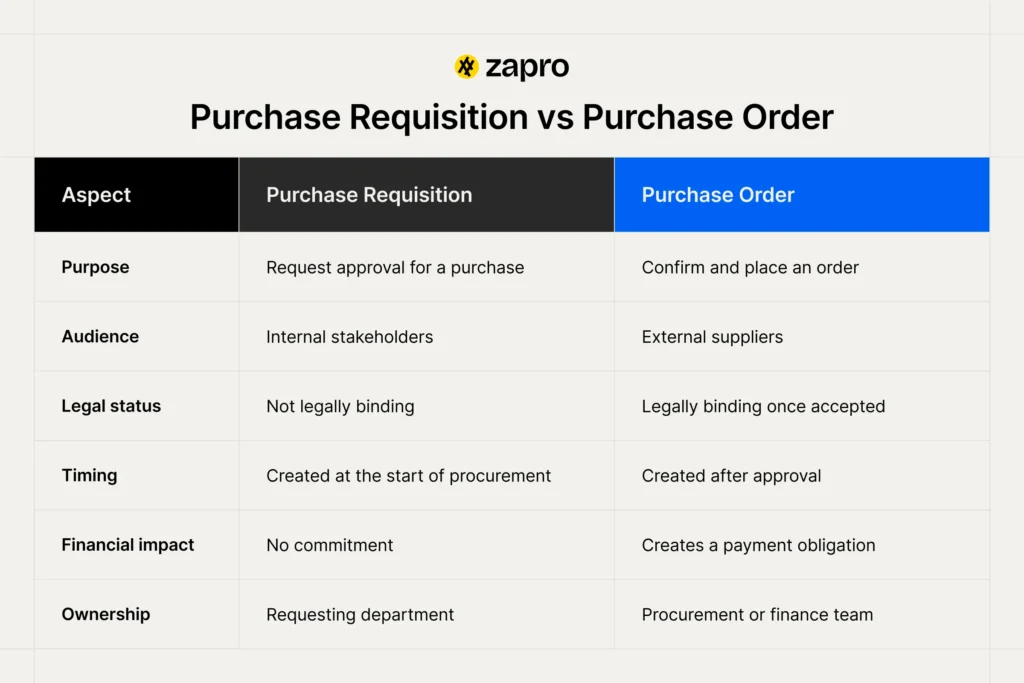
Purchase Requisition vs Purchase Order: Key Differences
A purchase requisition is an internal request to spend company money—it’s how someone requests approval and makes sure there’s enough budget. A purchase order, on the other hand, goes to the vendor and becomes a contract once accepted. Keeping these two documents separate and clear cuts down on confusion and prevents mistakes in the buying process.
| Factor | Purchase Requisition | Purchase Order |
|---|---|---|
| Purpose | Request approval to spend | Place an order with a vendor |
| Who creates it | The employee or department with the need | Procurement or purchasing, after approval |
| Who receives it | Internal approvers | The vendor |
| Legal status | None, an internal request | Becomes a binding contract once the vendor accepts |
| Timing | First step in the buying cycle | Issued after the requisition is approved |
| Budget effect | Reserves budget | Commits budget |
| Main control | Budget and policy compliance | Price, terms, and delivery |
Where commitment begins in the requisition-to-order flow
How Purchase Requisitions and Purchase Orders Work Together
The two documents are successive stages of one process, not alternatives. The standard PR-to-PO process runs in four moves.
- Request and approve: A team member explains what is needed and completes a requisition form. The managers then check it to ensure that all the details are correct and comply with company policy before giving their approval.
- Source and issue: The procurement department considers suppliers, selects the one that best suits the needs, and issues a purchase order based on the approved request.
- Receive and match: When the order arrives, the team verifies that the delivery corresponds with both the purchase order and the details on the invoice, and they only go ahead with approving the payment if all the items match.
- Pay and record: The company pays the bill and maintains a complete, easy-to-follow record from the first request to the final payment.
When the stages are not connected, approved requests never become orders, orders go out without approval, and finance loses sight of committed spend.
What Goes Wrong at Each Document
Every document has its own method of failing. A requisition fails if approval is delayed, creating a backlog and pushing staff to make informal purchases, which leads to maverick spending. A purchase order fails if it is issued out of sequence. For example, after the goods have already been ordered or when the budget has too little left. Because the requisition sets aside the budget and the purchase order commits it, the two can fall out of sync, leaving finance with an incorrect understanding of what has already been allocated.
If you omit the requisition, you remove the primary spending control; if you skip the purchase order, you lose a record of what the vendor agreed to. Some organizations allow exceptions for low-value purchases. For example,, when using a purchasing card or a punch-out catalog which automatically generates the PO, this is acceptable provided that the policy specifies the thresholds and the exceptions.
Benefits of Using Purchase Requisitions and Purchase Orders
- Better financial control: Requisitions make sure that spending remains within the budget, and purchase orders ensure that payments stay within the agreed terms.
- Audit readiness: Auditors have a clear route from request to payment.
- Clear accountability: Each of the requesters, the approvers, the procurement department, and finance has a clearly defined role.
- Stronger vendor relationships: Clear purchase orders improve confirmation, delivery accuracy, and trust.
- Operational productivity: Standard processes cut to-and-fro and manual corrections.
Automating Purchase Requisitions and Purchase Orders
Manual procurement methods cannot scale. Using email for approvals, spreadsheets, and separate systems leads to errors and delays. Automating the requisition-to-order process adds structure without increasing complexity: requests are submitted digitally, approvals follow predefined workflows, and purchase orders are generated from approved requisitions. It then enables procurement and finance to take action based on real-time visibility of commitments before a problem turns into an overrun.
You can tell whether the handoff is working by monitoring two factors: the time it takes between the approval of a requisition and the issuance of a purchase order, and the percentage of purchase orders that are created without a requisition having first been approved. If that second percentage increases, it shows orders are being placed before approval. This clearly indicates the process is being bypassed.
Zapro AI is one example of a procurement platform that manages this flow end to end, keeping approvals and budget checks in a single workflow. Both documents are part of the core suite on every Zapro AI pricing plan.

Stop Chasing Approvals. Start Automating Success.
Automate procurement from requisition to payment with Zapro’s AI platform. Cut processing time by 90%, eliminate errors, and replace 15+ tools with one intelligent solution.
Frequently Asked Questions
Which Comes First, PO or PR?
The purchase requisition comes first. You create it to request approval for a purchase, and once approved, it converts into a purchase order.
How Is a PR Converted to a PO?
After approval, the procurement team reviews the requisition and creates a purchase order using the approved details. In automated systems, the platform converts it directly.
Is a Purchase Requisition the Same as a Purchase Order?
No. A purchase requisition is an internal request for approval. A purchase order is an external document sent to a vendor to place an order, and it becomes binding once the vendor accepts it.
Is a Purchase Order Legally Binding?
A purchase order is usually an offer that turns into a binding contract when the vendor agrees to it. For example,, by confirming the order or sending the goods. However, terms vary by jurisdiction, so consult legal counsel regarding your contract terms.
Can You Skip the Requisition and Go Straight to a PO?
For small or pre-approved purchases, many companies let you skip the usual process—often with a company card or online catalog. For everything else, you need a requisition to keep spending in check. The policy should make it clear when you can use the shortcut.
What Is a Purchase Order Request?
It is another name for a purchase requisition: an internal request, sent to approvers or the purchasing department, to obtain goods or services. It is not the purchase order itself.
Stop Unapproved Orders
A requisition explains what you need and why, making the case for a purchase. The purchase order then locks in the details with the vendor—what you’re buying, for how much, and under what terms. Each document should have a clear owner and its own checks, with a smooth handoff so nothing slips through the cracks.
With Zapro AI, once a request is approved, it flows straight into a purchase order. All approvals and budget checks happen in one place, so orders go out only after everyone who needs to sign off has done so.
Sources / References
- APQC, “Percentage of Total Purchases Procured via Maverick Buying”: https://www.apqc.org/resources/benchmarking/open-standards-benchmarking/measures/percentage-total-purchases-procured
- Legal Information Institute, “UCC § 2-206. Offer and Acceptance in Formation of Contract”: https://www.law.cornell.edu/ucc/2/2-206
- Zapro AI, “What Is Procurement?”: https://zapro.ai/procurement/what-is-procurement/
- Zapro AI, “PO Management Software”: https://zapro.ai/purchase-order-po-management-software/
- Zapro AI, “Purchase Order vs Invoice”: https://zapro.ai/procurement/purchase-order-vs-invoice/
- Zapro AI, “Purchase Order Process”: https://zapro.ai/procurement/purchase-order-process/
- Zapro AI, “Automating the Requisition-to-Order Process”: https://zapro.ai/procurement/automating-requisition-to-order-process/
- Zapro AI, “Purchase Requisition Software”: https://zapro.ai/procurement/purchase-requisition-software/
Don’t miss our weekly updates
We’ll email you 1-3 times per week—and never share your information.
Let’s Simplify Your Requisition Management
We’ll unify your requisition data and help your team move faster and smarter.

About the Author

Md. Kafil


About the Reviewer

Zapro is dedicated to helping businesses of all sizes make informed decisions. We adhere to strict editorial guidelines to ensure that our content meets and maintains our high standards.
Our editorial standards help keep every article accurate, useful, and trustworthy.