

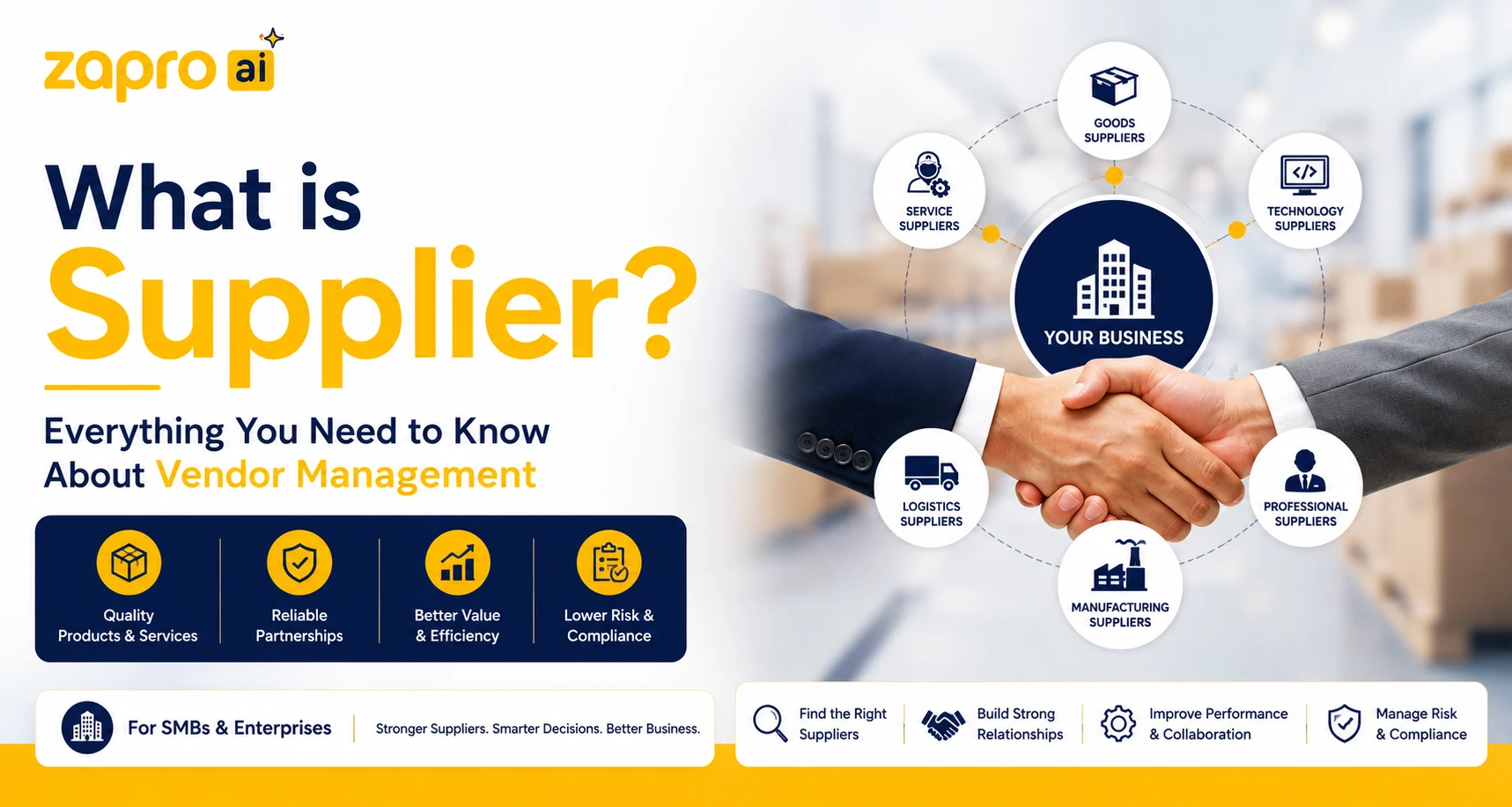
The short answer: A supplier is a business or individual that provides the raw materials, components, or services another company depends on to produce what it sells. Suppliers sit upstream in the supply chain, before or alongside production, and the relationship is normally ongoing and contracted rather than a one-off transaction. If a supplier stops delivering, something the buyer’s own customer would notice usually breaks: a production line stalls, a menu item runs out, a project stops.
Key takeaways
- A supplier provides the inputs behind what a business makes. A vendor sells a finished good or service the buyer uses as delivered. See the full vendor vs supplier comparison.
- Suppliers are usually tiered. Tier 1 sells directly to the buyer, Tier 2 supplies Tier 1, and so on, because most manufactured goods pass through several supplier layers before reaching a factory floor.
- In the U.S., importers are legally responsible for verifying their suppliers are not using forced labor and, for food, that foreign suppliers meet FDA safety standards. That responsibility sits with the buyer, not just the supplier.
- Supplier diversity, meaning sourcing a share of spend from certified minority-, women-, and veteran-owned suppliers, is a formal requirement for many large U.S. corporations and virtually all federal contractors, not just a goodwill initiative.
- Most accounting and ERP systems still file suppliers under the same generic “vendor” record as everyone else a company pays. That’s a bookkeeping convention, not a statement about how the relationship should be managed.
What Is a Supplier?
A supplier is any individual, business, or organization that provides the materials, components, or services another company needs to produce what it ultimately sells. That could be steel sold to an automotive plant, flour sold to a bakery, cloud infrastructure sold to a software company, or temporary labor supplied to a warehouse. What all of these have in common is dependency: the buyer’s own output relies on the supplier’s input arriving on time, at the agreed specification, and at a workable cost.
The word traces to the Latin supplere, “to fill up” or “to complete,” the same root behind “supply” and “supplement.” That origin is a fairly literal description of the role: a supplier fills a gap in what a business can produce or provide on its own.
Three things are almost always true of a supplier relationship, in contrast to a simple vendor purchase:
- It is ongoing and contracted. Supply agreements typically cover a period of time, a minimum volume, or a call-off schedule, not a single transaction.
- The output is an input. What the supplier delivers gets processed, assembled, or consumed further before reaching the buyer’s own customer.
- Replacement is slower. Qualifying a new supplier, meaning checking quality, capacity, compliance, and price, routinely takes longer than switching a vendor, sometimes months for regulated industries.
Like “vendor,” the term “supplier” gets used loosely in everyday conversation. Most people say “supplier” and “vendor” interchangeably and are understood fine. The distinction matters most in contracting, risk management, and how a business decides who gets close oversight and who doesn’t. The complete classification test is in vendor vs supplier: what’s the difference and how to classify yours.
What Does a Supplier Do?
- Provides an input to production, such as a raw material, a component, a bulk commodity, or a service that another business’s own product or process depends on.
- Delivers against a supply agreement, often with scheduled or call-off shipments rather than a single order.
- Meets a specification, such as a material grade, a tolerance, or a certification, that the buyer’s own product quality depends on.
- Carries shared risk. A supplier’s quality failure, delay, or compliance lapse becomes the buyer’s problem too, which is why supplier oversight tends to be heavier than vendor oversight.
Types of Suppliers
Raw material suppliers
Provide unprocessed or minimally processed inputs, such as timber, cotton, crude metals, and agricultural commodities, that a buyer’s own manufacturing process transforms further.
Component and parts suppliers
Supply manufactured parts, such as semiconductors, fasteners, and sub-assemblies, that get built into a larger finished product rather than sold as-is.
Manufacturer-suppliers
A manufacturer acts as a supplier when it sells its output in bulk to another business that will process, assemble, or resell it. The same manufacturer becomes a vendor the moment it sells the finished item directly to whoever will use it.
Distributor-suppliers
Distributors act as suppliers when a buyer depends on them as the ongoing, contracted source for a material or component, rather than making a one-off purchase.
Service suppliers
Contract manufacturers, co-packers, and outsourced labor providers supply a service that is functionally an input to production, even though nothing physical changes hands directly from supplier to end customer.
Drop-ship suppliers
Common in e-commerce: the supplier manufactures and warehouses the product, then ships it directly to the end customer on the retailer’s behalf. The retailer never holds inventory, but still depends entirely on the supplier’s fulfillment.
How a Supplier Relationship Works
Because the relationship is ongoing rather than transactional, sourcing a supplier takes longer and involves more steps than sourcing a vendor:
| Step | What happens |
|---|---|
| 1. Sourcing / RFQ | The buyer defines the specification and sends a request for quote (RFQ) to candidate suppliers. |
| 2. Qualification | The buyer verifies quality certifications, capacity, financial stability, and compliance before approving the supplier. |
| 3. Contract negotiation | Price, volume commitments, lead times, quality terms, and remedies for nonconformance are set in a supply agreement. |
| 4. Ongoing supply | The supplier delivers against a schedule or call-off orders under the umbrella agreement, often for years at a time. |
| 5. Performance monitoring | Delivery, quality, and responsiveness are tracked on a recurring scorecard, since a single missed shipment can stop production. |
| 6. Requalification or exit | Suppliers are periodically reassessed, and contracts include exit or transition terms in case the relationship ends. |
The sourcing and qualification steps in that table, from the initial RFQ through recurring scorecards, are increasingly run through AI procurement software rather than tracked by hand, so a supplier’s qualification history and performance record stay in one place instead of scattered spreadsheets.
In manufacturing, this structure is usually described in tiers: a Tier 1 supplier sells directly to the buyer, a Tier 2 supplier sells to that Tier 1 supplier, and so on back through the chain. A business can have full visibility into its Tier 1 suppliers and almost none into Tier 3. Closing that gap is exactly what recent U.S. import-compliance rules, covered below, now hold buyers accountable for doing.
Supplier Classification and U.S. Regulatory Considerations
Supplier relationships carry a heavier compliance load than vendor purchases, largely because the buyer’s own product quality, safety, and legal exposure depend on what the supplier does upstream.
Contracts for goods: UCC Article 2
Supply agreements for physical goods are governed by Article 2 of the Uniform Commercial Code (UCC), adopted in some form across U.S. states. It sets default rules for delivery, acceptance and rejection of nonconforming goods, and implied warranties of merchantability, forming the baseline a buyer can rely on even when a supply contract doesn’t spell every scenario out. Full text: UCC Article 2 (Sales) via Cornell Law School’s Legal Information Institute.
Import compliance: forced-labor due diligence
Under the Uyghur Forced Labor Prevention Act (UFLPA), U.S. Customs and Border Protection presumes that goods made wholly or partly in China’s Xinjiang region involve forced labor, and it blocks their import unless the importer can prove otherwise with supply-chain evidence tracing well beyond the direct, Tier 1 supplier. Details: CBP: Uyghur Forced Labor Prevention Act. This is one of the clearest examples of why supplier due diligence now has to reach past the first tier.
Food and agricultural suppliers: FSVP
Businesses importing food into the U.S. must verify their foreign suppliers meet FDA safety standards under the Foreign Supplier Verification Programs rule. The importer, not the supplier, holds legal responsibility for that verification. Details: FDA: FSVP Final Rule.
Buy American and domestic-sourcing rules
Suppliers selling into federal supply chains, directly or as a sub-tier supplier to a prime contractor, are frequently subject to Buy American Act requirements around the percentage of domestic content in what they supply. See Acquisition.gov: Buy American Act.
Supplier diversity certification
Many large U.S. corporations run formal supplier diversity programs, sourcing a set share of spend from certified minority-, women-, and veteran-owned suppliers. Certification typically runs through the National Minority Supplier Development Council (NMSDC) for private-sector buyers, or through SBA programs, including 8(a), HUBZone, and Women-Owned Small Business, for suppliers targeting federal spend: SBA federal contracting assistance programs. For a certified supplier, that credential is often a prerequisite to even being invited to bid, not a tiebreaker.
Examples of Suppliers by Industry
| Industry | Example supplier | What they provide |
|---|---|---|
| Manufacturing | A steel mill supplying an automotive plant | Raw sheet metal under a multi-year volume contract |
| Food & beverage | A commercial flour mill | Bulk flour supplied to a bakery under scheduled delivery |
| Apparel & retail | An overseas garment factory | Finished garments manufactured to a retailer’s private-label specification |
| Construction | A concrete or lumber supplier | Bulk materials delivered on a project schedule |
| Healthcare / pharma | An active pharmaceutical ingredient (API) manufacturer | Regulated raw ingredient supplied to a drug manufacturer under strict quality specification |
| Technology hardware | A semiconductor foundry | Chips supplied to an electronics manufacturer under long lead-time contracts |
Supplier vs. Vendor, Distributor, and Manufacturer
The short version: a supplier provides the inputs a business needs to produce what it sells, under an ongoing contracted relationship. A vendor sells you a finished good or service you use as delivered, usually transactionally. A distributor buys in volume from manufacturers and moves goods onward, sitting between a manufacturer and the businesses that buy from it. A manufacturer makes the product, and is a supplier or a vendor depending on who it’s selling to and in what form.
These roles overlap constantly. The same company can be a supplier to one buyer and a vendor to another. The full three-question test for telling them apart is in vendor vs supplier: what’s the difference and how to classify yours.
How Supplier Management Works
Supplier management covers qualification, contracting, ongoing performance tracking, and risk monitoring for the suppliers a business depends on, distinct from a one-time purchase. Because a supplier failure has a much higher chance of reaching the buyer’s own customer, supplier management typically runs on a longer cycle and deeper documentation than vendor management does: formal business reviews, multi-year scorecards, and named backup or dual-source suppliers for anything business-critical. The full lifecycle is covered in supplier lifecycle management: the complete guide and supplier relationship management software.
Supplier Risk and Why It Matters
Supplier risk tends to be lower in frequency but higher in severity than vendor risk. A single-source supplier going out of business, a natural disaster closing a factory, or an import compliance failure can halt production entirely, not just cause an inconvenience. Businesses manage this through supplier segmentation, giving the most attention to the suppliers whose failure would hurt most, dual-sourcing critical materials, and ongoing supplier performance management rather than a one-time qualification check. At enterprise scale that segmentation is only workable inside Vendor Management software for Enterprise, where qualification records, risk flags and performance history are held against every supplier rather than spread across category spreadsheets.
Supplier Glossary
- RFQ (Request for Quote): a buyer’s formal request for pricing and terms from candidate suppliers before awarding a contract.
- Supplier qualification: the process of verifying a candidate supplier’s quality, capacity, financial stability, and compliance before approval.
- Tier 1 / Tier 2 / Tier 3 supplier: a supplier’s position in the chain. Tier 1 sells directly to the buyer, Tier 2 supplies Tier 1, and so on.
- Supplier scorecard: a recurring, weighted rating of a supplier’s delivery, quality, cost, and responsiveness.
- Single sourcing: relying on one supplier for a critical material or component, which maximizes leverage but concentrates risk.
- Dual or multi-sourcing: qualifying more than one supplier for the same material to reduce dependency on any single source.
- Supplier diversity: sourcing a defined share of spend from certified minority-, women-, or veteran-owned suppliers.
- MBE / WBE: Minority Business Enterprise / Women Business Enterprise, common supplier diversity certifications in the U.S.
- Country of origin: the country where a supplied good was manufactured or substantially transformed, which drives tariffs, labeling, and import compliance.
- Force majeure clause: a supply-contract clause excusing performance when an extraordinary event outside either party’s control disrupts delivery.
- Supplier code of conduct: a buyer’s documented labor, safety, and ethics standards that suppliers must contractually agree to meet.
- Lead time: the time between placing an order with a supplier and receiving the goods.
- Minimum order quantity (MOQ): the smallest volume a supplier will accept per order, common with overseas manufacturing suppliers.
Frequently Asked Questions
Is a supplier the same thing as a vendor?
Not exactly, though the words are used interchangeably in everyday conversation. A supplier provides the inputs a business needs to produce what it sells, usually under an ongoing contract. A vendor sells a finished good or service the buyer uses as delivered, usually transactionally. See the full vendor vs supplier comparison.
What is a Tier 1 supplier?
A Tier 1 supplier sells directly to the buyer. A Tier 2 supplier sells to that Tier 1 supplier, and so on back through the chain. Most companies have strong visibility into Tier 1 and rapidly declining visibility further upstream, which is why regulations like the UFLPA now push companies to trace further back than Tier 1.
What is a certified diverse supplier?
A supplier formally certified as minority-, women-, or veteran-owned, typically through the National Minority Supplier Development Council for private buyers or SBA programs for federal contracting. Many large corporations and government agencies require or strongly prefer certified suppliers for a portion of their spend.
Do suppliers need to comply with the Uyghur Forced Labor Prevention Act?
The legal obligation sits with the U.S. importer, not the supplier directly. In practice, though, the importer can only meet it by requiring supply-chain evidence and cooperation from suppliers at every tier. A supplier that can’t document its own inputs makes it very hard for its U.S. buyer to import the finished goods at all.
What is supplier qualification?
The process of verifying a candidate supplier’s quality systems, production capacity, financial stability, and regulatory compliance before approving them to supply. In regulated industries like pharma or aerospace, qualification can take months and includes on-site audits.
What’s the difference between a supplier and a manufacturer?
A manufacturer makes a product. It acts as a supplier when it sells that output in bulk to a business that will process, assemble, or resell it further, and as a vendor when it sells the finished item directly to the end user. A supplier isn’t always a manufacturer, either. Distributors and raw commodity traders act as suppliers too, without making anything.
What’s the difference between a supplier and a distributor?
A distributor buys in volume from manufacturers and moves goods onward, adding warehousing and logistics. A distributor acts as a supplier specifically when a buyer depends on it as an ongoing, contracted source, rather than making a one-off purchase from it.
Can a company be both a supplier and a vendor?
Yes, and it’s common. The same manufacturer can supply bulk components to one buyer under a supply contract, and sell a finished unit directly to a different buyer as a vendor. Classify the relationship, not the company.
What is single sourcing versus multi-sourcing?
Single sourcing means relying on one supplier for a critical material, which usually gets better pricing and simpler management but concentrates risk. Multi-sourcing means qualifying more than one supplier for the same material, trading some cost efficiency for resilience if one supplier fails.
What is a supplier scorecard?
A recurring, weighted rating of a supplier’s delivery performance, quality, cost, and responsiveness, used to decide which suppliers get more volume, which need a corrective action plan, and which should be phased out.
About the Author
Md. Kafil is the Founder and CEO of Zapro, an AI-powered procurement and spend management platform. He has over 16 years of leadership experience across product, customer success, marketing, and sales for global enterprises in North America, Europe, and APAC, with a focus on how businesses source, qualify, and manage the suppliers their operations depend on. Read more on the About Zapro page or connect on LinkedIn.
Sources and Further Reading
- Cornell Law School, Legal Information Institute: Uniform Commercial Code, Article 2 (Sales)
- U.S. Customs and Border Protection: Uyghur Forced Labor Prevention Act
- U.S. Food and Drug Administration: Foreign Supplier Verification Programs (FSVP) Final Rule
- Acquisition.gov: Buy American Act
- National Minority Supplier Development Council: NMSDC
- U.S. Small Business Administration: Federal Contracting Assistance Programs
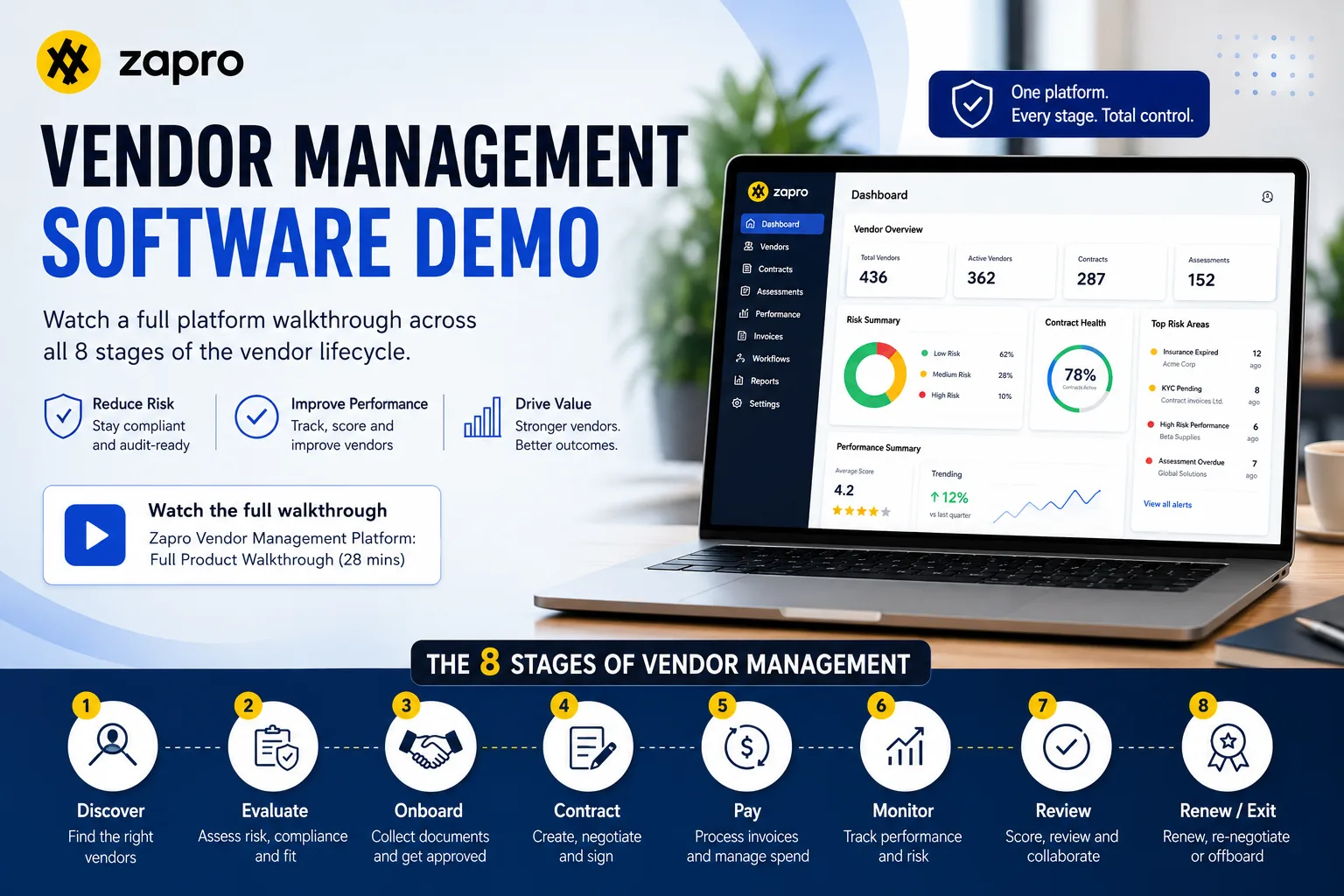
See how supplier records actually stay under control. Zapro handles supplier qualification, contract tracking, performance scorecards, and risk monitoring in one platform, so a supplier approved correctly on day one still has clean, current records years later. Book a 30-minute demo, or walk through the vendor management software demo first.
Don’t miss our weekly updates
We’ll email you 1-3 times per week—and never share your information.
About the Author

Md. Kafil


About the Reviewer

Zapro is dedicated to helping businesses of all sizes make informed decisions. We adhere to strict editorial guidelines to ensure that our content meets and maintains our high standards.
Our editorial standards help keep every article accurate, useful, and trustworthy.
Related Blogs