

Retail procurement refers to the processes through which a retailer identifies, purchases, and acquires goods and services from manufacturers or suppliers needed to sell or lease to customers and support business operations. Effective retail procurement practices help protect margins, ensure levels are stocked, and give the finance function accurate spend visibility. Perhaps the most effective way to control costs is by using an adequate strategy and digital technologies.
Key takeaways
- Retail procurement considers both goods and services, ensuring a continuous supply of goods for resale and those that support sales functions.
- A unified data view is required to avoid imbalances such as overstocking or shortages, making this stage a critical success factor.
- Distribution and retail buyers spend more time automating buying functions than service-industry counterparts do, while analytics takes priority.
- Best practice is to start by automating purchase order creation, which is repetitive and easy to measure.
What is Retail Procurement?
The retail procurement process includes all goods and services a company purchases and sells in its retail stores. This process is divided into two categories, each requiring different effort and strategies.
Direct and Indirect Spend
Direct spend refers to goods that a seller purchases and sells in its retail stores. In this case, buyers aim to find reliable suppliers who provide the best prices and adequate supply chains.
Direct spend refers to all expenses related to producing, distributing, and selling goods.
While indirect spend requires management, direct spend is highly volatile and should be monitored at scale. Many companies neglect indirect spend and control it only partially, increasing buyers’ exposure to unplanned costs and unauthorized expenses.
How does it differ from other industries?
Unlike many other fields, retail procurement involves a very fast-paced process. Many suppliers are involved, and interacting with them takes considerable effort and time. Trends are short-lived, and seasonal variations are difficult to predict. Therefore, a mid-size retailer interacts with hundreds of suppliers weekly and monitors ongoing changes in prices, delivery terms, and quality.
A common saying in retail is that buyers work at the intersection of tying up cash in inventory and losing revenue when out-of-stock items cannot be sold.

By 2029, 80% of human decisions will be augmented by generative AI, transforming procurement operations.
– Gartner
Challenges of Retail Procurement
Retail procurement must consider numerous factors, including demand forecasts, price fluctuations, and supplier performance, which create challenges in the process. Four main pressures influence retailers’ procurement.
1. Supplier sprawl: A growing number of suppliers makes it difficult to manage hundreds of suppliers.
2. Price changes: The volatility of prices is another major force in retail procurement. Raw material, freight, and foreign exchange price changes can squeeze profit margins because they are not always easy to predict.
3. Demand uncertainty: The uncertainty of demand forecasts challenges retailers to make accurate projections about their needs.
4. Manual workflows: The reliance on manual processes in recording purchase orders, approvals, and management of suppliers’ data is a significant hindrance in the process. The data are not integrated into enterprise systems that allow analysis and informed procurement decisions.
The Data silos problem
According to KPMG, many retailers have disjointed systems and processes where procurement data exists in silos within merchandising, distribution supply chains, and finance, which prevents retailers from having an end-to-end view of inventory and costs. Integrated systems enable organizations to make accurate inventory forecasts, helping prevent excess stock or shortages.
Sourcing, tariffs, fulfillment, labor, and inventory costs are important aspects of procurement that significantly impact a retailer’s margin. As such, weaknesses in the procurement process will negatively affect the retailer’s margins.
Supply Chain Exposure
Retail supply chains are more global and complex than ever, making it harder to manage and mitigate associated risks. In addition, overreliance on single-source suppliers, limited transparency, and government policies expose retailers to disruptions and limit their negotiating power.
Core Stages of the Retail Procurement Process
| Stage | What happens | Common failure point |
|---|---|---|
| Need identification | Buyers or store teams flag demand | Forecasts built on stale data |
| Sourcing | Team finds and compares suppliers | Reliance on a few familiar vendors |
| Negotiation | Price, terms, and lead times are set | Terms stored in scattered files |
| Purchase order | Approved order goes to the supplier | Manual entry and email approvals |
| Receiving | Goods arrive and are checked | Mismatches with the order |
| Invoice and payment | Invoice is matched and paid | Duplicate or incorrect payments |
Where Delays Accumulate?
The problem in the procurement process is not in the point-of-purchase decision-making. Usually, it results from handoffs and approvals, missing fields in vendor forms, or a mismatch between the invoice and the receipt. Optimizing handoffs will yield bigger improvements than speeding up the negotiation process.
1. Three-Way Matching
Three-way matching is a control mechanism that compares the purchase order, goods receipt, and invoice. It ensures that the seller’s invoice matches the purchase order and goods receipt and is applied before any payments are processed. The method prevents overcharging and quantity discrepancies, and companies that do not use it have to bear the costs of mistakes.
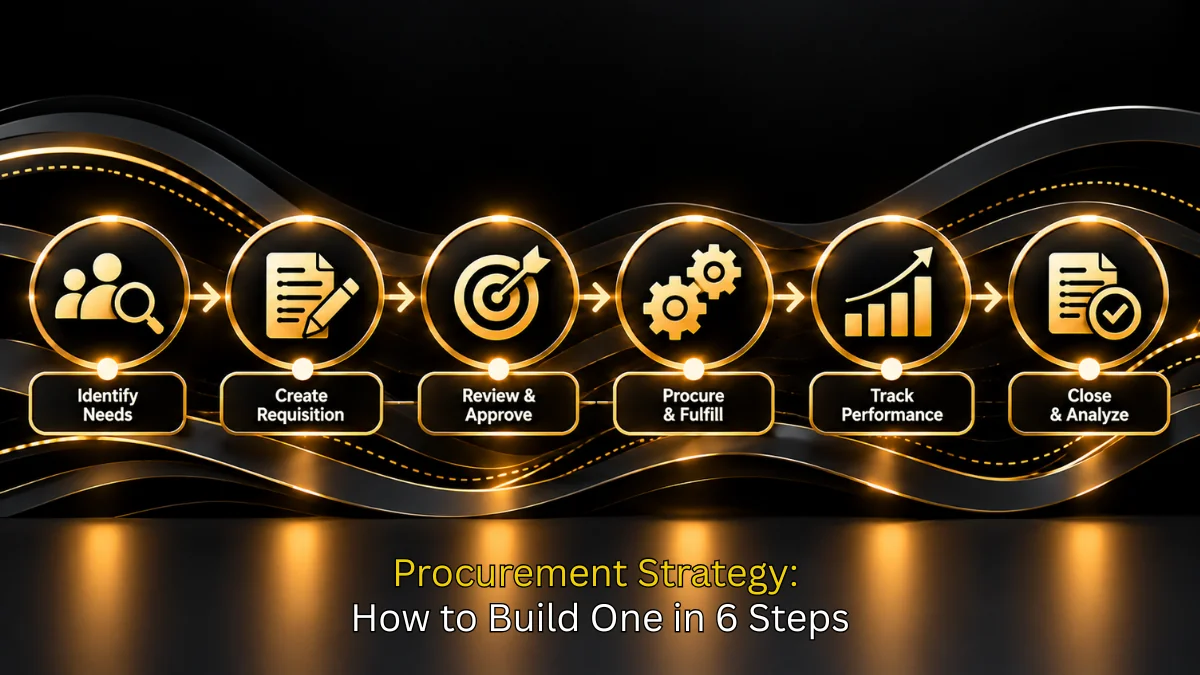
2. Building a Retail Procurement Strategy
Develop a retail procurement strategy as a document that connects spend-based categories to strategic purchasing objectives. It should include spend-related categories and requirements to specific areas, purchase conditions, performance evaluations, and key terms.
3. Segment Your Spend
The initial step in developing a procurement strategy should be depicted by dividing spend into particular segments and establishing their priorities. The largest categories should receive the most attention, and each segment should have a tailored approach. For example, private-label merchandising requires a close partnership, while packaging spend can be optimized through catalog buying.
4. Diversify Your Suppliers
The focus on one supplier in a category can lead to a decrease in price but will also eliminate the possibility of a substitution, which is a significant risk in the procurement process. Thus, the strategy should focus on the creation of a balanced supplier base, meaning that for every category, there should be one main supplier and at least one alternative one with negotiating capabilities. Identify those alternatives in advance and ensure they have enough expertise in the area; otherwise, onboarding will take too much time and effort in an emergency.
5. Link Purchasing Data to Inventory
Define the connection between purchasing and inventory at the data level, enabling the procurement team to make dynamic reorder-point decisions. It will help the company reduce excess stock and obsolescence, which directly impact the company’s profits, as well as minimize shortages, which harm customer satisfaction. The strategy should be based on sales data analysis, not seasonal adjustments.
6. Establish Governance
The procurement strategy should establish governance rules, including spend approval limits, the preferred vendor list, and the contract review and renewal process. This will minimize the risk of Maverick spending and ensure all purchasing activities are conducted within the defined parameters and terms. It should be enforced through automated approval workflows, not verbal reminders or email.
Transform Your Procurement Process with Ease

Retail Procurement Digital Transformation
Retail procurement digital transformation is a multi-year program that redesigns how retailers source, buy and pay for goods. It moves them from fragmented, store-by-store purchasing to a cloud procurement platform with centralised supplier data, demand-driven replenishment, automated PO-to-invoice matching and real-time margin and spend analytics.
Retail procurement digital transformation is a process that replaces fragmented, manual buying procedures with an integrated system that automates them through real-time data exchange.
The strategy is a strategic priority for many companies: according to PwC’s fifth Digital Procurement Survey, it is the second-most strategic priority for procurement departments, despite cost-saving pressures.
According to PwC’s research, procurement departments set the average percentage of digitalization target for 2027 at 70%.
For the distribution and retail sectors, the investments forecasted for 2027 are set to exceed the services sector’s expenditures on average, with analytics being the strategic focus. The same study revealed that the digitalization level reported by procurement respondents was consistent with that of 2022.
The latter finding may indicate that ambitious goals have so far remained unmet, as the practical experience of buying departments demonstrates that standalone software packages are not a silver bullet. Preparatory measures that focus on business processes and data cleansing should be given priority.
The market speaks for itself: a research company predicted that the retail sourcing and procurement market will be worth $6.34 billion in 2025 to $7.25 billion in 2026, growing at a compound annual rate of 14.4%. The report named AI-driven sourcing solutions, cloud-based procurement platforms, and analytics as the growth drivers.
Retail Procurement Digitization
Retail procurement digitization replaces paper, email and spreadsheet buying with connected digital workflows: e-requisitions, automated approvals, electronic purchase orders, supplier portals, digital contracts and automated invoice matching. Retailers can then see committed spend, store-level demand and supplier performance in one system.
Retail procurement digitization is a part of a broader transformation that replaces paper-based and email procedures with digital equivalents. The former are gradually phased out, often replaced with integrated systems.
Common examples include electronic purchase request forms, which replace multiple paper-based email approvals, standard electronic formats for contract storage, or invoice capture through scanning.
However, it is important to adopt a step-by-step approach. The procurement function is not the best candidate for end-to-end AI application, so a sensible approach is to start with less complex processes with readily achievable outcomes.
Purchase order generation, for example, can be automated, thus eliminating errors associated with manual data entry and accelerating processing times. Other areas that can be digitized include supplier onboarding, invoice-three-way matching, and spend analysis.
Retail Industry Procurement Solutions: What to Look For
Retail industry procurement solutions are software platforms that manage how retailers buy goods for resale and store operations: supplier onboarding, sourcing, purchase orders, contracts and invoice matching, integrated with inventory, POS and ERP data. The best options offer multi-store approvals, demand-linked replenishment, supplier scorecards and real-time margin and spend visibility.
The best retail industry procurement software solutions unify purchase requests, approvals, orders, suppliers, and invoices. Use these criteria to shortlist options.
1. Procurement Software Capabilities Criteria
Request intake and approvals: Purchases are initiated in one place and routed according to predefined rules.
2. Supplier management: Maintain compliance, onboard new suppliers, and track performance in one place.
3. Purchase orders and three-way matching: Create purchase orders from approved requests and match them against invoices.
4. Contracts: Review terms, dates, and pricing for active contracts.
5. Spend analytics: View spend data by category, supplier, and stores.
6. Integration: See if the software integrates with your ERP, financial systems, and inventory management.
Questions for Vendors
- What is the onboarding time for new suppliers?
- How many systems does it integrate with out-of-the-box?
- How does the pricing plan work for additional users?
Ask for a pilot on one category. This will help you see if the tool is adopted at the store level, which is critical for any procurement software.
Business Case
Compare the cost of inefficiencies such as late payments and duplicated disbursements to the software cost and savings. Stick to your numbers, not necessarily the vendor’s averages, since every company has a different mix of suppliers and stores.
Gain control with Zapro AI
We are a procurement software for retail organizations seeking to unify request to payment processing under one platform. We position Zapro AI as AI-powered procurement software that automates the purchasing process from request intake through invoice approval. We also handle purchase orders, supplier onboarding with risk assessment, and three-way invoice matching.
Use Cases
- Midsize retailer with a growing need for purchasing supplies and services (store maintenance, etc.) that wants to consolidate indirect spend.
- Finance team at a retail company that wants to implement three-way matching to prevent erroneous or duplicate payments.
- Procurement manager at a retail organization that needs to assess the risk profile and performance of a large and diverse supplier base.
Start with one category or type of spend, such as indirect, and measure the impact of the software on processing times and invoice accuracy.

Get Started with Procurement the Zapro Way
Simplify purchasing with Zapro — procurement made smarter and effortless.
FAQ
What is retail procurement?
Retail procurement is a set of managerial functions related to buying goods and services from external suppliers to support day-to-day operations and resell inventory.
How is procurement different in retail than in manufacturing?
Compared to manufacturing, retail procurement deals with finished goods, has a shorter supply chain, tends to have more diverse suppliers, and is more susceptible to demand fluctuations.
What are the first steps in digitizing retail procurement?
The first steps should be focused on relatively simple and standardized processes such as purchase order creation, approval, and invoice capture. Straightforward automated tasks have definable metrics and pose less of a risk than more complex procedures. The next processes to consider should be supplier management and analytics.
What are the key drivers of overstocked items and stockouts?
Disconnected retail procurement processes and deficient forecasting are the two critical drivers. According to KPMG, integrated systems offer a significant advantage in demand planning and forecasting. In other words, disconnected systems result in inaccurate forecasts, which cause overstocked items and stockouts.
Do small-scale retailers need a procurement strategy?
They do because even small-scale retailers are subject to price fluctuations, supplier risks, and inventory tie-ups. A procurement strategy does not have to be comprehensive. It could be as simple as having a written policy with approval limits, alternative suppliers, reorder points, etc.
Don’t miss our weekly updates
We’ll email you 1-3 times per week—and never share your information.
Let’s Streamline Your End-to-End Procurement
We’ll unify your P2P process and empower your team to work smarter.

About the Author

Md. Kafil


About the Reviewer

Zapro is dedicated to helping businesses of all sizes make informed decisions. We adhere to strict editorial guidelines to ensure that our content meets and maintains our high standards.
Our editorial standards help keep every article accurate, useful, and trustworthy.