

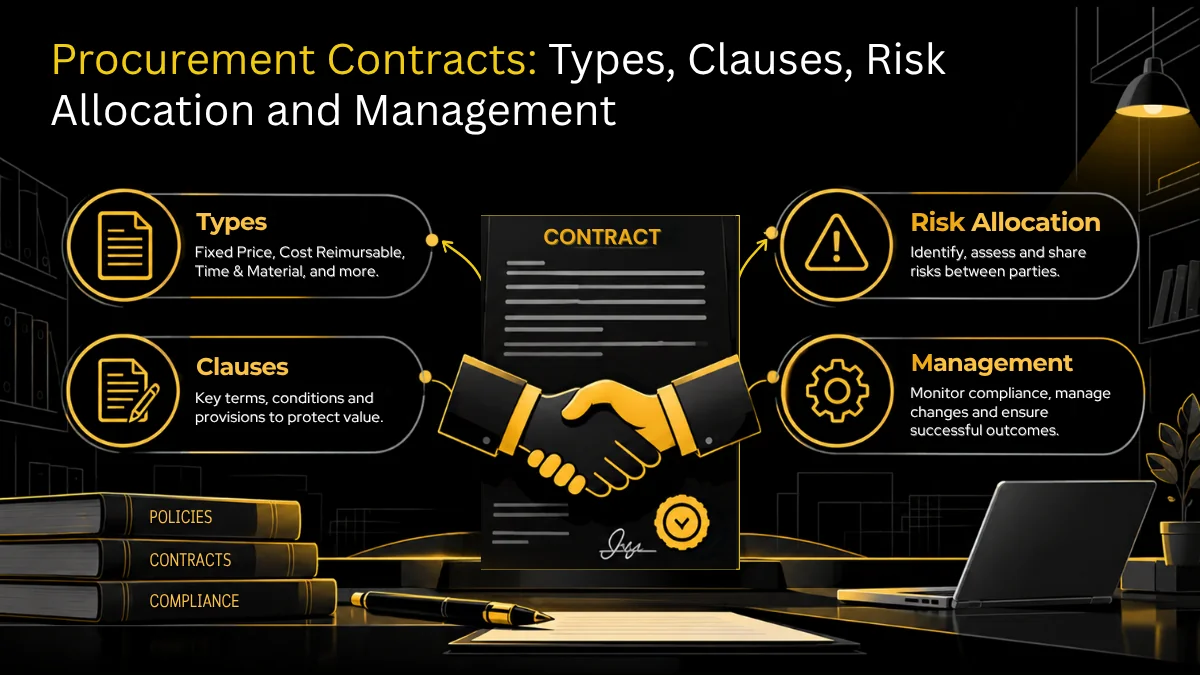
Most contract disputes begin before you sign an agreement. Choosing a fixed price for an unclear scope or an open-ended reimbursement model for predictable work can lead to higher costs, delays, and supplier disputes.
The right procurement contracts help you set clearer expectations, allocate risk fairly, and maintain better control over costs and supplier performance.
Here we will look into procurement contracts in detail: the types, the clauses that matter most, and how to choose the right structure for different purchasing situations. You will also learn practical contract management strategies to track obligations, manage changes, monitor suppliers and get more value from your agreements throughout their lifecycle.
Key Takeaways
- Selecting the right procurement contract type requires considering scope clarity, cost predictability, project complexity, and each party’s ability to manage risk.
- Fixed-price contracts provide greater cost predictability but require a clearly defined scope.
- Cost-reimbursable contracts provide flexibility when costs are uncertain but require stronger financial oversight.
- Time and materials contracts support evolving requirements but need rate controls, spending limits and regular monitoring.
- Framework agreements, master service agreements and purchase orders can support recurring or transactional purchasing depending on the procurement requirement.
- Important clauses should address scope, pricing, delivery, performance, payment, warranties, liability, confidentiality, changes, termination and dispute resolution.
- Risk should generally be allocated to the party best positioned to manage or control it rather than transferred automatically to the supplier.
- Contract management continues after signature. Performance, spend, renewals, compliance and changes need ongoing oversight.
What Is a Procurement Contract?
A procurement contract is a legally binding agreement between a buyer and supplier that defines how goods or services will be provided. Contracts sit at the centre of procurement, the function that sources and buys the goods and services a business needs.
A contract typically covers the scope of work, pricing, payment terms, delivery requirements, performance standards, responsibilities, warranties, confidentiality, liability, and termination.
Procurement contracts can range from simple purchase agreements to complex, multi-year arrangements for technology, manufacturing, logistics or professional services. They also set out how changes, delays, price adjustments, and performance issues will be handled. As a result, procurement contracts play an important role in procurement strategy, helping teams manage costs, responsibilities and supplier risks.
What’s Included in a Procurement Contract?
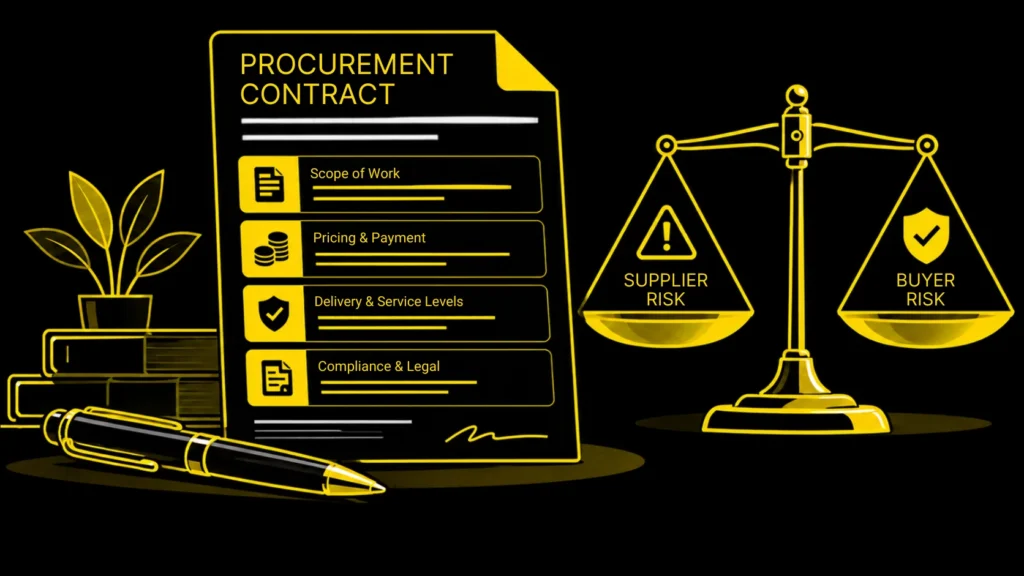
Procurement contracts define the terms, responsibilities and expectations between a buyer and supplier. A well-structured contract typically includes:
- Scope of work: Details the products or services, specifications, quantities and deliverables.
- Pricing and payment terms: Covers agreed prices, payment schedules, taxes, discounts and invoicing requirements.
- Delivery requirements: Specifies delivery dates, locations, shipping responsibilities and acceptance criteria.
- Performance standards: Establishes quality requirements, service levels, warranties and performance metrics.
- Roles and responsibilities: Clarifies the obligations of both the buyer and supplier.
- Risk and liability: Defines liability limits, insurance requirements, indemnification and procedures for handling losses or damages.
- Compliance requirements: Covers applicable laws, regulations, industry standards and procurement policies.
- Termination and dispute resolution: Explains when the agreement can be terminated and how disputes will be addressed.
- Confidentiality and data protection: Protects sensitive business, customer and supplier information.
- Contract changes: Establishes how amendments, price changes or changes in scope must be approved and documented.

Up to 70% of procurement contracts are not digitally managed, resulting in poor compliance and increased risk.
Types of Procurement Contracts: How the Main Structures Work
Procurement contracts differ mainly in how they determine payment and distribute financial risk between the buyer and supplier.
The three main types of procurement contracts include fixed-price, cost-reimbursement, and time-and-materials contracts. Other commonly used structures include framework agreements, master service agreements, and unit price agreements.
1. Fixed-Price Contracts
The Fixed-Price Contract is where a specific price is set for a certain quantity or specification of items or service provision. Here, the supplier takes more accountability for cost control in meeting the said scope.
This type of procurement contract works best when requirements, specifications, quantity, and delivery are certain.
Common variations include:
- Firm fixed price: The supplier delivers the agreed scope for a predetermined price.
- Fixed price with incentive: The agreement combines a defined price with incentives linked to performance, efficiency, or other measurable outcomes.
- Fixed price with economic adjustment: The contract allows defined price adjustments when specified economic conditions, such as changes in material costs or an agreed index, occur.
The main advantage is budget predictability. The main limitation is flexibility. If the buyer changes the scope after signing, the supplier may require a change order, additional payment or an adjustment to the delivery schedule.
For example, a company purchasing standardized equipment with established specifications may use a fixed-price agreement. The supplier can price the requirement with relatively low uncertainty and the buyer gains greater visibility into the expected expenditure.
2. Cost-Reimbursable Contracts
Cost-reimbursable arrangements compensate the supplier for allowable costs incurred during performance, usually with an additional fee or incentive.
They can be useful when the buyer cannot reasonably establish the complete scope or cost before work begins. Research, development, complex technical projects and other uncertain requirements can fall into this category.
Common variations include:
- Cost plus fixed fee: Actual allowable costs are reimbursed and the supplier receives a predetermined fee.
- Cost plus incentive fee: The supplier receives an incentive based on defined performance or cost objectives.
- Cost plus award fee: An additional fee may be awarded according to specified performance criteria.
The flexibility comes with greater oversight requirements. Buyers need mechanisms for validating costs, reviewing invoices, monitoring budgets and identifying deviations from agreed expectations.
Without effective controls, the final expenditure can become difficult to predict.
3. Time and Materials Contracts
Time and materials contracts pay suppliers according to agreed labor rates and the cost of specified materials or other allowable expenses.
They can be useful when the work needs to start before the full scope can be accurately estimated. Software development, consulting, technical support and maintenance projects may use this structure when requirements can evolve.
The flexibility is valuable, but so is discipline.
A buyer should establish approved labor categories, hourly or daily rates, material rules, expense policies, reporting requirements and a maximum contract value or spending threshold where appropriate.
Regular reviews of hours consumed, deliverables completed and remaining budget can prevent an initially flexible agreement from becoming an uncontrolled source of expenditure.
4. Framework and Master Agreements
Framework agreements and master service agreements are designed to establish commercial and legal terms for recurring purchases or multiple engagements.
Instead of negotiating every transaction from the beginning, the parties establish baseline terms and use purchase orders, statements of work, and other ordering documents for individual requirements.
These arrangements can reduce repetitive negotiations and provide greater consistency across recurring supplier relationships.
However, the framework should clearly define how individual orders interact with the main agreement. Pricing, service levels, change procedures and precedence between documents should be explicit.
5. Unit-Price Contracts
Unit pricing involves fixing the price on each unit bought or supplied in advance.
The price can be based on a per-unit, per-license, per-kilometer, per-service-hour, or other unit measure.
It may be applied in cases where the cost of the unit to be purchased is fairly certain, while the exact quantity is not known.
The key consideration is volume risk. A low unit price does not necessarily result in lower total expenditure if actual consumption is significantly higher than expected.
How to Choose Between Procurement Contract Types?
Choosing among procurement contract types requires more than comparing quoted prices. The contract should reflect the commercial and operational reality of the purchase.
| Factor | Key question | What it points to | What goes wrong if you ignore it |
|---|---|---|---|
| Scope certainty | Can the requirements be defined clearly before signing? | Stable scope may support fixed price. Evolving scope may require greater flexibility. | Frequent change orders, disputes, and inflated contingency pricing |
| Cost predictability | Can the supplier estimate delivery costs accurately? | Predictable costs support fixed price. Major uncertainty may support cost reimbursable or time and materials. | Budget overruns |
| Risk control | Who can actually manage each risk? | Assign the risk to the party best positioned to manage it. | Higher prices or unmanaged exposure |
| Market conditions | How many capable vendors can compete? | Competitive markets may support stronger commercial terms. | Higher prices or limited supplier participation |
| Administrative capacity | Can your team monitor invoices, milestones, performance, changes, and compliance? | Complex contracts require stronger controls and systems. | A good-looking structure becomes unenforceable in practice |
What are the Essential Clauses in a Procurement Contract?
The types of contract in procurement determine the overall commercial structure, while individual clauses define how that structure works in practice.
A strong agreement should address at least the following areas.
Scope and Deliverables
The scope should define what the supplier must provide and what falls outside the agreement.
Include specifications, quantities, milestones, acceptance criteria, exclusions and delivery requirements. Ambiguous scope is one of the most common sources of disagreement because each party may interpret the original requirement differently.
Pricing and Payment Terms
Specify the pricing model, rates, payment schedule, taxes, reimbursable costs, discounts, and pricing adjustments.
For long-term contracts, you may want to look into using a pricing adjustment mechanism based on some index. Pricing adjustment must specify the triggers, index, formula, and frequency.
Service Levels and Performance Standards
The performance clause should convert expectations into quantifiable metrics.
This will vary by category and could include things like delivery accuracy, response times, uptime, defect rates, time to resolution, etc.
A service level is more useful when the contract also establishes what happens when the supplier fails to meet it.
Inspection and Acceptance
Define how goods or services will be inspected and accepted.
The clause should establish inspection periods, acceptance criteria, rejection procedures and correction obligations.
This is particularly important where payment depends on milestone completion or acceptance of deliverables.
Change Contract Control
Requirements can change after signing. The contract should therefore explain how changes are requested, assessed, approved and documented.
A formal change-control process should identify the impact on price, scope, resources and timelines before the change becomes part of the supplier’s obligation.
Warranties and Remedies
Warranties establish what the supplier guarantees about the quality and conditions of their goods and services.
The agreement should also identify the available remedy if those commitments are not met, such as repair, replacement, re-performance, refund or another agreed remedy.
Confidentiality, Data and Intellectual Property
Contracts involving software, consulting, technology or sensitive business information should address confidentiality, data handling, security requirements and intellectual property ownership or licensing.
These provisions should be aligned with the type of information the supplier will access and the nature of the services being provided.
Liability and Indemnification
Liability clauses determine how responsibility for certain losses is allocated.
The agreement may establish liability caps, exclusions and specific exceptions. Indemnification provisions can address particular third-party claims or losses.
Because these provisions can have significant legal and financial consequences, procurement teams should coordinate closely with legal counsel.
Termination and Renewal
The contract should state how and when either party can terminate it.
Some important factors include termination for cause, termination for convenience if relevant, notice periods, cure periods, any payments due, as well as information transfer.
In case of contracts that can be renewed, make sure to establish the dates for renewal in advance. Failure to renew on time might prolong commercial terms unsuitable for current business needs.
Dispute Resolution and Governing Law
The contract should establish how disputes will be escalated and resolved.
Depending on the agreement, this may involve internal escalation, negotiation, mediation, arbitration or litigation. Governing law and jurisdiction should also be clearly identified.
Risk Allocation in Procurement Contracts
A useful way to evaluate types of contracts in procurement is to ask one question: which party is best positioned to manage each risk?
Cost risk, supply risk, quality risk, demand risk, regulatory risk, technology risk and schedule risk do not necessarily belong to the same party.
For example, a supplier may have greater control over manufacturing efficiency, while the buyer may control demand forecasts. A supplier may manage service delivery, while the buyer controls access to internal systems required to complete the work.
Common Procurement Risks
- Cost risk: Prices may increase because of labor, materials, currency movements or market conditions.
- Scope risk: The requirements might expand after signing the agreement.
- Supplier performance risk: Deliverables may fail to meet the agreed quality and/or performance standards.
- Supply continuity risk: A supplier may experience capacity constraints, financial difficulties or disruptions in its own supply chain.
- Compliance risk: A supplier may fail to meet applicable legal, regulatory, security or industry requirements.
- Data and cybersecurity risk: Suppliers handling sensitive data pose an extra risk if the security measures are not enough.
- Concentration risk: Heavy dependence on one supplier can make disruption more difficult to manage.
- Renewal risk: Automatic renewals can reduce opportunities to reassess performance, pricing, and business requirements.
How to Manage Procurement Contract Risk After Signing?
Selecting the right option from the different types of contracts in procurement is only the beginning. Effective contract management requires continuous oversight throughout the agreement’s entire lifecycle.
Turn Obligations Into a Working Checklist
List all obligations from each side, including the owner and deadline. Deliverables, payment schedules, reports, certificates and audits must all be part of this. If the obligation does not have an owner, it will be easily ignored.
Track Performance Against Agreed Standards
Review performance against established criteria such as service levels, delivery time and quality results, instead of waiting until there is a problem. If there are service credits or liquidated damages built into the contract, apply these consistently. Consistently turning a blind eye to small infractions will complicate bigger issues.
Control Changes Before They Become Disputes
Scope changes will cause many unforeseen costs. Ensure there is written authorization, cost analysis, and a new time frame prior to any additional work being done. Verbal authorization and e-mails will only cause problems in the future.
Check Invoices Against the Contract
Make sure that all invoices match the agreed pricing, variations and work done. In cost-based agreements, compare the timesheet and cost report against the agreed spending limit every month.
Watch Renewal and Exit Dates
Schedule reminders early enough ahead of any notice dates to give yourself plenty of time to negotiate, switch suppliers or terminate the agreement altogether. You don’t want to miss an automatic renewal and be stuck with unfavorable terms.
Monitor the Vendor, Not Just the Paperwork
Monitor the financial stability, compliance status, personnel changes and delivery capability of the supplier. Early indicators give you time to react before any problems arise.
Keep One Source of Truth
Maintain the signed contract along with any subsequent amendments, approvals, and related communication in one place. Lack of this will make teams spend precious time searching for the updated contract.
Review and Close Out
Once the contract expires, ensure that the deliverables have been delivered and all issues resolved with proper documentation of lessons learned from it. Such lessons can be used in future contracts.
What Is Procurement Software?
Procurement software is a digital solution that helps businesses manage purchasing activities in one place. It supports tasks such as sourcing products, creating purchase requests, approving orders, managing suppliers and tracking purchases.
Procurement software solutions help centralize purchasing data, improve spending visibility and reduce manual work. They also help procurement and finance teams streamline approvals, maintain budget control, and make informed purchasing decisions based on accurate, accessible data.
How Procurement Software Supports Contract Management
Procurement software helps teams manage supplier agreements beyond the signing stage by connecting contracts with purchasing, supplier activity and spend data. A procurement software solution can support contract management by:
- Centralizing contracts: Store agreements, amendments and supporting documents in one searchable location for easier access and version control.
- Tracking obligations: Monitor deliverables, pricing, service levels and other contractual commitments to improve supplier accountability.
- Managing renewals: Automated alerts can notify teams about upcoming expiry and renewal dates, giving procurement time to review terms and negotiate changes.
- Improving compliance: Connecting contract terms with purchasing activity can help identify off-contract spending, pricing discrepancies and compliance exceptions.
This approach gives procurement teams better visibility throughout the contract lifecycle while reducing reliance on spreadsheets, emails and manual tracking.
Make Every Procurement Contract Work Better
Contract management begins even before the contract is signed. Procurement teams should analyze scope, price, capabilities, and risk to choose the right type of procurement contract. A well-structured agreement balances cost predictability with flexibility, while clear clauses define responsibilities, manage changes, allocate risk, and establish clear termination terms.
As supplier networks grow, managing agreements alongside purchasing, approvals, invoices, supplier performance and spend data can become challenging. Zapro AI brings these elements together, helping procurement teams improve visibility, monitor compliance and maintain greater control throughout the contract lifecycle.
Ready to simplify procurement contract management? Explore Zapro AI to connect contracts, purchasing and spend in one streamlined platform. You can also compare Zapro pricing plans to find the right fit for your team.
FAQs About Procurement Contracts
What is the purpose of a procurement contract?
A procurement contract defines the buyer’s and supplier’s obligations for a purchase. It establishes scope, pricing, delivery, performance, payment, risk allocation, remedies and other commercial terms.
What are the main procurement contract types?
The main pricing structures are fixed-price, cost-reimbursable and time and materials. Framework, unit-price and indefinite-delivery arrangements may also be used depending on the purchasing requirement and operating model.
When should a fixed-price contract be used?
A fixed-price contract may be appropriate when there is enough clarity regarding the scope, specification, and delivery to reasonably estimate the cost.
When is a cost-reimbursable contract appropriate?
A cost-reimbursable structure can be appropriate in situations where there is real uncertainty surrounding the project and where the costs cannot be estimated with accuracy.
What are the most important procurement contract clauses?
The most important procurement contract clauses are scope, pricing, payment, performance, acceptance, warranties, confidentiality, intellectual property, liability, indemnification, change control, termination, dispute resolution, and governing law.
How should procurement risk be allocated?
Risk should generally be assigned to the party that can best control, prevent, or mitigate it. Transferring risks without considering the supplier’s ability to manage them can increase prices or create disputes.
What is the difference between a procurement contract and a purchase order?
A procurement contract typically sets broader business and legal terms for a buyer-seller relationship. A purchase order will then be used to authorize a particular purchase according to these terms. Legal implications vary by case and by jurisdiction.
How can procurement teams manage contracts more effectively?
Procurement teams can better manage their contracts through centralization of agreements, ownership, performance monitoring, renewal tracking, change control, and linkages between agreements and purchase/invoice processing.
References
- Acquisition.gov. FAR 16.101 General. https://www.acquisition.gov/far/16.101
- Acquisition.gov. FAR Part 16, Types of Contracts. https://www.acquisition.gov/index.php/far/part-16
- Acquisition.gov. FAR Overhaul Part 16, Negotiating Contract Type. https://acquisition.gov/node/63934
- World Commerce & Contracting. Contract Management: An Overlooked Driver of Business Agility and Financial Performance (2025). https://info.worldcc.com/contract-management-aug-2025
- Procurement & Supply. Procurement contracts leaking 11 percent of value due to enterprise-wide failures. https://procurementandsupply.com/procurement-contracts-leaking-11-percent-of-value-due-to-enterprise-wide-failures/
- CIPS. Contract terms. https://1prd-dxp.cips.org/intelligence-hub/contract-management/contract-terms
Don’t miss our weekly updates
We’ll email you 1-3 times per week—and never share your information.
Ready to Take Control of Your Procurement Contracts?
Talk to experts for smarter, safer contract management.

About the Author

Md. Kafil


About the Reviewer

Zapro is dedicated to helping businesses of all sizes make informed decisions. We adhere to strict editorial guidelines to ensure that our content meets and maintains our high standards.
Our editorial standards help keep every article accurate, useful, and trustworthy.