

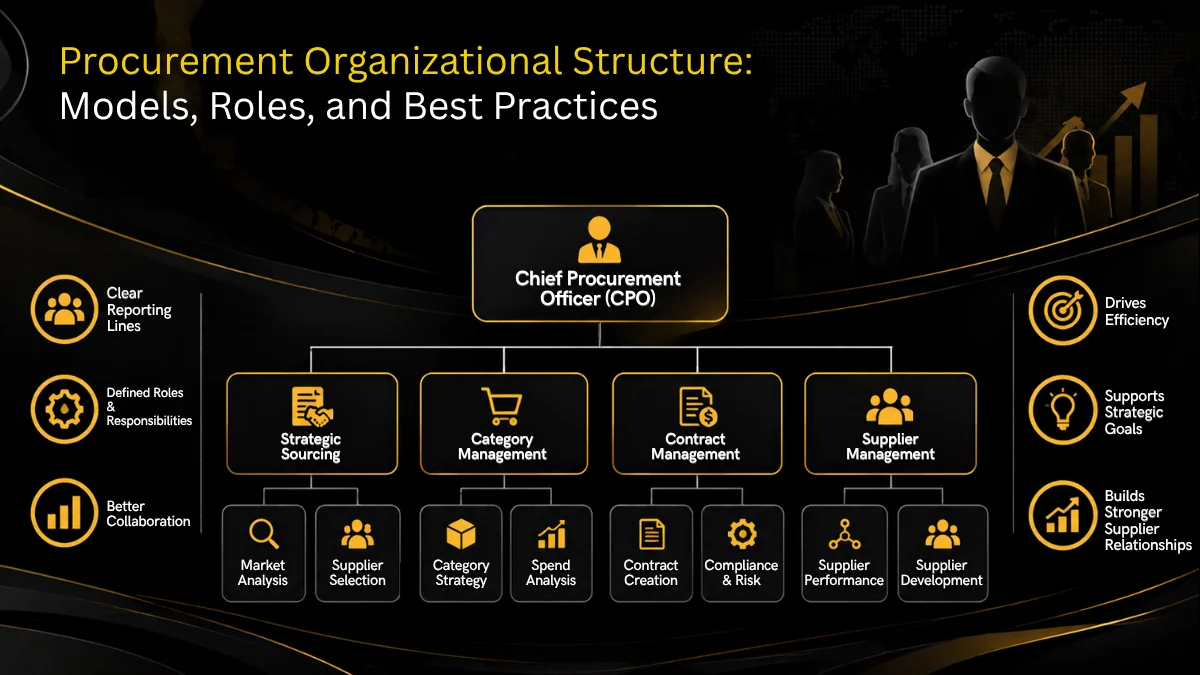
A clear procurement organization structure shows who is responsible for purchase decisions, who leads each part of the procurement process, who has the authority to approve spending, and how central procurement teams work with various departments or locations.
The three common models are centralization, decentralization, and a hybrid one.
The model chosen depends on factors such as spending levels, risk levels, business unit requirements, the geography involved, and the amount of local knowledge required for a purchase.
Because the structure is well designed, people have enough authority to make reasonable decisions while keeping the main rules, data, and controls consistent across the company.
Key Takeaways
- The organization chart in the procurement section indicates who reports to whom, whereas a good procurement operating model shows who really has the power to make decisions.
- In centralized procurement, the authority to make purchases is given to a central team, while in decentralized procurement it is given to the various departments, locations, or business units.
- The central and the local teams each have responsibilities under the hybrid model.
- 44% of the organizations taking part in the study carried out the process on a global basis but implemented it locally, and 35% administered and carried out the process from a central location.
- The capacity for clear decisions can be just as significant as the reporting structure, since if both individuals think that they have the authority to approve a matter, then the organizational chart has not really solved the problem.
Your Ideal Procurement Team Structure
A company’s procurement team structure describes how it assigns roles, responsibilities, authority, reporting relationships, and the power to make purchasing decisions.
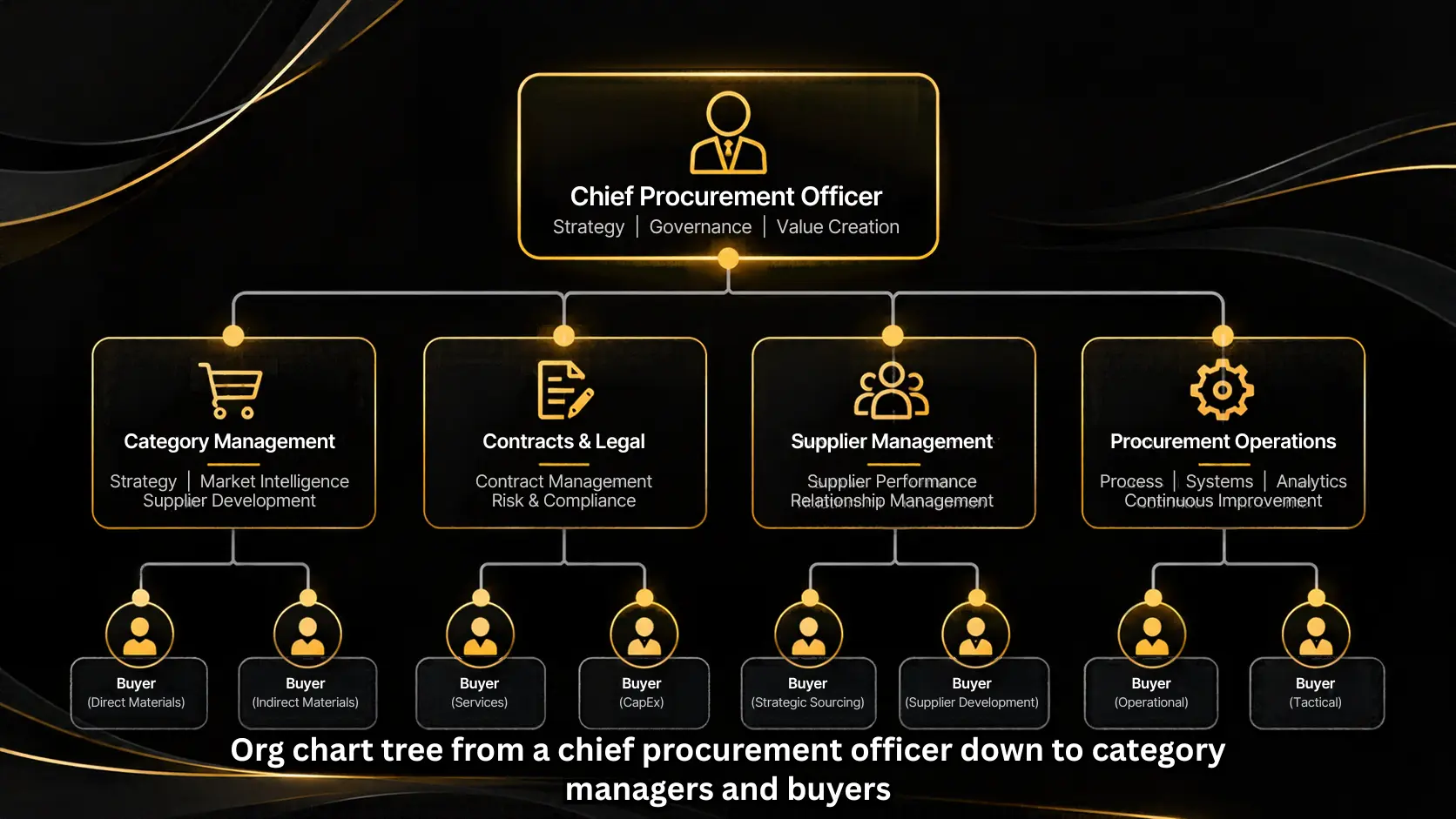
Picture it as a map that applies to each instance of a purchase.
One person establishes the business’s requirements, while another may find vendors, negotiate terms, authorize the purchase, prepare the purchase order, receive the goods, or check the invoice. In many companies, a single small team can handle these duties, or they can be split among procurement, finance, operations, IT, legal, and the various business units.
Consequently, the way the procurement organization is structured is more complicated than drawing boxes on an organization chart.
The real problem is this: who should be responsible for each decision, and how much power should they have? If a company has more than one location, business unit, product category, or country, then answering the question becomes much more difficult.
A strong structure also connects procurement with the wider procurement function.
Why Procurement Organizational Design Is Crucial
The way in which procurement is organized affects the buying experience on a day-to-day basis.
Let us consider a retailer who owns a number of stores. If a store manager wishes to replace the equipment, should the store be permitted to buy it directly? Is it essential that the procurement department approve the purchase? In the case where the item is covered by an existing contract, how should this situation be handled? And who is in charge of verifying whether or not another store already has a more favorable vendor agreement?
Imagine a company operating in the consumer packaged goods industry buying specialized production materials. Although the procurement team may be the one who knows most about contracts and market prices, the production team is probably better equipped to understand the technical requirements.
It is exactly in this case that the value of the way in which the procurement organization is structured is revealed.
A useful structure answers four basic questions:
- Who owns the category?
- Who should the purchase request be addressed to?
- Who can approve it?
- Who is to be held responsible for the result?
Employees will have to take some time to work out how the process works if the various departments give out inconsistent answers without delivering a clear explanation.

Only about one-third of CEOs have an operating and business model fit for an AI-driven world.
– David Furlonger, Gartner Research, from the 2025 Gartner CEO
The Three Main Procurement Organization Structures
Procurement teams are usually situated somewhere along the scale that goes from centralization to decentralization, with combined models occupying the position between the two.
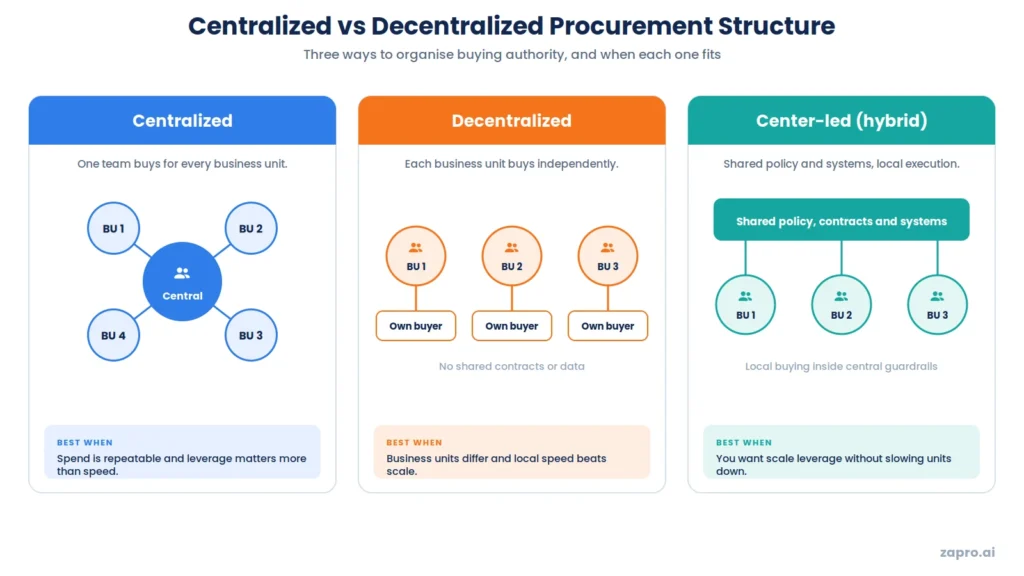
Gartner’s procurement organization research found that 51% of survey respondents used center-led structures, compared with 39% using centralized structures.
1. Centralized Procurement
In a centralized procurement organization, the central team carries out the main purchasing activities for the company.
The team might be in charge of strategic sourcing, selecting vendors, negotiating contracts, managing product categories, setting up procurement policies, approving purchases, overseeing vendors, and carrying out spend analysis.
The model will work as long as the company has common purchasing rules, consolidated data, and consistent controls.
It can also make things simpler in the case where a number of departments buy the same products or services. Instead of five different teams having to negotiate five separate agreements, one procurement team could look after the category across the whole business.
The catch is proximity.
Even if the central procurement team is familiar with the commercial aspects of a purchase, they might have only a limited amount of knowledge of the day-to-day situation in the department that is making the request.
This is important in all cases where the purchase requires technical or local knowledge.
2. Decentralized Procurement
In a decentralized procurement system, each individual department, business unit, or location has more control over its purchasing.
Each regional office could look after its own vendors, the manufacturing site could handle the purchases connected with production, and the marketing team could take responsibility for its own agencies and software.
You can understand this arrangement because local knowledge matters.
The problem is a lack of consistency, since different teams might draft their own procedures, arrange things on their own, or keep purchasing data in separate places.
That could make it more difficult to give straightforward answers to questions like this one regarding just how much we are really spending.
3. Hybrid / Center-Led Procurement Model
A hybrid or center-led model splits procurement responsibilities between central and local teams. The central function can set policies, manage strategic categories, and maintain common controls, while business units handle purchases that require local knowledge or faster decisions.
It allows companies to keep their procurement standards consistent at the same time as making purchasing decisions near the teams that understand the business context. Just as APQC’s 2025 research found, 44% of the organizations that took part in the study carry out procure-to-pay globally but do so locally.
The central team could prepare the policies, negotiate the enterprise agreements, handle the strategic categories, ensure that the procurement technology continues to function, and arrange the controls.
Local teams could make the approved purchases, provide the business requirements, deal with local vendors, and look after any exceptions all within the specified limits.
Instead of asking ourselves, when looking at centralized, decentralized, or hybrid procurement, ‘Which model should we choose?’, we should ask ‘Which decisions should be made at which level?”
| Structure | Decision-making | Works well when | Main challenge |
|---|---|---|---|
| Centralized | Central procurement team | Purchases are standardized and scale matters | Local teams may have less control |
| Decentralized | Departments or locations | Local knowledge and speed matter | Spend and processes can become fragmented |
| Hybrid | Shared between central and local teams | The company needs both control and flexibility | Decision rights need to be very clear |
Rather than choosing a model first, consider which decisions need to be made at each stage. This can lead to a more practical procurement structure.
How to Decide Where Procurement Decisions Belong
A simple test is available for each of the main types of purchasing.
Start with business knowledge
Find out how much specialized knowledge is required for the purchase.
Where a person has good knowledge of the manufacturing process, it is necessary when a component is being made, while for ordinary office furniture only a limited amount of specialized knowledge is required.
The person most closely associated with the work may therefore have to take a more active role in reaching the first decision.
Look at spend concentration
See how much money the company spends in its different departments.
There may well be a valid reason for having the category managed centrally because ten business units are purchasing the same service from different vendors.
It would be more sensible to go with local ownership since each location buys an item that is very specific to its local market.
Consider risk
It might be assumed that a low-value purchase should go through the same approval process as a high-risk purchase.
For example, a typical office purchase could go through a simple approval process, while a vendor who deals with sensitive company information would have to be subject to additional reviews by security, legal, or IT.
Think about how frequently a purchase takes place
Standard operating procedures should be used to handle transactions that take place repeatedly and in large volumes.
An item that is hard to buy has to go through a different process and, as a result, needs expert judgment.
Give each decision to one person
A section which teams often leave out is this one.
For every major category, document:
- Who recommends?
- Who approves?
- Who negotiates?
- Who signs?
- Who looks after the vendor afterward?
- Who handles exceptions?
If the answer to any of the questions is ‘it depends’, then enumerate all the factors on which it depends. It thus forms the basis upon which a real procurement organization can be designed.
Procurement Team Design for Retail and CPG Companies
Retail businesses and all other people who are concerned with consumer packaged goods have a certain kind of structural problem since purchases can occur at a number of levels. This is where CPG procurement organization design and retail procurement org design become especially relevant.
A business retailer might have corporate procurement, regional teams, individual stores, distribution centers, merchandising teams, IT and facilities, as well as marketing.
A firm in the consumer packaged goods industry could have departments responsible for corporate procurement, manufacturing, research and development, packaging, quality control, logistics, marketing, and regional operations.
As a result, there is no single rule that can be formulated for each category.
When setting up retail procurement organizations, the central teams can look after enterprise-wide contracts, the technology, major services and the different categories, while the local teams deal with the purchases where knowledge of the market or of the particular location is important.
When the procurement organization is being set up in the CPG industry, the production, engineering, quality or R&D departments may all need to be closely involved; the procurement function can look after the business aspect while the subject-matter experts help to work out what the business really needs.
What matters is that the handover is made clear.
Procurement owns vendor negotiations ⇒ Engineering decides on tech specifications ⇒ Finance confirms budget availability ⇒ Business owner agrees to the final purchase
That is much more useful than simply putting ‘Procurement’ in a box on an organization chart.
The Roles Inside a Procurement Organization
The larger and more complex the company is, the kind of team that will be required will depend on it, but procurement organizations generally have a number of separate responsibilities.
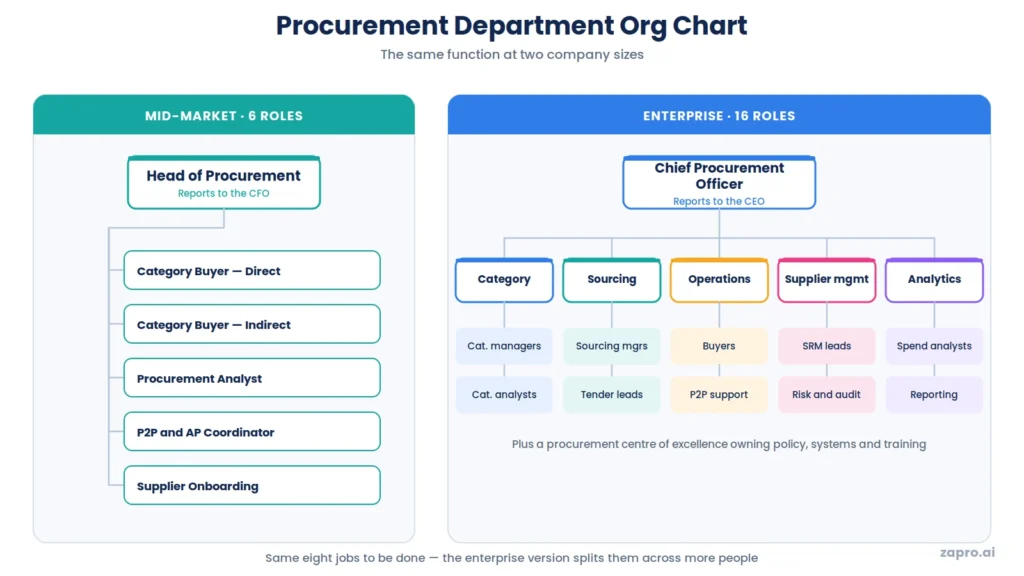
Chief Procurement Officer or Procurement Leader
The procurement strategy has already been established, the function is under supervision, and the procurement priorities have been connected with the general business goals.
Category Manager
Involves a particular category or a number of categories that are closely related to one another; the role usually includes carrying out market research, drawing up sourcing strategies, negotiating with vendors, and keeping an eye on category performance.
Procurement Manager
Oversees the procurement activities for a business unit, a region, or a number of product categories.
Sourcing Specialist
Performs the work concerning sourcing, evaluates various vendors, compares the proposals, and provides assistance with the negotiations.
Contract Manager
The contract’s terms, their renewals, the obligations connected with them, and the pertinent documentation are dealt with.
Vendor Relationship Manager
Once they have been chosen, the company looks after the main vendors, monitoring their performance and dealing with any problems that occur.
Procurement Analyst
The reason for carrying out an analysis of spending and procurement data is to detect trends, gaps, and opportunities.
Purchasing or Procurement Coordinator
It carries out a great deal of work which is of a transactional character, for example by processing purchase orders, dealing with requests, and following up on orders.
In a small company, one person will carry out several of those jobs, whereas a larger procurement organization will have separate teams for each task.
What is important is that the work does have an owner, even if the job title has not yet been decided.
A Practical Way to Build the Structure
It makes no sense to start off with a drawing of an org chart.
Start off with purchasing.
Step 1: Map the current workflow
Begin to make a note as soon as a person makes a request until the seller has received payment.
Look at the purchase requests, the approvals, the sourcing, the vendor onboarding, the purchase orders, the receiving, the invoice matching, the payment, and the vendor performance.
The fundamental problem will most likely still remain unsolved simply due to the fact that the reporting structure has changed unless the company can clearly explain the present method of doing things.
Step 2: Group purchases into categories
Divide the purchases into those that are strategic, specialized, routine, and local.
It is therefore easier to decide which kind of work should have central expertise and which should involve local participation.
Step 3: Assign decision rights
Make a simple decision matrix.
| Decision | Central procurement | Business unit | Finance | Legal / IT / Security |
|---|---|---|---|---|
| Procurement policy | Own | Input | Input | Input |
| Category strategy | Own | Input | Input | As needed |
| Business needs | Support | Own | Input | Input |
| Vendor selection | Lead | Participate | As needed | As needed |
| Budget approval | Input | Request | Own | As needed |
| Contract review | Lead | Input | Input | Review when required |
| Purchase execution | Govern | Execute where delegated | Monitor | As needed |
| Vendor performance | Govern | Provide feedback | Input | Input |
It doesn’t apply to every situation, but rather is intended to enable the organization to become aware of its power in making decisions.
Step 4: Set approval thresholds
The level of approval has to be in keeping with the organization’s risk and spending rules.
For example, a company could obtain the various departments’ approval when making small purchases, establish an additional procurement review if a certain threshold is reached, and get approval from senior management in the case of major commitments.
The exact figures should be contained in the company’s own policies.
Step 5: Put the process into a system
Once the structure has been made clear, technology can enforce it.
A procurement platform can send requests to the correct approver, retain records of all purchasing information, and give both the procurement and finance departments a common view of spending.
The spend management features of Zapro AI cover all the various aspects of spending from the time a request is made until it is paid and then subjected to review.
The various workflows relating to vendor onboarding, performance monitoring, reporting, and the management of vendor data are all included on the platform used by the vendor manager. Zapro applies the same idea across intake, purchase requests, approvals, purchase orders and invoices, so decision rights are enforced consistently.
What matters is that technology should be given a properly organized design rather than attempting to compensate for one that has not been properly defined. If you are still choosing a tool, a comparison of the best procurement software can help match platforms to your decision matrix.
A simple method to arrive at an estimate of the value of getting rid of unnecessary approval work−
Envision a company that receives 1,200 purchase requests each month.
Picture a changed workflow in which the time required for each request is reduced by getting rid of the unnecessary handoffs.
1,200 × 10 minutes = 12,000 minutes
12,000 ÷ 60 = 200 hours
That amounts to 200 hours of administrative work each month.
It should be emphasized that this is only a hypothetical example and not a standard by which to judge; the important issue is the method. Weighing that time saving against procurement software pricing gives a rough sense of whether automating approval routing is worth it. Procurement managers can input their own request volume and average handling time so as to be able to see the measurable effects that changes to the workflow would have.
It also brings up a point which is easy to overlook—that an organizational design decision can have effects that go beyond simply setting out the lines of reporting and can in fact influence the length of time it takes people to get a purchase through the business.
Transform P2P with the Power of AI and Zapro.

How to Know if the Structure Is Working
Do not judge the structure by whether it is centralized or decentralized. Judge it by what changes in cost, speed, control, service, and productivity.
APQC’s procurement benchmarking guidance groups procurement measures into areas including cost effectiveness, cycle time, process efficiency, and staff productivity.
| Area | Measures to watch | What the measure can reveal |
|---|---|---|
| Speed | Purchase order issuance cycle time | 2.0 days |
| Productivity | Purchase orders processed per FTE | 1,619 POs |
| Control | Maverick buying | 1.2% |
| Cost | Procurement process cost per $1,000 of purchases | $15.00 |
| Vendor management | Supplier setup cycle time | 3.0 days |
Review results at both the enterprise and business-unit level. A structure can improve central efficiency while creating friction locally, so both views matter.
Common Procurement Organization Design Mistakes
Treating every category the same
The procedure followed when deciding to buy an item that is important for production is generally different from that followed in the case of a normal office supply.
Giving everyone approval authority
Even if raising the approval levels may delay normal purchases, they could still create the impression that one has control, which is why it is necessary to set up thresholds and intentionally grant authority.
Centralizing without local input
If central procurement had access to the people who understand the business requirements, the commercially attractive agreement would not work properly.
Decentralizing without shared standards
Procurement will be able to carry on so long as there are explicit policies, consistent data standards, fixed approval rules, and defined reporting procedures in place; but if these measures are not set up, each business unit will start to establish its own procurement system.
Designing around job titles instead of work
A firm is quite capable of coming up with very impressive job titles without making it clear who is actually responsible for sourcing, the approvals, the contracts, and the supervision of vendors, and the best approach in this case is to first look at the tasks in question before determining which posts are responsible for them.
Forgetting that the structure can change
The structure of a company’s procurement organization can become quite different after an acquisition, as a result of international expansion, or because of a major change in the product range; whenever there is a change in the business, the model should be examined.
FAQs
What Is a Procurement Organization Structure?
The structure of a procurement organization determines the roles, responsibilities, authorities, reporting relationships, and the decision-making powers that are employed in the management of purchasing within the organization.
What are the three kinds of procurement organization structures?
The principal types are centralized, decentralized, and hybrid. In centralized procurement, the bulk of the purchasing power is held by a central team. Decentralized procurement gives departments or locations greater control. In hybrid procurement, the duties are divided between the central and local teams.
What is intended by procurement organizational design?
The organization of procurement entails determining how the procurement posts, responsibilities, decision-making powers, workflows, and reporting relationships should be set up.
What is the difference between an organization structure and an organization design in the field of procurement?
The structure is the resulting arrangement of roles and responsibilities. Design is the process of creating that arrangement and deciding how procurement should operate.
How should a company choose between centralized and decentralized procurement?
Start with the work, not the label. Review the category’s spend, risk, frequency, need for local knowledge, and possibility of standardization. Then decide which responsibilities belong with central procurement and which should stay with the business.
Can retail procurement use a hybrid structure?
Yes. A retail procurement organization can centralize enterprise-wide categories, contracts, policies, data, and strategy-related sourcing while giving regional or store teams authority over approved local purchases.
How does technology affect procurement organization design?
Technology can enforce approval rules, route purchase requests, centralize procurement data, automate regular workflows, and give teams better visibility into spending. It works best when the organization’s decision rights are already clear.
Explore Zapro AI’s procurement platform to see how procurement workflows can be structured and routed.

Step into the Future of Procurement with Zapro.
AI automation makes your P2P faster, smarter, and error-free.
Don’t miss our weekly updates
We’ll email you 1-3 times per week—and never share your information.
Redefine Procurement Efficiency with Zapro.
Unlock AI-powered P2P automation to cut costs, save time, and scale with confidence.

About the Author

Md. Kafil


About the Reviewer

Zapro is dedicated to helping businesses of all sizes make informed decisions. We adhere to strict editorial guidelines to ensure that our content meets and maintains our high standards.
Our editorial standards help keep every article accurate, useful, and trustworthy.