


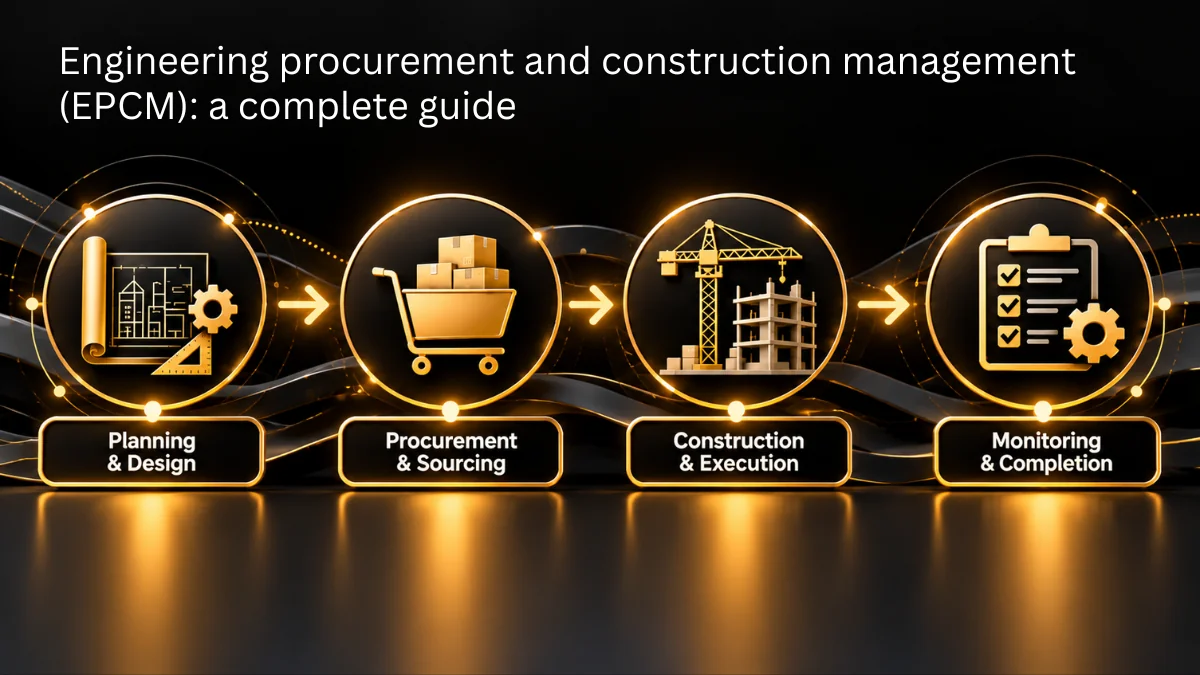
Engineering procurement and construction management (EPCM) is a project delivery model in which an owner hires an engineering firm to design the project, source its equipment, and manage construction on the owner’s behalf, while the owner holds the vendor and construction contracts directly. It is widely used for industrial and infrastructure projects, including mining, oil and gas, and petrochemicals.
This setup puts owners in the driver’s seat—they get expert engineering help and can make the important calls, but they’re also the ones who have to deal with unexpected costs and delays if things go wrong. That’s the big difference from an EPC contract, and it directly affects how the buying process works.
Key Takeaways
- EPCM is a delivery model in which an engineering firm manages design, procurement, and construction for a fee, while the owner holds the vendor and construction contracts.
- EPC is a lump-sum turnkey contract in which one contractor designs, buys, and builds the facility and carries the cost and schedule risk.
- EPCM suits projects whose scope may change, and EPC suits well-defined projects where a fixed price is the priority.
- Under EPCM, the owner maintains cost transparency and control but also carries cost and schedule exposure, so tracking commitments is essential.
- The right choice depends on the owner’s in-house skills, scope certainty, and risk appetite, not on which model looks cheaper on paper.
What Is Engineering Procurement and Construction Management (EPCM)?
In EPCM, the client contracts an engineering firm for the professional services needed to design, source, and manage a project’s construction, without the firm necessarily acting as the constructor. The EPCM contractor works as part of the client’s team: it handles complex engineering questions, runs procurement tenders, oversees site construction, and coordinates the client’s representatives.
With this approach, owners stay hands-on—they retain control and make the key decisions. They sign construction and equipment contracts, monitor every dollar spent, select vendors, and approve design changes. This model works well for technical projects that benefit from specialist advice, especially when the owner wants to stay actively involved.

By 2029, 80% of human decisions will be augmented by generative AI, transforming procurement operations.
– Gartner
What Is EPC in Construction?
EPC stands for engineering procurement construction, and an engineering procurement and construction contract is a turnkey arrangement. One contractor takes responsibility for design, procurement, and construction under a fixed lump-sum price, and the owner receives a finished facility ready to operate, which is where the phrase “turnkey” comes from. FIDIC’s Conditions of Contract for EPC/Turnkey Projects, known as the Silver Book (first edition 1999), are recommended where one entity takes total responsibility for the design and execution of an engineering project. The contractor carries the risk of overruns and delays, and owners choose an EPC contract for that certainty.
EPC vs EPCM: Who Holds What?
The main difference between the two models is who signs the contracts. In EPC, the owner signs one contract, and the contractor buys and builds under it; whereas in EPCM, the owner signs both the vendor and construction contracts, and the EPCM company provides advice and management. Understanding this distinction is essential to project procurement management because it determines where the risk, data, and approvals lie.
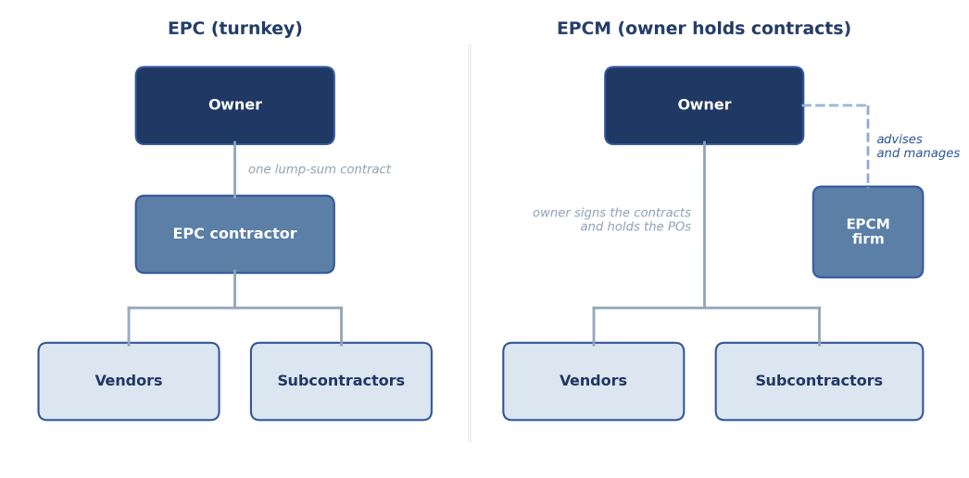
Who signs the contracts under EPC and under EPCM?
| Area | EPC | EPCM |
|---|---|---|
| Contract basis | Fixed lump sum, turnkey | Professional services, usually cost-reimbursable or unit rate |
| Who contracts vendors | The EPC contractor | The owner |
| Purchase orders issued in | The contractor’s name | The owner’s name |
| Design changes | Hard to absorb, often priced as variations | Easier to absorb as the project evolves |
| Cost certainty | High, price locked at signing | Lower, final cost known late |
| Overrun risk | Mostly the contractor | Mostly the owner |
| Owner effort | Low | High, needs a strong in-house team |
How Does an EPCM Contract Work?
An EPCM contract is a professional services agreement, usually arranged on a cost-reimbursable or unit-rate basis, so the contractor is paid for its expertise and management resources.
Fee structures: Under cost-reimbursable terms, the contractor is paid the actual costs incurred, for example, for labor hours, plus an agreed management fee. Under unit rates, payment is made according to predefined rates for specific services or deliverables.
The contractor’s role: The EPCM firm provides conceptual and detailed engineering designs, evaluates tenders technically, and provides construction management staff to supervise site work. It does not physically build the project.
The client’s role: The client contracts vendors and subcontractors directly, and the client bears all legal and financial obligations. The EPCM contractor manages those relationships and recommends decisions, but the client must approve major changes, so it needs an experienced in-house team to review the firm’s advice.
The Three Phases of EPCM
Engineering: This phase turns the project concept into technical reality: plans and drawings, material requirements, the site plan, and the layout of the facilities.
Procurement: The EPCM team acts as the client’s agent to source materials and equipment. It selects technically capable vendors with a reliable track record that meet safety standards, runs the bidding process, evaluates proposals commercially and technically, negotiates terms, and administers purchase orders. The procurement process is the same in outline as any other buying cycle, but the stakes are higher because packages are large and long-lead.
Construction management: The company keeps subcontractors in line with the designs and safety regulations, keeps an eye on how well the schedule and budget are being met, and carries out quality control in accordance with the specifications established during the engineering phase.
Transform Your Procurement Process with Ease

EPC Procurement Process: How Buying Differs Between the Models
Although EPC procurement and EPCM procurement appear similar on the schedule, they differ on paper. In the case of an EPC project, the contractor purchases the goods in its own name as part of the lump sum, so the owner is not exposed to the individual vendor prices. With EPCM, the contractor handles prequalification, tendering, technical evaluation, and expediting, but the owner generally places the purchase orders in its name. This arrangement gives the owner direct relationships with the vendors, transparent pricing, and ownership of the equipment, while the EPCM firm carries out the professional work.
The result is easy to overlook. The owner now has all the commitments, so it needs a separate record of what has been committed, what has been invoiced, and what is forecasted for all packages, along with formal control over variations. Good purchase order tracking transforms owner-held purchase orders from an administrative chore into a tool for cost visibility.
The formal variation control procedure enables this to work. If the scope changes, the EPCM company must first put the change in writing, price it, and evaluate its effect on the schedule before the owner approves it and work proceeds. Otherwise, minor variations can go unnoticed, and the owner may not discover the cost overrun until the invoices arrive.
Advantages of the EPCM Model
- Owner control: The client has the last word on critical decisions, such as contractor selection and design changes.
- Transparent procurement: Because the client holds the contracts, it sees every payment for materials and labor.
- Flexible design: Since changes to the scope during construction do not trigger the sharply increased pricing for change orders that usually applies in a lump-sum EPC.
- Spread risk: Splitting work into packages across several subcontractors avoids dependence on a single contractor.
Disadvantages and Risks of EPCM
- More contract risk for the owner: If the project goes wrong, the owner faces extra budget and delays.
- Many contracts to manage: The client administers many subcontractor agreements, which construction contract management software can keep in order.
- Uncertain final cost: Unlike an EPC lump sum, the total is not known until the project is nearly finished.
- Strong client skills required: The owner must be technically competent and able to challenge the EPCM firm’s recommendations.
The problem is not minor. According to KPMG’s 2026 report, cost overruns on very large capital projects average 88 percent, and more than 75 percent of projects finish over budget. With an EPC contract, much of that risk moves to the contractor, but with EPCM, the owner retains the risk.
When to Use EPCM vs EPC
Go for EPCM if you want to have control over the design and the choice of vendors, if the project is complicated or if the scope could change during the course of execution, and if your company has a strong in-house project management team. Select EPC instead if a fixed, guaranteed budget is the top priority, you lack the necessary in-house skills or don’t want to handle day-to-day supervision, and the project is clearly defined and unlikely to change halfway through.
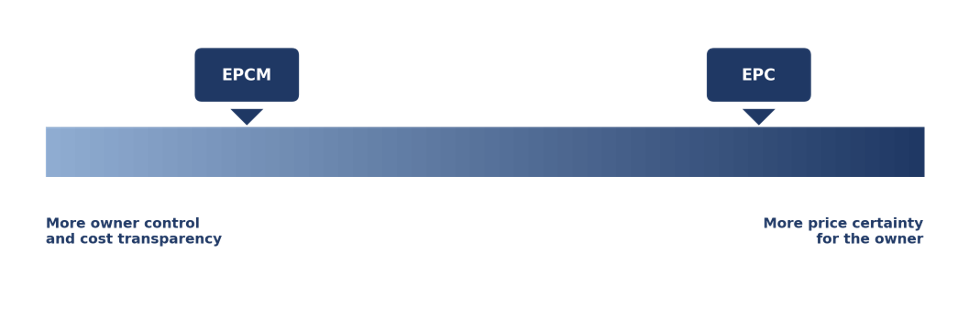
The trade-off between owner control and price certainty
Most decisions hinge on four questions: can we handle a large number of contracts? Will the scope remain fixed? Is a predictable budget better than design flexibility? And who is best positioned to assume the construction risk? In some cases, owners also divide up the scope, using EPC for a well-defined process unit and EPCM for the parts most likely to change, so it is necessary to check whether a combined approach is suitable before deciding on one type of model.
EPCM in Key Industries
Oil, gas, and petrochemicals: Such projects are complex, require large amounts of capital, and are subject to strict safety regulations. By employing an EPCM arrangement, operators can maintain close quality control over procuring and installing essential process equipment while benefiting from worldwide engineering expertise.
Mining and minerals processing: Mining often faces uncertain geology. EPCM lets operators adjust mine and plant designs as geological data emerges, which a rigid EPC contract would not allow.
How to Select an EPCM Contractor
Since the EPCM company functions as an extension of your team, select it with the same care as when hiring a contractor. Consider three criteria.
- Industry track record: Has the company carried out projects similar to yours and demonstrated value?
- Technical depth: Do the members of the team have the necessary competence to meet your design requirements at your scale?
- Safety culture: Is the safety culture standard sufficient to meet yours?
During tendering, ask how the firm’s procurement activity connects to your ERP, how it handles a change while keeping costs transparent, and which projects it has run with many subcontractors. Treat an opaque billing or margin policy, a one-size-fits-all approach, and thin site-management staffing as red flags.
Owners who manage the purchasing side themselves can also read our overview of construction procurement software.

Get Started with Procurement the Zapro Way
Simplify purchasing with Zapro — procurement made smarter and effortless.
Frequently Asked Questions
What Is Engineering, Procurement and Construction Management (EPCM)?
EPCM is a delivery model in which a contractor provides engineering design, procurement services, and construction management on the owner’s behalf, while the owner holds the construction contracts directly. The EPCM firm manages the work, and the owner keeps contractual risk and cost transparency.
What Is EPC in Construction?
EPC is a turnkey contract in which one contractor takes lump-sum responsibility for engineering, procurement, and construction, and delivers a completed facility. The contractor carries cost and schedule risk.
What Is the Difference Between EPC and EPCM?
With an EPC arrangement, the contractor assumes full responsibility for the finished facility and bears both cost and schedule risk; with EPCM, the contractor manages engineering, procurement, and construction, while the owner retains the supply and construction contracts and takes on the risks.
When Should an Owner Choose EPCM Over EPC?
Choose EPCM when your project isn’t fully defined, you want to see exactly where the money goes, and you need to select vendors as the work moves forward. On the other hand, EPC makes sense when you have a clear plan from day one and want a fixed price while leaving the details to someone else.
How Is Procurement Managed in an EPCM Contract?
The contractor does the groundwork—finding the right vendors, organizing bids, checking technical details, and ensuring on-time deliveries. The owner, though, signs the purchase orders. This way, the owner keeps a direct line to suppliers, sees exactly what things cost, and owns the equipment from day one. The contractor’s job is to coordinate and keep everything moving smoothly.
What Are the Main Risks of EPCM Delivery?
With EPCM, the owner takes on most of the risk. Any gaps in cost control, unclear scope, or delays in decision-making can quickly lead to budget overruns and missed deadlines. To avoid this, owners must closely monitor commitments and follow a strict change-management process.
Track Every Commitment
EPCM gives an owner control, and control only helps when the numbers behind it are current. Every owner-held purchase order, approval, and variation must be visible in one place, or the model’s promised transparency never materializes.
Zapro AI centralizes the related purchase orders and approvals in one procurement platform, so project owners can see what is committed, approved, and outstanding across all packages while the EPCM firm manages the work.
Sources / References
- FIDIC, “EPC/Turnkey Contract 1st Ed (1999 Silver Book) General Conditions for Training Purposes Only”: https://fidic.org/books/epcturnkey-contract-1st-ed-1999-silver-book-general-conditions-training-purposes-only
- KPMG, “Under Pressure: An Industry Reckoning” (2026): https://kpmg.com/kpmg-us/content/dam/kpmg/pdf/2026/under-pressure.pdf
- Zapro AI, “What Is Procurement?”: https://zapro.ai/procurement/what-is-procurement/
- Zapro AI, “Project Procurement Management”: https://zapro.ai/procurement/project-procurement-management/
- Zapro AI, “Procurement Process”: https://zapro.ai/procurement/procurement-process/
- Zapro AI, “Purchase Order Tracking”: https://zapro.ai/procurement/purchase-order-tracking/
- Zapro AI, “Construction Contract Management Software”: https://zapro.ai/contract-management/construction-contract-management-software/
- Zapro AI, “Construction Procurement Software”: https://zapro.ai/procurement/construction-procurement-software/
- Zapro AI, “Contract Management”: https://zapro.ai/contract-management/
Don’t miss our weekly updates
We’ll email you 1-3 times per week—and never share your information.
Let’s Streamline Your End-to-End Procurement
We’ll unify your P2P process and empower your team to work smarter.

About the Author

Md. Kafil


About the Reviewer

Zapro is dedicated to helping businesses of all sizes make informed decisions. We adhere to strict editorial guidelines to ensure that our content meets and maintains our high standards.
Our editorial standards help keep every article accurate, useful, and trustworthy.