

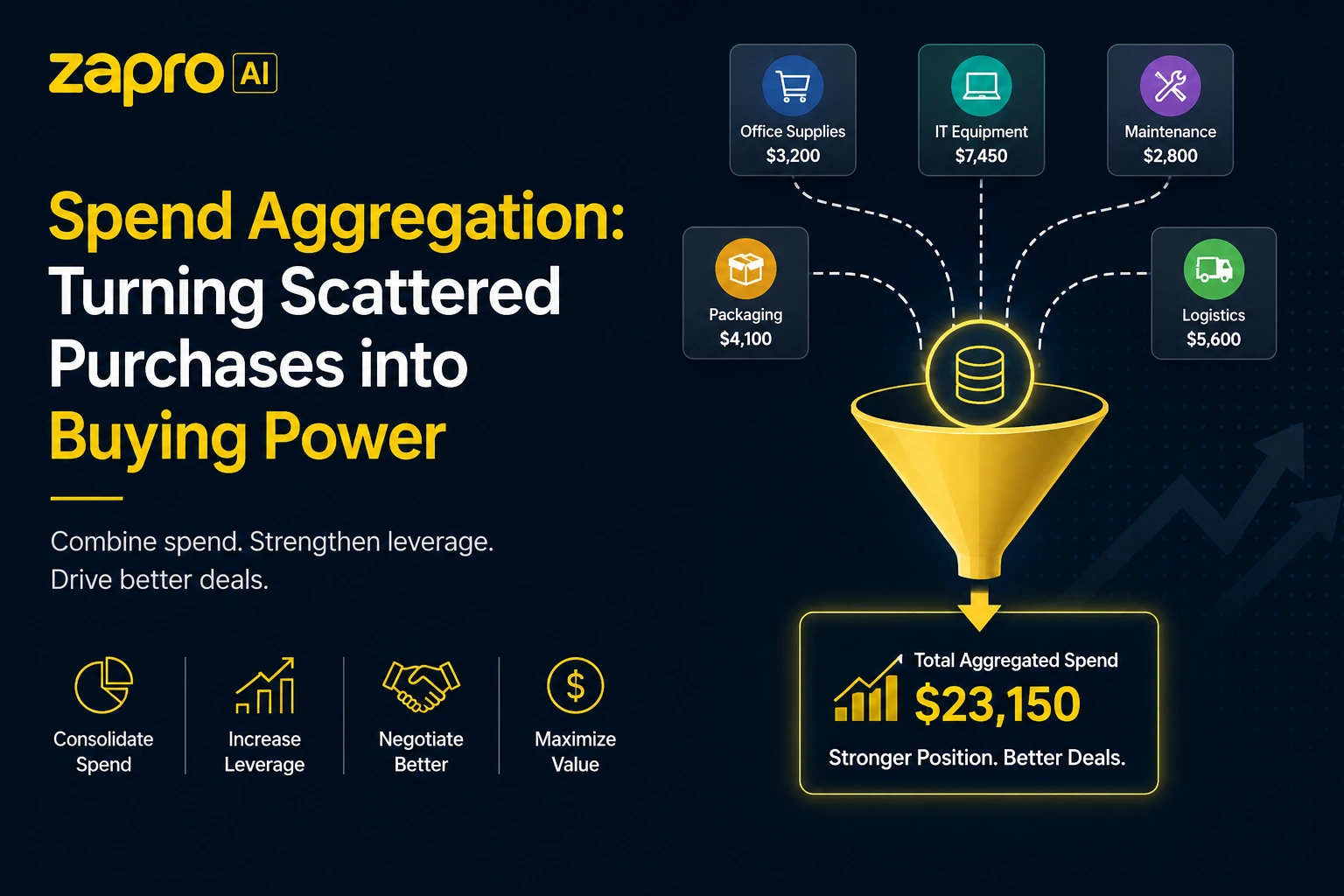
Spend aggregation means pooling the same purchases from across your departments and sites so they go to fewer vendors. Buying the same thing in one large volume earns better pricing than buying it in forty small ones. It also cuts the paperwork, because one vendor sends one invoice instead of forty.
Key takeaways
- Spend aggregation consolidates scattered purchases so that you can buy in volume instead of in pieces.
- Companies can expect to make savings in two places: a better rate and far less paperwork.
- Not every category requires consolidation, and some get worse when you try.
- Track the ratio per category, not across the business as a whole.
- Consolidating too far creates dependency, so cap how much of a critical category one vendor holds.
Team A needs 200 units and agrees on a price of $500 with the vendor. Team B needs the same 200 units from the same vendor and pays $300. Here, we lost a savings opportunity.
But neither knows that both are about to place the same order at two different prices. Both raise a purchase order, both get approved and processed separately, and the company pays the $200 gap, plus the cost of running the same transaction twice. Whereas, if the two teams had been aware they were making the same purchase and had consolidated their buys, then one order for 400 units would have been quoted lower than either.
What is spend aggregation?
Spend aggregation is a core procurement practice that combines similar purchases across an organisation so they can be bought as one volume. The purchases were always happening. Aggregation makes them visible as a single quantity you can negotiate on.
The trick is simple. Check if a vendor quotes a different price for 400 laptops than for 40, even when your annual total is identical.
Aggregation vs consolidation vs centralisation
These three terms are often used interchangeably, though they describe completely different things. Aggregation is about volume: you pool demand so it can be bought together, whoever does the buying. Consolidation is about vendor count, reducing how many vendors serve a category.
Centralisation is about authority, moving buying decisions into one team. You can aggregate without centralising, and many companies do, by agreeing on common vendors while each site places its own orders.
How aggregation relates to tail spend and addressable spend
Aggregation is a key tool for reducing tail spend, since pooling demand fixes a long list of small vendors. It only works within your addressable spend, because you cannot pool a purchase once a sourcing decision is made.
How to calculate spend aggregation
Measuring aggregation tells you how concentrated a category already is, which is how you decide whether consolidation would actually help you or make it worse.
The aggregation ratio formula
Aggregation ratio = (aggregated spend ÷ total spend) × 100
Run this formula per category, and not across the business. A company-wide figure averages a consolidated category against a fragmented one and hides both.
Track vendor count alongside it. The ratio tells you where the money goes; the count tells you what administration you carry to send it there.
What a good aggregation ratio looks like
There is no universal target, because the right ratio depends on the category. Paper or peripherals might be above 90%. A category with genuine variety, such as specialist consulting, might even be near 50% and still be well managed.
The useful comparison is against yourself. Measure each category, set a target for the ones you intend to work on, and re-check next year.
Which spend categories should be aggregated
Aggregation rewards some categories and damages others. The difference is whether the thing you are buying is genuinely interchangeable.
High-return aggregation candidates
| Category | Aggregation return | What makes it work |
| Office and facilities supplies | High | Identical items, bought everywhere, no switching cost |
| IT peripherals and standard software | High | Standardized specs, and seat counts pool cleanly |
| Print and marketing collateral | High | Same output, and volume moves the price sharply |
| Freight and courier | High | Lanes repeat, so committed volume earns rate cards |
| MRO consumables | Medium | Standard parts pool well, critical spares do not |
Categories where aggregation backfires
Some purchases lose value when you force them through one vendor. We have listed some examples below:
- Specialist professional services: You are buying a person’s judgment, not a commodity. Saving 5% by consolidating to one firm is a poor trade-off against getting the wrong advice.
- Emergency and critical spares: Availability matters more than price when a line goes down. One vendor with a two-day lead time costs more than three with one.
- Regulated or approved-source items: Where a specification or a regulator names a particular source to acquire goods, there is nothing to pool.
- Creative work: Design and campaign work vary by the individual doing it, so a rate card tells you little about what you will receive.
How to segment before you consolidate
Split each category into three groups before even reaching the vendor stage. You can easily pool identical purchases. Similar purchases specified differently need the spec agreed first, which is where the real work usually sits. Leave genuinely unique purchases alone.
Many aggregation projects stall when this step is skipped. Teams try to consolidate a category that was never uniform, hit resistance they cannot answer, and conclude the approach does not work.
How to implement spend aggregation
The sequence matters here. Each step depends on the preceding one, and starting at step four is why consolidation efforts produce numbers nobody trusts.
Step 1: Centralise procurement and invoice data
Pull purchase and invoice data from every system into one place, including sites and entities running their own tools. Partial data produces partial aggregation, and the categories you cannot see are usually the fragmented ones.
Zapro AI is designed for exactly this step, pulling purchase orders, receipts, and invoices from every connected system into one view so no category stays hidden by default.
Step 2: Clean and normalise vendor records
The same vendor is often recorded three times under slightly different names. To avoid this issue from costing you money: merge duplicates, standardise legal names, and match records to tax IDs where you can. Until you do, every count overstates fragmentation.
Step 3: Classify spend against a consistent taxonomy
Assign every transaction to a category using one scheme applied the same way everywhere. Your spend analysis process supplies the method. Without it, similar purchases sit in different buckets and never look poolable. Many of the best procurement software platforms automate this classification step.
Step 4: Rationalise the vendor base
Now pick which vendors to keep in each category. Choose based on delivered performance, not only price, and deactivate the ones you replace. Leaving them open lets the old list quietly rebuild itself.
Step 5: Consolidate orders and invoices
Move the pooled volume onto agreed contracts, then set up catalogs or standing orders so people buy from them without thinking. Where a vendor can bill monthly rather than per delivery, take it. That is where the processing savings come from.
Step 6: Monitor vendor performance post-consolidation
Fewer vendors means each one matters more, so performance tracking becomes more important after consolidation, not less. Set the review cadence and metrics before you sign, using your existing supplier performance framework.
Tracking that cadence across dozens of consolidated vendors is easier inside an AI Vendor Management platform, where performance data, contracts, and renewal dates sit against each vendor instead of a separate spreadsheet.
Step 7: Re-baseline each quarter
Recalculate the aggregation ratio and vendor count every quarter. New vendors appear constantly through legitimate one-offs, and a category left unchecked for a year drifts back toward where it started.
Benefits of spend aggregation
The returns arrive in four places, though only the first gets counted.
Volume pricing and improved terms
Larger committed volume earns better unit pricing, and often more than price. Payment terms, delivery frequency, and service levels become negotiable once a vendor sees meaningful annual value.
Fewer POs, fewer invoices, lower processing cost
Every removed vendor removes a stream of transactions. The worked example cut 930 invoices from one category, and across a full program the administrative saving frequently rivals the pricing saving.
Cleaner data and faster reporting
Seven vendors in a category produce data you can read. Forty-six produce a reconciliation exercise that slows every report after it.
Cleaner category data also makes expense forecasting more reliable, since the projection is only as good as the spend history it is built from.
Stronger vendor relationships
A vendor holding meaningful volume gives you senior attention, faster problem resolution, and earlier notice of supply issues. A marginal account receives none of that.
Spend aggregation challenges and risks
Aggregation fails for predictable reasons, and two are worth planning for before you start.
Departmental resistance to losing autonomy
Teams that chose their own vendors experience consolidation as something taken away. Involve them in setting the specification and choosing the vendor, then give them a faster route to buy than they had.
Fragmented data across ERPs and spreadsheets
Companies that grew by acquisition often run several systems with different vendor records and category schemes. Reconciling them is slow, and underestimating that work is why aggregation programs miss their first deadline.
Vendor concentration and dependency risk
This is the risk most aggregation advice skips. Consolidation improves your negotiating position at first, then gradually reverses it. A vendor holding 80% of a critical category knows switching would be painful, and the next renewal price reflects that.
Set a concentration cap per category before you consolidate. A common rule keeps any single vendor below roughly 40% of a business-critical category, with a qualified alternate live even if it gets little volume.
Aggregate invoicing and order aggregation
Order and invoice aggregation are the transactional half of the practice, and they save money even where pricing is fixed.
What aggregated invoicing is
Aggregated invoicing means a vendor bills you once for a period rather than per delivery. Fifty deliveries become one invoice with fifty lines. The goods and the price do not change, only the paperwork.
When to consolidate invoices vs. keep them separate
Consolidate when transactions are high-volume, low-value, and charged to the same budget. Keep them separate when costs are recharged to clients or projects, when different entities must be billed for legal reasons, or when goods receipt is verified per delivery. Splitting a consolidated invoice afterwards costs more than never combining it.
Frequently asked questions about spend aggregation
What is spend aggregation in procurement?
Spend aggregation is the practice of pooling similar purchases across departments, sites, or business units so they can be bought as one volume. The larger volume earns better pricing, and routing it through fewer vendors cuts the transactions your team processes.
What is aggregate spend?
Aggregate spend is the combined total of what an organisation buys in a category, or from a vendor, across all its units. It is the figure you negotiate on, and it is usually far larger than any single department realises it controls.
How do you calculate the spend aggregation ratio?
Divide the spend going to preferred vendors in a category by total spend in that category, then multiply by 100. Run it per category, since a blended company-wide figure hides which categories are consolidated and which are fragmented.
What is the difference between spend aggregation and spend analysis?
Spend analysis tells you what you bought, from whom, and in what quantity. Aggregation acts on that by pooling similar purchases into fewer, larger buys. Analysis is the diagnosis; aggregation is one of the treatments.
What is aggregated invoicing?
Aggregated invoicing is when a vendor issues one invoice covering a period rather than one per delivery. It cuts processing cost and reconciliation effort without changing what you bought or what you pay.
Is spend aggregation right for every category?
No. Aggregation works where items are interchangeable, such as office supplies, peripherals, or freight lanes. It works poorly for specialist services, emergency spares, and regulated items, where the source is fixed or availability matters more than price.
Consolidate spend without losing control
Aggregation succeeds when the pooled volume is visible, and the agreed route is the easy one to follow. Both are system problems as much as sourcing ones.
Zapro brings requisitions, purchase orders, receipts, and invoices onto one platform, so spend across every site and entity sits in one classified view. Fragmented categories become poolable once you see the combined volume, and the aggregation ratio becomes a number you pull rather than rebuild each quarter.
Catalogs and approval rules keep consolidated vendors as the default path, which stops the vendor list from rebuilding itself once a project ends. AI agents handle the routing and matching behind each transaction, so fewer vendors also mean less administration.
This kind of consolidation is difficult to sustain by hand once a business runs more than a few categories, which is why procurement teams increasingly manage aggregation inside an AI procurement platform rather than spreadsheets and email threads. You can check Zapro pricing to see which plan covers your sites and entities.
Book a demo to see how Zapro handles consolidated buying, catalogs, and spend visibility across your sites.
Don’t miss our weekly updates
We’ll email you 1-3 times per week—and never share your information.
About the Author

Md. Kafil


About the Reviewer

Zapro is dedicated to helping businesses of all sizes make informed decisions. We adhere to strict editorial guidelines to ensure that our content meets and maintains our high standards.
Our editorial standards help keep every article accurate, useful, and trustworthy.