

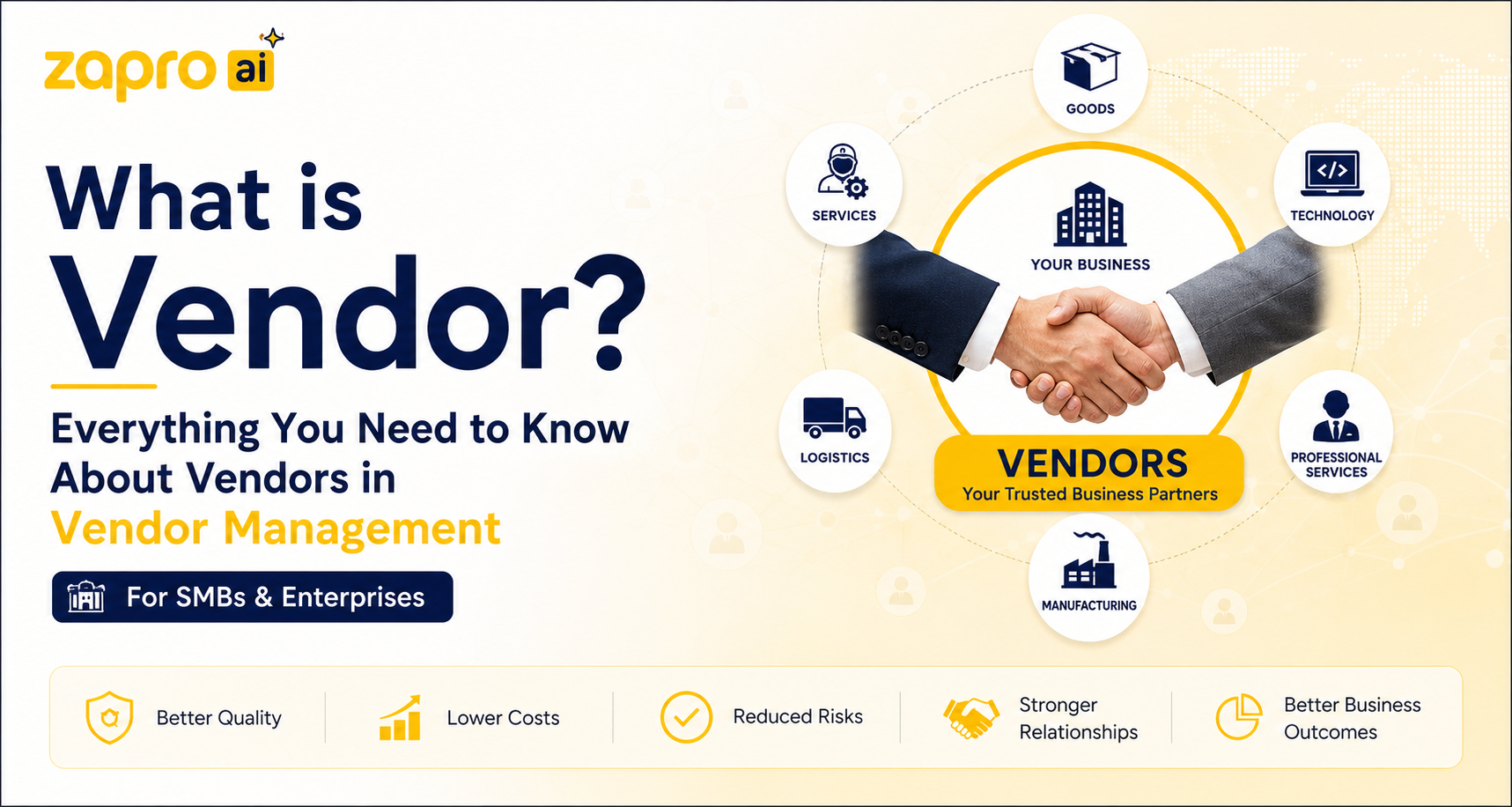
The short answer: A vendor is a person or company that sells goods or services directly to a buyer, usually a finished product the buyer will use or resell exactly as it arrives. Vendors sit at the end of the supply chain, closest to the point of use, and most vendor relationships are transactional rather than deeply integrated. In everyday U.S. business language — and in almost every accounting or ERP system — “vendor” is also the catch-all word for any third party a business pays, whether that party is technically a supplier, a contractor, or a vendor in the stricter sense.
Key takeaways
- A vendor sells a finished good or service. A supplier provides the raw materials or components behind what a business makes — see the full vendor vs supplier comparison.
- Vendors range from a Fortune 500 software company to a single roaster at a Saturday farmers market. Size does not define the term — the transaction does.
- In the U.S., how you classify a vendor for tax purposes — 1099-NEC contractor, corporation, or W-2 employee — carries real IRS penalties if you get it wrong.
- Most accounting and ERP systems file every third party you pay under one “vendor master” record. That is a bookkeeping convention, not a judgment about how important the relationship is.
- Selling to the federal government as a vendor requires registering in SAM.gov and holding a Unique Entity ID (UEI) — a step a lot of small businesses skip, then wonder why they cannot bid on a contract.
What Is a Vendor?
A vendor is any individual, business, or organization that sells something to a buyer in exchange for payment. That “something” is normally a finished product or a defined, self-contained service — office supplies, a software subscription, catering for an event, cleaning services for an office, or components sold retail rather than for further processing. The buyer takes what the vendor delivers and uses it, sells it, or consumes it largely as-is. The vendor does not typically become part of the buyer’s own production process the way a raw-material supplier does.
The word itself is old and has barely drifted in meaning. “Vendor” comes from the Latin vendere, “to sell,” by way of Anglo-French vendour. It entered English commercial and legal writing in the 15th century meaning exactly what it means today: one who sells. That stability is part of why the term stretches comfortably across such different contexts — a vendor booth at a craft fair and a $2 billion enterprise software vendor are using the same word correctly.
Three things are almost always true of a vendor relationship:
- It is transactional. A purchase order, invoice, or receipt typically governs a single exchange or a series of similar exchanges, rather than a long-term development contract.
- The product is standardized. A vendor generally sells the same thing to many buyers, with limited customization.
- Replacement is comparatively fast. Because the offering is standardized, switching vendors — a new office-supply company, a new caterer — is usually a matter of weeks, not months.
None of that means vendors are unimportant. A payroll vendor, a core banking vendor, or a single-source software vendor can be more operationally critical than most suppliers — the label describes the shape of the relationship, not its importance. That distinction is covered in full in vendor vs supplier: what’s the difference and how to classify yours.
What Does a Vendor Do?
Strip away the industry-specific detail and every vendor performs the same short list of functions:
- Sells a defined product or service at a stated or quoted price.
- Fulfills against an order — a purchase order, a signed quote, or a point-of-sale transaction — rather than against an open-ended scope of work.
- Invoices for what was delivered, usually referencing the PO or order number so the buyer’s accounts payable team can match it.
- Carries limited ongoing obligation once the good is delivered or the service is performed, beyond warranty terms or a subscription renewal.
Many finance teams now hand that matching step to AP Automation Software, which pulls the PO and invoice together automatically and flags any mismatch before payment goes out.
What a vendor does not typically do is participate in the buyer’s product design, hold multi-year exclusivity, or accept the kind of joint liability that shows up in a strategic supplier or contractor agreement. When a relationship starts to look like that — deep integration, single-source dependency, shared risk — it has usually outgrown the vendor label, whatever the accounting system still calls it.
Types of Vendors
Vendors are usually grouped by where they sit in the chain between production and use, not by industry.
Manufacturers
A manufacturer acts as a vendor when it sells its finished product directly to the business or person who will use it — a printer manufacturer selling directly to an office, for instance. The same manufacturer is a supplier when it sells the same or a related item in bulk to a company that will process, assemble, or resell it further. The manufacturer does not change; the relationship does.
Wholesalers and Distributors
Wholesalers and distributors buy in volume from manufacturers and sell onward, adding logistics, warehousing, and often financing terms. They act as a vendor to the retailer or business buying from them, even though almost nothing they sell was made in-house.
Retailers
Retailers are vendors to end consumers and to businesses buying off-the-shelf goods rather than negotiating a supply contract — an office manager buying furniture from a retail store is buying from a vendor in the plainest sense of the word.
Service and Software Vendors
This is the fastest-growing category in most modern vendor files: SaaS subscriptions, IT support contracts, marketing agencies, staffing firms, cleaning and facilities services. The product is intangible, but the same logic applies — a defined, largely standardized offering sold under a contract or order.
Independent and Gig Vendors
Freelancers, sole proprietors, and trade-show or market vendors sell directly, often without a company structure behind them. In the U.S., this is the group most likely to be paid on a 1099-NEC and most likely to trigger a worker-classification question — covered below.
Government Vendors
A business that sells goods or services to a federal, state, or local government agency is a government vendor. This category runs under its own registration and compliance rules — covered in the dedicated section below — because the buyer is a public body rather than a private one.
How a Vendor Relationship Works
Most vendor transactions, regardless of industry, move through the same sequence:
| Step | What happens |
|---|---|
| 1. Need identified | A department identifies something to buy and checks whether an approved vendor already covers it. |
| 2. Vendor selected | The buyer picks a vendor — from an existing list, a quick quote comparison, or a new vendor is onboarded. |
| 3. Order placed | A purchase order, signed quote, or online order confirms price, quantity, and delivery terms. |
| 4. Vendor delivers | The goods ship or the service is performed against the order. |
| 5. Vendor invoices | The vendor bills the buyer, referencing the PO or order number. |
| 6. Buyer matches and pays | Accounts payable checks the invoice against the PO and receipt (a “three-way match”) and pays per the agreed terms — commonly net 30 in the U.S. |
| 7. Performance is (sometimes) reviewed | Repeat or high-spend vendors get tracked on delivery, quality, and responsiveness; one-off vendors usually do not. |
Step 6 is where most of the friction lives in practice. A mismatch between the PO, what was actually delivered, and what the vendor invoiced is the single most common reason a payment stalls — which is exactly the gap that procure-to-pay automation exists to close.
Those same steps — identifying a need, selecting a vendor, and routing the resulting purchase order for approval — are exactly what an AI procurement platform is built to run end to end, so the vendor records built here feed directly into requisitioning and approvals instead of sitting in a separate system.
Vendor Classification in the United States: Tax, Legal, and Compliance Status
This is the part of “what is a vendor” that generic definitions skip and that actually creates risk. In the U.S., how you classify and document a vendor determines your tax reporting obligations, not just your bookkeeping labels.
1099-NEC contractor vs. W-2 employee
An individual vendor who is not incorporated is usually either an independent contractor (paid via Form 1099-NEC, with no tax withheld) or, if the business actually controls how, when, and where the work is done, legally an employee who should be on payroll instead. The IRS evaluates this using behavioral control, financial control, and the type of relationship — there is no single deciding factor, which is exactly why misclassification is one of the most common payroll audit findings for small and mid-size businesses. The IRS’s own guidance on this is the most current source: Independent Contractor (Self-Employed) or Employee?
Getting it wrong is not a paperwork problem. A business that misclassifies an employee as a 1099 vendor can be liable for back payroll taxes, penalties, and interest — and in some states, additional wage-and-hour exposure on top of the federal issue.
Collecting a W-9 before you pay
Before paying a new U.S. vendor — especially an individual, sole proprietor, or LLC — standard practice is to collect a completed Form W-9. It records the vendor’s legal name, entity type, and Taxpayer Identification Number, and is what a business uses to determine whether it owes that vendor a 1099-NEC at year-end (generally required once payments to a non-corporate vendor for services cross $600 in a calendar year, per Form 1099-NEC instructions). Skipping this step is the single most common reason accounts payable teams scramble every January.
If a vendor refuses to provide a W-9 or provides an incorrect Taxpayer Identification Number, the IRS can require the payer to withhold 24% of future payments to that vendor — known as backup withholding — until the issue is resolved.
Contracts for goods: UCC Article 2
When a vendor is selling goods rather than services, the sale is generally governed by Article 2 of the Uniform Commercial Code (UCC), adopted in some form by every U.S. state. UCC Article 2 sets default rules for delivery, acceptance, warranties, and remedies for breach that apply even when a purchase order doesn’t spell every term out — see the full text of UCC Article 2 via Cornell Law School’s Legal Information Institute. It’s why a one-page PO for physical goods is legally enforceable even without a lengthy contract behind it.
State sales and use tax
A vendor selling taxable goods or services generally has to collect sales tax in states where it has “nexus” — a physical or economic presence — and remit it to that state. A business buying for resale, rather than for its own use, typically provides the vendor a resale certificate instead of paying sales tax on the purchase. Rules and thresholds vary by state, which is why multi-state vendors usually run this through dedicated sales-tax software rather than manual tracking.
Registering as a Vendor with the U.S. Government
Selling to a federal agency runs on different rules than selling to a private business, and it’s a step many otherwise-qualified small businesses never take because they assume it’s only for large contractors.
- SAM.gov registration. Any business that wants to sell to the federal government must register in the System for Award Management (SAM.gov) and obtain a Unique Entity ID (UEI). No SAM.gov registration means no federal contract, no matter how competitive the offer.
- GSA Schedules. Many federal purchases run through the GSA Multiple Award Schedule, a pre-negotiated contract vehicle that lets agencies buy from approved vendors without a full solicitation each time.
- Small-business set-asides. Programs such as 8(a), HUBZone, Women-Owned Small Business (WOSB), and Veteran-Owned Small Business certifications reserve a share of federal spending for qualifying vendors — the federal government targets at least 23% of contracting dollars toward small businesses each year. Full program details are on the SBA’s federal contracting assistance programs page.
State and local governments run parallel — but separate — vendor registration portals, so a business selling to a state agency and the federal government typically has to register in both places.
Examples of Vendors by Industry
| Industry | Example vendor | What they sell |
|---|---|---|
| Retail | A point-of-sale software company | Checkout and inventory software, sold as a standard subscription to any retailer |
| Construction | An equipment rental company | Scaffolding or machinery rented for the duration of a project |
| Healthcare | A medical supply distributor | Gloves, syringes, and consumables sold from stock catalog pricing |
| SaaS / IT | A cloud hosting or CRM provider | A standardized software product sold under a subscription license |
| Hospitality / Events | A catering company | Food and service for a defined event, priced per head |
| Government contracting | An office-furniture company on a GSA Schedule | Furniture sold to agencies under a pre-negotiated federal contract |
Vendor vs. Supplier, Contractor, and Distributor
The short version: a vendor sells you a finished good or service you use as delivered. A supplier provides the materials or components your business depends on to produce what it sells. A contractor sells expertise and labor against a defined scope rather than a product. A distributor buys in volume from manufacturers and moves goods onward, usually without ever selling directly to the end user itself.
These lines blur constantly in practice — the same company can be a vendor on one contract and a supplier on another. The full breakdown, including a three-question test for classifying an ambiguous relationship, is in vendor vs supplier: what’s the difference and how to classify yours.
How Vendor Management Works
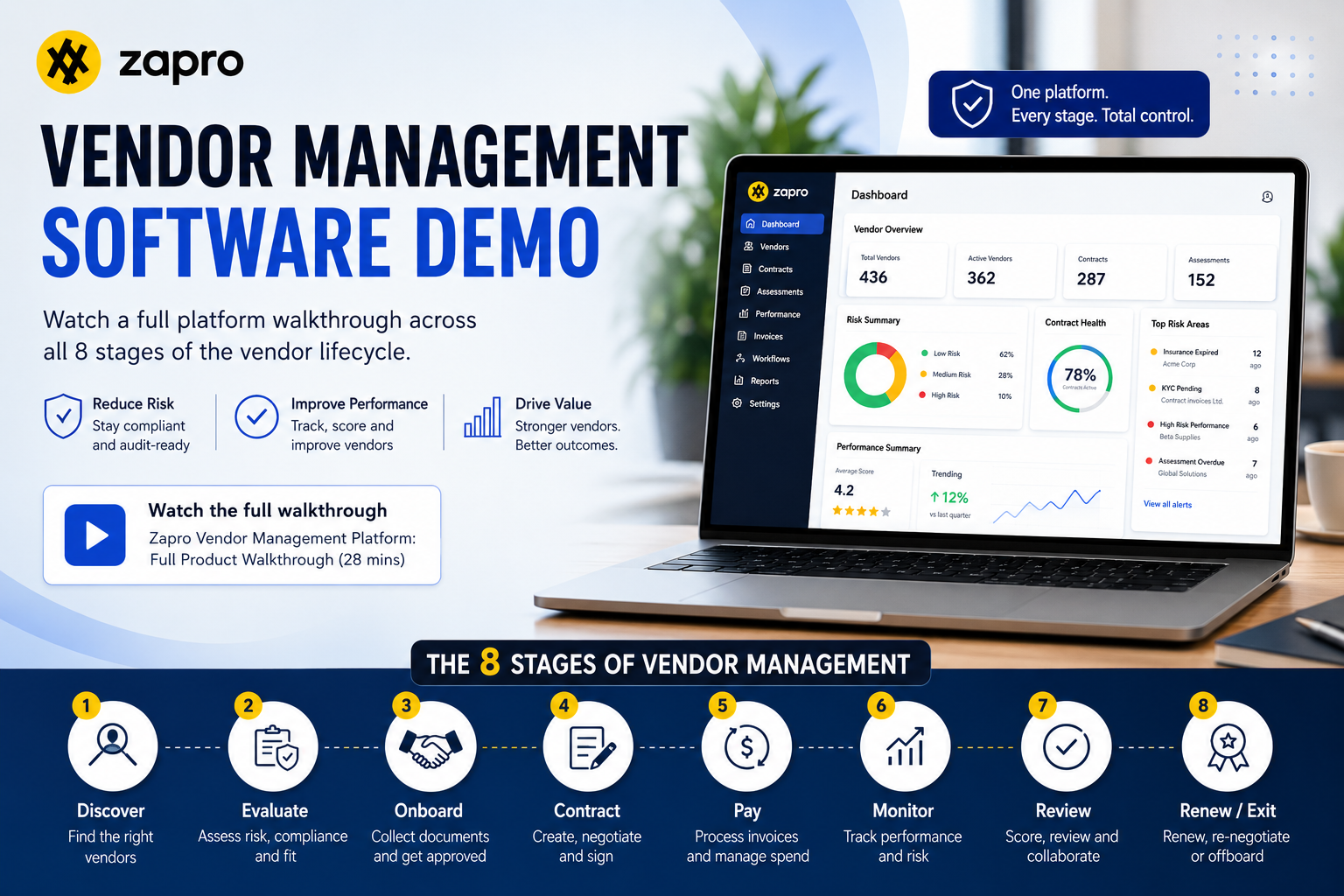
Vendor management is the ongoing work of finding, onboarding, paying, and evaluating the vendors a business relies on — separate from the one-time act of buying something. For a low-stakes, easily replaced vendor, that might mean nothing more than a clean record in the accounting system. For a vendor a business depends on heavily, it means onboarding checks, contract tracking, performance scorecards, and a documented offboarding process. Smaller teams that have outgrown a spreadsheet usually move this into Vendor Management software for SMB, which keeps the W-9, the contract, the payment record and the performance notes on one vendor record without an enterprise-sized rollout. The full framework, including an eight-stage lifecycle and a 90-day plan for building a vendor management program from scratch, is covered in vendor management: the complete guide.
Common Vendor Risks and Challenges
The risks that come with vendors are usually smaller in scale than supplier risk but more numerous, simply because there are more vendors than suppliers on most third-party lists: duplicate vendor records that split spend and hide volume discounts, missing or expired W-9s that create year-end tax scrambles, vendors quietly operating without the insurance a contract requires, and vendor sprawl — dozens of small software vendors nobody remembers approving. A structured vendor risk management process catches most of this before it becomes expensive.
Vendor Glossary
- Vendor master file — the central record in an accounting or ERP system holding every approved vendor’s tax, banking, and contact details.
- Purchase order (PO) — a buyer-issued document authorizing a specific purchase at a specific price before the vendor delivers.
- Three-way match — reconciling the purchase order, the goods receipt, and the vendor’s invoice before payment is approved.
- Net terms — the payment window a vendor grants, such as net 30 (due 30 days after invoice date).
- W-9 — the IRS form a U.S. vendor completes to provide its legal name, entity type, and Taxpayer ID before being paid.
- 1099-NEC — the IRS form reporting nonemployee compensation paid to an unincorporated vendor.
- Backup withholding — the 24% the IRS requires a payer to withhold from a vendor who fails to provide a valid Taxpayer ID.
- Preferred vendor — a vendor a business has pre-approved, often at negotiated rates, so buyers don’t need to re-source every time.
- Vendor onboarding — the process of collecting a new vendor’s legal, tax, banking, and compliance information before the first payment.
- Vendor scorecard — a recurring rating of a vendor’s delivery, quality, and responsiveness, used mainly for repeat or high-spend vendors.
- Unique Entity ID (UEI) — the identifier a business must hold in SAM.gov to register as a federal government vendor.
- GSA Schedule — a pre-negotiated federal contract vehicle that lets agencies buy from approved vendors without a new solicitation each time.
- Resale certificate — a document a reselling business gives a vendor to buy goods without paying sales tax on that purchase.
Frequently Asked Questions
Is a vendor and a supplier the same thing?
Not exactly, though the words are used interchangeably in casual conversation. A vendor sells a finished good or service you use as delivered; a supplier provides the inputs your business depends on to produce what it sells. See the full vendor vs supplier comparison for the classification test.
Is a vendor a 1099 employee?
Not automatically. A vendor can be an individual paid on a 1099-NEC as an independent contractor, or it can be an incorporated business that issues its own invoices and receives no 1099 at all. Whether an individual vendor should legally be a 1099 contractor or a W-2 employee depends on the IRS’s behavioral- and financial-control tests, not on what either party calls the arrangement.
Do I need a W-9 from every vendor?
Best practice is to collect one from every U.S. vendor before the first payment, especially individuals, sole proprietors, and LLCs, since it’s what determines whether a 1099-NEC is owed at year-end. Some businesses skip it for large, obviously-incorporated vendors, but collecting it upfront avoids a January scramble either way.
What’s the difference between a vendor and a contractor?
A vendor typically sells a standardized product or service against an order. A contractor sells labor and expertise against a defined scope of work, often for a fixed project rather than a repeatable transaction. In practice, a contractor on a critical path can carry more operational risk than most vendors do, even though the two are taxed and contracted similarly.
Is it “vendor” or “vender”?
“Vendor” is the correct spelling in business, accounting, and legal contexts. “Vender” is a common misspelling and does not appear in procurement or tax terminology — always use “vendor” on purchase orders, W-9 requests, and vendor master records.
What is a preferred vendor?
A preferred vendor is one a business has already vetted and approved, usually at negotiated pricing, so buyers can purchase from them without re-sourcing or re-approving each time. Preferred vendor lists are one of the simplest ways to cut maverick spend.
What’s the difference between a vendor and a manufacturer?
A manufacturer makes a product. It acts as a vendor when it sells that finished product directly to whoever will use it, and as a supplier when it sells the same or a related item in bulk to a business that will process, assemble, or resell it. The manufacturer doesn’t change — the relationship does.
Do small businesses need to register as vendors with the government?
Only if they want to sell directly to a government agency. Selling to a private business requires no special registration. Selling to the federal government requires SAM.gov registration and a Unique Entity ID at minimum, regardless of company size.
What is a vendor master file?
It’s the central record in a company’s accounting or ERP system listing every approved vendor along with its tax ID, banking details, contact information, and payment terms. A messy vendor master — duplicate entries, outdated banking details — is one of the most common sources of payment errors and fraud exposure.
Can an individual be a vendor?
Yes. A freelancer, sole proprietor, or independent seller at a market or trade show is a vendor in the fullest sense of the word, even without a formal company behind them. The tax treatment simply shifts to an individual’s Social Security Number instead of a business Tax ID, typically reported on a 1099-NEC.
About the Author
Md. Kafil is the Founder and CEO of Zapro, an AI-powered procurement and spend management platform. He has over 16 years of leadership experience across product, customer success, marketing, and sales for global enterprises in North America, Europe, and APAC, with a focus on how businesses structure, classify, and manage the third parties they pay. Read more on the About Zapro page or connect on LinkedIn.
Sources and Further Reading
- IRS — Independent Contractor (Self-Employed) or Employee?
- IRS — About Form W-9
- IRS — About Form 1099-NEC
- Cornell Law School, Legal Information Institute — Uniform Commercial Code, Article 2 (Sales)
- U.S. General Services Administration — SAM.gov
- U.S. General Services Administration — GSA Multiple Award Schedules
- U.S. Small Business Administration — Federal Contracting Assistance Programs
See how vendor records actually stay clean. Zapro handles vendor onboarding, W-9 and tax data collection, three-way matching, and payment in one platform, so a vendor classified correctly on day one still has clean records three years later. Book a 30-minute demo, or walk through the vendor management software demo first.
Don’t miss our weekly updates
We’ll email you 1-3 times per week—and never share your information.
About the Author

Md. Kafil


About the Reviewer

Zapro is dedicated to helping businesses of all sizes make informed decisions. We adhere to strict editorial guidelines to ensure that our content meets and maintains our high standards.
Our editorial standards help keep every article accurate, useful, and trustworthy.