

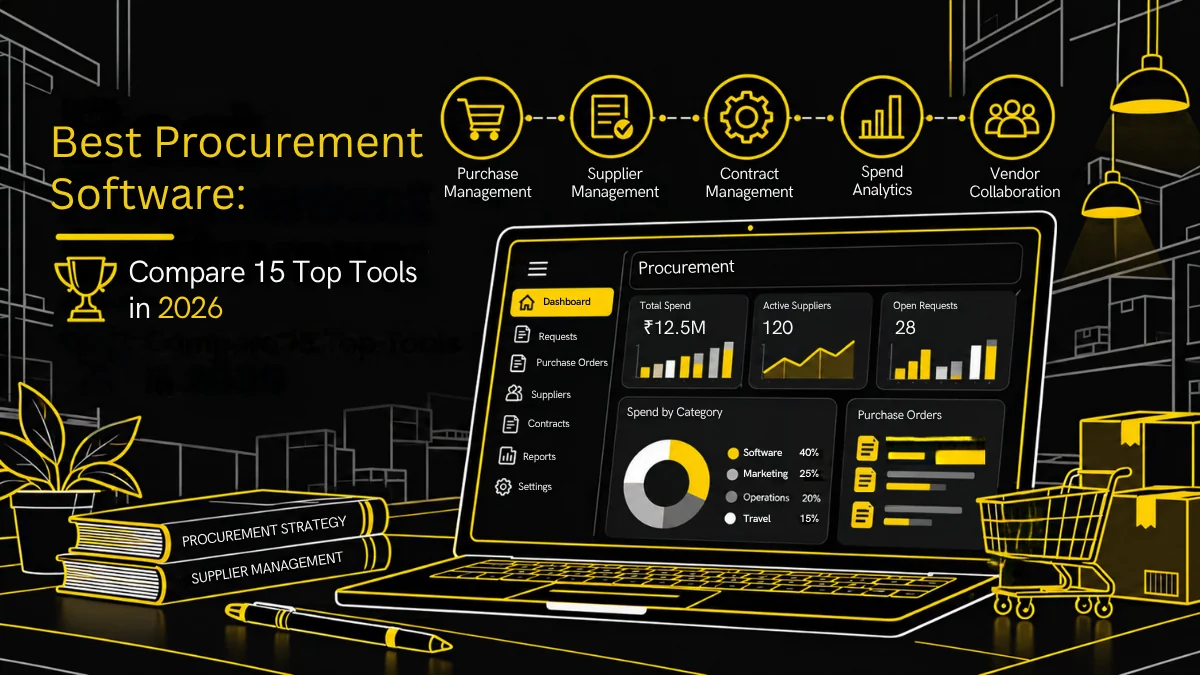
As businesses scale, it becomes increasingly important to choose the best procurement software to organize, control, and expedite purchases.
However, with ample platforms offering features such as supplier management, order management, spend tracking, workflow automation, and AI-powered procurement, finding the one that suits you can be overwhelming.
At a Glance: Our Top Picks for 2026
| Platform | Best For | Starting Price | Pros | Cons |
|---|---|---|---|---|
| Zapro AI | AI-powered procurement and AP automation | • AI-native automation for invoice capture, matching, and anomaly detection • Combines procurement, AP automation, and supplier risk management • Fast implementation and scalable pricing for SMBs to enterprises | • May offer more functionality than very small businesses need • Best suited to organizations looking to automate AP and procurement together • Advanced capabilities may require implementation and configuration | |
| SAP Ariba | Global enterprise procurement | Price Upon Request | • Strong support for global enterprise procurement • Broad supplier network and source-to-pay capabilities • Integrates well with SAP environments | • Can be complex for smaller businesses • Best fit often depends on an existing SAP ecosystem • Enterprise functionality can require significant implementation effort |
| Coupa | Enterprise spend management | Price Upon Request | • Broad spend management capabilities across procurement, expenses, invoicing, and payments • Strong supplier management and spend visibility • Provides analytics and centralized spend control | • Enterprise-focused platform may be more than smaller organizations need • Broad functionality can make implementation more involved • Organizations may need configuration to fit specific procurement workflows |
| Oracle Fusion Procurement | Oracle ERP customers | $400 to $625/ Month | • Strong integration with Oracle Cloud ERP • Covers purchasing, sourcing, suppliers, and contracts • Supports automated procurement workflows | • Most suitable for organizations already using Oracle Cloud • May be complex for smaller businesses • Can require significant implementation and configuration |
| Ivalua | Complex procurement environments | Price Upon Request | • Highly configurable for complex procurement environments • Covers the full source-to-pay lifecycle • Strong supplier, contract, and strategic sourcing capabilities | • Primarily geared toward larger organizations • Extensive configurability can increase implementation complexity • May be more functionality than organizations with simple procurement needs require |
| GEP SMART | Unified source-to-pay | Price Upon Request | • Unifies source-to-pay processes on one platform • Uses AI and analytics across procurement workflows • Supports strategic sourcing and broader procurement operations | • Broad functionality can require a more involved implementation • May be excessive for organizations with straightforward purchasing needs • Best suited to organizations seeking a comprehensive procurement platform |
| JAGGAER | Institutional and regulated procurement | Price Upon Request | Strong fit for specialized sectors such as healthcare, education, and research • Supports sourcing, supplier management, contracts, and spend analytics • Handles specialized procurement and compliance requirements | • Specialized capabilities may be unnecessary for simpler procurement environments • Enterprise and institutional functionality can add complexity • Organizations with basic purchasing needs may not need its broader feature set |
| Zip | Intake-to-procure orchestration | Price Upon Request | • Streamlines intake-to-procure workflows • Centralizes purchase requests and approvals • Can work alongside existing procurement systems | Primarily focused on the front end of procurement • Organizations may still need separate tools for downstream procurement functions • Value depends on how well it integrates with existing procurement systems |
| Precoro | SMB procurement | $499/Month | • Designed for small and mid-sized organizations • Covers requisitions, purchase orders, approvals, budgets, and suppliers • Provides purchasing controls without requiring a large enterprise suite | • More limited in scope than comprehensive enterprise procurement platforms • May not suit highly complex global procurement environments • Organizations needing advanced strategic sourcing may require additional capabilities |
| Procurify | Budget and spend control | Price Upon Request | • Strong focus on purchasing and spend control • Provides budgeting, approvals, and spend visibility • Suitable for growing businesses seeking better purchasing controls | • May not meet complex enterprise supplier-risk requirements • More focused on purchasing and spend control than full source-to-pay functionality • Larger organizations may need more advanced procurement capabilities |
| Airbase | Procurement, cards, and AP | Price Upon Request | • Combines procurement with AP and corporate card functionality • Helps centralize different types of business spending • Useful for finance teams seeking streamlined spend management | • Procurement is only part of its broader finance platform • May not provide the depth of strategic sourcing found in enterprise procurement suites • Organizations with complex procurement requirements may need additional functionality |
| Order.co | Multi-location purchasing | Price Upon Request | • Useful for multi-location purchasing • Centralizes orders and vendor spending • Improves visibility across purchasing activity | • Best suited to purchasing and order management rather than full source-to-pay procurement • May be less suitable for organizations needing advanced strategic sourcing • Multi-location functionality may be unnecessary for smaller, centralized businesses |
| Kissflow Procurement Cloud | No-code workflows | Price Upon Request | • Flexible no-code workflow customization • Supports purchase requests, purchase orders, and approvals • Allows teams to adapt workflows without extensive developer involvement | • May require configuration to support highly complex procurement environments • Organizations needing advanced strategic sourcing may need additional capabilities • Broad enterprise procurement requirements may call for a more specialized platform |
| Tradeshift | E-invoicing and supplier connectivity | Price Upon Request | • Strong focus on e-invoicing and supplier connectivity • Supports digital transactions and AP workflows • Connects businesses with supplier networks | • Less focused on complex internal procurement workflows • May not be the best fit for organizations seeking comprehensive source-to-pay functionality • Businesses may need additional tools for broader procurement processes |
| Fraxion | Spend control and compliance | Price Upon Request | • Strong focus on purchasing compliance and spend control • Supports requisitions, budgets, approvals, and purchasing policies • Suitable for mid-market organizations and multi-entity purchasing | • More focused on purchasing control than strategic sourcing • May not match the breadth of larger source-to-pay suites • Organizations seeking advanced AI or strategic sourcing capabilities may need to compare additional platforms |
15 Best Procurement Software Platforms for 2026
Choosing the best procurement software platforms helps businesses streamline purchasing, automate repetitive tasks, and control budgets and spending.
To make things easier, we have put together a list of the 15 best procurement software platforms for 2026, based on their specifications, key features, automation capabilities, integrations, usability, and AI tools.
Zapro AI
Zapro AI is an AI-native procure-to-pay and accounts payable platform that helps bring AP automation, supplier risk management, and purchasing into one place.
The main advantage is that AI is integrated into the platform from the start, managing invoice capture, three-way matching, and automatic anomaly detection, which reduces manual effort.
It works best for SMBs that want to automate processes with enterprise-level efficiency without the risk.
Main features:
- AI-powered invoice OCR automatically captures and extracts data from the invoices.
- Also matches and verifies purchase orders with the invoices.
- Supports approval workflows on multiple levels by simplifying purchasing approvals.
- Provides clear insights into spending and expenses through real-time analytics.
- Manages supplier relationships through vendor onboarding and risk scoring.
- Connects with existing systems through integrated accounts and Native ERP.
- Fast implementation gets teams up and running in weeks
- Scalable pricing supports businesses from SMBs to enterprises
See the full workflow in action: a start-to-finish walkthrough of the OCR capture and matching described above.
Zapro AI is rated 4.7 stars on G2 by finance and procurement teams
SAP Ariba
SAP Ariba is best for large global enterprises, as it is one of the most well-known procurement platforms and is specifically meant for organizations that already use SAP infrastructure.
The SAP ecosystem encompasses procurement, sourcing, vendor management, contracts, and related source-to-pay processes, while the business network connects buyers and suppliers.
Main features:
- It provides global procurement support.
- Keeps the entire supplier network connected.
- Helps with strategic sourcing while managing contracts simultaneously.
- Streamlines procurement workflows and integrates with SAP environments.
Although large organizations will benefit from working with SAP Ariba, it could be complicated for smaller businesses.
Coupa
Coupa works best for enterprise spend and supplier management, providing a comprehensive platform for businesses to manage their expenditures, procurement, invoicing, payments, and related spend processes.
The platform is built to provide procurement and finance teams with visibility across several categories of business expense management.
Main Features:
- Helps manage and track expenses.
- Supports purchasing processes and procurement.
- Helps businesses with supplier management
- Provides detailed expense reports and analytics.
- Secures payment and invoice workflows efficiently.
- One platform for all spending, including procurement and other business areas.
Oracle Fusion Cloud Procurement
Oracle Fusion Cloud Procurement works best for companies already using Oracle Cloud ERP, as the procurement platform integrates with the ecosystem. It is one of the leading procurement software with automation features.
The platform covers purchasing, sourcing, supplier management, contracts, and related procurement workflows.
Main Features:
- It is integrated directly with the Oracle ecosystem.
- Supports procurement management and sourcing suppliers for businesses.
- Works well for businesses already equipped with Oracle Cloud applications,
Ivalua
Ivalua is well-suited for highly configurable enterprise procurement, offering source-to-pay functionality for organizations with complex procurement processes, numerous entities, requirements, or categories.
The platform improves configurability, enabling organizations to adapt procurement workflows to their internal processes.
Main features:
- Manages the complete source-to-pay process
- Helps businesses manage suppliers
- Manages contracts
- Offers strategic sourcing tools and workflows that can be customized
- Fits large organizations with complex needs of procurement.
GEP SMART
GEP Smart is well-suited for unified source-to-pay procurement, as it brings everything onto a single platform.
- It utilizes AI and insights across different procurement processes.
- Supports the full source-to-pay cycle.
- Manages strategic sourcing.
- Supports AI-powered procurement workflows
- Designed to manage multiple procurement processes in a unified space.
JAGGAER
Jaggaer, suitable for academic, healthcare, research, and public-sector procurement, offers procurement and sourcing technology for organizations with specialized requirements.
The customer base and product capabilities of Jaggaer make it especially relevant to institutional environments where sourcing rules, compliance, and specialized purchasing workflows are necessary.
Main features:
- Supports strategic sourcing
- Manages procurement procedures
- Provides supplier management tools
- Helps manage contracts
- Tracks spend analytics and is designed for specific industries
- Suitable for healthcare, research, education, and public-sector organizations.
ZIP
Zip is best for orchestrating intake-to-procure as it focuses on the front end of the procurement process.
Employees can submit purchase requests in one place, and the platform automatically sends them through the right approval and procurement steps.
Main features:
- Employees can submit purchase requests on a single platform.
- Manages and directs approval processes.
- Helps teams manage procurement requests
- Automates and centralizes routine procurement workflows
- Works for businesses with existing procurement systems but want an efficient purchasing process.
Precoro
Precoro focuses on core procurement workflows for small and mid-sized organizations and offers purchasing controls without requiring an institution to adopt a large enterprise procurement suite.
Main features:
- Supports purchase requisitions.
- Helps create and handle purchase orders
- Encourages approval workflows
- Assists teams in managing purchasing budgets and suppliers
- Well-suited for SMBs that require better control over purchasing and approvals
Procurify
Procurify is for SMBs with mid-market spend control, helping organizations control spending before purchases become invoices.
It made the list of best procurement software platforms, offering purchasing, budgeting, approval, and spend visibility features to help finance teams screen expenses.
Main features:
- Helps with purchase requests and orders
- Assists in budget tracking and managing spend
- Approval workflows and reporting with proper data
- Growing businesses that need stronger purchasing controls and budget visibility will benefit.
However, organizations that require extensive enterprise supplier risk management will need a more robust platform.
Airbase
Airbase combines procurement workflows with corporate card and accounts payable functionality.
This can be beneficial for finance teams that want to manage different types of business spending from a streamlined platform.
Main features:
- Supports procurement processes
- Manages accounts payable
- Offers corporate cards for business spending
- Helps control employee expenses
- Mid-sized finance teams looking to streamline procurement and spend procedures will benefit from Airbase.
Order.co
Order.co is appropriate for multi-location purchasing for businesses operating across different locations and interacting with multiple vendors. Centralizing purchases helps businesses track orders and vendor spending more easily.
Main features:
- It supports purchasing across multiple locations and managing different vendors.
- Makes managing purchase orders even simpler and helps track orders.
- Offers better visibility into spending and better manages expenses.
Kissflow Procurement Cloud
Kissflow Procurement Cloud offers flexible workflows that teams can modify without much developer assistance.
With this approach, organizations whose approval structures and procurement processes change frequently will find it useful.
Main features:
- Enables teams to build workflows without coding.
- Supports purchase requests by creating and managing purchase orders.
- Automates approval processes and provides procurement reports.
Tradeshift
Tradeshift is best for E-invoices and supplier connectivity, as it focuses heavily on digital invoicing and B2B supplier connectivity.
It has a network-oriented approach that works for companies wanting to digitize invoice exchange and connect with vendors virtually.
Main features:
- Helps with e-invoicing and virtual connectivity with suppliers
- Assists in accounts payable workflows and managing digital transactions
- Manages the network of suppliers.
However, businesses primarily seeking complex internal procurement workflows should compare Tradeshift with dedicated source-to-pay platforms.
Fraxion
Fraxion is a procurement platform built for mid-sized businesses, offering better control over compliance and spending.
It assists with purchase management requests, budgets, approvals, and purchasing policies before making purchases.
Main features:
- Supports purchase requisitions
- Helps and manages approval systems.
- Ensures every spend follows company policies.
- Offers reports of procurement
- Can support purchasing across several business entities.
- Suitable for mid-market businesses that need better budget control.
How We Evaluated These Procurement Software Platforms
When selecting procurement software, it is more than just comparing features or reviewing scores. We used a 100-point procurement software evaluation framework to analyze these platforms consistently.
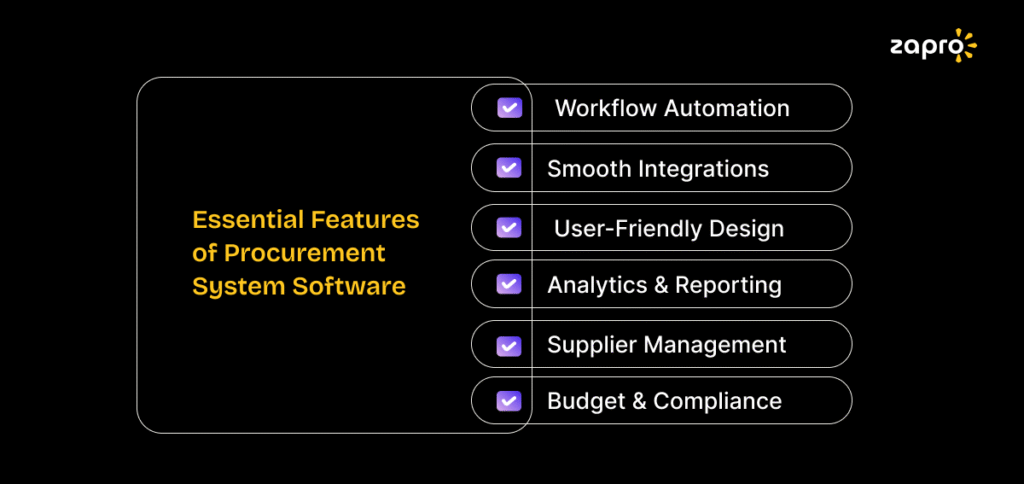
This framework covers six main categories
- Core procurement workflow (20 points): We carefully assessed the effectiveness of each procurement system in supporting the end-to-end purchasing workflow, from purchase requisitions to purchase order matching.
- AI and automation (20 points): Instead of simply checking whether the platform is marketing itself as an AI-powered solution, we evaluated the practicality and depth of each platform’s AI and automation capabilities.
- Total cost of ownership (15 points): Pricing, although not a key factor, is significant in determining the purchase. We considered whether the pricing information is available publicly, use cases where SMBs scaled to enterprise, and whether additional charges are required.
- Security and risk assessment (10 points): We reviewed security certifications, support resources, onboarding, reliability, and how vendors handle service disruptions and customer issues.
- Supplier management (20 points): We evaluated supplier onboarding, risk management, performance tracking, compliance, document collection, and supplier data management, as well as how each platform supports vendor comparison and supplier evaluation.
- Integration and IT footprint (15 points): We looked at ERP and accounting integrations, API and SSO support, setup requirements, and the IT work needed to maintain each platform.
How We Validated Our Findings
We also evaluated public G2 reviews and Capterra reviews to find common customer testimonials and complaints. Our focus was on reviewing comments rather than on average ratings, as ratings change over time.
We also analyzed each supplier’s security and compliance documents and also tested the software through a live demo or sandbox wherever possible.
This system offers a logical framework for comparing procurement software, and you can also use it to choose what fits you.
How To Choose The Top Procurement Software
Choosing the top procurement software starts with matching the software to your business needs. One needs to look beyond specifications and analyze how efficiently the platform handles everything.
- Make sure to check purchase requests, approvals, POs, invoices, receipts, and payments.
- Look for useful automation such as invoice capture, three-way matching, anomaly detection, spend classification, and approval routing.
- Make sure vendor management covers onboarding, documentation, compliance, risk, and performance tracking.
- Verify integrations with your ERP, accounting, HR, identity, and payment systems.
- Compare the total cost, including implementation, integrations, training, support, and additional fees.
- Review security certifications, access controls, audit trails, and data-handling practices.
- Consider whether the platform can scale with your transaction volume, entities, currencies, and approval requirements.
Procurement Software for Startups
Companies with fewer than 50 employees usually do not have a dedicated procurement team. Hence, procurement software should be simple enough for founders, finance teams, and office managers to manage alongside other responsibilities.
Basic challenges include unapproved spending, unnoticed SaaS renewals, and limited visibility into committed spending before invoices arrive.
At this point, the priority should be three capabilities:
- Approvals should be simple and can be made via Slack, email, or mobile devices to help teams manage purchases without disrupting operations.
- The pricing should be flexible enough so that not every occasional requester needs a paid license.
- Should be directly integrated with QuickBooks, Zoho Books, Xero, or similar platforms to reduce manual data entry.
Startups usually do not need advanced sourcing, extensive catalogs, or complicated supplier risk management from the beginning. However, choosing a platform that supports these capabilities goes a long way.
Procurement Software for Small Business and SMEs
Small and medium-sized businesses usually need procurement software that better accommodates purchasing control without the challenges of an enterprise platform.
Key features include purchase order management, approval workflows, budget visibility, supplier management, and automated invoice matching.
Zapro AI, Precoro, and Procurify are better fitted for these requirements.
When testing procurement software for SMBs, focus on the features that will benefit your business now. Consider how the platform can scale as purchasing volume and team size increase.
Procurement Software for Large Enterprises
Large enterprises usually require more complicated features, including multiple entities, locations, currencies, approval structures, and supplier networks.
At this stage, consider configurability and integration capabilities, supplier management, and global support.
Platforms such as Zapro AI, SAP Ariba, Coupa, Oracle Fusion Procurement, Ivalua, and GEP SMART support a range of enterprise procurement requirements.
Before selecting an enterprise procurement platform, assess implementation requirements, integration capabilities, data migration, user adoption, and ongoing support costs.
Procurement Software Pricing For SMBs and Enterprises
Procurement software pricing varies based on company size, number of users, transaction volume, integrations, and implementation requirements.
A business should evaluate the total cost of ownership, not just the price advertised online.
A small- to medium-sized business would likely have a user-based, monthly, or fixed platform fee, while a mid-market business would include platform and user fees, plus additional integration or implementation costs.
Pricing is usually quote-based depending on factors like number of users, transaction volume, integrations, and implementation requirements for large enterprises.
Companies operating across multiple countries should consider currency, tax, entity, and regional licensing requirements when comparing procurement software pricing.
Always request the total first-year cost, including implementation, integrations, onboarding, and recurring licensing fees.
How to Run a Vendor vs. Competitor Comparison
A strong vendor comparison should not just involve feature checklists.
More than one platform can offer similar specifications but differ slightly in automation, usability, integration, and implementation needs.
Here’s a guide that you can follow while comparing procurement software:
- Score each platform against the features that matter the most to your business.
- Use the same PO and a complicated invoice with errors in demo environments.
- Ask suppliers for references from similar businesses so that you can cross-check with customers.
- Compare the total cost of the end-to-end process, not just the listed price.
A well-designed analysis comparing suppliers helps businesses assess how each platform can perform in the actual ecosystem.
What Is The Best Way To Make Payments
After choosing your desired procurement software, organizations should establish a strong and controlled process for initiating vendor payments.
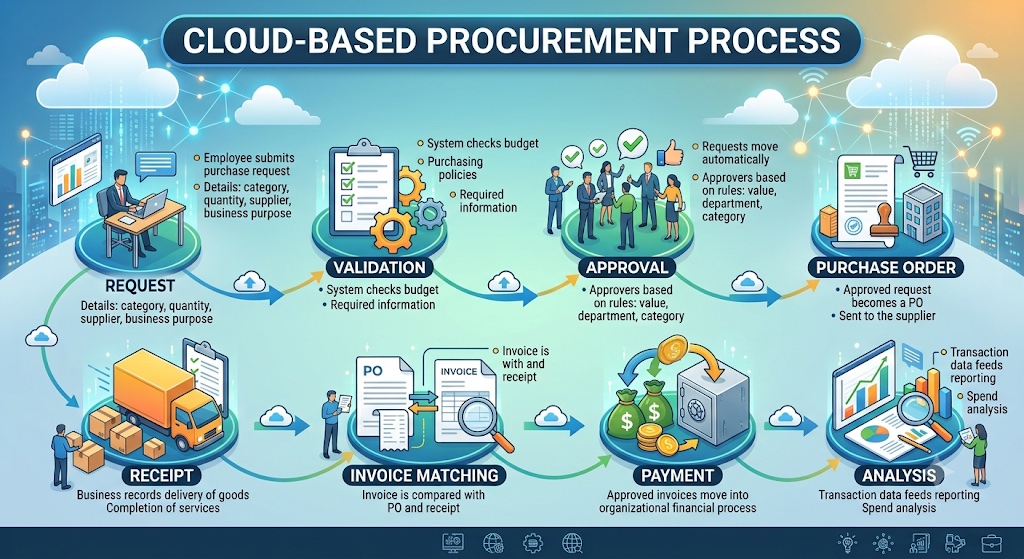
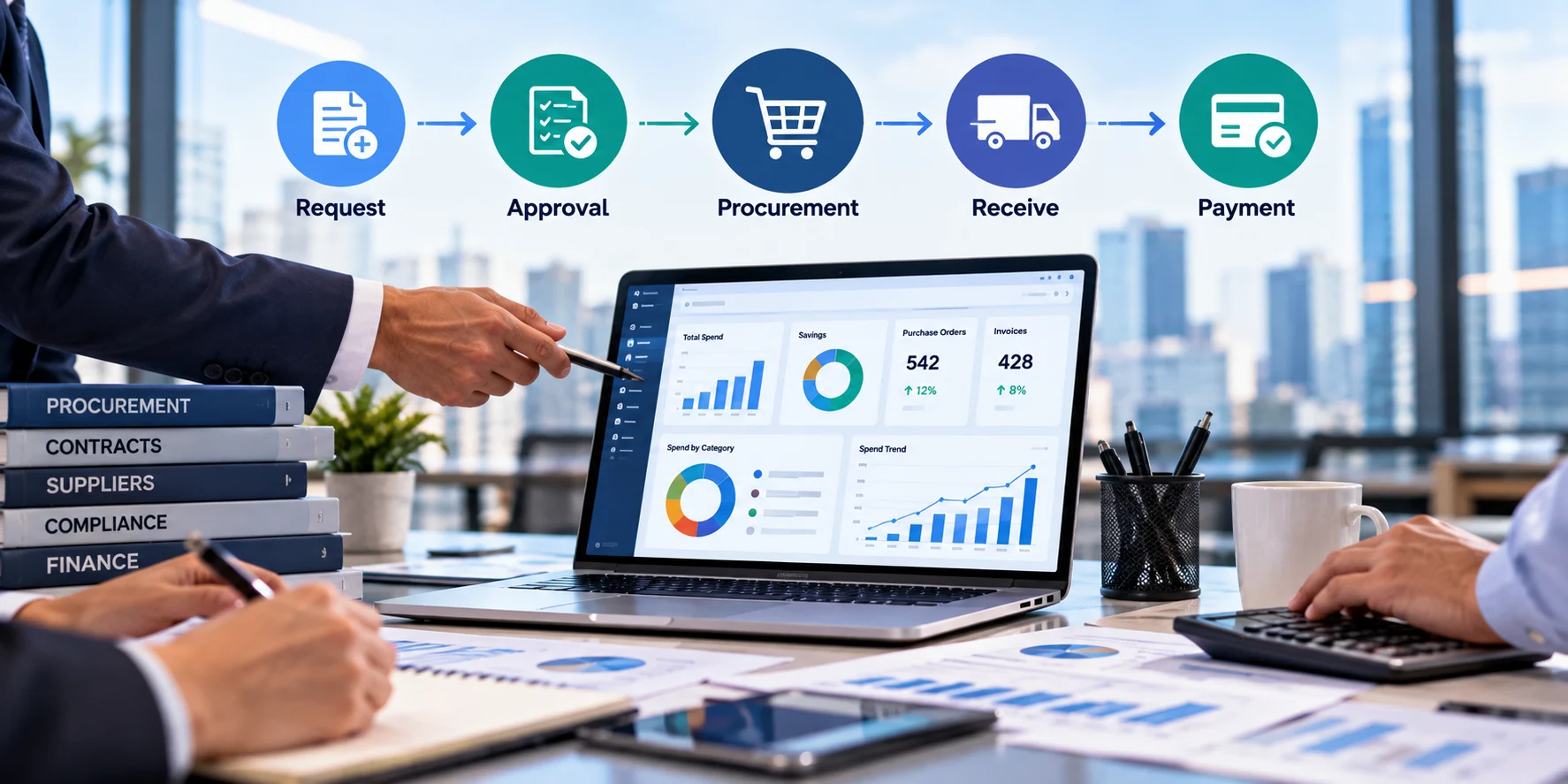
An efficient procure-to-pay process connects purchase orders, receipts, invoices, approvals, and payments together.
A general approach incorporates matching invoices with purchase orders before approving payments.
Instead of processing payments individually, use defined payment routines with appropriate methods like ACH for suitable recurring domestic payments and virtual cards for additional control.
Process payments through approved systems to maintain a clean record and prevent duplicate payments or risk of fraud.
Keeping vendor payments within the established procurement and AP systems can improve visibility, control, and compliance throughout the procure-to-pay process.
Best Procurement Software by Industry
The procurement requirements differ from industry to industry. While the focal points remain similar, businesses may need dedicated controls for supplier compliance, approvals, materials, budgets, or risk management.
| Industry | What Matters Most | Shortlist From This List | Read More |
|---|---|---|---|
| Healthcare | Contract Price Compliance, Supplier Credentialing, And Clinical Vs. Non-Clinical Approvals | Jaggaer, Zapro AI | Healthcare Procurement |
| Financial Services | Third-Party Risk Management, Audit Trails, And Segregation Of Duties | Coupa, Zapro AI | Finance Procurement |
| Technology And Saas | Software Spend, Subscription Renewals, And Security Reviews | Zip, Zapro AI | Saas Procurement Software |
| Manufacturing And Distribution | Direct Materials, Goods Receipt, And Three-Way Matching At Scale | SAP Ariba, Coupa, Jaggaer | Direct Vs. Indirect Procurement |
| Construction | Job-Site Purchasing, Cost Codes, And Subcontractor Compliance | Zapro AI | Construction Procurement Software |
| Multi-Location Businesses | Location-Based Budgets, Repetitive Purchases, And Consolidation Of Suppliers | Order.Co, Procurify | Purchase Order Software |
| VC and PE Portfolio Companies | Standardized Procurement Controls Across Multiple Entities | Zapro AI, Airbase | Vc Procurement |
| Public Sector And Higher Education | Formal Bidding Requirements And Regulatory Compliance | Jaggaer | Nonprofit Procurement |
Procurement Software Requirements by Region
Businesses that purchase from suppliers across different countries should also check that the procurement software supports relevant tax, invoicing, and compliance requirements. This reduces reliance on manual effort.
| Region | Rules Affecting Procurement | Specifications Required |
|---|---|---|
| United States | SOX controls for public companies, W-9 collection, 1099 reporting, and state sales and use tax | Approval audit trails, segregation of duties, vendor tax ID capture, and 1099 vendor flags |
| United Kingdom and EU | VAT, UK Making Tax Digital, country-specific B2B e-invoicing requirements, and GDPR | VAT codes, reverse-charge handling, structured e-invoices such as Peppol, and appropriate data hosting options |
| India | GST, GST e-invoicing where applicable, TDS, and MSME payment requirements | GSTIN validation, GST code mapping, TDS handling, MSME vendor flags, and payment aging |
Multi-entity enterprises should also verify how the platform manages several legal entities, base currencies, and tax registrations with one system.
What is “AI-Powered” Procurement Software in 2026

The global procurement software market is projected to grow from USD 7.9 billion in 2025 to USD 21.9 billion by 2035, at a CAGR of 9.7%.
— Future Market Insights, Procurement Software Market Size, Demand & Forecast 2025 to 2035
Most procurement software suppliers highlight AI capabilities, but the level of automation can vary by platform.
The main question is whether AI can reduce manual work and improve the accuracy of the procurement process and accounts payable processes.
To evaluate AI procurement software, search for:
- whether it extracts invoice data such as line items, totals, and taxes from digitally scanned documents.
- automatically cross-check purchase orders, receipts, and invoices while flagging exceptions.
- detecting duplications and anomalies.
- automatically segregate transactions accordingly
- Automates approval routing
When evaluating AI procurement software, ask suppliers to demo how the platform’s capabilities provide a broader view of how it streamlines the process.
Frequently Asked Questions
What is the best procurement software in 2026?
As per our evaluation, Zapro AI is the best procurement software in 2026 for small and mid-sized businesses.
What is the best procurement platform for large enterprises?
SAP Ariba, Ivalua and Coupa are proven choices for large enterprises.
What is the most affordable procurement software for SMBs?
Although actual costs vary by the needs and systems, Zapro AI, Precoro, and Procurify are some affordable options.
Does procurement software support GST in India?
Some platforms support GST compliance features such as GSTIN validation, CGST/SGST/IGST mapping, TDS deductions, and GST e-invoicing (IRN), with Zapro AI offering these natively.
How long does it take to implement procurement software?
It can take anywhere from a few weeks to months, depending on the business and the provider.
Don’t miss our weekly updates
We’ll email you 1-3 times per week—and never share your information.
Your Smarter Procurement Journey Starts Here
Our experts are here to help you simplify POs, engage suppliers, and boost efficiency.

About the Author

Md. Kafil


About the Reviewer

Zapro is dedicated to helping businesses of all sizes make informed decisions. We adhere to strict editorial guidelines to ensure that our content meets and maintains our high standards.
Our editorial standards help keep every article accurate, useful, and trustworthy.