

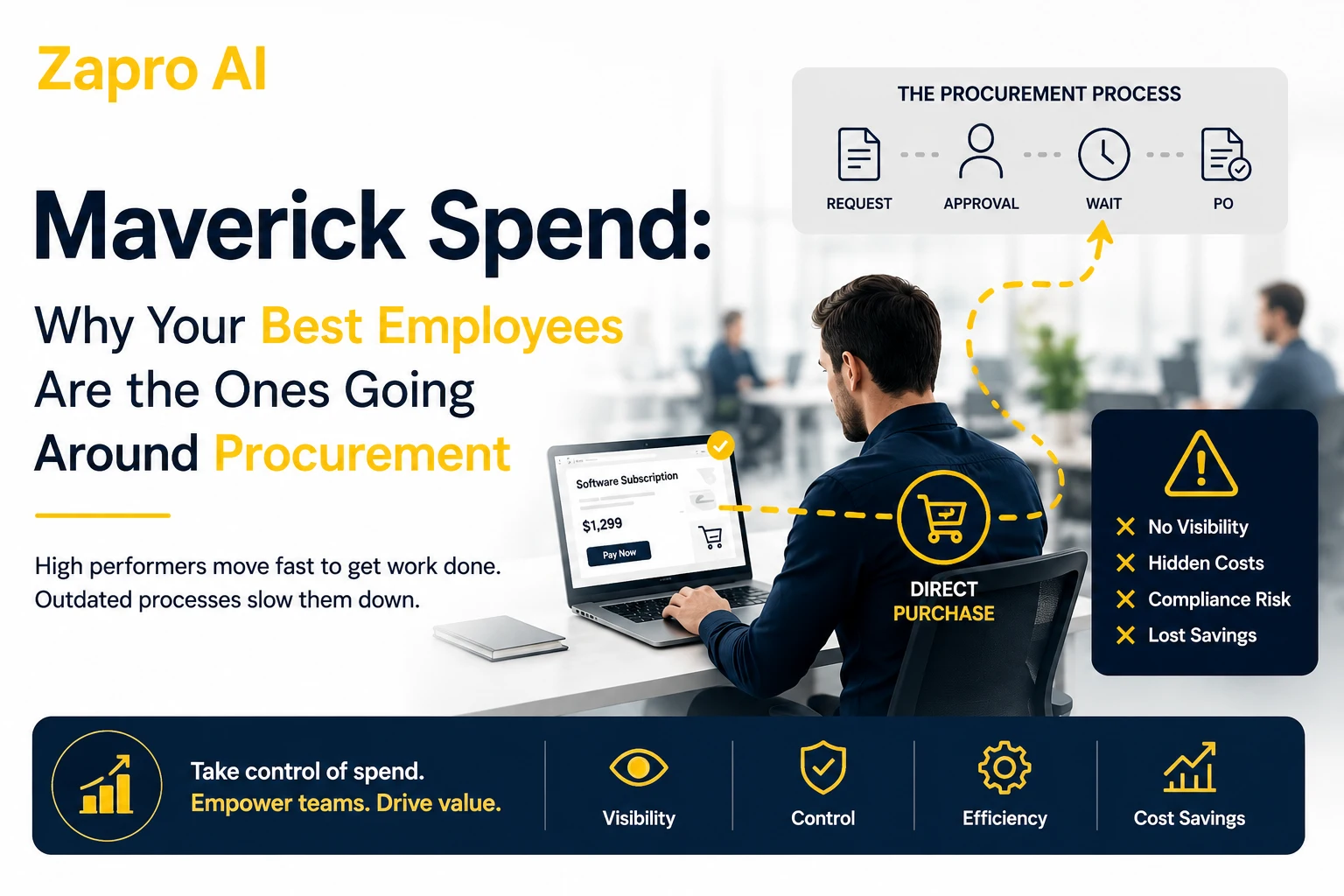
Maverick spend is any purchase made outside your approved procurement policy, channels, or contracts. It covers buying from an unapproved vendor, buying from an approved one at the wrong price, and skipping the requisition process entirely. It is almost always a sign that the compliant route was slower than the workaround.
Key takeaways
- Maverick spend is defined by how something was bought, not by what was bought.
- It is a process-design problem far more often than a compliance problem.
- The measurement method matters more than any benchmark you compare against.
- Most of it is findable today in AP and card data, without new software.
- The fix is making the approved route faster, not enforcing the slow one harder.
On this page
- What is maverick spend?
- Maverick spend vs. adjacent terms
- What maverick spend actually looks like
- How to find maverick spend in your data
- What causes maverick spend
- What maverick spend actually costs you
- Frequently asked questions
The people creating maverick spend are usually the ones trying hardest to get work done. That is the useful thing to know, because it shifts the fix from enforcement to design.
What is maverick spend?
Maverick spend refers to rogue, off-contract purchases that bypass the controls the procurement function puts in place. A purchase can be legitimate, correctly budgeted, and good value and still be maverick; it is classified by how it’s made.
Why it is called maverick buying
The word comes from Samuel Maverick, a nineteenth-century Texas rancher who did not brand his cattle. Unbranded animals became known as mavericks, and the word came to mean anyone operating outside the herd’s markings.
The analogy holds. A maverick purchase is not necessarily a bad purchase. It is an unbranded one, with nothing tying it to a contract or an approval.
Rogue spend, dark spend, off-contract spend: same thing?
Mostly, with slight differences in emphasis.
| Term | What it emphasizes | Practical difference |
|---|---|---|
| Maverick spend | Bypassing the process | The standard term; covers all of the below |
| Rogue spend | Deliberate rule-breaking | Same behavior, more accusatory framing |
| Off-contract spend | Buying outside a negotiated agreement | Narrower; only applies where a contract exists |
| Dark spend | Invisibility to procurement | Emphasizes detection rather than compliance |
| Non-compliant spend | Policy breach | Common in audit and finance language |
Use one consistently in your reporting. Switching between them makes a trend look like a change in measurement.
Maverick spend vs. adjacent terms
| Maverick spend | Tail spend | Indirect spend | Fraud | |
|---|---|---|---|---|
| Defined by | How it was bought | Value and vendor count | What was bought | Intent to deceive |
| Is it a policy breach? | Yes | No | No | Yes, and usually illegal |
| Typical cause | Slow or unclear process | Purchases too small to source | Nature of the category | Deliberate concealment |
| Who fixes it | Procurement and systems | Procurement | Nobody, it is a classification | Audit, legal, HR |
Maverick spend vs. tail spend
This is a common confusion, but there is a distinct difference between the two. Tail spend is defined by the size of the transaction — a spend can be small in value, but not necessarily non-compliant. On the other hand, maverick spend is off-contract and unauthorised. A small purchase from an approved catalog is tail spend but not maverick, and a large off-contract purchase is maverick but not tail.
Maverick spend vs. indirect spend
Indirect spend describes what was bought: anything not going into the product you sell. It says nothing about how. Most maverick spend is indirect, but the categories are unrelated.
Maverick spend vs. fraud
Maverick spend is a process breach. Fraud is deliberate deception for personal gain. Treating the two as the same loses the cooperation you need to fix the process, and it misconstrues what is almost always ordinary impatience.
The overlap is narrow. Persistent buying from one vendor by one requester is worth a closer look, which is a different exercise from reducing maverick spend generally.
What maverick spend actually looks like
Five forms of maverick buying
- Unapproved vendor. Buying from someone outside the approved vendor list entirely.
- Approved vendor, wrong price. Buying from a contracted vendor without applying contracted rates.
- Right vendor, wrong channel. Ordering by email or phone instead of through the system, so no PO exists.
- Personal card and expense claims. Paying personally and reclaiming, which routes a purchase around procurement completely.
- Split purchases. Breaking one order into several to stay under an approval threshold.
The last matters most. It is deliberate, invisible in totals, and signals a threshold set wrong.
The three control tiers: unknown, semi-known, known
Known maverick spend runs through a PO with a contracted vendor, just outside agreed terms. It is visible and correctable.
Semi-known spend has a PO but no contract behind the vendor, so you see it only after the commitment exists.
Unknown spend has neither, surfacing when an invoice or expense claim arrives. This tier holds the real exposure and is where detection work should start.
Worked examples through departments
| Department | The purchase | Why it is maverick |
|---|---|---|
| Marketing | Freelance designer engaged directly, invoiced after the work | No PO, no vendor onboarding |
| Engineering | Cloud tooling on a corporate card | Approved vendor, unapproved channel and no contract rate |
| Facilities | Emergency repair from a local contractor | Legitimate urgency, no retrospective approval raised |
| Sales | Conference sponsorship split across three invoices | Structured to stay under the $10,000 threshold |
| HR | Recruitment agency outside the panel | Panel rates not applied, no framework in place |
Only one of those looks like rule-breaking. The rest are people solving a problem the process did not solve for them.
How to find maverick spend in your data
Most of this is findable today, in systems you already have. A spend analysis gives you the clean, classified data to run these against; without it, duplicate vendor records distort every count.
Signals to query in AP: off-contract vendors, no-PO invoices
Pull every invoice with no matching purchase order, then split by whether the vendor holds an active contract. Invoices from contracted vendors with no PO are process bypasses. Invoices from vendors absent from the vendor master are the unknown tier.
Then compare invoice unit prices against contracted rates. Variance against a contract you hold is maverick spend a PO check will never catch.
Signals to query in expenses: reimbursements and card spend
Query expense claims above a low threshold, filtered to categories where a contract exists. Anything appearing there was bought outside procurement by definition.
For card spend, filter merchant category codes against contracted categories. Recurring monthly charges to one merchant are subscriptions nobody negotiated.
Signals to query in vendor master: single-transaction vendors
List vendors with exactly one transaction in twelve months. Each is an onboarding cost paid for a purchase nobody planned, and clusters within one department point at a category with no contract.
Also flag vendors created within seven days of their first invoice. That sequence usually means the vendor was set up to pay someone already engaged.
A detection checklist you can hand to an analyst
- Invoices with no matching PO, split by contracted and non-contracted vendor.
- Invoice unit price versus contracted unit price, by item.
- Expense reimbursements in categories that hold a contract.
- Card transactions by merchant category code against contracted categories.
- Vendors with a single transaction in the last twelve months.
- Vendors created within seven days of their first invoice.
- Multiple invoices from one vendor within thirty days, each just under an approval threshold.
- Purchase orders raised after the invoice date.
Run all eight, deduplicate, then split by tier. Items seven and eight are the ones most teams have never run, and they surface the deliberate behavior the other six miss.
What causes maverick spend
The process is slower than the workaround
The dominant cause. APQC’s data shows organisations with higher maverick rates take a median of 16 hours longer to issue a purchase order, which is the gap people step around.
Closing that gap is largely a systems problem: give requesters a route through an AI procurement platform that is faster than working around it, and following the process stops costing them time. If you are weighing tools for this, a comparison of the best procurement software shows how platforms handle intake and approval routing.
Nobody knows which contracts exist
People cannot buy from an agreement they have never seen. Where contract terms live in a folder procurement owns, requesters default to the open market.
The approved vendor could not deliver
Sometimes the contracted vendor is out of stock, booked up, or cannot meet the date. Without a defined exception route, the requester invents one.
Decentralised buying with no visibility
APQC’s 2023 survey found 55% of organisations run a decentralised structure for indirect materials and services, which is precisely where maverick spend is hardest to see.
Unclear accountability
Where no one owns a category, no one notices it drifting. Unowned categories accumulate maverick spend quietly and are usually the last to get a contract.
Personal incentive and kickback risk
A small minority of cases involve genuine self-interest. Concentrated buying from one vendor by one requester is the pattern worth escalating, and it is rare enough that treating it as the default explanation damages everything else.
What maverick spend actually costs you
Price variance against negotiated rates
The direct cost is the gap between what was paid and the contracted rate: (actual price − contract price) × quantity, on every flagged item where a comparable contract exists.
Lost volume tiers and rebate thresholds
Diverted spend counts toward nothing. Volume that would have crossed a discount tier or triggered a rebate is lost twice, once on price and once on the threshold missed.
Contract minimum breaches
Where an agreement carries a committed minimum, spend leaking elsewhere can put you in breach of a contract you negotiated for the savings.
Unvetted vendor and compliance exposure
Vendors brought in outside the process skip credit checks, insurance verification, security review, and signed terms. The exposure surfaces when something goes wrong and nobody can find a contract.
An AI Vendor Management platform can close that gap by running credit, insurance, and security checks automatically during onboarding, so a vendor can’t become payable until those steps are done.
ESG and reporting integrity
Off-contract vendors sit outside vendor codes of conduct and emissions reporting boundaries. Spend that never entered the vendor master cannot appear in a sustainability disclosure, which makes the disclosure incomplete rather than optimistic.
Frequently asked questions
What is maverick spend?
Maverick spend is any purchase made outside approved procurement policy, channels, or contracts. It includes buying from unapproved vendors, buying from approved vendors at non-contracted rates, and skipping the requisition process. The purchase itself may be entirely legitimate.
What is the difference between maverick spend and tail spend?
Tail spend is defined by value and vendor count, covering small purchases spread across many vendors. Maverick spend is defined by route, covering anything bought outside the agreed process. A purchase can be one, both, or neither.
Why is it called maverick buying?
The term traces to Samuel Maverick, a Texas rancher who left his cattle unbranded. Unbranded animals became known as mavericks, and the word came to describe anything operating outside the established markings.
What are the risks of maverick spend?
Price variance against negotiated rates, lost volume discounts and rebates, breached contract minimums, and exposure to vendors who skipped credit, insurance, and security checks. Off-contract vendors also sit outside ESG reporting boundaries.
How do you measure maverick spend?
Divide spend outside approved channels by total addressable spend and multiply by 100. Identify the numerator by running detection rules against AP, expense, card, and vendor master data, then deduplicate before calculating.
How do companies reduce maverick spend?
By making the approved route faster than the workaround. That means publishing contracted vendors and rates where requesters can find them, routing approvals by value and category, and fixing the categories where the compliant path genuinely failed.
Is maverick spend the same as fraud?
No. Maverick spend is a process breach, usually driven by urgency as well as a slow system. Fraud involves deliberate deception for personal gain. A small subset of maverick spend warrants investigation, but treating the whole category as fraud misreads the cause.
Make the approved route the easy route
Maverick spend is feedback. Every off-contract purchase is somebody telling you the approved path did not work that day, and the number moves as the path changes rather than when the policy is restated.
Zapro AI brings requisitions, purchase orders, receipts, and invoices onto one platform, so the approved route is the quickest one available and off-process buying shows up while it can still be corrected.
Book a demo to see how requests, approvals, and contracted rates sit in one place. You can also review Zapro pricing to size the change against your current off-contract spend.
Don’t miss our weekly updates
We’ll email you 1-3 times per week—and never share your information.
About the Author

Md. Kafil


About the Reviewer

Zapro is dedicated to helping businesses of all sizes make informed decisions. We adhere to strict editorial guidelines to ensure that our content meets and maintains our high standards.
Our editorial standards help keep every article accurate, useful, and trustworthy.