

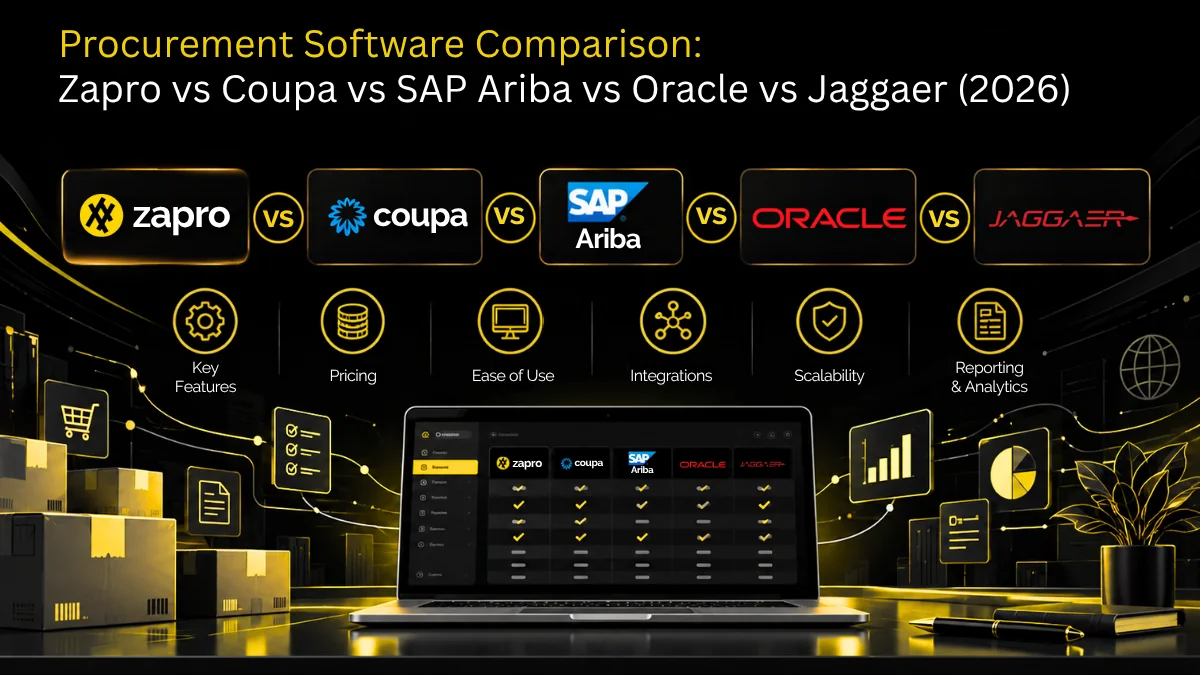
Businesses need procurement software that does more than just offer a feature-rich platform; they need a solution that simplifies the purchasing process. To choose the right platform, run a thorough procurement software comparison.
You should go beyond the feature lists to analyze how each platform manages the complete purchasing lifecycle from start to end.
Some platforms excel at business spend management, while others integrate with ERP systems or offer configurable S2P.
We have evaluated seven platforms, including Zapro AI, Coupa, SAP Ariba, Ivalua, JAGGAER, GEP SMART, and Oracle Fusion Cloud Procurement.
Key Takeaways
- Zapro AI connects all the purchasing stages and data from start to end in one platform for growing companies.
- Coupa is more focused on helping organizations manage their purchasing expenses and other expenses.
- SAP Ariba is specifically applicable for businesses that are familiar with the SAP systems or those that need vendor collaboration through SAP Business Network.
- Ivalua also provides source-to-pay systems and a cohesive data model for complicated procurement needs.
- JAGGAER backs industry-specific procurement processes like strategic sourcing and vendor collaboration.
- GEP SMART is also considered a unified S2P platform integrated with GEP, combining its software portfolio under GEP Quantum Intelligence.
- Oracle Fusion Cloud Procurement suits organizations that want procurement integrated with Oracle’s broader ERP and finance environment.
Comparing 7 Procurement Software
This table lists the main differences between the seven platforms and gives you an overview of what suits your business.
| Platform | Core Focus | Key Capabilities | Typical Fit |
|---|---|---|---|
| Zapro AI | Connected Procurement Automation | Purchasing, Approvals, Suppliers, Sourcing, Invoices, Analytics, And AI | SMBs, Growing Businesses, And Larger Organizations |
| Coupa | Business Spend Management | Procurement, Invoicing, Expenses, And Spend Visibility | Organizations Seeking Broader Spending Control |
| Sap Ariba | Sap-Connected Procurement | Guided Buying, Sourcing, Supplier Collaboration, And Invoicing | SAP-Centric And Large Enterprises |
| Ivalua | Configurable Source-To-Pay | Sourcing, Purchasing, Supplier Management, And AP Workflows | Businesses With Complex Procurement Processes |
| Jaggaer | Enterprise Source-To-Pay | Strategic Sourcing, Supplier Intelligence, Purchasing, And Payments | Large And Industry-Specific Procurement Teams |
| Gep Smart | Source-To-Pay And Spend Intelligence | Spend Analysis, Sourcing, Contracts, And Purchasing | Organizations Pursuing Procurement Transformation |
| Oracle Fusion Cloud Procurement | Erp-Connected Procurement | Purchasing, Sourcing, Supplier Management, And Invoicing | Businesses Already Using Oracle Fusion Cloud |

Global procurement software market is expected to reach $16.38 billion by 2029 at 13.6% CAGR
Which Procurement Software Fits Your Business
The procurement software that suits your business depends on the problems your procurement teams face and need to fix. An established multinational replacing several procurement systems has different needs than a small business moving away from spreadsheets.
Zapro AI
Our top option is Zapro AI, as it connects the entire purchasing cycle from beginning to end and the data in one platform. It has configurable plans that serve smaller teams and growing companies as well as bigger businesses. Zapro AI can also integrate into your existing ERP, making the transition smoother for your team. You should consider it if you want to streamline procurement activities and automate the system without immediately investing in a large enterprise deployment.
Coupa
If your goal is business spend management, Coupa is your best bet as it connects procurement with spending activities to improve control and visibility. Coupa is particularly relevant when procurement improvements form part of a wider finance and spend-management strategy.
SAP Ariba
SAP Ariba integrates procurement functions with SAP Business Network and SAP’s enterprise ecosystem. It offers guidance at every step.
Businesses that are already familiar with SAP should consider if Ariba is compatible with their existing systems.
Ivalua
With Ivalua, you get a configurable source-to-pay system structured around a cohesive data model.
The configuration choices assist companies in adapting the framework and updating it. You can opt for Ivalua if your procurement activities are multifarious.
JAGGAER
JAGGAER also covers the procurement cycle along with specialized requirements in different areas.
GEP SMART
GEP SMART usually offers cloud-based source-to-pay capabilities in a traditional pattern.
GEP is consolidating its software portfolio under GEP Quantum Intelligence, an AI-native procurement and supply chain platform.
Oracle Fusion Cloud Procurement
Oracle Fusion Cloud Procurement integrates the purchasing step with Oracle’s extended business applications. So, if you are already using Oracle Fusion Cloud for other operations, this is your winner.
What Differentiates Procurement Platforms
The procurement platforms that are available today mostly offer similar services like approvals, reporting, etc.
The main difference is how these functionalities work together. Coupa specializes in business spend management, while SAP Ariba connects procurement to SAP’s ecosystem and vendor network.
Ivalua is a platform that focuses on personalization and a cohesive data model, and JAGGAER helps with wider S2P processes.
GEP is migrating towards an AI-based architecture, and Oracle implements procurement with its expansive Fusion Cloud environment.
Zapro AI takes a different approach with a connected system bringing everything in one place.
This differentiation is important as complications in the procurement system can disrupt individual processes.
When you are using enterprise procurement software, it is important to consider whether information is smoothly transmitted between the systems and departments.
Automate Your Procurement in Days, Not Months

How The Platforms Handle A Procurement Process
When a business is considering purchasing a special element from a new supplier, the procurement team must be thorough and nitpicky with the entire process; there is no scope for mistakes. Each platform also supports relevant stages, but the system and configuration may vary.
| Zapro AI | Sap Ariba | Coupa | Jaggaer | Gep Smart | Ivalua | Oracle Fusion | |
|---|---|---|---|---|---|---|---|
| Request And Intake | Structured purchase requests and configurable approvals | Guided buying and catalogs | Intake and guided purchasing workflow | Purchase requests and procurement workflows | Purchase requisitions and guided procurement | Intake management and request routing | Requisitions integrated with business applications |
| Sourcing And Supplier Selection | RFI/RFP functionality; advanced options depend on the plan | Sourcing tools and supplier quotation management | Strategic sourcing and supplier selection | Sourcing, supplier selection, and quotation management | Strategic sourcing and supplier selection | Strategic sourcing and supplier selection | Sourcing and supplier management capabilities |
| Approval And Purchasing | Connected procurement workflows, budgets, supplier records, and purchase orders | Purchasing workflows, catalogs, and approval controls | Purchasing, budgets, and configurable approval workflows | Purchasing and procurement workflow management | Purchasing and procurement process management | Purchasing workflows and approval management | Purchasing integrated with wider business applications |
| Invoices And Payments | Purchase orders, goods receipts, invoices, and AP automation | Invoice processing and procurement integration | Invoice management and accounts payable automation | Purchasing, invoicing, and payment workflows | Procure-to-pay and invoice management | Purchasing integrated with accounts payable workflows | Invoice processing and accounts payable integration |
Procurement Software Pricing Comparison
Procurement software pricing differs by platform, business size, modules, implementation, and a number of other factors. Many businesses offer quotes on request rather than set subscription prices.
Zapro AI Pricing
Zapro AI publishes the following plans in the source pricing information:
- Spark: $699/month, with up to 50 vendors
- Growth: $1,999/month, with up to 500 vendors
- Scale: Custom pricing for larger organizations
Enterprise Platform Pricing
Coupa, Ivalua, SAP, GEP, Oracle, and JAGGAER usually provide quotes on request and a commercial discussion.
Therefore, strategic sourcing software pricing comparison SMB should be considered beyond subscription fees.
SMBs should also take this into account, and it is smart to compare the total cost of ownership for several years. Settling for a lower license fee is not always valuable if you have to add additional features or manual work to it.
Things Procurement Teams Should Consider
Before deciding on a platform, there are a couple of things procurement teams should consider and not rely on an impressive demo.
It is important to see how the software platform performs in day-to-day operations and manage complications.
Another factor that matters is user experience, as some companies can prioritize the controls and supplier capabilities of these platforms, while some find their implementation needs exhausting. So, before evaluating, consider individual experiences and do not treat them as the only factor.
Ask suppliers to demonstrate a real purchasing scenario using your needs and follow it from raising the request to payment completion.
A practical demonstration using your own workflows will reveal more than a generic feature presentation.
Conclusion
Businesses should always consider how each platform supports the procurement process, and all seven of these have different approaches.
Coupa helps businesses manage spending, while SAP Ariba works well for companies already using SAP. Ivalua offers flexibility to tailor workflows, JAGGAER supports complex sourcing needs, GEP brings sourcing and procurement together, and Oracle Fusion Cloud Procurement is a natural fit for businesses using Oracle’s cloud solutions.
So, if you are choosing between Ariba vs. Coupa, think about what you already have, what the procurement needs are, and what would solve your problems.
If you want to simplify procurement without replacing your existing systems, Zapro AI is your best friend. With integrations that you can adjust to your current systems, and more apps, you can centralize the entire system.
Explore Zapro AI to see how you can streamline procurement, automate workflows, and gain better control over spending.

Make the Smart Switch to Zapro
Get enterprise features without enterprise complexity. Start your free trial.
Frequently Asked Questions
Who Wins: SAP Ariba Vs. Coupa?
It depends on what systems work for you, as SAP Ariba is closely connected to SAP’s ecosystem and supplier network, while Coupa focuses on business spend management.
Is Zapro AI an Alternative To Coupa And SAP Ariba?
Yes. Zapro AI is great for SMBs not looking to make a huge investment, as its practicality depends on your needs.
What Is The Best Procurement Software For An SMB?
Small and medium-sized businesses should prioritize usability, transparent pricing, approval workflows, supplier management, invoice automation, and room to grow. Zapro AI offers published plans, while several enterprise platforms use customized pricing.
How much does procurement software cost?
Pricing depends on the platform, modules, implementation, integrations, and support. Zapro AI lists plans starting at $699 per month in the source pricing information, while several enterprise platforms require custom quotes.
Don’t miss our weekly updates
We’ll email you 1-3 times per week—and never share your information.
Ready to Transform Your Procurement?
Modern interface, powerful automation, and savings from day one. Schedule a demo with our procurement experts today.

About the Author

Md. Kafil


About the Reviewer

Zapro is dedicated to helping businesses of all sizes make informed decisions. We adhere to strict editorial guidelines to ensure that our content meets and maintains our high standards.
Our editorial standards help keep every article accurate, useful, and trustworthy.