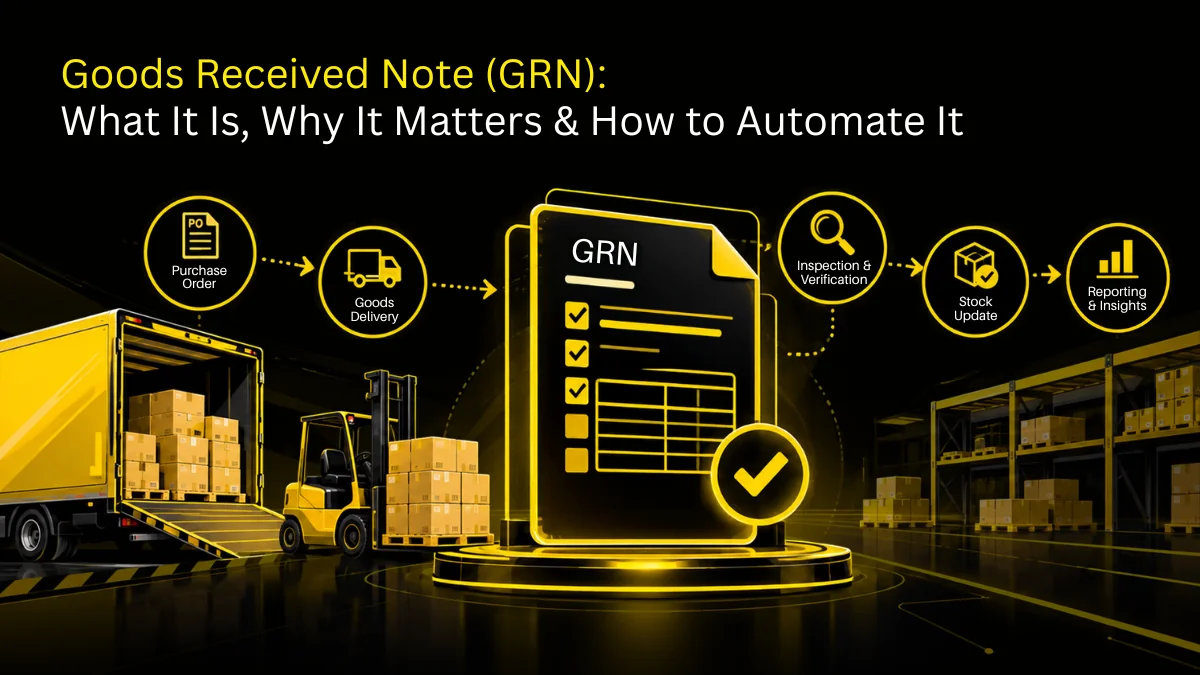


Procure-to-pay automation, also referred to as P2P automation or purchase-to-pay automation, involves replacing a number of manual handoffs with one automated workflow that includes requisitioning, approval, purchase orders, receiving, invoice processing, and payment.
The automation that is claimed by most companies in fact only applies to part of the process. This guide explains which sections are currently fully automated, which still call for human intervention, and where to begin.
Key Takeaways
- Procure-to-pay automation links requisitioning, approval, purchase orders, receiving, invoice processing, and payment into a single workflow instead of a series of manual handoffs.
- Only 35.4% of invoices are processed straight-through today, with no manual touch, even at companies that already run some automation. Running automation and running full automation are not the same thing.
- Automate high-volume, rule-based steps first, such as catalog requisitions and standard approvals, before you automate exceptions.
- Companies that invest the most in procurement technology report three times the return on generative AI compared to their peers (Deloitte, 2025).
- Purchase-to-pay automation and procure-to-pay automation describe the same cycle. AI procure-to-pay tools add pattern matching and exception handling on top of the rule-based automation most platforms already run.
What Procure-to-Pay Automation Does
Procure-to-pay automation is software that takes a purchase from request through to payment without anyone having to retype the information at each stage; the term refers to the same thing as purchase-to-pay automation and P2P automation. Various vendors and regions use different names when describing this process.
In practice, automation of the procure-to-pay process includes a requisition being converted into a purchase order without anyone having to rebuild it in another system, and a matched invoice leading to payment without anyone having to approve it twice. For an explanation of the basic principles behind this cycle, see our guide to what procurement is and how it works, and for a description of the process before automation is introduced, see the procure-to-pay process.

Organizations that leverage digital procurement tools see a 30% reduction in procurement costs.
– Deloitte
Where Manual Procure-to-Pay Breaks Down
Manual P2P processes break down in predictable situations: paper requisitions remain in an inbox, approvals are followed up on by email, purchase orders have to be retyped into an accounting system, and invoices are manually checked against a purchase order and a receipt, which are kept in three separate files.
A team of ten people can cope with this, but a team of two hundred cannot.
- Every request is slowed down by the use of paper forms, spreadsheets, and email approvals.
- Data has to be typed in twice, first into the procurement system and then into accounting, which causes entry errors to accumulate.
- Approvals are delayed if the person who has to approve it is traveling, if they have a series of meetings, or if they forget.
- There is no single source where you can check the status of a purchase order or the total amount that has been committed.
How to Automate the Procure-to-Pay Process
The steps are not eliminated by automation; what is eliminated is the manual handoff between them.
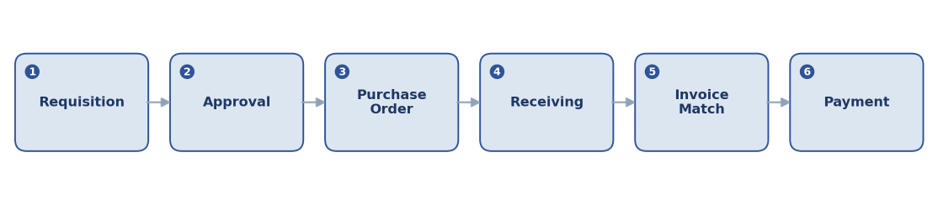
The six stages are connected into one workflow.
The requisition tool sends the request to the appropriate approver according to the amount and category. After approval, the system produces the purchase order on its own. When the goods or services arrive, the receiving department confirms the delivery against the order. The invoice, which is obtained by using OCR, is then verified against both the order and the receipt. Only when all three documents agree is payment made on time, with no one having to enter the same figures twice.
Take Control of Your Procure-to-Pay Process

What You Can Automate in the P2P Cycle Today
Now it is relatively easy to automate certain parts of the cycle, while other parts still require a person, typically because the situation lies outside a well-defined rule.
| Stage | What Automates Well | What Still Needs a Person |
|---|---|---|
| Requisition and intake | Catalog-based requests routed by preset rules | Non-catalog or unusual requests |
| Approval | Rule-based routing by amount and category | Exceptions that fall outside policy |
| Purchase order creation | Auto-generated from an approved requisition | Custom terms and one-off negotiations |
| Receiving | Automatic matching against the purchase order | Physical inspection of goods |
| Invoice processing | OCR capture, plus two-way or three-way matching | Invoices with mismatches or no purchase order on file |
| Payment | Scheduled runs based on approved terms | Disputes and exceptions |
AI tools used in the procure-to-pay process go a step further by reading through the items on invoices, identifying those that are likely to be duplicates, and picking up on small differences that can safely be cleared automatically. However, this is only possible if the data underlying it is clean. A smart AI matching system cannot correct a vendor record that already has three different spellings.
How Much of Invoice Processing Is Still Manual
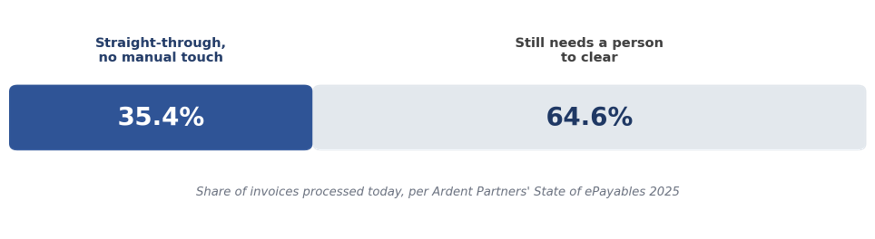
Ardent Partners, The State of ePayables 2025
The Numbers to Watch
Only 35.4% of invoices are processed straight-through, with no manual touch, and the average invoice exception rate sits at 18.4%, even though 57.4% of vendors can already send invoices electronically. Most of the manual work left in P2P is not a technology gap. It is a data and process gap that automation alone will not close.
A simple example will make the gap clear. Suppose a team handles 2,000 invoices each month; at a straight-through rate of 35.4 percent, approximately 708 of these will pass through without any manual review, while the other 1,292 will have to be reviewed.
If each exception takes five minutes of human effort, this amounts to nearly 108 hours of manual invoice processing every month, equivalent to more than half of one person’s working month being used on invoices that a more complete automation system would clear automatically. This example demonstrates the extent of the gap and should not be taken as a measure for any particular company.
Ardent Partners also states that its Best-in-Class group, which consists of the highest-performing AP teams within its research, has invoice processing costs and cycle times that are about 79% lower than those of the rest of the industry, their exception rates being 47% lower.
Where to Automate First If You Cannot Do Everything at Once
The order of things makes a difference here. If you automate exception handling before correcting the data itself, you’ll simply speed up the confusion. A more reliable sequence is as follows.
- Catalog requisitions and rule-based approvals
It is the phase of highest volume and lowest complexity within the cycle, and it is in this phase that the majority of the daily friction occurs.
After approvals have been automated, the cost of producing the purchase order is almost nothing.
- Three-way matching for standard, PO-backed invoices
It is here that the largest portion of manual AP hours generally is spent.
- Exception handling and AI-based matching
Hold it until last since it relies on clean vendor and item data that is established by the previous steps.
How to Know Whether the Investment Is Paying Off
According to Deloitte’s 2025 Global Chief Procurement Officer Survey, which took into account responses from over 250 CPOs in 40 countries, the organizations that the firm refers to as Digital Masters allocate up to 24% of their procurement technology budget to automation and AI and achieve three times the return on their generative AI investment as do their peers.
The amount allocated in the budget doesn’t match the results achieved, so keep a record of these instead:
✓ Straight-through rate
The proportion of invoices that clear without any manual processing. This is the best indicator of how much automation works in practice.
✓ Cycle time
The time between placing a requisition and receiving payment is several days; the fewer days in this cycle, the fewer manual handoffs there are usually going to be in the process.
✓ Exception rate
The proportion of invoices that call for human intervention is decreasing, which means that automation is eliminating actual gaps, not simply providing a dashboard over the existing manual tasks.
The guide on our procurement KPIs includes all the metrics that procurement teams keep track of apart from these three.
Why Zapro AI Goes Beyond Standard P2P Tools
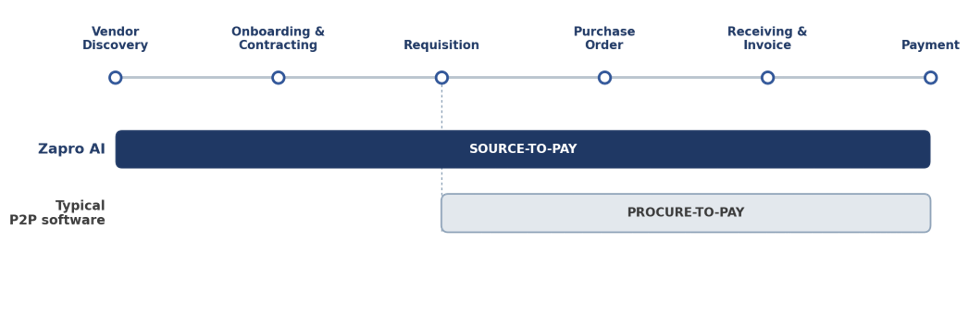
“P2P software” is not one category. Most platforms on a typical shortlist are procure-to-pay tools: they start once a vendor is already onboarded and under contract, and from there they manage requisitions, purchase orders, receiving, and invoices. A smaller group of platforms, source-to-pay (S2P) tools, start earlier, at vendor discovery, and carry that vendor through onboarding and contracting before procurement even begins. Zapro AI is built as the second kind.
| Platform | Lifecycle supported | What It Covers | Pros/Cons |
|---|---|---|---|
| Zapro AI | Source-to-Pay | Purchase request intake, configurable approval routing, requests for quotes, supplier onboarding and supplier portal, purchase orders, contracting and three-way invoice matching on one record | Pros: One record from request to matched invoice; suppliers respond to quotes and submit invoices through their own portal; handles high-volume, low-value tail spend allowing businesses to analyze their spend. Cons: Teams get the most out of it once every department uses it, so rolling it out company-wide takes some coordination |
| SAP Business Network | B2B trading network (supports procure-to-pay transactions) | A network where buyers and suppliers automate procurement transactions such as orders and invoices, and collaborate on planning, inventory and quality | Pros: Large network of trading partners; connects buyers and suppliers on shared transactions and planning Cons: It is a network, not a full sourcing-to-payment suite on its own (sourcing and contracts sit in SAP Ariba); suppliers need to be on the network |
| Coupa | Source-to-Pay | Source-to-contract, procure-to-order, invoice-to-pay and direct spend management, with a self-service supplier portal that flags incomplete submissions | Pros: Covers the full lifecycle, including direct spend; suppliers keep their own records up to date Cons: A broad suite, so teams that only need purchasing may use a small part of it |
| Procurify | Procure-to-Pay | Purchase requests, approval routing, mobile purchasing, invoice processing, expense reports, spend insights and vendor management (onboarding, performance tracking, contract compliance) | Pros: Mobile approvals and purchasing; integrates with QuickBooks, NetSuite, Sage Intacct and Microsoft Dynamics 365, plus Amazon Business and Staples Cons: Built for purchasing and spend control rather than sourcing and contract negotiation |
| Precoro | Procure-to-Pay | Customizable request forms, multi-entity management, supplier catalogs and RFPs, contract renewal reminders, mobile approvals, spending card controls and ERP integration (NetSuite, Xero, QuickBooks) | Pros: Deploys in 2 to 8 weeks; manages several entities from one account; SOC 2 and GDPR compliant Cons: Built for mid-sized companies, so large enterprises with complex needs may outgrow it |
That earlier starting point is the real difference. If you’re using a standard P2P tool, you’ll still juggle spreadsheets or other tools to find vendors, check compliance, and get contracts signed before using the platform. Zapro AI keeps the same vendor record from the first search through onboarding, contracts, POs, and invoices. Procurement isn’t the starting line. It kicks in once the vendor’s in the system. Check our vendor management and sourcing pages for what happens before P2P starts.

Discover How P2P Automation Works in Real-Time
Book a demo to see how Zapro streamlines procurement from request to payment.
Frequently Asked Questions
What is procure-to-pay automation?
Procure-to-pay automation involves the use of software to link together the various stages of requisitioning, approval, purchase orders, receiving, invoice processing, and payment so that purchases can move from request to payment without someone having to retype the same information into different systems at each stage.
What is the difference between procure-to-pay automation and purchase-to-pay automation?
There is no real difference between them since purchase-to-pay automation and procure-to-pay automation refer to the same requisition-to-payment cycle; purchase-to-pay is more frequently used in the UK and in some ERP documentation, whereas procure-to-pay is the more commonly used term in the United States.
What kinds of tasks can automation of the procure-to-pay process handle?
Rule-based automation is capable of dealing with catalog requisitions, routing approvals according to amount and category, generating purchase orders, capturing invoices using OCR, and carrying out two-way or three-way matching for standard invoices that have a purchase order on file; however, custom negotiations, physical receiving inspections, and true exceptions still have to be handled by a person.
What does AI procure-to-pay entail, and in what way is it different from rule-based automation?
Rule-based automation works on a set of fixed rules: if the invoice matches both the purchase order and the receipt, then it should be approved. AI procurement-to-pay builds on this by incorporating pattern recognition, which allows it to identify probable duplicates, highlight unusual changes by vendors, and learn which small discrepancies can be cleared without manual review. However, it still requires clean underlying data in order to function properly.
How long does it take to automate the procure-to-pay process?
The extent of the scope, not the level of drive, makes the difference. It can take weeks to automate requisitions and approvals on a modern platform, but it usually takes months to automate invoice matching and payment across several entities or using an older ERP, mainly due to the necessary first step of cleaning up the vendor and item data.
Before You Automate
Take one month of invoices and separate them into two groups: the ones that cleared with no manual touch, and the ones that needed a person. That split is your real straight-through rate, and it is a better starting point than any vendor’s demo. Pair that baseline with procurement software pricing to estimate payback before you commit.
See how procurement automation tools and AP automation work together on one platform, run your own numbers through the procurement ROI calculator, or book a demo to see the full cycle end-to-end.
Sources / References
- Deloitte, “2025 Global Chief Procurement Officer Survey: Agents of Change”: https://www.deloitte.com/content/dam/assets-zone3/us/en/docs/services/consulting/2025/us-deloitte-2025-global-cpo-survey.pdf
- Ardent Partners, “The State of ePayables 2025: AP’s Unfinished Journey”: https://www.bottomline.com/resources/state-epayables-2025-aps-unfinished-journey
- Ardent Partners, “State of ePayables (Part Nine): AP Benchmarks and Best-in-Class Performance”: https://payablesplace.ardentpartners.com/2026/01/state-of-epayables-part-nine-ap-benchmarks-and-best-in-class-performance/
- Zapro AI, “What Is Procurement?”: https://zapro.ai/procurement/what-is-procurement/
- Zapro AI, “Procure-to-Pay Process”: https://zapro.ai/procurement/procure-to-pay-process/
- Zapro AI, “AP Automation”: https://zapro.ai/ap-automation/
- Zapro AI, “Vendor Management”: https://zapro.ai/vendor-management/
- Zapro AI, “Procurement Automation Tools”: https://zapro.ai/procurement/procurement-automation-tools/
- Zapro AI, “Procurement KPIs”: https://zapro.ai/procurement/procurement-kpis/
- Zapro AI, “Procurement ROI Calculator”: https://zapro.ai/digital-procurement-roi-calculator/
- Zapro AI, “Procurement Software Demo”: https://zapro.ai/procurement/procurement-software-demo/
- Zapro AI, “Strategic Sourcing”: https://zapro.ai/strategic-sourcing/
- Zapro AI, “Digital Transformation in Healthcare Procurement” (source for the P2P software comparison table): https://zapro.ai/procurement/digital-transformation-healthcare-procurement/
- Zapro AI, “Vendor Management Software Demo”: https://zapro.ai/vendor-management/vendor-management-software-demo/
Don’t miss our weekly updates
We’ll email you 1-3 times per week—and never share your information.
Get Expert Guidance on Your P2P Automation Journey
Connect with our specialists to optimize your procurement and accounts payable processes.

About the Author

Md. Kafil


About the Reviewer

Zapro is dedicated to helping businesses of all sizes make informed decisions. We adhere to strict editorial guidelines to ensure that our content meets and maintains our high standards.
Our editorial standards help keep every article accurate, useful, and trustworthy.