

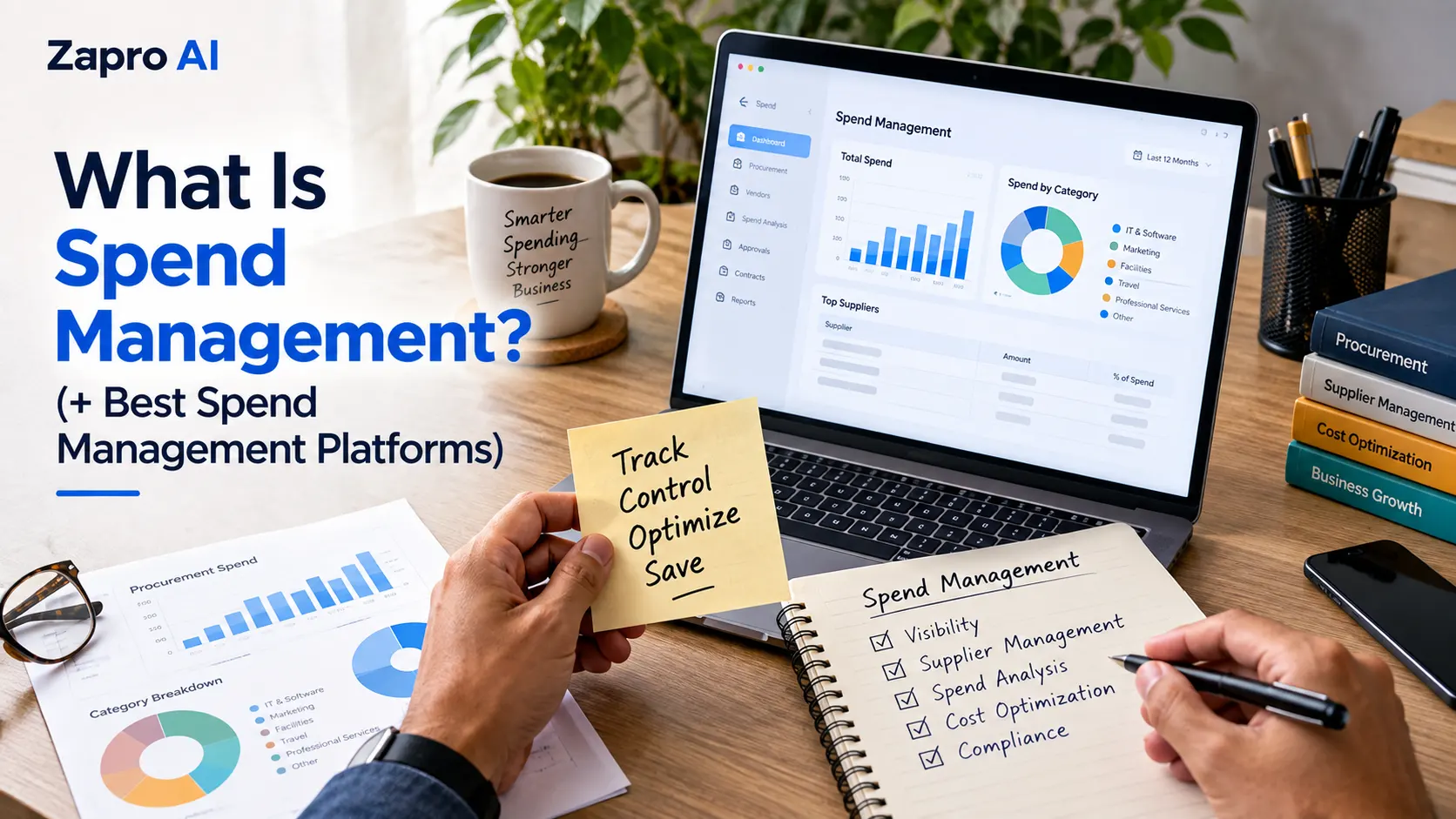
Spend management is how a company plans, approves, tracks, and reviews its spending. Finance, procurement and supply chain teams work together in this area, and it covers every purchase from the first request to the final payment.
It matters because many companies cannot see their full spending picture. Without that view, spending grows without a clear reason, departments pay different prices for the same item, and employees buy outside approved channels.
Spend management solves this by setting rules before money is committed, sending each request through approval, and bringing all spending data into one place.
This guide explains what spend management means, what it covers, the types of spend involved, and how it differs from expense management and procurement. It also covers what to track, the common challenges, and how to improve your approach. Finally, the article compares the best spend management platforms in the market.
Key takeaways
- Spend management controls company spending from the purchase request to payment and review.
- It sets rules and approvals before money is committed, not after.
- It covers budgets, intake, sourcing, purchasing, matching, payment and analysis.
- Scattered data, manual approvals and off-policy buying are the most common problems.
- Good platforms offer approval routing, three-way matching, ERP integration and spend analysis.
What is spend management?
Spend management is the practice of controlling company spending across its full life cycle, from the purchase request to supplier payment and the review that follows. This includes the source-to-pay process. Budgeting, purchasing, approvals, invoices, payments, and analysis all fall under spend management and are interconnected.
The goal is to make sure every purchase supports the company’s financial and business goals. A company with good spend management knows how much it spends, how often it spends, and which suppliers receive the money. It also pays suppliers on time, as agreed in their contracts.
Spend management goes beyond mere record-keeping. It involves building policies and approvals into the buying process itself, so the company can question or stop a purchase before it commits the money.
What does spend management cover?
Spend management follows each purchase through a series of stages as stated below:
- Budgets and rules: At this stage, finance sets spending limits, approval thresholds and policies for each department before anyone buys anything.
- Intake and approvals: Employees submit purchase requests through a standard form. The system then checks each request against policy and budget, and sends it to the right approvers.
- Sourcing and contracts: Procurement compares suppliers on cost, quality, reliability and risk. The team then agrees on pricing and terms with the chosen supplier in a contract.
- Purchasing: The team places the order with an approved supplier through a purchase order.
- Receiving and matching: The team confirms that the goods or services have arrived. It then checks the purchase order, the receipt and the invoice against each other. This check is called a three-way match.
- Invoicing and payment: Accounts payable processes the approved invoice and pays the supplier. Well-planned payments also help a company improve working capital and capture early-payment discounts.
- Analysis and reporting: The team collects spending data, cleans it, sorts it into categories and studies the trends. This analysis shows where the company can save money and helps it plan future budgets.
The following three activities also run in parallel:
- Supplier management: tracking supplier performance on quality, cost, and delivery, and monitoring contract renewals and obligations.
- Supplier risk management: monitoring issues with a supplier’s quality, delivery, finances, compliance, or reputation that could disrupt supply or harm the company’s name.
- Compliance and audit trails: building controls into every step so each purchase links to a person, a budget and a purpose.
Whose responsibility is spend management?
No single team owns the whole process. The responsibilities are usually split the following way:
| Team | What it handles |
| Procurement | Purchase intake, sourcing, supplier selection, contract negotiation and purchase orders |
| Finance | Budgets, spend visibility, invoicing, compliance and cash flow |
| Supply chain | Direct spend planning, inventory, demand forecasting and supplier collaboration |
Types of spend
Spend management applies to every kind of business spending. These are the main types.
- Direct spend: purchases that go straight into what the company makes, such as raw materials and components. This spend affects revenue directly.
- Indirect spend: goods and services that keep the business running but do not go into the product. Examples include software, marketing, office supplies, utilities and cleaning services.
- Tail spend: small purchases that happen now and then. Each one looks minor, but together they can hurt profitability when nobody manages them.
- Maverick spend: purchases made outside the approved buying process. These purchases often cost more than they should.
- Capital expenses (CapEx): long-term investments in assets such as equipment, buildings and technology.
- Operating expenses (OpEx): regular running costs such as salaries, rent and utilities.
APQC’s data shows that how a company organizes its buying affects what it costs. Buying for direct spend costs less when one central team handles it for the whole company. Buying for indirect spend costs less when each department or business unit handles its own. At the median, companies spend $2.20 on buying direct spend and $2.81 on buying indirect spend for every $1,000 of revenue.
Spend management vs. expense management
Expense management deals with spending that employees start, such as travel, meals, corporate card purchases and reimbursements. Teams usually review these costs after the purchase to confirm that they followed policy.
Spend management covers everything the organization buys, from office supplies to raw materials. It also puts controls in place before the purchase happens. Expense management is one part of spend management.
| Spend management | Expense management | |
| Scope | All company spending across every department and supplier | Employee spending such as travel, meals and card purchases |
| When control happens | Before, during and after the purchase | Mostly after the purchase |
| Main question | Is this spend planned, approved and giving the company value? | Did this expense follow policy, and should we reimburse it? |
| Time horizon | Long-term planning, supplier negotiations and budgets | Day-to-day oversight and reimbursement |
GMI’s research on the expense management market, which it values at $9.1 billion in 2026, names corporate card and spend management as the fastest-growing segment, at 13% a year.
Spend management vs. procurement
Procurement is the work of sourcing and buying goods and services. It covers choosing vendors, negotiating contracts and placing orders, and it makes sure the company buys the right items from the right suppliers.
Spend management is the wider framework. It includes procurement, and it also includes budgeting, expense management, invoicing, payments and analysis. Procurement is one stage within spend management.
| Spend management | Procurement | |
| Scope | The full life cycle of company spending | Sourcing and buying goods and services |
| Main activities | Budgets, approvals, purchasing, expenses, invoices, payments and analysis | Supplier selection, contract negotiation and purchase orders |
| Owners | Finance, procurement and supply chain together | Mainly procurement |
What to track in spend management and the challenges to watch for
Metrics to track
These measures show whether spend management is working:
- Spend under management: the share of total spend that goes through approved processes and suppliers
- Policy compliance rate: how many purchases follow the company’s buying rules
- Maverick buying: how much off-policy spending has dropped over time
- Spend by category: where the money goes and how that changes
- On-contract spend: how much spending happens under negotiated contracts
- Supplier performance: how well suppliers deliver on quality, cost and timelines
- First-time invoice match rate: how many invoices match their purchase order and receipt on the first check
- Cycle times: how long purchase orders and invoices take to process
- Supplier diversity and sustainability: the share of spend with diverse suppliers and with suppliers that meet sustainability goals
The cost of running procurement is also worth tracking. APQC tracks it as total procurement cost per $1,000 of revenue. Across its database, the top 25% of organizations spend $2.31 or less, the median sits at $4.53, and the bottom 25% spend $7.50 or more. People make up 59% of that cost, and procurement staff spend half their time on ordering. They spend 16% of their time on sourcing strategy and 15% on managing suppliers.
Common challenges
- Scattered data. Spending sits across ERPs, spreadsheets and other disconnected systems, so no one can see the full picture.
- Late visibility. Teams cannot see current spending against budget in real time, and leaders receive reports that are already out of date.
- Manual workflows. Approvals that run on email or paper cause delays and make the process inconsistent between teams.
- Off-policy buying. Departments skip the approved process and buy on their own. This weakens the company’s negotiating power, and different teams end up paying different prices for the same item.
- Resistance to change. Teams push back on new procedures and continue to use familiar workarounds.
- Too many suppliers. Many contracts, terms and performance measures make supplier management complex and make it harder to negotiate combined deals.
- Weak enforcement. Gaps in training, rigid tools and a lack of real-time monitoring make it hard to enforce policy.
How to improve your spend management strategy
- Map your current spend. Review spending across every department and system to understand where the money goes today.
- Set clear goals. Define what you want to achieve and choose the metrics that will measure progress.
- Bring spend data into one system. A single source of spending data reduces gaps and makes savings easier to find.
- Design approval workflows that balance control and speed. Standardize the process across departments so every team follows the same rules, and set approval levels that match the size and risk of each purchase.
- Automate the routine steps. Automate approvals, invoice processing and reporting so the team spends less time on manual work.
- Consolidate suppliers. Reduce overlapping vendors and renegotiate contracts to get better terms.
- Train your teams. Explain the reasons behind each policy so people understand why the process matters and follow it.
- Start small, then expand. Pick one high-impact problem first, such as late invoices or off-contract spending. Once that works, extend the approach to two or three major spend categories.
- Review often. Check results every quarter, audit spend categories regularly and refine the process based on what the data shows.
The 2025 Deloitte Global Chief Procurement Officer Survey, cited by Amazon Business, found that organizations investing in technology outperform others on cost savings, cost avoidance, stakeholder satisfaction, supplier performance and innovation. Research from The Hackett Group, also cited by Amazon Business, shows that top-performing procurement organizations generate twice the cost savings and cut maverick buying 60% more effectively.
Match the approach to your company size
- Startups can begin with simple controls and basic visibility. Many move to dedicated software once tracking vendors becomes hard to manage.
- Small and mid-sized businesses benefit from cloud-based tools with automatic receipt capture, approval workflows and live dashboards that do not need a large IT investment. Growing companies gain from building one shared platform early instead of adding separate tools for each task.
- Large enterprises need systems that handle complex approval chains, multiple legal entities, international compliance and dashboards for different roles. Their main focus is often on bringing disconnected systems together.
Spend management platforms: a comparison
When you compare platforms, look for these capabilities:
- Real-time dashboards that show committed and actual spend
- Policy checks and budget checks at the moment someone requests a purchase
- Automatic approval routing
- Integration with ERP and accounting systems such as NetSuite and QuickBooks
- Supplier and contract management with renewal alerts
- Automated three-way matching
- AI-driven spend analysis that flags unusual spending
- Mobile access for approvals and receipts
- Room to grow as the company scales
The table below compares platforms based on how each vendor describes its own product.
| Platform | Platform type | What it covers | Best if your problem is |
| Zapro AI | Procurement platform for vendor spend | Purchase intake and approvals, requests for quotes, purchase orders, supplier onboarding and portal, and three-way invoice matching | Purchase requests, orders and invoices spread across email, the ERP and inboxes, with little view of tail spend |
| Coupa | Unified spend management platform | Source-to-contract, procure-to-order, invoice-to-pay and direct spend management | Disconnected systems across sourcing, buying and paying |
| SAP | Cloud-based spend management platform connected to global supplier networks | Sourcing, contracting, purchasing, supplier management, invoices and payments | Sourcing-to-payment processes spread across separate tools |
| Ivalua | Spend management and procurement platform | Spend analysis, sourcing, supplier and contract management, procurement automation and ERP integration | Limited visibility into spend and suppliers |
| Ramp | Spend management platform built around corporate cards | Corporate cards, bill payments, reimbursements and vendor spend | Card spend, bills and reimbursements managed in different places |
| Procurify | Procurement and spend management software | Spend insights, approval routing, invoice processing, expense reports and mobile purchasing | Purchase requests that need approval before money is spent |
| Amazon Business | Business purchasing with built-in spend controls | Spend visibility, guided buying and approval workflows | Business supply purchases that need budget rules and approvals |
Coupa
Coupa offers one platform for the full spend life cycle. It covers source-to-contract, procure-to-order, invoice-to-pay and direct spend management. Its features include AI-supported purchase intake and routing, supplier risk and performance monitoring, three-way matching and AI-driven spend analysis.
SAP
SAP brings sourcing, contracting, purchasing, supplier management, invoices and payments together on one cloud-based platform. The platform connects to global supplier networks, and SAP positions it to help companies improve free cash flow, manage working capital and capture early payment discounts.
Ivalua
Ivalua combines real-time spend analysis with sourcing tools for competitive supplier bids. It also offers supplier performance tracking, contract management, procurement automation and integration with financial and ERP systems. Ivalua includes agentic AI through its IVA assistant.
Ramp
Ramp brings corporate cards, bill payments, reimbursements and vendor spend into one place. It checks each purchase against policy and budget, flags exceptions, routes approvals, syncs transactions with accounting systems and offers a mobile app.
Procurify
Procurify focuses on controlling spend before it happens. Its features include spend insights, approval routing, invoice processing, expense reports and mobile purchasing. It integrates with QuickBooks, NetSuite, Sage Intacct, Dynamics 365, Amazon Business, Staples and ZAGENO.
Amazon Business
Amazon Business adds spend controls to business purchasing. Spend Visibility, available with Business Prime, collects spend data across users, cost centers and categories. Guided Buying lets companies set rules for categories and budgets, and approval workflows support tiered spending limits. Amazon Business connects with more than 300 tools, including SAP Ariba, Coupa and Oracle.
Complete spend visibility with Zapro AI
Most spending visibility is fragmented across systems. The request is usually in email, the order in the ERP, and the invoice in someone’s inbox. Zapro AI keeps every vendor purchase on one record, from the first request to the matched invoice, so procurement and finance can see where each purchase stands and where the money is going.
- Intake and approvals: Every purchase request comes in through one standard form and follows an approval chain the company configures, so spend is visible before it is committed.
- Sourcing: Buyers send requests for quotes to several suppliers and compare the responses in one place before choosing one.
- Purchasing: Approved requests become purchase orders with approved suppliers, linked to the request behind them.
- Receiving and matching: Zapro AI reads supplier invoices and runs a three-way match against the purchase order and the receipt.
- Supplier management: Suppliers go through onboarding before anyone can buy from them, and they use their own portal to respond to requests and submit invoices.
Zapro AI is especially strong on tail spend: the high volume of small purchases that make up most transactions but a small share of spend. Those purchases usually go unseen, and Zapro AI automates them and brings them into view.
Book a demo to see how Zapro AI handles intake, approvals, matching and spend visibility across your categories.
Don’t miss our weekly updates
We’ll email you 1-3 times per week—and never share your information.
About the Author

Md. Kafil


About the Reviewer

Zapro is dedicated to helping businesses of all sizes make informed decisions. We adhere to strict editorial guidelines to ensure that our content meets and maintains our high standards.
Our editorial standards help keep every article accurate, useful, and trustworthy.
Related Blogs

Wait! Don't Leave Without This Free Guide
How AI Is Replacing Manual Procurement And What Your Team Should Do Next