

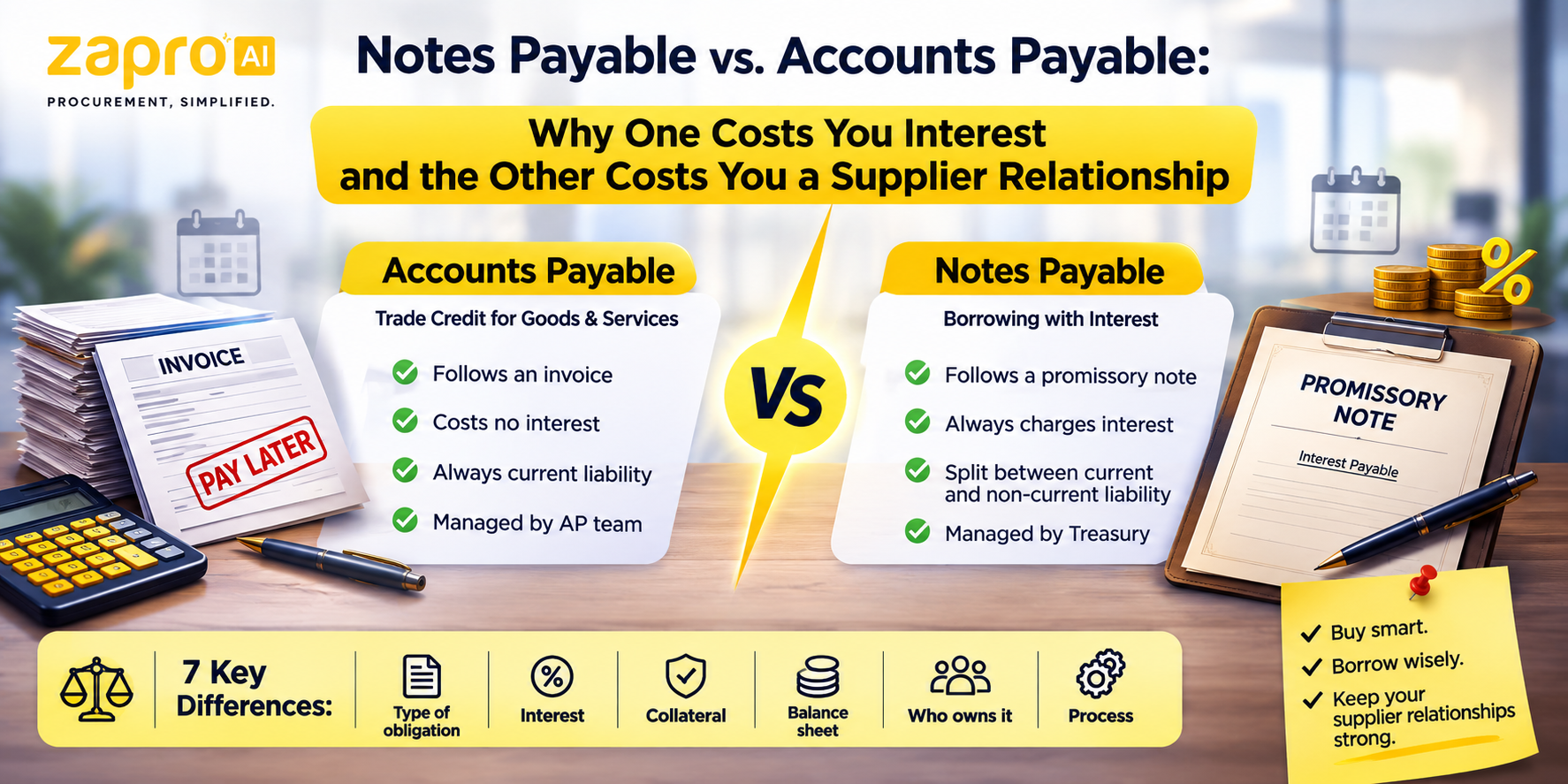
Accounts payable is what you owe suppliers for goods and services already delivered, supported by an invoice and normally interest-free. Notes payable is what you owe under a signed promissory note, always carrying interest and often collateral. One arises from buying; the other from borrowing. Both are liabilities, but different teams manage them for different reasons.
Key takeaways
- Accounts payable follows an invoice, while notes payable follows a signed promissory note.
- Accounts payable costs you nothing until you pay late, but notes payable charges interest from day one.
- Accounts payable always sits in current liabilities. Notes payable is split between current and non-current depending on maturity.
- The AP team manages accounts payable as a process. Treasury manages notes payable as a financing decision.
- An overdue supplier balance can convert into a note, moving the obligation between categories and starting the interest clock.
Notes payable vs. accounts payable at a glance
Everything below expands on these seven rows.
| Accounts payable | Notes payable | |
| Type of obligation | Goods or services received | Money borrowed |
| Formality | Invoice and standard payment terms | Signed promissory note |
| Interest | None, unless you pay late | Always, stated in the note |
| Collateral | Unsecured | Often secured against an asset |
| Balance sheet | Current liabilities only | Current and non-current, split by maturity |
| Who owns it | Accounts payable team | Treasury or finance leadership |
| Process | Match, approve, pay | Draw down, accrue interest, amortise |
What is accounts payable?
Accounts payable is the money you owe suppliers for goods and services they have already delivered but you have not yet paid for. A supplier ships, invoices and then waits out the payment terms, and the amount sits as a liability until you pay.
This is trade credit rather than borrowing, because no money changed hands to create it and no contract exists beyond the purchase terms. The supplier charges nothing for the delay as long as you pay when you agreed to.
Key characteristics of accounts payable
Accounts payable arises from operations rather than financing, and it carries short terms of typically 30 to 60 days, so it always sits in current liabilities. Nobody signs a separate instrument because the invoice and the agreed payment terms create the obligation — whether it arrives as a PO invoice or a non-PO invoice.
Interest does not accrue unless you breach those terms. Some suppliers charge late fees, but the standard arrangement costs nothing while you stay inside the window, and suppliers rarely take security, so they carry the exposure and manage it through credit limits instead.
Common accounts payable examples
To understand common accounts better, here are some examples of them: a regular supplier ships raw materials on 45-day terms, a software vendor invoices annually for a subscription your team already uses, and the utility company bills you for electricity you have already burned. A logistics provider charges for freight it has already moved, and a law firm bills for work it has already done.
Each of the above-mentioned processes follow the same pattern. Something arrived, an invoice followed, and payment lags behind delivery — and the vendor payment process closes it out.
Because accounts payable is really the tail end of a purchasing decision, tightening it up gets easier when the buying side is instrumented too — an AI procurement platform that captures the purchase order and approval up front leaves AP with cleaner data to match against, rather than chasing context after the invoice lands.
What is notes payable?
Notes payable is the money you owe under a formal written promise to repay, called a promissory note. Someone lends you money or extends you credit, you sign, and the note fixes the amount, the interest rate, the repayment schedule and the consequences of default.
The obligation exists because you borrowed rather than because you bought, and that difference drives everything else about how it behaves.
Key characteristics of notes payable
A promissory note is a negotiable instrument with legal force independent of any commercial relationship. In the United States it is governed by Article 3 of the Uniform Commercial Code, which sets out what makes a written promise to pay negotiable, who can enforce it and how liability transfers. The note names a principal, an interest rate, a maturity date and a repayment schedule.
Interest accrues from the drawdown date and appears as interest expense on the income statement, separate from the principal on the balance sheet. Lenders often take security over an asset, and notes frequently carry covenants on leverage, coverage and reporting that you can breach even while making every payment on time.
Terms run from months to years, and the values dwarf individual invoices. Treasury manages the drawdown, the amortisation schedule and the covenant reporting.
Common notes payable examples
A bank advances a term loan to fund a facility expansion, or an equipment vendor extends credit under a signed note instead of invoicing. A business draws a working capital facility to cover a seasonal gap, or a shareholder lends money and both sides document it as a note. A supplier can also restructure an overdue balance into a repayment agreement, which the conversion section covers in full.
Is notes payable a current or long-term liability?
It can be both, and the same note often appears in both places at once.
The portion falling due within twelve months sits in current liabilities as the current portion of long-term debt, and the rest sits in non-current liabilities. Under IAS 1 Presentation of Financial Statements, the test is whether you hold a right at the reporting date to defer settlement for at least twelve months — not what you expect or intend to do. A three-year note repaid in equal instalments therefore shows one year of principal as current and two years as non-current, and that split shifts every reporting period as maturity approaches.
The split matters for your current ratio, because moving a note from non-current to current as it nears maturity worsens your working capital ratios even though nothing about the business has changed.
The seven differences that actually matter
Type of obligation: goods received vs. money borrowed
Accounts payable arises when a supplier delivers something and invoices you for it, while notes payable arises when someone advances you funds or credit under a signed instrument. One is an operating liability and the other a financing liability, and analysts read them very differently.
Formality: invoice terms vs. promissory note
An invoice carries terms you agreed to, commercially, often in a purchase order or a framework contract. A promissory note is a standalone legal instrument that the borrower signs and that stands on its own terms.
Interest: none unless late vs. always
Accounts payable costs nothing while you pay on time, which makes it the cheapest funding a business can reach and explains why finance teams stretch payment terms.
Notes payable charges interest from the first day on the outstanding principal. That interest appears as an expense and reduces profit before tax, so it also produces a tax shield that trade credit does not — subject to the limitation on the deduction for business interest expense under section 163(j), which caps the deduction for most larger taxpayers rather than allowing it in full.
Collateral: unsecured vs. potentially secured
Suppliers extend trade credit unsecured and manage the risk through credit limits, terms and occasionally personal guarantees, so if you fail they join the unsecured creditors.
Lenders frequently secure notes against specific assets or a general charge, and default lets them enforce against that asset, which puts them ahead of your suppliers in recovery.
Balance sheet classification
Accounts payable sits in current liabilities and never moves, while notes payable splits across current and non-current by maturity, and that split changes each period.
Converting a payable into a long-term note therefore improves your current ratio even though total liabilities have not moved at all. The improvement is presentational, and any competent analyst will unwind it.
Who owns it: AP team vs. treasury
The AP team owns accounts payable, and throughput, accuracy and payment timing measure their performance in what is a high-volume operational discipline — the reason most teams reach for AP automation rather than more headcount. Weighing accounts payable outsourcing vs. in-house execution is the other lever teams pull once automation alone stops closing the gap.
Treasury or the finance director owns notes payable, answering instead for cost of capital, covenant headroom and liquidity. Signing a note is a financing decision that usually needs board or lender approval. The two functions rarely share a system, which is why your total obligations are harder to see than either number on its own — and why running one procure-to-pay process end to end matters more than it sounds.
Process: three-way matching vs. amortisation schedule
Accounts payable runs a repeating cycle in which an invoice arrives, matches to an order and a receipt, gains an approval and then pays, and the controls sit in that three-way matching step. Most of that cycle is now handled by automated invoice processing.
Notes payable runs a schedule that both sides set at signing. You accrue interest each period, make payments split between interest and principal, reclassify the current portion at each year-end, and report against covenants, so the controls sit in the schedule instead.
How to record each
Journal entry for an accounts payable transaction
A supplier invoices $2,400 for office supplies on 30-day terms, and the expense line carries whichever GL code your chart uses for office supplies. If you are still building that chart, the GL code list gives worked examples by account type, and GL coding in accounts payable covers how the code gets assigned on the way through.
| Debit | Credit | |
| Office supplies expense | 2,400 | |
| Accounts payable | 2,400 |
Thirty days later you pay:
| Debit | Credit | |
| Accounts payable | 2,400 | |
| Cash | 2,400 |
Two entries settle it and the liability clears in full without interest. The same movement in T-accounts puts accounts payable on the right when the obligation arises and on the left when you clear it.
Journal entry for a notes payable transaction
You borrow $50,000 on a twelve-month note at 8% to fund equipment.
At drawdown:
| Debit | Credit | |
| Cash | 50,000 | |
| Notes payable | 50,000 |
Each month you accrue interest of $333 ($50,000 × 8% ÷ 12):
| Debit | Credit | |
| Interest expense | 333 | |
| Interest payable | 333 |
At maturity you repay principal and accrued interest:
| Debit | Credit | |
| Notes payable | 50,000 | |
| Interest payable | 4,000 | |
| Cash | 54,000 |
Three differences stand out. Cash increased when the liability arose, which never happens with accounts payable; interest accrues every period whether or not you pay anything; and the total cash outflow exceeds the original principal by $4,000.
Side by side on the balance sheet
A mid-market extract showing both in position:
| Liabilities | Amount |
| Current liabilities | |
| Accounts payable | 412,000 |
| Accrued expenses | 85,000 |
| Notes payable — current portion | 60,000 |
| Total current liabilities | 557,000 |
| Non-current liabilities | |
| Notes payable — long term | 240,000 |
| Total liabilities | 797,000 |
The same note appears twice, with $60,000 falling due within a year above the line and $240,000 falling due later below it. Accounts payable appears once, because nothing about it can be non-current.
When accounts payable becomes notes payable
A supplier balance can turn into a note more often than the textbooks suggest, and the conversion changes the obligation in ways worth understanding before you agree to it.
Converting an overdue supplier balance to a note
A buyer owes a supplier $80,000 that is now 120 days overdue. The supplier wants payment and the buyer cannot pay in full, so rather than suspend supply or start recovery they agree a twelve-month repayment schedule at 9%, documented as a promissory note.
The conversion entry:
| Debit | Credit | |
| Accounts payable | 80,000 | |
| Notes payable | 80,000 |
From that point, interest accrues at $600 a month, and the buyer’s obligation to that supplier is a debt instrument rather than an unpaid invoice.
What changes on the balance sheet when it converts
Total liabilities do not move, but the composition does, and so does everything that reads composition.
Accounts payable falls by $80,000, which improves days payable outstanding without any operational improvement behind it. Notes payable rises by the same amount, which worsens debt-to-equity and every leverage covenant tied to it. Interest expense now appears on the income statement where nothing appeared before, and if the note runs beyond twelve months the current ratio improves as well, again with no underlying change.
Anyone reading your statements watches an operating liability turn into a financing liability, which signals distress more clearly than the overdue balance ever did.
When conversion is the right call
Conversion helps when the alternative is worse. A supplier about to suspend delivery on a category you cannot replace quickly — particularly where supplier concentration leaves you with no second source — is a bigger problem than 9% interest, and a formal schedule can preserve a relationship that repeated broken promises would destroy.
It hurts when it papers over a structural problem. Converting because you are consistently short of cash treats only the symptom, and the interest makes next quarter harder than this one. Before signing, compare it against the alternatives: purchase order financing funds the order rather than the arrears, and it does not restate an operating liability as debt. Check your loan covenants too, because many define debt in ways that capture a supplier note and would put you in breach immediately.
Because a note conversion is usually a symptom of relationship strain that has been building for months, catching it earlier is easier with an AI Vendor Management platform that tracks supplier payment history and risk signals in one place, rather than discovering the pattern only once a supplier threatens to cut off supply.
How to measure each
AP metrics: DPO, turnover ratio, discount capture
Days payable outstanding is accounts payable divided by cost of goods sold, multiplied by 365, and it tells you how long you take to pay. A higher number preserves cash, but pushing it too far burns supplier goodwill and costs you priority when supply tightens.
Accounts payable turnover is cost of goods sold divided by average accounts payable, showing how many times you clear the balance in a year. It moves in the opposite direction to DPO.
Discount capture rate is the early-payment discounts you took divided by those suppliers offered you. A 2/10 net 30 discount is worth roughly 36% annualised, so missing them costs more than the P&L ever shows — and missed discounts are almost always an approval-speed problem that invoice automation solves.
NP metrics: debt-to-equity, interest coverage, cash flow to debt
Debt-to-equity is total debt divided by shareholders’ equity, and it measures how much of the business runs on borrowed money. Lenders set their covenants against it.
Interest coverage is operating profit divided by interest expense, showing how many times over you can service the interest. It is usually the first ratio to fail when trading weakens.
Cash flow to debt is operating cash flow divided by total debt, and it is the most honest of the three because it tests repayment against cash rather than against accounting profit.
What good looks like for a mid-market company
Treat these as orientation rather than as targets. Capital-intensive businesses run higher leverage by design, and a services business with almost no debt looks excellent on every debt ratio while telling you nothing useful.
| Metric | Typical range | What sits outside it |
| Days payable outstanding | 30–45 days | Above 60 usually means strained supplier relationships |
| AP turnover | 8–12× | Below 6 suggests slow payment or overstated balances |
| Discount capture | Above 80% | Low capture usually reflects slow approvals, not policy |
| Debt-to-equity | Below 2.0 | Above 3.0 limits further borrowing |
| Interest coverage | Above 3.0× | Below 1.5 puts covenant breach within one bad quarter |
| Cash flow to debt | Above 0.20 | Below 0.10 signals repayment pressure |
Frequently asked questions
What is the difference between accounts payable and notes payable?
Accounts payable is what you owe suppliers for goods and services already delivered, evidenced by an invoice and normally interest-free. Notes payable is what you owe under a signed promissory note, carrying interest and often collateral.
What is a note payable in simple terms?
A written promise to repay a specific amount by a specific date, usually with interest. Signing it creates a legal obligation independent of any commercial relationship.
Is notes payable the same as accounts payable?
No, although both are liabilities. Accounts payable arises from buying and notes payable from borrowing, and the two differ in formality, interest, collateral, balance sheet treatment and who manages them.
What account type is notes payable?
A liability account. It splits between current and non-current depending on when the principal falls due, and the same note can appear in both.
Is notes payable a debit or credit?
Notes payable carries a credit balance, as every liability does. You credit it when the obligation arises and debit it when you repay principal.
Is notes payable a current liability?
It is partly current. Principal due within twelve months sits in current liabilities and the rest sits in non-current, so a twelve-month note is entirely current while a five-year note starts out mostly non-current.
Can accounts payable become notes payable?
It can. When a buyer and supplier restructure an overdue balance into a formal repayment schedule with interest, the obligation moves from accounts payable to notes payable. Total liabilities do not change, but leverage ratios and interest expense both do.
Are notes payable and notes receivable the same?
No, they sit on opposite sides of the same instrument. Notes payable is money you owe under a note, while notes receivable is money someone owes you under one, which makes the first a liability and the second an asset.
Get full visibility into what you owe
Zapro AI gives finance teams a single system for tracking supplier obligations, whether they sit in accounts payable or have been converted into a formal note.
Most finance teams can produce an accounts payable figure and a debt figure separately, but far fewer can produce them together at supplier level, because the two live in different systems and report on different cycles.
Zapro captures supplier obligations from requisition through to settlement in one procure-to-pay flow, with spend analytics on top, so finding out what you owe and to whom takes one query rather than a reconciliation exercise.
Don’t miss our weekly updates
We’ll email you 1-3 times per week—and never share your information.
About the Author

Md. Kafil


About the Reviewer

Zapro is dedicated to helping businesses of all sizes make informed decisions. We adhere to strict editorial guidelines to ensure that our content meets and maintains our high standards.
Our editorial standards help keep every article accurate, useful, and trustworthy.