

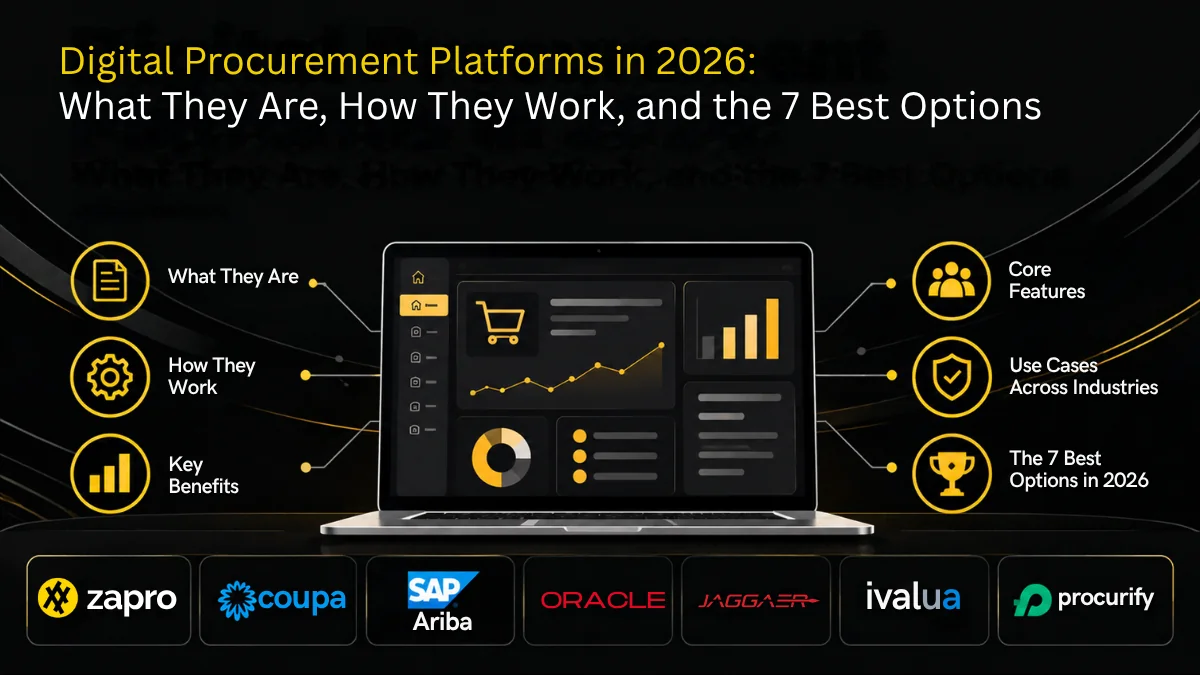
Digital procurement modernizes and automates every stage of purchasing, from initial vendor onboarding and purchase requests to contract sign-offs, invoice payments, and spend tracking. Replacing slow email threads and manual spreadsheets, it gives finance and operations teams a single place to control company spending.
Most procurement teams are not slow because the people are slow. They are slow because a request lives in an email thread, the contract lives in someone’s drive, the budget lives in a spreadsheet, and nobody sees the invoice until it lands on the finance desk. Every one of those is a handoff, and every handoff is where the time and the money go.
A digital procurement platform closes those gaps by moving the whole source-to-pay cycle into one system. This guide covers what digital procurement actually is, the seven platforms worth shortlisting in 2026, how the process runs end to end, where AI genuinely changes the work, and what a transformation programme looks like once you have chosen a platform. If requisition-to-PO automation is your only requirement, start narrower with the e-procurement software comparison instead.
Key takeaways
- Digital procurement is the strategy – running the full vendor lifecycle on data and automation. A digital procurement platform is the software layer that delivers it.
- E-procurement digitises transactional buying. A digital procurement platform adds sourcing, contracts, supplier risk and analytics on the same data model.
- Zapro, Coupa, Jaggaer, Ivalua, Procurify, Kissflow and Tipalti cover the realistic 2026 shortlist, and they are not interchangeable – each fits a different spend profile.
- Organisations report 20-40% cost reduction and 50-80% shorter P2P cycles after automation, but only once vendor master data has been cleaned first.
- The failure point is almost never the software. It is adoption, master data, and treating the platform as PO automation rather than vendor lifecycle management.
What Is Digital Procurement?
Digital procurement is the use of cloud software, automation, data and AI to run procurement digitally, from sourcing and supplier onboarding to purchase requests, orders, invoices and payments, instead of on paper, email and spreadsheets. It improves spend visibility, policy compliance, cycle times and supplier collaboration.
Digital procurement is the use of technology, automation and integrated platforms to manage the entire purchasing and vendor lifecycle – from request to renewal. It replaces manual, paper-based and email-driven workflows with structured digital systems that provide visibility, control and accountability. In plain terms: it is procurement powered by data, automation and real-time insight rather than by chasing people.
Digital Procurement vs Traditional Procurement
Traditional procurement relies on spreadsheets, email, disconnected systems and manual approvals. Information is scattered, visibility is limited, and compliance checks tend to happen too late to matter. Digital procurement centralises requests, automates approvals, tracks vendor risk and reports in real time – so teams manage spend before it commits rather than explaining it afterwards.
| Traditional Procurement | Digital Procurement |
| Manual, email-driven workflows | Automated, structured workflows |
| Siloed systems | Centralised visibility |
| Reactive issue management | Proactive risk monitoring |
| Paper-based documentation | Integrated digital platforms |
| Limited, monthly reporting | Real-time dashboards |
Digital Procurement vs E-Procurement
The two get used interchangeably and should not be. E-procurement software digitises transactional buying – requisitions, orders, invoices. Digital procurement extends across the full source-to-pay cycle, adding sourcing events, contract lifecycle management, supplier risk and analytics, so strategic and transactional activity share the same supplier and spend data. Digital procurement is the strategy; e-procurement is one layer that delivers part of it.
What Is a Digital Procurement Platform?
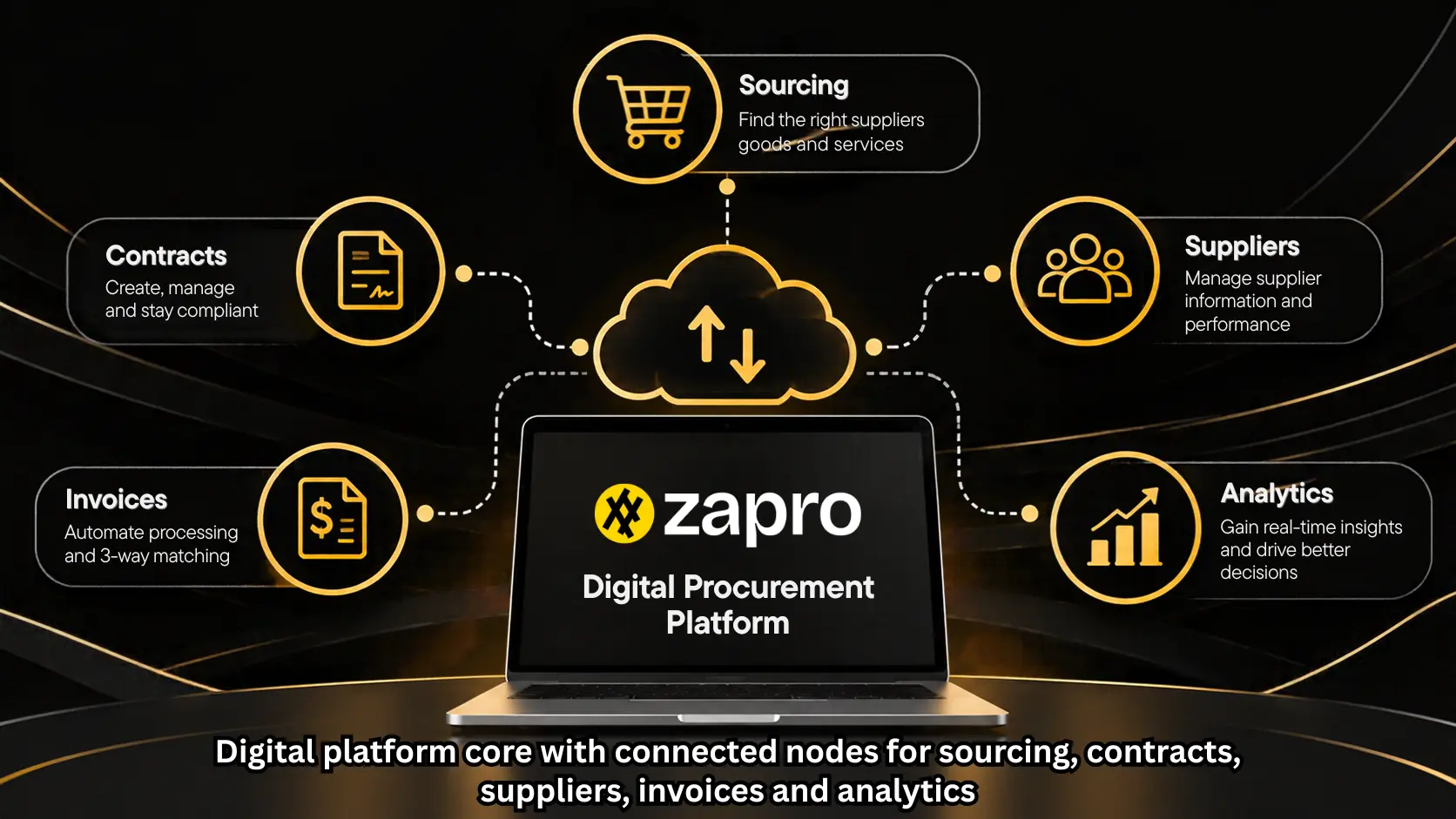
A digital procurement platform is cloud software that runs purchasing end to end: intake and purchase requests, approvals, supplier onboarding, purchase orders, contracts, invoice matching and spend analytics, in one system. It replaces email and spreadsheets and gives finance real-time control of company spend.
A digital procurement platform is the cloud-based system that runs all of the above through a single interface – sourcing, requisitioning, contract management, ordering, receiving, invoicing and analytics on one data model. Every commitment, contract and payment traces back to one record, which is what makes policy enforceable rather than aspirational and turns procurement from a cost centre into a control function over the whole procurement lifecycle.

By 2027, 50% of organizations will support supplier contract negotiations through the use of AI-enabled contract risk analysis and redlining tools
– Gartner, Predicts 2024: CPOs Adjust to Technology’s Impact on Procurement
Core Features of a Digital Procurement Platform
Six capabilities separate a genuine platform from a workflow tool with a procurement label on it.
1. Supplier management
One record per vendor, holding contracts, performance scorecards, risk assessments and compliance documents. This is the foundation for vendor management that survives audit – if supplier data is scattered, nothing built on top of it is reliable.
2. Requisition and approval workflows
Purchase requisitions are submitted through structured intake forms that capture business need, budget line, risk impact and stakeholders. Rules route each request by amount, category and role automatically – no chasing, and no request that skipped legal because someone forgot.
3. Automated purchase orders
POs generate on approval and go to the supplier without rekeying, with budget checks and contract pricing applied at the point of creation rather than discovered at invoice.
4. Invoice matching and payment tracking
Two-way or three-way matching runs automatically against the PO and the receipt, so exceptions surface instead of everything needing review. This is where AP automation turns from data entry into exception handling, and it produces the audit trail as a by-product.
5. Analytics and reporting
Spend analytics across category, department, vendor and period – available on demand rather than compiled monthly. Predictive models flag where next quarter is heading rather than describing last quarter.
6. Contracts, risk and integration
Contract storage with renewal tracking, embedded risk and compliance checks, and native integrations with ERP, accounting and security tools. A platform that cannot write to your ERP has not removed a silo, it has added one.
The 7 Best Digital Procurement Platforms in 2026
These seven cover the realistic shortlist across company sizes and spend profiles. For a broader field including enterprise suites, see the full best procurement software ranking.
1. Zapro
Best for: organisations of 100 to 5,000 employees that need vendor management, approvals and source-to-pay live quickly rather than configured for two quarters.
Strengths: unifies the full source-to-pay cycle with performance tracking and risk monitoring on one data model, 300+ integrations, and the fastest time-to-value of the group. AI-driven invoice matching handles the exception work rather than presenting it. Pricing is published from $699/month rather than quote-on-request.
Watch for: a smaller reference base at the 10,000+ employee tier than the legacy suites – worth confirming through a pilot at that size.
Ready to optimize & save? Start here.

2. Coupa
Best for: large enterprises that need advanced spend management and strategic sourcing depth.
Strengths: business spend management breadth, extensive integration options, complete P2P coverage, strong benchmarking data. Implementation overhead and pricing put it out of reach for most mid-market teams.
3. Jaggaer
Best for: complex direct spend, particularly manufacturing and higher education.
Strengths: handles intricate commodity and service sourcing events at scale, with strong supplier intelligence. The interface shows its age against newer platforms.
4. Ivalua
Best for: organisations whose processes are too specific for an off-the-shelf configuration.
Strengths: configurability – the platform adapts to your workflow rather than the reverse, including industry-specific regulatory requirements. That flexibility costs implementation time.
5. Procurify
Best for: teams focused on spend control and budget compliance across business units.
Strengths: approachable interface, strong requisition management and budget tracking. Lighter on sourcing and contract depth.
6. Kissflow Procurement Cloud
Best for: teams that want to build and change procurement workflows visually without IT.
Strengths: no-code workflow design and fast reconfiguration. Missing some enterprise-scale sourcing features.
7. Tipalti
Best for: global invoice and payment operations, particularly multi-entity AP.
Strengths: automated global payables and tax compliance. It is not a sourcing platform – pair it or look elsewhere if upstream procurement matters.
See the full Tipalti alternatives breakdown if procurement depth upstream is the gap you are solving for.
Comparing platforms goes faster once you have watched one run end to end. Walk through a procurement software demo to set the benchmark you measure the rest of the shortlist against.
Where AI Actually Changes the Work
AI is the 2026 label on every procurement product page, which makes it worth separating the parts that change day-to-day work from the parts that are a chatbot on a dashboard. Five areas hold up.
- Spend analysis. Line-item classification runs continuously rather than in a monthly cleanse, so category spend is current and savings opportunities surface as they appear.
- Predictive analytics. Demand and delay forecasting moves the team from reacting to shortages to planning around them.
- Vendor selection. Suppliers are scored on performance, cost and risk together, which compresses a manual shortlisting exercise into a reviewable recommendation.
- Contract review. Renewal dates, obligations and unusual clauses are extracted on ingestion, which is the difference between a contract repository and a contract you can act on.
- Risk and anomaly detection. Duplicate invoices, price drift against contract, and supplier-detail changes get flagged before payment rather than found in audit.
AI only adds value once the underlying workflow is already digital – a model reading a scanned PDF that a human then rekeys has moved the work, not removed it. Compare AI procurement software with the intelligence built in rather than bolted on.
The Digital Procurement Process, Step by Step
A true digital procurement process spans the full vendor lifecycle, not just the purchase order. Eight stages, in the order they run:
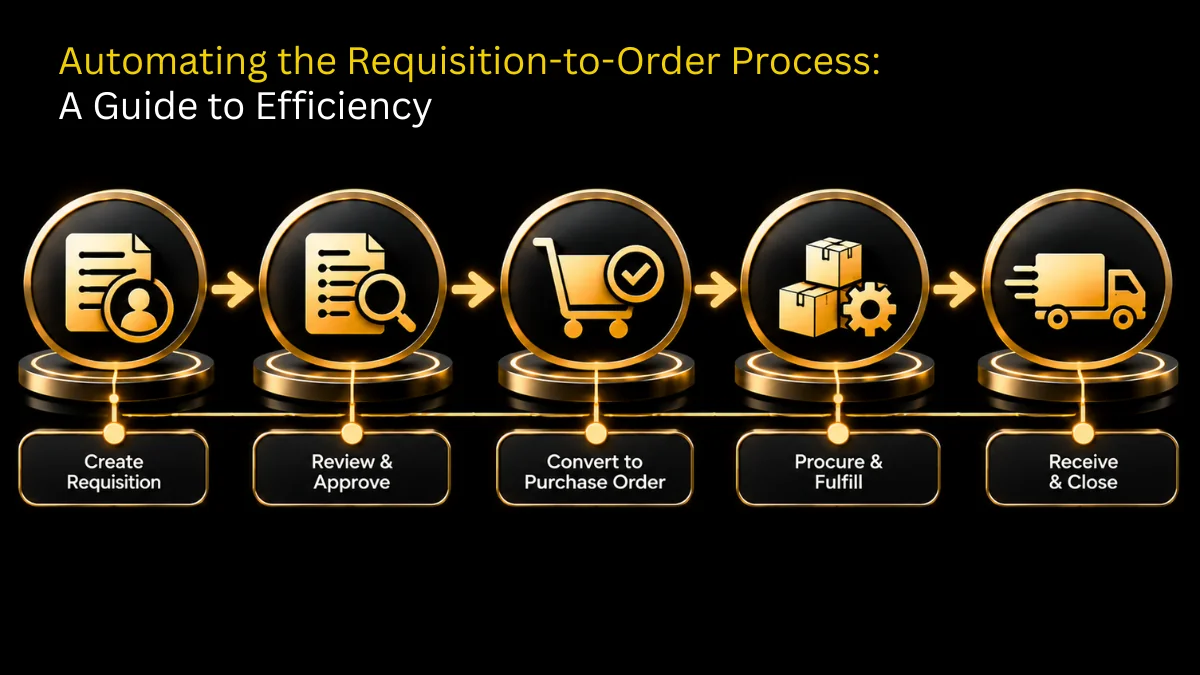
- Digital intake and request management. Every request starts in one place, on a structured form capturing need, budget, risk impact and stakeholders. This single change eliminates most downstream chasing.
- Automated approvals. Role- and threshold-based routing sends requests to finance, legal, security or the department head without anyone forwarding an email.
- Vendor discovery and evaluation. Standardised criteria, financial health checks, risk review and capability assessment – comparable across candidates because everyone was scored the same way.
- Digital onboarding and compliance. Security reviews, data protection assessment and legal documentation happen inside the workflow, with every approval traceable.
- Contracting and purchase orders. Version control, approval logs and e-signature, with the PO generated from the contract terms in the same system.
- Receipt and invoice matching. Invoices match against PO and receipt automatically; only exceptions reach a person.
- Payment and spend tracking. Payments schedule on time, early-payment discounts apply automatically, and dashboards show spend by department, category or vendor as it happens.
- Renewals and lifecycle management. Renewal alerts fire early enough to negotiate, and offboarding workflows close out access and data when a contract ends.
Digital procurement transformation is only complete when every one of those stages is digitised – a platform that stops at step six is purchase order software, not a procurement platform. See how the stages connect in the procure-to-pay process and the wider procurement workflow guide.
Benefits of Digital Procurement Solutions
The numbers organisations report after moving to a digital procurement platform, and what actually produces them:
- 20-40% cost reduction, from automation, enforced compliance and better-informed vendor negotiation – not from any single feature.
- 50-80% shorter P2P cycle times, because approvals stop queueing behind availability. Zapro clients have reported cycle times down 60% and invoice processing up to 75% faster through AI matching.
- Fewer manual errors. Structured forms and automated matching remove the rekeying that produces them.
- Audit readiness by default. The audit trail is a by-product of the workflow rather than a reconstruction exercise each year.
- Stronger vendor governance. Performance tracking and renewal alerts cut contract exposure and duplicate subscriptions.
- Cross-functional visibility. Finance, legal, security, IT and procurement work from the same record instead of four versions of it.
The biggest benefit is not efficiency, though. It is that risk drops while speed increases – which is the combination that usually forces a trade-off. Solution scope and price move together, so map both early: Zapro publishes pricing across three plans rather than quoting on request.
Digital Procurement Transformation: Turning a Platform Into a Programme
Buying the platform is a purchase. Changing how the organisation buys is a programme. Digital procurement transformation is the structured shift from manual, reactive purchasing to a technology-enabled operating model – and it is more than going paperless, because paperless still lets you run a broken process quickly.
Why traditional procurement slows businesses down
- The approval black hole. Requests sit in email threads for weeks with no owner and no visibility into where they are stuck.
- Missing contracts. Agreements scattered across shared drives mean renewal dates are found after they pass.
- Invisible spend. Finance learns about the commitment when the invoice arrives, which is the last moment anything can be done about it.
- Manual matching. Hours spent checking invoices against POs, with errors that survive the check.
- Best-effort compliance. Security and legal review happens when someone remembers, not when the risk is created.
The four pillars of digital transformation in procurement
Centralised vendor management. One searchable source of truth for documents, contracts and contacts – so nobody hunts for a SOC 2 report again. This is where vendor contract management stops being a filing problem.
Structured workflows and approvals. A trackable digital request replaces the “can I buy this?” message, routed automatically by department and amount.
Digital invoice processing and matching. Two- and three-way matching verifies the invoice against the order and the receipt without a person in the loop for the clean ones.
Spend visibility across teams. Real-time spend by department exposes duplicate subscriptions and creates the volume leverage to renegotiate.
Retail procurement digital transformation
Retail feels this harder than most sectors, for three structural reasons: vendor counts and PO volume are an order of magnitude higher; seasonality creates buying surges a manual team cannot absorb; and distributed store and warehouse networks need supplying simultaneously. A two-week approval delay in retail is empty shelves and lost revenue, not an administrative annoyance. Digitising the workflow is what keeps a complex supply chain moving at customer pace – see the retail procurement guide for the category-level detail.
Healthcare feels the same pressure for different reasons: patient safety and strict compliance rules, which is why digital transformation in healthcare procurement starts with one system for requests, suppliers, orders and invoices.
What the transformation sequence looks like
A realistic digital procurement transformation runs 12-24 months for a mid-market organisation, delivered in quarterly increments rather than one cutover. The order matters, because each stage depends on data quality established by the previous one:
- Baseline assessment and spend visibility.
- Vendor master and spend taxonomy cleansing.
- Transactional automation – requisition to order first, since it delivers the fastest measurable cycle-time gain and enforces policy at the point of commitment.
- Invoice automation.
- Contract and supplier management digitisation.
- Analytics and category strategy.
- Predictive and AI-assisted decision support.
Transactional automation can show results inside the first quarter; category strategy and supplier development mature across the full cycle. For operating-model and org-design change beyond the technology, see the procurement transformation guide.
Common Challenges, and How to Solve Them
| Challenge | What to do about it |
| Low adoption — teams route around the system | Make the compliant path the fast path: simple intake forms, catalogs for high-volume items, mobile approvals, SSO. Then block invoices without a PO so the workaround stops working. |
| Change resistance — people trust their spreadsheet | Start training before go-live with sandbox practice on real scenarios, train by role rather than uniformly, and name a champion per department to carry it. |
| Tool sprawl — three systems, four versions of the truth | Consolidate vendor workflows onto one platform rather than integrating four. Every integration you avoid is a failure mode you avoid. |
| Weak integrations — the new tool is a new silo | Confirm the ERP and accounting connectors are native before signing, not on the roadmap. |
| Dirty master data | Cleanse vendor and spend data before migration. Organisations that skip this spend the first six months fixing reports instead of realising savings. |
| No defined process | You cannot digitise a mess. Document approval thresholds, routing rules and the spend taxonomy first — automation makes an undefined process fail faster, not better. |
| Treating it as PO automation only | Design workflows around the whole vendor lifecycle including risk, contracts and renewals. Stopping at the PO is the most common reason a platform underdelivers. |
Two practices sit above all of these: bring CFO, procurement and department heads in before selection rather than at rollout, and set your baselines before go-live so improvement is provable afterwards.
How to Choose the Right Digital Procurement Platform
Four criteria decide fit, and one prerequisite decides whether any of them matter.
- Scalability. Handle user and transaction growth at the rate your five-year plan implies, not today’s volume.
- Integration. Native connection to your specific ERP or accounting system. “Integrates with everything” is not an answer.
- User experience. Test with an actual requester who has never seen the tool. If they cannot raise a request unaided in the demo, adoption will fail whatever the feature list says.
- AI capability. Predictive risk scoring and automated classification, not reporting relabelled as intelligence.
The prerequisite: a cleansed vendor master, an agreed spend taxonomy, a documented approval matrix with thresholds, digitised contracts and executive sponsorship. Without those, the best platform on the market produces fast, well-formatted, unreliable reporting. If you are weighing hosted against on-premise, the cloud procurement guide covers the trade-offs, and the procurement management system overview explains where the platform sits relative to your ERP.
Digital Procurement for SaaS and Software Buying
SaaS is where digital procurement stops being an efficiency project. Most organisations run dozens or hundreds of subscriptions, and each one grants a vendor access to company data. Without structured oversight, the failure modes stack up:
- Auto-renewals that inflate budgets before anyone reviews them.
- Shadow IT purchases that never passed approval.
- Security reviews performed after the contract is signed.
- Contract sprawl across departments with no central record.
- No visibility into license usage against license count.
Digital procurement fixes the sequence: security and IT assess risk before approval, finance monitors subscription budgets in real time, legal reviews contracts early, and IT tracks access, renewals and usage after go-live. Buying software is a data access decision as much as a financial one, which is why SaaS procurement automation is worth treating as its own category rather than a subset of general purchasing.
Where Procurement Technology Goes Next
- Autonomous negotiation and predictive supply planning as AI moves from recommendation to action on low-risk categories.
- Blockchain-backed contract and supplier verification where provenance matters more than speed.
- Sustainable procurement with ESG performance tracked as a scored supplier attribute rather than a questionnaire.
- Deeper analytics as several years of clean transactional data become available to model against.
In capital-intensive verticals such as telecom, where external spend can exceed half of total revenue, a unified platform is even more critical. See how telecom companies adopting digital procurement are consolidating hundreds of vendor relationships and cutting sourcing cycles from months to weeks.
FAQs
Q1. What is digital procurement?
Digital procurement is the use of automated platforms and integrated tools to manage purchasing, vendor onboarding, contracts, spend tracking and renewals digitally, replacing manual and email-driven workflows with structured, auditable ones.
Q2. What is a digital procurement platform?
A digital procurement platform is an integrated system covering sourcing, contracting, purchasing, receiving, invoice matching and analytics in one connected environment. It replaces disconnected point tools with a single data model, so every commitment, contract and payment traces back to one record.
Q3. How does digital procurement work?
It centralises requests through structured intake, automates approvals by role and threshold, embeds compliance checks in the workflow, matches invoices against orders and receipts automatically, tracks spend in real time, and manages renewals through scheduled alerts.
Q4. How is digital procurement different from e-procurement?
E-procurement focuses on transactional online purchasing – requisitions, orders, invoices. Digital procurement manages the entire vendor lifecycle including sourcing, risk, compliance, contracts and renewals, with strategic and transactional activity sharing the same data.
Q5. What is digital procurement transformation?
Digital procurement transformation is the structured redesign of procurement operating models, processes, data and technology to shift the function from transactional processing to strategic value delivery. It combines automation of routine work with new capability in analytics, supplier risk and category strategy.
Q6. What are the stages of digital procurement transformation?
Baseline assessment and spend visibility, vendor master and data cleansing, transactional automation, contract and supplier management digitisation, analytics and category strategy, then predictive and AI-assisted decision support. Each stage depends on the data quality established in the one before it.
Q7. How long does digital procurement transformation take?
Twelve to twenty-four months for a mid-market organisation, delivered in quarterly increments rather than a single cutover. Transactional automation can show results within the first quarter; category strategy and supplier development mature across the full cycle.
Q8. Why do procurement transformations fail?
Most often from poor master data, weak executive sponsorship, over-customised technology, no change management for requesters, and measuring success by system go-live rather than business outcome. Adoption, not implementation, is the usual failure point.
Q9. Which digital procurement solution should you implement first?
Requisition-to-order automation. It delivers the fastest measurable cycle-time gain and enforces policy at the point of commitment. Invoice automation follows, then contract management and analytics once transactional data is reliable enough to analyse.
Q10. What business outcomes should a digital procurement platform deliver?
Shorter requisition-to-order cycle time, a higher percentage of spend under contract, lower processing cost per transaction, less duplicate and off-contract spend, and reporting available on demand rather than compiled monthly. Set baselines for each before implementation.
Q11. How do you measure the impact of digital procurement?
Track cycle time from request to order, processing cost per transaction, percentage of spend under contract, supplier count per category, invoice exception rate and realised savings against baseline pricing. Capture all six before go-live so the improvement is provable.
Q12. Do digital procurement platforms work for small and mid-sized businesses?
Yes. Cloud delivery removed the infrastructure and services costs that once limited these platforms to large enterprises. Mid-sized businesses typically start with requisition and purchase order automation, then add analytics and contract management as spend grows.
Q13. What is a digital procurement platform and how is it different from legacy software?
Three practical differences. It is usable by people outside procurement, so intake and approvals happen in the system rather than around it. It connects the stages, so a requisition becomes a purchase order, a receipt and a matched invoice without re-entry. And it produces data continuously, so spend, cycle time and compliance are reportable without an extraction project. Legacy systems typically handle the transaction but push collaboration into email, which is why reporting from them is always incomplete. Zapro is built to this pattern: an AI-native platform streamlining the entire purchasing process from requisition to closure, with simple intake for every employee, real-time insights and ready-to-use integrations into existing ERP and finance systems.
Conclusion
Manual procurement is not slow because anyone is doing it wrong. It is slow because the information needed to make each decision lives in a different place from the decision. A digital procurement platform’s real contribution is putting those in the same place – which is why the benefits show up as risk reduction and speed at the same time rather than as a trade between them.
Choose on fit rather than feature count, clean the vendor master before migration, and sequence the rollout so each stage stands on reliable data from the last. See Zapro’s plans and pricing to anchor the business case, watch a full procurement software demo to set the benchmark for your shortlist, or talk to an expert about your own approval matrix and spend profile.

The procurement platform that’ll save you millions in 2026
See how Zapro transforms procurement with AI automation and unified workflows.
Don’t miss our weekly updates
We’ll email you 1-3 times per week—and never share your information.
Ready to Revolutionize Your Procurement?
Zapro delivers end-to-end procurement automation with AI-powered insights, supplier optimization, and zero manual errors.
About the Author

Md. Kafil


About the Reviewer

Zapro is dedicated to helping businesses of all sizes make informed decisions. We adhere to strict editorial guidelines to ensure that our content meets and maintains our high standards.
Our editorial standards help keep every article accurate, useful, and trustworthy.