

|
Key Takeaways
- Tipalti is a payments-first platform. It is strongest at global mass payouts, supplier tax onboarding, and multi-entity payment compliance, and weaker at controlling what gets bought before an invoice exists.
- The eight strongest alternatives fall into three groups: AP automation platforms, card-first spend management, and full procure-to-pay.
- The decision is where control sits. Post-purchase tools make paying accurate and fast. Pre-purchase tools stop the wrong purchase from happening.
- Published pricing understates real cost. Per-payment transaction fees, multi-entity surcharges, and implementation typically dominate the headline subscription.
- Zapro AI is the procurement-first option for mid-market teams who need requisition and approval control before the commitment, not just clean payment after it.
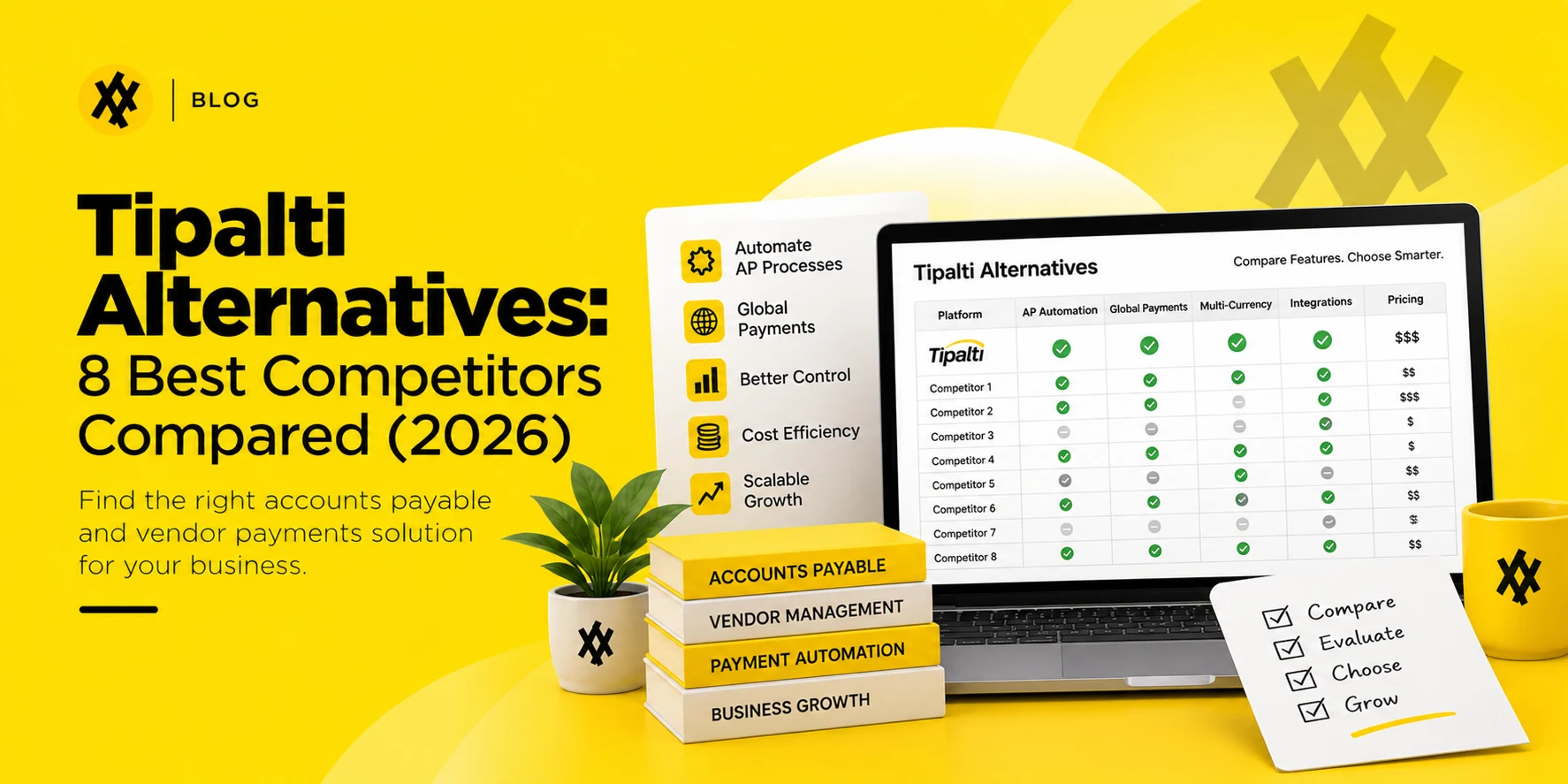
Tipalti alternatives at a glance
| Tool | Best for | Starting price | G2 score | Company size | Control point |
| Zapro AI | AI-led procure-to-pay in the mid-market | $699 | 4.7/5 | Mid-market | Pre-purchase |
| Coupa | Enterprise source-to-pay at scale | Custom quote | 4.2/5 | Enterprise | Pre-purchase |
| Stampli | Collaborative invoice approval | Custom quote | 4.6/5 | Mid-market | Post-purchase |
| BILL | SMB accounts payable and receivable | From ~$45–$49 per user/month | 4.4/5 | SMB | Post-purchase |
| Ramp | Card-led expense control | Free tier; paid AP tiers from ~$15 per user/month | 4.8/5 | SMB to mid-market | At purchase |
| AvidXchange | High-volume vertical AP | Custom quote | 4.4/5 | Mid-market | Post-purchase |
| Precoro | Lightweight purchasing control | Published per-user pricing | 4.7/5 | SMB to mid-market | Pre-purchase |
| Order.co | Catalog-controlled indirect spend | Custom quote | 4.4/5 | Mid-market | Pre-purchase |
On this page
- Why teams look for a Tipalti alternative
- The three categories of Tipalti alternative
- The 8 best Tipalti alternatives in 2026
- How to choose a Tipalti alternative
- Migrating off Tipalti
- Frequently asked questions about Tipalti alternatives
Top 8 Tipalti Alternatives to Consider in 2026
Most teams evaluating Tipalti alternatives are not unhappy with how Tipalti pays vendors. They are unhappy that by the time an invoice reaches it, every decision that mattered has already been made.
Why teams look for a Tipalti alternative
What problem does Tipalti solve
Tipalti solves a hard problem properly. Paying many suppliers across borders means collecting W-8 and W-9 forms, validating tax identity in multiple jurisdictions, handling 1099 filing, and moving money across payment rails that each behave differently.
It is built for global mass payouts and multi-entity finance, and the supplier onboarding portal removes work that otherwise lands on a controller. If your problem is paying 2,000 contractors in 40 countries without a compliance incident, Tipalti is a reasonable answer and most alternatives on this list are not.
Where the payments-first model runs out
The limitation is structural rather than a missing feature. A payments-first platform picks up the transaction at the invoice, and by then the vendor has been chosen, the price agreed, and the commitment made.
Everything a payments platform can do at that point is accuracy work: match the invoice, code it correctly, approve it, pay it on time. Useful, but it cannot tell you the purchase was unnecessary, that a contracted vendor already offered the same item cheaper, or that nobody with authority approved it before the money was committed.
Three signals you have outgrown it
You are catching problems in AP that started in procurement. Invoices arriving without a purchase order, prices that do not match a contract, and duplicate vendors are symptoms of an upstream gap, and no amount of AP automation closes them.
Your spend is mostly domestic. Tipalti’s core value is cross-border compliance. If most payouts are ACH to domestic vendors, you are paying for capability you do not use.
Requisition and approval live somewhere else. If purchase requests run through email, a ticketing system, or a spreadsheet before they reach any platform, the control gap is where they start rather than where they end.
The three categories of Tipalti alternative
Grouping by feature list produces a table nobody can act on, because every platform in this category claims most of the same features. Grouping by where control sits produces a shortlist, because a tool cannot control a decision that happened before it saw the transaction.
AP automation platforms
These improve the invoice-to-payment stretch: capture, coding, approval routing, matching, and disbursement. Stampli, BILL, and AvidXchange fall under this category, alongside Tipalti itself.
They differ mainly in what they optimize around. Stampli optimizes around the approval conversation, BILL around small-business simplicity and the vendor network, AvidXchange around vertical-specific volume, and Tipalti around cross-border payment compliance.
Choose this category when your upstream process is genuinely fine and the pain is in invoice handling. Choose something else if you are using AP to catch problems that started earlier.
Card-first spend management
These move control to the moment of purchase using corporate cards with rules attached: transaction limits, cycle limits, merchant category restrictions, and vendor locks. Ramp is the clearest example.
The trade-off is that a card enforces boundaries rather than judgment. Nothing checks whether a contracted vendor already covers the purchase, or whether the price matches an agreed rate.
Choose this category when spending is distributed across many people making small purchases and the problem is visibility rather than approval.
Procure-to-pay platforms
These start at the requisition and carry through to payment, so approval happens before a commitment exists. Zapro AI, Coupa, Precoro, and Order.co are considered procure-to-pay platforms. Though they take different routes to the same control point: Zapro AI and Precoro through requisition and approval, Order.co through a managed catalog, and Coupa through the full sourcing and contract lifecycle.
Choose this category when the purchases you regret were approved by nobody, approved by someone without authority, or made from a vendor you already had a better contract with. These are the failures no post-purchase tool can reach.
Which category fits which problem
| Your problem | Category | Why |
| Invoices take too long to process | AP automation | The bottleneck is genuinely post-purchase |
| Global contractor payouts and tax compliance | AP automation | Tipalti’s own strength; few alternatives match it |
| Small purchases across many employees | Card-first | Control at the transaction, not at approval |
| Purchases made without approval | Procure-to-pay | Only pre-purchase control fixes this |
| Off-contract buying at list price | Procure-to-pay | Requires a catalog and contracted rates at request |
| Enterprise sourcing, contracts, and supply chain | Procure-to-pay | Needs source-to-pay depth |
The 8 best Tipalti alternatives in 2026
Each entry below states where its control sits, what it costs, what it does not do, and how it compares to Tipalti specifically rather than in general.
1. Zapro AI
What it does. Zapro AI is best for AI-led procure-to-pay in the mid market. It covers requisition, approval, purchase order, receipt, and invoice on one procurement platform. Control sits at the request: a purchase is routed by value, category, and vendor status before any commitment exists, and AI agents handle the routing and matching work that usually occupies an AP team. Because the same record carries the purchase from request through payment, the audit trail is a by-product rather than a retrieval exercise.
Compared with Tipalti. The two platforms overlap only at the end. Tipalti begins where an invoice arrives; Zapro AI begins where someone asks to buy something. Teams switching usually do so because the problems they were catching in AP had already been created upstream.
Pricing.
- Spark: $699/month (see Zapro pricing). This plan works best for small and growing teams with up to 50 vendors and allows you to onboard unlimited users.
- Growth (Premium): $1999/month. Recommended for teams scaling up, enabling them to manage up to 500 vendors and onboard unlimited users.
- Scale (Enterprise): Custom/month pricing. This plan is for larger organisations as it allows them to work together with Zapro’s team and customise the software as per their needs. It allows businesses to manage unlimited vendors and onboard unlimited users.
G2 score. 4.7/5
Limitations. Zapro AI is still in the building stage to support global mass payouts, so organizations paying large contractor populations across many tax jurisdictions might come across some limitations.
2. Coupa
What it does. Full source-to-pay across sourcing events, contract lifecycle management, procurement, invoicing, payments, and supply chain planning. Its community spend dataset supports benchmarking that smaller platforms cannot offer, and the sourcing optimization capability is genuinely differentiated at scale.
Compared with Tipalti. Coupa is a superset in scope and a different class of commitment. Where Tipalti is bought by a controller, Coupa is bought by a CPO and implemented as a program.
Pricing. Custom quote, enterprise tier. Priced by modules, so the platform demonstrated and the platform contracted are frequently different.
G2 score. 4.2/5
Limitations. Implementation runs long and usually requires a systems integrator, which adds cost outside the license. The module structure makes total cost hard to establish upfront. For most mid-market teams it is more platform than the problem requires, and adoption suffers accordingly.
3. Stampli
What it does. Builds everything around the invoice itself, threading communication directly onto each one so approvers, AP, and requesters resolve questions in context rather than across email chains. An in-context AI assistant handles coding suggestions and routing.
Compared with Tipalti. Both are post-purchase. Stampli is stronger on the human coordination of approval; Tipalti is stronger on payment execution and cross-border compliance. Teams sometimes run both, which is a sign that neither addresses the upstream gap.
Pricing. Custom quote based on invoice volume. Buyers consistently rate the interface above category average, which is what the premium buys.
G2 score. 4.6/5
Limitations. Deliberately invoice-centric, so there is no requisition layer and no pre-purchase approval. Some reviewers describe the interface as dated despite the strong workflow. It resolves the approval conversation, not the purchasing decision that preceded it.
4. BILL
What it does. Accounts payable and receivable in one product, with deep QuickBooks and Xero integration and one of the largest vendor payment networks in the category. Approval workflows are straightforward to configure without implementation support.
Compared with Tipalti. BILL is the SMB answer to the same post-purchase problem. It lacks Tipalti’s international payout depth and tax documentation handling, and costs considerably less at small scale.
Pricing. Published per-user pricing, with the Essentials tier around $45–$49 per user per month. Payment transaction fees apply on top.
G2 score. 4.4/5
Limitations. Per-user pricing scales awkwardly as the finance team grows, and approval logic is thin for organizations with multiple entities or complex authority tiers. No procurement layer at all. Many companies outgrow it between $20M and $50M in revenue.
Verdict. Sensible for smaller businesses on QuickBooks or Xero that need AP and AR together, and a stepping stone rather than a destination.
5. Ramp
What it does. Corporate cards with programmable controls, plus expense management, reimbursements, and bill pay. Control lands at the moment of purchase through card limits, merchant category restrictions, and vendor locks, and the free tier is genuinely functional rather than a trial.
Compared with Tipalti. A different control point entirely. Ramp catches spend as it happens; Tipalti processes it after the fact. Ramp’s international coverage is narrower, and it does not handle supplier tax documentation.
Pricing. Free tier available. Paid AP tiers reported from around $15 per user per month.
G2 score. 4.8/5
Limitations. The model assumes a card is the right instrument, which breaks down for contracted vendors, large purchases, and anything requiring a purchase order. Cards produce visibility, not approval, so a card program can quietly become an uncontrolled channel of its own. International payment coverage is narrower than Tipalti’s.
Verdict. Excellent for distributed small spending and a genuinely strong free product. Not a replacement for procurement control, and not a fit for global payouts.
6. AvidXchange
What it does. AP automation built around specific industries, particularly real estate, construction, healthcare, and community associations, with a large supplier payment network and workflows shaped to those verticals’ approval patterns.
Compared with Tipalti. Similar post-purchase position, different specialization. Tipalti optimizes for cross-border complexity; AvidXchange optimizes for domestic invoice volume inside particular industries.
Pricing. Custom quote; pricing is not published. Independent modeling places real Year-1 cost in a similar band to Tipalti once implementation is included.
G2 score. 4.4/5
Limitations. The vertical focus is a strength inside those industries and a real limitation outside them, where workflows fit less naturally. No procurement functionality. Implementation is longer than SMB-oriented tools, and the platform is generally regarded as less modern than newer entrants.
Verdict. Worth shortlisting if you sit in one of its core verticals with high invoice volume, and worth skipping if you do not.
7. Precoro
What it does. Purchase requisitions, approval workflows, purchase orders, budget tracking, and basic receiving, with published per-user pricing and an implementation measured in weeks rather than quarters.
Compared with Tipalti. Opposite ends of the same process. Precoro controls the request and the order; Tipalti handles the invoice and the payment. Companies running both are effectively assembling a procure-to-pay platform from parts.
Pricing. Published per-user pricing, which makes it one of the few in this list you can budget for without a sales conversation.
G2 score. 4.7/5
Limitations. Payment capability is thin relative to Tipalti, so it typically runs alongside a payment tool rather than replacing one. Reporting depth becomes limiting at higher volumes, and multi-entity handling is less developed than enterprise platforms.
Verdict. A good fit for smaller teams that want requisition control quickly and can accept a separate payment layer.
8. Order.co
What it does. Consolidates indirect purchasing through a managed catalog, tags line items to the correct GL account, and rolls vendor payments into a consolidated bill. Control sits at the catalog: people buy from an approved set at agreed prices.
Compared with Tipalti. Order.co removes the purchasing decision from the individual rather than processing its consequences. Its consolidated billing also reduces AP volume, which addresses part of what teams use Tipalti for.
Pricing. Custom quote.
G2 score. 4.4/5
Limitations. The catalog model suits repeat indirect purchasing and fits services, contracts, and one-off buying less well. Consolidated billing reduces AP volume but places a layer between you and item-level vendor pricing, which weakens the spend analysis you can run afterward.
How to choose a Tipalti alternative
Do you need control before or after the purchase?
This is the question that eliminates most of the list. Write down your last five purchases you regret, and identify where each one could have been stopped.
If they could have been stopped at approval, you need a procure-to-pay platform. If they could only have been caught at the invoice, an AP automation tool is enough. If they were small and scattered, a card-first tool fits.
Domestic spend or global contractor payouts?
Be honest about the split. Cross-border compliance is expensive to build, which is why platforms that have it charge for it.
If under 10% of payment volume is international, you are unlikely to recover the premium for global payout infrastructure. If a large contractor population across many jurisdictions is core to your model, that capability is worth paying for and few alternatives match Tipalti on it.
What does it actually cost at your volume?
Headline pricing is the least useful number in this category. Independent analysis of AP automation pricing found published “starting at $99 a month” figures represent roughly 30% of real Year-1 cost, with the rest in per-payment transaction fees and implementation.
The same analysis modeled a company processing 500 invoices a month with 30 international wires, and put real Year-1 cost on a payments-first platform between $25,000 and $40,000, including roughly $5,000 to $15,000 of implementation.
Model your own number with four components:
| Component | What to ask the vendor |
| Base subscription | Per user, per invoice, or flat? What happens at 2× volume? |
| Transaction fees | Cost per ACH, wire, card, and international payment? |
| Surcharges | Multi-entity, additional currencies, extra approval tiers? |
| Implementation | One-off cost, and is it in the quote or separate? |
Run it at today’s volume and at twice today’s volume. The pricing model, not the headline rate, decides who is cheapest for you, and per-user models and per-invoice models cross over at different points.
Will it survive your ERP?
Ask which specific version of your ERP is supported, whether the connector is built by the vendor or a third party, whether sync is real-time or batched, and who maintains it after an ERP upgrade. “Integrates with NetSuite” describes several different things.
Point solution or unified platform?
Two or three focused tools can beat one platform, provided someone owns the joins. The cost of a point-solution stack is not licensing; it is reconciliation, duplicate vendor records, and the questions nobody can answer because the data sits in three systems.
Count the platforms your spend already crosses. If it is more than two, consolidation is usually worth more than any single tool’s feature advantage.
Migrating off Tipalti
What transfers cleanly
Vendor master data, banking details, historical invoices and payment records, and your chart of accounts mapping all export in structured form. Most platforms will assist with the import.
What needs rebuilding
Approval workflows do not transfer. Rebuilding them is an opportunity rather than a chore, since most have accumulated exceptions nobody remembers agreeing to, but it takes longer than teams expect because it surfaces disagreements about authority that were previously buried in configuration.
Supplier tax documentation collected through Tipalti’s onboarding portal may need re-collection, depending on how it was stored and whether the new platform can accept it in that form. Confirm this before signing, because re-collecting W-8 and W-9 forms across a large supplier base is a project in itself.
ERP integrations are rebuilt from scratch. If you are moving to a procure-to-pay platform, also budget for work that has no Tipalti equivalent: catalogs, requisition forms, category structures, and approval thresholds per category.
A realistic timeline
For a mid-market finance team, expect eight to twelve weeks from decision to full cutover. Vendor data migration happens early and moves quickly. Approval workflow design consistently takes longer than planned, because it is a governance exercise disguised as a configuration task.
Sequence it: export and clean vendor data, map the chart of accounts, build and test approval workflows, connect the ERP, run a pilot with one department, then cut over.
Run parallel for at least one full close cycle. Cutting over mid-month with no fallback is the most common cause of a migration going badly, and the cost of a month of duplicate subscriptions is trivial against the cost of a failed close.
Frequently asked questions about Tipalti alternatives
What is Tipalti used for?
Tipalti is used for accounts payable automation and global mass payments. Its core strengths are supplier onboarding with tax documentation, cross-border payouts across multiple payment methods, and multi-entity payment compliance.
What is the best alternative to Tipalti?
It depends on where your control gap is. For pre-purchase control in the mid-market, Zapro AI. For enterprise source-to-pay, Coupa. For invoice approval, Stampli. For SMB AP and AR, BILL. For card-led spending, Ramp. No single tool is best for everyone.
Is there a free alternative to Tipalti?
Ramp offers a free tier covering cards, expense management, and basic bill pay. It is a genuine free product rather than a trial, though it addresses a different problem: card spend control rather than global payables.
Who are Tipalti’s main competitors?
In AP automation, BILL, Stampli, and AvidXchange. In card-first spend management, Ramp. In procure-to-pay, Zapro AI, Coupa, Precoro, and Order.co. Competitors vary by category, since Tipalti overlaps only partially with each.
What is the difference between AP automation and procurement software?
AP automation handles what happens after an invoice arrives: capture, coding, approval, matching, and payment. Procurement software handles what happens before the purchase: requisition, approval, vendor selection, and purchase orders. One makes payment accurate; the other decides whether the purchase should happen.
Is Tipalti good for procurement?
Not primarily. Tipalti is a payments and AP platform, and while it includes purchase order functionality, control sits after the buying decision. Teams needing requisition approval, catalogs, and contracted pricing at the point of request generally use a procure-to-pay platform.
How hard is it to migrate off Tipalti?
Moderate. Vendor data, payment history, and GL mappings export cleanly. Approval workflows, ERP integrations, and supplier tax documentation need rebuilding. Expect eight to twelve weeks for a mid-market team, with at least one parallel close cycle before cutover.
See where your spend control should start
If the purchases you regret were already made by the time finance saw them, no payment platform will fix that, including a better one.
Zapro AI brings requisitions, approvals, purchase orders, receipts, and invoices onto one platform, so control sits at the request rather than at the invoice. For a direct feature comparison, see Zapro AI vs Tipalti.
Book a demo to see how a request gets approved before it becomes an invoice.
Don’t miss our weekly updates
We’ll email you 1-3 times per week—and never share your information.
About the Author

Oishani Bhattacharya


About the Reviewer

Zapro is dedicated to helping businesses of all sizes make informed decisions. We adhere to strict editorial guidelines to ensure that our content meets and maintains our high standards.
Our editorial standards help keep every article accurate, useful, and trustworthy.
Related Blogs
Coupa Competitors and Alternatives: 7 Platforms Compared for 2026
BetterCloud Competitors and Alternatives: 8 SaaS Management Tools Compared