



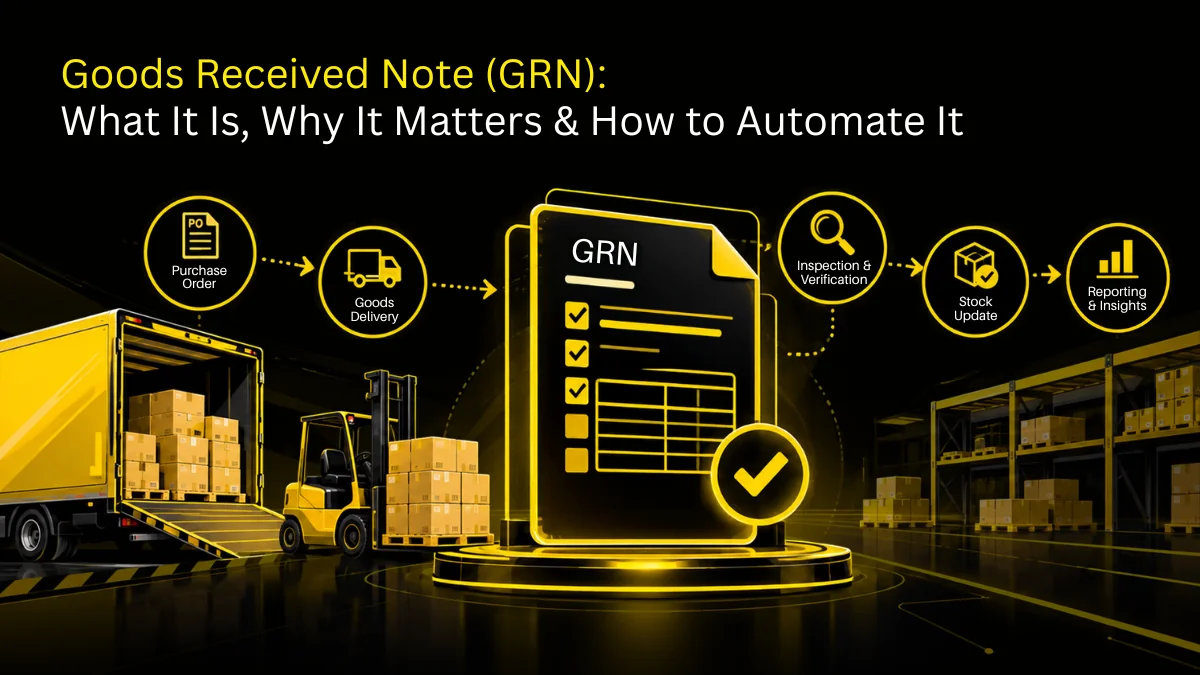
A goods received note, often referred to as a GRN, is an internal document that confirms goods have been delivered, received, and checked against the purchase order. It lists the items that have arrived, together with the quantity and condition of those items.
Key Takeaways
- A GRN confirms that the ordered goods have been delivered and connects the purchase order with the supplier invoice.
- The GRN full form in purchase is Goods Received Note, also known as a receipt or receiving report.
- A basic GRN consists of the GRN number, date, PO number, supplier information, item descriptions, quantities, condition, and details of the receiver.
- GRNs encourage teams to identify bottlenecks, damaged goods, or inaccurate deliveries before completing the payment.
- Incomplete deliveries should be recorded as partial receipts so the remaining quantity of the purchase order stays open.
- GRN, purchase order, and invoice records support the three-way matching process used to verify purchases before payment.
- Digital procurement platforms can record goods receipts, update inventory records, and connect receipt information with invoice matching.
What is a goods received note (GRN)
The official document that confirms the delivery of goods from a supplier is a goods received note (GRN). It contains all the details of the delivered goods by matching them against the original purchase order.
The goods receipt note definition is simply the receiving record that confirms the condition and quantity of goods delivered to a business.
A GRN basically includes the purchase order number, supplier information, date of delivery, details, and quantity of items, or any issues found during inspection.
The GRN is a significant link between purchasing and accounts payable that the purchasing team can use to confirm the fulfillment of the order, while accounts payable can use it to check the invoice.
Also, a GRN is not the same as a delivery note, as a supplier may provide a delivery note with a shipment, but a GRN is usually an internal record created by the receiving party after checking the delivery.

A GRN isn’t just a checkbox—it’s the moment procurement and finance unite, preventing fraud and ensuring accuracy.
[Co‑founder, Buyers Meeting Point]
What Is The Purpose Of A Goods Received Note
The purpose of a goods received note is to create a steady record of what an enterprise actually received, as it assists teams in verifying the purchase order.
The core purposes of a GRN in procurement are:
- Verifying the delivery against the purchase order
- Updating inventory records
- Processing invoices
- Recording damaged or inaccurate goods
- Creating an audit record
- Improving supplier responsibility
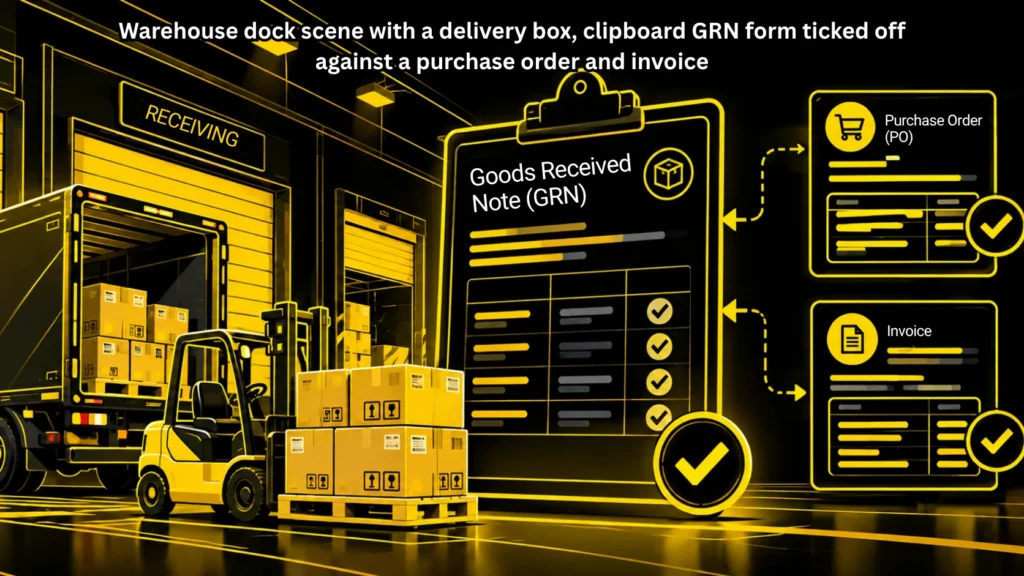
A regular three-way match is done when the PO shows what the business ordered, the GRN exhibits the reception of goods, and the invoice shows the payment information. Evaluating these records helps in identifying bottlenecks before payment.
Why Are Goods Received Notes Important
Goods received notes are essential as they give finance and procurement teams a record of actual receipt. Teams have to depend on paperwork, emails, and manual processes without this record.
Preventing Financial Discrepancies
A GRN stops payment for goods that were not delivered or received, as the receiving team can log errors or inaccurate quantities before the invoice is approved by accounts payable.
Streamlining Invoice Reconciliation
GRNs offer substantial information for settling the invoice, as accounts payable can compare the received quantity with the quantity billed and assess the differences before releasing payment. GRNs come in handy when the order is delivered in multiple shipments, as each receipt can be separately recorded instead of treating the entire order as complete after the first delivery.
Guaranteeing Precise Record-Keeping
Accurate goods receipt records help businesses maintain a stable purchasing and inventory record, as procurement teams can use the receipt details to understand and review performance.
A GRN can also help differentiate between the ordered, delivered, and accepted goods.
Maintaining Vendor Responsibility
A purchasing process that has all the steps recorded makes it easier to solve delivery issues if goods are damaged or the quantity of goods is incorrect; the receiving team can record the issue when the shipment arrives. Hence, procurement can maintain an accurate record when communicating with the supplier about these issues.
Supporting Compliance And Audits
GRNs can be a part of the audit record for purchases as they show that the business did not just approve an invoice based on the supplier’s billing document.
When reviewers evaluate a transaction, the GRN, PO, and invoice can offer a connected record of the purchase from beginning to end.
What Information Is Required In A Goods Received Note
A classic GRN should contain sufficient information to identify the purchase and record every detail and disruption. Although the official format varies by organization, most goods receipt notes usually have:
- GRN number, which is a unique reference number found in the receipt
- Purchase Order Number, which is the reference that connects the receipt to the original order
- Vendor details containing relevant information about the supplier
- Date of delivery, as to when the goods were received at the receiving location.
- A proper description of each item received, perfectly corresponding to the purchase order.
- The quantity originally mentioned on the purchase order and the quantity received.
- The unit used to record the item, such as pieces, boxes, kilograms, or liters.
- Notes about damaged, defective, missing, or rejected items.
- The warehouse, office, site, or department where the goods were received.
- The name, signature, or other identification of the person who checked the delivery.
- Additional information about shortages, replacements, backorders, inspection results, or other delivery issues.
What Is a GRN Number
A GRN number is the unique reference number given to a goods received note that helps different teams to find and reference a particular receipt.
This number can be used to trace the receipt back to its purchase order and send the relevant invoice.
A unique GRN is particularly beneficial when one purchase order has more than one delivery, and each receipt can have its own GRN number and create an accurate record of what arrived and when.
How GRN Works In Procurement
The GRN in procurement sits between purchasing and accounts payable. A typical process works like this:
- purchase order is created and approved
- ordered goods delivered by the suppliers
- shipment checked against the purchase order
- accepted quantity and condition recorded on the GRN
- shortage, damaged, or rejected items are also recorded
- inventory records updated when possible
- invoice sent by vendor
- three-way matching is done
- discrepancies investigated before payment
- invoice approved when records match
| Record | What It Confirms |
|---|---|
| Purchase Order | What The Organization Ordered |
| GRN | What The Organization Received |
| Supplier Invoice | What The Vendor Is Charging |
The GRN is thus a fundamental control between the physical delivery and the financial transaction.
What Happens With Partial Deliveries
When a delivery is partially completed, a partial receipt is generated rather than closing the purchase order. The full receipt will only be generated when the order arrives without any discrepancies or damage.
What Happens When Goods Are Damaged Or Rejected
Rejected or damaged goods are recorded on the GRN upon identification of the issue, where the damage must be clearly stated in detail.
Documenting this at the initial stages gives procurement and accounts payable an accurate record to use when solving disputes.
How Can Technology Improve GRN Management
Manual GRNs can delay information when it has to travel between different teams and locations.
Zapro AI is a procurement platform that connects the purchasing and receiving workflows so teams can have a streamlined record of purchase orders and receipts.
Digitizing the goods receipt procedure reduces manual data entry, making receipt information very simple to access during invoice matching.
Conclusion
A goods received note might look simple, but it is a crucial part of having control over the purchasing process as it records what arrived and connects physical delivery to the remaining steps.
An efficient GRN process also encourages firms to handle partial deliveries, damaged or rejected goods, supplier disputes, inventory updates, and audits with less manual investigation.
Digitizing this process can help expanding teams make it easier to track and match every step. Zapro AI can also integrate procurement information with accounts payable systems, as once the receipt and invoice information is available, finance teams can use that to support invoice approval instead of manually re-entering receiving information.
Streamline goods receipts with Zapro’s smart procurement tools.

Frequently Asked Questions
What Is The Full Form Of GRN In Procurement?
GRN is the abbreviation for Goods Received Note, which is an internal document used to record the receipt of goods from a vendor.
Is a GRN the same as a delivery note?
No, A GRN is an internal document created by the receiver, while a delivery note is usually given by the supplier with the shipment.
Why is a GRN needed for three-way matching?
A GRN is essential for three-way matching as it provides evidence of the received goods and discrepancies if any.
Can one purchase order have multiple GRNs?
Yes. A purchase order can have multiple GRNs when goods arrive in separate shipments. Each receipt can record the quantity received during that delivery.
What should a GRN contain?
A GRN should normally include the GRN number, purchase order number, vendor details, delivery date, item descriptions, quantities ordered and received, unit of measure, condition of goods, receiving location, receiver details, and relevant notes.
Don’t miss our weekly updates
We’ll email you 1-3 times per week—and never share your information.
Let’s Talk Optimization
Connect with our team to streamline your goods received process and boost procurement efficiency.

About the Author

Md. Kafil


About the Reviewer

Zapro is dedicated to helping businesses of all sizes make informed decisions. We adhere to strict editorial guidelines to ensure that our content meets and maintains our high standards.
Our editorial standards help keep every article accurate, useful, and trustworthy.
Related Blogs
Wait! Don't Leave Without This Free Guide
How AI Is Replacing Manual Procurement And What Your Team Should Do Next