


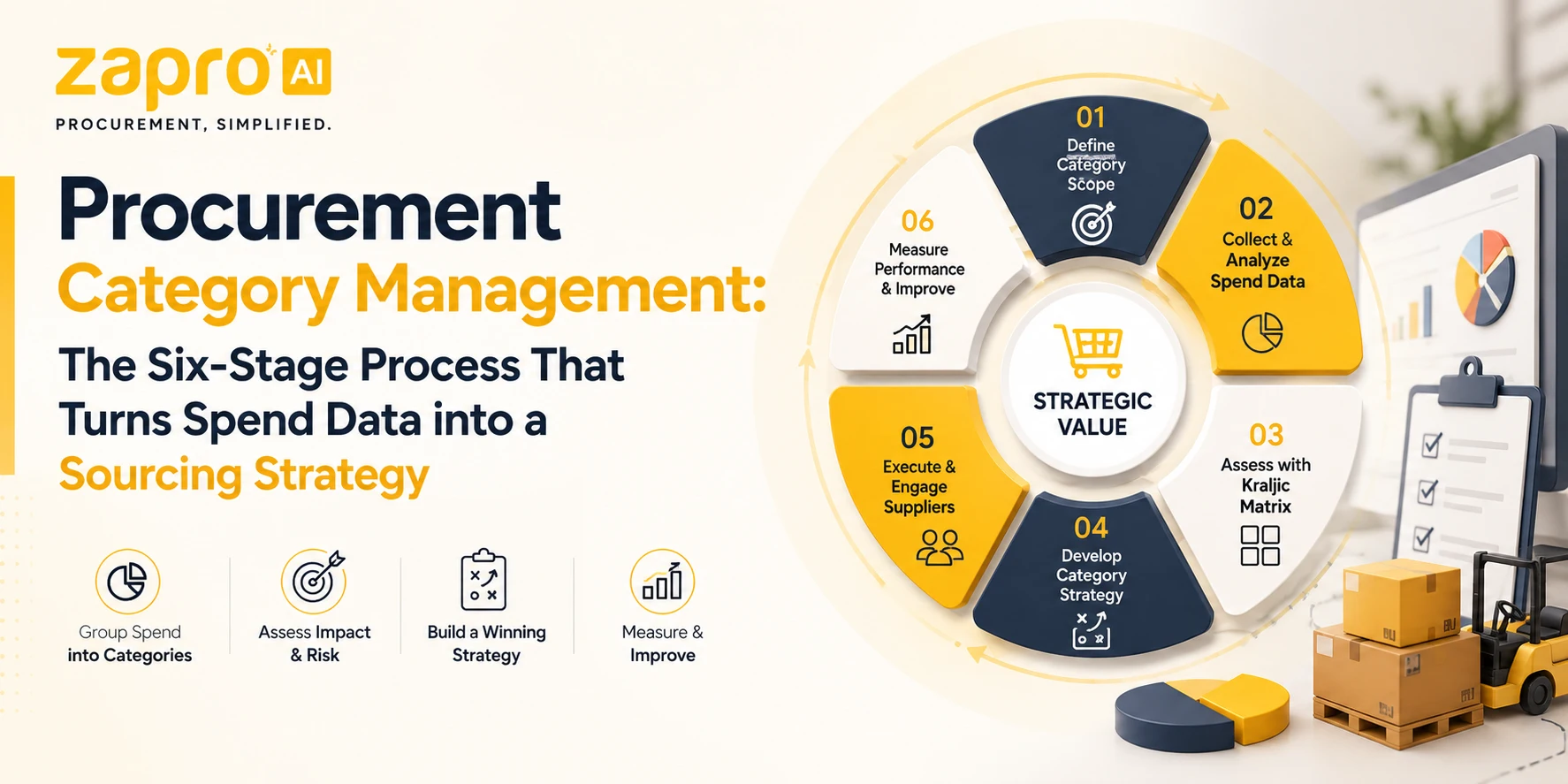
Category management groups related spend into categories and manages each one as a strategic unit with its own plan, owner and targets. Instead of running purchases one at a time, a team analyses an entire category, strategically procures all materials within it, and holds that strategy for years. It applies analysis where the money and risk actually are.
Key takeaways
- A category is a group of spend that belongs to the same supply market. Not every category needs to follow the same strategy.
- The segmentation process determines where you focus your effort.
- The Kraljic Matrix scores each category on business impact and supply risk, and each quadrant demands a different strategy.
- A category strategy holds for two to three years.
- Stakeholders decide whether a strategy works.
- Buying the wrong thing cheaply is not a saving.
What is category management in procurement?
Category management organises spend into groups that share a supply market, then treats each group as something to plan rather than a queue of purchases to process.
Here, the spend isn’t the most important number to note; rather, the strategy behind those transactions is. The shift runs from transactions to strategy. Instead of asking how to run this purchase, a business focuses on how to plan these purchases so that a whole category can be bought in one go for a considerable amount of time — for the next three years: how many suppliers, on what terms, with what risk cover, and who decides.
The Chartered Institute of Procurement & Supply defines category management as organising procurement resources so they face outwards onto supply markets rather than inwards onto internal departments. That outward orientation is the whole point, and it is what separates category management from the rest of what procurement does day to day.
Procurement category management vs. retail category management
Although the two sound like they fall under the same umbrella, the two are completely unrelated disciplines. If you came looking for the retail sense, the second column is yours.
Everything below covers the buy side only.
| Procurement category management | Retail category management | |
| Which side of the business | Buying | Selling |
| What a category groups | Spend sharing a supply market | Products a store sells together |
| What it optimises | Cost, risk and supply continuity | Range and sales performance |
| Who runs it | A category manager in procurement | A merchandising or buying team |
| Main output | A category strategy and a supplier base | A range plan |
Category management vs traditional sourcing
Traditional sourcing goes something like this — a contract expires; procurement runs an event, awards it, and moves on. The next requirement starts from scratch.
Category management is ahead of that. The strategy is set before the final decision, so the sourcing event executes it in alignment with the business. Strategic sourcing comes a few steps later in this process and plays an important role.
Category management vs catalog management
Catalog management controls what buyers can order and at what price once the strategy is finalised. Category management decides the strategy that fills the catalogue. One is execution, the other is planning, and a catalogue without a category strategy just automates whatever you were already buying — which is why the catalogue inside your e-procurement software is only ever as good as the strategy behind it.
What counts as a procurement category?
A category is a group of spend that a single strategy can cover. That sounds loose because it is: the boundary is a judgment call, not a rule. Even the US federal government, which runs category management across roughly $500 billion of annual buying, settled on just ten government-wide categories of common goods and services — a reminder that useful category structures are far coarser than most spreadsheets suggest.
Direct vs indirect spend categories
Direct spend goes into what you sell: raw materials, components, contract manufacturing, inbound freight. It includes cost of sales, so every improvement moves gross margin.
Indirect spend keeps the business running. Expenses on software, facilities, professional services, travel, and marketing are some of the most common under ‘indirect spend’. Multiple teams are involved in the buying process, fewer govern it, and it fragments more, which is why it often holds more recoverable value than direct spend despite being smaller. If the split isn’t clear in your own data, start with direct vs indirect procurement before you draw any category boundaries.
Common procurement categories
| Category | Typical sub-categories |
| IT and software | SaaS subscriptions, hardware, cloud infrastructure, support |
| Professional services | Consulting, legal, audit, recruitment |
| Facilities | Cleaning, security, maintenance, utilities, waste |
| Marketing | Agencies, media, print, events |
| Logistics | Freight, warehousing, last mile, customs |
| Raw materials | Metals, polymers, chemicals, packaging |
| Travel | Air, accommodation, ground transport, expense tools |
| HR services | Benefits, payroll, temporary labour, training |
Five ways to draw category boundaries
Most teams draw boundaries badly the first time, because they copy the general ledger. Five lenses give better answers, and they conflict, which is the point.
Classify spend groups by value, then the category groups that need management surface first. Similarly, group supply by who sells it — if two things come from the same suppliers, they belong together. You can also group suppliers by who you already buy from to reveal duplication. Risk groups can be tied together by what disruption would cost, which pulls small categories into focus that spend alone would hide — the same logic that drives procurement risk management.
Where the lenses disagree, follow the supply market. A strategy only works if it addresses a market you can actually negotiate in.
How granular should a category be?
Granular enough that one strategy fits the whole category, broad enough that one person can own it.
If a category needs two contradictory strategies, split it. If a manager holds thirty categories, they run none of them. Most mid-sized organisations land on fifteen to twenty-five top-level categories, with the sub-categories beneath carrying the real detail.
Stage-by-stage breakdown of the procurement category management process
There are six stages to this process. A first cycle takes roughly nine to eighteen months, then repeats.
Stage 1: Spend and market analysis
Establish what you spend, with whom, and under what contracts. Then do some ground research: who else supplies this market, how prices move, what drives cost, and how far supply concentrates.
Both halves matter. Your own data tells you your status; market data tells you whether that position is good. Holding 90% of a category with one supplier might seem like a good strategy that works just fine until you find out that six credible alternatives exist. Structured vendor discovery and a well-built request for information are how you find out before the market finds out for you.
Stage 2: Category segmentation and prioritisation
Score each category on business impact and supply risk, then segment and decide which ones to strategise around. Most organisations can run three to five properly at once.
Segmentation exists to say no. A team that prioritises everything ends up with a folder of documents nobody implemented. The Kraljic section below covers how to score and what each result means.
Stage 3: Stakeholder engagement
Find the people who use the category and the person who owns the budget, then involve them before you form a view rather than after.
Teams skip this stage, and skipping it is why strategies fail. Procurement can negotiate a contract nobody uses. A budget holder who helped shape the strategy defends it; one who receives it finished works around it.
Stage 4: Category strategy development
To develop an efficient category management strategy, turn your research and analysis into decisions. Ask questions like: how many suppliers, which contract structures, what to consolidate, where to dual-source, what targets to commit to, and what you will do differently in a year.
The framing and documentation of this strategy should be clear enough that someone can act on it without you in the room.
Stage 5: Implementation and sourcing
Execute according to the strategy. Run the sourcing events, negotiate, contract, transition suppliers, and load the outcome into the catalogue so buyers can actually use it.
Stage 6: Performance tracking and continuous improvement
Track the category against the targets set in the chosen strategy, review it quarterly with the budget holder, and refresh it annually. This is where supplier performance management stops being a scorecard exercise and starts being the evidence that the strategy worked.
How to apply the Kraljic Matrix to your categories
Peter Kraljic published this in the Harvard Business Review article “Purchasing Must Become Supply Management” in 1983, and it remains the standard segmentation model. Most articles show the picture. This section covers how to score a category and act on the answer.
The two axes: business impact and supply risk
To assess business impact, look at what grouping certain supplies under a category does to your financial position: share of total spend, effect on gross margin, and whether quality or availability reaches the customer.
Calculating supply risk means checking how exposed you are. It inspects how many credible suppliers exist, how long it would take to switch from one to another, how volatile pricing is, and how concentrated the market is.
Score each axis one to five. Applying the same scale to every category matters more than precision, because the output ranks categories against each other rather than measuring them absolutely.
The four quadrants and the strategy each demands
The common error is treating bottleneck categories as routine because the spend is small. A low-value item with one qualified supplier can stop production as effectively as a strategic one.
| Quadrant | Impact | Risk | Strategy |
| Strategic | High | High | Long-term partnership, joint planning, shared risk, executive relationship |
| Leverage | High | Low | Competitive tendering, consolidate volume, negotiate hard, review often |
| Bottleneck | Low | High | Secure supply first: dual source, hold stock, qualify alternatives, redesign out |
| Routine | Low | Low | Cut transaction cost: catalogues, automation, minimal management attention |
A worked example: plotting three categories
A coffee shop chain with forty sites scores three of its categories.
Beans cost more than anything except rent and wages, and only a few roasters can supply that blend, which puts them high on both axes. Beans are therefore strategic, so the chain signs a long-term agreement and qualifies a second roaster.
Cups cost very little and dozens of suppliers sell them, which puts them low on both axes. Cups are routine, so the chain picks one supplier, sets up automatic reordering and moves on.
Servicing barely registers on the spend report, but only two engineers hold the certification for those machines and a shop with a broken machine sells nothing. That makes servicing low impact and high risk, which is the bottleneck quadrant, so the chain contracts both engineers and keeps spare parts on site.
Servicing is the case that justifies the exercise, because a review sorted by spend would never reach it while a review sorted by exposure puts it near the top. Tail spend hides more of these than most teams expect.
Where the Kraljic Matrix breaks down
It shows a moment, not a trajectory. A category that scores routine today moves to bottleneck when a supplier exits the market, and nothing in the model prompts you to rescore.
It also treats you as the only actor. If you are a small account to a large supplier, your leverage is weaker than the quadrant suggests. Some teams add a supplier-view axis for this. And it says nothing about sustainability, which increasingly drives category decisions that the two original axes cannot capture.
What goes into a category strategy document
The category strategy one-pager
A category strategy that runs to forty slides does not get read. One page, refreshed annually, holds everything a stakeholder needs:
- The category — what it covers, what it excludes, annual spend, current suppliers
- Position — Kraljic quadrant, market conditions, contract expiry dates
- Objectives — three at most, each with a number and a date
- Strategy — supplier count, contract structures, what changes and what stays
- Actions — what happens in the next twelve months, with owners
- Risks — what could break, and what you have done about it
- Governance — who reviews it, how often, and who approves changes
The detailed analysis lives in an appendix nobody reads until they need it.
Category KPIs worth tracking
Savings realised in budget is the one that matters. A saving finance cannot find is a claim, not a result.
Category run-rate data feeds the same expense forecast finance builds next year’s numbers from, so a category without an owner is a forecast built on a guess.
| KPI | What it tells you |
| Addressable spend under management | How much of the category the strategy actually reaches |
| Savings realised in budget | Whether savings survived into the P&L |
| Contract coverage | Share of spend on a current, negotiated agreement |
| Off-contract spend | Where buyers route around the strategy |
| Supplier count | Whether consolidation happened or reversed |
| Price variance vs. index | Whether you tracked the market or drifted from it |
| Supplier performance score | Whether the cheaper option still delivers |
Who owns category management
The category manager role and required skills
A category manager owns the strategy, the supplier base and the results for a group of spend. They are not processing purchase orders.
The role needs analysis to read spend and market data, commercial judgment to structure a deal, and influence, because a category manager holds no authority over the budget holders whose spend they are managing. That last one decides who succeeds in the job, and it is the hardest to hire for — which is also why the procurement manager job description and the category manager job description rarely map cleanly onto each other.
Category manager vs. buyer vs. project manager
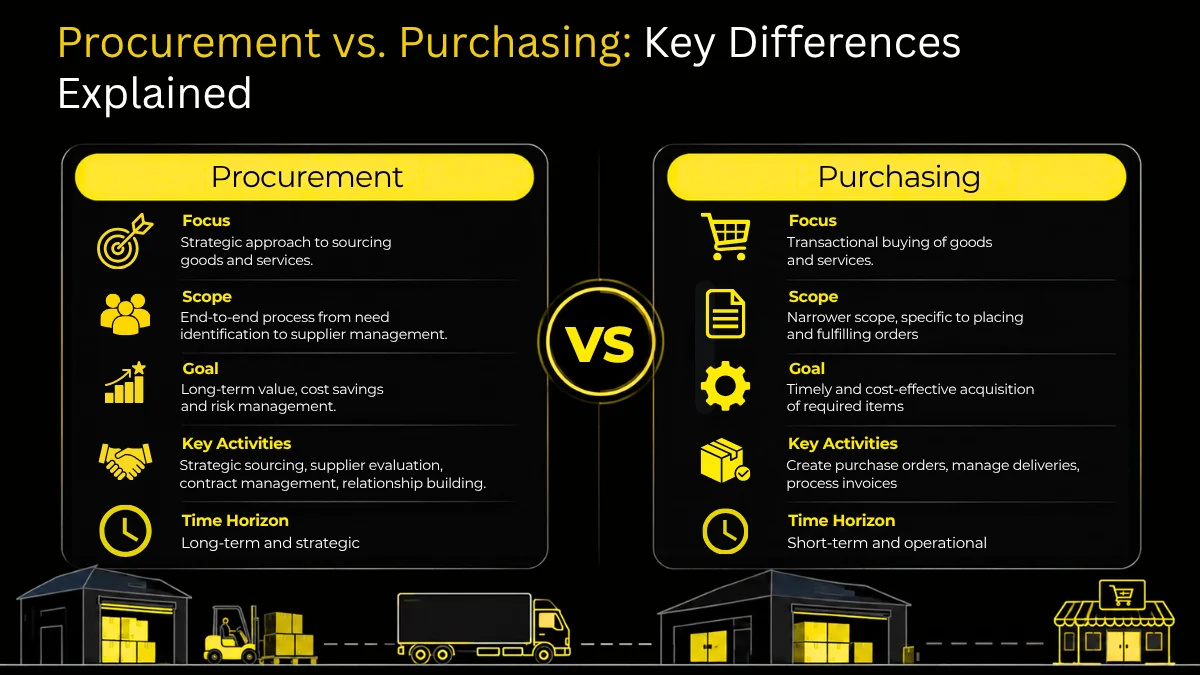
A buyer executes transactions: raising orders, chasing deliveries, resolving invoice queries. The work is operational, and throughput measures it — the classic procurement vs. purchasing divide.
A category manager sets direction over years, and category outcomes measure them. A sourcing project manager runs one event to a deadline and finishes when the contract signs. Small teams put all three in one person, which is workable until the operational work crowds out the strategic work — and it always does.
Category management examples by category
Facilities management: consolidate and standardise SLAs
Facilities fragments by site, because each location arranges its own cleaning, security and maintenance. The strategy consolidates to a regional supplier per service, standardises service levels across sites, and shifts to outcome-based contracts backed by contract compliance tracking. Standardisation delivers more than rate reduction.
IT software and services: partnerships and volume agreements
Software fragments by team, and duplicate tools accumulate faster than anyone tracks. The strategy inventories what you hold, consolidates overlapping tools, aligns renewal dates so negotiations carry weight, and moves major vendors to enterprise agreements. Renewal timing matters more than list price, which is why IT procurement teams increasingly run software as its own category with dedicated SaaS procurement software and disciplined SaaS contract management.
Raw materials: dual sourcing and forward contracts
Raw materials carry price volatility and supply concentration together. The strategy qualifies a second source before you need one, structures pricing against a published index, and uses forward commitments to smooth exposure. Qualification takes months, so it has to start before the disruption — which is why the category plan and your supply chain forecasting have to be built off the same numbers.
Professional services: rate cards and statement-of-work control
Professional services leak value through scope rather than rate. The strategy sets rate cards by grade, controls statements of work so scope changes need approval, and measures outcomes rather than hours. A negotiated day rate means nothing if the engagement runs twice as long as planned.
Why the same category needs different strategies by industry
IT software is a leverage category for a manufacturer, where alternatives exist and switching costs stay manageable. For a software company, the same spend line includes the platform its product runs on, which makes it strategic and sometimes bottleneck.
Copy the framework, not another company’s quadrant assignments. What a category is depends on what your business does with it.
A category management maturity model
Level 1 to Level 4: where is your team today
Most organisations that believe they run category management sit at level two. The document exists. The behaviour has not changed.
| Level | What it looks like | Typical signal |
| 1. Reactive | No categories. Purchases handled as they arrive | Nobody can say what the top ten categories cost |
| 2. Defined | Categories exist, spend is classified, a few strategies written | Strategies exist but sit unimplemented |
| 3. Managed | Prioritised categories have owners, strategies and tracked KPIs | Savings get validated by finance |
| 4. Optimised | Category strategy shapes budgets; suppliers contribute to planning | Business units approach procurement first |
What moving up one level actually requires
One to two needs data. You cannot manage what you cannot see, and classification unblocks everything after it — which is why spend analytics is the first investment, not the last.
Two to three needs ownership and time. Named people with protected capacity, because a category manager who also runs daily buying will always run daily buying.
Three to four needs the business to come to procurement early, which no procurement team can mandate. It follows from level three delivering results the business noticed, which is why skipping levels does not work and why most procurement transformation programmes stall exactly here.
Common category management mistakes
Segmenting every category as strategic
Every stakeholder believes their category is critical, and a matrix built from those conversations puts everything in the top-right quadrant. Then attention spreads evenly and nobody manages anything properly. Scoring against the same scale, not against how strongly people argue, is what prevents it.
Building strategies without stakeholder input
A strategy built in isolation optimises what procurement can measure and misses what the business actually needs. Stakeholders also ignore it, because nobody who has to live with a decision feels bound by one they did not shape.
Treating the category strategy as a one-time document
Markets move, suppliers exit, contracts expire and requirements change. A strategy written eighteen months ago and never reopened describes a category that no longer exists. Quarterly review and annual refresh is the minimum that keeps it honest.
Measuring savings that never reach the P&L
Procurement reports a negotiated reduction, finance never sees the budget fall, and the credibility of every future number drops. Agree with finance in advance how you will measure a saving and where it should appear. A saving nobody can trace is a claim.
How software supports category management
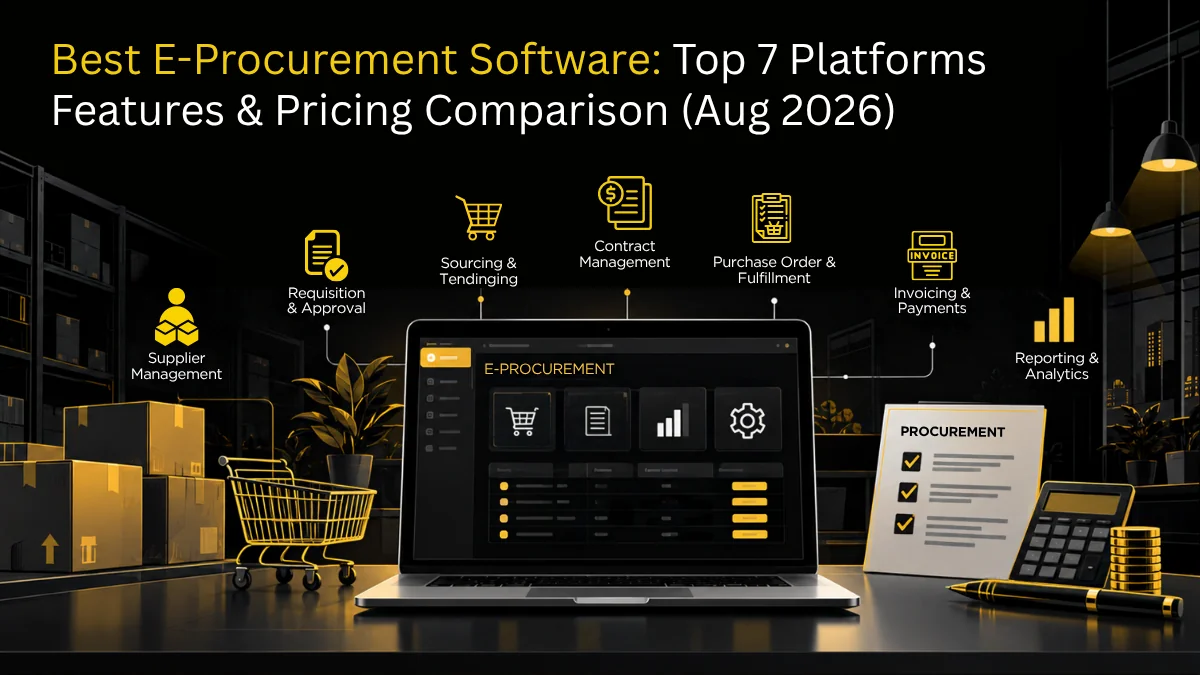
If you are still deciding what to run the process on, our comparison of category management software covers where the main platforms differ, and our roundup of the best procurement software covers broader suites.
Centralised spend visibility and classification
Every stage depends on stage one, and stage one depends on classified spend. A system capturing requisitions, orders and invoices in one procure-to-pay process produces that classification as a by-product rather than a quarterly project. That is why category teams in large organisations run the process on Procurement software for Enterprise rather than on ERP exports — the classification stays current between reviews instead of being rebuilt for each one.
Category structures that match how you actually buy
Category structures need to reflect supply markets rather than the chart of accounts, which means the system has to let you define them yourself. Zapro classifies vendors into the four Kraljic quadrants as a field on the record, so the segmentation you decided at stage two governs the vendor management relationship afterwards rather than sitting in a slide.
Category-level analytics and reporting
Reporting has to answer category questions: spend by supplier within a category, contract coverage, off-contract leakage, and movement against last year. A general ledger view cannot answer these, because a category rarely maps to one account.
Category management is especially impactful in industries with massive external spend. In telecom, where operators source everything from network equipment to IT consulting, category management in telecom procurement helps consolidate fragmented vendor bases and extract volume discounts across spend categories.
Frequently asked questions about category management
What is category management in procurement?
Grouping related spend into categories and managing each as a strategic unit with its own plan, owner and targets, rather than handling purchases individually as they arise.
What is the difference between procurement and category management?
Procurement is the function. Category management is one way that function organises its work — around groups of spend rather than around individual requests or business units.
What are the six steps of the category management process?
Spend and market analysis, category segmentation and prioritisation, stakeholder engagement, strategy development, implementation and sourcing, then performance tracking and continuous improvement.
What is category management analysis?
The first stage: establishing internal spend patterns, supplier concentration and contract coverage, then assessing the external supply market for competition, price drivers and risk.
What does a category manager do?
They own the strategy, supplier base and commercial results for a group of spend. The work runs from analysis and segmentation through negotiation to performance review, over years rather than per transaction.
What is the difference between a category manager and a buyer?
A buyer executes transactions, and throughput measures the work. A category manager sets direction across a category over years, and category outcomes measure it.
How many procurement categories should a company have?
Most mid-sized organisations manage fifteen to twenty-five top-level categories with sub-categories beneath. What matters more is that one strategy fits each category and one person can own it.
Is category management the same in retail and procurement?
No. They share a name and nothing else. Retail category management works on what a business sells; procurement category management works on what it buys.
Build category strategies on real spend data
Category management fails at stage one more often than anywhere else. The analysis needs spend classified by category across every business unit, and most teams rebuild that by hand from an ERP export each time.
Zapro captures requisitions, orders and invoices against your own category structure, so the data a strategy needs already exists when you sit down to write it. You can review Zapro pricing to see which plan fits your category team.
Zapro AI brings category management, sourcing and supplier data together in one procurement platform, so category managers are not stitching together spreadsheets and point tools to run the process end to end.
Don’t miss our weekly updates
We’ll email you 1-3 times per week—and never share your information.
About the Author

Md. Kafil


About the Reviewer

Zapro is dedicated to helping businesses of all sizes make informed decisions. We adhere to strict editorial guidelines to ensure that our content meets and maintains our high standards.
Our editorial standards help keep every article accurate, useful, and trustworthy.