

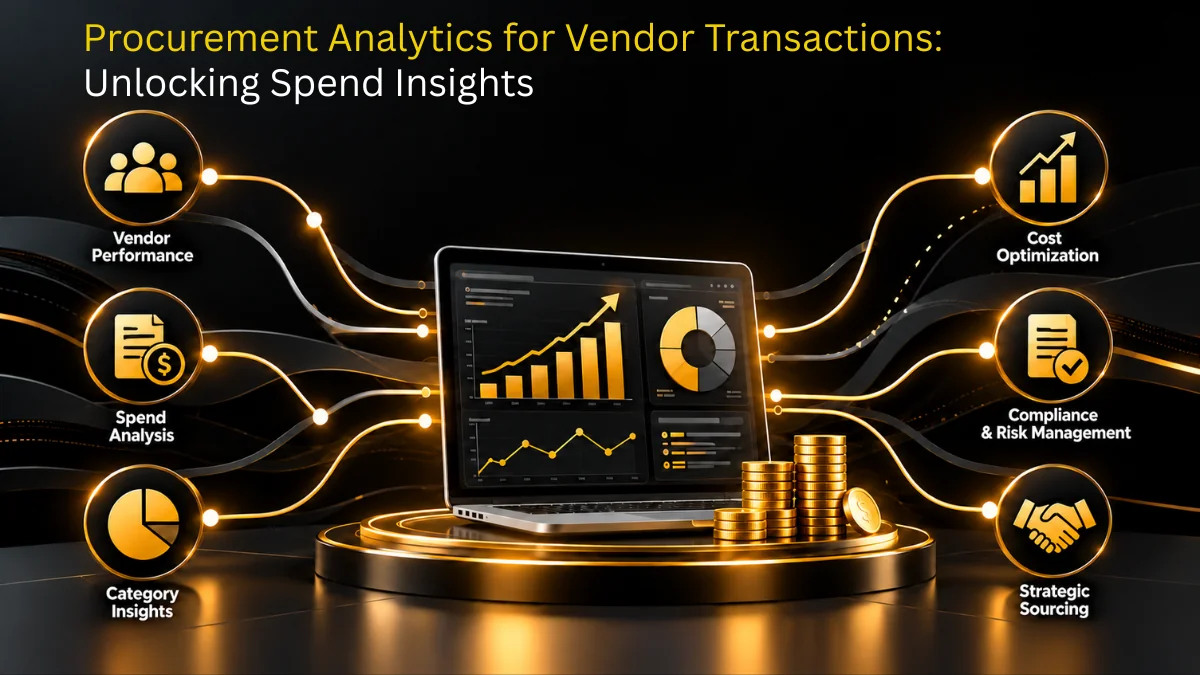
Procurement analytics is the process of collecting, cleaning and analyzing purchase order, invoice, payment and vendor performance data to find savings, reduce risk and improve purchasing decisions, moving from descriptive spend reports to diagnostic, predictive and prescriptive insight.
The practice of procurement analytics consists of using data from purchase orders, invoices, and payments to make decisions regarding where money is leaking out of contracts, which vendors are slowing you down, and what to buy differently next quarter. Most organizations already gather this type of data.
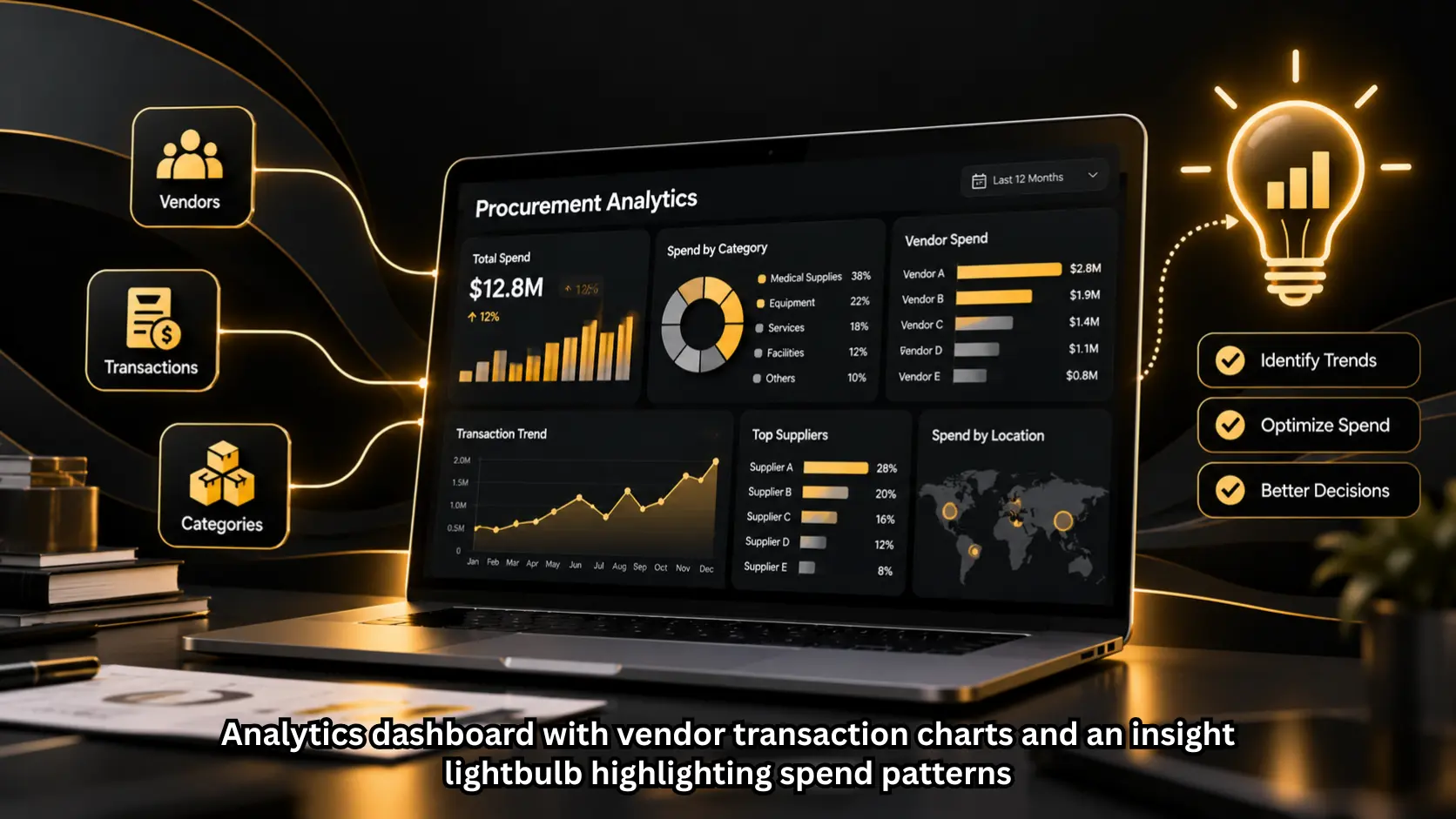
Few turn it into anything more than a monthly report. This guide covers what procurement analytics does in practice and where most teams leave value on the table.
Key Takeaways
- Procurement analytics turns purchase order, invoice, and payment data into decisions, not just a monthly report.
- Clean, centralized data is the foundation. Expensive analytics tools return unreliable results without it.
- In a Gartner survey of 111 procurement leaders, 68% said technology and data skills had increased in importance over the past year, more than any other competency area.
- Detecting spend leakage depends on clean invoice data in the first place, which is exactly what AP automation is built to validate before the data ever reaches the analytics layer.
- Predictive and prescriptive analytics only work once descriptive and diagnostic reporting are already reliable. Skipping ahead produces forecasts nobody trusts.
The Untapped Potential of Your Vendor Transaction Data
The data needed by most procurement teams is already available. Each day, purchase orders, invoices, payments, and measures of vendor performance are recorded in ERP and vendor management systems, but only a small part of this information is actually used when making decisions.
Since the data remains in separate systems, procurement teams are unable to get a comprehensive view of spend efficiency, vendor reliability, and operational performance. Nowadays, platforms like Zapro AI are being developed so that purchase orders, invoices, and payment data can be brought together in a single view, and this is typically the first practical move to eliminate the gap.
A basic report simply outlines what has already taken place: the total amount spent, the main vendors, and the number of transactions. While this kind of information is useful, it only provides description. Procurement analytics earns its name when it goes beyond this by explaining why something occurred and indicating what should be done next.
Four Types of Procurement Analytics, and Which One Changes Decisions
Most guides on this topic name four levels of analytics. Each one answers a different question, and most procurement teams have only built the first one.
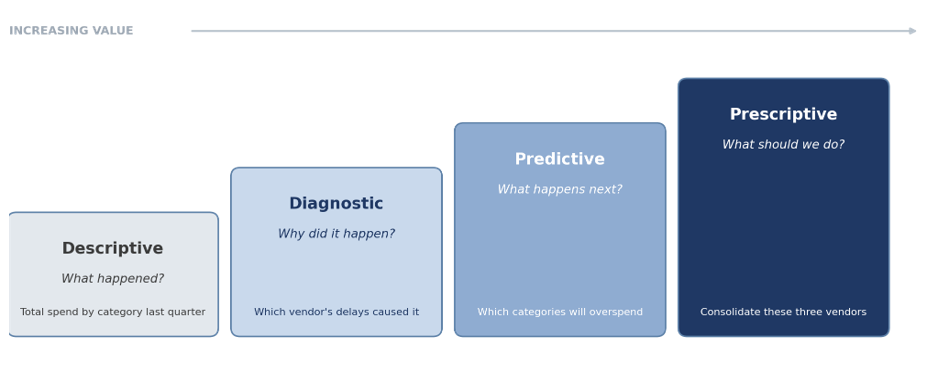
- Descriptive analytics answers the question ‘what happened,’ for example, by showing the total amount spent by category last quarter and indicating which vendors were paid the most.
- Diagnostic analytics explains why the increase in late deliveries is due to a capacity problem with one vendor, not a shipping issue.
- Predictive analytics, usually based on machine learning rather than fixed rules, determines which categories are on course to overspend by referring to past patterns rather than a fixed budget line.
- Prescriptive analytics answers what to do: consolidate three overlapping vendors into one contract to hit a volume discount.
The procurement analysis tools currently available on the market are generally descriptive dashboards which have been given a predictive label. Before you accept that label, ask during a demonstration for a specific forecast or recommendation rather than just seeing a chart.
Three Pillars of Reliable Procurement Analytics
Effective procurement analytics depends on data that is clean and well-structured, and that is kept in a consistent manner. If that basic foundation is missing, then sophisticated tools will generate results that no one can act on with confidence.
Data Collection and Cleansing
The procurement data comes from ERP systems, vendor management systems, invoices, contracts, and vendor portals; due to differences in format, the presence of duplicate entries, and missing fields, the analysis is unreliable from the very beginning. A systematic cleansing procedure is carried out to standardize the fields, eliminate the duplicates, and combine all these sources into a single dataset, which then forms the basis for all subsequent steps.
Spend Categorization and Classification
Because the spend data is unorganized, it is difficult to find out where the money is being spent. By categorizing the purchases into direct, indirect, and service-based spending, a standard taxonomy like UNSPSC or the organization’s own system can be used. The data, after it has been categorized, shows consolidation opportunities and contract compliance gaps that are hidden by raw lists of transactions.
Vendor Segmentation and Performance Data
Different vendors do not all have the same level of importance. By segmenting vendors, one can classify them according to their spending level, their degree of risk exposure, and their strategic value, the latter being assessed based on delivery timeliness, defect rates, and cost. This approach is most effective when applied to current vendor records rather than to a static spreadsheet, since a connected vendor management platform provides transaction-based analytics together with up-to-date scorecards and risk data rather than relying on a snapshot from six months ago.
Where the Real Savings Hide
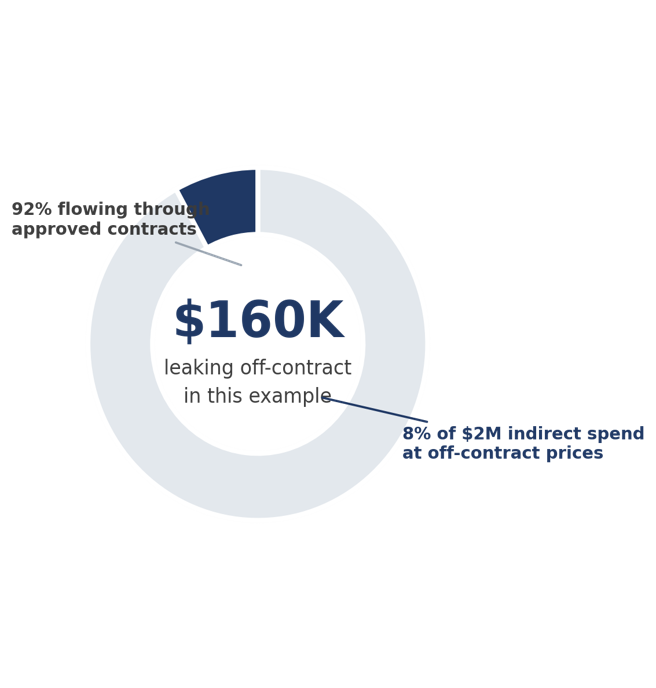
Spend leakage happens when purchases run through channels that bypass approved contracts and negotiated rates. It is one of the easiest things for analytics to catch, and one of the easiest to underestimate.
💡A Worked Example
A mid-size company with $2,000,000 in indirect spend finds that 8% of it, $160,000, is going through unapproved vendors at list price instead of a negotiated contract. That is not a one-time finding; it repeats every year the leak goes unaddressed. This is an illustrative calculation, not a benchmark for any specific company.
Payment term optimization
Analyzing payment patterns and early-payment behavior lets treasury teams capture discounts they are currently leaving on the table, and flags which late payments are quietly damaging vendor relationships.
Vendor consolidation
By combining purchases from fewer vendors, after identifying overlaps, procurement can gain real influence in the following negotiation, rather than managing multiple small contracts at different rates.
None of this requires predictive modeling. It requires someone to look at categorized, accurate transaction data on a regular schedule, which is the part most teams skip. Procurement software with built-in spend analytics keeps purchase orders, invoices, and payments categorized in one place, which makes that regular review easier to sustain.
Building a Data-Driven Procurement Culture
Analytics will not work unless an organization trusts the numbers sufficiently to take action on them, and that requires more than just a dashboard.
- Make sure that there is clear data ownership within both the procurement and finance departments so that all parties know who is responsible for validating what.
- Begin with a small number of KPIs, for example those relating to spend under management and contract compliance, rather than starting with twenty indicators which no one checks.
- Teach the staff to read the dashboards that have been provided to them; a tool which is not understood will be ignored within a month.
“Zapro made procurement effortless with a user-friendly interface and stellar support. Our team and suppliers adapted quickly, and we’re now seeing faster approvals and smoother collaboration.”
— Maria Rowan, Business Controller, Repromed
Repromed, a company that provides fertility care, is an example of how this works in practice. Once it had centralized its procurement data with Zapro AI, the company’s team noted that approvals were quicker and that cooperation with vendors became smoother. Maria Rowan, Repromed’s Business Controller, stated that the platform was easy for both her team and the vendors to adopt, and the speed of approvals became clearly faster as a result.
Implementing Smarter Procurement Analytics With Zapro AI
Dashboards won’t cause decisions to change by themselves. A procurement analysis platform establishes its value by carrying out three things at the same time: it brings together vendor and spending data in a single location, highlights issues without it being necessary to build a report first, and provides procurement, finance, and vendors with the same figures to work with. Zapro AI is designed around those three functions. Since it is a procurement solution based on analytics, it incorporates vendor information and spending data into one interface and converts raw transactions into figures that a team can take action on.
For teams that run procure-to-pay analytics from requisition through payment, the table below maps each need covered in this guide to what Zapro AI provides.
| Analytics Need | What Zapro AI Provides |
|---|---|
| One view of vendor and spend data | Instant access to vendor performance data and spending patterns in a single, user-friendly interface |
| Early warning on leakage | Maverick buying and delayed payments detected at their onset, before they build into a larger loss |
| KPI tracking without spreadsheet work | Automated tracking of KPIs, plus reports for compliance purposes |
| Shared figures with vendors | Transparent data sharing that supports better vendor collaboration |
| Savings that can be measured | Cost reductions a team can quantify once spend data sits in one place, as with the $160,000 leak in the worked example above |
Zapro AI also applies AI to that data to flag spending anomalies, vendor consolidation opportunities, and contract optimization potential automatically. Measured against the four levels of analytics covered earlier, that moves a team past descriptive reporting: the system surfaces the pattern, and a person decides what to do with it. The spend analytics page shows the dashboards in more detail.
Two checks are worth making before committing to any platform. First, analytics depth often varies by plan tier, so confirm which capabilities each plan includes: see procurement platform pricing and plans. Second, dashboards are easier to judge on live data than in screenshots, so ask for a spend dashboard walkthrough in a product demo and confirm that the cuts you need, by category, vendor, and department, are available.
That shift, from processing transactions to planning from them, is what separates a reporting tool from a platform worth the budget. To check whether a platform clears that bar, a Zapro AI demo lets you review spend analytics against your own purchase orders and invoices.
Frequently Asked Questions
What is procurement analytics?
Procurement analytics is the process of collecting, cleaning, and analyzing purchase order, invoice, payment, and vendor performance data to find savings, reduce risk, and improve purchasing decisions. It ranges from simple spend reports to predictive models that flag problems before they happen.
What is the difference between procurement analytics and spend analytics?
Spend analytics is that aspect of procurement analytics which deals specifically with where money is spent: it includes categorized purchase history, vendor spend, and budget tracking. Procurement analytics as a whole also encompasses vendor performance, contract compliance, and process metrics such as cycle time.
What procurement analysis tools should a team start with?
Begin with a procurement analysis platform that is able to reliably bring purchase order, invoice, and payment data together in a single, categorized view. This platform will justify its cost when the manual process of compiling spreadsheets takes over a few hours each month, or when more than one person has to trust the same figures.
How does AI change procurement data analytics?
AI and machine learning enable procurement data analytics to go beyond simple descriptive reporting by predicting which categories are likely to exceed their spending, identifying vendor risk before it causes a disruption, and detecting anomalies that a manual review would fail to pick up. However, it still relies on the same clean and categorized data that basic reporting requires.
Do I need a dedicated procurement analysis platform, or can I start in a spreadsheet?
A spreadsheet can answer simple descriptive questions for a small vendor list. It breaks down once data comes from multiple systems, more than one person needs to update it, or the questions move past what happened and into what is likely to happen next.
Turn Data Into Decisions
Procurement analytics is about trusting your numbers so you can move fast. Zapro AI puts all your orders, invoices, and vendor info in one spot. Now you spend less time looking for data and more time making moves.
Don’t miss our weekly updates
We’ll email you 1-3 times per week—and never share your information.
Spreadsheets Can't Find Hidden Savings. AI Can.
Zapro's procurement analytics goes beyond basic reporting with AI that identifies spending anomalies, vendor consolidation opportunities, and contract optimization potential automatically.

About the Author

Md. Kafil


About the Reviewer

Zapro is dedicated to helping businesses of all sizes make informed decisions. We adhere to strict editorial guidelines to ensure that our content meets and maintains our high standards.
Our editorial standards help keep every article accurate, useful, and trustworthy.