

If a company needs 10,000 units of a product, who makes sure they are available?
One team might find the suppliers, compare prices, negotiate terms, and place the order. Another might plan how much inventory is needed, arrange transportation, manage the warehouse, and make sure the product reaches customers.
So, is all of that procurement?
Not quite.
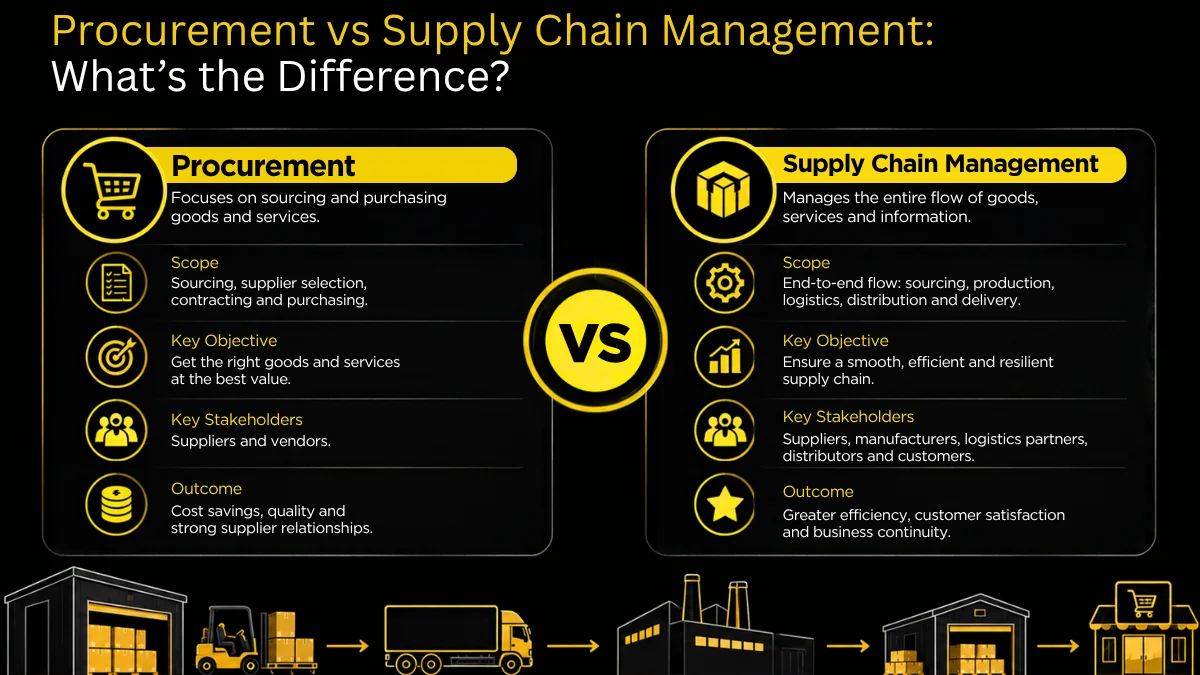
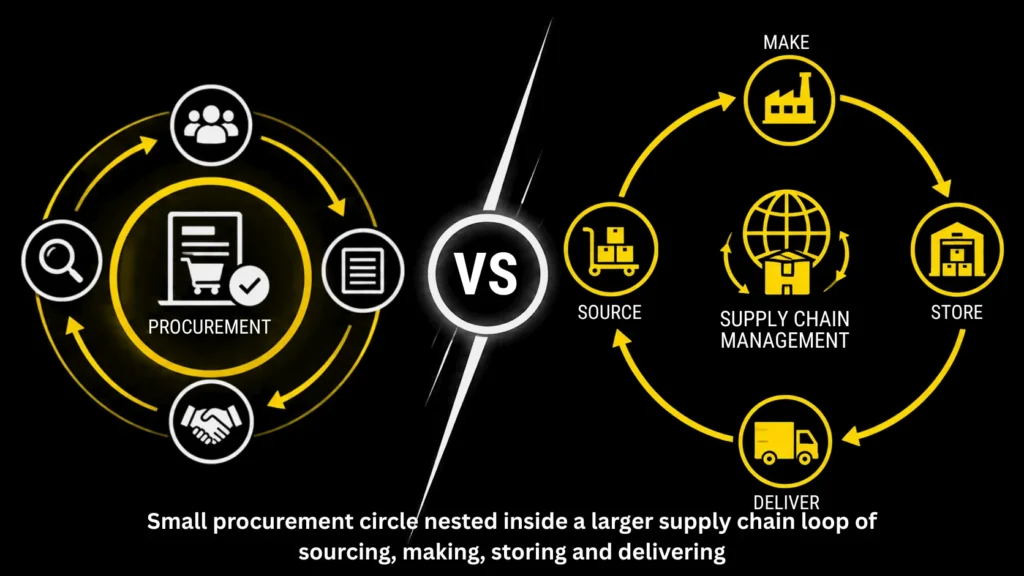
Procurement focuses on how a business gets the goods and services it needs from suppliers. Supply chain management covers the much wider system that plans, sources, moves, stores, and delivers those goods.
That sounds straightforward, but the terms get confusing in practice. Companies often organise these responsibilities differently, and procurement, purchasing, sourcing, and supply chain can overlap depending on the business.
The easiest way to understand the difference is to look at what each function is responsible for, where procurement sits in the supply chain, and what happens when a purchasing decision affects everything that comes after it.
Key takeaways
- Procurement is a focused function within the supply chain.
- Procurement deals with sourcing, supplier selection, negotiation, contracts, purchasing, and supplier management.
- Supply chain management covers a wider journey, including planning, inventory, production, logistics, and distribution.
- Procurement decisions can affect inventory, delivery times, production, risk, and the total cost of getting a product to customers.
- Procurement software helps businesses bring requests, approvals, suppliers, purchase orders, invoices, and spend information into a connected process.
What does procurement actually do?
Procurement is often reduced to one word: buying.
That is only part of it.
The Association for Supply Chain Management (ASCM) describes procurement as a focused area of the supply chain that covers the activities involved in obtaining the goods and services an organization needs. It can include sourcing, negotiating terms, supplier management, purchasing, and maintaining records.
In practice, procurement can start long before anyone places an order.
A typical process looks something like this:
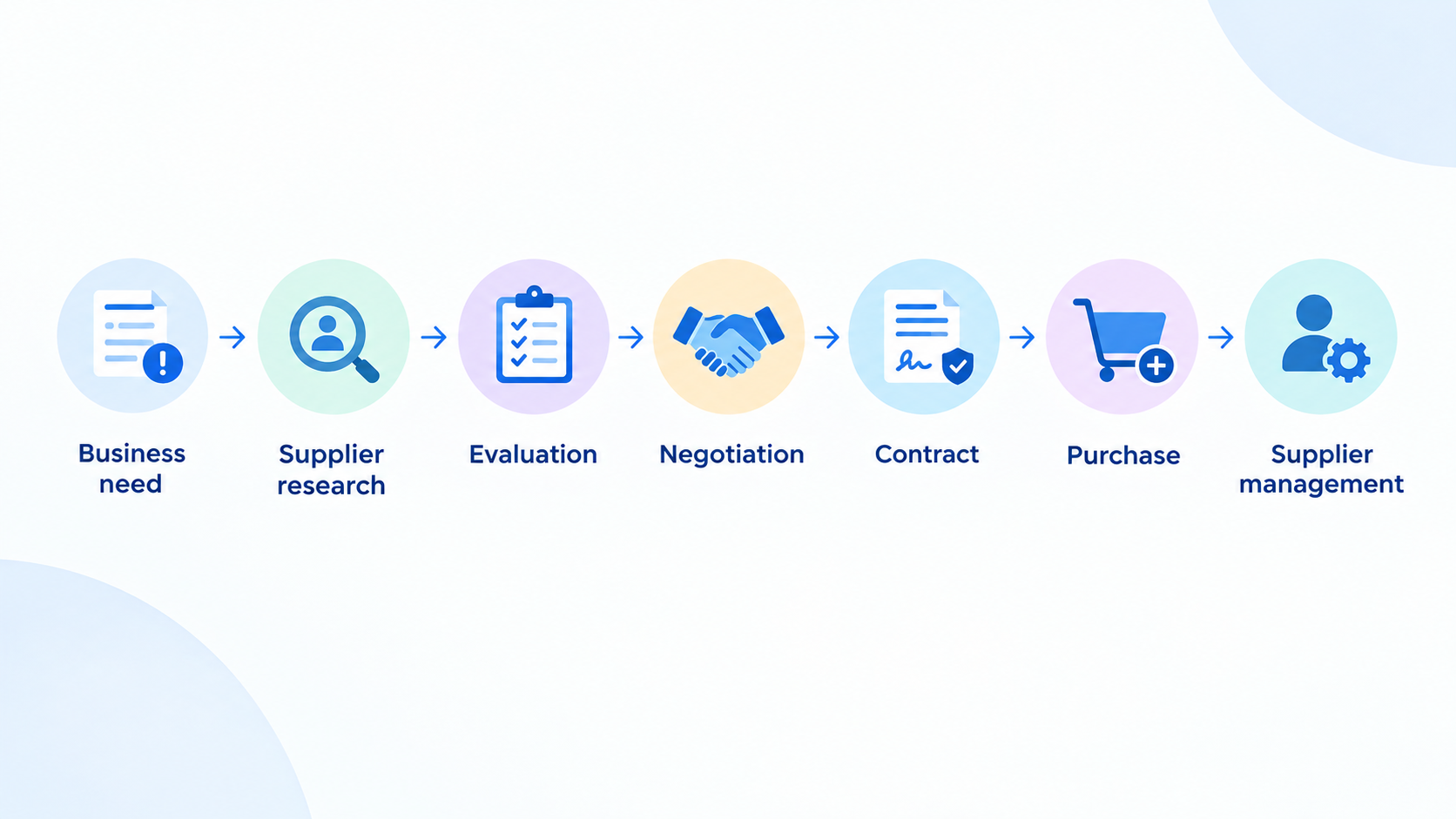
Business need → Supplier research → Evaluation → Negotiation → Contract → Purchase → Supplier management
For example, imagine a company needs new packaging for a product line. Procurement may:
- understand the business requirement
- find potential suppliers
- request and compare quotations
- evaluate quality, capacity, price, and delivery terms
- negotiate commercial conditions
- select and onboard a supplier
- manage the contract
- monitor supplier performance
- support future purchases
So the procurement team is not simply asking, “Where can we buy this?”
It is also asking, “Who should we buy it from, on what terms, and how do we manage that relationship?”
That distinction becomes important when supplier decisions have consequences beyond the purchase itself.
What does supply chain management cover?
Supply chain management is the larger picture.
Think about what happens between a business deciding it needs something and a customer eventually receiving the finished product.
There may be:
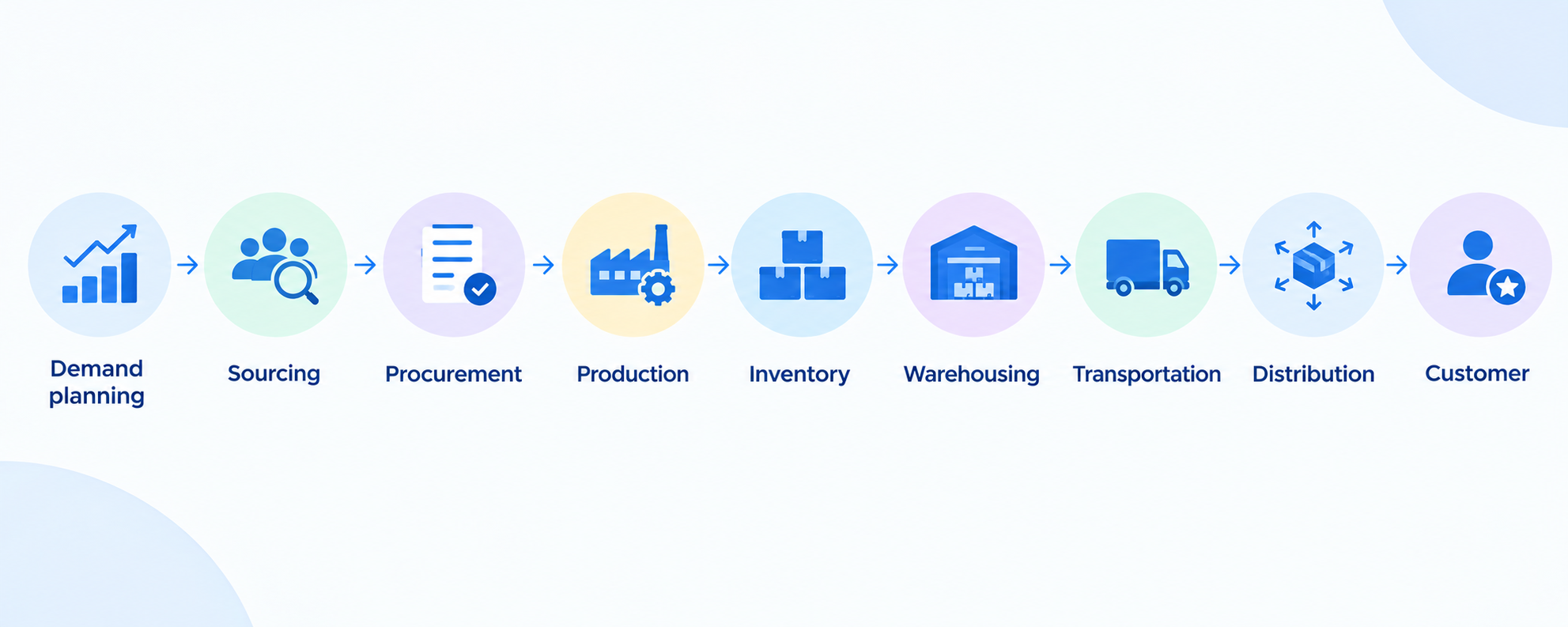
Demand planning → Sourcing → Procurement → Production → Inventory → Warehousing → Transportation → Distribution → Customer
Supply chain management coordinates this wider flow.
Depending on the organization, that can include demand and supply planning, procurement, production planning, inventory management, warehousing, transportation, logistics, distribution, and fulfillment.
The goal is not simply to purchase something at a good price. The business also needs the right quantity, at the right time and place, with enough visibility to respond when something changes.
This is why supply chain management is broader than procurement.
Procurement answers questions around suppliers and purchasing decisions. Supply chain management looks at how those decisions fit into moving goods and resources across the business.

Organizations that integrate procurement and supply chain functions achieve up to 25% greater operational efficiency and 15% higher cost savings compared to those managing them separately.
Is procurement part of supply chain management?
Generally, yes.
ASCM describes procurement as operating within a specific, focused area of the supply chain.
However, that does not mean every company has a department called “Supply Chain” with procurement reporting into it.
Organisational structures vary. In some companies, procurement and supply chain sit under the same leadership. In others, procurement may report through finance, operations, or a dedicated chief procurement officer.
Practitioners also point out that titles such as buyer, purchasing specialist, procurement specialist, and supply chain specialist can mean different things from one company to another.
So there are two separate questions:
Is procurement conceptually part of the supply chain?
Usually, yes.
Does procurement always sit inside the same department as supply chain?
No. That depends on the organization.
Procurement vs supply chain management
| Procurement | Supply Chain Management | |
|---|---|---|
| Primary focus | Getting goods and services from suppliers | Managing the wider flow from source to customer |
| Main concern | Suppliers, sourcing, purchasing, contracts, and spend | Planning, movement, inventory, production, logistics, and fulfillment |
| Typical activities | Sourcing, supplier selection, negotiation, purchasing, supplier management | Demand planning, procurement, production, inventory, warehousing, transportation, distribution |
| Key relationships | Suppliers and internal stakeholders | Suppliers, procurement, operations, logistics, production, and customers |
| Common measures | Savings, supplier performance, compliance, spend | Inventory, lead time, fulfillment, delivery, and logistics performance |
| Scope | A focused business function | A broader end-to-end business process |
The simplest way to remember it is:
Procurement gets the business what it needs. Supply chain management manages how everything moves and works together around that need.
What happens when a procurement decision affects the supply chain?
This is where the difference becomes more than a definition.
Suppose two suppliers can provide the same component.
Supplier A: ₹100 per unit, 20-day lead time
Supplier B: ₹92 per unit, 50-day lead time
At first glance, Supplier B looks like the obvious choice.
But the procurement decision does not stop at the purchase price.
A 50-day lead time could mean the company needs to carry more inventory. It could require more warehouse space. If demand changes, that extra stock could become a problem. If the supplier misses a shipment, production may be affected.
The cheaper supplier may still be the right choice. The point is that purchase price alone does not tell the whole story.
The same applies to minimum order quantities.
A supplier may offer a significant discount if the company buys 10,000 units instead of 5,000. Procurement may secure a better unit price, but the business now has more cash tied up in inventory and potentially more storage and obsolescence risk.
Supplier selection can also affect resilience. A single supplier may offer excellent pricing and quality, but depending heavily on one source can leave the business more exposed if that supplier experiences a disruption.
This is why procurement decisions can have consequences far beyond the procurement team.
Who manages the supplier?
Another common point of confusion is supplier ownership.
The answer depends on the organization and the type of supplier, but procurement often plays a central role in the commercial relationship.
That can include:
- selecting and onboarding suppliers
- negotiating contracts
- managing commercial terms
- monitoring supplier performance
- reviewing compliance
- handling renewals
- handling supplier risk
Other teams may own parts of the relationship too.
Quality teams may monitor defects. Operations may care about production performance. Finance may monitor invoices and payment terms. Supply chain teams may track delivery and availability.
The result is a lot of supplier information spread throughout various parts of the business.
That becomes difficult to manage when nobody has a reliable view of the full supplier relationship.
Does procurement mean the same thing as purchasing?
Not always.
The terms are often used interchangeably, but there is a useful distinction.
Procurement is the larger process. Purchasing is the transactional part of getting something bought.
For example:
Procurement:
Find suppliers, evaluate them, negotiate terms, select one, manage the contract.
Purchasing:
Create the purchase order, receive the goods or service, process the transaction, and maintain the relevant records.
ASCM makes a similar distinction, describing procurement as the more extensive strategy and purchasing as the execution of that strategy through specific transactions.
The terminology is not universal, though. Practitioners regularly point out that companies combine or divide these responsibilities differently.
So if you are comparing procurement or purchasing roles, look at the responsibilities rather than relying on the job title alone.
What information needs to move between procurement and supply chain?
The two functions do not need to become one department to make better decisions.
They do need access to the information that affects their decisions.
For example:
Demand information
How much will the business need?
Supplier information
Who can supply it, at what capacity and under what conditions?
Cost information
What is the business actually paying?
Lead-time information
How quickly can the supplier deliver?
Performance information
Does the supplier deliver on time and meet quality requirements?
Risk information
What is capable of disrupting supply?
Without this information, procurement can optimise one part of the process while another team deals with the consequences later.
This is also why procurement is becoming more data-driven. In 2026, Gartner has highlighted data quality, legacy-system integration, process efficiency, and AI readiness as important issues for procurement organisations.
Where does procurement software fit?
Once procurement involves dozens or hundreds of suppliers, requests, approvals, contracts, purchase orders, invoices, and spend records, managing everything through email and spreadsheets becomes difficult.
The problem is not only the amount of work.
It is the lack of connection between the work.
A purchase might begin as an employee’s request, move through several approvals, become a purchase order, generate a supplier invoice, and eventually appear in finance records.
If those steps live in different places, it becomes harder to answer basic questions:
- Who approved this purchase?
- Which supplier was selected?
- What terms were agreed?
- Has the supplier delivered?
- Does the invoice match the order?
- How much have we spent with this supplier?
- What is still pending?
That is where procurement software can help.
Zapro AI’s procurement platform brings purchase requests, approvals, purchase orders, vendor onboarding, invoice matching, and procurement workflows into one system. Its approach is centred on keeping the process structured while leaving commercial judgement and approval authority with people.
For example, a procurement workflow can move from:
Request → Approval → Supplier → Purchase Order → Invoice → Payment
without requiring teams to recreate the same information at every stage.
Zapro AI also connects this with supplier management, so supplier onboarding, performance, risk, and ongoing vendor information do not have to live in a completely separate process.
For businesses trying to get better visibility into procurement, that connection can matter as much as automation itself. When comparing options, weigh procurement software pricing against how much manual re-entry each platform actually removes.
What should businesses look for in procurement software?
The right platform depends on how a business buys, but a useful starting checklist includes:
- Purchase request and approval workflows
- Purchase order management
- Supplier onboarding and management
- Contract visibility
- Spend tracking
- Supplier performance monitoring
- Invoice matching
- Reporting and analytics
- ERP and finance integrations
- Audit trails and role-based controls
AI is also becoming part of procurement technology, but it is worth looking beyond the word “AI” when evaluating a platform.
Gartner’s 2026 procurement research points to data quality, integration, governance, security, and change management alongside AI capabilities.
In other words, the useful question is not simply:
“Does this procurement software use AI?”
It is:
“Does it make the procurement process easier to control, easier to understand, and easier to act on?” If you want to test that against your own workflow, you can book a demo of Zapro AI.
Unify Procurement & Supply Chain — Boost Efficiency Now!

Frequently asked questions
Is procurement part of supply chain management?
Yes. Procurement is generally considered a focused function within the wider supply chain. It deals primarily with sourcing and acquiring the goods and services a business needs, while supply chain management covers the wider flow of goods, information, inventory, logistics, and fulfilment.
What is the difference between procurement and supply chain management?
Procurement focuses on obtaining goods and services from suppliers, including sourcing, negotiation, purchasing, contracts, and supplier management. Supply chain management has a wider scope that can include planning, procurement, production, inventory, warehousing, transportation, and distribution.
Is procurement the same as purchasing?
No. Purchasing is generally the transactional part of buying, such as creating purchase orders and processing receipts and invoices. Procurement is broader and can include sourcing, supplier selection, negotiation, contracting, and supplier management. The exact responsibilities vary between organisations.
What is procurement in supply chain management?
Procurement is the part of supply chain management responsible for obtaining the goods and services the organisation needs. Its decisions can influence cost, quality, supplier risk, inventory, lead times, and the reliability of the wider supply chain.
Who manages suppliers: procurement or supply chain?
There is no universal answer. Procurement commonly handles the commercial side of supplier relationships, while supply chain, quality, operations, finance, or other teams may own particular aspects such as delivery, quality, risk, or payment. Responsibilities depend on the organisation.
Does procurement only focus on reducing costs?
No. Cost is important, but procurement also considers quality, supplier performance, delivery, contractual terms, compliance, risk, and business continuity. A lower purchase price does not necessarily mean a lower total cost for the business.
What does procurement software manage?
Procurement software can manage parts of the purchasing lifecycle, including requests, approvals, suppliers, purchase orders, contracts, invoices, and spend. Modern platforms may also automate repetitive tasks and provide analytics or AI-assisted workflows.
References
- ASCM: What is Procurement?
- CIPS: What is Procurement?
- Gartner: 2026 Chief Procurement Officer Priority: Reinvent Procurement for the AI-First Era
- Gartner: 2026 CPO Challenge: Driving AI Readiness Through Procurement Process Management
- Zapro AI: Procurement Software
- Zapro AI: Procurement Process
- Zapro AI: Vendor Management Software
Don’t miss our weekly updates
We’ll email you 1-3 times per week—and never share your information.
Let’s Align Procurement and Supply Chain
We’ll unify your data and help your team work smarter, faster.

About the Author

Md. Kafil


About the Reviewer

Zapro is dedicated to helping businesses of all sizes make informed decisions. We adhere to strict editorial guidelines to ensure that our content meets and maintains our high standards.
Our editorial standards help keep every article accurate, useful, and trustworthy.