Zycus Pricing 2027: Module Costs, Setup and What Buyers Pay

Zycus Pricing 2027: Module Costs, Setup and What Buyers Pay

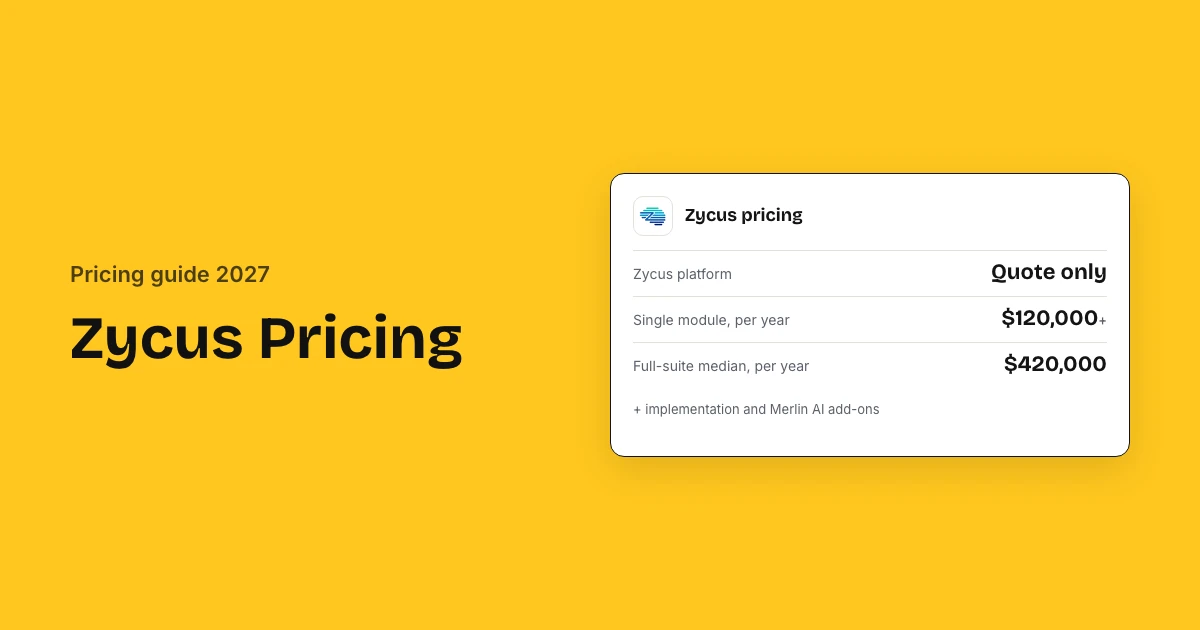
Zycus costs $120,000 to $240,000 a year for a single module and $380,000 to $720,000 for a full source-to-pay suite, based on VendorBenchmark's negotiated deals. Every contract is quoted by modules, users, suppliers and spend. By Zycus's own comparison, its mid-market package includes implementation and goes live in 6 to 8 weeks.

Zycus pricing: key takeaways

  • Quote only: Zycus prices by modules, user tiers, supplier counts and spend bands, with no public list price.
  • Typical cost: VendorBenchmark puts single-module Zycus deals from $120,000 a year, with a $420,000 median full-suite contract.
  • Mid-market: By Zycus's own comparison, its mid-market package includes implementation and goes live in 6 to 8 weeks.
  • Merlin AI: Adding the Merlin AI suite raises the bill by 25% to 40% over the base modules, VendorBenchmark reports.
  • Users: Requesters price at about 18% to 28% of a power user, and approvers at 8% to 14%.
  • Discounts: Buyers report a 30% median discount, with five-year terms and competing quotes pushing past 40%.

How much does Zycus cost?

Zycus costs $120,000 to $240,000 a year for one module such as iSource or iContract, based on VendorBenchmark's negotiated ranges. Source-to-contract runs $225,000 to $420,000 and a full source-to-pay suite $380,000 to $720,000. Zycus quotes every procurement software contract, with implementation on top.
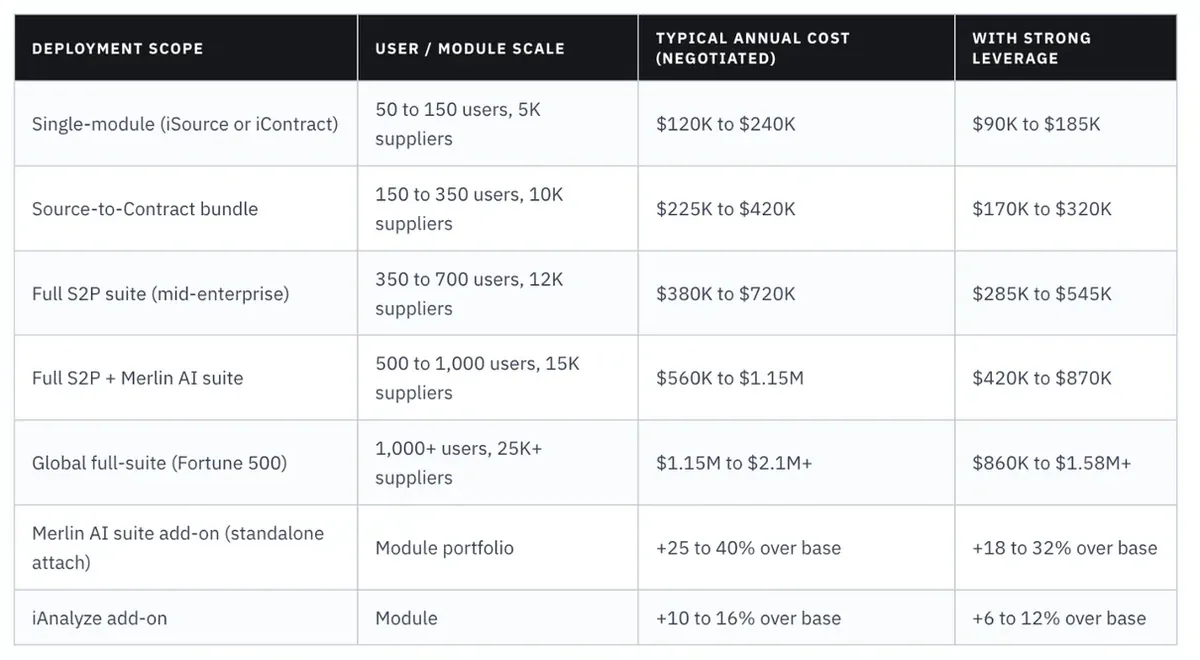
VendorBenchmark table of Zycus annual costs by deployment scope, from a single module at $120K to $240K up to a global full suite for Fortune 500 companies
What buyers pay for Zycus by deployment size, per VendorBenchmark. Source: VendorBenchmark Zycus pricing
DeploymentScaleTypical per yearWith strong leverage
Single module (iSource or iContract)50–150 users$120,000–$240,000$90,000–$185,000
Source-to-Contract bundle150–350 users$225,000–$420,000$170,000–$320,000
Full S2P suite350–700 users$380,000–$720,000$285,000–$545,000
Full S2P + Merlin AI500–1,000 users$560,000–$1,150,000$420,000–$870,000

What drives a Zycus quote

Your Zycus quote rises with the modules you buy, users by type, supplier count, spend under management, Merlin AI agents and the contract term.

  • Modules: e-procurement, e-invoicing, sourcing, contracts, supplier management, spend analysis
  • Users by type: power users, requesters and approvers
  • Supplier count, which sets iSupplier tiers
  • Spend under management and transaction volume
  • Merlin AI agents and the contract term

What will Zycus cost for your business?

Zycus costs a 50 to 200 employee company $120,000 to $240,000 a year for one module, VendorBenchmark's smallest band, sized for 50 to 150 users. Its mid-market package, with implementation included, is quoted; the only figure for it, a Zycus scenario no longer online, was $95,000 a year plus $65,000 setup.

Three example companies

Monthly costOne moduleSource-to-contractFull S2P + Merlin
Zycus subscription$10,000–$20,000$14,167–$26,667$31,667–$60,000
Merlin AI suite––$7,917–$24,000
Billed per year$120,000–$240,000$170,000–$320,000$475,000–$1,008,000
Setup, one-timeQuoted; included in mid-market packageQuoted; included in mid-market packageQuoted; included in mid-market package
  • One module: One module such as iSource or iContract for 50 to 150 users, typical negotiated price
  • Source-to-contract: Sourcing, contracts and supplier management for 150 to 350 users, strong negotiating leverage
  • Full S2P + Merlin: Full source-to-pay for 350 to 700 users with the Merlin AI suite, typical negotiated price

Ranges are buyer-reported negotiated prices from VendorBenchmark; implementation is excluded.

Estimate your own Zycus cost

What Zycus charges on top of the subscription

Zycus charges for implementation, Merlin AI at $85,000 to $280,000 a year standalone and higher iSupplier fees at each supplier tier, on top of the subscription. VendorBenchmark puts full-suite implementation at 55% to 95% of year-one subscription, Merlin AI at 25% to 40% over base and iSupplier steps at 12% to 20%.

Add-ons and fees reported by buyers

Buyers report implementation at 55% to 95% of year-one subscription on full suites, Merlin AI at 25% to 40% over base and iSupplier steps of 12% to 20%.

CostReported amountSource
Implementation (enterprise full suite)55–95% of year-one subscriptionVendorBenchmark
Implementation (Zycus mid-market package)IncludedZycus
Merlin AI suite+25–40% over base modulesVendorBenchmark
iAnalyze spend analytics add-on+10–16% over baseVendorBenchmark
iSupplier tiers+12–20% at each supplier breakpointVendorBenchmark
Annual list increase4–6%VendorBenchmark

Module prices at enterprise scale

At enterprise scale, each Zycus module costs $140,000 to $420,000 a year, and Merlin AI attaches at $85,000 to $280,000.

  • iAnalyze (spend analytics): $140,000 to $260,000 a year
  • iSource (sourcing): $160,000 to $280,000 a year for 150 users
  • iContract (contracts): $170,000 to $310,000 a year
  • iProcure (procure-to-pay): $220,000 to $420,000 a year
  • Merlin AI standalone attach: $85,000 to $280,000 a year

How much does Zycus ERP integration cost?

Zycus does not charge a separate ERP integration fee: integration is priced inside the implementation quote, and it lists SAP, Oracle and NetSuite integrations. CheckThat.ai reports a 3-to-5-week fast track only for NetSuite, while multi-ERP enterprise projects take 6 to 9 months. Ask which ERP path your quote assumes.

Your ERPHow Zycus connectsEffect on cost
NetSuiteListed integration3–5 week fast track (CheckThat.ai)
SAPListed integrationPart of implementation quote
OracleListed integrationPart of implementation quote
Several ERPsIntegration per system6–9 month projects (CheckThat.ai)

What to confirm about your ERP

Confirm your ERP connector sits in the implementation scope rather than a change request, and whether a second ERP or entity adds fees.

  • Your ERP connector is in the implementation scope, not a change request
  • Which objects sync: suppliers, POs, invoices, GL codes, contracts
  • Whether a second ERP or entity adds integration fees
  • Who maintains the connector after go-live
  • API access for contract tracking; one G2 reviewer saw little value without it

Zycus also sells AppXtend for custom extensions and a supplier network, and its tools page lists dedicated SAP, Oracle and NetSuite integration pages. Ask which of these your quote includes, and whether the NetSuite fast track applies to your ERP.

Zycus implementation cost and setup time

Zycus says its mid-market package goes live in 6 to 8 weeks with implementation included, against 12 to 18 months and $500,000 or more for typical enterprise source-to-pay. VendorBenchmark puts full-suite implementation at 55% to 95% of year-one subscription, so confirm in writing which package your quote is.
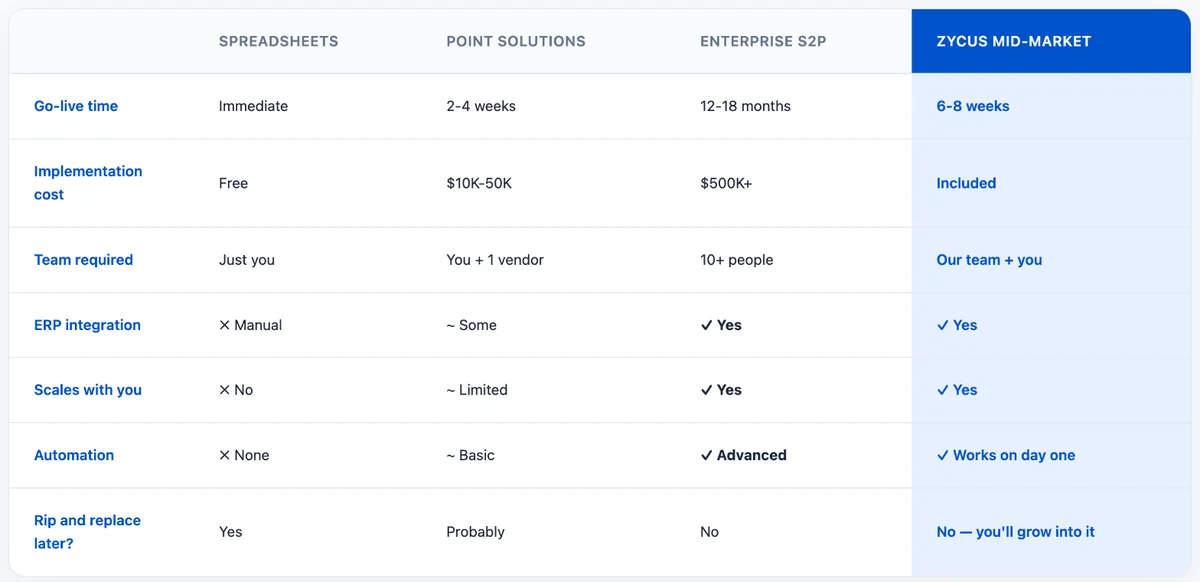
Zycus comparison table: Zycus Mid-Market goes live in 6-8 weeks with implementation cost included, versus enterprise S2P at 12-18 months and $500K+
Zycus's own comparison of go-live time and implementation cost. Source: Zycus mid-market
DeploymentTimeCost
Zycus mid-market package6–8 weeks (Zycus)Included (Zycus)
Mid-market on NetSuite3–5 weeks (CheckThat.ai)Quoted
Typical enterprise S2P12–18 months (Zycus)$500,000+ (Zycus)
Full suite, Fortune 1000Multi-phase55–95% of year-one subscription (VendorBenchmark)

Year-one budget

On the mid-market package, year one is the subscription alone, since Zycus includes implementation. On a full suite, VendorBenchmark's figures give $589,000 to $1,404,000 for year one: $380,000 to $720,000 of subscription plus 55% to 95% of it for implementation.

  • Scope a few priority workflows first, as mid-market customers do
  • Write down who can request what and who approves it; a clear procurement request intake process cuts configuration days
  • Get implementation as a fixed fee, not time and materials
  • Expect scope to grow 20% to 40% from the first estimate, per VendorBenchmark

Modules, users and contract terms

Zycus sells modules singly or in bundles, prices users by type, steps supplier fees at fixed breakpoints, and gives 16 to 22 more discount points on five-year terms than three-year ones. VendorBenchmark reports requesters cost 18% to 28% of a power user and approvers 8% to 14%.

User typePrice vs a power user
Power user (buyer, category manager)100%
RequisitionerAbout 18–28%
Approver or light userAbout 8–14%

VendorBenchmark also reports module-dependency pricing: buying an AI module on top of non-Zycus workflows can cost 20% to 35% more than its logical share, because it assumes base modules. Price the AI module both ways.

Renewal terms to check before you sign

Zycus renewals without leverage often apply a list uplift with only 0% to 4% discount, so cap the uplift at the lower of CPI or 4% and keep your per-module prices.

  • Renewals without leverage often apply a list uplift with 0% to 4% discount
  • Cap the renewal uplift at the lower of CPI or 4%
  • Preserve your per-module prices from the first term
  • Cap Merlin AI volume pricing at 20% to 25% over the contract tier
  • Check iSupplier steps at 2,500, 10K, 25K, 50K and 100K suppliers

Companies pay a median of $420,000 a year for a full Zycus suite at 400 to 500 users, per VendorBenchmark, with single-module deals from $120,000. SelectHub estimates $50,000 to $250,000 a year, and buyers report a 30% median discount, up to 52% on large competitive deals with long terms.
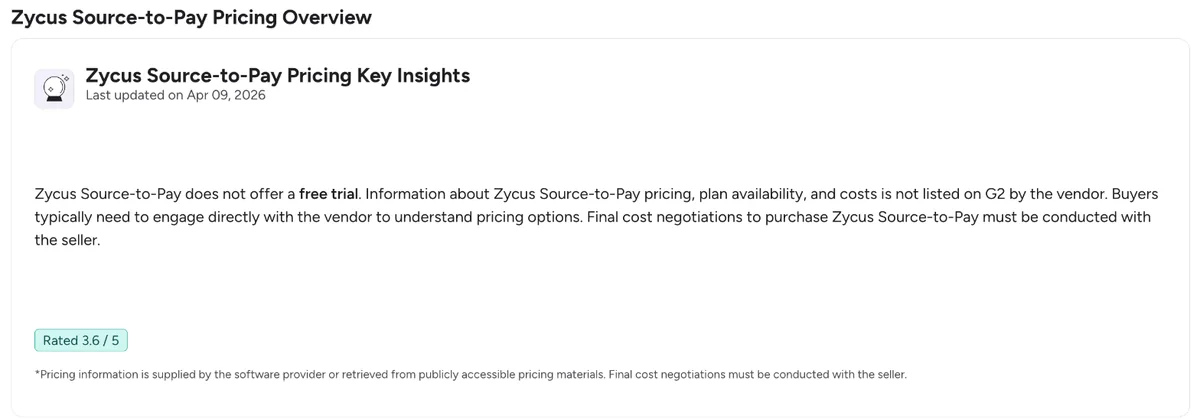
G2 Zycus Source-to-Pay pricing overview: no free trial, pricing not listed by the vendor, rated 3.6 out of 5
Zycus's G2 pricing listing: quote only. Source: G2 Zycus pricing

What buyers and G2 reviewers report

Buyers report a $420,000 median full-suite contract and a 30% median discount, while G2 rates Zycus 3.6 of 5 with no free trial.

SourceWhat it reports
VendorBenchmarkMedian full-suite $420,000/yr; single module $120,000–$240,000
VendorBenchmark discounts30% median; 20% to 52% range
SelectHub$50,000–$250,000 a year
CheckThat.ai, citing a Zycus scenario no longer onlineMid-market: about $95,000 a year plus $65,000 implementation
G2 (3.6 of 5)No free trial; implementation of contract loads could improve
CapterraContact vendor for pricing

VendorBenchmark notes that Zycus deals cluster between about $380,000 and $1.15 million a year for typical Fortune 1000 full-suite deployments, so mid-size buyers should push for the mid-market package or a single module first.

Is Zycus worth the price?

Zycus is worth the price for enterprises that want sourcing, contracts, supplier management and procure-to-pay with AI agents in one suite. VendorBenchmark puts it 20% to 32% below the comparable enterprise suites for like-for-like scope. For mid-size teams, six-figure yearly costs weigh heavily, so compare Zycus alternatives.

Worth it if

  • You need full source-to-pay across 350+ users
  • You want AI agents for sourcing and intake
  • You can negotiate a five-year term with competing quotes
  • You run SAP, Oracle or NetSuite

Look elsewhere if

  • Your budget is under $100,000 a year
  • You only need requests, approvals and POs
  • You want a published price and a free trial
  • You cannot staff a multi-month rollout

How to get a better Zycus price

Bring documented quotes from competing enterprise suites, classify users by type, and negotiate during January to March before Zycus's March 31 fiscal year-end. VendorBenchmark reports full-suite deals with competitive pressure and five-year terms reaching 40% to 52% off.

Deal scenarioTypical discountWith full leverage
Single module, 3-year, no competition12–20%20–28%
Source-to-contract with Ariba and Ivalua bids22–32%30–38%
Full S2P, 5-year, competitive28–40%36–46%
Renewal without leverage0–4%–

Get in writing

  • Price per module and per user type
  • Implementation as a fixed fee
  • Merlin AI volume caps
  • iSupplier tier breakpoints
  • Renewal uplift cap
  • Per-module prices preserved at renewal

Ways to pay less

  • Run a multi-vendor RFP
  • Close in January to March
  • Classify requesters and approvers
  • Start with one or two modules
  • Trade a five-year term for discount

Zycus pricing vs alternatives

Zycus's smallest reported deal, $120,000 a year for one module (VendorBenchmark), sits above Coupa's $94,519 Vendr median across all deal sizes, though Zycus runs 22% to 32% below Coupa for equal scope. Zapro pricing is Spark at $699 a month, Growth $1,999, Scale custom, all with unlimited users; your ERP or bank pays suppliers.

ToolPricing modelTypical cost (basis)Users priced
ZycusQuote: modules + user tiers$120,000–$240,000/yr, one module (VendorBenchmark range)By user type
CoupaQuote by module$94,519/yr (Vendr median, all deal sizes)Active users
ZipQuote: platform + seats + modules$88,856/yr (Vendr median)Seats
Oracle Procurement CloudList per userFrom $75,000/yr (Oracle list minimum)Full $625; self-service $8
ZaproFlat plans, unlimited usersSpark $699 / Growth $1,999 a month; Scale customNo per-user fee

Zycus pricing FAQs

How much does Zycus cost?

Zycus costs $120,000 to $240,000 a year for one module and $380,000 to $720,000 for a full source-to-pay suite, per VendorBenchmark; every contract is quoted. The median full-suite contract is $420,000, plus implementation unless you buy the mid-market package.

What does Zycus stand for?

Zycus is a company name, not an acronym. Zycus is a procurement software vendor founded in India that sells source-to-pay modules such as iSource, iContract, iSupplier, iProcure and iAnalyze, plus Merlin AI agents.

What is the cost of procurement software like Zycus?

Procurement software like Zycus costs from $120,000 a year in licences, plus implementation at 55% to 95% of year-one subscription on full-suite enterprise deals, per VendorBenchmark. Zycus bundles implementation into its mid-market package, and its own comparison puts typical enterprise source-to-pay setup at $500,000 or more.

Does Zycus offer a free trial?

No. G2 states Zycus Source-to-Pay does not offer a free trial, and Capterra asks buyers to contact the vendor for pricing. You need a scoped demo and proposal to see what the platform costs for your modules.

How long does Zycus take to implement?

Zycus's mid-market package goes live in 6 to 8 weeks with implementation included, by Zycus's own comparison. Typical enterprise source-to-pay projects take 12 to 18 months, and CheckThat.ai reports a 3-to-5-week fast track only for NetSuite customers with two or three priority workflows.

Does Zycus charge per user?

Partly. Zycus prices modules with user tiers, and VendorBenchmark reports requesters cost about 18% to 28% of a power user and approvers 8% to 14%. Supplier counts and spend bands also set the price, so it is not a flat per-seat fee.

What is the best procurement software for a mid-size business?

For a mid-size business, the best procurement software is usually a tool with published monthly prices that covers requests, approvals and POs. Zycus suits enterprises needing full source-to-pay at $120,000 a year and up.

Sources: VendorBenchmark Zycus pricing; Zycus mid-market; G2 Zycus pricing; CheckThat.ai; SelectHub. Prices come from Zycus's own pages where published and from the third-party sources listed, labelled as such. Estimates are not quotes.


Read More

Zoho Spend Pricing 2027: Licences, Add-Ons and Real Cost

Zoho Spend Pricing 2027: Licences, Add-Ons and Real Cost

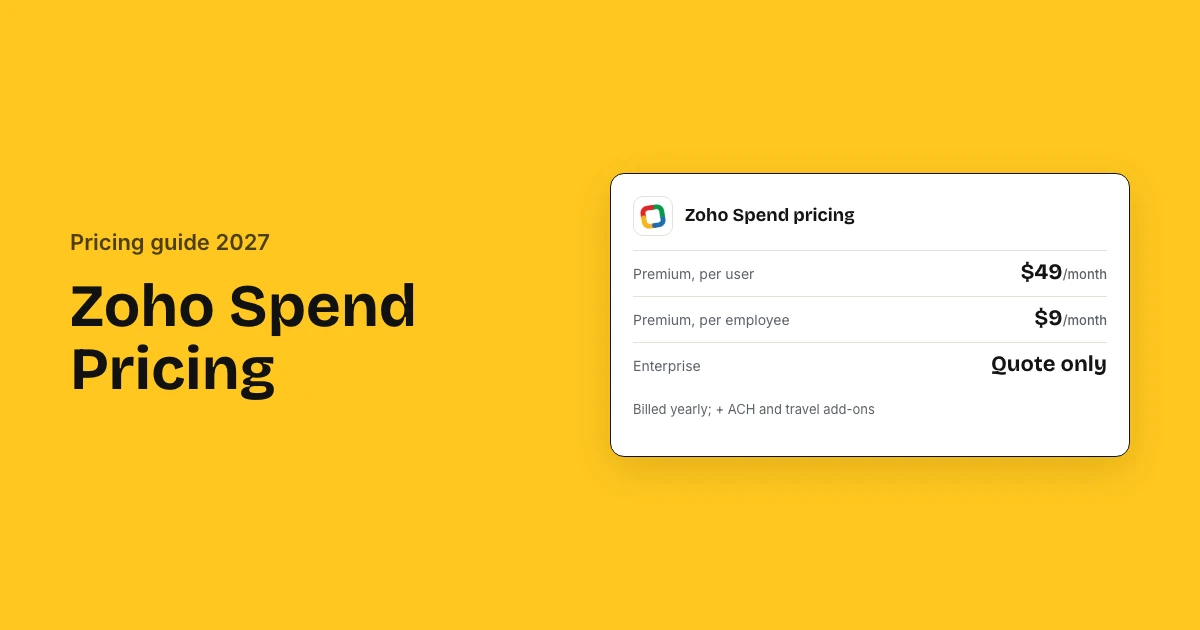
Zoho Spend costs $49 per admin user and $9 per employee a month on Premium billed yearly, or an estimated $8,340 to $24,540 a year for a 50-200 employee company. That range assumes 5 admin users; monthly billing raises the licences to $60 and $11, with a three-user minimum. Enterprise is quoted, and ACH payments cost $0.49 each.

Zoho Spend pricing: key takeaways

  • Two licences: Admin users cost $49 a month billed yearly, and self-service employees cost $9 a month billed yearly.
  • Monthly billing: Paying month to month raises the user licence to $60 and the employee licence to $11, about 22% more.
  • Minimum: Zoho requires at least three user licences, so the smallest Premium plan is $1,764 a year before employees.
  • Add-ons: ACH payments cost $0.49 each, travel bookings $9.99 a trip, and agent-assisted bookings $25 after year one.
  • Enterprise: Three-way matching, SSO, custom ERP integrations and multi-state payroll need the quote-only Enterprise edition.
  • No lock-in: Zoho calls Spend pay-as-you-go with no contract, and offers a 14-day free trial without a credit card.

How much does Zoho Spend cost?

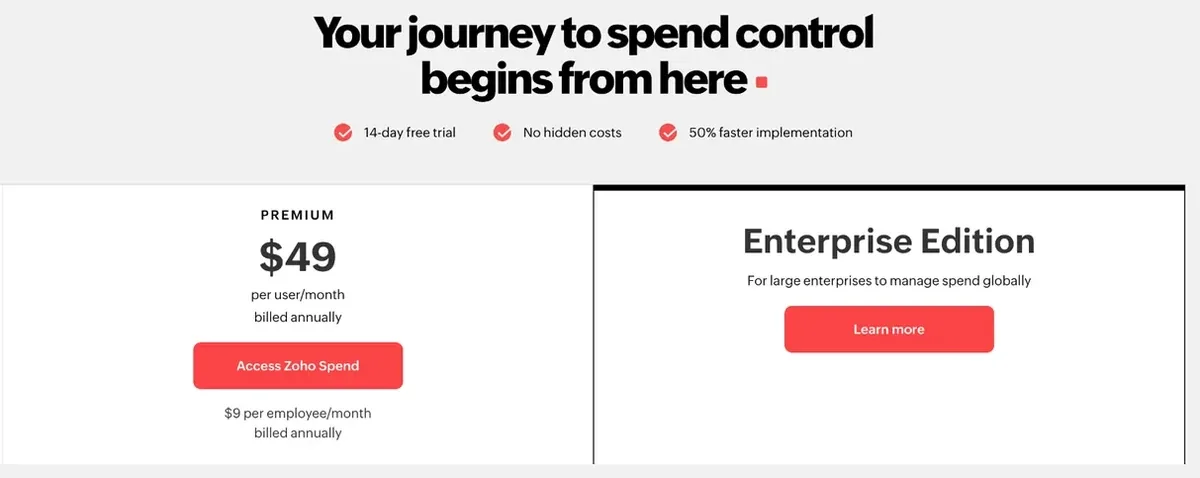
Zoho Spend costs $49 per user and $9 per employee a month billed yearly on Premium, its one priced plan, or $60 and $11 billed monthly, with a three-user minimum. Enterprise is quoted for larger or global teams that need three-way matching or SSO. Both run Zoho's spend analytics and spend control suite.

Zoho Spend pricing page: Premium $49 per user per month billed annually and $9 per employee per month, Enterprise Edition for large enterprises
Zoho Spend's US prices, billed annually. Source: Zoho Spend pricing
LicenceWho needs itBilled yearlyBilled monthly
UserAdmins who set policies, approvals, budgets and vendors$49 a month$60 a month
EmployeeStaff who submit expenses, raise purchase requests and book travel$9 a month$11 a month
EnterpriseLarge or global teamsQuoteQuote

What Premium includes

Zoho Spend Premium covers expenses, travel, purchase requests and POs, invoices with two-way matching, ACH payments and budgets.

  • Expenses with AI receipt capture, corporate card feeds, mileage and per diem
  • Travel requests, policy, travel desk and self-booking
  • Purchase request portal, catalogs, purchase orders and RFQ to PO
  • Invoice inbox, AI invoice extraction, two-way matching and ACH payments (US)
  • Sourcing events, single-state payroll and real-time budgets

What will Zoho Spend cost for your business?

Zoho Spend costs a 50-200 employee company with 5 admin users an estimated $8,340 to $24,540 a year billed yearly, before ACH fees, as every employee who submits spend needs a licence. With 100 employees and 100 ACH payments a month it is $14,328. Zoho publishes no onboarding fee, so year one is that plus any onboarding quote.

Three example companies

Monthly cost5 users + 100 employees10 users + 250 employees3 users + 50, monthly
User licences$245$490$180
Employee licences$900$2,250$550
ACH payments$49$245–
Travel bookings–$100–
Billed per year$14,328$37,019$8,760
Setup, one-timeNot publishedNot publishedNot published
  • 5 users + 100 employees: 5 user licences, 100 employee licences, billed yearly, 100 ACH payments a month
  • 10 users + 250 employees: 10 user licences, 250 employee licences, billed yearly, 500 ACH payments and 10 trips a month
  • 3 users + 50, monthly: 3 user licences, 50 employee licences, billed monthly, payments made outside Zoho

Travel agent support ($25 per booking after year one), card issuer fees and any partner implementation are not included.

Estimate your own Zoho Spend cost

Zoho Spend add-ons and fees on top of licences

Zoho Spend add-ons cost $0.49 per US ACH payment through its Forte integration, $9.99 per travel booking and $25 per agent-assisted booking, free for the first year. Those are the three add-ons Zoho publishes. Other extras, such as onboarding help and premium support, are not priced for Spend, so ask for them in writing.

Zoho Spend add-on repository: Payment $0.49 per ACH transaction, Travel Booking $9.99 per trip, Travel agent support $25 per booking free for first year
Zoho Spend's published add-on fees. Source: Zoho Spend pricing
Add-onPriceExample
ACH payment (US, via Forte)$0.49 each500 payments a month = $245 a month
Travel booking$9.99 per trip10 trips a month = $99.90 a month
Travel agent support$25 per bookingFree in year one
New Forte account100 free creditsOn Enterprise

Costs Zoho does not list for Spend

Zoho lists no Spend price for onboarding or premium support, which Zoho Expense lists from $490 a year, and card issuer or partner fees are extra.

  • Onboarding and integration help (see setup below)
  • Premium support; Zoho Expense lists it from $490 a year
  • Card program fees from your card issuer
  • Partner fees if a Zoho partner runs your rollout

How much does Zoho Spend ERP integration cost?

Zoho Spend syncs with Zoho Books and other Zoho apps out of the box, but custom ERP and HRMS integrations are listed only on the quote-only Enterprise edition. If you run NetSuite, Sage Intacct or Dynamics and need a custom sync, budget for Enterprise rather than Premium.

Your setupHow it connectsEffect on cost
Zoho Books or Zoho OneBuilt-in Zoho syncWithin Premium
Another accounting system, standard exportStandard integration or file exportWithin Premium; check what syncs
Custom ERP or HRMS integrationCustom integrationEnterprise quote
Several entities or statesMulti-entity, multi-state payrollEnterprise quote

What to confirm about your ERP

Check whether your ERP has a standard connector on Premium, because custom ERP integrations, three-way matching and SSO need Enterprise.

  • Whether your ERP has a standard connector on Premium or needs Enterprise
  • Which records sync: vendors, POs, bills, payments and GL codes
  • Whether three-way matching is required, since Premium has two-way only
  • Who builds and maintains a custom integration, Zoho or a partner
  • Whether SSO is a must, since it is Enterprise only

Zoho Spend implementation cost and setup time

Zoho publishes no Spend implementation fee or timeline; Enterprise includes personalised implementation and onboarding at no listed extra cost. Partners charge separately for rollouts, Zoho promises 50% faster implementation, and partners such as Al Fahad run rollouts in six steps.

PhaseWhat happensWho pays
Free trial14 days with all features, no cardFree
Process mapping and policy designMap spend flows, set limits and approval thresholdsYour team or a partner
Workflow configurationBuild approval hierarchiesYour team or a partner
System integrationConnect accounting, HR and card systemsEnterprise or partner fee
User enablement and optimisationTrain teams, monitor adoptionYour team; Enterprise onboarding included

The only published Zoho onboarding price is for a sister product: Zoho Expense sells Jumpstart onboarding, with a product expert, integration setup, hypercare and training, from $500 a year. Spend has no equivalent price, so ask Zoho for an onboarding quote and get partner bids in writing.

Keep setup cheap

Set policies during the free trial, start with expenses and requests, and confirm Zoho's own onboarding before paying a partner.

  • Use the trial to set policies before you pay
  • Start with expenses and purchase requests, then add AP
  • Ask whether Zoho's own onboarding is included before hiring a partner

Enterprise upgrade, contract terms and modules

Zoho Spend has no lock-in: Zoho calls it pay-as-you-go, so you can start and stop any time, and yearly billing simply saves about 18% against monthly. The real contract question is when you outgrow Premium, because several controls mid-size teams expect are Enterprise only.

Features that push you to Enterprise

Three-way matching, SSO, custom ERP integrations and multi-state payroll are the features that push teams from Premium to Enterprise.

NeedPremiumEnterprise
Invoice matchingTwo-wayThree-way
Single sign-on, IP restrictionNoYes
Custom ERP and HRMS integrationsNoYes
PayrollSingle stateMulti-state
Approval workflows, audit trail, analyticsBasicCustom, advanced

Renewal terms to check before you sign

Zoho Spend has no lock-in, so the terms to check are price locks for the year, mid-year user billing and the Enterprise per-user price.

  • Whether yearly prices are locked for the term
  • How added users and employees are billed mid-year
  • Whether add-on fees can change during the term
  • The Enterprise price per user if you upgrade later
  • Minimum user count on Enterprise

Companies pay Zoho Spend list price, about $14,328 a year for 5 admins, 100 employees and 100 ACH payments a month. No contract data is published and Vendr has no page for it; Capterra and GetApp show only the $49 user price, leaving out employee licences, the bigger bill for a mid-size firm.

TeamYearly licencesSource
3 users (minimum), no employees$1,764Zoho list price
10 users, no employees$5,880Zoho list price
5 users + 100 employees$13,740Zoho list price
10 users + 250 employees$32,880Zoho list price
Capterra Zoho Spend pricing: Premium $49.00 per user per month, Enterprise custom quote per user with custom ERP integrations and personalized implementation
Capterra lists Premium at $49 per user and Enterprise by quote. Source: Capterra Zoho Spend pricing

What reviewers report

G2 reviewers rate Zoho Spend 4.7 of 5 from 558 reviews and praise its procure-to-pay automation, but no review site scores its value yet.

  • G2 rates Zoho Spend 4.7 out of 5 from 558 reviews, with no price listed on G2
  • Capterra lists no value-for-money score yet for Zoho Spend
  • Reviewers praise automating the procure-to-pay cycle from vendor onboarding to payment

Is Zoho Spend worth the price?

Zoho Spend is worth it for teams already on Zoho Books that want expenses, travel and purchasing in one tool at a low admin price. It gets costly when every employee needs a licence and you need Enterprise for three-way matching, which is when Zoho Spend alternatives are worth comparing.

Worth it if

  • You already run Zoho Books or Zoho One
  • Few admins run spend and approvals
  • You want expenses, travel and POs together
  • You value no lock-in and a free trial

Look elsewhere if

  • Hundreds of employees need licences
  • You need three-way matching or SSO
  • You run NetSuite or Dynamics and need a custom sync
  • You want procurement only, not travel and payroll

How to get a better Zoho Spend price

Bill yearly, which cuts the user licence from $60 to $49 and the employee licence from $11 to $9. Give full user licences only to people who set policy or approve, and keep everyone else on employee licences. Then ask whether the $0.49 ACH fee drops at your payment volume and whether onboarding is included.

Get in writing

  • Yearly price per user and employee
  • Who counts as a user
  • ACH fee at your volume
  • Enterprise price per user
  • Onboarding included or not
  • Price lock for the term

Ways to pay less

  • Bill yearly
  • Keep requesters on employee licences
  • Stay on Premium until you need three-way matching
  • Use the free year of travel agent support
  • Consider standalone Zoho Procurement if you only need POs

Zoho Spend pricing vs alternatives

Zoho Spend charges $49 per admin user plus $9 per employee a month, while Zoho Procurement alone starts at $29 per user and Ramp Plus at $15 per user. Procurify is quoted with a $15,000 median. Zapro pricing has Spark at $699 a month, Growth at $1,999 and Scale on custom terms, all with unlimited users; your ERP or bank pays suppliers.

ToolPricing modelTypical cost (basis)Users priced
Zoho SpendPer user + per employee$49/user + $9/employee a month (list)Both
Zoho ProcurementPer user$29–$59/user a month (list)Per user; 50 free requesters each
RampFree, then per user$0; Plus $15/user (list)On Plus
ProcurifyQuote: products + Pro usersMedian $15,000/yr (Vendr)Pro users; Basic free
ZaproFlat plans, unlimited usersSpark $699 / Growth $1,999 a month; Scale customNo per-user fee

When each option costs less

Zoho Spend costs least with few admins and employees; with many requesters or a large headcount, free-requester or flat plans cost less.

  • Few admins and few employees: Zoho Spend Premium is hard to beat
  • Many requesters: tools that let requesters in free avoid Zoho's $9 employee licence
  • Purchasing only: standalone Zoho Procurement gives 50 free requester licences per paid licence
  • Large headcount: a flat plan with unlimited users stops cost rising with every new hire

Per-employee pricing is what separates Zoho Spend from tools that let requesters in free. For 100 employees, the employee licences alone cost $10,800 a year.

Zoho Spend pricing FAQs

How much does Zoho Spend cost per month?

Zoho Spend Premium costs $49 per user and $9 per employee a month billed yearly, or $60 and $11 billed monthly. You need at least three user licences, so the smallest plan is $147 a month billed yearly before any employees.

What is the difference between Zoho Expense and Zoho Spend?

Zoho Expense covers expense reports and travel, from free for 3 users to $3 to $6 per user a month. Zoho Spend adds procurement, AP automation, sourcing, cards and payroll in one platform, and also charges for every employee who submits spend.

How much does Zoho Expense cost?

Zoho Expense is free for up to 3 users. Standard costs $3 per user a month billed yearly or $4 monthly, and Premium $5 yearly or $6 monthly. Premium support starts from $490 a year and Jumpstart onboarding from $500 a year.

Does Zoho Spend have a contract?

No. Zoho describes Spend as pay-as-you-go, so you can start and stop your subscription at any time. Yearly billing is cheaper than monthly, and you can pay yearly plans by card, PayPal or bank transfer.

What are the disadvantages of Zoho Spend?

The main ones are cost and plan limits. Every employee who submits expenses or requests needs a $9 licence, Premium has only two-way invoice matching and single-state payroll, and SSO and custom ERP integrations need the quote-only Enterprise edition.

Is there a free trial of Zoho Spend?

Yes. Zoho Spend offers a 14-day free trial with all features and no credit card. There is no free plan; after the trial you pay Premium's user and employee licences, and billing yearly instead of monthly saves about 18%.

Sources: Zoho Spend pricing; Zoho Expense pricing; Capterra Zoho Spend pricing; G2. Prices come from Zoho Spend's own pages where published and from the third-party sources listed, labelled as such. Estimates are not quotes.

Read More

ZipHQ Pricing 2027: What Zip Costs, Setup Fees, Contracts

ZipHQ Pricing 2027: What Zip Costs, Setup Fees, Contracts

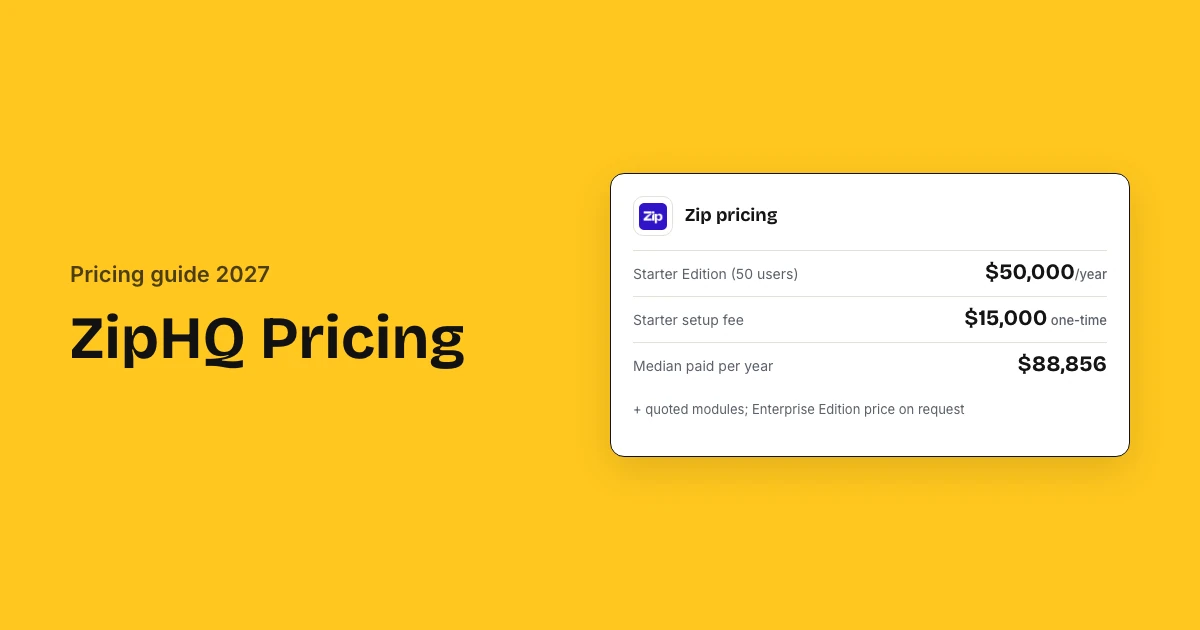
Zip costs $50,000 a year for 50 users on Starter plus a $15,000 setup fee, and buyers pay a median of $88,856 a year, from $27,776 to $220,210, per Vendr. Zip's own site shows no prices; Starter is on its SAP Store listing. An AWS pilot costs $75,000 for 100 users, and Enterprise is quoted.

Zip pricing: key takeaways

  • Typical cost: The median Zip contract is $88,856 a year, from $27,776 to $220,210, across 78 Vendr purchases.
  • Starter Edition: Starter costs $50,000 a year for 50 users plus a $15,000 setup fee, per Zip's SAP Store listing.
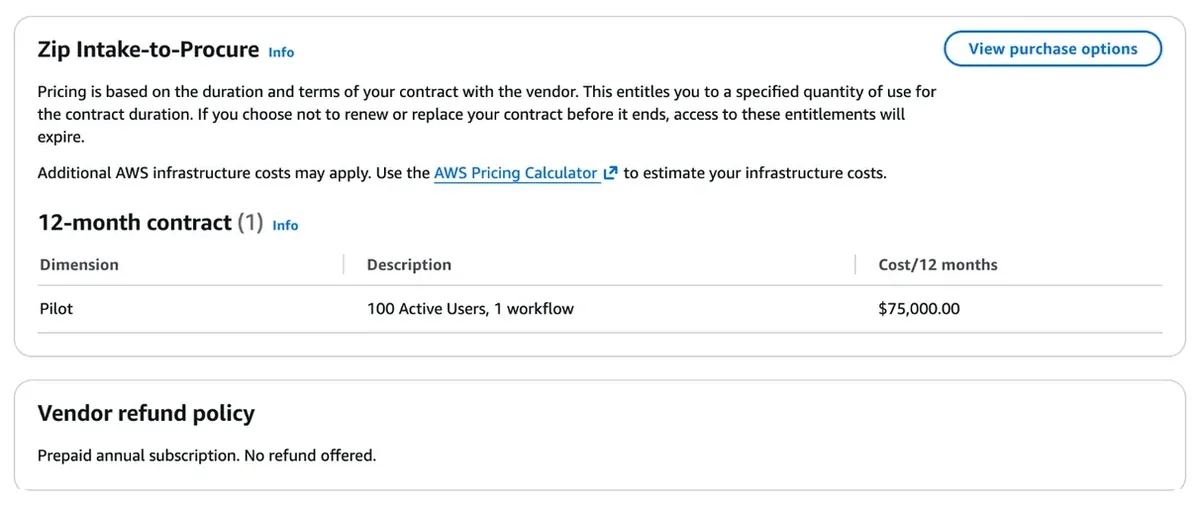
  • Pilot: A 12-month pilot for 100 active users and one workflow costs $75,000 prepaid on AWS Marketplace.
  • Pricing model: Quotes combine a platform fee scaled by company size, user seats and add-on modules such as contracts and vendor risk.
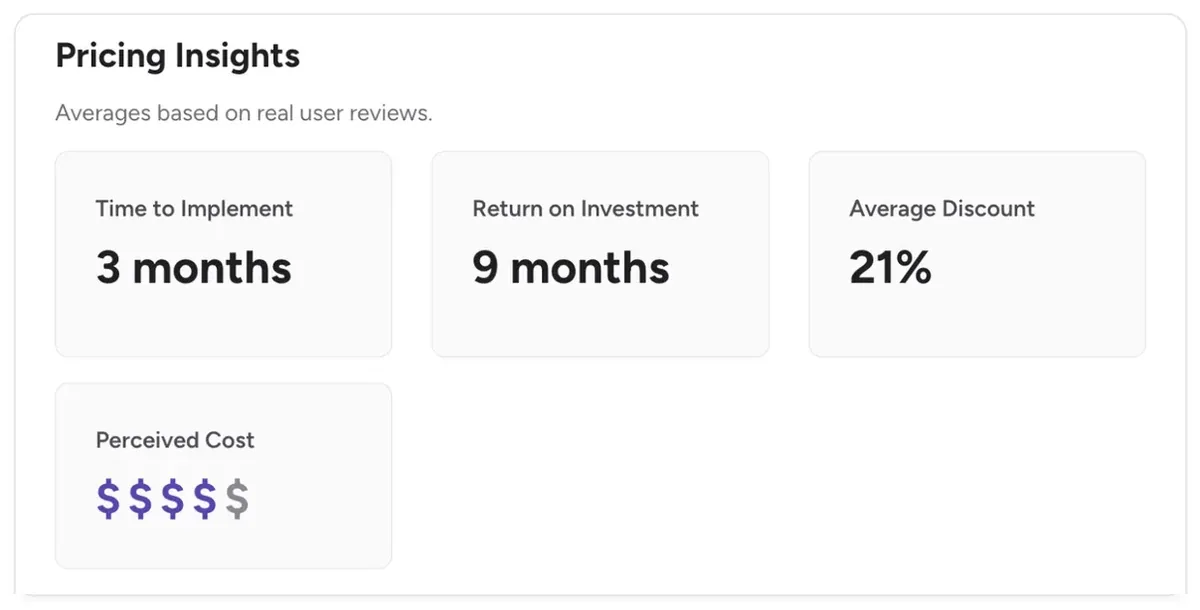
  • Setup: Zip says a standard rollout takes eight weeks or less; G2 reviewers report about 3 months on average.
  • Discounts: G2 reviewers report a 21% average discount and Vendr buyers save about 19%, mostly through multi-year terms.

How much does Zip cost?

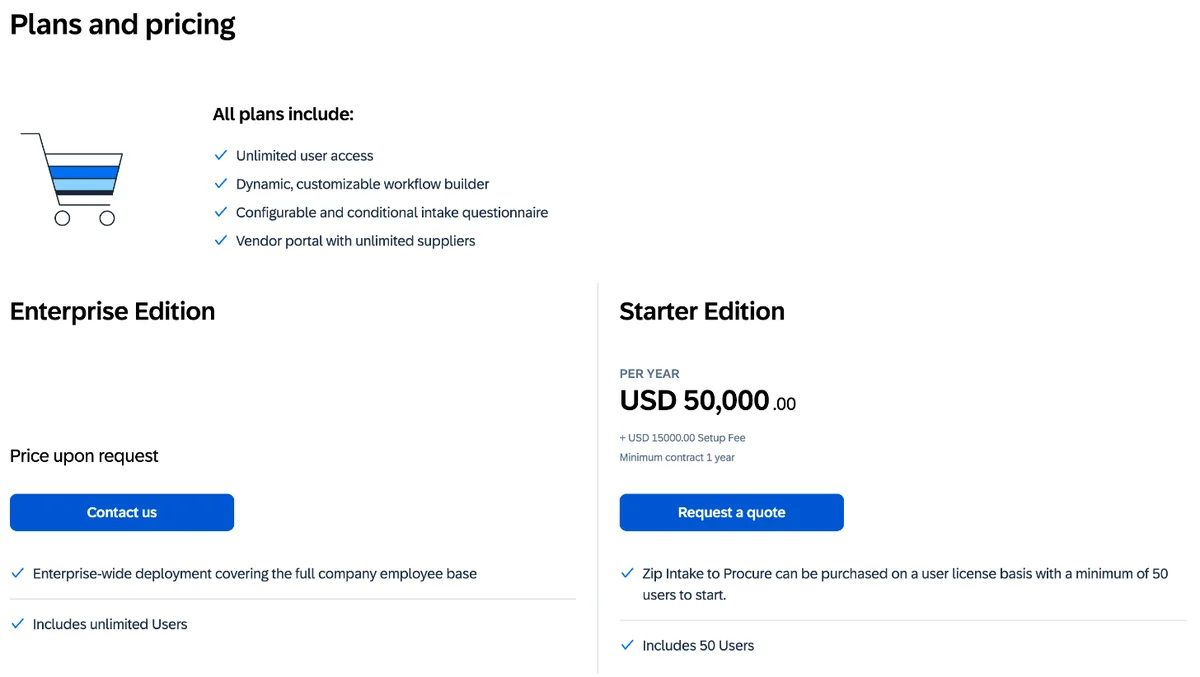
Zip costs $50,000 a year on Starter, licensed per user with a 50-user minimum, and quoted contracts run a median of $88,856 a year, per Vendr. Enterprise is quoted for the whole company with unlimited users; the SAP Store and AWS listings are the only public prices for this intake-to-pay procurement software platform.

Zip plans on the SAP Store: Enterprise Edition price on request with unlimited users, Starter Edition USD 50,000 a year plus USD 15,000 setup fee, 50 users
Zip's plans and prices on its SAP Store listing. Source: Zip on the SAP Store
OptionPriceUsersTerms
Starter Edition (SAP Store)$50,000/year + $15,000 setup50 usersMinimum 1-year contract
Pilot (AWS Marketplace)$75,000 for 12 months100 active users, 1 workflowPrepaid, no refund
Enterprise EditionPrice on requestUnlimited usersFull employee base
What buyers pay (Vendr)Median $88,856/yearVaries78 purchases

What every Zip plan includes

Every Zip plan includes unlimited users to submit and approve requests, a no-code approval workflow builder, a conditional intake form and a vendor portal.

  • Unlimited user access to submit and approve requests
  • A no-code workflow builder for approvals
  • A conditional intake questionnaire, configured per request type
  • A vendor portal with unlimited suppliers

What will Zip cost for your business?

Zip costs a 50-200 employee business with 10 to 50 procurement users $65,000 in year one on Starter: $50,000 a year for 50 users plus a $15,000 setup fee. A 20-user team still pays for 50 seats. Add-on modules are quoted on top; Vendr's lowest reported Zip deal is $27,776 a year.

Three example companies

Monthly costStarter, 50 usersPilot, 100 usersEnterprise
Zip subscription$4,167$6,250$7,405–$18,351
Billed per year$50,000$75,000$88,856–$220,210
Setup, one-time$15,000 on Starter; else quoted$15,000 on Starter; else quoted$15,000 on Starter; else quoted
  • Starter, 50 users: A mid-size company on Zip's Starter Edition with 50 licensed users, intake-to-procure only
  • Pilot, 100 users: A company running Zip's 12-month AWS pilot for 100 active users and one workflow
  • Enterprise: A larger company on Enterprise Edition with added modules, priced from Vendr's median to high

Quoted deals use Vendr's reported range, which already includes any modules bought. Starter and pilot exclude add-on modules.

Estimate your own Zip cost

What Zip charges on top of the subscription

Zip charges a $15,000 setup fee on Starter, its only published extra, and Vendr lists other quoted costs that raise the bill. These are one-time implementation, integrations, data migration, training, premium support, add-on modules and annual price increases of 3% to 7%, so ask for each as a named line.

Costs to plan for

Plan for the $15,000 Starter setup fee plus quoted implementation, add-on modules, integrations and premium support, none of which Zip prices publicly.

CostWhat it coversPublished price
Setup feeConfiguration on Starter Edition$15,000 one-time
ImplementationSetup, configuration, training, data migrationQuoted
Add-on modulesContracts, vendor management, risk, analyticsQuoted per module
IntegrationsComplex or custom ERP and legacy systemsQuoted or bundled
Premium supportHigher support tiers or success managerQuoted
OverageUsers or volume above the contractPer contract
Annual increaseRenewal escalatorTypically 3% to 7%

Payments and cards

Zip routes purchases to Zip Vendor Cards and earns rebates, according to its ROI calculator, but it publishes no card or payment fee schedule. Ask what payment processing costs if Zip will pay suppliers.

How much does Zip ERP integration cost?

Zip publishes no ERP integration price: Vendr reports integrations are priced as add-ons, bundled into enterprise packages, or included after negotiation. Zip connects to ERPs such as NetSuite, SAP and Oracle, accounting tools such as QuickBooks and Xero, and Slack or Microsoft Teams, so ask which ones your quote covers.

Your systemHow Zip connectsEffect on cost
SAP S/4HANA, SAP ECC, SAP AribaBi-directional integration (SAP Store listing)Ask; often in enterprise packages
NetSuite, OracleERP integrationAdd-on or bundled (Vendr)
QuickBooks, XeroAccounting integrationAdd-on or bundled (Vendr)
Slack, Microsoft TeamsCollaboration integrationAsk
Legacy or custom ERPProfessional servicesQuoted separately (Vendr)

What to confirm about your ERP

Confirm your ERP connector is on the order form with its price, whether syncing vendors, POs and GL codes needs services, and who maintains it after go-live.

  • Your ERP connector is named on the order form with its price, or marked included
  • Whether syncing vendors, POs and GL codes needs professional services
  • Who maintains the integration after go-live
  • Whether a second ERP or entity changes the platform fee
  • How your chart of accounts maps to Zip's GL fields; one G2 reviewer traced setup problems to their own ERP

Zip implementation cost and setup time

Zip charges a $15,000 setup fee on Starter and says implementation takes eight weeks or less, while G2 reviewers report about 3 months; Enterprise and pilot implementation are quoted. Advanced configurations and messy ERP data add work and cost, so ask for a fixed timeline and fee.

PhaseTimeCost
Pilot (optional)12 months, 100 users, 1 workflow$75,000 prepaid (AWS)
Standard implementationEight weeks or less, per Zip$15,000 on Starter; quoted otherwise
Year one on Starter–$50,000 subscription + $15,000 setup = $65,000
Average go-live reportedAbout 3 months (G2)Part of the implementation quote
Return on investmentAbout 9 months (G2)–
Zip Intake-to-Procure on AWS Marketplace: 12-month pilot for 100 active users and 1 workflow at $75,000, prepaid with no refund
Zip's 12-month pilot price on AWS Marketplace. Source: Zip on AWS Marketplace
  • Ask for a fixed implementation fee with a cap on professional services hours
  • Settle request types and approval routes internally before kickoff, so configuration time goes on building, not discovery
  • Price training and data migration in the same quote
  • Agree who owns workflow changes after launch

Modules, users and contract terms

Zip prices each add-on module separately, licenses Starter per user with a 50-user minimum on a 1-year term, and prepays the AWS pilot with no refund. Modules include Intake-to-Procure, Procure-to-Pay, Contract Orchestration, Sourcing, Risk Orchestration and Supplier Onboarding, so price year-two modules now.

ModuleWhat it addsHow it is priced
Intake-to-ProcureRequests, approvals, POs, basic vendor managementCore platform
Procure-to-PayPO and invoice managementModule, quoted
Contract Orchestration (CLM)Contract authoring, clauses, renewalsAdd-on, flat or per contract
Risk Orchestration, Supplier OnboardingVendor risk, compliance, supplier portalAdd-on, per vendor or user
SourcingRFx managementModule, quoted

Renewal terms to check before you sign

Zip renewals typically carry 3% to 7% annual escalators, so ask for a cap of 3% to 5% and start renewal talks 90 to 120 days early.

  • Annual escalators typically run 3% to 7%; Vendr suggests asking for a cap of 3% to 5%
  • Ask for a 10% to 20% overage allowance on users or volume, with annual true-ups
  • Get flexibility to add users or modules mid-term without penalty
  • Start renewal talks 90 to 120 days ahead; Zip's fiscal year ends in December

Companies pay a median of $88,856 a year for Zip, with deals from $27,776 to $220,210 across 78 Vendr purchases and average savings of about 19%. That sits close to Coupa's $94,519 median and far above Procurify's median, and it comes before Zip's setup fee and any add-on modules.

$88,856median a year
$27,776$220,210
G2 pricing insights for Zip: 3 months to implement, 9 months return on investment, 21% average discount
G2 reviewer averages for Zip. Source: G2 Zip pricing

What buyers and G2 reviewers report

Vendr buyers report a median of $88,856 a year, and G2 reviewers report about 3 months to implement and a 21% average discount.

SourceWhat it reports
VendrMedian $88,856/year; $27,776 to $220,210; 19% average savings
G2 pricing insights3 months to implement, 21% average discount, ROI in 9 months
G2 reviewersPricing can feel high for smaller teams; worth it for mid-size and large companies
Reddit r/procurement (anecdotal)One buyer heard 100k to 200k USD a year

Is Zip worth the price?

Zip is worth its price for mid-size and large companies that route many purchases through legal, security, IT and finance reviews. For smaller teams, Starter's 50-user minimum means a 20-user team pays for 50 seats, which is when Zip alternatives with flat plans are worth comparing.

Worth it if

  • Purchases need multi-team reviews from legal, security and IT
  • You run SAP, NetSuite or Oracle and want deep intake on top
  • You have 500 or more employees and many requesters
  • You plan to add contracts, risk and supplier onboarding

Look elsewhere if

  • Your budget for procurement software is under $50,000 a year
  • You need simple requests, approvals and POs only
  • You cannot prepay a year up front
  • You want a published price without a sales cycle

Zip cites a Forrester study it commissioned: 386% ROI, 3.3% cost savings on governed spend and a 70% cut in cycle time. G2 reviewers report payback in about 9 months. Test those claims against your own request volume and spend.

How to get a better Zip price

Ask for module-by-module pricing, a fixed implementation fee and a written list of included integrations. Then use Zip's December fiscal year-end, a two- or three-year term and a competing quote from another intake-to-pay suite to push toward the 19% to 21% discounts buyers report.

Get in writing

  • Price per module and per user
  • Which roles need a paid seat
  • Fixed implementation fee
  • Integrations included
  • Renewal cap
  • Overage allowance and true-up

Ways to pay less

  • Start with Intake-to-Procure only
  • Sign near a quarter-end or December
  • Bring a Coupa or Procurify quote
  • Trade a multi-year term for a lower rate
  • Negotiate training into the deal

Zip pricing vs alternatives

Zip's Starter Edition lists at $50,000 a year and Vendr's median Zip deal is $88,856. Coupa's Vendr median is $94,519, and Ramp is free or $15 per user a month on Plus plus a platform fee. Zapro pricing is Spark at $699 a month, Growth at $1,999 a month and Scale on custom pricing, all with unlimited users, and your ERP or bank pays suppliers.

ToolPricing modelPrice (basis)Users priced
ZipQuote: platform + seats + modulesVendr median $88,856/yr; Starter list $50,000/yrStarter 50 users
CoupaQuote by moduleVendr median $94,519/yrActive users
ProcurifyQuote: products + Pro usersVendr median $15,000/yrPro users; Basic free
RampFree, then per user + platform feeList: $0; Plus $15/user a month + platform feeOn Plus
ZaproFlat plans, unlimited usersList: Spark $699 / Growth $1,999 a month; Scale customNo per-user fee

Zip pricing FAQs

What does Zip HQ do?

Zip is an intake-to-pay procurement platform. Employees request purchases through one intake form, Zip routes them through legal, security, IT and finance approvals, creates POs and can manage invoices, contracts, vendor risk and supplier onboarding.

How much does Zip cost per year?

Zip's Starter Edition costs $50,000 a year for 50 users plus a $15,000 setup fee, according to its SAP Store listing. Larger deals are quoted; Vendr's data from 78 purchases puts the median at $88,856 a year.

Is Zip an AI platform for enterprise procurement?

Yes. Zip markets itself as an AI procurement orchestration platform with AI agents across intake, contracts and invoices. Its pricing reflects that enterprise focus: Starter begins at $50,000 a year, and most contracts are quoted.

Does Zip offer a free trial?

Zip does not list a free trial. Its AWS Marketplace listing offers a paid 12-month pilot for 100 active users and one workflow at $75,000, prepaid with no refund, and the SAP Store lists Starter Edition with a 1-year minimum.

Who are ZipHQ's main competitors?

Zip's main competitors are Coupa, SAP Ariba, Procurify, Ramp and Ivalua. Coupa and SAP Ariba are quoted enterprise suites like Zip's Enterprise Edition, Procurify quotes mid-market deals with a free Basic tier, and Ramp pairs free cards and expenses with a paid Plus plan.

How long does Zip take to implement?

Zip says a standard implementation takes eight weeks or less. G2 reviewers report about 3 months on average, and advanced configurations or messy ERP data can stretch that, so ask for a fixed timeline in the order form.

Sources: Zip on the SAP Store; Zip on AWS Marketplace; Zip; Vendr; G2 Zip pricing. Prices come from Zip's own pages where published and from the third-party sources listed, labelled as such. Estimates are not quotes.
Read More

Vroozi Pricing 2027: Plans, Quote Drivers and What to Ask

Vroozi Pricing 2027: Plans, Quote Drivers and What to Ask

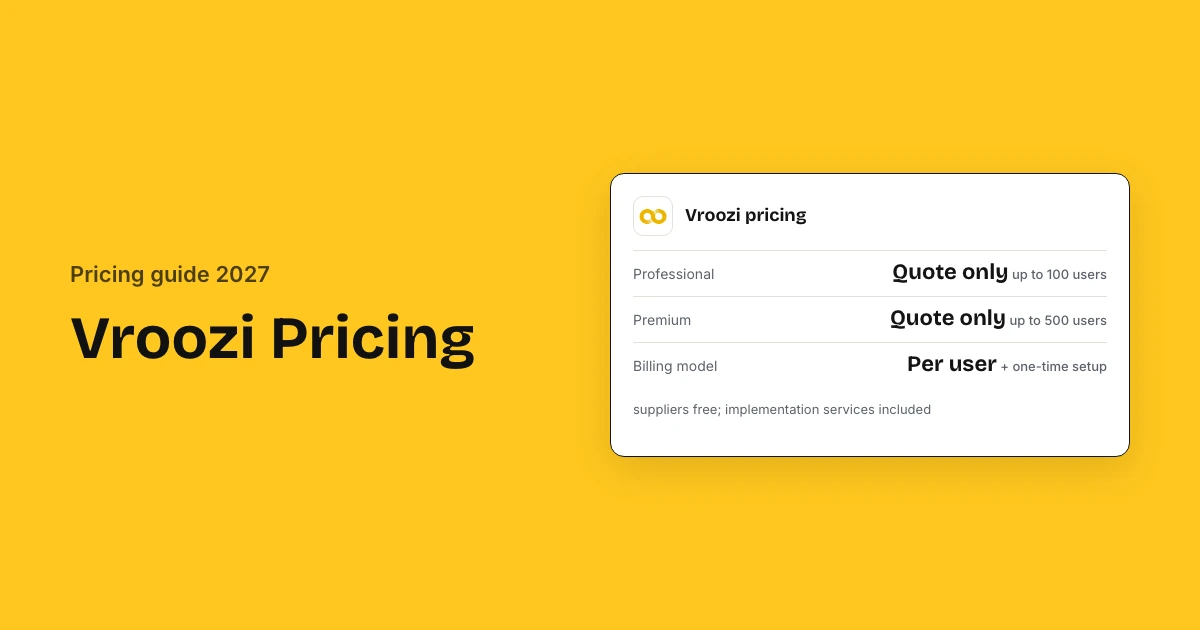
Vroozi publishes no prices. Its three plans, Professional, Premium and Enterprise, are sized by users, invoices a month and data integrations, and each says Request pricing. On G2, Vroozi describes its model as a monthly per-user subscription plus a one-time setup fee, with unlimited suppliers at no cost.

Vroozi pricing: key takeaways

  • Quote only: Vroozi lists Professional, Premium and Enterprise plans, all marked Request pricing, with no dollar amounts.
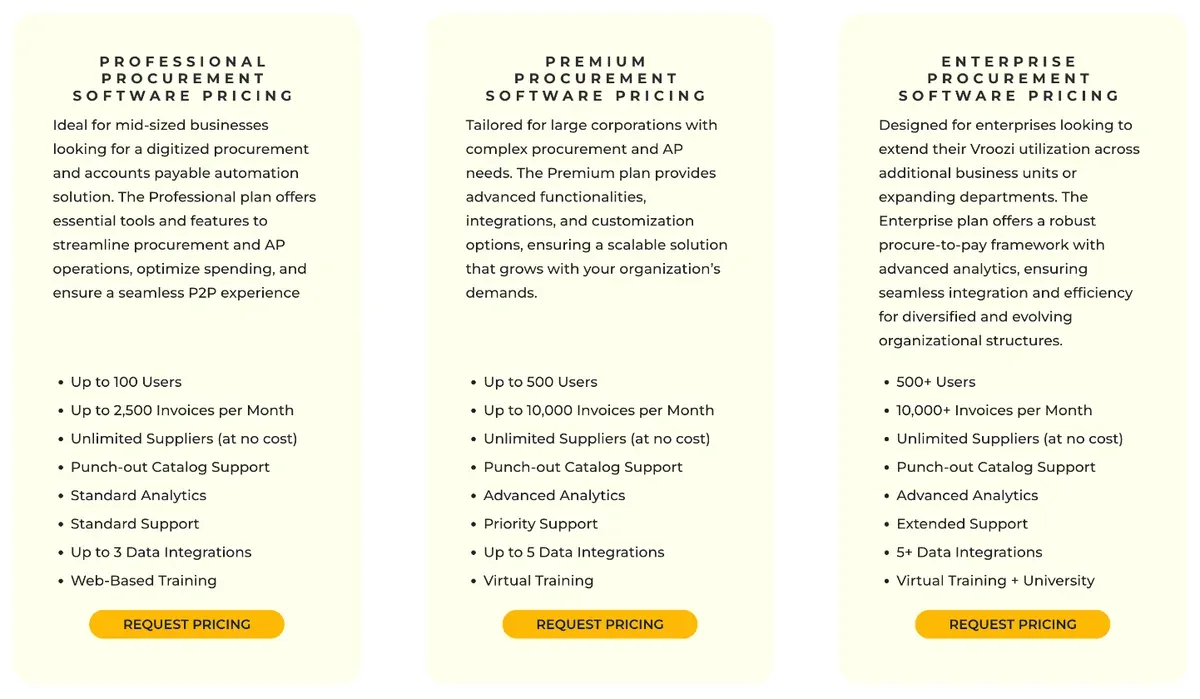
  • Plan limits: Professional covers up to 100 users and 2,500 invoices a month; Premium up to 500 users and 10,000 invoices.
  • Billing model: Vroozi tells G2 it bills a monthly subscription per user and charges a separate setup fee once, at the start.
  • Included: Every P2P suite includes implementation services, a customer success manager and unlimited suppliers at no cost.
  • Integrations: Professional allows up to 3 data integrations, Premium up to 5 and Enterprise 5 or more.
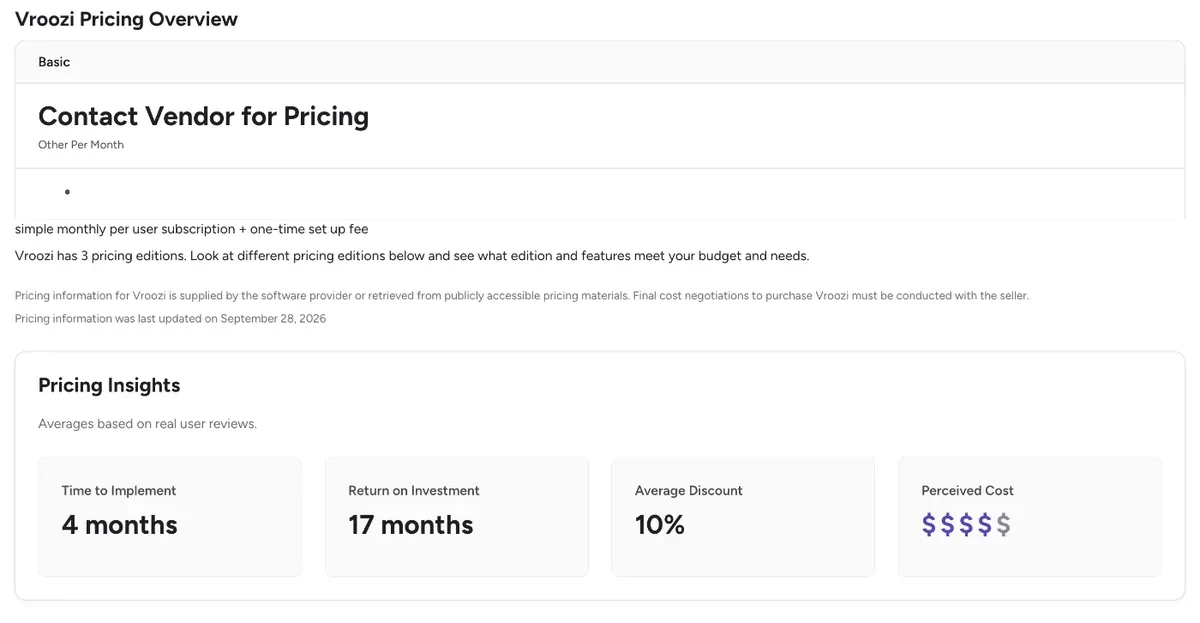
  • Reviews: G2 reviewers report about four months to implement, a 10% average discount and ROI in 17 months.

How much does Vroozi cost?

Vroozi publishes no price: its Professional, Premium and Enterprise plans are quoted, billed per user each month with a one-time setup charge. Its pricing page sizes the plans of this procure-to-pay procurement software platform by users, invoices a month and data integrations, with no amounts shown.

Vroozi pricing page: Professional up to 100 users and 2,500 invoices, Premium up to 500 users and 10,000 invoices, Enterprise 500+ users, all Request Pricing
Vroozi's three plans, sized by users and invoices. Source: Vroozi pricing page
PlanUsersInvoices a monthIntegrationsSupport and training
ProfessionalUp to 100Up to 2,500Up to 3Standard support, web-based training
PremiumUp to 500Up to 10,000Up to 5Priority support, virtual training
Enterprise500+10,000+5+Extended support, virtual training and university

What every plan includes

Every Vroozi plan includes unlimited suppliers, punch-out catalogs, purchase requests and POs, invoice processing, integrations, approval workflows and implementation services.

  • Unlimited suppliers at no cost and punch-out catalog support
  • Digital marketplace, purchase requests and purchase orders
  • Supplier setup and vendor portal, intelligent invoice processing
  • Integration with existing systems and an approval workflow engine
  • Implementation services, real-time support and a customer success manager

Vroozi serves industries including aerospace and defense, manufacturing, government contractors, retail, healthcare and education, and sells by use case: full procure-to-pay, AP invoice automation, eProcurement, marketplace and digital payments.

What will Vroozi cost for your business?

Vroozi publishes no price, so a 10-to-50-user team on its Professional plan gets a quoted per-user fee a month plus a one-time setup fee. Professional covers up to 100 users, 2,500 invoices a month and 3 data integrations. No buyer benchmark has enough deals to trust, so budget from a written quote.

What drives your quote

Your Vroozi quote rises with users, invoices a month and data integrations, which set your plan, plus the one-time setup fee and the support level you choose.

DriverWhat raises itWhat to ask
UsersPassing 100 users moves you to Premium; 500 to EnterprisePrice per user and per plan
Invoices a monthMore than 2,500 or 10,000 invoicesOverage terms if volume grows
Data integrationsMore than 3 on Professional or 5 on PremiumWhich ERP connectors count as one
SetupA one-time setup feeThe fee in dollars and what it covers
Support and trainingPriority or extended supportWhat each support level adds

Ask Vroozi for these in writing

Get the monthly per-user price, the one-time setup fee, invoice and integration limits with overage pricing, and renewal terms in writing.

  • The monthly per-user price for your plan
  • The one-time setup fee
  • Invoice and integration limits, and overage pricing
  • What happens to price when you pass a plan limit
  • Renewal increases and contract length

Published prices of the alternatives

Precoro publishes $499 to $999 a month and ProcureDesk $830 to $1,250 a month, while Procurify and Coupa are quoted, with Vendr medians of $15,000 and $94,519 a year.

ToolPublished price
Precoro$499 to $999 a month, billed annually
ProcureDesk$830 to $1,250 a month, billed annually
ProcurifyQuoted; median $15,000 a year (Vendr)
CoupaQuoted; median $94,519 a year (Vendr)

What Vroozi charges on top of the subscription

Vroozi's only stated extra is a one-time setup fee, with no published price, on top of the per-user subscription, according to its G2 listing. Suppliers join at no cost, and implementation services are included in every P2P suite. Plan limits on users, invoices and integrations are where extra cost appears.

G2 Vroozi pricing: Basic contact vendor for pricing, simple monthly per user subscription plus one-time set up fee, 4 months to implement, 17 months ROI, 10% average discount
Vroozi's pricing model and user-reported insights on G2. Source: G2 Vroozi pricing
Possible extraWhat is public
Setup feeOne-time, amount not published
More usersNext plan at 100 and 500 users
More invoicesNext plan above 2,500 and 10,000 a month
More integrationsProfessional 3, Premium 5, Enterprise 5+
Supplier feesNone: unlimited suppliers at no cost

Vroozi's ROI calculator models savings on spend routed through its marketplace at 5%, 10% or 30%, and invites you to a discovery call to review Vroozi pricing estimates. Use that call to get the subscription and setup fee as dollar figures.

How much does Vroozi ERP integration cost?

Vroozi includes ERP integration in every P2P suite and publishes no separate integration price. Data integrations are counted by plan: up to 3 on Professional, 5 on Premium and 5 or more on Enterprise. Vroozi has solution pages for SAP, Oracle, Deltek Costpoint, NetSuite, IBM and Microsoft Dynamics.

ERPVroozi pageEffect on cost
SAP, OracleEnterprise integration pagesCounts toward plan integrations
NetSuiteSuiteApp listing and solution pageCounts toward plan integrations
Deltek CostpointGovernment contractor pageCounts toward plan integrations
Microsoft Dynamics, IBMSolution pagesCounts toward plan integrations

Vroozi is also listed as a SuiteApp for NetSuite, where it connects buyers to suppliers' negotiated pricing and catalog content. For Deltek Costpoint users, Vroozi has a dedicated page for bringing purchasing and spend into Costpoint.

What to confirm about your ERP

Confirm how Vroozi counts a data integration, whether your ERP connection sits in the setup fee, which objects sync and what an extra integration costs.

  • How Vroozi counts a data integration: per system or per data flow
  • Whether your ERP connection is in the one-time setup fee
  • Which objects sync: vendors, POs, receipts, invoices, payments
  • What a fourth or sixth integration costs on your plan
  • Who maintains the connector after go-live

Vroozi implementation cost and setup time

Vroozi cites an average 3.5 months to go live, with implementation services included in every P2P suite and a one-time setup fee it does not publish. G2 reviewers now average four months, and one reviewer was placing orders within a week. Ask for the setup fee in dollars and what it covers before you sign.

Vroozi pricing page section listing what is included in all P2P suites, including implementation services, customer success manager and integration with existing systems
Implementation services are listed in every Vroozi suite. Source: Vroozi pricing page
PhaseTimeCost
Quote and setup scopingBefore startOne-time setup fee
Implementation and integration3.5 months (Vroozi) to 4 months (G2)Implementation services included
TrainingWeb-based or virtual by planIncluded by plan
Return on investment10 months (Vroozi) to 17 months (G2)Not applicable

Vroozi says its 3.5-month average go-live is 15% faster than the average P2P rollout, citing G2. G2's current reviewer average is 4 months, so plan your go-live date and internal staffing on the longer figure.

Plan limits, support and contract terms

Vroozi's plans differ by limits and support rather than by core features: Professional has standard support and web training, Premium priority support and virtual training, Enterprise extended support and a training university. Because limits set the plan, growth in users or invoices is what changes your price.

PlanAnalyticsSupportTraining
ProfessionalStandardStandardWeb-based
PremiumAdvancedPriorityVirtual
EnterpriseAdvancedExtendedVirtual + university

The Enterprise plan is aimed at companies extending Vroozi across more business units or departments, so ask whether adding a unit later is priced as new users only or also brings a new setup fee and integration work.

Renewal terms to check before you sign

Vroozi publishes no contract terms, so get a per-user price cap, the contract length and notice period, and how passing a plan limit is billed in writing.

  • A cap on the per-user price at renewal
  • Whether passing a plan limit mid-term triggers an immediate upgrade
  • Whether the setup fee repeats when you add business units
  • Contract length and notice period
  • Whether support level can change without changing plan

Vroozi has no public buyer-price data: Vendr has no Vroozi page, G2 lists no price, and no buyer benchmark has enough deals to trust. G2 reviewers report a 10% average discount and rate Vroozi 4.3 out of 5 across 71 reviews, so a written quote is the only number to budget from.

SourceWhat it reports
Vroozi pricing pageThree plans, Request pricing; implementation services included
G2 pricingPer-user monthly subscription + one-time setup fee; 10% average discount
G2 reviews (71, 4.3/5)Setup straightforward; some placing orders within a week

Ask Vroozi for a written quote that separates the per-user subscription, the setup fee and any integration or support charges, so you can compare it line by line with tools that publish prices.

  • Vroozi's own page says users report ROI within the first 10 months, against a 19-month competitor average
  • G2's current averages are 17 months to ROI and 4 months to implement
  • Perceived cost on G2 is four out of five

Is Vroozi worth the price?

Vroozi is worth it for mid-size and larger companies that want catalog buying, POs and invoice processing with SAP, Oracle, Deltek or NetSuite, and like having implementation included. With no published price and per-user billing, Vroozi alternatives are easier to budget for smaller teams.

Worth it if

  • You buy heavily from catalogs and punch-out suppliers
  • You run SAP, Oracle, Deltek Costpoint or NetSuite
  • You want implementation and a success manager included
  • Your user count fits within 100 or 500

Look elsewhere if

  • You need a published price before a sales call
  • Many occasional requesters would each be a paid user
  • You connect more systems than your plan allows
  • You want to go live in days, not months

How to get a better Vroozi price

Get the per-user price, setup fee and plan limits in writing, and ask how passing a limit is billed. G2 reviewers report a 10% average discount, so push back on the first quote, bring published list prices from tools that publish them, and negotiate the setup fee given that implementation services are listed as included.

Get in writing

  • Per-user monthly price
  • One-time setup fee
  • User, invoice and integration limits
  • Overage and upgrade terms
  • Support level
  • Renewal cap

Ways to pay less

  • Count only active buyers as users
  • Stay within your plan's integrations
  • Ask to waive or cut the setup fee
  • Bring published competitor prices
  • Ask for the 10% average discount

Vroozi pricing vs alternatives

Vroozi publishes no price, while Precoro publishes $499 to $999 a month, ProcureDesk $830 to $1,250 a month and Procurify is quoted with a $15,000 median. Vroozi bills per user with a setup fee. Zapro pricing is Spark at $699 a month, Growth at $1,999 a month and Scale on custom pricing, all with unlimited users; your ERP or bank pays suppliers.

ToolPricing modelTypical costUsers priced
VrooziQuote, per user, one-time feeNot publishedPer user
PrecoroPublished plans by user tier$499–$999/monthTier; Standard users free
ProcureDeskPublished plans + extra users$830–$1,250/month10 or 20 included
ProcurifyQuote, Pro usersMedian $15,000/yrPro users; Basic free
ZaproFlat plans, unlimited usersSpark $699 / Growth $1,999 a month; Scale customNo per-user fee

Vroozi pricing FAQs

How much does Vroozi cost?

Vroozi does not publish prices; all three plans say Request pricing. It bills a monthly subscription per user and a setup fee once, and the plan depends on users, invoices a month and data integrations.

What does Vroozi do?

Vroozi is procure-to-pay software. It covers a digital marketplace with punch-out catalogs, purchase requests and purchase orders, a supplier portal, invoice processing, approvals and spend analytics, with connectors for SAP, Oracle, NetSuite and other ERPs.

Does Vroozi charge suppliers?

No. Every Vroozi plan includes unlimited suppliers at no cost, and supplier setup and the vendor portal are listed as included in all P2P suites. The buying company pays the per-user subscription and setup fee.

How long does Vroozi take to implement?

About three to four months. Vroozi cites an average 3.5 months to go live, G2 reviewers average four months, and implementation services are included in every suite. Smaller teams report placing orders within a week of setup.

Is Vroozi a good fit for small businesses?

Not for the smallest teams. Vroozi's entry plan, Professional, is aimed at mid-sized businesses with up to 100 users and 2,500 invoices a month. Smaller teams that want a published price may find tools with list prices easier to budget.

Does Vroozi offer a free trial?

No. Vroozi does not list a free trial on its pricing page; each plan has a Request pricing button and Vroozi offers a product tour and demo instead. Ask whether a pilot is possible, and whether the one-time setup fee applies to it.

Sources: Vroozi pricing page; G2 Vroozi pricing. Prices come from Vroozi's own pages where published and from the third-party sources listed, labelled as such. Estimates are not quotes.
Read More

Vertice Pricing 2027: Spend Bands, Renewals and Real Cost

Vertice Pricing 2027: Spend Bands, Renewals and Real Cost

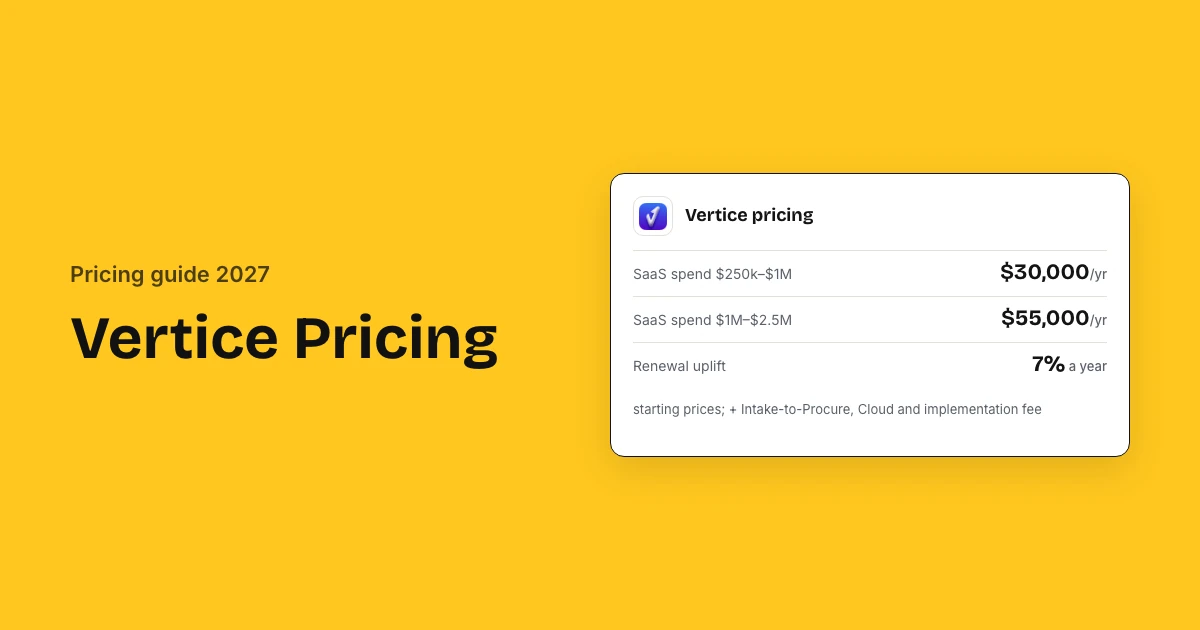
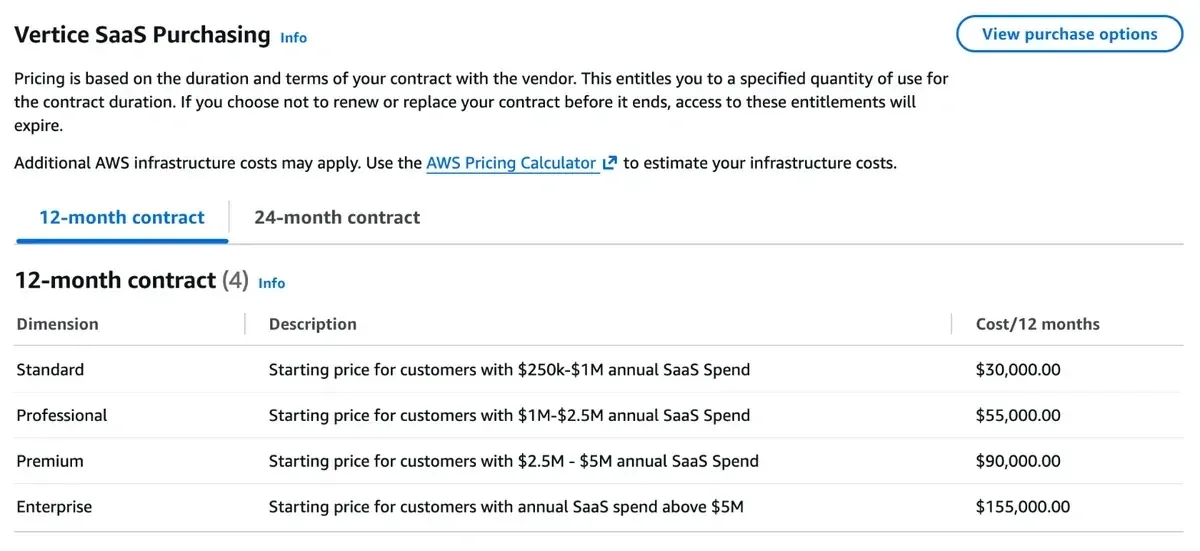
Vertice costs $30,000 a year for $250k to $1M of SaaS spend, $55,000 for $1M to $2.5M, $90,000 for $2.5M to $5M and $155,000 above that, on AWS Marketplace. Vertice prices by annual SaaS spend, not seats. Extra products are priced on top, and the contract raises fees 7% at each renewal.

Vertice pricing: key takeaways

  • Pricing basis: Vertice charges a fixed annual fee set by your annual SaaS spend, not by users or seats.
  • Spend bands: Starting prices run $30,000, $55,000, $90,000 and $155,000 a year as SaaS spend grows past $1M, $2.5M and $5M.
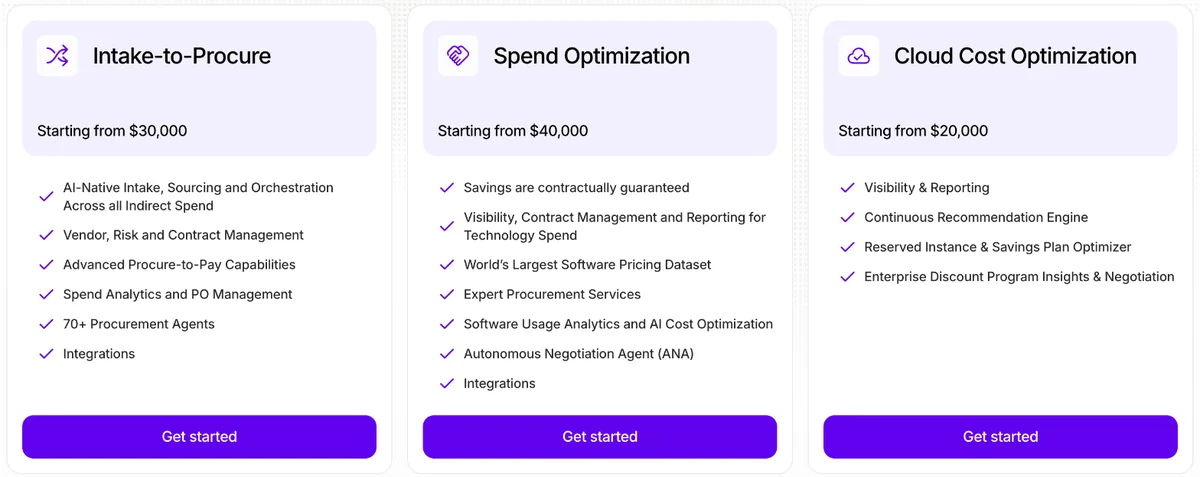
  • Products: Vertice's site lists Spend Optimization from $40,000, Intake-to-Procure from $30,000 and Cloud Cost Optimization from $20,000.
  • Renewal: Vertice's contract auto-renews with a 7% fee increase unless you give written notice 30 days before the term ends.
  • Guarantee: Savings are contractually guaranteed, but reimbursement is your only remedy and you cannot terminate if savings fall short.
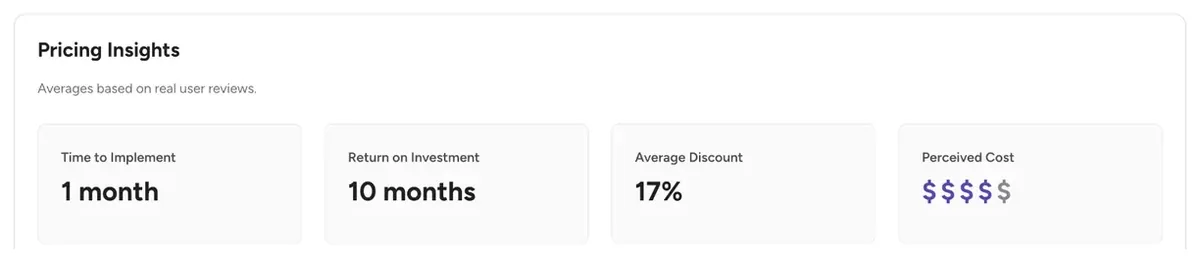
  • Reviews: G2 reviewers report about one month to implement, ROI in 10 months and a 17% average discount.

How much does Vertice cost?

Vertice costs $30,000 to $155,000 a year on AWS Marketplace, set by your annual SaaS spend band, and its site lists Spend Optimization from $40,000 a year. Intake-to-Procure matches the entry band and Cloud Cost Optimization starts from $20,000; this SaaS buying and spend analytics platform publishes starting prices only.

Vertice pricing page: Intake-to-Procure starting from $30,000, Spend Optimization starting from $40,000, Cloud Cost Optimization starting from $20,000
Vertice's three products and starting prices. Source: Vertice pricing page
ProductStarting price per yearWhat it covers
Spend Optimization (SaaS Purchasing)From $40,000 on vertice.one; from $30,000 on AWSGuaranteed savings, expert negotiation, pricing benchmarks, usage analytics, contract management
Intake-to-ProcureFrom $30,000AI intake and approvals, sourcing, vendor, risk and contract management, PO management
Cloud Cost OptimizationFrom $20,000Cloud visibility, reserved instance and savings plan optimisation, discount program negotiation

Vertice price by annual SaaS spend

Vertice's entry band covers $250k to $1M of SaaS spend, the top band costs $155,000 a year above $5M, and 24-month terms cost exactly double.

AWS Marketplace Vertice SaaS Purchasing 12-month prices: Standard $30,000, Professional $55,000, Premium $90,000, Enterprise $155,000 by annual SaaS spend
Vertice's spend bands on AWS Marketplace. Source: AWS Marketplace: Vertice SaaS Purchasing
TierAnnual SaaS spend12-month contract24-month contract
Standard$250k–$1M$30,000$60,000
Professional$1M–$2.5M$55,000$110,000
Premium$2.5M–$5M$90,000$180,000
EnterpriseAbove $5M$155,000$310,000

On AWS, each 24-month price is exactly double the 12-month price, so a two-year term buys price certainty for your band rather than a discount. The contract's 7% uplift then applies at the first renewal.

What will Vertice cost for your business?

Vertice costs a 50 to 200 employee company $30,000 to $40,000 a year at $250k to $1M of SaaS spend, plus an unpublished Implementation Fee. The low end is the AWS Marketplace band and the high end Spend Optimization's list price; each renewal adds 7%, and Vertice says it suits companies of over 500 employees.

Three example companies

Monthly cost$250k–$1M spend$1M–$2.5M + intake$1M–$2.5M, year 3
Spend Optimization$2,500–$3,333$4,583$5,247
Intake-to-Procure–$2,500–
Billed per year$30,000–$40,000$85,000$62,970
Setup, one-timeQuoted in Order FormQuoted in Order FormQuoted in Order Form
  • $250k–$1M spend: Spend Optimization only, first contract year
  • $1M–$2.5M + intake: Spend Optimization plus Intake-to-Procure, first contract year
  • $1M–$2.5M, year 3: Spend Optimization only, third year after two 7% renewals

Starting prices only. The Implementation Fee and any charge for actual SaaS spend above the contract estimate are set in your Order Form and excluded.

Estimate your own Vertice cost

What Vertice charges on top of the annual fee

Vertice charges an Implementation Fee it publishes no figure for, plus overage when your SaaS spend exceeds the contract estimate, on top of the annual fee. Both sit in its November 2025 master services agreement, overage carries into the renewal price, and late payments accrue 8% interest a year.

Charges in Vertice's Master Services Agreement

The master services agreement adds an Implementation Fee, overage when actual spend beats the estimate, taxes and 8% a year late-payment interest to the Annual Fee.

ChargeWhat the contract says
Annual FeeSet in the Order Form by your SaaS spend band
Implementation FeeA separate fee for implementation, set in the Order Form
Spend above estimateAmounts due when Actual Spend exceeds Estimated Spend, carried into renewal
TaxesVAT and other taxes added to invoices
Late payment8% a year interest after 15 days' notice
  • Invoices are due within 30 days, and disputes must be raised within 15 days
  • If fees are 30 days overdue, Vertice can suspend service and invoice the rest of the term
  • Fees are non-cancellable and non-refundable unless the contract or Order Form says otherwise

Negotiation support is part of the core offer, not a premium add-on, according to Vertice's pricing FAQ. Ask how many RFPs and negotiations a year your fee covers before extra work is charged.

How much does Vertice ERP integration cost?

Vertice does not charge separately for ERP integration: it lists all major finance ERPs inside each product rather than as priced add-ons. It also connects contract management, ticketing, messaging, risk tools and SSO. Any setup work sits in the Implementation Fee on your Order Form, so ask for it in dollars.

ConnectionWhat is publicEffect on cost
Finance ERPSupported on all major ERPsPart of the Implementation Fee scope
SSOUsed for app usage trackingIncluded in product features
Slack or TeamsRenewal alerts and approvalsIncluded
Vanta, OneTrust, Dun & BradstreetRisk data integrations, per Najar.aiConfirm in quote

What to confirm about your ERP

Confirm whether your ERP connector is live at launch or built during implementation, and whether the Implementation Fee covers it.

  • Whether your ERP connector is live at launch or built during implementation
  • Whether the Implementation Fee covers ERP, SSO and contract-system connections
  • Whether invoice and payment data sync back for Procure-to-Pay, or only spend data comes in
  • Who maintains the integration after go-live
  • Reviewers list integration gaps among Vertice's cons, so test your systems in the demo

Vertice implementation cost and setup time

Vertice implementation takes about 1 month on G2 reviewers' average, and Vertice publishes no Implementation Fee; each Order Form sets one. No source reports the amount, and reviewers rate the setup effort high, with go-live in weeks to months, so get the fee in dollars, or $0, in writing.

PhaseWhat happensTimeCost
Order FormSpend band, products, term and Implementation Fee agreedBefore startImplementation Fee, quoted
SetupPlatform configuration, integrations, contract uploadAbout 1 month (G2 average)In the Implementation Fee
First renewalsExperts negotiate renewals using benchmarksOngoingIn the Annual Fee
PaybackSavings cover the fee90 days typical (Vertice); 10 months ROI (G2)Guaranteed savings

Reviewers on G2 describe a very good onboarding experience with the Vertice team, but some say renewals can get overcomplicated and the interface can feel busy.

Savings guarantee, renewal and contract terms

Vertice guarantees a saving equal to each renewal's fee, auto-renews a fixed term with no exit for convenience, and raises the fee 7% at each renewal. If savings fall short, reimbursement under your Order Form is the only remedy, and you cannot cancel for that reason, so define how savings are measured.

Contract termWhat it means for cost
Fixed term, no exit for convenienceYou pay for the full term
Auto-renewalRenews unless you give notice 30 days before the end
7% renewal uplift$55,000 becomes $58,850 then $62,970
Minimum Guaranteed SavingEqual to the renewal term's fee
Shortfall remedyReimbursement only, no termination right

Renewal terms to check before you sign

Vertice auto-renews unless you give notice 30 days before the term ends, at 7% more each time, so diarise the date and ask to cap the uplift.

  • Diarise the 30-day non-renewal notice date before the term ends
  • Ask to cap or remove the 7% renewal increase
  • Define how savings are measured and the baseline used
  • Set the Estimated Spend realistically to avoid true-up charges
  • Ask whether a 24-month term locks the band price for both years

Companies pay Vertice their SaaS spend band's fixed price, up to $155,000 a year, less the 17% average discount G2 reviewers report from quotes. Vendr, which Vertice bought in June 2026, lists no Vertice data. Over three years at 7% uplifts, a $55,000 contract totals about $176,820, so model renewals first.

G2 Vertice pricing insights from user reviews: 1 month to implement, 10 months return on investment, 17% average discount, perceived cost four of five
What Vertice users report on G2. Source: G2 Vertice pricing
SourceWhat it reports
AWS Marketplace$30,000 to $155,000 a year by SaaS spend band
G2 pricing (280 reviews, 4.6/5)One Basic edition at a flat yearly rate; 17% average discount; ROI in 10 months
Three-year maths$55,000, $58,850 and $62,970 = $176,820

Is Vertice worth the price?

Vertice is worth its price for companies spending $1M or more a year on SaaS, where a 20% saving clears a $55,000 fee and expert negotiators save team time. Below that, the entry fee and auto-renewing contract weigh more, which is when Vertice alternatives are worth comparing.

Worth it if

  • Your SaaS spend sits in the second band or higher
  • You want experts to negotiate renewals for you
  • You value a contractual savings guarantee
  • You can manage a fixed term with auto-renewal

Look elsewhere if

  • Your SaaS spend is under $250k a year
  • You need purchasing and POs for all spend, not just software
  • You want to cancel at any time
  • You do not want a 7% increase each renewal

How to get a better Vertice price

Ask for the band price that matches your real SaaS spend, the Implementation Fee in dollars, and a cap on the 7% renewal uplift. G2 reviewers report a 17% average discount, so push back on the first quote, ask for a private offer on AWS Marketplace, and define the savings guarantee before you sign.

Get in writing

  • Your SaaS spend band and Estimated Spend
  • Implementation Fee amount
  • Renewal uplift cap
  • How savings are measured
  • Reimbursement terms
  • Which products are included

Ways to pay less

  • Start with one product
  • Use a 24-month term to lock the band
  • Request an AWS private offer
  • Ask for the 17% average discount
  • Give non-renewal notice on time

Vertice pricing vs alternatives

Vertice costs $30,000 to $155,000 a year by SaaS spend; SpendHound is free under 1,000 employees and Spendflo advertises $2,500 to $7,000 a month. Vendr's Zip median is $88,856. Zapro pricing is Spark at $699 a month, Growth at $1,999 a month and Scale custom, all with unlimited users, and your ERP or bank pays suppliers.

ToolPricing modelPrice (basis)What sets the price
VerticeFixed annual fee by SaaS spendList (AWS): $30,000–$155,000/yrSaaS spend band
ZipQuote: platform + seats + modulesVendr median $88,856/yrUsers and modules
SpendHoundFree, then flat feeList: $0; $10,000/yr at 1,000–5,000 staffEmployee count
SpendfloQuoteAdvertised: $2,500–$7,000/monthCompany needs
ZaproFlat plans, unlimited usersList: Spark $699 / Growth $1,999 a month; Scale customNo per-user fee

Vertice pricing FAQs

How much does Vertice cost?

Vertice starts at $30,000 a year for companies with $250k to $1M of annual SaaS spend, then $55,000, $90,000 and $155,000 as spend rises. Intake-to-Procure starts at $30,000 and Cloud Cost Optimization at $20,000.

What does Vertice do?

Vertice is a procurement platform focused on software spend. It tracks SaaS contracts and renewals, benchmarks prices across 32,000+ vendors and uses in-house experts to negotiate renewals, with intake, approvals and cloud cost tools sold as separate products.

Is Vertice legit?

Yes. Vertice is a procurement software company with 280 G2 reviews averaging 4.6 out of 5, a listing on AWS Marketplace and a published master services agreement. It bought Vendr in June 2026.

Does Vertice have a free trial?

No. G2 lists no free trial and no free plan for Vertice. Pricing is a fixed annual fee based on your SaaS spend, with a contractual savings guarantee instead of a trial period, and G2 reviewers report a 17% average discount from first quotes.

Can I cancel a Vertice contract early?

Not for convenience. Vertice's master services agreement allows termination only for an uncured breach, insolvency or non-payment, and unpaid fees for the rest of the term fall due on termination. Give notice 30 days before the term ends to stop auto-renewal.

Where is Vertice based?

Vertice Technology Ltd is based in Altrincham in the United Kingdom, with procurement experts across the US, EMEA and APAC. US customers sign with Vertice's US entity in Delaware, under Delaware law, according to its master services agreement.

Sources: Vertice pricing page; AWS Marketplace: Vertice SaaS Purchasing; Vertice Master Services Agreement; G2 Vertice pricing; SpendHound. Prices come from Vertice's own pages where published and from the third-party sources listed, labelled as such. Estimates are not quotes.
Read More

Unimarket Pricing 2027: Flat Annual Fee and Implementation

Unimarket Pricing 2027: Flat Annual Fee and Implementation

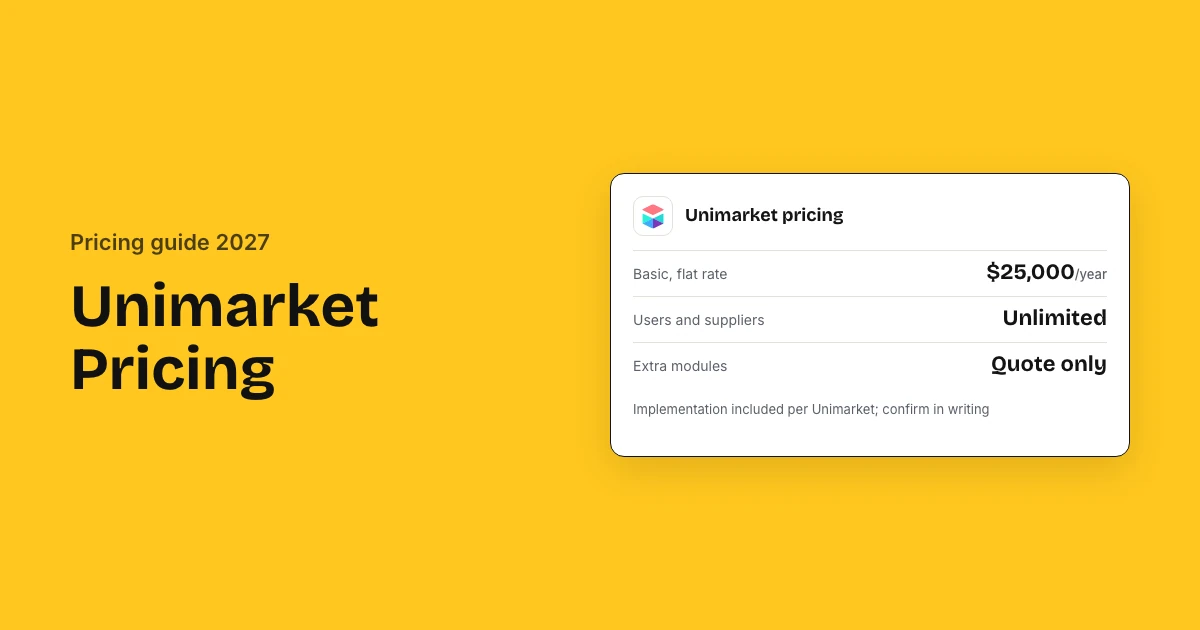
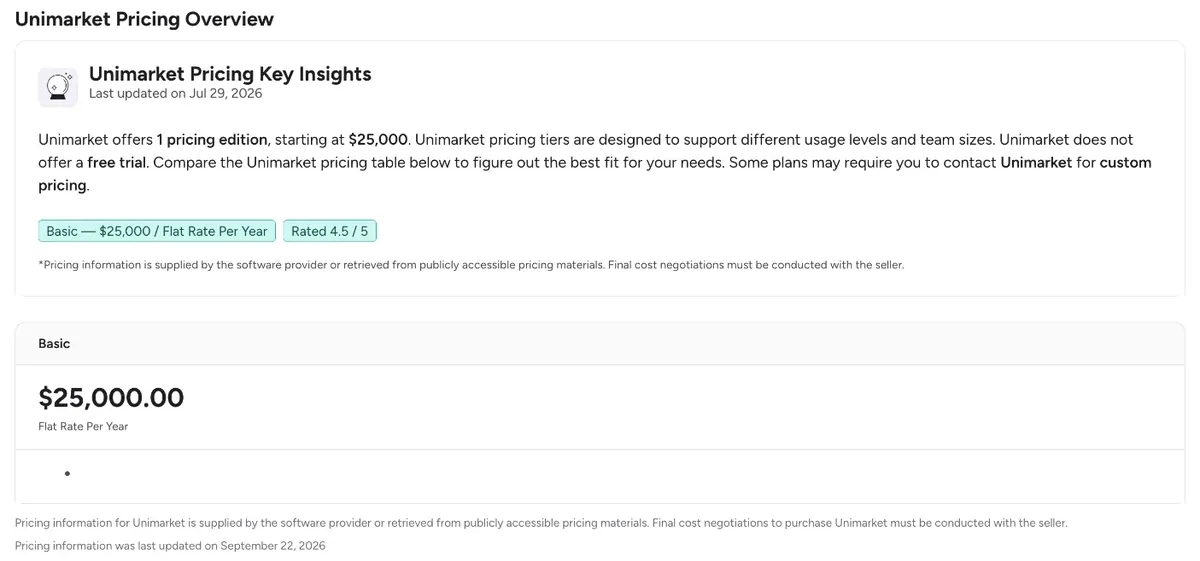
Unimarket starts at $25,000 a year as a flat-rate subscription, the price it lists on G2 and Software Advice. The fee covers unlimited users and suppliers, and Unimarket says implementation, training and support are included. Extra modules such as sourcing, invoicing or payments are licensed separately and quoted.

Unimarket pricing: key takeaways

  • Starting price: Unimarket's Basic plan is listed at $25,000 a year, flat rate, on both G2 and Software Advice.
  • Unlimited users: The fixed annual fee covers unlimited users and suppliers, so adding staff does not change the price.
  • Modules: Unimarket is modular: sourcing, contracts, invoicing, expenses and payments are licensed as needed and quoted.
  • Implementation: Unimarket says implementation, testing, training and support are included, while G2's listing mentions a one-off first-year cost.
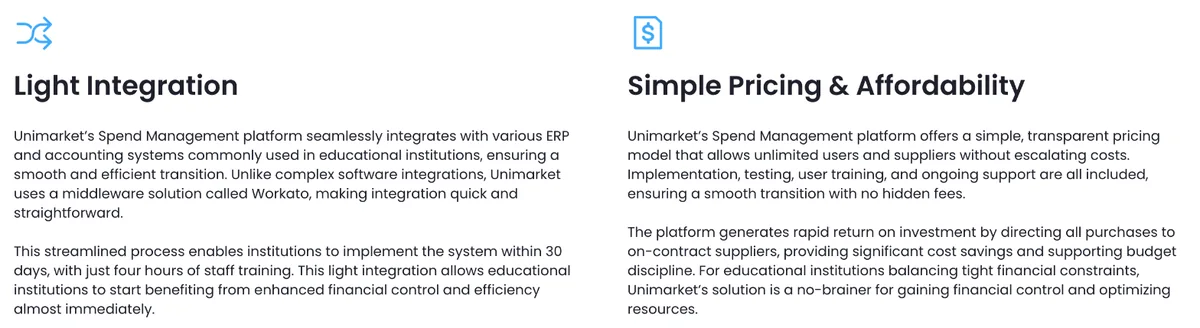
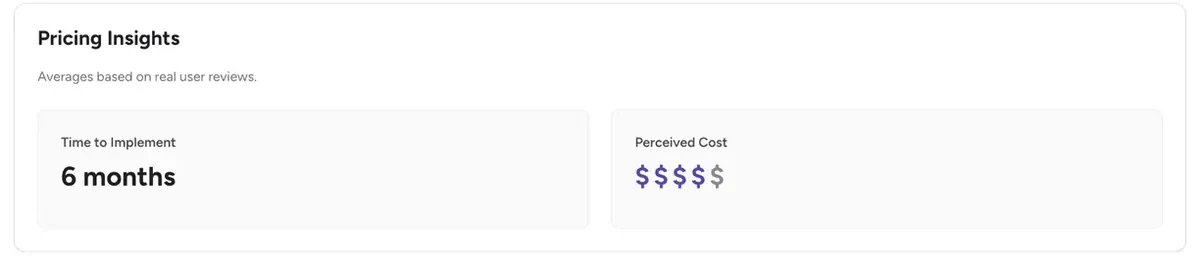
  • Setup time: Unimarket promises 30 days and four hours of staff training; G2 reviewers average about 6 months.
  • Reviews: G2 rates Unimarket 4.5 out of 5, and reviewers ask for clearer pricing, especially for smaller organisations.

How much does Unimarket cost?

Unimarket costs from $25,000 a year as one flat annual subscription, the rate listed on G2 and Software Advice for this source-to-pay procurement software platform. That price covers unlimited users and suppliers, so headcount does not move it. Additional modules are licensed only if you need them, and their prices are quoted.

G2 Unimarket pricing: one edition, Basic at $25,000 flat rate per year, rated 4.5 out of 5
Unimarket's listed starting price on G2, supplied by the vendor. Source: G2 Unimarket pricing
What you buyWhat it coversPrice
Basic subscriptionCore eProcurement: requisitions, approvals, purchase orders, catalog marketplace$25,000 a year, flat rate
Users and suppliersEvery requester, approver and supplierIncluded, unlimited
Implementation, training, supportSetup, testing, user training, ongoing supportIncluded per Unimarket
Extra modulesSourcing, contracts, invoicing, expenses, payments, supplier managementQuoted

What the flat rate means in practice

Unimarket's flat rate is about $2,083 a month, the same for a pilot or a company-wide rollout, with no per-seat fee.

  • The flat rate works out to about $2,083 a month, or $75,000 over three years before any increase
  • There is no per-seat fee, so a campus or company-wide rollout costs the same as a pilot
  • You pay more only by adding modules
  • There is no free trial

What will Unimarket cost for your business?

Unimarket costs a 50 to 200 person company $25,000 a year for core eProcurement, its listed flat rate, and the same in year one if implementation is included as Unimarket says. With 10 to 50 users that is $500 to $2,500 per user a year, and modules such as invoicing or sourcing are quoted on top.

What the flat fee costs per user

Unimarket's flat fee costs $2,500 a user a year at 10 users and falls to $250 at 100, so it pays off as user counts grow.

UsersCost per user a yearWhat it means
10$2,500Far above most per-user tools
25$1,000Still above most per-user plans
50$500Closer to per-seat pricing
100$250Similar to many per-user tools

What drives your quote

Modules, implementation scope, buying route and term length move a Unimarket quote; headcount does not.

DriverWhat raises itWhat to ask
ModulesInvoicing, sourcing, contracts, supplier management, paymentsPrice per module in writing
ImplementationA custom ERP link or several entitiesWhether setup is in the base fee
Buying routeDirect contract vs the E&I cooperative contractWhich route gives the lower price
TermMulti-year commitmentA cap on renewal increases

What Unimarket charges on top of the subscription

Unimarket charges no fee for implementation, testing, training or support, and extra only for added modules and services such as the Virtual Mailroom and supplier verification. The Virtual Mailroom is priced on invoice volume, Unimarket says its pricing has no hidden fees, and users and suppliers are unlimited.

Unimarket education page: simple pricing with unlimited users and suppliers, implementation, testing, training and support included; light integration via Workato within 30 days
Unimarket's description of its pricing model and integration. Source: Unimarket education
Cost itemHow it is priced
Users and suppliersIncluded, unlimited
Implementation, testing, training, supportIncluded, per Unimarket's education page
Sourcing, contracts, invoicing, expenses, paymentsModules, quoted
Virtual MailroomDepends on your needs, such as invoice volume
Supplier onboarding, vetting and screening servicesServices, quoted

Services Unimarket lists

Unimarket lists onboarding, supplier verification, enablement and Virtual Mailroom services alongside the platform, so ask which sit outside the flat fee.

  • Pre-implementation services
  • Supplier onboarding and vetting
  • Supplier verification and screening
  • On-contract supplier enablement for the catalog
  • Virtual Mailroom for invoice capture

Get the inclusions in writing

G2's vendor listing describes one-off implementation costs in the first year, while Unimarket's education page says implementation is included. Ask for the order form to state which applies to you.

How much does Unimarket ERP integration cost?

Unimarket publishes no separate ERP integration fee: it calls ERP links light integration that is part of implementation, so a standard link should sit inside the flat fee. It connects through Workato middleware and lists Ellucian Banner, Ellucian Colleague, Workday, Oracle, TechnologyOne and SAP; confirm custom work separately.

Your ERPHow it connectsEffect on cost
Ellucian Banner or ColleagueStandard connector via WorkatoWithin implementation
Workday, Oracle, SAP, TechnologyOneStandard connector via WorkatoWithin implementation
Custom or homegrown ERPWorkato or APIAsk for a quote

What to confirm about your ERP

Confirm your ERP connector sits in the flat fee and whether the Workato layer carries its own licence cost.

  • Whether your ERP connector is in the flat fee
  • Which records sync: suppliers, POs, receipts, invoices and GL codes
  • Whether the Workato layer has its own licence cost
  • Who supports the integration after go-live
  • How long the integration takes; Unimarket cites 30 days for education

Unimarket implementation cost and setup time

Unimarket says implementation is included in the $25,000 subscription and takes 30 days, though G2 reviewers report about 6 months. Its G2 listing mentions a one-off first-year implementation cost, so get the inclusion in writing, along with the four hours of training it quotes.

PhaseTimeWho pays
Pre-implementation services and scopingBefore go-liveIncluded per Unimarket
ERP integration via WorkatoWithin 30 days (Unimarket)Included per Unimarket
Staff trainingAbout four hoursIncluded
Go-live and supplier onboardingUp to 6 months on average (G2)Your team; services quoted
First savings3 to 4 months (Unimarket)Your team tracks them
G2 pricing insights for Unimarket: time to implement 6 months
G2 reviewer average: about 6 months to implement Unimarket. Source: G2 Unimarket pricing

Keep the rollout short

Keep the rollout near Unimarket's 30-day plan by starting with requisitions and the catalog, then adding invoicing.

  • Start with requisitions and the catalog marketplace, add invoicing later
  • Load preferred suppliers and contract pricing before go-live
  • Ask how supplier onboarding is handled and whether it is in the flat fee

Modules, contract terms and renewal

Unimarket sells a fixed annual fee and licenses modules as you need them. Education buyers can use the E&I Cooperative contract, which runs from November 2025 to October 2030 with yearly renewals, and E&I scores the contract's total economic benefit for members at 10% to 15%.

Renewal terms to check before you sign

Unimarket publishes no renewal cap, so lock the yearly increase, module prices and notice period into the contract.

  • A cap on the yearly increase to the flat fee
  • Module prices fixed for the term
  • Whether implementation stays included when you add modules
  • Notice period and renewal date
  • Data export terms if you leave

Modules you can license

Purchasing and the marketplace are in Unimarket's base fee; every other module is quoted.

ModulePrice
Sourcing and contract managementQuoted
Purchasing and marketplaceIn the base fee
Invoicing and Virtual MailroomQuoted
Expenses and paymentsQuoted
Supplier management and screeningQuoted

Unimarket pricing for universities and schools

Universities and schools buy Unimarket on the same flat annual model, listed from $25,000 a year, and E&I Cooperative members can buy through contract CR001502, awarded for 2025 to 2030. The contract lets institutions license only the modules they need and covers K-12 as well as higher education.

  • Contract CR001502 runs from 1 November 2025 to 31 October 2030, with five one-year renewals
  • Fixed annual pricing: usage can expand across users and suppliers at no additional cost
  • ERP integrations named in the contract: Ellucian Banner, Ellucian Colleague, Workday and Oracle
  • Unimarket claims savings of $600K+ a year at about 2,000 FTE and $4M+ at about 20,000 FTE
  • Lehigh University uses Unimarket for requisitions, contracts, sourcing, receiving and invoicing, with catalogs from VWR, Fisher and Grainger

Companies pay Unimarket a flat rate from $25,000 a year, as listed on G2 and Software Advice; no buyer data source publishes contract values and Vendr lists it without figures. Reviewers say pricing could be clearer for smaller organisations and that they had to work out the final price from several factors.

SourceWhat it reports
G2 (vendor-supplied)Basic $25,000 flat rate per year; no free trial
Software AdviceSame flat starting price per year
G2 reviewersAbout 6 months to implement; 4.5 out of 5 from 64 reviews
G2 reviewsPricing transparency could be better for smaller organisations
E&I CooperativeFixed annual pricing; 10% to 15% total economic benefit

What reviewers say about cost and value

G2 reviewers rate Unimarket's cost four of five dollar signs and want clearer prices, especially for smaller organisations.

  • Pricing transparency could be better, particularly for smaller organisations (G2)
  • Reviewers would prefer specific prices instead of working out a final price from several factors (G2)
  • Perceived cost on G2 sits at four out of five dollar signs
  • Universities using it, such as Lehigh, point to transparent pricing on pre-negotiated supplier contracts in the catalog

Is Unimarket worth the price?

Unimarket is worth it for universities, schools and public bodies with many requesters, where one fee for unlimited users beats per-seat tools. For a small private company, that fee is a high floor for core purchasing, which is when Unimarket alternatives with lower entry prices are worth comparing.

Worth it if

  • You have hundreds of requesters
  • You run Banner, Colleague, Workday or Oracle
  • You can buy through the E&I contract
  • You want implementation and support in one fee

Look elsewhere if

  • You have only a few buyers and a small budget
  • You need a price below the flat base fee
  • You want every module priced up front
  • You cannot wait up to 6 months to go live

How to get a better Unimarket price

Ask for the base subscription and each module priced separately, and confirm in writing that implementation, training, support and your ERP link are included. If you are in education, compare the E&I contract terms, and lock the flat fee for a multi-year term with a cap on increases.

Get in writing

  • Base fee and each module
  • Implementation included or not
  • ERP connector included
  • Virtual Mailroom pricing
  • Renewal cap
  • Contract term

Ways to pay less

  • Start with core purchasing only
  • Use the E&I contract if eligible
  • Commit to a multi-year term
  • Add modules at renewal, not mid-term
  • Push all requesters onto the flat fee

Unimarket pricing vs alternatives

Unimarket charges one flat yearly fee from $25,000 with unlimited users, while Procurify's Vendr median is $15,000 a year and ProcureDesk publishes $830 to $1,250 a month. Zapro pricing has Spark at $699 a month, Growth at $1,999 a month and Scale on custom pricing, all with unlimited users; your ERP or bank pays suppliers.

ToolPricing modelTypical costUsers priced
UnimarketFlat annual fee + modulesFrom $25,000/yr (list, G2)Unlimited
ProcurifyQuote: products + Pro users$15,000/yr (Vendr median)Pro users; Basic free
ProcureDeskPublished plans$830–$1,250/month, billed annually (list)See plan
PrecoroPublished plansFrom $499/month (list)See plan
ZaproFlat plans, unlimited usersList: Spark $699 / Growth $1,999 a month; Scale customNo per-user fee

Unimarket and the flat-rate tools suit large requester bases; per-user tools can be cheaper for small teams with few buyers.

Unimarket pricing FAQs

How much does Unimarket cost?

Unimarket starts at $25,000 a year as a flat-rate subscription, according to its G2 and Software Advice listings. That covers unlimited users and suppliers; extra modules such as sourcing, invoicing or payments are quoted separately.

Does Unimarket charge per user?

No. Unimarket uses a fixed annual fee with unlimited users and suppliers, so adding requesters, approvers or departments does not raise the price. You pay more only when you license extra modules or services.

What does Unimarket do?

Unimarket is cloud source-to-pay software for requisitions, approvals, purchase orders, a supplier catalog marketplace, sourcing, contracts, invoicing and payments. It is widely used by universities and public bodies and integrates with Banner, Workday, Oracle and SAP.

Is Unimarket legit?

Yes. Unimarket is an established source-to-pay vendor, now merged with VendorPanel, with a 4.5 out of 5 rating from 64 G2 reviews. It holds an E&I Cooperative contract for higher education and K-12 running to 2030.

How do I register as a supplier with Unimarket?

Suppliers usually join when a buying organisation invites them, then complete onboarding in Unimarket's supplier portal at no cost to the buyer's licence, because suppliers are unlimited. Check with the buyer for any supplier vetting steps they require.

Sources: G2 Unimarket pricing; Unimarket education; E&I Unimarket contract; Software Advice. Prices come from Unimarket's own pages where published and from the third-party sources listed, labelled as such. Estimates are not quotes.
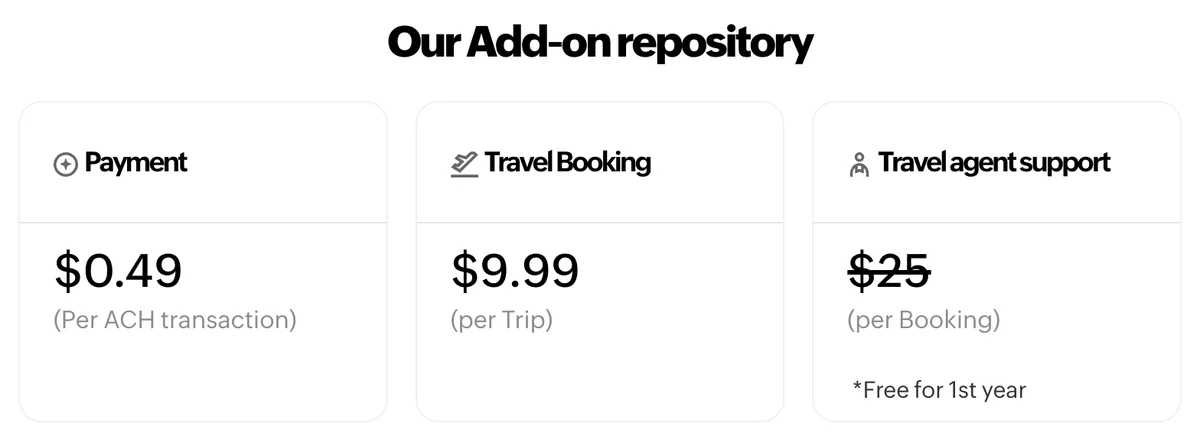
Read More

Tipalti Pricing 2027: Plans, Fees and Real Annual Cost

Tipalti Pricing 2027: Plans, Fees and Real Annual Cost

Tipalti costs from $99 a month for Accounts Payable or $249 for Mass Payments plus transaction fees, and buyers report a median of about $15,400 a year. Both plans include unlimited users. Fees run about $1 per invoice, about $1 per ACH payment and $10 to $32 per domestic wire, plus FX on foreign payments.

Tipalti pricing: key takeaways

  • Starting price: Accounts Payable from $99 a month and Mass Payments from $249 a month, with unlimited users and approvers on both.
  • Fees on top: Buyers report about $1 to $1.50 per invoice, about $1 per ACH payment, $10 to $32 per domestic wire and 1.9% to 3.2% FX on foreign payments.
  • ERP integration: NetSuite, Sage Intacct, Dynamics 365 Business Central and SAP Business One have two-way Tipalti connectors; custom or API integrations can cost extra.
  • Setup: Standard setups are included, but buyers report $5,000 to $15,000 for typical rollouts and $20,000 to $50,000+ for multi-entity ones.
  • Real annual cost: The median buyer pays $15,384 a year; teams sending 500 to 2,000 payments a month report $30,000 to $50,000 in platform fees alone.
  • Contract: Contracts renew automatically, and fees can rise by up to 7% or CPI at each renewal unless you negotiate a cap.

How much does Tipalti cost?

Tipalti costs from $99 a month for Accounts Payable and $249 a month for Mass Payments, both with unlimited users, plus per-invoice and per-payment fees. That is the entry fee: this AP automation platform quotes the final platform fee on payment volume, entities, payment methods and modules.

Tipalti pricing page showing Accounts Payable from $99 a month and Mass Payments from $249 a month
Tipalti's two plans and the fees charged on top. Source: Tipalti pricing page
PlanStarts atIncludedCosts extra
Accounts Payable$99/monthUnlimited users, supplier portal, invoice capture, 2- and 3-way PO matching, approvals, ERP syncPer-invoice and per-payment fees; Procurement, Expenses, Treasury
Mass Payments$249/monthUnlimited users, payee portal, payouts in 200+ countries, tax formsPer-payment fees and FX

Why other sites show Select, Advanced or Starter plans

Tipalti merged five tiers into two plans between March and June 2026. Older pages, including G2 and Tipalti's own get-started page, still show the old names.

G2 Tipalti pricing page last updated May 2026 listing five editions starting at $99
G2 still lists five editions (updated 13 May 2026). Source: G2 Tipalti pricing
  1. Before March 2026Five tiers: Select $99, Advanced $199, Elevate, Accelerate, Plus
  2. June 2026Two plans: Accounts Payable from $99, Mass Payments from $249; Treasury added

What will Tipalti cost for your business?

Tipalti costs a 50-200 employee US company sending about 100 ACH payments a month $18,120 to $32,172 a year. Setup is included as standard, but buyers report up to $15,000 when charged, so year one runs $18,120 to $47,172. Foreign payments and a second entity can double it, and FX adds more in the exchange rate.

Three example companies

Monthly costUS company, ~100 paymentsMid-size, NetSuite, 2 entitiesGlobal, 4 entities, Procurement
Platform subscription$1,250–$2,100$1,250–$2,100$2,500–$4,200
Invoice processing$150–$225$600–$900$1,200–$1,800
Payment fees$110–$356$1,230–$2,301$4,044–$7,154
Extra legal entities–$250–$833$750–$2,499
Procurement module––$833–$3,333
Billed per year$18,120–$32,172$39,960–$73,608$111,924–$227,837
Plus FX in exchange rates, per yearNone$34,200–$45,000$191,520–$252,000
Setup, one-time$0–$15,000$0–$15,000$0–$15,000
  • US company, ~100 payments: AP plan, 150 invoices and 100 payments a month, US only, mostly ACH, one entity, QuickBooks Online
  • Mid-size, NetSuite, 2 entities: AP plan, 600 invoices and 400 payments a month, mostly US with some international, ACH and checks, half of foreign payments converted, two entities, NetSuite
  • Global, 4 entities, Procurement: AP plan with Procurement, 1,200 invoices and 800 payments a month, mostly international, half of foreign payments converted, four entities, Sage Intacct

Estimate your own Tipalti cost

What Tipalti charges on top of the subscription

Tipalti charges about $1 to $1.50 per invoice, about $1 per ACH payment, $10 to $32 per domestic wire and a 1.9% to 3.2% FX markup, buyers and payment providers report. It publishes no rate card; checks run about $3 and international wires $20 to $36, with invoice fees covering AP invoice processing.

Invoice and payment fees

Tipalti's cheapest way to pay is ACH at about $1 a payment, while wires cost $10 to $36, so moving regular suppliers to ACH is the fastest saving.

  • ACH is the cheapest way to pay; wires cost 10 to 30 times more
  • Moving regular suppliers from wire and check to ACH is the fastest saving
FeeReported cost
Invoice processing~$1.00–$1.50 per invoice
Invoice processing with managed services~$2.75–$3.25 per invoice
ACH payment (US)~$0.50–$2.00
Paper check~$3.00–$3.20
Domestic wire~$10–$32
International ACH (eCheck)~$5.00–$6.00
International wire (non-USD)~$20–$36
W-8 form collection~$3.50–$4.00 per form

FX fees on foreign payments

The FX markup is added to the exchange rate, not billed separately, and it falls as payments get larger.

Payment sizeFX markupExample
Up to $499.99~3.0%–3.2%$15–$16 on $500
$500 to $99,999.99~2.5%$250 on $10,000
$100,000 and over~1.9%$1,900 on $100,000

How much does Tipalti ERP integration cost?

Tipalti ERP integration is included in standard setup for its two-way NetSuite, Sage Intacct, Business Central and SAP Business One connectors; custom or API integrations cost extra. Vendr reports one-time ERP setup fees of $2,500 to $15,000 in some contracts, and complex rollouts on larger ERPs often need paid services.

Tipalti integrations page listing Oracle NetSuite, Sage and Microsoft Dynamics Business Central
Tipalti's listed ERP connectors. Source: Tipalti integrations
Your ERPHow Tipalti connectsWhat to budget
NetSuite, Sage Intacct, Dynamics 365 BCTwo-way connectorIncluded; $2,500–$15,000 if quoted separately
QuickBooks Online, XeroTipalti connectorUsually included
SAP Business One, Acumatica, Dynamics GPTipalti connectorUsually included; confirm
SAP S/4HANA, Oracle Fusion, Workday, InforListed connectors, larger ERPsOften paid services; $20,000–$50,000+ for complex rollouts
Homegrown or other ERPAPI or customExtra; scoped by professional services

What to confirm about your ERP

Confirm the connector sits on the order form at $0, what each extra entity adds, and whether custom fields or a second ERP need paid services.

  • The connector is on the order form at $0, not a separate line
  • Each extra entity in the ERP adds an entity fee
  • Custom fields or a second ERP mean professional services

Tipalti implementation cost and setup time

Tipalti charges no fee for standard implementation and publishes no exact timeline beyond its FAQ, which says due diligence and setup take several weeks for most teams. Buyers report $5,000 to $15,000 when setup is charged, and complex multi-ERP or custom rollouts need paid services.

SetupReported costTime
One entity, listed ERP connectorIncluded; $5,000–$15,000 when chargedSeveral weeks
Multi-entity, multi-region or custom$20,000–$50,000+Longer: due diligence plus custom work
  • Technical setup takes days; Tipalti's due diligence on your company takes weeks
  • Buyers report a $4,000–$5,000 setup list price often discounted to near zero, so ask for it to be waived

Entities, modules, support and contract terms

Each extra Tipalti entity costs about $250 to $833 a month, the Procurement module $10,000 to $40,000 a year and premium support 10% to 20% of the platform fee, buyers report. Fees can also rise by up to 7% or CPI at each renewal unless you cap them, so these lines grow with your structure and contract.

CostReported amount
Each extra legal entity~$250–$833 a month
Procurement module~$10,000–$40,000 a year
Expenses and Treasury modulesQuote only
Premium support+10%–20% of the platform fee
Users and approversNo per-user fee

Renewal terms to check before you sign

Tipalti contracts renew automatically and fees can rise by up to 7% or CPI at each renewal, so negotiate a cap and give 30 days' written notice if you plan to leave.

Tipalti services agreement clause 6.1 allowing an automatic fee increase of up to 7% or CPI at renewal
Clause 6.1, Tipalti services agreement (highlight added). Source: Tipalti services agreement
  • Contracts renew automatically, for 12 months unless the order form says otherwise
  • Fees can rise up to 7% or CPI at each renewal, and renewal fees are never lower than the last term
  • Discounts renew at list price unless the order form says otherwise
  • To leave, email legal@tipalti.com at least 30 days before the term ends

Companies pay a median of $15,384 a year for Tipalti, with deals from $2,476 to $27,024 across 52 purchases, based on Vendr buyer data. Platform fees alone run about $15,000 to $25,000 a year under 500 payments a month and $30,000 to $50,000 from 500 to 2,000, before transaction fees and FX.

$15,384median a year
$2,476$27,024
VolumeReported annual cost
Under 500 payments a month~$15,000–$25,000 platform fee
500–2,000 payments a month~$30,000–$50,000 platform fee
With payment fees, modules and integrations~$75,000–$150,000+ total

Is Tipalti worth the price?

Tipalti is worth its price when you pay suppliers in many countries, run several entities or pay a large payee network, because tax forms, FX and multi-entity AP sit in one place. For a few hundred US ACH payments a month, per-payment fees make Tipalti alternatives worth comparing.

Worth it if

  • You pay suppliers in many countries and currencies
  • You run several entities and want one AP process
  • You pay creators, sellers or contractors at scale
  • Your ERP is NetSuite, Sage Intacct or Business Central

Look elsewhere if

  • You mostly pay a few hundred US suppliers by ACH
  • You need requests and POs before the invoice (extra Procurement module)
  • You run SAP S/4HANA or a custom ERP
  • You want a fixed price before a sales call

How to get a better Tipalti price

Ask for every rate in writing before you sign: per invoice, per payment method, FX markup, per entity and per module. Then negotiate a multi-year fixed platform fee, a lower cap on renewal increases, a waived setup fee and cheaper wires. Vendr reports that buyers who negotiate save 23% on average.

Get in writing

  • Price per invoice
  • Price per ACH, check and wire
  • Price per international payment
  • FX markup by payment size
  • Fee per extra entity
  • Module prices for later
  • ERP connector and setup fees
  • Renewal cap and notice date

Negotiate

  • A 2–3 year fixed platform fee
  • A renewal cap, such as 3%, instead of 7% or CPI
  • Setup and ERP connector waived
  • Lower wire and international fees
  • A calendar reminder 30 days before renewal

Tipalti pricing vs alternatives

Tipalti starts at $99 a month plus per-invoice and per-payment fees, while BILL charges per user from $49 a month and Ramp has a free plan and a $15 per-user Plus plan. AvidXchange quotes by volume. Zapro pricing has Spark at $699 a month, Growth at $1,999 and Scale on custom terms, all with unlimited users; your ERP or bank pays suppliers.

ToolPricing modelStarting price (basis)Per userPays suppliers
TipaltiPlatform + per-invoice and per-payment fees$99/month + fees (list)NoTipalti
BILLPer user$49/user/month (list)YesBILL
RampFree, then per user + platform fee$0; Plus $15/user (list)On PlusRamp
AvidXchangeQuote, by volumeQuote onlyNot publishedAvidXchange
ZaproFlat plans, unlimited usersSpark $699 / Growth $1,999 a month; Scale customNoYour ERP or bank

Tipalti pricing FAQs

How much does Tipalti cost per month?

Tipalti's Accounts Payable plan starts at $99 a month and Mass Payments at $249 a month, with unlimited users. Tipalti publishes no rate card: buyers report per-invoice fees of about $1 to $1.50, per-payment fees of about $1 for ACH and $10 to $32 for a domestic wire, plus FX on foreign payments.

Is Tipalti free to use?

No. Tipalti has no free plan for businesses. Suppliers and payees who receive money through Tipalti do not pay a subscription, but the paying company pays the platform fee and the transaction fees.

Does Tipalti charge per user?

No. Both Tipalti plans include unlimited users and approvers, so adding finance staff or approvers does not change the subscription. The bill grows with invoices, payments, payment methods, entities and modules instead of seats.

How much does Tipalti NetSuite integration cost?

Tipalti's NetSuite connector is two-way and covered by standard implementation. Some contracts list a one-time ERP setup fee; Vendr reports $2,500 to $15,000. Ask for the connector and setup to be included in writing.

What is Tipalti's FX fee?

Reported FX markups are about 3% to 3.2% on payments under $500, about 2.5% from $500 to $99,999.99 and about 1.9% from $100,000. Tipalti does not publish the rates, so ask for the markup over the mid-market rate in your quote.

Can Tipalti raise prices at renewal?

Yes. Tipalti's services agreement lets fees rise automatically at each renewal by up to the greater of 7% or CPI, unless Tipalti gives other pricing 30 days before renewal. Contracts renew automatically; cancel with 30 days' written notice.

Why do some sites list Select and Advanced plans?

Those are Tipalti's older tiers: Select at $99 and Advanced at $199 a month. In mid-2026 Tipalti merged its five tiers into two plans, Accounts Payable and Mass Payments, but some pages still show the old names.

Sources: Tipalti pricing page; Tipalti get-started page; Tipalti integrations; Tipalti FAQ; Tipalti services agreement; PricingSaaS change log; Vendr; Wise; G2 Tipalti pricing. Prices come from Tipalti's own pages where published and from the third-party sources listed, labelled as such. Estimates are not quotes.
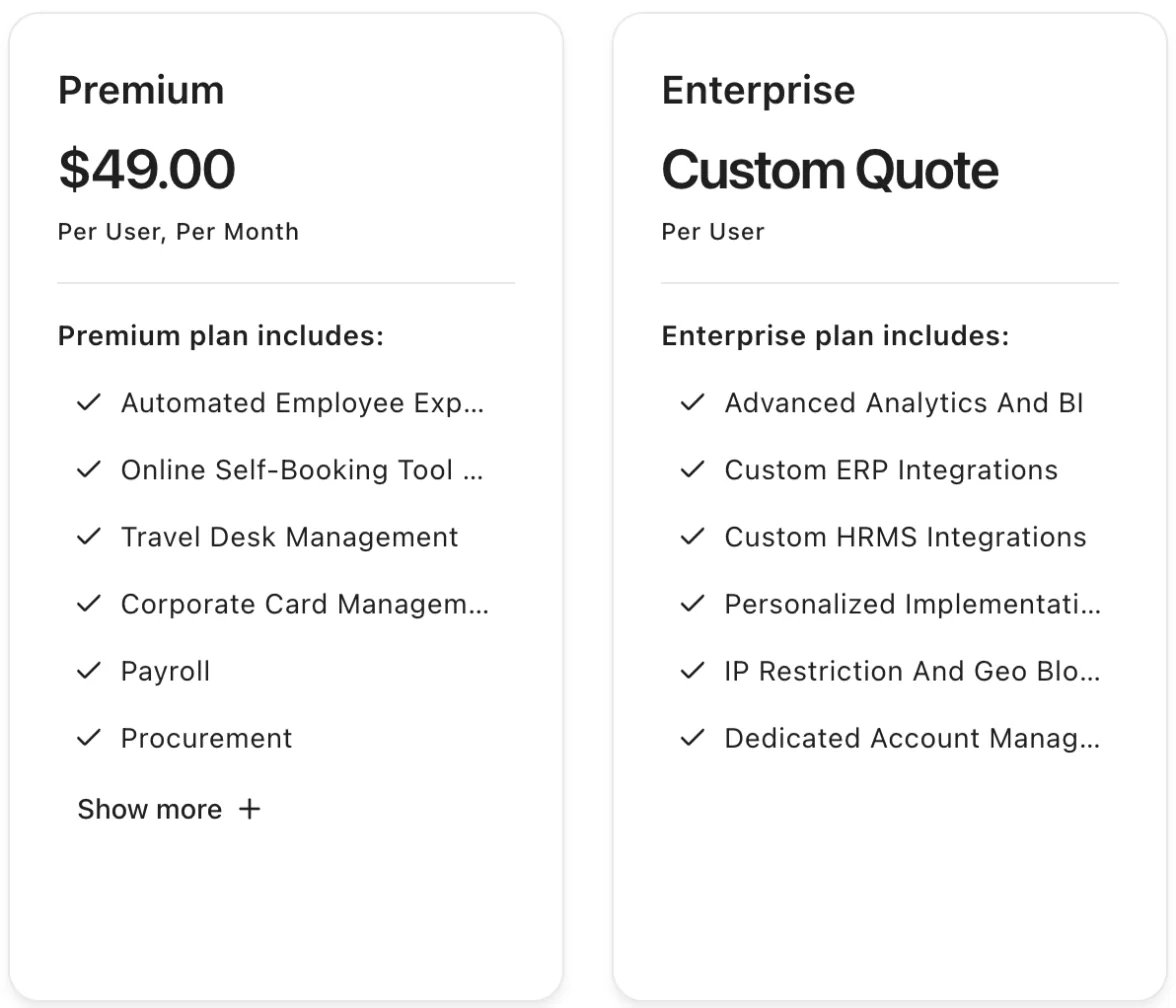
Read More

Spendwise Pricing 2027: Per-User Plans and Annual Cost

Spendwise Pricing 2027: Per-User Plans and Annual Cost

Spendwise costs $9 per user a month on Basic and $19 per user a month on Pro, and Enterprise is quoted. Basic covers up to 5 users and 10 transactions; Pro covers 5 to 50 users with unlimited transactions. Implementation, inventory and accounting integrations are add-ons with unpublished prices.

Spendwise pricing: key takeaways

  • Basic: Basic costs $9 per user a month, covers up to 5 users and allows only 10 transactions a month.
  • Pro: Pro costs $19 per user a month with a 5-user minimum and 50-user cap, and adds approvals, budgets and roles.
  • Enterprise: Enterprise is quoted, needs at least 5 users, and includes unlimited users, an implementation package and priority support.
  • Add-ons: Implementation, inventory management, Amazon integration and accounting integrations cost extra, and Spendwise does not publish their prices.
  • Real cost: A 25-user team on Pro pays $475 a month, or $5,700 a year, before any add-ons.
  • Setup: Spendwise says most customers are up and running within a few weeks, and offers monthly or annual plans.

How much does Spendwise cost?

Spendwise costs $9 per user a month on Basic for up to 5 users and $19 per user a month on Pro for 5 to 50 users. Enterprise, for larger or unlimited teams, is quoted. This procure-to-pay procurement software bills every user with a login, so headcount, not spend or transactions, sets the price.

Spendwise pricing page: Basic $9 per user per month up to 5 users, Pro $19 per user per month up to 50 users, Enterprise contact us
Spendwise's three plans on its pricing page. Source: Spendwise pricing
PlanPriceUsersTransactionsAdds
Basic$9/user/month1 to 510 a monthAP, purchasing, receiving, reports
Pro$19/user/month5 to 50UnlimitedDashboards, approval limits and workflows, roles, budgets, currencies
EnterpriseQuote5+, unlimitedUnlimitedImplementation package, priority support

What a team pays on Pro

Spendwise Pro costs $1,140 a year at the 5-user minimum, $2,280 for 10 users, $5,700 for 25 and $11,400 at the 50-user maximum.

Pro usersMonthlyYearly
5 (minimum)$95$1,140
10$190$2,280
25$475$5,700
50 (maximum)$950$11,400

When to move from Basic to Pro

Move from Basic to Pro once you pass 5 users or 10 transactions a month, or need approval limits, workflows, budgets, custom roles or currency conversions.

  • You raise more than 10 transactions a month
  • You need approval limits, workflows or budgets
  • You have more than 5 users
  • You want custom roles or currency conversions

What will Spendwise cost for your business?

Spendwise costs a 50-200 employee company $2,280 to $11,400 a year on Pro for 10 to 50 buyers and approvers, or about $5,700 for 25 users. Implementation is an optional paid package with no published price, so year one adds that package and any accounting integration quote. Past 50 users you need Enterprise.

Pro bills a 5-user minimum, so a 3-person team on Pro still pays $95 a month. Basic is cheaper at $9 per user, but its 10-transaction monthly cap rules it out for most teams that buy every week.

Three example companies

Monthly costPro, 25 usersBasic, 5 usersPro, 50 users
Subscription$475$45$950
Billed per year$5,700$540$11,400
Setup, one-timeOptional paid packageOptional paid packageOptional paid package
  • Pro, 25 users: A mid-size team with 25 Spendwise users on Pro
  • Basic, 5 users: A small team with 5 users on Basic, under 10 transactions a month
  • Pro, 50 users: A growing team at Pro's 50-user maximum

Figures exclude add-ons (implementation, inventory, Amazon and accounting integrations), which Spendwise prices on request.

Estimate your own Spendwise cost

What Spendwise charges on top of the subscription

Spendwise publishes no price for its four paid add-ons on Pro: an implementation package, inventory management, Amazon integration and accounting system integrations. Enterprise includes implementation but still charges for inventory, Amazon, accounting integrations and single sign-on, so ask for each price in writing.

Add-ons by plan

Spendwise publishes no add-on prices; Enterprise includes implementation and priority support, while inventory, Amazon and accounting integrations cost extra on both Pro and Enterprise.

Add-onProEnterprisePrice
Implementation packageOptional add-onIncludedNot published
Inventory managementOptional add-onOptional add-onNot published
Amazon integrationOptional add-onOptional add-onNot published
Accounting system integrationsOptional add-onOptional add-onNot published
Single sign-onNot offeredOptional add-onNot published
Priority supportNot offeredIncluded–

Basic lists no add-ons at all, and its 10-transaction monthly cap means most growing teams move to Pro quickly. Ask for every add-on you need as a fixed price in the same quote.

Spendwise says its pricing depends on the number of users, features and subscription term, so the add-on quote and your billing cycle together set the real annual cost.

How much does Spendwise ERP integration cost?

Spendwise charges for accounting system integration as a paid add-on on Pro and Enterprise, but publishes no price or full list of supported systems. Third-party listings name QuickBooks as a Spendwise integration, and Spendwise says integrations keep purchasing and AP in sync to cut duplicate entry.

IntegrationPlanEffect on cost
QuickBooks (per ProcureDesk)Pro, EnterprisePaid add-on, price not published
Other accounting systemsPro, EnterprisePaid add-on; confirm support
Amazon (purchasing)Pro, EnterprisePaid add-on
Single sign-onEnterprisePaid add-on

What to confirm about your ERP

Confirm that your accounting system and edition are supported, what the integration add-on costs, which records sync and who fixes sync errors.

  • That your accounting system and edition are supported
  • The integration add-on price, one-time or monthly
  • Which records sync: vendors, bills, POs, GL codes
  • Whether Basic can connect at all, since it lists no add-ons
  • Who fixes sync errors; G2 reviewers mention integration issues

Spendwise implementation cost and setup time

Spendwise publishes no implementation fee, and most customers are up and running within a few weeks, per Spendwise. The setup package is a paid add-on on Pro and is included on Enterprise, and third-party listings note in-person or online training for new buyer teams, so ask what your plan includes.

PhaseTimeCost
Free trialOne month (per ProcureDesk)Free
Self-setup on Basic or ProA few weeks, per SpendwiseIncluded in subscription
Implementation package (Pro)By scopePaid add-on, not published
Implementation package (Enterprise)By scopeIncluded
Accounting integrationPart of setupPaid add-on, not published
  • Use the trial to test approvals and receiving with real requests
  • Write down approval limits by amount and department before you configure Pro's approval workflows
  • Ask for the implementation package as a fixed fee; its size depends on users, approval rules, inventory and your accounting connection
  • Confirm training is included

Third-party listings show in-person and online training plus chat, phone and live rep support for Spendwise. Ask which of these come with your plan and which sit inside the paid implementation package.

Users, plan limits and contract terms

Spendwise's plan limits drive upgrades: Basic stops at 5 users and 10 transactions a month, Pro needs at least 5 users and stops at 50, and Enterprise takes over beyond that. Spendwise offers monthly and annual plans, and says price depends on users, features and subscription term.

  • Pro bills at least 5 users, so a 3-person team pays for 5
  • A 51st user means moving to quoted Enterprise
  • Approvals and budgets are Pro features, not Basic

Renewal terms to check before you sign

Spendwise offers monthly and annual plans, so confirm any annual discount, whether the $19 Pro rate is locked at renewal and how mid-term users and add-ons are billed.

  • Any discount for annual instead of monthly billing
  • Whether the $19 Pro rate is locked at renewal
  • How users added mid-term are billed
  • Cancellation notice on monthly plans
  • Whether add-on prices can rise at renewal

Companies pay Spendwise its list rate for their headcount, since prices are published: $2,280 a year for 10 Pro users and $11,400 for 50, plus add-ons. Procurer.io puts 20 Pro users at about $4,560 a year. G2 users rate it 4.7 of 5, and Capterra users rate value for money 4.5.

G2 Spendwise pricing editions: Basic $9 per user per month up to 5 users, Pro $19 up to 50 users, Enterprise contact vendor
Spendwise's editions as listed on G2. Source: G2 Spendwise pricing

What buyers and reviewers report

Buyers and reviewers report list prices of $9 and $19 per user a month, about $4,560 a year for 20 Pro users, and G2 and Capterra ratings of 4.7 and 4.6.

SourceWhat it reports
Spendwise pricing pageBasic $9, Pro $19 per user per month; Enterprise quoted
G2 (4.7 of 5, 75 reviews)Same editions; cons include PO management and integration issues
Capterra (4.6, 236 reviews)From $9 per user per month; value for money 4.5
Procurer.io20 Pro users about $4,560 a year before add-ons
ITQlickLists different, higher figures; Spendwise's page is current
Capterra Spendwise pricing: Basic $9.00 per user per month, Pro $19.00 per user per month, Enterprise custom quote
Spendwise's plans as listed on Capterra. Source: Capterra Spendwise pricing

Is Spendwise worth the price?

Spendwise is worth its price for small and mid-size teams of up to 50 users that want published, low per-user pricing for purchasing, receiving and AP. Paid integrations, a 50-user Pro cap and per-user billing weigh against it as you grow, which is when Spendwise alternatives are worth comparing.

Worth it if

  • Your team is under 50 users
  • You want a published price and a free trial
  • You need approvals, budgets and receiving on Pro
  • You can live with a paid accounting integration

Look elsewhere if

  • Many employees only request and you do not want to pay per head
  • You will pass 50 users soon
  • You need SSO without Enterprise
  • You need the integration price before you start

G2 reviewers most often praise ease of use, simplicity and customer support. The most common complaints are purchase order management issues, integration issues and some inflexibility, so test your PO workflow and accounting sync during the trial.

How to get a better Spendwise price

Spendwise publishes list prices, so savings come from user count, billing term and add-ons. Count only the people who need a login, ask whether annual billing earns a lower rate than monthly, and get the implementation and accounting integration add-ons priced as fixed fees before you sign.

Get in writing

  • Annual vs monthly rate
  • Each add-on price
  • Integration support for your system
  • Rate lock at renewal
  • Mid-term user billing
  • Cancellation notice

Ways to pay less

  • License only active purchasers
  • Pay annually if discounted
  • Self-implement instead of the package
  • Start on Basic if under 10 transactions
  • Trial before adding paid add-ons

Spendwise pricing vs alternatives

Spendwise costs $9 or $19 per user a month. ProcureDesk publishes $830 to $1,250 a month billed annually with 10 users included, SpendMap charges $15 per user per module and Procurify has a $15,000 median. Zapro pricing has Spark at $699 a month, Growth at $1,999 and Scale on custom terms, all with unlimited users; your ERP or bank pays suppliers.

ToolPricing modelTypical cost (basis)Users priced
SpendwisePer user$9–$19/user/month (list)Yes, every user
ProcureDeskPublished plans$830–$1,250/month, billed annually (list)10 users included
SpendMapPer user, per module$15–$20/user/module/month (list)Yes, by module
ProcurifyQuote: products + Pro usersMedian $15,000/yr (Vendr)Pro users; Basic free
ZaproFlat plans, unlimited usersSpark $699 / Growth $1,999 a month; Scale customNo per-user fee

For small teams Spendwise is usually cheaper than flat-fee tools: 10 Pro users cost $190 a month, while ProcureDesk's Startup plan costs $830 a month billed annually with 10 users included and $20 for each extra user.

Spendwise pricing FAQs

How much does Spendwise cost?

Spendwise costs $9 per user a month on Basic, for up to 5 users and 10 transactions, and $19 per user a month on Pro, for 5 to 50 users. Enterprise is quoted. A 25-user Pro team pays $5,700 a year before add-ons.

What is Spendwise?

Spendwise is procure-to-pay software that helps organizations manage purchasing and accounts payable in one place, covering requisitions, purchase orders, receiving, invoice matching, budgets and reports, with optional inventory management.

Does Spendwise have a free trial?

Yes. Spendwise offers a free trial from its website, and third-party listings describe it as one month. G2 and Capterra also list a free trial, which lets you test approvals and receiving before you pay.

Does Spendwise integrate with QuickBooks?

Yes, by third-party listings, but accounting integration is a paid add-on on Spendwise's Pro and Enterprise plans and its price is not published. Ask for the QuickBooks integration price in writing before you sign.

What happens when you pass 50 users on Spendwise?

Pro is capped at 50 users, so a larger team moves to Enterprise, which Spendwise quotes. Enterprise adds unlimited users, an implementation package and priority support, with inventory, integrations and SSO still sold as add-ons.

Is Spendwise cheaper than Procurify?

For small teams, usually yes. Spendwise charges $19 a user a month on Pro, so 20 users cost about $4,560 a year, while Procurify is quoted, with a $15,000 median in buyer benchmarks. Above 50 users, Spendwise moves to quoted Enterprise pricing.

Does Spendwise charge per transaction?

Only Basic is limited by transactions, to 10 a month. Pro and Enterprise include unlimited transactions, so on those plans you pay per user, not per purchase order, plus any add-ons such as integrations or inventory management.

Sources: Spendwise pricing; Spendwise; G2 Spendwise pricing; Capterra Spendwise pricing; Procurer.io. Prices come from Spendwise's own pages where published and from the third-party sources listed, labelled as such. Estimates are not quotes.

Read More

ServiceNow Procurement Pricing 2027: Packages and Real Cost

ServiceNow Procurement Pricing 2027: Packages and Real Cost

ServiceNow procurement costs $70 to $200+ per fulfiller a month on third-party platform estimates, and Vendr's buyers pay a median of $127,118 a year across all ServiceNow products. ServiceNow publishes no procurement price: Source-to-Pay Operations comes in two quoted packages, Foundation and Prime, and implementation is billed on top.

ServiceNow procurement pricing: key takeaways

  • Quote only: ServiceNow sells Source-to-Pay Operations Foundation and Prime only on custom quotes, with no list price.
  • Packages: Foundation covers procurement and invoice case management; Prime adds sourcing, POs and AP invoice processing.
  • Licensing: ServiceNow typically licenses fulfillers who work cases, while employees who only submit requests usually pay nothing.
  • Platform spend: Vendr's data on all ServiceNow products shows a $127,118 median, from $43,647 to $700,691 a year.
  • Implementation: Vendr says implementation can run from a large share to multiples of the annual software spend.
  • Renewals: Third-party guides report 5% to 10% yearly uplifts and true-ups when users grow mid-term.

How much does ServiceNow procurement cost?

ServiceNow procurement costs $70 to $200+ per fulfiller a month on third-party platform guides, as ServiceNow publishes no price and quotes Source-to-Pay Operations in two packages. Foundation covers procurement, supplier and invoice cases; Prime adds the sourcing, PO and AP invoice processing of full procurement software.

ServiceNow Source-to-Pay Operations pricing page comparing Foundation and Prime packages and what each includes, sold on custom quote
ServiceNow's two Source-to-Pay packages, both priced on a custom quote. Source: ServiceNow Source-to-Pay pricing
PackageWhat it addsPrice
Source-to-Pay Operations FoundationProcurement, supplier and invoice case management; supplier portal; ERP Integration Framework; Document Intelligence; platform AICustom quote
Source-to-Pay Operations PrimeFoundation plus sourcing and purchasing automation, spend and savings, sourcing pipeline, supplier operations, POs, AP invoice processingCustom quote

Why ITSM prices do not answer this

Most ServiceNow price guides quote IT Service Management at $70 to $200+ per fulfiller a month. Those are third-party estimates for a different product, so use them only as a sign of how ServiceNow licenses seats, not as a procurement price.

How ServiceNow seat pricing looks on other products

Third-party guides put ServiceNow ITSM seats at $70 to $100 a month on Standard, rising to $150 to $200+ on Enterprise, with AI adding 25% to 60%.

ITSM tier (third-party estimate)Per fulfiller a month
Standard$70–$100
Pro$100–$150
Enterprise$150–$200+
AI add-on+25%–60% over base

What will ServiceNow procurement cost for your business?

ServiceNow procurement costs a company with 10 fulfillers about $12,000 to $20,000 a year, or $20,000 to $50,000 in year one with setup, on third-party ITSM estimates from July 2026. ServiceNow publishes no procurement price, and a 10 to 50 user team often has fewer fulfillers, since requesters usually pay nothing.

Quote driverWhat moves it upWhat to ask
Fulfiller seatsMore procurement and AP staff working casesPrice per fulfiller and whether requesters are free
PackagePrime instead of FoundationPrice of each package for your seat count
ModulesSourcing, spend management, invoice processingWhich modules each package includes
AIHigher AI entitlements and usageAI allowances and overage rates
IntegrationsMore IntegrationHub transactions and ERPsTransactions included and overage price
InstancesExtra development and test environmentsInstances included in the order

Ask ServiceNow for these in writing

Get Foundation and Prime priced side by side for your fulfiller count, with AI, IntegrationHub, implementation and renewal terms fixed in writing.

  • Foundation and Prime priced side by side for your fulfiller count
  • Whether employees who only submit requests are free
  • AI entitlements and the overage rate
  • IntegrationHub transactions included
  • Implementation scope and fee, by ServiceNow or a partner
  • A cap on renewal uplifts and true-up rates

Published prices of the alternatives

Dedicated procure-to-pay tools either publish a price or have a Vendr buyer median, so use these figures to test whether a ServiceNow quote is in line.

ToolPublished price
CoupaQuote; median $94,519 a year (Vendr)
ZipQuote; median $88,856 a year (Vendr)
ProcurifyQuote; median $15,000 a year (Vendr)
ProcureDesk$830 to $1,250 a month, billed annually

What ServiceNow charges on top of the subscription

ServiceNow charges extra for AI features, at 25% to 60% on top of a base licence, and for extra sub-production instances at $50,000 to $150,000 a year. Third-party guides also list IntegrationHub transaction fees, premium support plans and higher rates for licences added mid-term; the instance figure applies to large estates.

Common extras on ServiceNow contracts

The common extras are AI uplifts of 25% to 60%, IntegrationHub transaction fees, extra instances, premium support and higher-priced mid-term licences.

ItemWhat is reportedSource
AI (Now Assist) uplift25%–60% over the base licenceBuyers report
IntegrationHubTransaction fees above allowanceBuyers report
Extra instances$50,000–$150,000 a year for large estatesThird-party guides
Premium supportFaster response, account managementVendr
Licences added mid-termOften at higher rates than initial pricingVendr
  • Maintenance is typically a portion of licence value each year and is negotiable (Vendr)
  • A dedicated platform administrator can cost about $120,000 a year in salary (third-party guides)
  • Training runs from $300 for self-paced courses to $15,000+ for architect tracks (third-party guides)
  • Standard support covers the support portal, knowledge base, community forums and standard response times (Vendr)

How much does ServiceNow procurement ERP integration cost?

ServiceNow publishes no ERP integration fee: Source-to-Pay Foundation includes its ERP Integration Framework, so procurement and invoice data can sync with your ERP. Integration work sits in the implementation project, and IntegrationHub transactions above your allowance can add fees, according to third-party guides.

CostWhat is knownSource
ERP Integration FrameworkIncluded in FoundationServiceNow
Integration buildPart of implementation servicesVendr
IntegrationHub transactionsFees above the allowanceBuyers report

What to confirm about your ERP

Confirm which ERP connectors the framework covers out of the box and how many IntegrationHub transactions your order includes before you sign.

  • Which ERP connectors the framework covers out of the box
  • How many IntegrationHub transactions your order includes
  • Whether invoice, PO and supplier data sync both ways
  • Who builds the integration: ServiceNow, a partner or your team
  • Whether the ERP stays the system of record for POs and payments

ServiceNow procurement implementation cost and setup time

ServiceNow implementation costs $100K to $250K for 50 fulfillers and takes about 5 months on G2 reviewers' platform average, per third-party guides. 200 fulfillers cost $300K to $600K, billed separately from the licence, Vendr says services can reach multiples of annual spend, and multi-team rollouts take 6 to 12 months.

G2 pricing insights for ServiceNow IT Service Management: 5 months to implement, 13 months return on investment, 15% average discount, perceived cost 4 of 5
G2 reviewers' averages for the ServiceNow platform (ITSM listing; no S2P listing exists). Source: G2 ServiceNow ITSM pricing
ItemTime or costSource
Implementation servicesSignificant share to multiples of annual spendVendr
Three-year total cost3–5x annual licenceThird-party guides
Services share of year one50%–70%Third-party guides
Time to implement (platform)5 monthsG2 reviewers, ITSM
Time to implement (multi-team)6–12 months is routineBuyers report
Time to payback (platform)13 monthsG2 reviewers, ITSM

Year-one cost by deployment size

Year one runs $20K to $50K for 10 fulfillers, $190K to $350K for 50 and $700K to $1.2M for 200, licence plus implementation services.

DeploymentImplementation servicesYear one (licence + services)
10 fulfillers (Desk365, ITSM)Included in year one$20K–$50K
50 fulfillers$100K–$250K$190K–$350K
200 fulfillers$300K–$600K$700K–$1.2M

These are third-party figures for ServiceNow deployments in general (guides published in July 2026 and April 2026), not S2P quotes. A small procurement team on Foundation, with only buyers and AP staff as fulfillers, compares with the 10-fulfiller row.

Packages, modules and contract terms

ServiceNow sells procurement as Foundation or Prime packages plus platform modules, on contracts with annual true-ups and 5% to 10% yearly uplifts, per Vendr and third-party guides. Extra licences come at renewal or by mid-term amendment, often at higher rates, so cap uplifts and mid-term rates in the contract.

TermWhat is reported
PackagesFoundation or Prime (ServiceNow)
User growthAnnual true-ups; mid-term licences often at higher rates (Vendr)
Renewal uplift5%–10% a year typical (buyers report)
DiscountsMid-market 20%–35%; enterprise 30%–50% (buyers report)
Average saving8% (Vendr); 15% average discount (G2, ITSM)

Renewal terms to check before you sign

ServiceNow renewals typically carry 5% to 10% yearly uplifts and true-ups for user growth, so cap the uplift and the mid-term licence rate before you sign.

  • A cap on the yearly uplift
  • The price of each extra fulfiller added mid-term
  • How true-ups are measured: named or peak users
  • AI and IntegrationHub overage rates for the full term
  • Notice period and renewal timing, since buyers who start early do better (Vendr)

Uplifts compound. At 7% a year, a $500K first-year contract becomes about $572K in year three and about $655K in year five, before any expansion.

Companies pay a median of $127,118 a year across all ServiceNow products, from $43,647 to $700,691 over 110 Vendr purchases; no procurement-only figure exists. Buyers save 8% on average. Procurement teams usually buy S2P on top of an existing ServiceNow estate, so price it as an add-on to that contract.

Vendr ServiceNow pricing: median buyer pays $127,118 per year, low $43,647, high $700,691, based on 110 purchases with 8% average savings
Vendr's ServiceNow price range, across all ServiceNow products. Source: Vendr
What is reportedFigureSource
Median, all ServiceNow products$127,118 a yearVendr
Range$43,647–$700,691 a yearVendr
Purchases analyzed110Vendr
Average saving8%Vendr
Average discount, ITSM15%G2 reviewers

Vendr notes that ServiceNow pricing varies widely by products deployed, user counts and whether you license named users, concurrent users or fulfiller seats. Ask your account team which of these applies to Source-to-Pay before you compare quotes.

Is ServiceNow procurement worth the price?

ServiceNow procurement is worth its price for enterprises already running ServiceNow, where procurement, supplier and invoice cases join existing workflows. For mid-size teams without it, platform, implementation and renewal costs weigh heavily, which is when ServiceNow Procurement alternatives are worth comparing.

Worth it if

  • You already run ServiceNow for IT or HR
  • You want procurement cases and approvals in the same portal
  • You have a platform team to configure and maintain it
  • Your ERP stays the system of record for POs and payments

Look elsewhere if

  • You do not use ServiceNow today
  • You need a published price before a sales cycle
  • You cannot fund implementation at or above the licence cost
  • You want a tool live in weeks

ServiceNow's own S2P page cites $5M of cost savings through procurement automation, a 40% reduction in time to solve supplier cases and 50% lower procurement case volume. These are vendor claims, so ask for references in your industry and size.

How to get a better ServiceNow procurement price

Bundle S2P into your next ServiceNow renewal, start talks early and bring competing quotes, since Vendr says buyers who evaluate alternatives achieve lower total cost. Count only true fulfillers, cap yearly uplift and mid-term licence rates, and fix AI and IntegrationHub allowances for the full term.

Get in writing

  • Foundation and Prime prices
  • Price per fulfiller
  • AI and IntegrationHub allowances
  • Implementation fee and scope
  • Uplift cap
  • Mid-term licence rate

Ways to pay less

  • Bundle S2P into a renewal
  • Start negotiations early
  • Bring competing quotes
  • License fulfillers only
  • Compare partner implementation bids

Discounts vary by deal size. Buyers report 20% to 35% off list for mid-market deals of 50 to 200 users, 30% to 50% for enterprise deals of 500+ users, and 60% to 80% on low-adoption niche modules, with first offers of 10% to 20% treated as placeholders.

ServiceNow procurement pricing vs alternatives

ServiceNow's $127,118 Vendr median across all products sits above Coupa's $94,519, Zip's $88,856 and Procurify's $15,000, though S2P itself is quoted. Zapro pricing is Spark at $699 a month, Growth at $1,999 and Scale custom, all with unlimited users; your ERP or bank pays suppliers.

ToolPricing modelTypical costUsers priced
ServiceNow S2PQuote by package and fulfillersQuote; $127,118/yr Vendr median, all ServiceNow productsFulfillers
CoupaQuote by moduleVendr median $94,519/yrActive users
ZipQuote: platform + seats + modulesVendr median $88,856/yrSeats
ProcurifyQuote: products + Pro usersVendr median $15,000/yrPro users; Basic free
ZaproFlat plans, unlimited usersSpark $699 / Growth $1,999 a month; Scale customNo per-user fee

ServiceNow pricing FAQs

How much does ServiceNow cost per year?

ServiceNow costs a median of $127,118 a year across all its products, from $43,647 to $700,691, per Vendr's buyer data. ServiceNow quotes its Source-to-Pay Foundation and Prime packages separately, and implementation services are billed on top.

Can ServiceNow be used for procurement?

Yes. ServiceNow sells Source-to-Pay Operations for procurement, supplier and invoice case management, and its Prime package adds sourcing, purchase orders and AP invoice processing. Its ITSM Procurement app also creates POs for catalog requests.

Does ServiceNow charge per user for procurement?

Usually per fulfiller. ServiceNow typically licenses the staff who work cases, while employees who only submit requests usually do not need a paid seat. Confirm how procurement and AP users are counted in your quote.

What is procurement pricing?

Procurement pricing is how a vendor charges for procurement software: per seat, per package, per module or as a flat platform fee. ServiceNow uses quoted packages and fulfiller seats, so its price rises with the staff who work procurement and AP cases.

What is the cost of procurement on ServiceNow?

Procurement on ServiceNow typically costs $190K to $350K in year one for 50 fulfillers, licence plus implementation, per third-party guides. Third-party guides put three-year total cost at 3 to 5 times the annual licence, and a platform administrator adds running costs on top.

What is the difference between Foundation and Prime?

Foundation covers procurement, supplier and invoice case management, a supplier portal and the ERP Integration Framework. Prime adds sourcing and purchasing automation, spend management, supplier operations, purchase orders and AP invoice processing.

Sources: ServiceNow Source-to-Pay pricing; ServiceNow Procurement Service Management pricing; Vendr; G2 ServiceNow ITSM pricing. Prices come from ServiceNow's own pages where published and from the third-party sources listed, labelled as such. Estimates are not quotes.

Read More

SAP Ariba Pricing 2027: Package Prices and Implementation

SAP Ariba Pricing 2027: Package Prices and Implementation

SAP Ariba costs $180K to $450K a year for 100 to 300 users, based on Vendor Benchmark contract data, before implementation. SAP lists one package price: Strategic Procurement at USD 2,420 a month in blocks of one user, five-user minimum, or $145,200 a year read per user. Buying and Invoicing and Sourcing are quoted.

SAP Ariba pricing: key takeaways

  • List price: SAP Strategic Procurement is listed at USD 2,420 a month in blocks of one user, with a minimum order of five users.
  • Quote only: SAP Ariba Buying and Invoicing is metered on the spend it processes each year and priced on request, on 3 to 5 year terms.
  • Typical cost: Vendor Benchmark reports $180K to $450K a year for 100 to 300 user deployments, and $450K to $1.8M for 300 to 1,000 users.
  • Implementation: System integrators usually run the rollout; G2 reviewers report about 6 months to implement SAP Ariba.
  • Contract terms: Every package auto-renews, and Vendor Benchmark says 3-year commitments typically win 20% to 30% off list.
  • Suppliers: The SAP Business Network Standard account is free; Enterprise suppliers pay $50 to $5,500 a year plus transaction fees.

How much does SAP Ariba cost?

SAP Ariba costs $180K to $450K a year at 100 to 300 users, per Vendor Benchmark. Its one list price is Strategic Procurement at USD 2,420 a month in blocks of one user, minimum five users. Buying and Invoicing is priced on spend processed, and Sourcing on active users, both on request through SAP's procurement software sales team.

SAP packageWhat it coversHow it is priced
SAP Strategic ProcurementRFI and RFP events, contracts with clause library, supplier qualification and performanceUSD 2,420 a month, blocks of 1 user, 5-user minimum
SAP Ariba Buying and InvoicingRequisitions, purchase orders, receiving, invoices, catalogs, multi-ERPOn request, metered on annual spend processed
SAP Ariba Sourcing, standard editionSourcing events with production and test tenantsOn request, per active user
Add-ons (direct materials sourcing, extra sites, e-tendering)Extra sites and public-sector tenderingOn request
SAP pricing page showing SAP Strategic Procurement at a monthly price of USD 2,420 in blocks of 1 user, contract 3 to 36 months, auto-renewal
SAP's listed price for SAP Strategic Procurement. Source: SAP procurement packages and pricing
SAP pricing details dialog: metric users, contract 3 months to 3 years, auto-renewal, public cloud non S/4HANA, minimum order quantity 5
SAP's pricing details for Strategic Procurement: users, 3 months to 3 years, minimum order of 5. Source: SAP procurement packages and pricing

How SAP counts users and spend

SAP Ariba counts anyone authorised to log in as a Strategic Procurement user, active profiles for Sourcing, and spend processed for Buying and Invoicing.

  • Strategic Procurement: a user is anyone authorised to access the cloud service
  • SAP does not say whether USD 2,420 is per user or per block; read per user it is $29,040 a user a year, above Vendor Benchmark's $5K to $25K per-user range, so confirm the basis in your quote
  • Sourcing: unique active profiles count as users
  • Buying and Invoicing: a yearly spend entitlement that depletes as you process spend
  • Joule Base AI is included in every plan at no extra cost
  • Vendor Benchmark warns that named users with a login count even when inactive, so cut unused seats before renewal

What will SAP Ariba cost for your business?

SAP Ariba costs a 50-200 person company with about 20 procurement users $100,000 to $500,000 a year, and $120K to $700K in year one. That applies Vendor Benchmark's $5K to $25K per user and 20% to 40% implementation to its smallest band, 100 to 300 users. SAP's five-user list floor is $145,200.

Three example companies

Monthly cost20 users5 users, list price100–300 users, 3 years
Subscription, per-user range$8,333–$41,667––
Strategic Procurement–$12,100–
Suite subscription––$10,500–$30,000
Billed per year$100,000–$500,000$145,200$126,000–$360,000
Setup, one-time$20,000–$200,000$29,040–$58,080$25,200–$144,000
  • 20 users: A 50-200 employee company with about 20 procurement users, priced on Vendor Benchmark's per-user range
  • 5 users, list price: SAP Strategic Procurement at the five-user minimum, list price read per user
  • 100–300 users, 3 years: Procurement and Sourcing for 100 to 300 users on a three-year commitment

Implementation is shown as a one-time range from Vendor Benchmark; integration middleware, add-on sites and supplier network fees are quoted and not included.

Estimate your own SAP Ariba cost

How SAP Ariba meters each package and the fees on top

SAP Ariba publishes no fee schedule: it prices each package by metric, not plan tier, and add-ons such as extra sites, test tenants and direct materials sourcing are priced on request. Strategic Procurement is per user, Sourcing per active profile, and Buying and Invoicing on the spend you process, which depletes a yearly entitlement.

Cost itemMetricPrice
Strategic ProcurementUsers, blocks of 1, minimum 5USD 2,420 a month per block
Buying and InvoicingAnnual spend processedOn request
Ariba SourcingUnique active usersOn request
Supplemental or additional siteTenantsOn request
Joule Base AIAll plansIncluded

Overage and renewal

SAP bills spend above your Buying and Invoicing entitlement as overage, and network fees of $0.02 to $0.10 per transaction can apply.

  • Buying and Invoicing spend above your yearly entitlement is billed as overage
  • Supplier network activity can carry per-transaction fees; Vendor Benchmark cites $0.02 to $0.10 per transaction
  • Data storage and cloud infrastructure can be bundled into renewals

Vendor Benchmark reports transaction overages of 10% to 20% beyond contracted volume in busy years, and renewal increases of 5% to 15% when the contract has no cap.

What suppliers pay on SAP Business Network

Suppliers can trade with an SAP Ariba buyer for free on a Standard account. An Enterprise account turns chargeable once a supplier sends five documents and over $50,000 with one customer in 12 months, then costs $50 to $5,500 a year by document count, plus a quarterly transaction fee.

Enterprise levelDocuments a yearAnnual fee
PremiumUp to 4No cost
Bronze5 to 24, or under $250,000$50
Silver25 to 99$750
Gold100 to 499$2,250
Platinum500 or more$5,500
  • Transaction Service fee: 0.155% of transaction value (0.35% where service entry sheets are used), billed quarterly and capped at $20,000 a year per buyer relationship, per SAP Learning's current supplier-fee course; SAP's 2017 fee schedule also listed 0.155%
  • Promote add-on for more leads and a verified badge: $1,200 a year
  • Suppliers may price these fees into what they charge you

How much does SAP Ariba ERP integration cost?

SAP publishes no Ariba integration price; Vendor Benchmark says services make up 15% to 25% of total contract value. Buying and Invoicing supports multi-ERP setups, but G2 reviewers say connecting Ariba to existing systems was the hardest part, with hidden middleware and integration costs, so get that scope in writing.

Your ERPHow it connectsEffect on cost
SAP S/4HANA or ECCSAP standard integrationLowest integration effort
Oracle, Microsoft Dynamics or NetSuiteMiddleware or partner connectorPartner services and middleware fees
Several ERPsMulti-ERP configurationMore services days and testing

What to confirm about your ERP

Confirm SAP's integration method for your ERP, whether middleware licences are in the quote and who maintains the link after go-live.

  • Which integration method SAP or the partner proposes for your ERP and version
  • Whether middleware licences are in the quote or billed separately
  • Who maintains the integration after go-live and at what yearly cost
  • Whether Gold-level suppliers will connect their own ERPs to SAP Business Network
  • Whether a later cloud migration is priced now; Vendor Benchmark says migrations are billed as new implementations

SAP Ariba implementation cost and setup time

SAP Ariba implementation adds 20% to 40% to year-one software, or $200K to $500K all-in for 100 to 300 users, and takes about 6 months, per G2 reviewers. Vendor Benchmark supplies the cost range. A system integrator usually runs it, quoted separately, and services rarely get more than 15% off.

PhaseWho does itCost or time
Software subscriptionSAPQuoted per package metric
Implementation servicesSAP or a system integrator20% to 40% of year-one software (Vendor Benchmark)
Data migrationSAP or partnerSeparate line item
ERP integration and middlewarePartnerQuoted; G2 reviewers flag hidden costs
Supplier enablementPartner and your suppliersSuppliers may pay network fees
Year one, about 20 usersSoftware plus services$120K–$700K (Vendor Benchmark per-user range plus 20–40%)
Year one, 100–300 usersSoftware plus services$200K–$500K (Vendor Benchmark)
Year one, 300–1,000 usersSoftware plus services$500K–$2M (Vendor Benchmark)
Total timeAllAbout 6 months on average (G2)
G2 pricing insights for SAP Ariba: time to implement 6 months, return on investment 16 months, average discount 9%
G2 reviewer averages for SAP Ariba: 6 months to implement, 16 months to ROI. Source: G2 SAP Ariba pricing

What drives the services bill

Modules, sites, ERP integration, supplier enablement and data migration drive the SAP Ariba services bill, so ask for a fixed price.

  • Number of modules and sites in scope
  • ERP integration and middleware
  • Supplier enablement on SAP Business Network
  • Data migration, testing and training
  • Ask for a fixed-price agreement; Vendor Benchmark says scope creep is the usual overrun

Contract terms, auto-renewal and modules

Every SAP Ariba package auto-renews. Strategic Procurement runs 3 to 36 months, Sourcing 1 to 5 years and Buying and Invoicing 3 to 5 years. Vendor Benchmark says SAP wants 180 days' notice to stop a renewal, so write the notice date and a cap on yearly increases into the contract before you sign it.

Renewal terms to check before you sign

SAP Ariba auto-renews, so start renewal talks early and cap per-user increases, which Vendor Benchmark says run 5% to 10% a year.

  • Start renewal talks 150 to 160 days out, ahead of the notice date
  • A cap on per-user increases, which Vendor Benchmark says run 5% to 10% a year
  • Support increases, typically 3% to 5%
  • Whether year-one discounts carry into the renewal
  • A semi-annual true-down for unused named users

Modules and scope

Buy only the 3 to 4 modules most teams need, and expect a higher per-user price at small scale than large deployments pay.

  • Buy only the modules you need; Vendor Benchmark says 3 to 4 modules cover most procurement needs
  • Ask how adding users or spend mid-term is priced
  • Expect a higher per-user price at small scale: Vendor Benchmark says 1,000-user deployments pay 20% to 30% less per user than 100-user ones

Companies pay $180K to $450K a year for 100 to 300 SAP Ariba users and $450K to $1.8M for 300 to 1,000 users, per Vendor Benchmark's contract reviews. Year one runs higher because of services. No source reports a deal under 100 users; SAP's only list price, read per user, is $145,200 a year.

DeploymentYear 1Each year after
Entry, 100 to 300 users (Procurement + Sourcing)$200K–$500K$180K–$450K
Mid-market, 300 to 1,000 users (full suite)$500K–$2M$450K–$1.8M
Large, 1,000+ users$2M–$5M+Not reported

What buyers and G2 reviewers report

G2 reviewers report about 6 months to implement and a 9% average discount, while Vendor Benchmark finds hidden costs add 15% to 25%.

SourceWhat it reports
G2 reviewers6 months to implement, 16 months to ROI, 9% average discount
G2 reviewsHidden integration and middleware costs; complex setup
Vendor BenchmarkIdentical user counts quoted from $400,000 to $800,000 a year
Vendor Benchmark73% of enterprises accepted SAP's first price
Vendor BenchmarkHidden costs add 15% to 25% to contract value

Is SAP Ariba worth the price?

SAP Ariba is worth its price for large companies on SAP ERP with complex sourcing and many suppliers already on SAP Business Network. For a mid-size team, a six-figure year one plus a 6-month rollout and a system integrator is a lot, which is when SAP Ariba alternatives are worth a look.

Worth it if

  • You run SAP S/4HANA or ECC
  • You source and contract at enterprise scale
  • Your suppliers already trade on SAP Business Network
  • You have budget for a system integrator

Look elsewhere if

  • You have fewer than five procurement users
  • You want a published price for purchasing and invoicing
  • You need to go live in weeks, not months
  • Your suppliers resist network fees

How to get a better SAP Ariba price

Price every SAP Ariba module on its own metric and ask for a three-year term, which Vendor Benchmark says wins 20% to 30% off list. Putting alternatives on the table can reach 30% to 35%. Ask SAP to quote implementation separately, as a fixed fee, and agree the renewal cap before you sign.

Get in writing

  • Price per module and metric
  • Spend entitlement and overage rate
  • Implementation statement of work
  • Renewal cap and notice period
  • Supplier fee impact on your vendors
  • Add-on and test site prices

Ways to pay less

  • Bring competing quotes
  • Commit to three years for 20% to 30% off
  • Start with 3 to 4 modules
  • Ask for net-60 or net-90 payment terms
  • Cap year-three increases

SAP Ariba pricing vs alternatives

SAP Ariba lists Strategic Procurement at $2,420 a month per user block and quotes the rest. Vendr reports a $94,519 median for Coupa, $88,856 for Zip and $15,000 for Procurify. Zapro pricing has Spark at $699 a month, Growth at $1,999 and Scale on custom terms, all with unlimited users; your ERP or bank pays suppliers.

ToolPricing modelTypical cost (basis)Users priced
SAP AribaPer package metric; mostly quoted$180K–$450K/yr, 100–300 users (Vendor Benchmark)Users or spend
CoupaQuote by moduleMedian $94,519/yr (Vendr)Active users
ZipQuoteMedian $88,856/yr (Vendr)Quoted
ProcurifyQuote: products + Pro usersMedian $15,000/yr (Vendr)Pro users; Basic free
ZaproFlat plans, unlimited usersSpark $699 / Growth $1,999 a month; Scale customNo per-user fee

SAP Ariba pricing FAQs

Is SAP Ariba free for suppliers?

Yes, on a Standard account. Suppliers can receive orders and send invoices free. An Enterprise account becomes chargeable after five documents and $50,000 with one customer in 12 months, then costs $50 to $5,500 a year plus a quarterly transaction fee.

How much does SAP Ariba cost per month?

SAP lists SAP Strategic Procurement at USD 2,420 a month in blocks of one user, with a five-user minimum; read per user, that is at least $12,100 a month. SAP Ariba Buying and Invoicing and Ariba Sourcing are priced on request, by spend processed and by active users.

How much does SAP Ariba cost per year?

SAP Ariba costs $180K to $450K a year for 100 to 300 user suites and $450K to $1.8M for 300 to 1,000 users, per Vendor Benchmark. Read per user, the five-user Strategic Procurement minimum is $145,200 a year at list price.

Is SAP Ariba an ERP?

No. SAP Ariba is procurement and supplier network software that sits next to an ERP such as SAP S/4HANA, Oracle or Microsoft Dynamics. The ERP stays the system of record for the general ledger, and Ariba handles sourcing, purchasing and invoices.

How long does SAP Ariba implementation take?

About six months on average, according to G2 reviewers, and longer for multi-module or multi-ERP rollouts. Implementation is usually run by a system integrator and quoted separately from the SAP subscription.

Sources: SAP procurement packages and pricing; SAP Ariba Buying and Invoicing pricing; SAP Business Network supplier pricing; Vendor Benchmark; G2 SAP Ariba pricing. Prices come from SAP Ariba's own pages where published and from the third-party sources listed, labelled as such. Estimates are not quotes.

Read More