


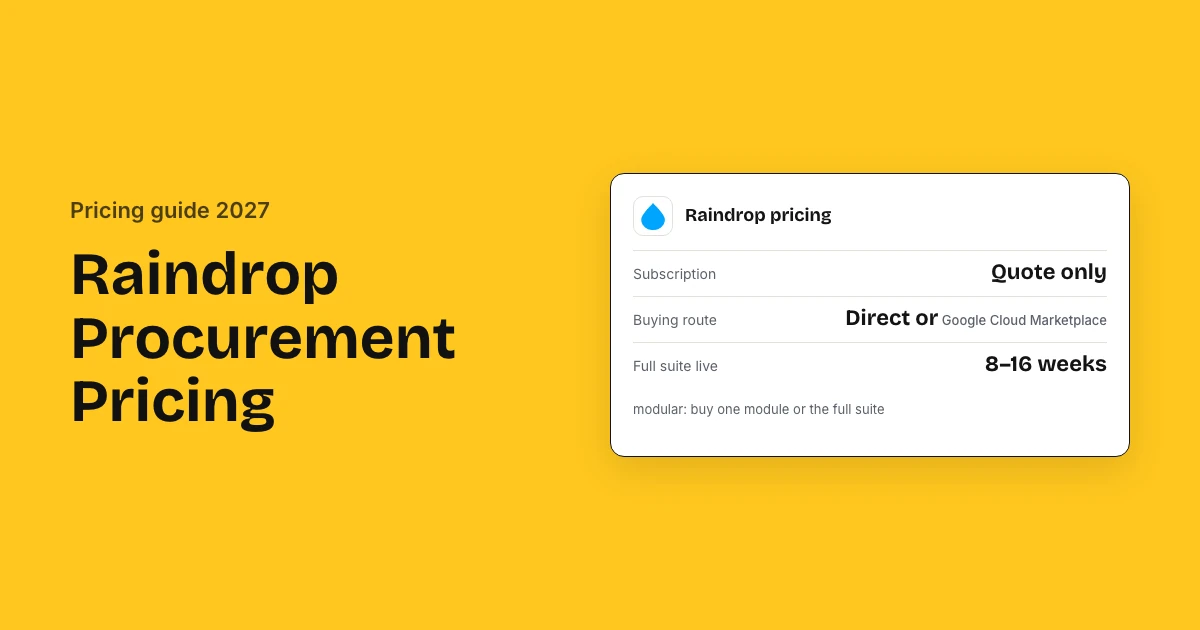
Raindrop publishes no price list: Raindrop Systems quotes its source-to-pay software as a full suite or single modules, or sells it as a Google Cloud Marketplace private offer. Modules include sourcing, contracts, eProcurement and AP automation. Raindrop calls its pricing value-aligned rather than per user or per entity.
Raindrop procurement pricing: key takeaways
- Quote only: Raindrop Systems publishes no prices, and G2 says pricing is not listed by the vendor.
- Modules: You can buy the full suite or any of Spend Orchestration, Sourcing, Contracts, eProcurement and AP Automation.
- Pricing model: Raindrop describes value-aligned SaaS pricing tied to outcomes rather than user or entity counts.
- Google Cloud: Buying through Google Cloud Marketplace puts Raindrop on your Google invoice and counts toward committed spend.
- Setup time: Raindrop says a single module can go live in about a week and the full suite in 8 to 16 weeks.
- Name check: Raindrop procurement software is not Raindrop.io, the bookmark app, or raindrop.ai, so ignore their prices.
How much does Raindrop cost?
Raindrop publishes no price, and no dollar figure appears on any Raindrop page; it quotes every deal for its AI source-to-pay suite. Raindrop describes the model as value-aligned SaaS rather than a licence plus services fee, which puts it with enterprise procurement software on scope.
| Module | What it covers | How it is priced |
|---|---|---|
| Spend Orchestration (intake) | One front door for purchase requests and approvals | Quoted |
| Sourcing | RFx and supplier selection | Quoted |
| Contracts | Contract lifecycle management | Quoted |
| eProcurement | Requisitions, catalogs, purchase orders | Quoted |
| AP Automation | Invoice capture, matching and approval | Quoted |
- Raindrop says pricing follows realized outcomes, not user or entity counts
- It claims value-aligned pricing can cut total cost of ownership by up to 40% against legacy suites
- Customers range from $250M to $2B in annual revenue, per Raindrop
- The platform runs on Google Cloud and can be bought through its Marketplace
Do not confuse it with other Raindrops
Prices you may see for Raindrop.io, a bookmark manager, or raindrop.ai, an AI monitoring tool, are for different products. A Capterra listing at $415 a month also appears to be another product, so we leave it out.
What will Raindrop cost for your business?
Raindrop publishes no price, so no sourced figure a year exists for a 50-200 person company: it quotes every deal, and no third party has buyer data. Its customers range from $250M to $2B in revenue, above most firms that size. Your quote, direct or via Google Cloud, depends on modules, implementation, ERP integration, support and term.
What drives your quote
Your Raindrop quote rises with the modules you buy, any outcome-based element, implementation scope, integrations beyond standard connectors, premium support and the buying route.
| Driver | What raises it | What to ask |
|---|---|---|
| Modules | Buying the full suite instead of one module | Price per module and for the suite |
| Outcome-based element | Raindrop ties pricing to realized outcomes, not users or entities | The metric, the baseline and any cap on that part of the fee |
| Implementation | Wider scope and more configuration | Fixed fee or time and materials |
| Integrations | Connections beyond standard RainConnect connectors | Which ERP connectors are included |
| Support | Premium support | What standard support covers |
| Buying route | Direct contract vs Google Cloud private offer | Whether the Marketplace price differs |
| Company size | Raindrop's customers run from $250M to $2B in revenue | Whether a smaller-company package or a single-module minimum exists |
Ask Raindrop for these in writing
Get each module's yearly price, how value-aligned pricing is measured, the implementation fee and timeline, ERP integration cost and renewal terms in writing.
- The yearly subscription for each module you need
- How value-aligned pricing is measured and when it changes
- Implementation fee and timeline
- Integration cost for your ERP
- Renewal increases and contract length
What Raindrop charges on top of the subscription
Raindrop publishes no fee schedule. RFP.wiki's review lists implementation and support fees, discounts and multi-year terms as undisclosed, and says first-year cost hinges on modules, configuration scope, integration work beyond standard connectors and any premium support. Ask for each as a separate line.
| Possible extra | What is public | What to ask |
|---|---|---|
| Implementation | Not published | A fixed fee by module |
| Integration beyond RainConnect | Not published | Price per extra connector |
| Premium support | Not published | What it adds and costs |
| Multi-year discount | Not published | Price for a three-year term |
| Google Cloud billing | Counts toward committed spend | Whether credits apply to your account |
Raindrop's own content cites 20% to 30% savings on request processing and 50% to 75% automation in year one. Treat these as vendor claims, and ask how any outcome-based element of the price is calculated.
How much does Raindrop ERP integration cost?
Raindrop publishes no ERP integration price and lists integrations, through its API-first RainConnect layer, as part of the platform rather than a priced add-on. Third-party reviewers note that integration work beyond the standard connectors is a cost driver, so get your ERP scope priced before you sign.
| Integration | What Raindrop says | Effect on cost |
|---|---|---|
| Standard ERP and P2P connectors | RainConnect, API-first | Part of the platform |
| Custom connectors | Not published | Implementation scope |
| Google Cloud | Built on Google Cloud | Billing via Google if bought there |
What to confirm about your ERP
Confirm whether your ERP has a standard RainConnect connector, which data syncs both ways, and who builds and pays for any custom connector.
- Whether your ERP has a standard RainConnect connector
- Which data syncs both ways: suppliers, POs, invoices, payments
- Who builds and maintains a custom connector, and at what cost
- Whether running alongside Coupa or another P2P tool is supported
- How long integration adds to the 8 to 16 week rollout
Raindrop implementation cost and setup time
Raindrop publishes no implementation fee, and says one module can go live in about a week and the full source-to-pay suite in 8 to 16 weeks. Modules in scope, ERP connections beyond its RainConnect connectors and data migration drive the quoted fee. RFP.wiki flags implementation complexity as a recurring buyer concern.
| Phase | Time (Raindrop) | Cost |
|---|---|---|
| Quote or Marketplace private offer | Before start | Subscription set here |
| First module live | From about 1 week | Implementation not published |
| Full suite live | 8 to 16 weeks | Implementation not published |
| Payback | 3 to 6 months (vendor claim) | Not applicable |
- Raindrop says setup needs low IT lift because RainConnect is API-first
- Supplier, contract and approval data can migrate through RainConnect, per Raindrop
- Built-in change-management tools are included, according to Raindrop
- Third-party summaries put implementation at 2 to 4 weeks per module
Raindrop supports phased rollouts, starting with intake, sourcing or AP automation, so you can price the first module's setup on its own before you commit to the full suite.
Buying through Google Cloud and contract terms
You can buy Raindrop directly or through Google Cloud Marketplace, where every dollar counts toward your Google Cloud committed spend and billing comes on one Google invoice. Raindrop says private offers are available and promises no lock-in and no wasted modules, but contract terms are not published.
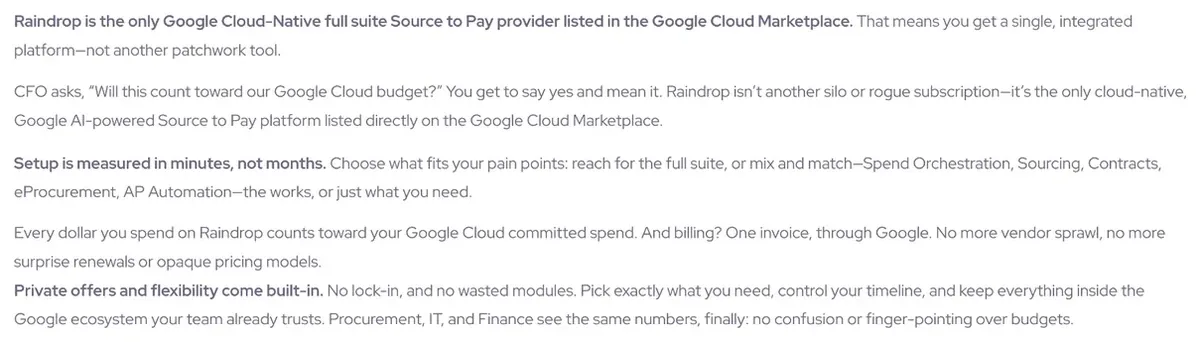
For buyers outside Google Cloud, the same modules are sold directly. Either way, Raindrop lets you start with one module, such as intake or AP automation, and add the rest later, so price the first module and the full suite in the same quote.
Renewal terms to check before you sign
Raindrop publishes no contract terms, so get the term length, a renewal cap, the right to drop modules and data export rights in writing before you sign.
- Term length and whether you can drop modules at renewal
- A cap on renewal increases
- How any outcome-based fee is measured each year
- Whether Marketplace and direct contracts renew on the same terms
- Data export rights if you leave
What companies actually pay for Raindrop
Raindrop has no public buyer-price data: G2 lists no price, Vendr has no Raindrop page, and RFP.wiki marks list prices, fee schedules and discount terms as unknown. Raindrop says its customers range from $250M to $2B in annual revenue, which points to mid-market and larger deals.

| Source | What it reports |
|---|---|
| Raindrop | No price list; value-aligned SaaS; private offers |
| G2 | Pricing not listed; no reviews yet |
| RFP.wiki (Aug 2026) | No public list price or SKU rates; fees and discounts unknown |
| Gartner Peer Insights | Listing exists; RFP.wiki notes some reporting gaps flagged |
Raindrop's own case figures, such as a 400% ROI on $120 million of managed spend and a 75% cut in intake-to-PO cycle time for a retailer, describe results, not prices. Ask for the quote that sat behind any case study you are shown.
Is Raindrop worth the price?
Raindrop is worth it for $250M to $2B revenue companies that want a full source-to-pay suite live in weeks and already buy through Google Cloud. With no public price and thin review evidence, budgeting is harder for finance teams, which is when Raindrop alternatives are worth comparing.
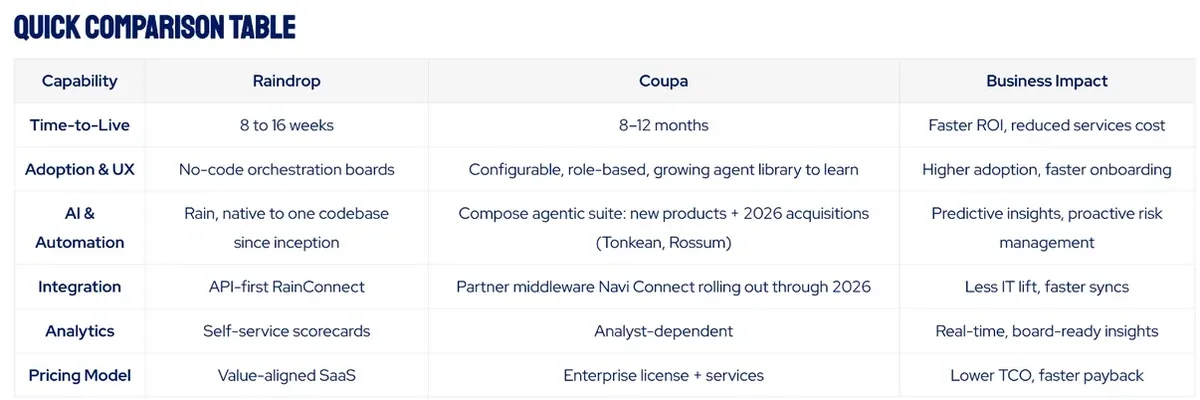
| Factor | Raindrop | Coupa (per Raindrop) |
|---|---|---|
| Time to live | 8 to 16 weeks | 8 to 12 months |
| Pricing model | Value-aligned SaaS | Enterprise licence + services |
| Integration | API-first RainConnect | Partner middleware |
| Analytics | Self-service scorecards | Analyst-dependent |
Worth it if
- You have Google Cloud committed spend to use
- You want sourcing, contracts and P2P in one suite
- You want to roll out module by module
- You are moving off Coupa or a legacy suite
Look elsewhere if
- You need a published price before a sales call
- You want plenty of peer reviews before buying
- You only need requests, approvals and POs
- You want per-user pricing you can model yourself
How to get a better Raindrop price
Ask for each module priced separately, implementation as a fixed fee and the formula behind any value-aligned element. Then compare the direct quote with a Google Cloud Marketplace private offer, which can use committed spend, and bring published prices from Precoro or ProcureDesk as a benchmark.
Get in writing
- Price per module
- How value-aligned pricing is measured
- Implementation fee
- Integration scope and cost
- Support level
- Renewal cap
Ways to pay less
- Start with one module
- Use Google Cloud committed spend
- Compare direct and Marketplace offers
- Bring published competitor prices
- Ask for a multi-year rate
Raindrop pricing vs alternatives
Raindrop publishes no price, while Precoro publishes $499 to $999 a month, ProcureDesk $830 to $1,250 a month, and Coupa's Vendr median is $94,519. Zapro pricing has Spark at $699 a month, Growth at $1,999 a month and Scale on custom pricing, all with unlimited users; your ERP or bank pays suppliers.
| Tool | Pricing model | Typical cost | Users priced |
|---|---|---|---|
| Raindrop | Quote, value-aligned | Not published | Not per user, per Raindrop |
| Precoro | Published plans by user tier | $499–$999/month (list price) | Tier; Standard users free |
| ProcureDesk | Published plans + extra users | $830–$1,250/month (list price) | 10 or 20 included |
| Coupa | Quote by module | $94,519/yr (Vendr median) | Active users |
| Zapro | Flat plans, unlimited users | Spark $699 / Growth $1,999 a month; Scale custom | No per-user fee |
Raindrop pricing FAQs
How much does Raindrop procurement software cost?
Raindrop does not publish prices. Each deal is quoted, or offered as a Google Cloud Marketplace private offer, based on the modules you buy, implementation and integration scope and support. G2 also lists no price for Raindrop.
Can I buy Raindrop on Google Cloud Marketplace?
Yes. Raindrop says it is the only full-suite source-to-pay provider built on Google Cloud that sells on Google Cloud Marketplace. Buying there puts it on your Google invoice, counts toward committed spend and allows private offers.
Does Raindrop charge per user?
No. Raindrop says it aligns pricing to realized outcomes, not user or entity counts, and describes the model as value-aligned SaaS. It does not publish how that is calculated, so ask for the formula and any minimums in writing.
How long does Raindrop take to implement?
Raindrop says one module can go live in as little as a week and the full source-to-pay suite in 8 to 16 weeks. Implementation fees are not published, and third-party reviewers cite implementation complexity as a buyer concern.
Is Raindrop the same as Raindrop.io?
No. Raindrop procurement software comes from Raindrop Systems, based in San Jose. Raindrop.io is a bookmark manager and raindrop.ai is an AI monitoring tool, so their published prices have nothing to do with Raindrop procurement pricing.
Can Raindrop run alongside Coupa?
Yes, according to Raindrop. It supports phased rollouts that start with intake, sourcing or AP automation before a full migration, and says supplier, contract and approval data can move across through RainConnect. Price each phase separately.
Sources: Raindrop vs Coupa; Raindrop and Google Cloud; G2 Raindrop pricing; RFP.wiki. Prices come from Raindrop's own pages where published and from the third-party sources listed, labelled as such. Estimates are not quotes.