


The best ZipHQ alternatives are 1. Procurify 2. Precoro 3. Zapro 4. Ramp 5. Coupa 6. SAP Ariba 7. Payhawk 8. Order.co 9. Kissflow.
The best Zip alternative depends on whether you want full procure-to-pay, a full suite or a card-first tool. Procurify and Precoro replace Zip's procure-to-pay flow for mid-sized teams. Coupa and SAP Ariba suit large enterprises, Ramp and Payhawk suit card-first finance teams, and Kissflow replaces only the intake layer.
ZipHQ competitors: key takeaways
 Procurify: Best for mid-sized teams that want requests, POs, invoice matching and supplier payments to 190+ countries from one vendor, at a Vendr buyer median of $15,000 a year.
 Precoro: Best for mid-sized companies with several sites that want purchasing and AP at a published price, from $499 a month billed yearly.
 Zapro: Best for mid-market teams that want intake, sourcing, contracts and POs at a published price, from $699 a month with unlimited users. Your ERP or bank still pays suppliers.
 Ramp: Best for finance-led teams that already run cards and bill pay on Ramp and want purchase approvals through its Procurement add-on.
 Coupa: Best for large enterprises that have outgrown an intake layer and need full source-to-pay, at a Vendr buyer median of $94,519 a year.
 SAP Ariba: Best for global enterprises on SAP ERP that want sourcing, contracts and buying from their finance vendor, with Ariba Snap for midsize firms.
 Payhawk: Best for multi-entity, multi-currency finance teams that want cards, AP and purchase requests in one tool, with Procurement from $499 a month.
 Order.co: Best for multi-location teams buying supplies from many vendors that want one cart, one consolidated bill and fewer supplier invoices.
 Kissflow: Best for teams that only want low-code intake and approvals around their ERP, on a fixed annual quote by apps and users.
ZipHQ alternatives compared
Zip alternatives fall into four groups: mid-market procure-to-pay (Procurify, Precoro, Zapro), enterprise suites (Coupa, SAP Ariba), card-first spend tools (Ramp, Payhawk) and buying or intake layers (Order.co, Kissflow). The table compares who each tool is built for, its key features, ERP integrations, starting price and G2 rating.
| Tool | Best for | Key features | ERP integrations | Starting price | Rating |
|---|---|---|---|---|---|
 Zip (for reference) | Enterprise intake orchestration | AI intake, approval workflows, POs, AI RFx, contract orchestration, supplier onboarding; Global Payments add-on | SAP S/4HANA, Oracle Fusion, Workday, NetSuite, Sage Intacct, Business Central; no QuickBooks | Quote; Vendr buyer data: median $88,856 a year | G2 4.6 (153) |
| Procurify | Mid-sized procure-to-pay | Requests, approvals, POs, receiving; AP add-on with 2-way and 3-way matching; payments to 190+ countries | NetSuite, QuickBooks, Sage Intacct, Dynamics 365 Business Central | Quote by Pro users; Vendr buyer data: median $15,000 a year | G2 4.6 (415) |
| Precoro | Procurement at a published price | Requests, POs, 2-way and 3-way matching on Core; RFPs, punch-out and AI capture on Automation | QuickBooks Online, Xero, NetSuite, Sage Intacct, Dynamics 365 Business Central | $499 per month (Core, billed yearly) | G2 4.7 (225) |
| Zapro | Mid-market intake to invoice | Intake, approvals, POs, RFI/RFP sourcing, contracts, 2-way and 3-way matching | Integrates with NetSuite, QuickBooks, Sage Intacct, SAP, Oracle, Workday, Dynamics | $699 per month, unlimited users | G2 4.7 (14) |
| Ramp | Card-first finance teams | Cards, expenses, bill pay; Procurement add-on with AI intake, POs and 3-way matching | QuickBooks, Xero; NetSuite and Sage Intacct on Plus; Workday and Oracle Fusion on Enterprise | Free $0; Plus $15 per user per month plus a platform fee | G2 4.8 (2,576) |
| Coupa | Enterprise source-to-pay | Intake, sourcing, contracts, POs, 2-way and 3-way matching, payments through partners | SAP, Oracle, NetSuite, Workday, Dynamics | Quote; Vendr buyer data: median $94,519 a year | G2 4.2 (571) |
| SAP Ariba | Global enterprises on SAP ERP | Sourcing, contracts, supplier lifecycle, guided buying, intake, invoicing; Snap package for midsize firms | SAP S/4HANA and SAP Cloud ERP | Quote only | G2 4.1 (818) |
| Payhawk | Multi-entity, multi-currency spend | Visa cards, expenses, OCR invoice capture, 2-way and 3-way matching, requests to POs | NetSuite, Sage Intacct, SAP S/4HANA, Oracle Fusion, Dynamics 365, Xero, QuickBooks | AP from $349 per month; Procurement from $499 per month | G2 4.5 (961) |
| Order.co | Multi-location supplies buying | One cart across vendors, approvals and budgets, POs; Order.co pays vendors and sends one bill | QuickBooks Online, NetSuite, Sage Intacct | Custom quote | G2 4.4 (155) |
| Kissflow | Intake around an existing ERP | Low-code intake and approvals, POs written to the ERP, goods receipt, 3-way matching | SAP S/4HANA and ECC, Oracle, NetSuite, Dynamics 365, JD Edwards, Sage | Fixed annual quote by apps and users | G2 4.3 (590) |
Find your ZipHQ alternative
Choose a Zip alternative by matching it to the job you use Zip for, your company size, your ERP and your budget. Zip is an intake and orchestration layer first, so some teams swap it for a full procure-to-pay tool and others for a lighter intake layer. Pick the tab that fits, then check the reasons teams leave below.
What you use Zip for
Kissflow Procurement CloudProcurifyPrecoroCoupaZaproRampPayhawkOrder.coCompany size
PrecoroRampProcurifyPrecoroZaproCoupaSAP AribaYour ERP
ProcurifyPayhawkPrecoroRampSAP AribaCoupaKissflow Procurement CloudProcurifyPrecoroBudget
PrecoroZaproProcurifyCoupaSAP AribaWhy teams leave Zip, and what fixes it
Teams leave Zip mainly over basic reporting (10 of 28 reviews), complex setup (5), ERP sync issues (4) and bugs (4). We read 28 Zip reviews on 11 November 2026: the 10 newest on G2 and 18 on Capterra. Each reason below names the alternatives that fix it and what to test in a demo.
What Zip does well came up more often: 11 of the 28 reviewers praised its single intake front door, and 11 praised how easy its approval workflows are to change.
What Zip doesn't cover, and who does
Zip covers intake, procure-to-pay, sourcing, contracts and supplier onboarding. Its own pages show five gaps: no price list, no QuickBooks on its integrations page, no named punch-out, no inventory and no employee cards or expenses. The table shows which alternatives fill each gap, so you only add a tool where Zip falls short.
| If you need | In Zip | Alternatives that include it |
|---|---|---|
| Published prices | Quote only; Vendr buyer data shows a median of $88,856 a year | PrecoroPayhawkRampZapro |
| QuickBooks integration | Integrations page names NetSuite, Sage Intacct and Business Central, but no QuickBooks | ProcurifyPrecoroRampZapro |
| Punch-out to Amazon Business | Catalog guidance only; no punch-out or Amazon Business named | ProcurifyPrecoroCoupa |
| Inventory | Zip's products cover intake, procure-to-pay, sourcing, contracts and risk; inventory is not one of them | PrecoroCoupa |
| Employee cards and expenses | Vendor Cards add-on pays suppliers; no employee expense tool | RampPayhawkProcurifyPrecoro |
The 9 best ZipHQ alternatives, reviewed
Each review below shows what the tool is built for, its key features, pros, cons, pricing and the buyer it fits best. Procurify, Precoro and Zapro cover requests to invoices, Coupa and SAP Ariba full source-to-pay, Ramp and Payhawk cards plus purchasing, Order.co multi-site buying and Kissflow intake only.
Procurify: best for mid-sized procure-to-pay
Best for Mid-sized procure-to-pay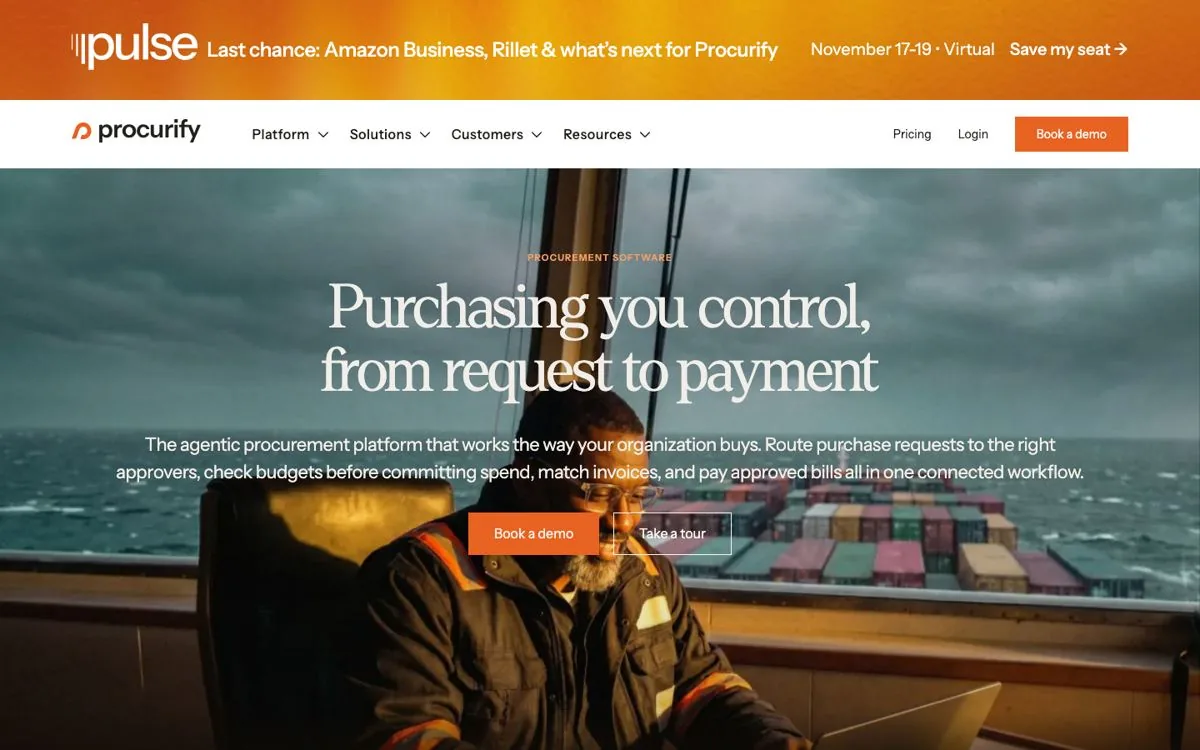
Procurify fits mid-sized teams leaving Zip that want requests, POs, receiving, invoice matching and supplier payments from one vendor. Its base Purchasing product covers requests, approvals and POs, with unlimited Basic users. AP, cards, intake and contracts are each priced separately, and it runs no sourcing events.
Key features 6 features
- Purchase requests and purchase orders in the base product
- Approval rules by department, location, account code or amount
- 2-way and 3-way matching in the AP product
- Supplier payments to 190+ countries
- Punch-outs to Amazon Business, Staples, Home Depot and Grainger
- Published rollout plans: 4 weeks (Basic) to 12+ weeks (Premium)
Pros and cons 3 pros, 3 cons
Pros
- Free Basic users: requesters on Basic seats cost nothing, so the whole company can submit requests without raising the quote
- One vendor: buying and paying suppliers sit in the same platform, so you avoid adding Zip's separate payments add-on
- Published rollouts: 4 weeks on Basic and 12 weeks for NetSuite, so you can plan the switch from Zip with real dates
Cons
- No sourcing: its platform pages show no RFx events, so teams that run supplier bids in Zip need another tool
- Separate modules: AP, cards, intake and contracts are each priced on their own, so the full set costs more than the base
- Quote only: there is no price list on its site, so you cannot compare cost with Zip until you talk to sales
Pricing
Quote only, built from products, add-ons, Pro users and integrations. Vendr buyer data shows a median of $15,000 a year, with a range of $4,210 to $40,000.
Best for
Mid-sized companies leaving Zip that want requests, POs, invoice matching and supplier payments with one vendor, without enterprise pricing.
Verdict
Verdict: Procurify covers Zip's procure-to-pay job at a much lower Vendr median. Pick another tool if you run sourcing events.
Precoro: best for procurement at a published price
Best for Procurement at a published price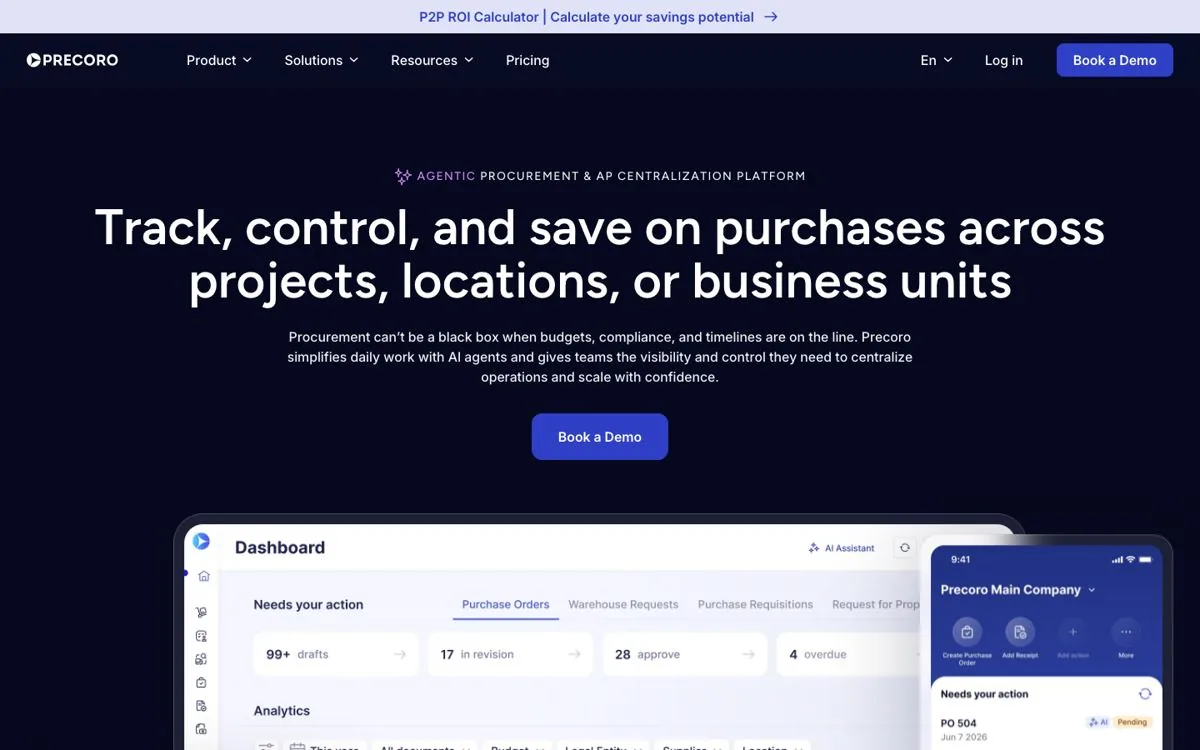
Precoro fits mid-sized companies with several sites or entities that want a full purchasing and AP flow at a published price. It runs requests, approvals, POs, receipts, invoices and payments next to your ERP, from $499 a month billed yearly. RFPs, punch-out and AI capture need the $999 Automation plan.
Key features 6 features
- 2-way and 3-way matching on Core
- AP automation with AI invoice capture on Automation
- Contract repository with an AI Contract Agent
- ACH, same-day ACH, wire and international transfers
- Punch-out to Amazon Business, Staples, Home Depot and Grainger on Automation
- Inventory on Automation and above
Pros and cons 3 pros, 2 cons
Pros
- Published price: the Core plan price is on its site, so you can budget purchasing before a sales call
- Easy exit: there is no formal contract and 30 days' notice to cancel, which lowers the risk of trying it
- Review base: G2 4.7 from 225 reviews, a solid sample for a procurement tool of its size
Cons
- User limits: unlimited users come only on Enterprise, so cost rises when many staff raise requests or approve
- Plan gates: RFPs, punch-out, vendor onboarding and AI capture need the $999 Automation plan, so Core suits basic PO work
Pricing
Core from $499 a month and Automation from $999 a month, billed yearly. A standalone AP module starts at $499 a month. Enterprise is custom.
Best for
Price-led mid-sized buyers who want a full purchasing and AP flow on a published plan and can work within plan user limits.
Verdict
Verdict: Precoro is a good price baseline for any Zip replacement. Check the user limit and which features need Automation before you commit.
Zapro: best for mid-market intake to invoice
Best for Mid-market intake to invoice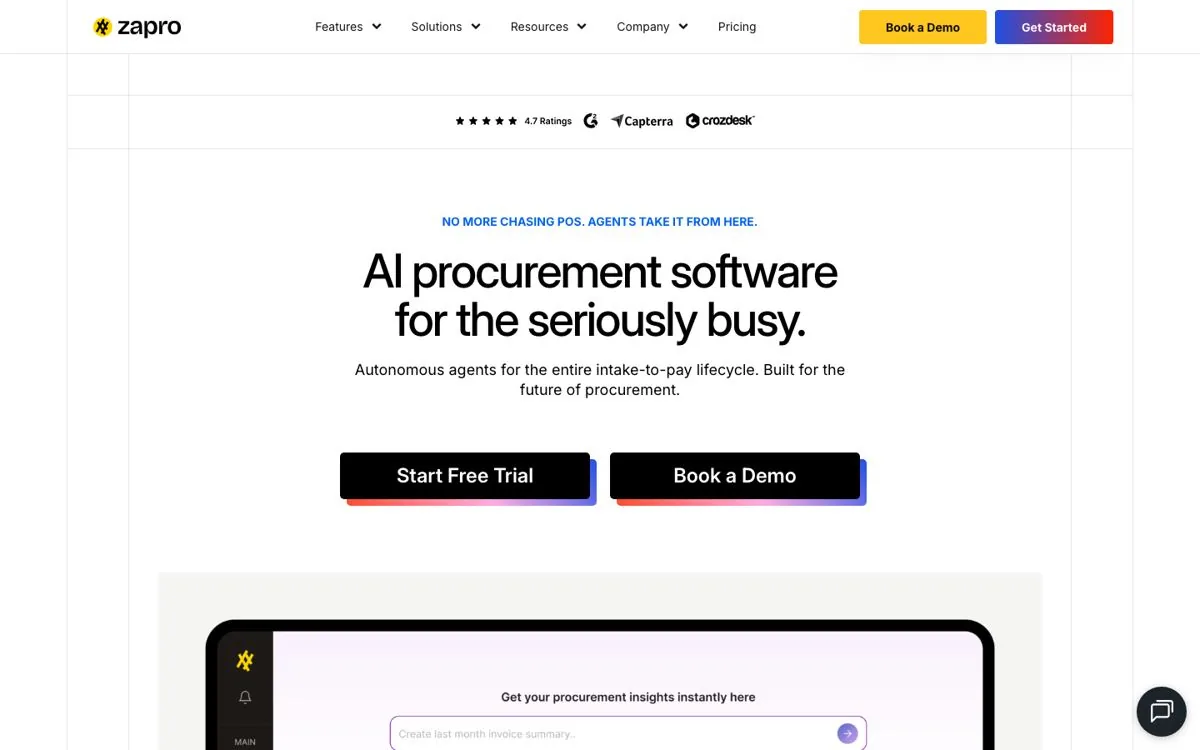
Zapro is a strong Zip alternative for mid-market teams whose gap is intake, sourcing and contracts at a published price. This AI-native procurement software covers intake, approvals, POs, RFI and RFP events, contracts and invoice matching, with unlimited users. Plans start at $699 a month, and your ERP or bank pays suppliers.
Key features 4 features
- Approvals routed by amount, category or vendor, in series or in parallel
- 2-way and 3-way matching with an exception queue (3-way on Growth and up)
- RFI and RFP events on every plan, plus contracts with renewal alerts
- Approve and raise requests in Slack or Microsoft Teams
Pros and cons 2 pros, 2 cons
Pros
- Unlimited users: every plan includes unlimited users, so requesters and occasional approvers never add to the monthly bill
- Published prices: Spark is $699 a month and Growth $1,999, so you can budget before you talk to sales
Cons
- No payments: it prepares payment batches, but your bank or ERP sends the money, so keep a payments tool if you want software to pay
- Vendor caps: Spark covers up to 50 active vendors and Growth up to 500, so teams with many suppliers need a higher tier
Pricing
Spark $699 a month (up to 50 vendors), Growth $1,999 a month (up to 500 vendors), Scale on custom pricing, as published on zapro.ai in November 2026. The pricing page lists 3-way matching and contract authoring in the Growth plan's AI suite.
Best for
Mid-market finance and procurement teams of 50 to 200 people that want intake, sourcing, contracts and matching in one suite at a published price.
Verdict
Verdict: Pick Zapro if the gap in Zip is price, sourcing or contracts. Keep a payments tool next to it if you want the software itself to pay suppliers.
Ramp: best for card-first finance teams
Best for Card-first finance teams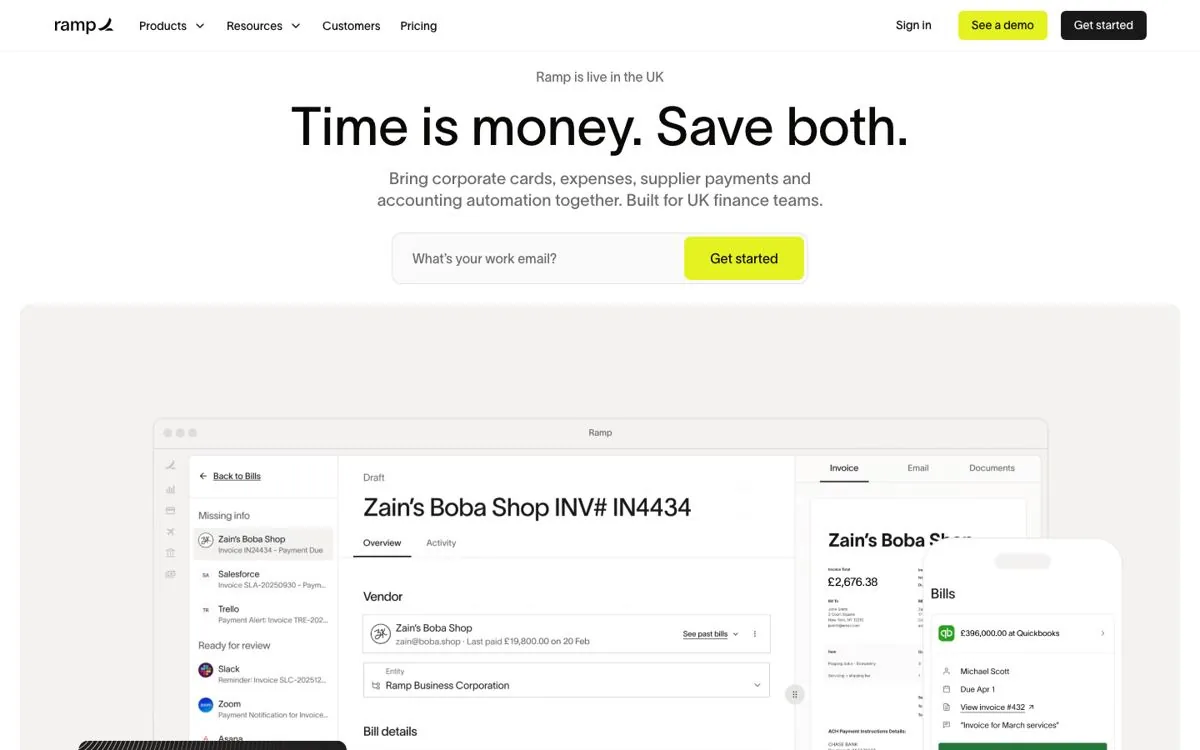
Ramp fits finance-led teams that already run cards, expenses and bill pay on Ramp and want purchase approvals in the same place. Its Procurement add-on brings AI intake, POs, RFx drafting and 3-way matching on Plus or Enterprise. The add-on has no list price, and for full contract management it connects to CLM tools such as Ironclad.
Key features 3 features
- Procurement add-on with AI intake and RFx drafting
- 2-way and 3-way matching, including card spend against POs
- Corporate cards, expenses and bill pay
Pros and cons 2 pros, 3 cons
Pros
- Review base: 4.8 on G2 from 2,576 reviews, the largest sample on this list for judging day-to-day use
- Fast start: Ramp says most teams are fully running on Procurement within a week, which shortens the switch from Zip
Cons
- Add-on pricing: Procurement is priced separately on top of Plus, so you only learn the cost of purchase approvals from a quote
- No auctions: its RFx agent drafts and scores bids but runs no auctions, so sourcing-heavy teams need another tool
- Light contracts: it tracks renewals with reminders, but full contract management runs through CLM tools such as Ironclad, so contract-heavy teams pay twice
Pricing
Free plan at $0; Plus at $15 per user per month plus a platform fee; Enterprise custom. The Procurement add-on is priced separately and needs Plus or Enterprise.
Best for
Finance-led companies that already pay suppliers and employees through Ramp and want purchase approvals in the same place as cards and bills.
Verdict
Verdict: Ramp suits teams whose finance stack already runs on it. Teams that need deep sourcing or contracts will find it thin.
Coupa: best for enterprise source-to-pay
Best for Enterprise source-to-pay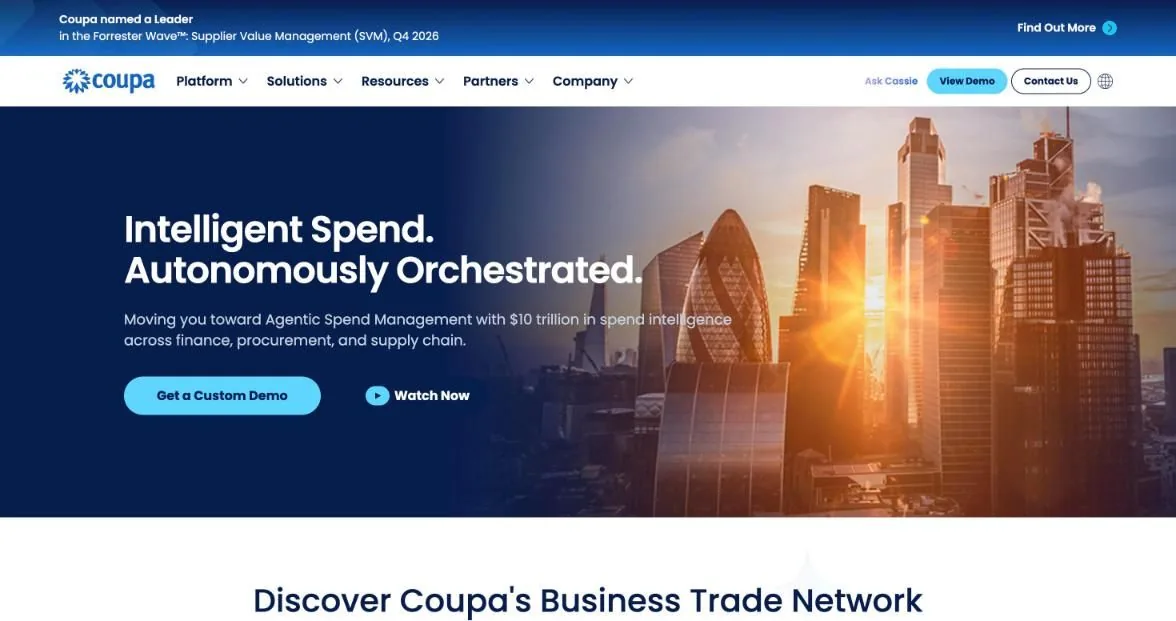
Coupa fits large enterprises that have outgrown Zip's orchestration layer and need full source-to-pay in one suite. It covers intake, sourcing, contracts, procurement, AP and payments through partners. Rollouts take months, often with partners, and Vendr buyer data shows a median of $94,519 a year, close to Zip's $88,856.
Key features 6 features
- Sourcing and advanced sourcing optimization
- Contract repository enforced at the time of purchase
- AI invoice capture with 2-way and 3-way matching
- Open Buy and Amazon Business punch-out
- Payments and virtual cards through partners
- Community benchmarking of spend KPIs
Pros and cons 2 pros, 4 cons
Pros
- Broad suite: sourcing, contracts, procurement, AP and payments sit in one platform, so large teams buy from one vendor
- Benchmarks: spend KPIs are compared across its customer community, which helps teams that found Zip's reports too basic
Cons
- Long rollouts: implementations take months and often run through partners, so plan for consulting fees and internal time
- Module pricing: each part of the suite is sold separately, so the price climbs as you add sourcing, contracts or payments
- Mid-market fit: the suite is more than most teams under 500 people need, so you may pay for depth you never use
- High cost: Vendr buyer data puts the median deal at $94,519 a year before partner fees, so budget well above mid-market tools
Pricing
Quote only, sold by module. Vendr buyer data shows a median of $94,519 a year across 128 purchases, from $20,804 to $331,084.
Best for
Large enterprises with global entities and a procurement team that have outgrown an intake layer and need full source-to-pay.
Verdict
Verdict: Coupa fits when Zip feels too light for your spend and reporting. For most mid-market teams, the cost and rollout outweigh the extra depth.
SAP Ariba: best for global enterprises on SAP ERP
Best for Global enterprises on SAP ERP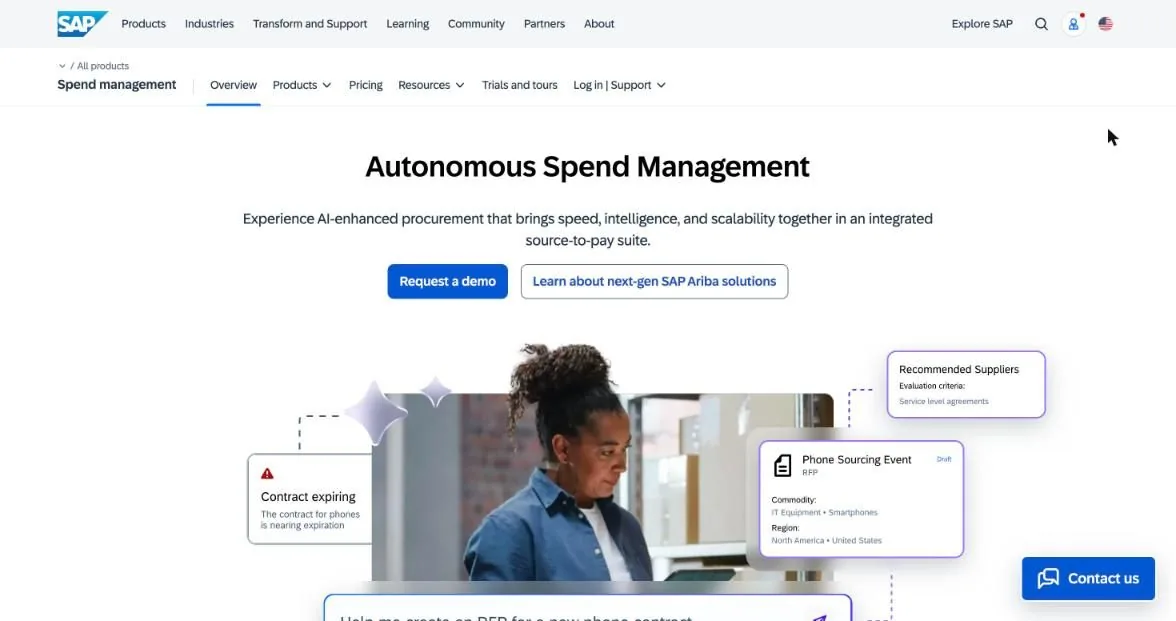
SAP Ariba fits global enterprises that run SAP ERP and want sourcing, contracts and buying from the vendor behind their finance stack. It covers sourcing, contracts, supplier management, guided buying, intake and invoicing. SAP is rebuilding it on its BTP platform from 2026, so existing customers face a platform change.
Key features 5 features
- Sourcing events; AI bid analysis announced
- Contract creation, approvals and compliance tracking
- Supplier lifecycle and performance
- Guided buying and Intake Management
- Ariba Snap, a packaged version for midsize firms
Pros and cons 3 pros, 3 cons
Pros
- One suite: sourcing, contracts, supplier management, buying and invoicing sit together, so large teams avoid stitching tools
- SAP fit: built around SAP S/4HANA and SAP Cloud ERP, so SAP shops keep one vendor for finance and procurement
- Midsize package: Ariba Snap is packaged and priced for midsize firms, with SAP stating spend control in as few as 12 weeks
Cons
- Click-heavy buying: reviewers report too many clicks and drop-downs, which slows simple purchases for everyday requesters
- Supplier fees: suppliers with enterprise accounts pay network fees past set limits, which some vendors push back on
- Platform change: SAP is rebuilding Ariba on BTP from 2026, so existing customers face a move to the new version
Pricing
Quote only, through SAP or its partners. Ariba Snap is sold as a fixed package through partners.
Best for
Global enterprises that already run SAP ERP and want a full source-to-pay suite from the vendor behind their finance system.
Verdict
Verdict: SAP Ariba suits a large SAP shop. Skip it if you chose Zip to avoid a heavy suite, because Ariba is one.
Payhawk: best for multi-entity, multi-currency spend
Best for Multi-entity, multi-currency spend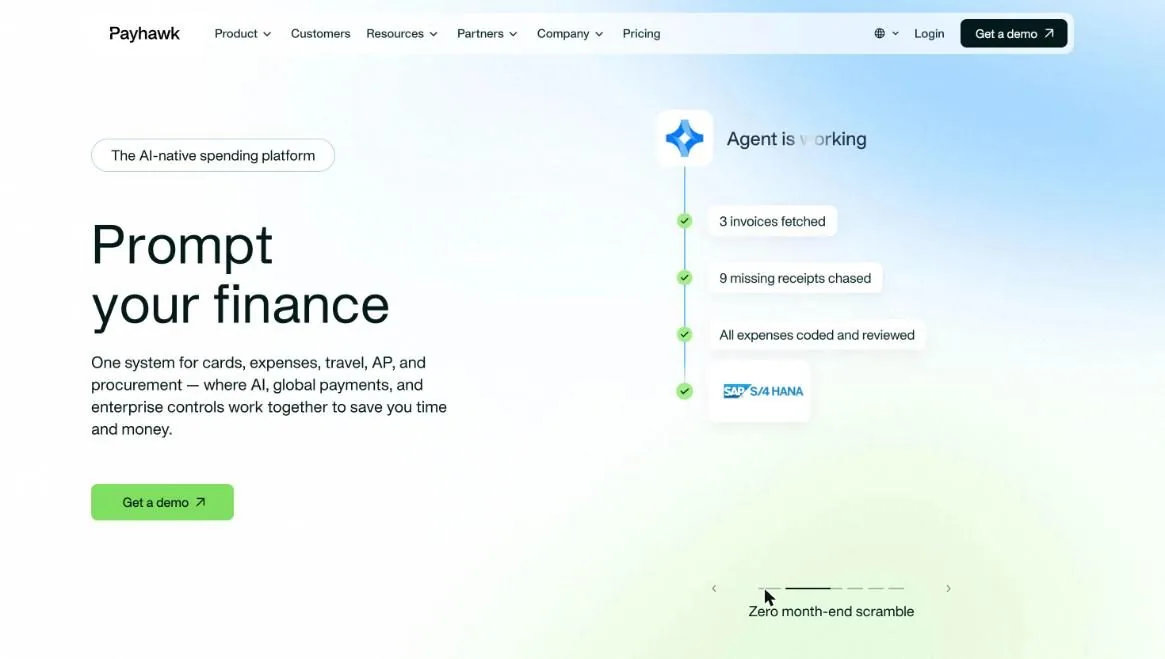
Payhawk fits finance teams with several entities or currencies that want cards, AP and purchase requests from one vendor instead of an intake layer. It turns plain-language requests into POs, matches invoices 2-way and 3-way and pays in 115+ currencies. Its US Procurement module starts at $499 a month, and it has no sourcing or contract module.
Key features 6 features
- Plain-language purchase requests that turn into POs
- Two-way PO sync with NetSuite
- OCR invoice capture in 60+ languages
- 2-way and 3-way matching to the line item
- Visa debit and credit cards with merchant and country controls
- Business accounts in EUR, GBP, USD, CHF, DKK and PLN
Pros and cons 2 pros, 2 cons
Pros
- Published prices: module prices are on its US site, so you can cost AP and procurement before a sales call
- No implementation fee: setup carries no one-off charge, which lowers the first-year cost of switching from Zip
Cons
- No sourcing or contracts: its product pages show no sourcing or contract module, so bids and renewals need another tool
- Paid add-ons: budget tracking and extra entities cost extra, so multi-entity groups should get a full written quote
Pricing
US site, per month: Travel from $299, Accounts Payable from $349, Cards & Expenses from $449, Procurement from $499. The full bundle is quoted.
Best for
Finance teams with several entities or currencies who want cards, AP and purchase requests in one tool rather than a separate intake layer.
Verdict
Verdict: Payhawk suits multi-currency, multi-entity spend. The modules add up, so price the bundle you really need.
Order.co: best for multi-location supplies buying
Best for Multi-location supplies buying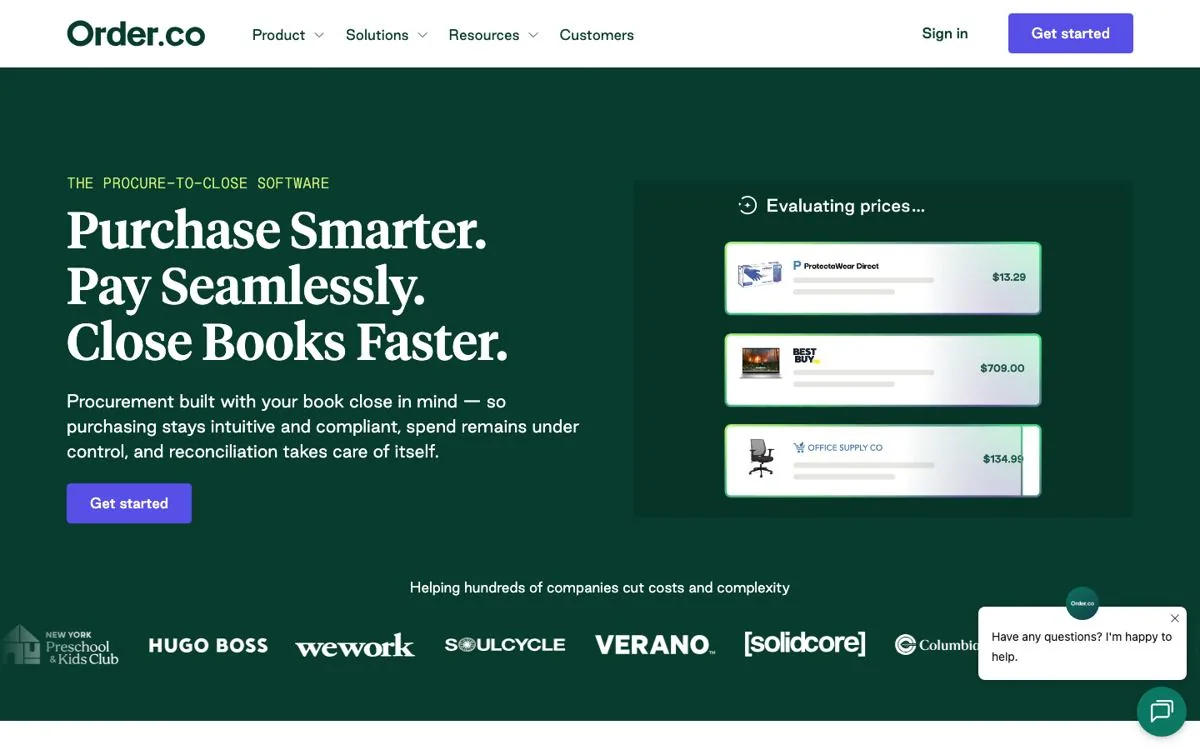
Order.co fits multi-location companies whose Zip pain is the buying itself, not the approvals. Formerly Negotiatus, it lets teams order from many vendors in one cart, then pays those vendors and sends one consolidated bill with line-level GL coding. It has no RFx events or contract lifecycle module, and prices are quote only.
Key features 5 features
- Guided purchasing across vendors in one cart
- Approvals by location, cost center, role or spend threshold
- Order.co pays vendors and sends one bill
- AI sourcing suggests cheaper vendors for the same items
- Vendor-locked virtual cards
Pros and cons 1 pros, 2 cons
Pros
- Fewer invoices: purchases roll into one Order.co bill, so AP processes far fewer supplier invoices each month
Cons
- No sourcing or contracts: there are no RFx events or contract lifecycle module, so services and contract-heavy spend need another tool
- No price list: there is no pricing page, so you cannot compare cost with Zip until you get a quote
Pricing
Custom quote. G2 says the standard package depends on locations and usage. Order.co states 4 to 6 weeks to set up core processes, ERP links and catalogs.
Best for
Multi-location companies buying supplies and equipment from many vendors that want one cart, one bill and fewer supplier invoices.
Verdict
Verdict: Order.co suits teams whose Zip pain is the buying, not the approvals. It is not built for services, sourcing or contract-heavy spend.
Kissflow: best for intake around an existing ERP
Best for Intake around an existing ERP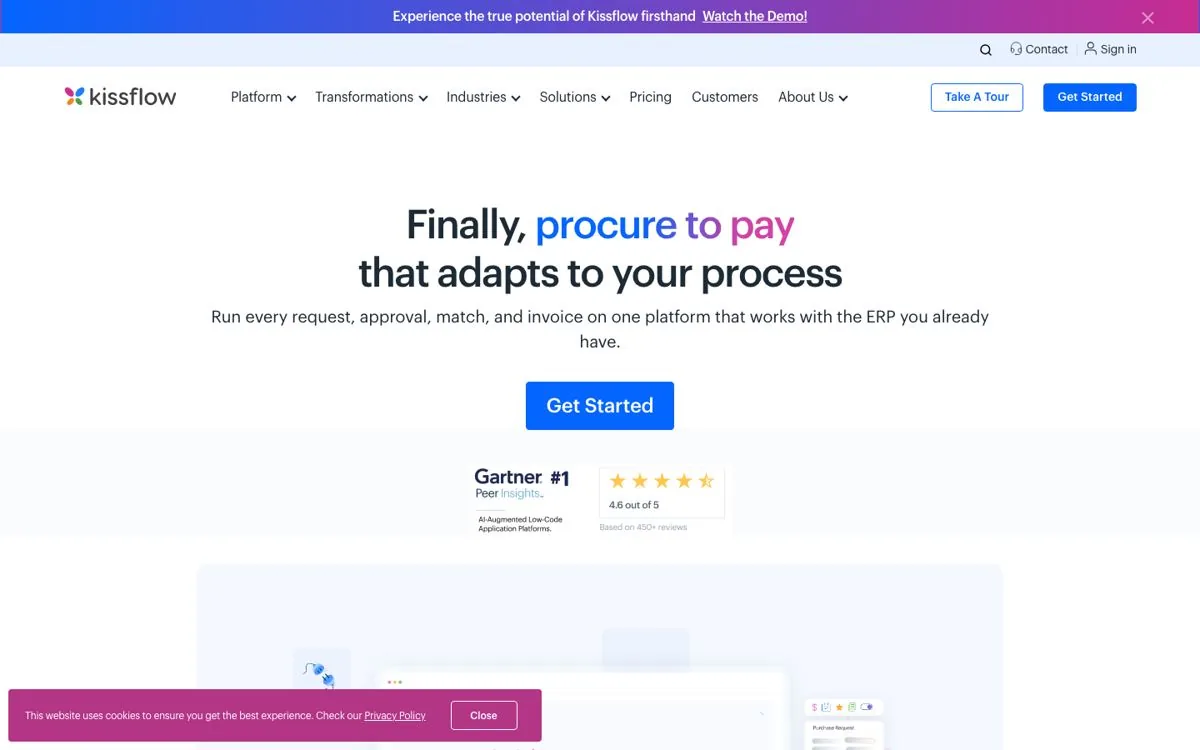
Kissflow fits IT-led or operations-led teams that want Zip-style intake and approvals around an existing ERP. Its low-code procure-to-pay layer runs requests, approvals, POs, receipts and 3-way matching, and it can sit beside SAP Ariba or Coupa. Payments stay in your ERP, and its homepage now leads with low-code apps.
Key features 5 features
- One request form for catalog and non-catalog buying
- Requests that convert into RFQs with scoring
- AI invoice capture with GL coding
- 3-way matching with tolerance rules
- Connects to SAP, Oracle, NetSuite and Dynamics 365
Pros and cons 2 pros, 3 cons
Pros
- No AI surcharges: there are no separate charges for AI or API use, so usage growth does not raise the bill
- Stated timeline: Kissflow plans about 8 weeks to the first full procure-to-pay cycle, so you can date the switch from Zip
Cons
- No payments: the payment run stays in your ERP or payment provider, so it does not replace Zip's Global Payments add-on
- Shifting focus: its homepage now leads with low-code apps, not procurement, so ask about the procurement roadmap
- Quote only: a fixed annual agreement with no public price, so you cannot compare cost with Zip before a sales call
Pricing
Quote only: a fixed annual agreement based on the apps you run and the people using them.
Best for
IT-led or operations-led teams that want Zip-style intake and approvals around an existing ERP and are comfortable configuring a low-code tool.
Verdict
Verdict: Kissflow suits teams that only want the orchestration layer. Choose a procurement suite if you also want sourcing and payments.
Also worth a look: ORO Labs and Omnea, two orchestration layers like Zip. ORO Labs says it orchestrates existing ERPs, suites and point solutions. Omnea covers intake, sourcing, procure-to-pay and supplier risk, with intake in Slack and Teams. Neither shows prices on its site. Vroozi runs catalog buying, POs, matching and supplier payments over your ERP.
Zip alternatives: feature-by-feature comparison
Compare Zip alternatives on the work Zip does every day: intake and approvals, requests and POs, sourcing and contracts, invoice capture and matching, and supplier payments. Order.co is a buying marketplace that bills you once, so its cells describe that model rather than a separate AP workflow. Cells show the plan or add-on where it matters.
| Tool | Intake and approvals | Requests and POs | Sourcing and contracts | Invoice capture and matching | Supplier payments |
|---|---|---|---|---|---|
| Zip | AI intake front door; no-code approval flows | PO generation and change orders | AI RFx; contract orchestration with renewal alerts | AI extraction from email; flags duplicates and overages | Global Payments add-on with 79+ international rails |
| Procurify | Order requests; rules by department, location or amount | POs in the base product; line-level receiving | Contracts add-on; no sourcing events | AP add-on; 2-way and 3-way matching | ACH, check, wire; 190+ countries |
| Precoro | Guided forms; approve by email, Slack, Teams or mobile | Blanket, recurring and service POs | RFPs on Automation; contract repository | 2-way and 3-way on Core; AI capture on Automation | ACH, wire and international transfers |
| Zapro | Intake form and catalog; routed by amount, category or vendor | Requests to POs on every plan | RFI and RFP on every plan; contract authoring on Growth | OCR capture; 2-way matching, 3-way on Growth | Prepares the payment batch; your ERP or bank pays |
| Ramp | Free AI Intake; no-code approval builder | POs in the Procurement add-on | AI RFx drafting; renewal tracking; CLM through integrations | 2-way and 3-way, including card spend | Bill pay on all plans; corporate cards |
| Coupa | Guided intake; approvals with a budget check | Requisitions and POs with PO Collaboration | Sourcing optimization and a contract repository | Any-format capture; 2-way and 3-way matching | Payments and virtual cards through partners |
| SAP Ariba | Intake Management and guided buying | Ariba Buying with Joule agents | Ariba Sourcing and Ariba Contracts | Invoicing, plus an announced AI Invoicing Assistant | No payment module on its product pages |
| Payhawk | Plain-language requests; routing by spend type or budget | Auto-generated POs; two-way PO sync with NetSuite | No sourcing or contract module | OCR in 60+ languages; 2-way and 3-way | Payments in 115+ currencies |
| Order.co | One cart; approvals by location, role or spend | Requisitions become POs; Order.co places orders | No sourcing or contract module | Orders feed one Order.co invoice; line-level GL coding | Pays vendors Net 1; one consolidated bill |
| Kissflow | One request form; low-code approval flows | Budget checks, then POs written to your ERP | Requests convert to RFQs; light contract features | AI capture with GL coding; 3-way matching | Payment run stays in your ERP |
How ZipHQ alternatives charge
ZipHQ pricing is quote only: Vendr says Zip quotes a platform fee plus seats that can differ by role. Its alternatives charge by quote (Procurify, Coupa, SAP Ariba, Order.co, Kissflow), per user (Ramp), by module (Payhawk) or by flat plan (Precoro and Zapro). Compare at your real volume, for example against flat Zapro pricing.
| Tool | Pricing model | Starting price |
|---|---|---|
| Zip | Quote: platform fee plus seats by role; add-on modules | Vendr median $88,856 a year |
| Procurify | Quote by modules and Pro users; Basic users free | Vendr median $15,000 a year |
| Precoro | Plan fee, billed yearly, with user limits | $499 per month (Core) |
| Zapro | Flat monthly plan by active vendors; unlimited users | $699 per month |
| Ramp | Per user plus platform fee; Procurement add-on extra | $0 (Free plan, no Procurement) |
| Coupa | Quote by module | Vendr median $94,519 a year |
| SAP Ariba | Quote through SAP or partners; Snap as a package | Quote only |
| Payhawk | Monthly fee per module, plus usage | $499 per month (Procurement) |
| Order.co | Quote by locations and usage | Custom quote |
| Kissflow | Fixed annual quote by apps and users | Custom quote |
Questions to ask any ZipHQ alternative
Before you choose a Zip alternative, ask every vendor the same five questions in writing: which Zip jobs it replaces, the total yearly cost for all your requesters, go-live time, what syncs with your ERP and whether it can rebuild one of your reports live. Strong answers are specific, dated and shown on your own data.
| Question | Why it matters | What a strong answer includes |
|---|---|---|
| Which parts of Zip do you replace: intake, POs, AP, sourcing or contracts? | Most tools replace part of Zip, not all of it. | A yes or no for each job, with the module and plan named. |
| Can you rebuild one of our reports live? | Reporting was the top Zip complaint in the reviews we read. | The report built in the demo from your own data fields. |
| What is the total cost per year for all our requesters? | Platform fees and seats by role change the real price. | A written quote with platform, seat and add-on costs split out. |
| How long until the first purchase request runs end to end? | Setup was the second most common complaint. | A dated plan with your team's hours estimated. |
| What syncs with our ERP, and how often? | Sync errors were a repeated complaint. | Your ERP named, with vendors, POs, bills and payment status listed, plus a test sync. |
Which ZipHQ alternative should you choose in 2027?
The best Zip alternative is the one that replaces the job you bought Zip for. For full procure-to-pay, start with Procurify or Precoro. For intake plus sourcing and contracts at a published price, look at Zapro. Card-first teams fit Ramp or Payhawk, Kissflow suits intake only, and Coupa or SAP Ariba suit large enterprises.
A practical shortlist for a mid-market team: Procurify or Precoro for procure-to-pay, Zapro if you also need sourcing and contracts, and Kissflow if you only want intake. Our Zip vs Zapro page shows where the two overlap. Run the same request and invoice through each tool before you sign.
Frequently asked questions
What is the best alternative to Zip?
Procurify and Precoro are the usual swaps for Zip's procure-to-pay job, at lower prices. Kissflow replaces only the intake layer, Ramp and Payhawk suit card-first finance teams, and Coupa or SAP Ariba suit large enterprises. Zapro fits teams that want intake, sourcing and contracts in one suite.
Who are Zip's main competitors?
Zip's main competitors are Procurify, Precoro and Zapro in mid-market procure-to-pay, and Coupa and SAP Ariba in enterprise source-to-pay. ORO Labs, Omnea and Kissflow compete as intake and orchestration layers, and Ramp and Payhawk compete for finance-led teams.
What are the best ZipHQ alternatives for small business?
Precoro and Ramp are the usual picks for small businesses. Precoro Core starts at $499 a month billed yearly, with POs and 2-way and 3-way matching. Ramp's Free plan covers cards and bill pay, and its Procurement add-on needs the Plus plan.
How much does ZipHQ cost?
Zip does not publish prices; it quotes each deal. Vendr buyer data shows a median of $88,856 a year across 78 purchases, ranging from $27,776 to $220,210. Vendr says Zip quotes a platform fee plus seats that can be priced by role, so ask for every seat type in writing.
Zip vs Coupa: which is better?
Coupa is better for large enterprises that want one full source-to-pay suite, with sourcing optimization and community benchmarks. Zip is an intake and orchestration layer that can sit on top of other systems, including Coupa. Their Vendr medians are close: $94,519 and $88,856 a year.
Zip vs Procurify: which is better?
Procurify is better for mid-sized teams that want purchasing and supplier payments from one vendor at a Vendr median of $15,000 a year. Zip is better for one intake front door with sourcing, contracts and supplier risk checks, while Procurify runs no sourcing events.
What do ZipHQ reviews say?
Zip rates 4.6 on G2 from 153 reviews. In the 28 reviews we read, 11 praised its single intake front door and 11 its easy-to-change approval workflows, while 10 criticized its basic reporting, the most common complaint. Zip also rates 4.7 on Capterra.
Get intake, sourcing and matching in one suite
See how Zapro handles purchase requests, approvals, sourcing events and 3-way matching for a mid-market team, with unlimited users on every plan.
Sources: Zip pricing on Vendr; Zip reviews on G2; Precoro pricing; Ramp pricing; ORO Labs; Omnea.