


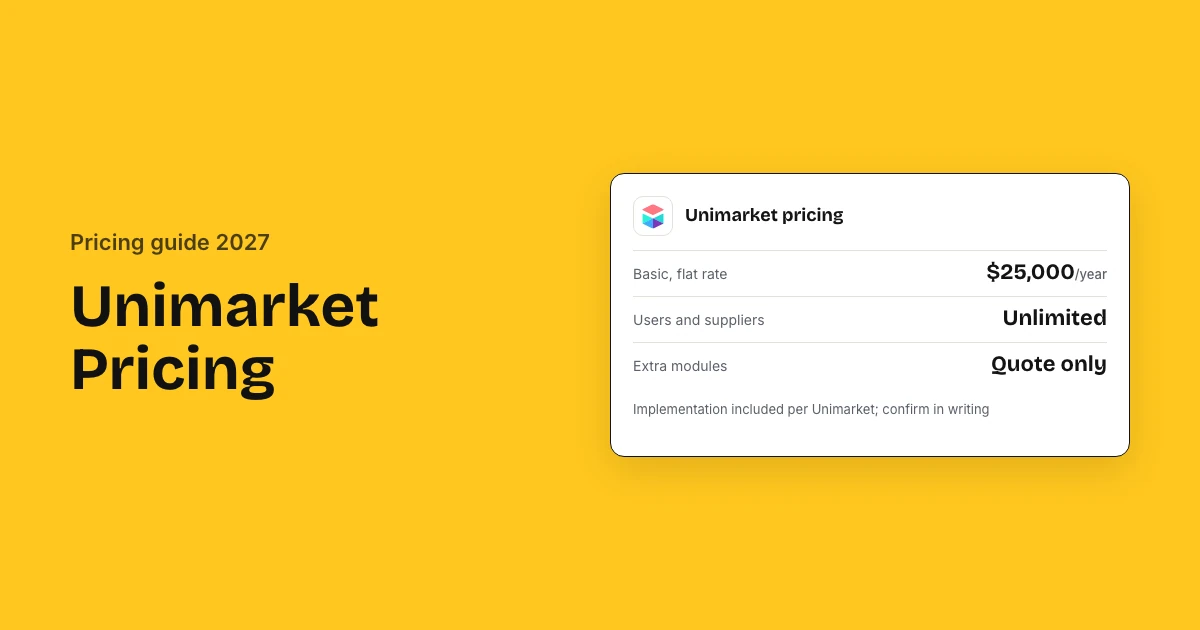
Unimarket starts at $25,000 a year as a flat-rate subscription, the price it lists on G2 and Software Advice. The fee covers unlimited users and suppliers, and Unimarket says implementation, training and support are included. Extra modules such as sourcing, invoicing or payments are licensed separately and quoted.
Unimarket pricing: key takeaways
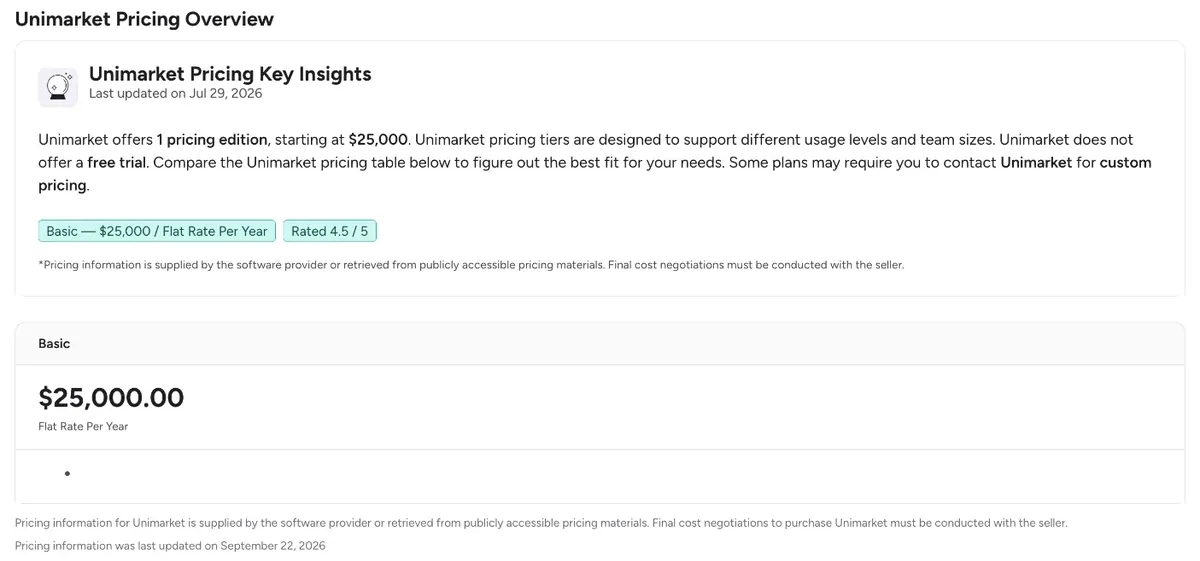
- Starting price: Unimarket's Basic plan is listed at $25,000 a year, flat rate, on both G2 and Software Advice.
- Unlimited users: The fixed annual fee covers unlimited users and suppliers, so adding staff does not change the price.
- Modules: Unimarket is modular: sourcing, contracts, invoicing, expenses and payments are licensed as needed and quoted.
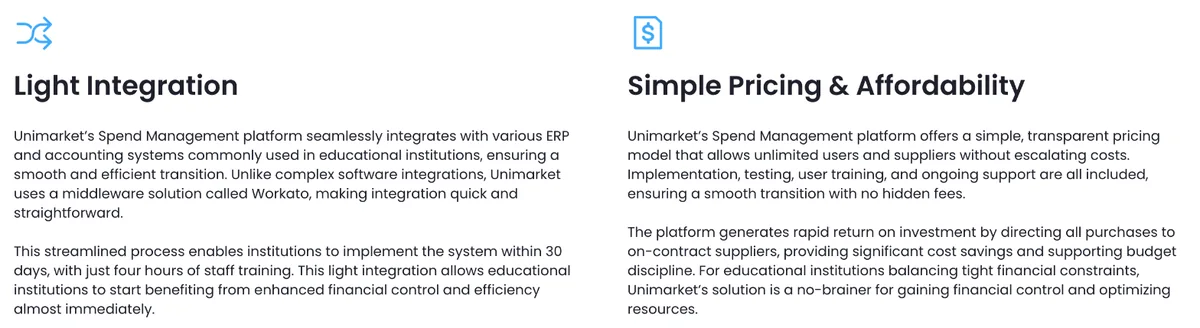
- Implementation: Unimarket says implementation, testing, training and support are included, while G2's listing mentions a one-off first-year cost.
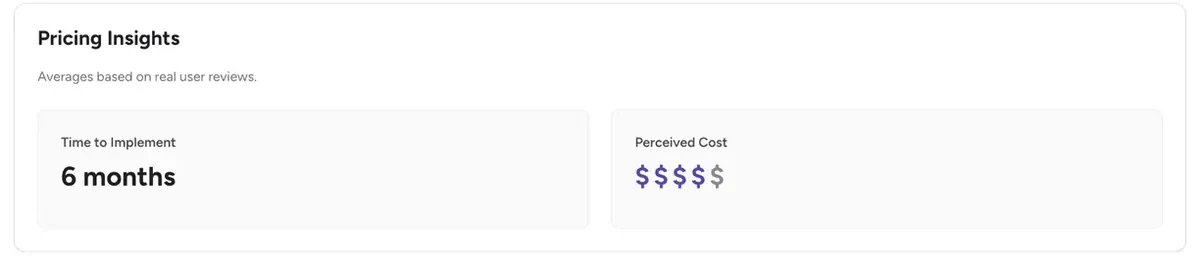
- Setup time: Unimarket promises 30 days and four hours of staff training; G2 reviewers average about 6 months.
- Reviews: G2 rates Unimarket 4.5 out of 5, and reviewers ask for clearer pricing, especially for smaller organisations.
How much does Unimarket cost?
Unimarket costs from $25,000 a year as one flat annual subscription, the rate listed on G2 and Software Advice for this source-to-pay procurement software platform. That price covers unlimited users and suppliers, so headcount does not move it. Additional modules are licensed only if you need them, and their prices are quoted.
| What you buy | What it covers | Price |
|---|---|---|
| Basic subscription | Core eProcurement: requisitions, approvals, purchase orders, catalog marketplace | $25,000 a year, flat rate |
| Users and suppliers | Every requester, approver and supplier | Included, unlimited |
| Implementation, training, support | Setup, testing, user training, ongoing support | Included per Unimarket |
| Extra modules | Sourcing, contracts, invoicing, expenses, payments, supplier management | Quoted |
What the flat rate means in practice
Unimarket's flat rate is about $2,083 a month, the same for a pilot or a company-wide rollout, with no per-seat fee.
- The flat rate works out to about $2,083 a month, or $75,000 over three years before any increase
- There is no per-seat fee, so a campus or company-wide rollout costs the same as a pilot
- You pay more only by adding modules
- There is no free trial
What will Unimarket cost for your business?
Unimarket costs a 50 to 200 person company $25,000 a year for core eProcurement, its listed flat rate, and the same in year one if implementation is included as Unimarket says. With 10 to 50 users that is $500 to $2,500 per user a year, and modules such as invoicing or sourcing are quoted on top.
What the flat fee costs per user
Unimarket's flat fee costs $2,500 a user a year at 10 users and falls to $250 at 100, so it pays off as user counts grow.
| Users | Cost per user a year | What it means |
|---|---|---|
| 10 | $2,500 | Far above most per-user tools |
| 25 | $1,000 | Still above most per-user plans |
| 50 | $500 | Closer to per-seat pricing |
| 100 | $250 | Similar to many per-user tools |
What drives your quote
Modules, implementation scope, buying route and term length move a Unimarket quote; headcount does not.
| Driver | What raises it | What to ask |
|---|---|---|
| Modules | Invoicing, sourcing, contracts, supplier management, payments | Price per module in writing |
| Implementation | A custom ERP link or several entities | Whether setup is in the base fee |
| Buying route | Direct contract vs the E&I cooperative contract | Which route gives the lower price |
| Term | Multi-year commitment | A cap on renewal increases |
What Unimarket charges on top of the subscription
Unimarket charges no fee for implementation, testing, training or support, and extra only for added modules and services such as the Virtual Mailroom and supplier verification. The Virtual Mailroom is priced on invoice volume, Unimarket says its pricing has no hidden fees, and users and suppliers are unlimited.
| Cost item | How it is priced |
|---|---|
| Users and suppliers | Included, unlimited |
| Implementation, testing, training, support | Included, per Unimarket's education page |
| Sourcing, contracts, invoicing, expenses, payments | Modules, quoted |
| Virtual Mailroom | Depends on your needs, such as invoice volume |
| Supplier onboarding, vetting and screening services | Services, quoted |
Services Unimarket lists
Unimarket lists onboarding, supplier verification, enablement and Virtual Mailroom services alongside the platform, so ask which sit outside the flat fee.
- Pre-implementation services
- Supplier onboarding and vetting
- Supplier verification and screening
- On-contract supplier enablement for the catalog
- Virtual Mailroom for invoice capture
Get the inclusions in writing
G2's vendor listing describes one-off implementation costs in the first year, while Unimarket's education page says implementation is included. Ask for the order form to state which applies to you.
How much does Unimarket ERP integration cost?
Unimarket publishes no separate ERP integration fee: it calls ERP links light integration that is part of implementation, so a standard link should sit inside the flat fee. It connects through Workato middleware and lists Ellucian Banner, Ellucian Colleague, Workday, Oracle, TechnologyOne and SAP; confirm custom work separately.
| Your ERP | How it connects | Effect on cost |
|---|---|---|
| Ellucian Banner or Colleague | Standard connector via Workato | Within implementation |
| Workday, Oracle, SAP, TechnologyOne | Standard connector via Workato | Within implementation |
| Custom or homegrown ERP | Workato or API | Ask for a quote |
What to confirm about your ERP
Confirm your ERP connector sits in the flat fee and whether the Workato layer carries its own licence cost.
- Whether your ERP connector is in the flat fee
- Which records sync: suppliers, POs, receipts, invoices and GL codes
- Whether the Workato layer has its own licence cost
- Who supports the integration after go-live
- How long the integration takes; Unimarket cites 30 days for education
Unimarket implementation cost and setup time
Unimarket says implementation is included in the $25,000 subscription and takes 30 days, though G2 reviewers report about 6 months. Its G2 listing mentions a one-off first-year implementation cost, so get the inclusion in writing, along with the four hours of training it quotes.
| Phase | Time | Who pays |
|---|---|---|
| Pre-implementation services and scoping | Before go-live | Included per Unimarket |
| ERP integration via Workato | Within 30 days (Unimarket) | Included per Unimarket |
| Staff training | About four hours | Included |
| Go-live and supplier onboarding | Up to 6 months on average (G2) | Your team; services quoted |
| First savings | 3 to 4 months (Unimarket) | Your team tracks them |
Keep the rollout short
Keep the rollout near Unimarket's 30-day plan by starting with requisitions and the catalog, then adding invoicing.
- Start with requisitions and the catalog marketplace, add invoicing later
- Load preferred suppliers and contract pricing before go-live
- Ask how supplier onboarding is handled and whether it is in the flat fee
Modules, contract terms and renewal
Unimarket sells a fixed annual fee and licenses modules as you need them. Education buyers can use the E&I Cooperative contract, which runs from November 2025 to October 2030 with yearly renewals, and E&I scores the contract's total economic benefit for members at 10% to 15%.
Renewal terms to check before you sign
Unimarket publishes no renewal cap, so lock the yearly increase, module prices and notice period into the contract.
- A cap on the yearly increase to the flat fee
- Module prices fixed for the term
- Whether implementation stays included when you add modules
- Notice period and renewal date
- Data export terms if you leave
Modules you can license
Purchasing and the marketplace are in Unimarket's base fee; every other module is quoted.
| Module | Price |
|---|---|
| Sourcing and contract management | Quoted |
| Purchasing and marketplace | In the base fee |
| Invoicing and Virtual Mailroom | Quoted |
| Expenses and payments | Quoted |
| Supplier management and screening | Quoted |
Unimarket pricing for universities and schools
Universities and schools buy Unimarket on the same flat annual model, listed from $25,000 a year, and E&I Cooperative members can buy through contract CR001502, awarded for 2025 to 2030. The contract lets institutions license only the modules they need and covers K-12 as well as higher education.
- Contract CR001502 runs from 1 November 2025 to 31 October 2030, with five one-year renewals
- Fixed annual pricing: usage can expand across users and suppliers at no additional cost
- ERP integrations named in the contract: Ellucian Banner, Ellucian Colleague, Workday and Oracle
- Unimarket claims savings of $600K+ a year at about 2,000 FTE and $4M+ at about 20,000 FTE
- Lehigh University uses Unimarket for requisitions, contracts, sourcing, receiving and invoicing, with catalogs from VWR, Fisher and Grainger
What companies actually pay for Unimarket
Companies pay Unimarket a flat rate from $25,000 a year, as listed on G2 and Software Advice; no buyer data source publishes contract values and Vendr lists it without figures. Reviewers say pricing could be clearer for smaller organisations and that they had to work out the final price from several factors.
| Source | What it reports |
|---|---|
| G2 (vendor-supplied) | Basic $25,000 flat rate per year; no free trial |
| Software Advice | Same flat starting price per year |
| G2 reviewers | About 6 months to implement; 4.5 out of 5 from 64 reviews |
| G2 reviews | Pricing transparency could be better for smaller organisations |
| E&I Cooperative | Fixed annual pricing; 10% to 15% total economic benefit |
What reviewers say about cost and value
G2 reviewers rate Unimarket's cost four of five dollar signs and want clearer prices, especially for smaller organisations.
- Pricing transparency could be better, particularly for smaller organisations (G2)
- Reviewers would prefer specific prices instead of working out a final price from several factors (G2)
- Perceived cost on G2 sits at four out of five dollar signs
- Universities using it, such as Lehigh, point to transparent pricing on pre-negotiated supplier contracts in the catalog
Is Unimarket worth the price?
Unimarket is worth it for universities, schools and public bodies with many requesters, where one fee for unlimited users beats per-seat tools. For a small private company, that fee is a high floor for core purchasing, which is when Unimarket alternatives with lower entry prices are worth comparing.
Worth it if
- You have hundreds of requesters
- You run Banner, Colleague, Workday or Oracle
- You can buy through the E&I contract
- You want implementation and support in one fee
Look elsewhere if
- You have only a few buyers and a small budget
- You need a price below the flat base fee
- You want every module priced up front
- You cannot wait up to 6 months to go live
How to get a better Unimarket price
Ask for the base subscription and each module priced separately, and confirm in writing that implementation, training, support and your ERP link are included. If you are in education, compare the E&I contract terms, and lock the flat fee for a multi-year term with a cap on increases.
Get in writing
- Base fee and each module
- Implementation included or not
- ERP connector included
- Virtual Mailroom pricing
- Renewal cap
- Contract term
Ways to pay less
- Start with core purchasing only
- Use the E&I contract if eligible
- Commit to a multi-year term
- Add modules at renewal, not mid-term
- Push all requesters onto the flat fee
Unimarket pricing vs alternatives
Unimarket charges one flat yearly fee from $25,000 with unlimited users, while Procurify's Vendr median is $15,000 a year and ProcureDesk publishes $830 to $1,250 a month. Zapro pricing has Spark at $699 a month, Growth at $1,999 a month and Scale on custom pricing, all with unlimited users; your ERP or bank pays suppliers.
| Tool | Pricing model | Typical cost | Users priced |
|---|---|---|---|
| Unimarket | Flat annual fee + modules | From $25,000/yr (list, G2) | Unlimited |
| Procurify | Quote: products + Pro users | $15,000/yr (Vendr median) | Pro users; Basic free |
| ProcureDesk | Published plans | $830–$1,250/month, billed annually (list) | See plan |
| Precoro | Published plans | From $499/month (list) | See plan |
| Zapro | Flat plans, unlimited users | List: Spark $699 / Growth $1,999 a month; Scale custom | No per-user fee |
Unimarket and the flat-rate tools suit large requester bases; per-user tools can be cheaper for small teams with few buyers.
Unimarket pricing FAQs
How much does Unimarket cost?
Unimarket starts at $25,000 a year as a flat-rate subscription, according to its G2 and Software Advice listings. That covers unlimited users and suppliers; extra modules such as sourcing, invoicing or payments are quoted separately.
Does Unimarket charge per user?
No. Unimarket uses a fixed annual fee with unlimited users and suppliers, so adding requesters, approvers or departments does not raise the price. You pay more only when you license extra modules or services.
What does Unimarket do?
Unimarket is cloud source-to-pay software for requisitions, approvals, purchase orders, a supplier catalog marketplace, sourcing, contracts, invoicing and payments. It is widely used by universities and public bodies and integrates with Banner, Workday, Oracle and SAP.
Is Unimarket legit?
Yes. Unimarket is an established source-to-pay vendor, now merged with VendorPanel, with a 4.5 out of 5 rating from 64 G2 reviews. It holds an E&I Cooperative contract for higher education and K-12 running to 2030.
How do I register as a supplier with Unimarket?
Suppliers usually join when a buying organisation invites them, then complete onboarding in Unimarket's supplier portal at no cost to the buyer's licence, because suppliers are unlimited. Check with the buyer for any supplier vetting steps they require.
Sources: G2 Unimarket pricing; Unimarket education; E&I Unimarket contract; Software Advice. Prices come from Unimarket's own pages where published and from the third-party sources listed, labelled as such. Estimates are not quotes.