

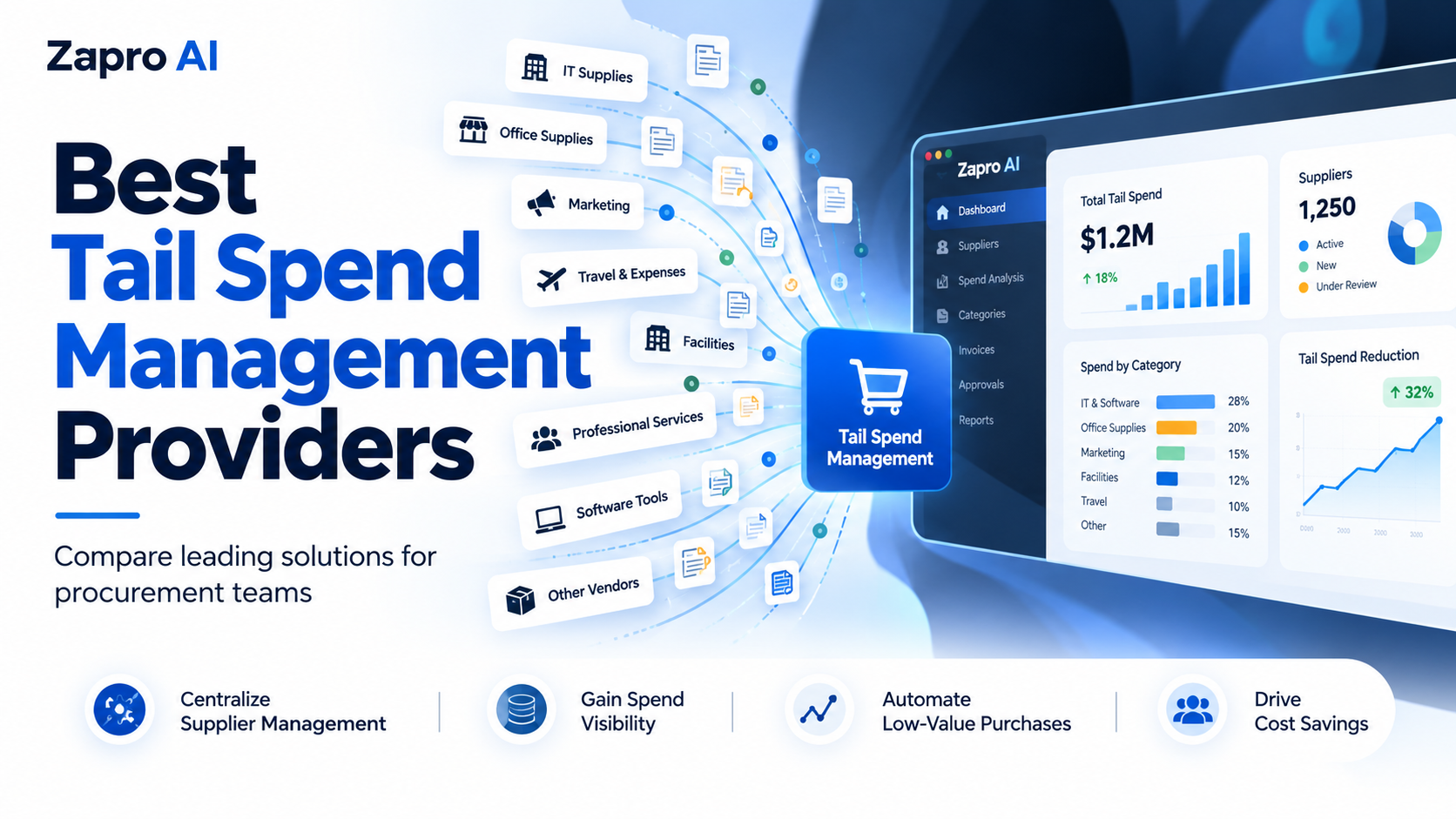
Tail spend is the long list of small, low-value purchases a company makes across many suppliers. It often makes up about 20% of total spend but covers around 80% of the supplier base.
Because each purchase is small, tail spend rarely gets the attention that strategic spend does. Purchase data is spread across different systems and card statements, so no one sees the full picture. Processing many small orders and invoices takes up administrative time. Employees buy outside approved channels when the formal process feels slow, and a long supplier list weakens the company’s negotiating power.
Companies can get outside help with this problem from three types of providers: managed service providers, consulting firms and technology platforms. This guide explains what each one does, names companies in each group, and shows which option fits which situation.
Key takeaways
- Tail spend is the long list of small, low-value purchases that makes up about 20% of total spend but around 80% of the supplier base.
- No single rule defines it. Companies draw the line by share of spend, a yearly supplier spend threshold (usually $100,000 to $1 million), management status or buying route.
- Roland Berger reports that well-designed tail spend programs typically generate 13% to 25% in savings, often within 10 weeks.
- Three types of providers can help: managed service providers (GEP, Genpact, SDI), consulting firms (Roland Berger, BCG, Deloitte, Kearney) and technology platforms (Zapro AI, Coupa, SAP, Oracle and others).
- Managed service providers suit highly fragmented, decentralized tail spend. Consulting firms suit a defined savings program on a set timeline. Technology platforms suit companies with mature procure-to-pay systems and centralized procurement.
- If you cannot yet see your tail spend, start with spend analysis, then pilot your chosen approach in one business unit before rolling it out.
What counts as tail spend?
No single rule decides what counts as tail spend. Each company draws the line based on its size, industry and buying habits, using one or more of these tests:
- Share of spend: Tail spend follows an 80/20 pattern. Around 80% of transactions make up only about 20% of total spend.
- Spend threshold: Any supplier whose yearly spend falls below a set amount counts as tail spend. That amount usually ranges from $100,000 to $1 million, depending on company size.
- Management status: Any supplier that procurement does not actively manage falls into the tail.
- Buying route: Small, infrequent or one-off purchases that skip the standard procurement process count as tail spend. This includes purchases made outside the approved catalog.
Most tail spend is indirect spend, meaning non-strategic purchases that keep the business running. Its challenges also differ by industry. Retailers deal with a large number of scattered product lines. Manufacturers deal with low-value components that go into their products. Healthcare organizations have to buy within regulatory limits.
Common examples of tail spend include:
- Office and facilities: office supplies, packaging, cleaning products and refreshments for company events
- Maintenance: minor repairs, equipment maintenance, emergency work and MRO (maintenance, repair and operations) parts
- Services: one-time professional or advisory services and temporary staffing
- Marketing: marketing materials, promotional items and trade show displays
- Software and travel: individual software subscriptions and business travel
Where tail spend stands in the industry
As mentioned in the introduction, tail spend makes up about 80% of transactions but only 20% of total spend — these stats come from a study conducted by Deloitte. The study also found that transactions with software vendors were largely concentrated in the tail.
But there is a silver lining. This is why it becomes paramount for a business to effectively manage tail spend. Roland Berger reports that well-designed tail spend programs typically generate 13% to 25% in savings, often within 10 weeks.
Research and Markets values the tail spend solution market at $438.06 million in 2025 and expects it to reach $542.55 million by 2030. The research names advanced analytics, cloud deployment and AI-driven platforms as the growth drivers.
AI is the main theme in current industry discussion. Kearney has published an analysis of how AI is reshaping the economics of tail spend, and Roland Berger says AI turns tail spend from a blind spot into a repeatable source of value. Vendors now offer AI agents that handle intake, find suppliers and negotiate. Gartner Peer Insights also tracks tail spend solutions as a separate software market and lists 20 vendors in it.
Who can help manage tail spend?
Each type of provider helps in a different way:
| Provider type | How it helps | Best suited for |
| Managed service provider (BPO) | An outside team runs spend analysis, buying channels and a buy desk for day-to-day purchases | Highly fragmented, decentralized tail spend that needs specialist expertise |
| Consulting firm | A time-bound program that finds savings and negotiates with suppliers | Companies that want a defined savings program on a set timeline |
| Technology platform | Software for intake, catalogs, sourcing, invoice processing and spend analysis that the company’s own team runs | Companies with mature procure-to-pay systems and centralized procurement |
Managed service providers (BPO)
How they help: A managed service provider takes over the day-to-day work. Providers usually start by analyzing spend data, then set up buying channels such as P-cards. They also run a buy desk, a central team that handles purchase requests and spot buys.
Examples:
- GEP: follows five steps: spend analysis, filtering, tail spend reduction, sourcing and ongoing spot buys through a buy desk. GEP runs its Total Tail Spend Solution with Full Horizon Ventures.
- Genpact: assesses how mature a company’s tail spend management is, then builds a program around buying channels, technology and change management. It runs a buy desk alongside an AI tool that finds and captures savings, and it reports up to 8% annual savings on addressable tail spend.
- SDI: works with manufacturing and industrial companies. Its buying desks combine similar orders for bulk discounts, and its eProcurement platform and AI analytics flag duplicate orders and chances to consolidate suppliers.
Cost structure: GEP, Genpact and SDI do not publish pricing for their tail spend services.
Best suited for: Companies whose tail spend is highly fragmented and decentralized and needs specialist expertise.
Consulting firms
How they help: Consulting firms run programs that find savings in tail spend and help companies capture them.
Examples:
- Roland Berger: works through four levers: removing purchases the company does not need, cutting demand, combining volumes across similar suppliers and negotiating at scale.
- Boston Consulting Group: runs a program that brings smaller suppliers into view and asks them to contribute savings. Its AI Tail Cutter tool sets a savings target for each supplier and shapes how the company approaches it.
- Deloitte: helped a life sciences company find savings in its software tail spend and then led negotiations on a $450 million, five-year vendor contract. Deloitte reports that its engagements typically save roughly 2% to 10% on costs.
- Kearney: offers procurement services and publishes research on how AI is changing tail spend.
Cost structure: Deloitte’s case study shows one model. The client would pay nothing if Deloitte found no significant savings within six months. Once Deloitte found savings, the client paid a fixed fee out of those savings.
Best suited for: Companies that want a defined savings program on a set timeline. Roland Berger reports that tail spend programs often deliver savings within 10 weeks.
Technology platforms
How they help: Technology platforms let the company’s own team bring tail spend under control. Their main features include:
- Spend analysis that pulls data from purchase orders, invoices and card transactions
- Guided buying and pre-approved catalogs that make it easy to buy from approved suppliers
- Automatic purchase order creation and invoice processing
- P-cards and virtual cards with preset spending limits
- AI tools that find suppliers, run requests for quotes and negotiate
Examples:
| Platform | What it offers for tail spend |
| Zapro AI | An AI procurement and accounts payable platform that routes every request through one intake, classifies each transaction at item level and applies AI agents to approvals, supplier matching and invoice processing |
| Coupa | A cloud-based spend management platform that uses AI to steer buyers toward preferred suppliers |
| SAP | Ariba Spot Buy, which offers a shopping-style experience across 200 million catalog items from vetted suppliers |
| Oracle | Self-service procurement, smart forms and machine learning applied to past purchase data |
| Ivalua | A source-to-pay suite with e-catalogs, web forms and data cleansing to classify small purchases |
| JAGGAER | AI and machine learning to clean and categorize spend, with dashboards for tracking KPIs |
| Zycus | AI agents for request triage and autonomous supplier negotiation |
| Basware | AI and optical character recognition that turn supplier invoices into structured data |
| Fairmarkit | AI agents for intake, supplier discovery, requests for quotes and bid evaluation |
| Zip | Intake at the point of the purchase request, with policy-based routing and AI agents |
| Amazon Business | A business marketplace with guided buying, multi-user accounts and consolidated invoicing |
Cost structure: Pricing varies widely across this group. Most enterprise suites quote on request based on spend volume and modules, while several newer platforms publish per-user or tiered subscription pricing.
Best suited for: Companies with mature procure-to-pay systems and centralized procurement, which can manage tail spend in-house.
How to choose between the three
| Your situation | Option to consider |
| You cannot yet see what your tail spend is | Start with spend analysis to define tail spend for each business unit. Managed service providers begin their work here, and technology platforms offer spend analysis tools. |
| Your tail spend is highly fragmented and decentralized, and you lack specialist expertise in-house | A managed service provider |
| You want a defined savings program on a set timeline | A consulting firm |
| Your procure-to-pay systems are mature and procurement is centralized | A technology platform run by your own team |
| You want to test an approach before rolling it out | Pilot the approach in one business unit, automate the process there, then extend it across the company |
Manage tail spend with Zapro AI
Zapro AI handles tail spend the way a technology platform is meant to: by catching small purchases at the point of request, before the money leaves.
Every request enters through a single intake form, no matter how small. Requests are routed by value, category and supplier status, so a $400 one-off clears on its own while anything that needs finance, legal or IT judgment reaches them automatically. That is what keeps spend from drifting outside the process in the first place.
Requisitions, purchase orders, receipts and invoices sit in one system, so the tail is no longer scattered across card statements and inboxes. Each transaction is classified at item level, which means the duplicate suppliers, the same item bought from three sources and the categories carrying volume with no contract behind them are visible without waiting on a periodic manual spend analysis.
AI agents take on the repetitive work that makes tail spend expensive to run: matching requests to existing catalog items and preferred suppliers, chasing approvals, and reading invoices into structured data so they clear three-way matching without manual keying.
The result is that tail spend stops being a separate problem. It runs through the same channels as the rest of your spend, and the supplier list gets shorter as consolidation opportunities surface on their own.
Book a demo to see how Zapro AI handles intake, approvals and spend visibility across your tail categories.
Don’t miss our weekly updates
We’ll email you 1-3 times per week—and never share your information.
About the Author

Md. Kafil