


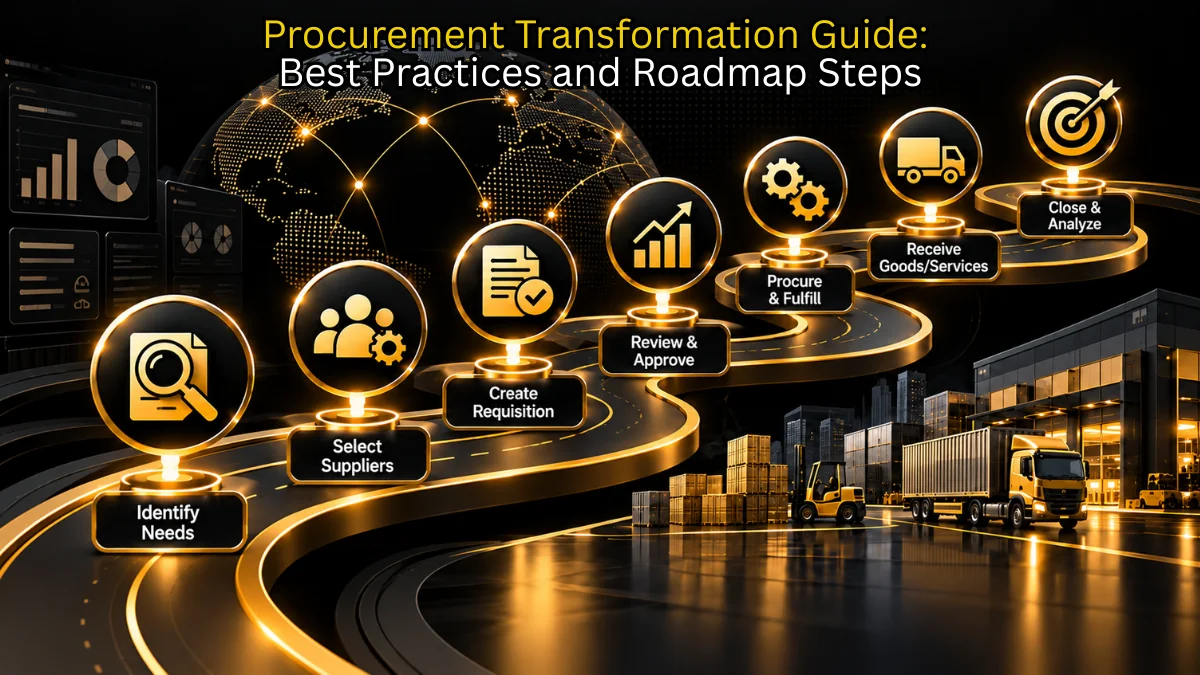
Procurement transformation refers to a business’s strategic and operational redesign of its purchasing capabilities in order to obtain value from the changes. It is a comprehensive approach that covers procurement strategy, processes, data, technology, and talent. Procurement transformation should be planned and executed strategically and iteratively to transform spends, suppliers, and the overall business.
Key Takeaways
- Procurement transformation should be driven by business priorities and not dictated by software vendors.
- The higher the level of procurement maturity, the more value transformation stages can deliver – in one study, every stage of improvement was associated with doubling the benefits realized.
- A phased approach that defines the baseline and first-win scenarios and incorporates change management processes is better than a big bang.
- Spending data cleansing and spend capture rules should be prioritized over automation and artificial intelligence.
- Different industries have different priorities for transformation; for example, the banking sector focuses on third-party risk, while software firms prioritize software as a service (SaaS) and cloud costs.
What is procurement transformation?
Procurement transformation is a process of upgrading the way in which a business acquires, purchases, remunerates, and compensates its goods and services. It is a comprehensive improvement cycle that goes beyond technology. It usually involves changes to the operating model, policies, supplier networks, data, and people.
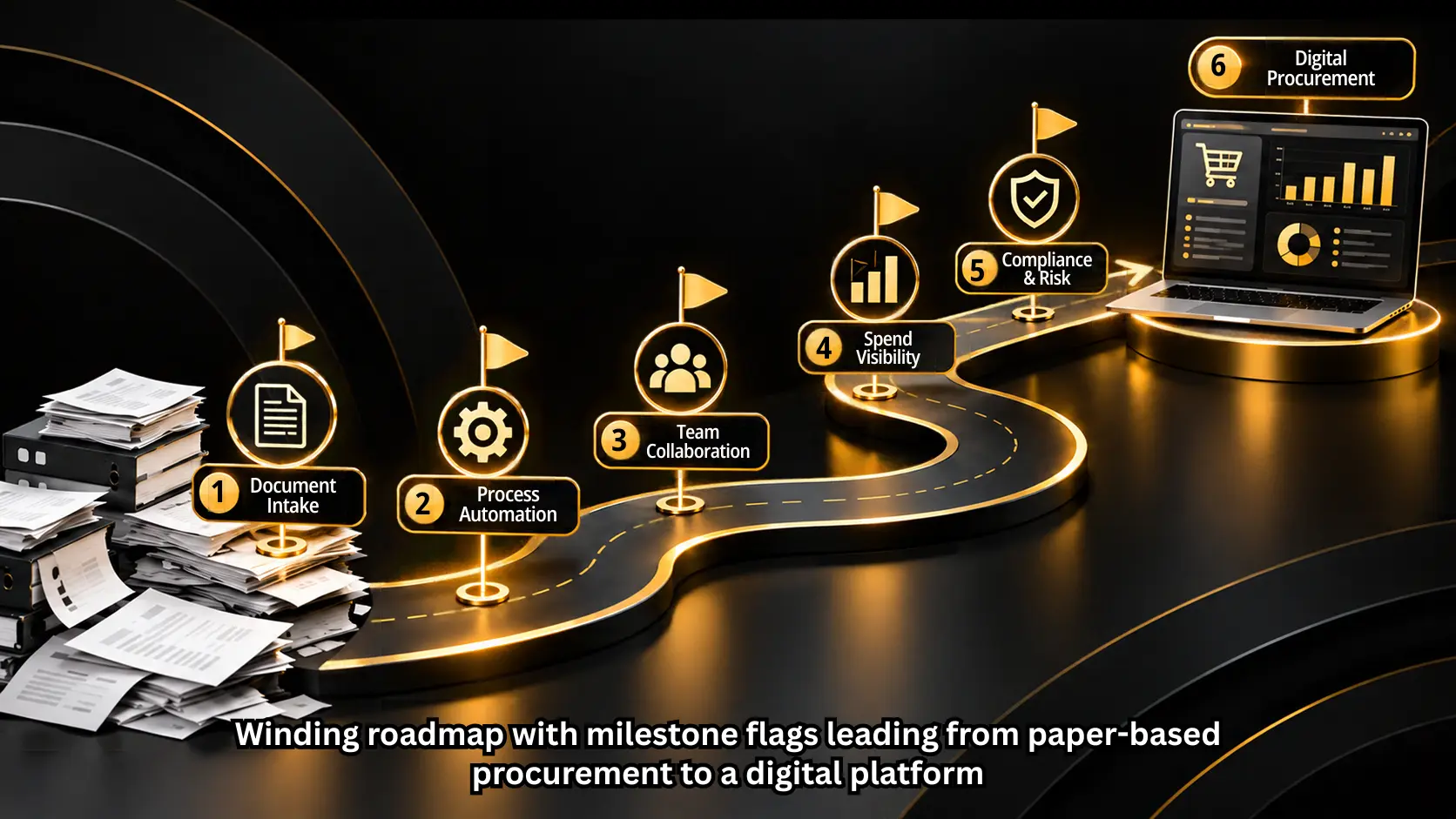
Many organizations confuse procurement digitization with transformation. The former involves scanning a paper-based approval process into digital form, whereas the latter asks who should own the approval process, whether it should exist, and what business metrics it should generate. One way to test if a procurement transformation is happening is to check if the same people are doing the same things after the project ends, which means the software was upgraded, not the procurement process itself.

In just the last 12 months, sourcing and procurement leaders cite a 69% increase in the importance of data and technology competencies.
Why procurement transformation is a priority right now?
Procurement has moved from corporate headquarters to the C-suite because of rising external spend, supply-side volatility, and technological disruption. Leaders that fail to act now will find their costs escalating and their supplier ecosystems becoming increasingly complex to navigate.
Spend and technology are rising
As per Deloitte’s 2025 Global CPO Survey of more than 250 chief procurement officers across 40 countries, respondents are now allocating approximately 20% of their overall budgets to procurement technology – compared to just 10% in 2023. The same survey found that digital leaders are realizing 2.8x return on investment (ROI) from generative AI, compared to 1.6x for peers.
Meanwhile, PwC’s digital procurement transformation survey of more than 1,000 companies found that 94% of purchasing departments are using source-to-pay solutions, with buyers aiming to digitize 70% of their processes by 2027.
A Maturity Gap Remains
Adoption is not the same thing as readiness. A 2025 survey by 4C Associates and the University of Birmingham, benchmarked against more than 400 organizations, found that 29% lacked a clear procurement strategy, only 12% had a comprehensive digital roadmap, and 75% reported only partial alignment between procurement and business objectives.
The same study estimated that a company with £250 million in external spend could realize £11.6 million in additional annual savings by advancing from “Progressing” to “Established” maturity.
Most companies buy into technology before they have a strategy, and the data show that only about one in eight had a full digital roadmap.
Leaders, too, feel the strategic tug. A BizClik survey of more than 600 procurement executives found that cost reduction was a priority for 68%, ESG compliance for 55%, and supplier collaboration for 51%.
Can’t See Where Your Procurement Budget Goes? Fix That Today.

Procurement Transformation Strategy
A procurement transformation strategy is the plan for turning procurement from a transactional purchasing function into a strategic, data-driven one. It defines target outcomes (savings, risk, speed, ESG), the future operating model, process and technology changes, data and talent needs, and a phased 12-36-month roadmap with KPIs to track value.
A procurement transformation strategy outlines where procurement will deliver value, what it will change, and how the company will measure its success. It should be concise, fit on a few pages, and be linked to corporate priorities such as margin expansion, growth, or risk reduction.
1. Start With Business Outcomes
It is critical to identify three to five business outcomes that procurement transformation must deliver before selecting tools, processes, and functions. Frequently, these are reductions in addressable spend by a certain percentage, decreases in purchase order cycle time, and lower supplier risk exposure, as well as higher spend under management.
Procurement transformation strategies also aim to secure a seat at the table. Only 46% of respondents to BizClik’s 3,458 DDM decision-makers survey said they completely agreed with procurement being included in executive forums where key discussions take place. A procurement transformation strategy that has executive sponsorship will help to overcome this challenge.
2. Consider the Operating Model
The operating model determines who buys what. According to BizClik’s survey, 52% of respondents were shifting towards a more centralized approach to achieve consistency and control.
More organizations are adopting a hybrid model, in which centralized functions are responsible for strategic categories, and business units manage low-complexity local spend with the guidance of procurement.
3. Establish a Data Foundation
The quality of data determines the extent of automation and analytics that can be achieved. Approximately 64% of decision-makers stated that generating new insights and greater analytical capability was a priority for the next one to two years.
Spend classification, de-duplication of suppliers, and standardized supplier information are essential before any analytics can be done.
Tools such as AI can be utilized for spend classification, supplier risk management, and negotiations and sourcing, according to 62% of respondents, 51%, and 48%, respectively.
4. Upskill the Workforce
Transforming procurement makes the job more analytical and less transactional, requiring training and updated roles. Upskilling programs should be initiated in the first stage since new tools and processes will make procurement more analytical and less transactional. 72% of respondents in the BizClik survey rely on external support for strategic sourcing activities, indicating that there is a skills gap and the need for in-house expertise.
Procurement transformation roadmap
A procurement transformation roadmap is a progression through distinct stages that propels the team from its current state to a target state over a period of 12–36 months. The following seven-step approach can be applied in any organization.
1. Assess the Current State
Document the current procurement landscape by designing the business process flow from requisition through payment. Benchmark time cycles, percentage of maverick spend, contract coverage, and supplier portfolio size. By understanding where the organization is compared to peers, the team can define gaps that must be closed to meet the strategy, all of which will inform executives that this roadmap has a basis in reality.
2. Define the Vision and Measures
The strategy needs to be translated into tangible measures. By establishing a target, the program has a benchmark for success; for example, if it takes 12 days from requisition to order, the target might be 4. This is important because, without a visible end point, the organization is left guessing as to when the road show is over.
3. Size the Opportunities and Plan the Program
Ideally, the team should prioritize opportunities based on value, effort, and risk and plot them on a simple two-times-two matrix. Quick wins such as cataloging standard purchases or establishing standard approval routings are needed to generate early enthusiasm and budget authority for more involved projects.
4. Standardize and Rationalize the Business Process
Before accelerating the process or automating decisions, the team needs to simplify the process, streamline approvals, set spending limits, and clarify the one procurement buying process that will be used in the organization. Otherwise, the team will accelerate processing errors.
5. Select and Deploy the Technology
The technology must be selected based on findings in step 1; the core functions will most likely include order management, purchase order processing, supplier management, contract management, invoicing and matching, and analytical reporting. According to research conducted by PwC, “more than 50% of surveyed companies have plans to invest in a contract lifecycle management tool within three years,” which is why this particular software solution is so coveted – and competitive.
6. Lead the Change and Influence Users
The team should appoint a business owner in each department; organize and deliver training presentations and a one-page “cheat sheet”; and conduct weekly audits to measure usage. No procurement transformation project can deliver value if the target processes are not adopted.
7. Monitor, Report, and Accelerate the Results
The team must review the implementation on a quarterly basis and report on key measures to the finance organization. The following scorecard illustrates one approach for doing this.
| Metric | What It Shows | Typical Review Cycle |
|---|---|---|
| Spend under management | Share of spend following policy | Quarterly |
| Requisition-to-PO cycle time | Process speed | Monthly |
| Contract coverage | Spend protected by terms | Quarterly |
| Touchless invoice rate | Automation maturity | Monthly |
| Supplier risk exposure | Resilience | Quarterly |
| User adoption rate | Change success | Weekly at launch |
Procurement Transformation Best Practices
Procurement transformation best practices: secure executive sponsorship and a quantified value case; baseline spend and maturity first; fix data and processes before automating; start with quick wins such as PO compliance and invoice automation; involve budget owners and suppliers early; roll out technology in phases; and track savings, cycle time and compliance KPIs monthly.
Procurement transformation best practices boil down to sequencing, ownership, and discipline: set goals, clean the data, simplify the process, and then layer on the technology. The following practices emerged as most common among the programs surveyed.
- Secure executive sponsorship. A CFO or COO sponsor can quickly resolve cross-functional disputes.
- Establish a baseline. Savings claims are impossible to verify without a benchmark.
- Pilot and then scale. Test one category or business unit for 60 to 90 days, identify issues, and refine the approach.
- Prioritize data governance. The chasm between Deloitte’s 2.8x and 1.6x return figures suggests that the difference often lies in how prepared the organization is to adopt the new technology, rather than the technology itself.
- Build in supplier collaboration. Suppliers should ideally see the new process and be prepared for it, particularly with regard to onboarding or invoicing.
- Embed risk and ESG requirements. With 80 percent of the organizations surveyed already working toward mandated, certified supplier status, sustainability considerations have to be embedded in sourcing events.
- Retain human governance over approvals. While AI can suggest deals, control over the approval and audit trails should be retained by humans to ensure accountability.
Common Pitfalls
Many programs wrongly fail to secure a baseline or appropriate change management budget, or attempt to transform all categories at once. Misadventures often stem from viewing the initiative as an IT project. Procurement and finance should own the outcome, and IT should provide the support. Software belongs in that budget as well, and Zapro AI pricing lists plans from $699 per month, each with unlimited users.
Procurement Transformation by Industry
Industry-specific considerations affect the objectives, risk profile, and sequencing of procurement transformation. The three views below reflect the global, software, and financial services contexts in which procurement transformation takes place.
Global Procurement Transformation
Global procurement transformation typically entails additional complexities such as multiple currencies, tax regimes, local suppliers, and regulatory environments. Deloitte’s experience across 40 countries demonstrates that digital leaders deliver against cost-saving, stakeholder engagement, and risk-management metrics more effectively. Global programs typically standardize data governance and policy at the center while retaining some leeway for local markets and suppliers.
Software Industry Procurement Transformation
Software industry procurement transformation tends to focus on a different set of spend categories. The mix often includes cloud infrastructure, SaaS subscriptions, contractors, and marketing technology. A significant portion of the software industry’s procurement spend falls under the indirect category, including spend on marketing technology. Much of it is initiated by engineers or team leads and not through a formal procurement process.
Software companies that have successfully transformed their procurement function often provide their budget owners with a simple, fast-track purchasing process so that they cannot avoid procurement. The effective ones also analyze the usage of seats and the overlap of tools and have a renewal calendar in place to ensure that renewals are not overlooked at the end of a contract.
Procurement Transformation in Financial Services
Procurement transformation in financial services reflects differing regulatory environments and the significant spend on third-party vendors. McKinsey’s research shows that at many large banks, around 40 to 50 percent of operating expenses are spent on goods and services provided by third-party suppliers and contractors, making it one of the largest levers for cost savings.
The emphasis on vendor due diligence, concentration risk management, and audit readiness is higher in financial services than in other industries.
Where Zapro AI Fits?
Zapro AI is an AI-native procurement and accounts payable platform that unifies vendor management, purchase orders, invoice matching, contracts, and spend analytics in one place.
Our design keeps AI in a tool role: invoices are scanned and matched to purchase orders by AI, but approval hierarchy and audit control remain in human hands. Rapport claims that their solution reduces vendor onboarding time by 50% (see their website) – take vendor-given figures with a grain of salt and test a pilot against your in-house baseline.
Our procurement platform is best used when a team has completed the process reengineering and now wants to automate intake, approvals, and three-way matching – in other words, to start getting value from their new procedures. It is not so useful as a first-time solution if the buying practices have not been standardized yet.

Stop Manually Analyzing Spend. Start Getting Automatic Insights.
Zapro delivers AI-powered procurement analytics for every vendor transaction & track spending
FAQ
What is procurement transformation?
It is a comprehensive redesign of an organization’s sourcing strategy, procurement practices, data, technology, and workforce to create value and build sourcing resilience. Procurement transformation spans the entire life cycle of a purchase, from identifying needs to negotiating and approving payments to managing supplier relationships.
How long does it usually take to complete a procurement transformation initiative?
It can range from 12 to 36 months, depending on an organization’s complexity and maturity. Quick wins are possible within 60-90 days, but strategic projects need continuous focus to accelerate improvement over time.
Does technology transformation or strategic redesign come first?
There is always a chicken-and-egg question between technology and strategy. In our experience, the strategic design comes first: according to our survey, 29% of procurement leaders do not have a formal procurement strategy, while the rest buy tools and then fail to adopt new practices.
How do you measure the success of a procurement transformation initiative?
The key performance indicators (KPIs) depend on the goals, but common metrics include spend under management, cycle time, contractual coverage, touchless invoice rate, risk exposure, and adoption rate of new tools or practices. Always define your baseline to understand your starting point and track progress.
Can AI replace procurement analysts and specialists?
Not in the near future. AI can support both analysts and executives by automating rule-based tasks, such as classifying contracts or matching invoices, but it cannot negotiate with suppliers or manage relationships. According to Gartner, 49% of procurement leaders say AI will be genuinely transformational for procurement in the next five years.
Don’t miss our weekly updates
We’ll email you 1-3 times per week—and never share your information.
Spreadsheets Can't Find Hidden Savings. AI Can.
Zapro's procurement analytics goes beyond basic reporting with AI that identifies spending anomalies, vendor consolidation opportunities, and contract optimization potential automatically.

About the Author

Md. Kafil


About the Reviewer

Zapro is dedicated to helping businesses of all sizes make informed decisions. We adhere to strict editorial guidelines to ensure that our content meets and maintains our high standards.
Our editorial standards help keep every article accurate, useful, and trustworthy.