

Last updated: November 6, 2026
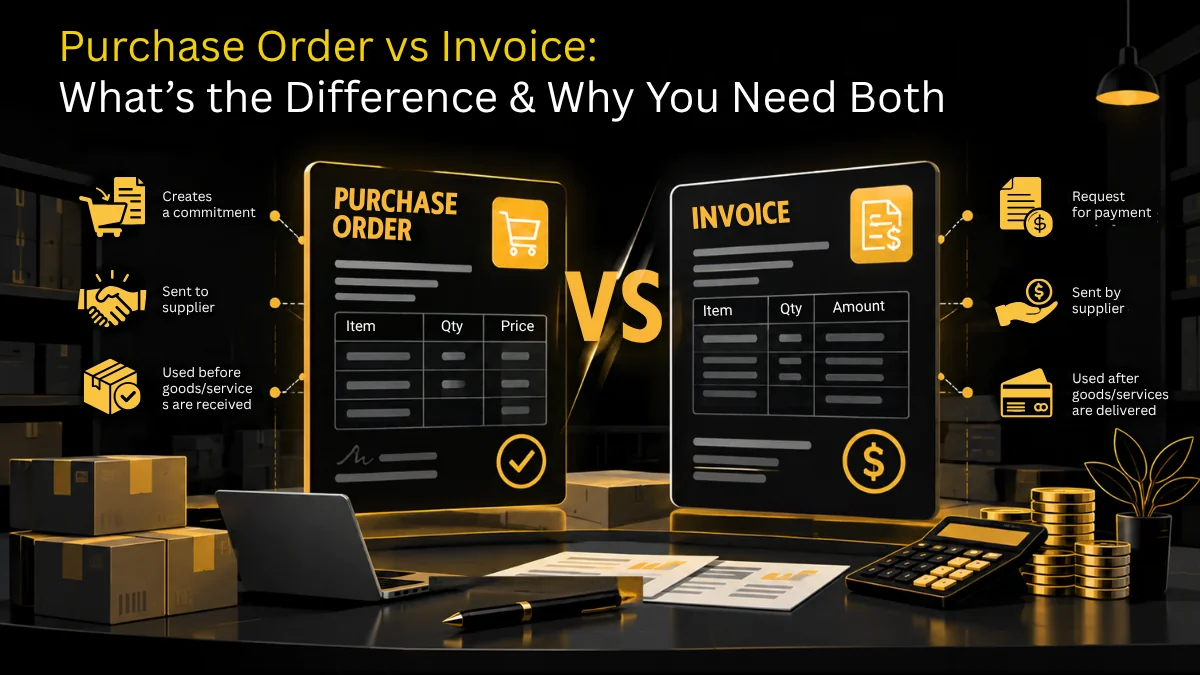
A purchase order is the buyer’s approval to buy, sent to the vendor before delivery. An invoice is the vendor’s request for payment, sent after delivery. So they are not the same document: accounts payable checks the invoice against the purchase order before it pays, and that check is where most billing mistakes are caught.
Key Takeaways
- A purchase order is created by the buyer before a purchase. An invoice is created by the vendor after delivery.
- A PO authorizes spending. An invoice requests payment for spending that already happened.
- A purchase order creates a commitment or encumbrance in accounting terms, not a liability. The invoice is what creates the liability on the books.
- When a PO and an invoice do not match on price or quantity, accounts payable holds the invoice for review rather than paying it as billed.
- The share of invoices that arrive with a valid PO attached is one of the clearest early signals of how disciplined a company’s purchasing process is.
Purchase Order vs Invoice at a Glance
What Is a Purchase Order?
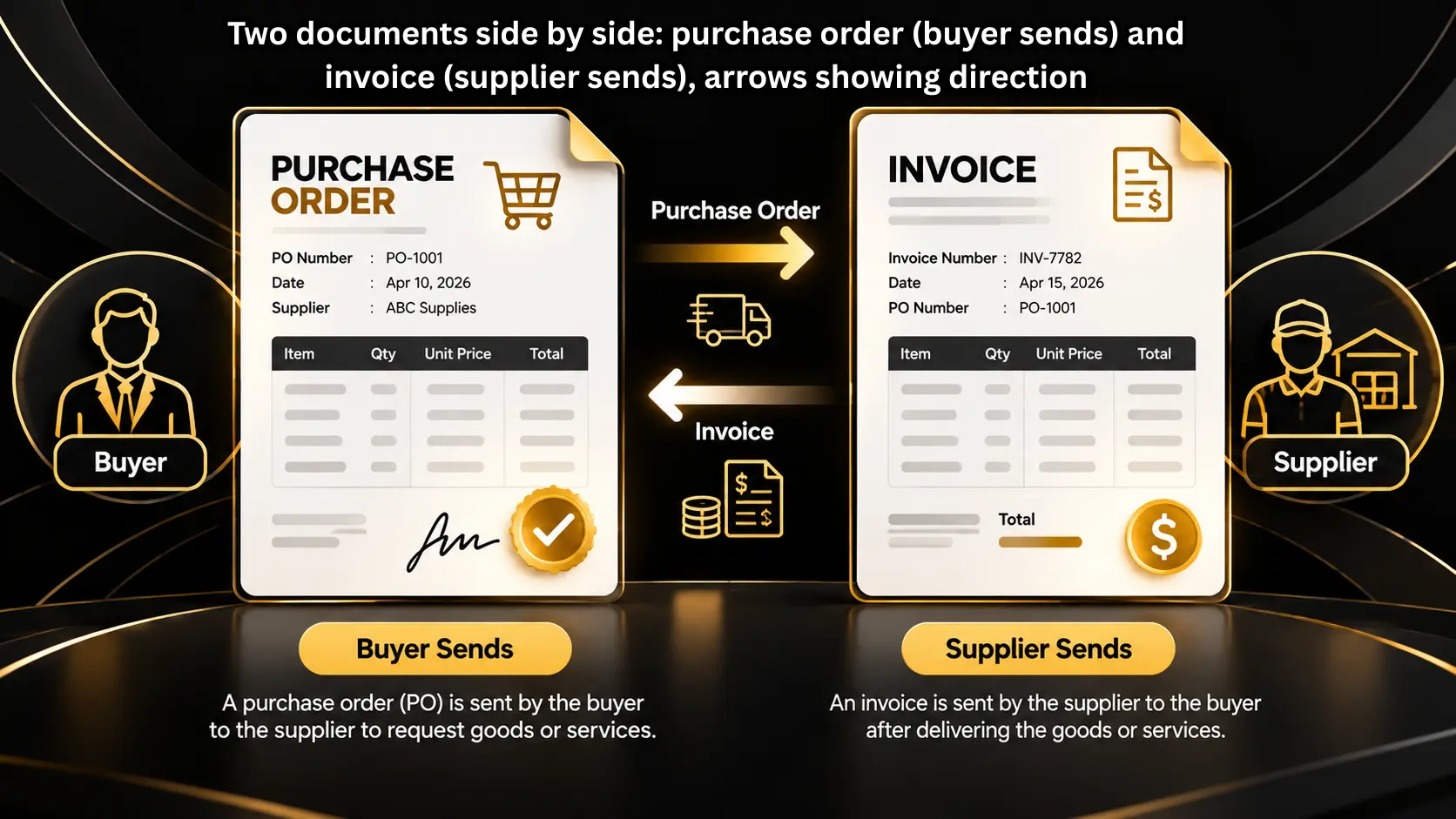
A purchase order, or PO, is the document a buyer sends to a vendor to place an order, once the purchase has been approved inside the company and before anything is delivered. It includes the items or services, the quantities, the agreed prices, and the delivery date. The purchase order becomes a binding agreement to supply the items as described at the price stated once the vendor has accepted it. It is one of the core control documents in procurement, the function responsible for buying goods and services on a company’s behalf.
- A PO number, used to track the order and match it to the invoice later
- Item descriptions, quantities, and unit prices
- Delivery date and shipping address
- Payment terms agreed in advance
Know the Difference. Streamline Both.

What Is an Invoice?
An invoice is a bill. The vendor sends it to the buyer after delivering the goods or services, and it states exactly what is owed. Where the PO says what the buyer intends to buy, the invoice says what the buyer now has to pay.
- An invoice number, separate from the purchase order number
- The PO number, which is how accounts payable links the two documents
- A breakdown of costs: subtotal, tax, shipping, and any discounts
- Payment due date and accepted payment methods
Comparing Purchase Order vs Invoice
| Attribute | Purchase Order | Invoice |
|---|---|---|
| Issued by | Buyer | Vendor |
| Issued when | Before delivery | After delivery |
| Purpose | Authorize and commit to a purchase | Request payment for a completed purchase |
| Key contents | Items, quantities, agreed prices, delivery date | Items delivered, amount due, payment terms |
| Legal effect | Becomes binding once the vendor accepts it | Evidence of a debt already owed |
| Accounting entry | Records a commitment, not a liability | Records a liability in accounts payable |
| Reference number | PO number | Invoice number, which quotes the PO number |

By automating the processing of invoices based on purchase orders (POs)… AP clerks were enabled to process about 50% more invoices.
What Happens When a PO and an Invoice Do Not Match
A mismatch is where the difference between the two documents starts to cost money. Here is a simple example.
The buyer orders 500 boxes at $18.50 each ($9,250 total). The vendor ships the boxes, but then sends an invoice for $19.75 each ($9,875 total). That’s $625 more than was agreed.
Accounts payable will not simply pay the invoice as billed. The invoice gets held as an exception, and one of three things typically happens next:
- The buyer approves the variance
If the price change is legitimate (a vendor surcharge, for example), someone with authority signs off, and the invoice is paid at $9,875.
- The invoice is paid against the PO amount
A number of companies pay only the amount stated, which is $9,250, and ask the vendor to submit a credit or an amended invoice for the difference.
- The invoice goes back to the vendor
Accounts payable will reject the variance if it appears to be an error rather than an accepted change and will request an amended invoice before making any payment.
This is an illustrative example to show the mechanics of a price variance, not a reference for how often mismatches occur at any particular company.
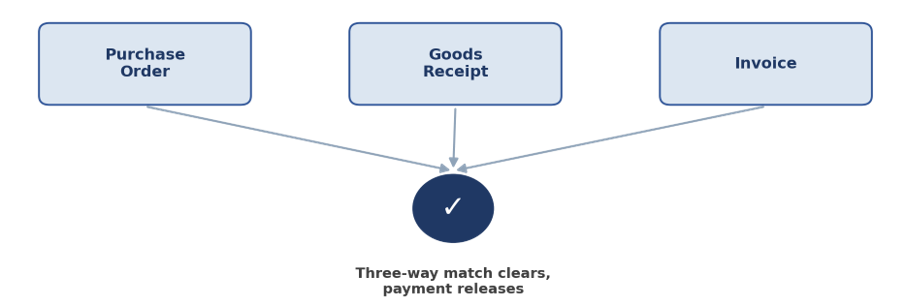
When a goods receipt confirms quantity too, this becomes a three-way match: the PO, the receipt, and the invoice all have to agree before payment clears.
How the Accounting Treatment Differs
The comparison table above says a PO “records a commitment” while an invoice “records a liability,” and that distinction is worth spelling out, because it is precise and it is often glossed over.
A PO doesn’t result in an accounting entry; it merely serves as a note indicating that money has been set aside. It is only the invoice that is recorded in the books: you debit expenses or inventory and credit accounts payable for the amount owed.
Take the packaging example mentioned above, which had been approved at a cost of $9,875; the entry is stated as: debit Inventory (Raw Materials) by $9,875 and credit Accounts Payable by $9,875. It is only when the invoice arrives that something is entered in the ledger. That is also the reason why a purchase order by itself is not proof of an expense for tax or audit purposes; it is the invoice that is.
How Mature Is Your PO Discipline?
One useful, underused diagnostic: what share of your invoices arrive with a valid purchase order already attached? APQC, the benchmarking organization, tracks the percentage of purchases made outside the formal procurement process as one of its core Open Standards Benchmarking measures, precisely because purchases made without a PO are the ones most likely to turn into invoice-matching problems later.
A company that constantly fields invoices with no PO on file is not looking at an accounts payable problem. It is looking at a procurement governance gap upstream, and a “No PO, No Pay” policy, refusing to process any invoice that does not reference an approved PO, is the most direct way companies close that gap. Software that will not process an invoice until it is linked to an approved PO makes that policy far easier to enforce.
Why You Need Both Documents
- They create a paper trail
If a vendor delivers the wrong quantity or bills the wrong price, the PO and invoice together settle the dispute without a guessing game.
- They support financial control
Companies are able to forecast their committed spending before it occurs, while invoices display the amounts that have actually been spent, allowing budgets to be verified against reality.
- They protect the audit trail
To verify that a purchase had been authorized, had been delivered, and had been paid correctly, the auditors trace the link from the purchase order to the invoice.
How Zapro AI Helps With Purchase Order vs Invoice Management
Most of the problems this guide covers, a price that drifts between the PO and the invoice, a missing PO reference, an invoice paid twice, come from keeping purchase orders and invoices as two separate records instead of one connected one.
Zapro AI’s purchase order management software keeps the two connected:
- PO flip and invoice capture: Zapro AI reads invoices by OCR, from email or the vendor portal, or by flipping the PO, so the invoice starts from the PO’s own items and prices instead of being keyed in again.
- 2-way and 3-way matching: Each invoice is checked against the PO, and against the goods receipt for physical goods, with an exception queue for the price and quantity gaps described above. AI agents handle the reading, routing and checking; people approve the spend.
- PO status in one place: Every purchase order can be followed from approval through receipt and invoice, so checking whether a purchase had a PO on file is a lookup, not an email search.
- Accounting sync: Vendor and master data sync both ways with your accounting system, and approved invoices pass to it by API or SFTP, so nobody re-enters them by hand.

Power Your Procurement with Zapro
Take control. Cut costs. Scale smarter.
Frequently Asked Questions
Why would a company require a purchase order?
A company requires a purchase order so spending is approved before money is committed. The PO fixes the vendor, price and quantity up front, shows finance money already promised, and gives accounts payable something to check the invoice against. Without one, AP has to chase whoever placed the order before it can pay the bill.
What is the difference between a PO number and an invoice number?
The buyer creates the PO number when it raises the purchase order, and it identifies that one order. The vendor creates the invoice number when it bills, and it identifies that one bill. A good invoice shows both so accounts payable can find the matching order. One PO can carry several invoice numbers if the vendor ships and bills in parts.
Can you have an invoice without a purchase order?
Yes. Non-PO invoices are common for recurring costs such as utilities, rent and software subscriptions, where raising a PO every month adds little control. Because there is no PO to match against, most companies send these invoices to a budget owner for approval before payment, and many set a dollar limit above which a PO is required.
What comes first, the PO or the invoice?
The purchase order comes first. The buyer issues it before anything ships, the vendor delivers, and only then does the vendor send an invoice that quotes the PO number. If a PO is raised after the invoice has arrived, often called an after-the-fact PO, the purchase skipped the normal approval step and should be reviewed.
Do a purchase order and invoice have to match exactly?
Not exactly, but any difference must be settled before payment. Many companies set a tolerance, such as 2% or $50, so small rounding or freight gaps pass on their own. Anything above the tolerance is held as an exception and is then approved by the buyer, paid at the PO amount, or sent back to the vendor for a corrected invoice.
Can a purchase order be used as an invoice?
No. A purchase order is the buyer’s approval to buy and has no amount due, so it cannot ask for payment. The vendor must send its own invoice after delivery, quoting the PO number, its invoice number, the amount owed and the due date. Some vendors offer a PO flip, where they turn the PO into an invoice in a portal, but the result is still a separate invoice.
What is the difference between a quote, a purchase order and an invoice?
They come in that order. A quote is the vendor’s offer: what it can supply and at what price. A purchase order is the buyer’s acceptance of that offer, with approved items, quantities and prices. An invoice is the vendor’s bill after delivery. If the invoice price is higher than the quote and the PO, accounts payable should hold it as an exception.
What is the difference between a purchase order, an invoice and a receipt?
A purchase order approves the purchase before delivery, an invoice asks for payment after delivery, and a receipt proves that payment was made. In procurement, receipt can also mean a goods receipt, the buyer’s record of what arrived. That goods receipt is the third document in a three-way match, checked against the PO and the invoice before payment.
What is the difference between a purchase order and a proforma invoice?
A proforma invoice is a vendor’s advance bill sent before delivery, showing the expected cost, often so the buyer can arrange prepayment, customs or budget approval. It is not a demand for payment and is not recorded as a liability. The buyer then issues a purchase order to confirm the deal, and the vendor sends the final invoice after delivery.
Is a bill the same as an invoice?
Yes, in most US companies. The vendor calls the document it sends an invoice, and the buyer’s accounting team often calls the same document a bill once it is entered for payment, as QuickBooks and NetSuite do. So bill vs purchase order is the same comparison as invoice vs purchase order: the PO approves the purchase, and the bill records what you owe.
What to Do First
From ten recent invoices, check how many reference a purchase order number that was approved before the goods arrived. That quick audit tells you more about your purchasing discipline than any policy document.
If many of them do not, start by giving every buyer a purchase order template with a PO number field, and ask vendors to quote that number on every invoice. Once volume grows, software can create the POs and match the invoices for you.
Sources / References
- APQC, “Percentage of Total Purchases Procured Outside of the Procurement Process”: https://www.apqc.org/resources/benchmarking/open-standards-benchmarking/measures/percentage-total-purchases-procured
- IRS, “Recordkeeping”: https://www.irs.gov/businesses/small-businesses-self-employed/recordkeeping
- Forrester, “The Total Economic Impact of Basware AP Automation”: https://tei.forrester.com/go/basware/apautomation/
Don’t miss our weekly updates
We’ll email you 1-3 times per week—and never share your information.
Ready to streamline your procurement?
Connect with our experts to see how Zapro can simplify your procurement.

About the Author

Md. Kafil


About the Reviewer

Zapro is dedicated to helping businesses of all sizes make informed decisions. We adhere to strict editorial guidelines to ensure that our content meets and maintains our high standards.
Our editorial standards help keep every article accurate, useful, and trustworthy.