Vendor Management
 End-to-End-Procurement
 Strategic Sourcing
 Spend Analytics
 AP-Automation
 Inventory Management
 ERP-Integration
 Blogs
Blogs Procurement Guide
 Ebooks
 News and Media
 Healthcare
 Financial Services
 Technology
 Venture Capitalist
 About Us
 Vendor Management Guide
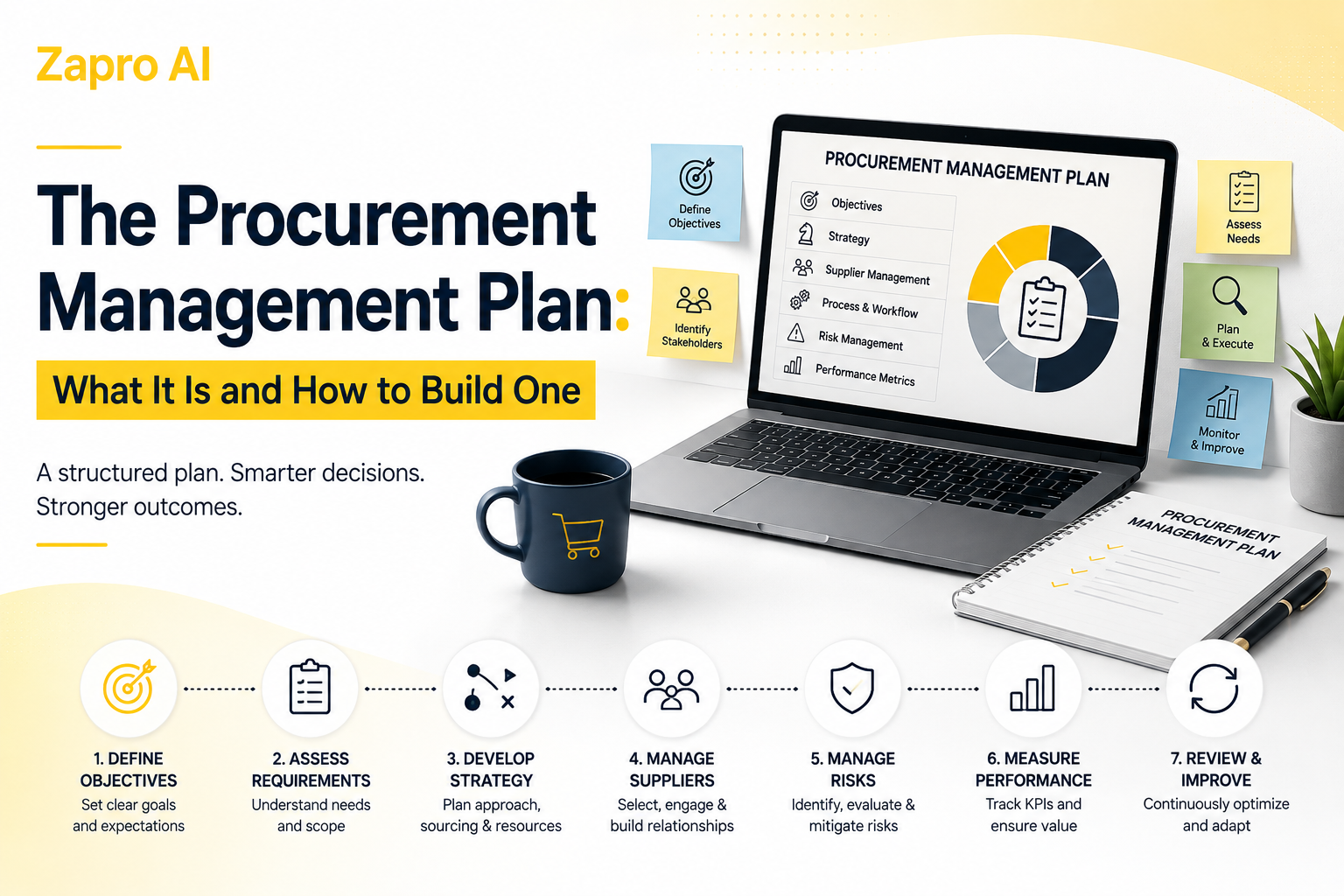
A procurement management plan is a document born from planning and strategy to organise and streamline procurement activities. This document sets out what a project will buy from outside vendors, how each purchase will be managed, and when each order must be placed. It sits inside the project management plan and covers evaluation criteria, approval thresholds, contract types, and closeout for every externally sourced item.
Key takeaways
- The plan comprises three things: what the project buys externally, how it buys, and by when.
- Milestones determine whether the plan works because they pin order dates to the schedule.
- This plan should also include approval thresholds.
- A plan never reopened stops being accurate the first time scope changes.
- Pick KPIs you will actually report, not everything you could measure.
On this page
- What is a procurement management plan?
- What a procurement management plan contains
- How to build one in eight steps
- Mapping lead times to the critical path
- A worked procurement management plan example
- Free procurement management plan template
- Keeping the plan alive
- Frequently asked questions
All seasoned project managers know that the first thing to do when they are made in charge of a project is to give it a spine so the project’s fundamental requirements can be laid out clearly. A Project Management Plan (PMP) is that spine of your project.
In this article, we will walk you through what a PMP is and how to build your own PMP in eight steps.
What is a procurement management plan?
A procurement management plan records how a project will acquire what it cannot produce itself, naming the items, the buying method, the evaluation criteria, the approvers, and the dates.
How it fits into the wider project plan
It is a subsidiary plan that is created alongside the schedule, cost, quality, and risk plans. There is a reason why the PMP is being positioned here, as this way the plan can inherit the constraints it requires. The schedule fixes need-by dates, and the budget fixes thresholds.
It also feeds back. If a lead time cannot fit inside the schedule, the schedule changes, not the lead time.
Plan Procurement Management as a PMBOK process
Procurement Management Plan is the PMBOK process that produces this document, along with the procurement statement of work and source selection criteria. It was the first of three procurement processes in the sixth edition. Its current position is covered on the project procurement management page.
What a procurement management plan contains
| Section | What it records | Who owns it |
|---|---|---|
| Scope of external purchases | Every item the project will buy rather than build | Project manager |
| Procurement schedule | Latest order date and need-by date per item | Project manager |
| Roles and approvers | Who decides, who signs, at what value | Sponsor |
| Vendor evaluation criteria | Scoring model agreed before bids arrive | Procurement |
| Bid and purchase process | Which solicitation type applies to each item | Procurement |
| Contract types | Which contract form fits each item’s risk | Procurement |
| Approval workflow and thresholds | Value bands and who clears each one | Finance |
| KPIs | The measures reported during delivery | Project manager |
| Closeout | Acceptance, final payment, performance record | Procurement |
| Change control | How scope changes reach the contract | Project manager |
How to build one in eight steps
Step 1: Establish scope and what must be bought externally
List every deliverable that is not part of the project’s internal production, then check that list against the work breakdown structure to make sure its status is known. Record each make-or-buy decision with its reasoning, since that reasoning is what you revisit when circumstances change.
Step 2: Map procurement milestones to the project schedule
Dates connect the procurement plan to the project. Take a need-by date for each item from the schedule, then work backwards to the latest date you can place an order.
Step 3: Identify stakeholders and approvers
It is paramount to know who has a say in each purchase. Hence, you should record who is consulted, who signs, and who is only being informed. Assigning each approval to a person rather than a department keeps the plan usable, and giving every approver a deputy prevents a purchase from sitting still while someone is away.
Step 4: Define vendor evaluation criteria
Here you decide how you will compare bids when the time comes. Agree on the scoring model and write the weightings down in advance, because criteria set afterwards tend to describe the vendor someone already prefers. Align lead time with price in that model, since a cheaper vendor who misses the need-by date has no value to the project.
Step 5: Set the bid and purchase process
Decide which solicitation type each item needs. Whether an item warrants an RFI, RFP or RFQ depends on how well the requirement is defined and how much you know about the market. Note the expected duration of each, because solicitation time sits on the schedule too.
Step 6: Build the approval workflow and thresholds
Set value bands and name who clears each. Thresholds set too low bury approvers in routine purchases; set too high, they remove oversight where it matters. Write down what happens when an approver is unavailable, since that gap is where projects stall.
Step 7: Choose the KPIs you will actually report
Four measures are usually enough: on-time delivery against contracted dates, cost against budget for each procurement, cycle time from requisition to order, and any vendor quality issues raised. It is better to choose a small number you will genuinely report than a longer list nobody returns to, because measures that go unreported are measures nobody acts on.
Step 8: Define procurement closeout
State what acceptance requires, who signs it, how final invoices are reconciled, when retention is released, and where vendor performance is recorded. Closeout written at the start is closeout that happens.
Mapping lead times to the critical path
This is where most project procurement fails, and it fails quietly. Nobody notices a missed order date until the delivery date moves.
Working backwards from the need-by date
The latest order date is not the need-by date minus the lead time. Four durations sit between them, and three usually get forgotten:
Latest order date = need-by date − (acceptance + delivery + manufacturing or preparation lead time + contracting time)
Contracting time is the one most often missed. Solicitation, evaluation, negotiation, and signature routinely take six to eight weeks for anything substantial, and none of it starts until the requirement is defined.
Take an item needed in week 30, with a 12-week manufacturing lead time, two weeks of delivery, one week of acceptance, and seven weeks of contracting. The latest order date is week 8, and solicitation starts in week 1.
Building buffer without padding the schedule
Buffer belongs at the point of highest uncertainty, not spread evenly. A commodity item from a known vendor needs little. A custom item from a new vendor needs real protection.
Hold it visibly as a named schedule allowance rather than hiding it inside each quoted lead time. Hidden buffer gets consumed without anyone deciding to spend it.
What to do when a procurement sits on the critical path
Three options, in order of preference. Shorten the procurement by pre-qualifying vendors before the requirement is final, which removes weeks from solicitation. Split the order so long-lead components go early. Or resequence so dependent work starts before full delivery.
Escalate any critical-path procurement to the sponsor at planning, not when it slips. An item with no float is a project risk and belongs in the risk register with an owner.
A worked procurement management plan example
The project scenario
A nine-month warehouse management system implementation with a $1.2 million budget. Go-live is fixed at week 36 because it is tied to a lease expiry on the existing site. Four items are bought externally.
The completed plan, section by section
| Section | Entry for this project |
|---|---|
| External purchases | WMS licenses; implementation partner; barcode scanners and printers; network cabling and installation |
| Procurement schedule | Scanners needed week 24, 10-week lead time, order by week 12. Cabling needed week 20, order by week 9. Partner needed week 6, contract by week 4. Licenses needed week 6 |
| Roles and approvers | PM defines requirements; IT director signs technical acceptance; CFO signs above $150k; procurement lead runs all solicitations |
| Evaluation criteria | Partner: relevant WMS experience 40%, team availability 25%, price 25%, references 10%. Hardware: price 50%, lead time 30%, warranty 20% |
| Bid process | Partner: RFP, 6 weeks. Hardware: RFQ, 3 weeks. Licenses: direct from vendor. Cabling: RFQ against existing framework |
| Contract types | Partner: fixed price with milestone payments. Hardware: firm fixed price. Cabling: time and materials with a $60k ceiling |
| Thresholds | Under $25k: PM approves. $25k–$150k: IT director. Above $150k: CFO |
| KPIs | On-time delivery against contracted dates; cost variance per procurement; requisition-to-order cycle time; defect rate on delivered hardware |
| Closeout | IT director signs acceptance; final invoices reconciled within 30 days; partner performance recorded before final payment released |
| Change control | Any scope change above $10k requires an approved change order before work proceeds |
The scanners are the critical-path item here. A 10-week lead time against a week 24 need-by date leaves no room, which is why they carry a named two-week allowance and get escalated at planning rather than at delivery.
Free procurement management plan template
What is in the template pack
Two files. The Word document holds the plan structure with prompts under each section. The spreadsheet holds the procurement schedule: one row per item, with need-by date, lead time components, calculated latest order date, and owner.
It runs the arithmetic above, so changing a lead time updates the order date rather than requiring a rebuild.
How to adapt it to your project size
Small projects can collapse evaluation criteria and contract types into one section and drop to two KPIs. Larger programs need a row per entity and an extra approval band. Keep the schedule tab whatever the size, since it prevents the failure this page opens with.
Keeping the plan alive
When to update the plan
Update it when scope changes, when a vendor is replaced, when a confirmed lead time differs from the estimate, and at every phase gate. A plan unchanged across a nine-month project has stopped matching reality.
Change control for scope-driven procurement changes
Route every scope change that touches a purchase through contract change control before the work happens. The failure pattern is familiar: the change is agreed verbally, the vendor delivers, and the invoice arrives with no approved change order behind it. Where a category is bought repeatedly, category management reduces how often this comes up.
Frequently asked questions
What is a procurement management plan?
A procurement management plan is a project document defining what will be bought from external vendors, how each purchase runs, who approves it, and when each order must be placed. It sits inside the project management plan.
What should be included in a procurement management plan?
Scope of external purchases, a procurement schedule with order and need-by dates, roles and approvers, vendor evaluation criteria, the bid and purchase process, contract types, approval thresholds, KPIs, closeout requirements, and change control.
What is Plan Procurement Management in PMBOK?
Plan Procurement Management is the PMBOK process that produces the procurement management plan, along with the procurement statement of work and source selection criteria. It was the first of three procurement processes in the sixth edition.
Who writes the procurement management plan?
The project manager owns it and writes the scope, schedule, and KPI sections. Procurement contributes evaluation criteria, contract types, and the bid process. Finance sets thresholds and the sponsor confirms signing authority.
How often should a procurement management plan be updated?
At every phase gate, and whenever scope changes, a vendor changes, or a confirmed lead time differs from the estimate. Treat it as a live document rather than a planning artifact filed once.
What is the difference between a procurement plan and a procurement strategy?
A procurement plan covers one project: what it buys, from whom, and by when. A procurement strategy sets the organization’s longer-term approach across categories, including vendor procurement policy and consolidation. The plan operates inside the strategy.
Turn the plan into tracked commitments
A procurement management plan is a set of intentions until the order dates, thresholds, and approvals exist where the project actually works.
Zapro holds requisitions, purchase orders, receipts, and invoices on one platform, so the thresholds written into the plan become approval rules that route automatically. Committed spend appears against the project budget at award rather than when the invoice lands, keeping the plan and the actuals in one place.
Book a demo to see how plan dates, approvals, and commitments stay connected through delivery.
Don’t miss our weekly updates
We’ll email you 1-3 times per week—and never share your information.
About the Author

Md. Kafil