Managing Returns & Reverse Logistics in Inventory: A Comprehensive Guide
In the current digital commerce environment, returns along with reverse logistics have evolved from simple operational procedures into essential components of inventory and supply chain operations. Every e-commerce leader, inventory manager, and operations manager must handle returns efficiently, as it functions as a competitive advantage.
This document examines basic concepts, emerging trends, and effective methods for reverse logistics and return management systems. The guide demonstrates how to leverage Zapro.ai, along with end-to-end visibility and automation tools, to maximize returns profitability.
What is Reverse Logistics? Definition and Scope
The reverse logistics process brings products from their end destination—usually with customers—back into supply chain operations for returns, refurbishment, recycling, or disposal purposes. The management of goods after sales takes center stage in this process, instead of focusing on forward logistics.
This includes:
Product Returns
Repairs and Warranty Management
Recycling and Disposal
Refurbishment and Remanufacturing
The process impacts stock levels, fulfillment timelines, and warehouse space utilization, requiring inventory operations to maintain supply chain efficiency.
The Rising Challenge of Returns in Modern Commerce
E-commerce operations have led to a substantial increase in return volumes across the board. The convenience of no-questions-asked returns now expected by consumers leads to significant expenses for merchants.
The National Retail Federation reports that U.S. retailers handled $743 billion in returns throughout 2023, with online returns ranging between 18% and 20%. These numbers represent multiple expenses, including restocking costs, lost sales potential, reverse shipping fees, and potential product degradation.
The practice of returns has become a profitability drain that demands immediate remediation.
Key Strategies for Efficient Returns Management
1. Clear Returns Policies
When companies provide clear returns policies, customers know what to expect, leading to fewer issues in operations. Well-documented return policies—defining acceptable conditions and outlining step-by-step procedures reduce customer service calls and disputes.
2. Streamlined Returns Authorization (RMA)
A Return Merchandise Authorization (RMA) system provides systematic tracking and validation of returns, enabling efficient processing. Automating RMA workflows reduces errors and accelerates the reverse supply chain.
3. Dedicated Returns Processing Centers
Organizations implement dedicated Returns Processing Centers (RPCs) as centralized facilities. These centers create efficient systems for product sorting and inspections, leading to faster processing and reduced storage costs.
4. Automated Sorting & Disposition Workflows
Technology enables automatic categorization of returned products:
Restock: Like-new items ready for resale.
Repair/Refurbish: Items requiring minor fixes or touch-ups.
Recycle/Scrap: End-of-life goods.
Donate/Liquidate: Unsellable inventory repurposed or offloaded.
5. Pre-Paid Shipping Labels & Drop-off Options
Enhancing customer convenience leads to faster returns and fewer disputes. QR code-based drop-offs, automated labels, and multiple return options improve customer experience while keeping the process under control.
In e-commerce, the returns experience is as critical as the initial purchase. A seamless reverse logistics process can turn a potentially negative experience into a positive, loyalty-building touchpoint.
Every return doesn’t have to be a loss. The correct approaches enable businesses to transform unwanted items into valuable stock which can be sold again.
• Restocking: Returns that are as good as new can go straight back into sellable inventory.
• Refurbishment/Repair: Slightly damaged or used items can be reconditioned.
• Remanufacturing: Recover valuable components or parts.
• Recycling: Extract raw materials to be reused or resold.
• Donation/Liquidation: Find a secondary market or a charitable outlet.
This approach supports circular economy principles, emphasizing waste reduction through intelligent product reuse and value extension.
Brands increasingly adopt closed-loop logistics models to reduce landfill impact and boost sustainability efforts.
The Role of Technology in Reverse Logistics & Inventory
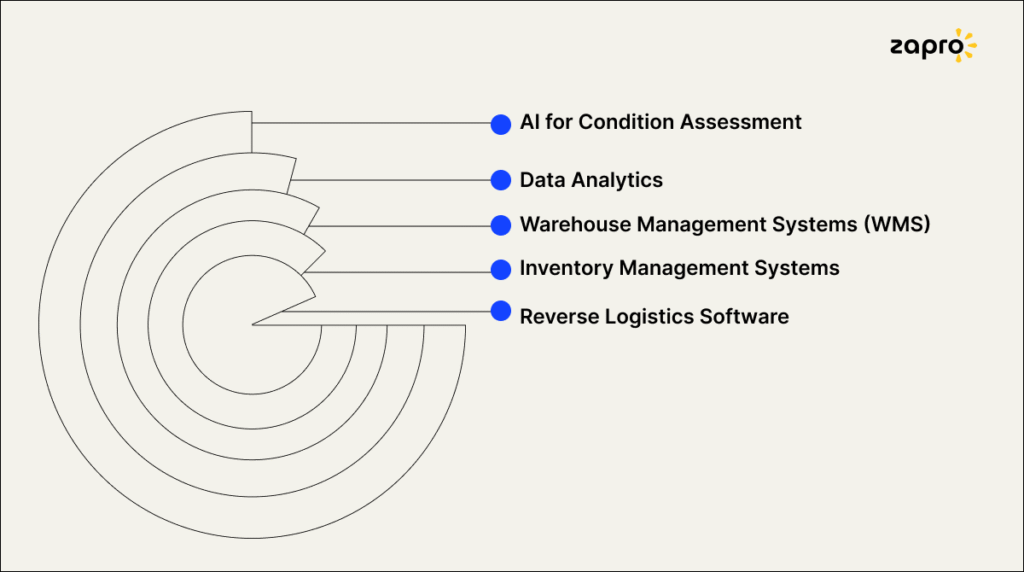
Modern returns management depends heavily on technology for efficiency and transparency. Key tools include:
1. Reverse Logistics Software
Manages the complete return cycle from RMA approval to final disposition while maintaining full visibility and control.
2. Inventory Management Systems (IMS)
Tracks returned stock and provides real-time inventory data, aiding restocking and liquidation decisions.
3. Warehouse Management Systems (WMS)
Improves warehouse space usage and workflow efficiency for returns handling.
4. Data Analytics
The platform delivers information about product returns along with details about quality defects and potential instances of fraudulent activities. Enables data-driven decision-making.
5. AI for Condition Assessment
Machine learning and computer vision assess the condition of returned items automatically, improving speed and accuracy.
How Zapro.ai Optimizes Returns & Reverse Logistics in Inventory
Zapro’s Smart Inventory Management Platform
Zapro.ai transforms how companies handle returns and reverse logistics by integrating seamlessly into your existing systems.
Zapro.ai helps businesses:
Automate RMA workflows.
Track every returned item from initiation to final disposition.
Identify return patterns using embedded analytics.
Recover value through intelligent sorting and resale management.
Zapro’s Features for Streamlined Returns Management
Returns Modules: Built-in tools for initiating, tracking, and completing returns.
Custom Disposition Workflows: Tailor return processes based on product type, condition, or origin.
Integrated Portals: Allow customers or staff to initiate returns via connected interfaces.
Actionable Reporting: Real-time dashboards on return rates, costs, and recovered value.
Explore Zapro Features to see how these tools reduce manual effort and increase operational agility.
Case Study: BrandCo Reduces Return Processing Costs by 35% with Zapro.ai
Company: BrandCo (Hypothetical Mid-Market Apparel Retailer) Challenge: High volumes of apparel returns, manual inspection, and long turnaround times. Solution: Implemented Zapro.ai for automated RMA and AI-powered grading. Results:
35% reduction in processing costs
28% increase in recovered value
15% improvement in customer retention rate
Visit Zapro Case Studies for more success stories.
Calculating the ROI of Efficient Reverse Logistics with Zapro.ai
Zapro.ai allows organizations to determine the return on investment (ROI) achieved by implementing efficient reverse logistics systems.
The implementation of optimized reverse logistics systems produces advantages which extend past reducing operational costs.
KPI
Before Zapro.ai
After Zapro.ai
Return Processing Cost (Avg)
$12 per item
$7.80 per item
Value Recovered (Avg)
40%
68%
Customer Support Tickets (Monthly)
450
310
Customer Satisfaction (CSAT)
78%
89%
Choosing the Right Inventory System for Robust Returns Management
When selecting an inventory platform with strong reverse logistics features, look for:
RMA Workflow Integration
Granular Tracking of Return Reasons and Status
Automated Disposition Capabilities
Compatibility with WMS, TMS, and ERP
AI and Analytics for Continuous Improvement
Explore unbiased reviews on platforms like Gartner or G2.
Why Zapro.ai is Your Partner for Smart Returns & Inventory Control
The platform serves as a strategic partner beyond its status as a platform. The complete range of Zapro capabilities supports businesses from procurement software through returns to achieve:
Improve inventory visibility
Automate reverse logistics workflows
Maximize recovery from returns
Elevate customer experience
Minimize waste, aligning with sustainability goals
Returns and reverse logistics have evolved from cost centers into opportunities. Platforms like Zapro.ai help businesses reduce losses, boost value recovery, and build customer loyalty—turning operational challenges into strategic advantages.
Turn Returns into Revenue with Smarter Reverse Logistics.
1. What is a Return Merchandise Authorization (RMA)?
RMA is used to track and approve returns which enables businesses to validate and monitor returned items before receiving physical possession.
2. How do returns impact inventory accuracy?
When returns remain untracked or experience delays it produces inventory mismatches which causes demand forecasting inaccuracies and results in stockpiling.
3. What are the environmental benefits of efficient reverse logistics?
Companies achieve reduced landfill waste through recycling and refurbishment operations while aligning their practices with circular economy principles.
4. How can e-commerce businesses minimize returns?
Online product descriptions that include size guides together with AR/VR try-ons and post-purchase support systems reduce the number of returns.
5. What is the role of quality control in processing returned goods?
Quality inspection procedures decide the fate of returned items by determining their suitability for restocking or repair or their need for disposal which impacts the recovery value.
6. How does omnichannel retail complicate returns management?
Different return points (stores, online, marketplaces) require a unified system to track, process, and manage returns centrally.
Forecasting feeds directly into planning. Let’s look at the most widely used models that help determine optimal stock levels and streamline operations for better inventory planning & forecasting.
1. Safety Stock Calculation
Safety stock protects supply from unanticipated demand surges and supply chain forecasting issues like lead times that are longer than expected. It’s influenced by:
Demand variability
Lead time fluctuations
Service level goals
Formula (Basic): Safety Stock = Z-score × Standard Deviation of Demand × √Lead Time
Advanced tools calculate dynamic ROPs that adjust in real-time to reflect current conditions. This ensures efficient demand planning inventory and reduces stockouts.
3. Economic Order Quantity (EOQ)
EOQ determines the optimal order size that minimizes total inventory costs (ordering + holding).
Modern EOQ models factor in variable lead times, bulk discounts, and multi-echelon logistics. These are among the most used inventory models in planning.
4. Material Requirements Planning (MRP)
MRP is used in manufacturing to ensure that there is availability of raw materials and components for the production. MRP incorporates:
Production schedules
Bill of Materials (BOM)
Inventory levels
MRP improves predictive inventory decisions, especially when combined with AI tools.
5. Distribution Requirements Planning (DRP)
This is used by companies that have more than one warehouse or retail store to ensure that there is efficient distribution of inventory throughout the network using proven stock optimization methods.
Challenges in Accurate Inventory Forecasting & Planning
Despite technological advancements, inventory forecasting still faces hurdles:
1. Data Quality and Silos
Inaccurate, outdated, or insufficient data used in the forecasting process leads to poor results. Lack of integration between different systems limits the visibility of the data quality and silos.
Long or unreliable lead times, port congestion, and raw material shortages impact availability.
4. Human Bias
Using too much intuition and old rules of thumb for forecasting can lead to inaccurate result
5. Lack of Real-Time Intelligence
Delayed insights mean slow reactions, missed opportunities, and lost revenue.
Forecasting is inherently flawed, but essential. The goal isn’t perfection, but continuous improvement and building resilience against forecast errors.
Work with suppliers, distributors, and partners to synchronize planning efforts through forecasting.
2. Leverage AI, ML & Advanced Analytics
Adopt systems that provide predictive insights and simulate demand scenarios.
3. Continuously Clean & Enrich Data
To have high-quality data, implement robust master data management practices.
4. Adopt Scenario Planning
Prepare for best-case, worst-case, and most likely outcomes to mitigate risks.
5. Foster Cross-Functional Collaboration
Involve sales, marketing, finance, and supply chain in the forecasting process.
Prescriptive analytics is on the rise. It not only predicts outcomes but also recommends actions—dramatically improving inventory efficiency and enabling better demand planning inventory systems.
How Zapro.ai Empowers Your Inventory Planning & Forecasting
Zapro.ai transforms traditional inventory planning & forecasting into a smart, automated, and data-driven function.
Key Capabilities:
Historical Data Analysis: Analyze trends, seasonality, and outliers
Custom Forecasting Models: Select from various statistical and AI-driven models
Real-Time Insights: Adjust plans based on live sales and supply chain data
Sales & ERP Integration: Connect planning directly with financial and operational systems
Unlock smarter predictive inventory decisions with these game-changing features:
Demand Sensing Short-term forecasting based on real-time signals like point-of-sale (POS) data, social media buzz, and promotions.
Safety Stock Optimization Automated calculations that factor in volatility, service levels, and risk exposure.
Multi-Location Inventory Visibility Holistic view across warehouses, stores, and distribution centers.
ERP & E-commerce Integration Seamless connection with existing platforms to automate workflows and enhance inventory forecasting techniques.
Case Study: How a Leading Consumer Electronics Company Improved Forecast Accuracy by 35% with Zapro.ai
A leading consumer electronics retailer struggled with erratic demand and stock imbalances. With Zapro.ai, they:
Deployed ML-based models for regional inventory forecasting
Reduced obsolete stock by 28%
Improved fulfillment rates from 86% to 97%
Outcome: The final results showed a 35% boost in forecast precision, 20% higher customer satisfaction rates, and 15% reduced inventory holding expenses.
Calculating the ROI of Advanced Inventory Planning with Zapro.ai
Zapro.ai allows businesses to calculate the return on investment of their advanced inventory planning & forecasting system. Smart forecasting tools create fast returns for business investments.
Benefit
Impact
Reduced Obsolescence
-20%
Lower Holding Costs
-10%
Improved Fill Rates
+15%
Higher Forecast Accuracy
+40%
Revenue from Improved Availability
+7%
Use the Zapro ROI Calculator to project your business gains.
Choosing the Right Software for Inventory Planning & Forecasting
Explore tools on G2 or consult Gartner for side-by-side comparisons. Choose a solution that supports stock optimization methods and predictive analytics.
Why Zapro.ai Is the Strategic Choice for Inventory Optimization
With Zapro.ai, you’re not just automating processes—you’re transforming how you plan, forecast, and deliver.
AI-powered insights
Real-time demand sensing
Seamless system integration
Customizable models
Scalable across regions and verticals
Zapro.ai = Inventory confidence, supply chain agility, and financial clarity.
Book a Demo | Explore Features
Conclusion
Modern supply chains rely on advanced inventory planning & forecasting as their fundamental operational structure. These systems go beyond guesswork by offering reliable methods for operating at faster speeds with increased resilience.
Zapro.ai and similar tools allow businesses to stay competitive by optimizing their inventory, improving customer satisfaction, and increasing profitability—regardless of demand volatility or global expansion goals.
1. What is the difference between demand forecasting and inventory forecasting?
Demand forecasting predicts customer demand. The inventory forecasting process uses supply chain factors (including lead time and safety stock) to calculate required stock levels.
2. How does seasonality affect inventory planning?
Seasonal trends lead to fluctuating customer demand levels. Planners need to modify their inventory quantities before seasonal patterns emerge.
3. What is safety stock and how is it calculated?
The additional stock quantity serves as protection against both supply and demand uncertainties. The calculation of safety stock depends on service level targets together with demand variability.
4. How does AI improve inventory forecasting?
AI analyzes complex patterns across massive datasets, adapting continuously and reducing errors vs. static models. This enhances both demand planning inventory and overall responsiveness.
5. What is the role of lead time?
The lead time determines the appropriate time for restocking operations. The extended duration of lead times requires businesses to increase their safety stock levels and start planning earlier.in inventory planning?
6. How can small businesses implement advanced forecasting techniques?
Begin with statistical inventory forecasting techniques before progressing to use Zapro.ai for its built-in AI forecasting and user-friendly dashboards.
Cloud-Based Inventory Management Software: A Complete Guide for Businesses in 2026
In case you are still keeping track of your stock through a desktop program or, even worse, through spreadsheets, then you are limiting yourself. The reason is that modern trading requires speed, accuracy, and accessibility—all of which cannot be provided by traditional, on-premise systems.
The answer lies in the implementation of cloud-based inventory management software. This is not just a technology fad; it is the basic operating system for any business that wants to grow, remain flexible, and get rid of the risk of running out of stock and making mistakes. This guide is an extensive resource that explains what cloud-based inventory management software is, why it is essential, and how to select the best cloud-based inventory management software for your business in 2026.
What is Cloud Based Inventory Management Software?
In its easiest term, cloud-based inventory management software is a tool that the program along with all your data are stored on servers that are not physically with you (the “cloud”) and you access them over the internet via a web browser or mobile app.
Defining Cloud Based Inventory Systems
Their model is that of Software as a Service (SaaS), which implies paying a subscription fee for the use of the software. The vendor also takes care of the hosting, maintenance, and security.
By 2026, virtual assistants and chatbots will gain traction, as 20% of organizations use them to handle internal and vendor interactions.
The difference between cloud and on premise is stark, particularly for inventory:
Feature
Cloud Based Software
On Premise/Desktop Software
Accessibility
Access from any location, on any device (phone, tablet, laptop).
Locked to a specific computer or internal network server.
Updates
Seamless, automatic updates and new features, zero downtime.
Requires manual installation, maintenance, and often system shutdown.
Real Time Data
Instant synchronization across all users and channels.
Data lag, often requiring manual synchronization.
IT Costs
Low: No server maintenance or dedicated IT staff required.
High: Requires dedicated hardware, IT personnel, and maintenance budget.
Scalability
Easy to add users, locations, and integrations instantly.
Requires purchasing new licenses and upgrading server capacity.
Key Features to Look For
In order to select the best cloud inventory management software, it is necessary to first rank the following must-have, cloud powered features in order of importance:
Real Time Inventory Tracking: The absolutely most important feature. Stock levels need to be updated instantly after every transaction—sale, receipt, return—across all channels, thus overselling is totally avoided.
Multi Location and Multi Channel Support: Be able to effortlessly control the inventory that is kept in different warehouses, retail stores, or with 3PLs, and also become able to synchronize the stock of all sales platforms (Amazon, Shopify, wholesale B2B portals) from one single dashboard.
Barcode and SKU Management: It should enable mobile barcode scanning via a mobile device or dedicated scanner to perform receiving, picking, and cycle counting in an automated manner, thus data accuracy is ensured.
Automated Alerts and Reorder Points: It is possible to set the minimum stock levels that will not only automatically trigger the alerts but also draft the purchase orders, thus cash flow will always be optimized and the purchasing will be free of any kind of guessing.
Reporting & Analytics: Delivering detailed and flexible cloud reports on inventory valuation, aging stock, cost of goods sold (COGS), and profit margins, available to all authorized users at any time.
Integration with POS, Ecommerce, and Accounting Tools: Your system should be equipped with pre-built connectors that are compatible with your current ecosystem (e.g., QuickBooks, Shopify, Square) for seamless, two-way data synchronization.
Streamline, Save, Succeed – Your Journey to Smarter Inventory Starts Here!
A switch to a cloud based inventory management system for small businesses can be seen very quickly in the terms of the company’s efficiency and its capability to bounce back from a crisis.
Accessibility from Anywhere
The software, which is web-based, allows inventory management from the office, warehouse, or at a trade show, even if it is located in another state. Therefore, the remote team gets enabled, support is provided to the managers who are constantly on the move and most importantly, the system is always accessible.
Reduced IT Costs
With a cloud based inventory management system there is a significant reduction in IT overhead that comes along with the cut of expenses for the local servers and hardware as well as their removal, the system configuration and maintenance. Besides that, the subscription turns a large capital expenditure into a predictable operational expense by covering maintenance, security, and infrastructure.
Seamless Updates & Maintenance
The software vendor takes complete control of the process of software updates, patches, and features and does it automatically, with no downtime for the operation, hence providing the team with the latest and most secure version at all times.
Collaboration Across Teams
Thanks to the cloud infrastructure, different departments – sales, procurement, finance, and warehouse operations can simultaneously and instantly access one and the same set of data. Such transparency drastically reduces the probability of errors and silos thus making the process of collaborative decision making both quicker and more accurate.
Security and Backup
Most of the time, cloud providers are in a better position to provide top-notch security and have multiple backup copies available of clients’ data than small or medium businesses that are located in urban areas and have limited resources for their own data centers. Your data backup is carried out in many locations, usually without your intervention, thus granting you protection against situations like hard drive crash, fire, or theft.
Top Features of the Best Cloud Based Inventory Management Software
When deciding on the best cloud-based inventory management software, you should only consider the vendors that possess the following key operational strengths:
User Friendly Interface: Although the software might have complicated features, the interface for everyday use has to be self-explanatory. Cloud software should work as efficiently as a modern web application thus the need for training sessions should be minimal and employee adoption should be fast.
Automation & Real Time Updates: Be aware of the present day automation features that free the hands of the operator from routine jobs like batch order processing, payment reconciliation, and multi-channel stock adjustments. All these steps should be executed in real time.
Reporting & Forecasting: TThe system should not be limited to giving only the static reports. It should be equipped with predictive analytics thus enabling the user to forecast demand accurately based on seasonal trends and historical data.
Cloud Security & Data Backup: Make sure that the vendor gives you the specifics about their encryption protocols, compliance standards (e.g., SOC 2), and disaster recovery plan. The data should always be encrypted whether it is being transferred or stored.
Pricing Transparency: The inventory management software cloud based pricing structure should be clearly differentiated, easily understood, and flexible. Do not allow vendors who charge you high fees for necessary integrations or give basic user access without capacity.
Selecting the right system requires matching the software’s capabilities to your unique business fingerprint.
Business Size & Industry
Small Business: Look for solutions that emphasize ease of use and essential integrations (e.g., QuickBooks).
Enterprise/Distribution: Prioritize complex features like EDI, third party logistics (3PL) integration, and advanced warehouse management.
Restaurant/Food Service: If you are a restaurant, you need cloud based restaurant inventory management software that can track recipe level ingredients, manage vendor ordering, and minimize waste, which requires specific features not found in standard retail solutions.
Budget & Pricing Model
Decide whether a low monthly subscription (for basic needs) or a higher tier, per user subscription (for complex operations) fits your financial model. Always calculate the total cost of ownership, including implementation and potential hidden fees.
Integration with Existing Tools
Verify that the cloud platform offers secure, pre built integrations with the key systems you rely on:
Your accounting software (QuickBooks, Xero).
Your eCommerce/POS platforms (Shopify, Magento, Square).
Your shipping/fulfillment providers.
Ease of Use & Support
Test the software interface with your actual team members. A powerful system that nobody can use is worthless. Confirm the vendor offers responsive customer support during your operating hours, whether that’s email, phone, or live chat.
Final Thoughts
The transition to inventory management cloud based software is a crucial moment for any business that is expanding. The company will no longer be operating under a veil of uncertainty as they will have real-time data at their disposal. Manual errors will be replaced with automation while high IT costs will be replaced with manageable subscriptions. When you go for a cloud solution that emphasizes accessibility, integration, and security, you are essentially keeping your operations up to date and making them compatible with the coming years while at the same time acquiring the necessary visibility for success in 2026.
Zapro roots in the belief that contemporary inventory management should be feature-rich, easily integrated with the procurement process, and both user-friendly and secure by design. It is a great representative of cloud-based inventory solutions, hence it can offer that level of control which a fast-growing business will have at a reasonable cost.
Say Goodbye to Spreadsheets and Stock Shortages
Automated inventory management with real-time visibility and multi-location control
1. How can small businesses streamline inventory management using cloud based software like Zapro?
Cloud-based solutions enable small companies to achieve the automation of purchase orders. Additionally, they facilitate the synchronization of stocks across all sales channels, which makes the process almost instant. On top of that, the technology provides mobile barcode scanning without the need to maintain manual spreadsheets, which greatly reduces errors and save costs.
2. What features should I look for in cloud inventory software to improve warehouse efficiency?
To make the warehouse activities more efficient, proper multi-location monitoring should be implemented. Moreover, the system must be capable of generating picking routes that are not only feasible but also the most optimized. At the same time, the process of barcode scanning when doing the receiving or packing task has to be carried out without interruption by means of mobile devices.
3. How do cloud based inventory tools help restaurants track ingredients and reduce waste?
Cloud-based restaurant inventory management software provides its users the ability of tracking ingredients at the unit level, besides calculating the costs of recipes and letting the managers be informed about either shortage of stock or even more than needed of aging inventory that in turn will lead to the minimization of food waste as well as the maximization of vendor ordering.
4. Can cloud inventory management platforms support multi location businesses efficiently?
Yes. Since all the inventory data are stored in one place, where all locations connect to, it gives managers a one-stop, real time view of stock levels in all warehouses or stores, no matter where geographically their are located.
5. How do cloud inventory systems simplify order tracking and reporting for growing businesses?
Cloud-based systems bring together all the data about the orders that come from various sales channels. Besides that, they handle the automation of the fulfillment processes, keep track of the orders via the shipping stages, and very quickly update the reports on inventory valuation, thus making things easy as far as compliance is concerned and giving instant financial insights which are very clear and up-to-date.
Best Warehouse Inventory Management Software in 2026: Complete Guide
For any company that sells physical products, the warehouse should be considered the core of the business and inventory is the most vital element. However, a significant number of such companies still use manual counting and old-fashioned spreadsheets for managing this most valuable resource. The consequence of such negligence is a lack of control that leads to delayed shipments, the waste of money on excess stock, and the customer frustration which is the backorder – the most terrible type of customer frustration.
The major factor of success in 2026 to the business operations is the purchase of the best warehouse inventory management software. It is a tool that essentially changes the warehouse from being a loss-making department to a profit-making one in a very efficient way thus keeping the right product, at the right place, at the right time is guaranteed. This article is a comprehensive guide to the features and solutions that are instrumental to supply chain efficiency.
What Is Warehouse Inventory Management Software?
Warehouse inventory management software is a software system that is capable of tracking, managing, and controlling the movement and storage of the stocks in the warehouse till the goods are delivered to the customer.
Core Functions:
Real Time Stock Tracking: Ensures that the stock available at different places is counted immediately and accurately.
Barcode/RFID Scanning: Exploiting technology to do data entry and verification automatically, which means that very few mistakes can be done by human hand.
Location Management: Helps the employees to locate the exact shelf, bin, or pallet where they can find the item they want to pick or put away.
Order Fulfillment: Handles the stages of the process from getting the goods requested and packing them to making the shipping label.
Reporting and Analytics: Creates the essential reports on stock turnover, valuation, and aging inventory.
Integration Capabilities: Warehouse data is linked to the finance, sales, and procurement systems through this tool.
Why It Matters
The execution of the proper inventory warehouse management software is a key factor that leads to profitability. The software links operational efficiency (faster receiving and picking) to financial impact (reduced carrying costs and minimized stockouts) and thus superior customer satisfaction is the end result.
According to a report by Gartner, companies that adopt AI-powered inventory management solutions can expect to see an average reduction of 10–15 % in inventory costs and a 15–20 % improvement in service levels.
While reviewing the solutions, the perfect inventory management software for warehouse should provide a good balance of fundamental and sophisticated features.
Must Have Features:
Barcode Scanning Integration: There is no compromise here. The use of scanners or mobile devices lowers manual errors by up to 67% compared to manual data entry.
Real Time Inventory Tracking: One has to be aware of stock levels at any time and for all the channels if s/he wants to avoid the problem of selling more than they have in stock.
Multi Location Support: The software should be able to handle inventory management of the warehouses, retail stores, or distribution centers, all from one platform, without any difficulty.
Automated Reordering: The system should be able to figure out when to reorder products automatically based on sales history and lead times, and also generate alerts that notify users of stock running out without any intervention from them.
Integration Capabilities: Be ERP connectors (SAP, Oracle), accounting (QuickBooks), or e-commerce platforms (Shopify), the connection should be smooth without any breaks or interruptions.
Mobile Accessibility: The inventory management task along with cycle counts and order processing can be done by mobile phone users anytime and anywhere and this is going to enhance the productivity level of supervisors and staff on the floor.
Smarter, future-ready inventory management with Zapro.ai.
Demand Forecasting: Predicting future buying requirements through analysis of past data and taking into consideration seasonal changes.
Batch and Serial Number Tracking: One important use of this is for the quality control and another one is for the regulatory compliance – it tracks the specification of the items or the batches all along the supply chain.
Cycle Counting Automation: Instruments for cycle counting that helps to simplify the process as well as schedule it for small and regular counts, hence, no need for costly annual physical inventory shutdowns.
Kitting and Bundling: Controls the process that involves the combining of several SKUs to form a package or a finished product.
Zapro Angle: It is not only the best that can do is just to keep a record of what you have but also they can decide what to buy and when to buy it. Be on the lookout for those that link inventory directly with procurement workflows thus stock data become a tool for optimized purchasing decisions.
The phrase warehouse management inventory software is used to describe a variety of different solutions, each of which is the most appropriate for a different type of a company.
Type of Software
Pros
Cons
Best For
Standalone Inventory Systems
Specialized features, often affordable.
Limited integration, manual data transfer.
Small warehouses with simple needs and limited SKUs.
Can be complex, expensive, and require lengthy implementation.
Large distribution centers and 3PLs with high volume.
ERP with Inventory Modules
Unified data across departments (finance, sales, manufacturing).
Less specialized inventory features; warehouse staff may find it cumbersome.
Mid to large enterprises prioritizing unified data.
Procurement Platforms with Inventory Management
Connects purchasing decisions with stock levels, optimizes spend and supplier management.
May need supplementary tools for complex, advanced warehouse operations.
Businesses prioritizing procurement efficiency and cost control.
Example: Platforms like Zapro offer the power of procurement optimization and supplier management with robust inventory visibility and control, providing a high ROI solution for companies that prioritize cost control alongside stock accuracy.
Top Warehouse Inventory Management Software Solutions
When seeking the best warehouse inventory management software, consider a solution’s core strength and its fit with your financial systems.
Solution
Brief Description
Best For
Pricing Tier
Integration Capabilities
Zapro
Modern, highly scalable platform unifying inventory control, supplier management, and procure to pay (P2P).
Growing mid-market businesses prioritizing procurement and inventory cost control.
Mid Range (Modular)
Strong ERP (SAP, Oracle, NetSuite) and accounting integration.
Zoho Inventory
Cloud based solution with excellent multi channel capabilities, ideal for e-commerce.
Small to mid sized e-commerce sellers with high multichannel volume.
Low to Mid Range
Deep integration with Zoho ecosystem and major e-commerce platforms.
Odoo
Modular, open source ERP with a robust inventory application.
Businesses wanting an all in one solution that can be highly customized.
Mid Range (Subscription + Customization)
Excellent across Odoo’s own native ERP modules.
NetSuite
Full cloud ERP solution with integrated warehouse and inventory modules.
Large enterprises needing a single, unified system for all business functions.
High End (ERP Pricing)
Native integration within the NetSuite ERP ecosystem.
SAP Business One
ERP aimed at small to mid sized businesses with a manufacturing focus.
Small manufacturers and distributors requiring sophisticated inventory costing.
Mid to High Range
Native integration within the SAP Business One environment.
Fishbowl
Often paired with QuickBooks, providing advanced features beyond basic accounting limits.
Small manufacturers and wholesalers using QuickBooks for finance.
Mid Range (License Fee + Maintenance)
Deep, specialized integration with QuickBooks.
inFlow Inventory
Known for its simplicity and user friendly interface, offering robust barcode and mobile support.
Small businesses and start-ups looking for a quick, non complex setup.
Low to Mid Range
Basic accounting and e-commerce integrations.
TradeGecko (QuickBooks Commerce)
A system focused on high volume B2B and B2C inventory and order management.
Brands and wholesalers needing tight QuickBooks synchronization.
Mid Range
Native integration with QuickBooks Online.
Barcode Scanner Integration: Why It’s Essential
The most effective way to eliminate the most common source of error—manual data entry—is by using barcode scanning.
99.9% Accuracy: Automated scanning delivers near-perfect accuracy compared to the estimated 83% accuracy rate of manual keying.
5x Faster: Scanning is significantly quicker than typing, leading to faster receiving and picking times, directly impacting your labor efficiency.
Real Time Updates: As soon as an item is scanned, the central warehouse inventory management system software is updated, giving decision makers instant visibility.
Reduced Training Time: Mobile applications with scanning functionality are highly intuitive, drastically cutting the time required to train new warehouse staff.
How to Choose the Right Software for Your Business
Choosing the best inventory warehouse management software requires a methodical approach that defines your current state and maps your future needs.
Decision Framework:
Assess Your Current State:
Current inventory value and number of SKUs.
Order volume and number of locations.
Specific challenges (e.g., lot tracking, complex kitting).
Define Your Requirements:
Create a list of must-have features (e.g., barcode integration, QuickBooks sync) versus nice-to-have features (e.g., advanced forecasting).
Define budget constraints and scalability requirements.
Consider Total Cost of Ownership (TCO):
Factor in software licensing or subscription fees.
Include costs for necessary hardware (scanners, mobile devices).
Budget for initial implementation, data migration, and training.
Evaluate Beyond Inventory: “Ask yourself: Is inventory management your only pain point, or are procurement delays, maverick spending, and supplier management also causing issues? If so, a platform that addresses the entire source-to-pay process might deliver better ROI.”
Test Before Committing: Utilize free trials, request a pilot program for a small subset of your operations, and conduct reference checks with similar businesses.
Implementation Best Practices
A smooth transition relies heavily on preparation and change management.
Success Factors:
Executive Buy in: Leadership must clearly communicate the importance of the new system to drive company-wide adoption.
Cross Functional Team Involvement: Include staff from the warehouse, AP, IT, and Procurement in the planning phase to ensure the solution meets everyone’s needs.
Clean Data Migration: Dedicate time to scrub your current SKU list, vendor data, and location codes. Bad data in equals bad data out.
Common Pitfalls to Avoid:
Underestimating the time required for data migration and configuration.
Failing to standardize receiving and putaway processes before implementation.
Insufficient training for warehouse floor staff, leading to low system adoption and inaccurate data.
The return on investment (ROI) from a unified warehouse inventory management software with barcode scanner functionality is substantial and multi-faceted.
Quantifiable Benefits:
25-35% reduction in carrying costs by optimizing stock levels and reducing unnecessary overstock.
20-30% improvement in order accuracy due to automated picking verification.
15-25% reduction in stock-out incidents through automated reordering and accurate tracking.
30-40% faster order fulfillment thanks to optimized warehouse workflows.
40-50% reduction in manual data entry time by leveraging barcode scanning.
Strategic Benefits:
The software delivers better cash flow management, allows for data-driven decision making regarding product profitability, and provides the scalability necessary to handle business growth without operational bottlenecks.
Connect to Procurement: Companies that integrate inventory data with procurement processes see an additional 15-20% reduction in inventory costs through optimized purchasing decisions informed by real-time stock levels and lead times. This eliminates the silo between what you have and what you buy.
Conclusion
In 2026, the competitive advantage lies in control and visibility. The right warehouse and inventory management software is the indispensable tool that delivers both. By choosing a system that prioritizes real time data, barcode accuracy, and seamless integration, you transform your warehouse operations from a source of stress into a powerful engine for profitability and customer satisfaction.
From Manual Tracking to Intelligent Inventory
Zapro replaces spreadsheets with automated stock updates, purchase workflows, and inventory alerts.
1. Can warehouse inventory management software integrate with my existing accounting system?
Yes, all leading warehouse inventory management system software solutions offer robust integration, often via pre-built connectors (APIs), to synchronize inventory valuation, Cost of Goods Sold (COGS), and purchase orders with popular accounting systems like QuickBooks, Xero, and major ERPs.
2. What’s the difference between perpetual and periodic inventory systems in warehouse software?
Perpetual inventory systems (used by modern software) update stock levels immediately with every transaction, providing real-time accuracy. Periodic inventory systems require manual physical counts at set intervals, offering only periodic accuracy.
3. How does warehouse inventory software handle lot tracking and expiration dates?
The software tracks items by unique Lot Numbers or Serial Numbers. Upon receiving, staff record the expiration date for that lot, and the system uses First Expiry, First Out (FEFO) logic to guide picking, ensuring stock is used before it spoils or expires.
4. Do I need dedicated hardware or can I use existing smartphones and tablets?
Many modern warehouse management inventory software solutions are cloud-based and support “bring your own device” (BYOD) using mobile apps on standard smartphones and tablets for barcode scanning and data entry, although ruggedized scanners are often preferred for high-volume environments.
5. How long does it typically take to fully implement warehouse inventory management software?
Implementation can take anywhere from 4 to 12 weeks for a mid-sized business, depending on the complexity of the software, the number of integrations, and the quality of the existing inventory data that needs to be migrated.
Manufacturing Inventory Management Software: Your Blueprint for Production Efficiency
If you are operating a manufacturing company, then you must be aware of the very small margin of error that is allowed. The whole production line can be stopped as a result of just one component that is wrongly placed. The lack of a delivery from a supplier can be the reason for the delay of hundreds of customer orders. Managing the intricacies of raw materials, components, and finished goods that are going through several production stages is the main reason why the traditional methods of using spreadsheets or simple accounting software have become insufficient.
Today, succeeding in manufacturing requires specialized tools. This guide introduces you to the concept of manufacturing inventory management software—a necessity designed not just to count stock, but to optimize your entire production lifecycle. We will explore the key features, critical benefits, and top choices for the best inventory management software for manufacturing in 2026.
What is Manufacturing Inventory Management Software?
Manufacturing inventory management software is a dedicated class of system that manages all resources involved in the transformation of raw materials into finished goods.
Definition
It is a specialized solution that monitors, tracks, and controls inventory across the entire manufacturing supply chain—from the purchasing of components, through the work in progress (WIP) stages on the shop floor, and out to finished goods storage.
Why It’s Different from Normal Inventory Software
Standard retail or wholesale inventory software primarily tracks finished goods and simple fulfillment. Inventory management software manufacturing solutions must handle:
Transformation: Tracking inventory as its value and form change (e.g., steel coil to machine part).
Layered Complexity: Managing Bill of Materials (BOM), tracking costs at various production milestones, and handling assemblies and disassemblies.
Advanced Planning: Linking inventory levels directly to production schedules and capacity planning.
AI-enabled supply chain management has enabled businesses to improve logistics costs by 15%, inventory levels by 35%, and service levels by 65%
Manufacturers face a unique set of challenges that standard retail software cannot address effectively.
Multi Stage Production: Tracking inventory across various checkpoints—from receiving dock to various assembly stations—is complex.
Raw Material Tracking: Ensuring that the correct quantity of raw materials is available before a production run starts, often involving complex unit conversions (e.g., purchasing in liters, using in milliliters).
Work in Progress (WIP) Monitoring: Accurately calculating the value and location of partially finished goods on the shop floor. Without this, cost accounting is impossible.
BOM Accuracy: Maintaining a precise, up to date list of every component and sub assembly required to build a finished product.
Demand Fluctuations: Balancing fluctuating customer demand with fixed production batch sizes and long lead times for specialized materials.
Production Scheduling: Synchronizing material availability with machine and labor capacity to avoid costly bottlenecks and downtime.
Must Have Features of the Best Manufacturing Inventory Management Software
The best manufacturing inventory management software is defined by its ability to integrate the shop floor with the back office.
Real Time Stock Tracking
Provides instant visibility into current stock levels and location across the warehouse and shop floor.
Bill of Materials (BOM) Management
Allows users to create, maintain, and version BOMs, automatically calculating material requirements and consumption when production starts.
Order & Production Planning
Links customer sales orders directly to production work orders, scheduling production runs based on capacity, material availability, and deadlines.
Multi Location Inventory Control
Handles stock in various physical locations, including raw material stores, WIP zones, and finished goods warehouses.
Barcode/QR Based Tracking
Supports mobile scanning of components and products as they move between production stages, ensuring accurate WIP tracking and data capture.
Supplier Management
Centralizes supplier data, performance history, and contract terms, ensuring you partner with reliable sources.
Automated Purchase Alerts
Triggers smart reorder points for raw materials based on lead times and planned production runs, preventing stockouts.
WIP Tracking
Allows materials to be issued to a work order and tracks the value and quantity of the partially finished goods until they are booked as finished product.
Benefits of Using Inventory Management Software for Manufacturing
Investing in the right inventory management software for manufacturers yields immediate returns across the organization.
Reduced Production Downtime: By automating reorder alerts and providing accurate real time stock status, the software ensures critical components are always available, minimizing costly delays on the shop floor.
Accurate Demand Forecasting: Tools use historical sales data and production schedules to project future material needs, allowing procurement to place optimized orders and secure better pricing.
Minimized Wastage: Better control over material usage and expiration dates (e.g., FIFO/FEFO rules) reduces waste of perishable or time sensitive materials.
Faster Order Fulfillment: Streamlined processes and accurate inventory ensure that products are built and shipped on time, improving customer satisfaction and fulfillment speed.
End to End Traceability: Essential for quality control and regulatory compliance, the software provides a complete audit trail from the incoming raw batch of materials to the final shipped product.
How Inventory Software Supports Different Manufacturing Types
Manufacturing isn’t one size fits all. The ideal software must accommodate specific production methods.
Discrete Manufacturing: (e.g., electronics, furniture, vehicles). The software must excel at complex BOMs, managing thousands of unique components, and tracking serialized items.
Process Manufacturing: (e.g., food and beverage, chemicals, pharmaceuticals). The system needs strong batch and formula management, quality control checks at various stages, and robust expiration date tracking.
Batch Manufacturing: (Producing goods in batches). Requires precise tracking of batch specific costs, quality testing, and lot traceability.
Custom Manufacturing: (Made to order). The software must integrate sales quoting with dynamic BOM creation and capacity scheduling, handling unique job specific requirements.
E Commerce Driven Manufacturing: (Selling direct to consumer). Needs seamless, real time integration with online sales platforms and fulfillment systems while managing the complexities of production scheduling.
How to Choose the Best Inventory Management Software for Manufacturing
Selecting the right manufacturing and inventory management software is a long term commitment. Use this checklist to guide your decision:
Checklist Item
Consideration
Why It Matters
Cloud vs. On Prem
Cloud offers remote access, faster updates, and lower IT costs; On-prem offers maximum data control.
Cloud is the modern standard for agility and scalability.
Customization
Can the software adapt its workflows, forms, and reports to your unique production processes?
Manufacturing processes are highly specific; the tool must adapt to you.
Integration with ERP/CRM
Does it connect seamlessly with your existing finance (ERP) and sales (CRM) systems?
Eliminates manual data entry between systems and ensures accounting accuracy.
Scalability
Can it handle a 10x increase in volume, additional warehouses, or new product lines?
Avoids expensive system migration down the line as you grow.
Automation Level
How many manual tasks (reordering, WIP reporting, costing) does the software eliminate?
Maximizes efficiency and minimizes human error.
Pricing
Is the pricing modular (pay for what you use) or an expensive, one size fits all package?
Look for transparency and a cost structure that scales predictably with growth.
Ease of Use
Can your shop floor and warehouse teams learn the system quickly?
High adoption rates are critical for data accuracy and successful implementation.
Why Modern Cloud Platforms Are Becoming the Go To for Manufacturers
Modern manufacturers are increasingly turning away from outdated, locally installed systems in favor of purpose built cloud platforms.
Real Time Data Access: The ability to see stock, orders, and WIP status instantly on a tablet or mobile device on the shop floor drastically improves decision making.
Zero Hardware Overhead: Cloud solutions require no capital investment in servers or maintenance, freeing up critical IT budget for innovation.
Fast Deployment: Cloud software can be implemented and running in weeks or months, not the years typically associated with monolithic ERP deployments, providing a rapid return on investment.
Why ZAPRO Is the Best Choice for Manufacturing Inventory Management Software
Zapro is designed to address the specific pain points of inventory management software for manufacturing companies by seamlessly linking inventory control with core procurement and financial workflows.
Zapro goes beyond simple inventory tracking by offering robust BOM management, real time WIP monitoring, and powerful automated purchasing alerts. Its deep integration capabilities ensure that your inventory data syncs perfectly with your existing ERP, providing accurate costing and valuation. This combination of granular control and high level financial integration makes Zapro the optimal platform for streamlining complex manufacturing supply chains and driving production efficiency.
Conclusion
Choosing the right inventory management software for manufacturing industry is the blueprint for your company’s future efficiency. By prioritizing tools with robust BOM management, WIP tracking, and automation, you move beyond guesswork and manual counting. You empower your business with the visibility, accuracy, and speed needed to meet demand, minimize waste, and maintain a competitive edge in 2026.
Take Control of Your Manufacturing Inventory
Reduce stockouts, eliminate overproduction, and gain real-time visibility.
1. How can manufacturers automate inventory tracking?
Manufacturers can automate tracking by implementing barcode/QR based tracking throughout the warehouse and shop floor. The system automatically updates stock levels and WIP status every time a scanner registers a component movement, eliminating manual logs.
2. What software helps manage raw materials and WIP easily?
Dedicated manufacturing inventory management software helps by tracking raw materials using lot/batch numbers and manages WIP by using the Bill of Materials (BOM) feature to issue materials to a specific production order and track the value added at each stage.
3. Which tool offers smart reorder alerts for manufacturers?
The best tools, like Zapro, integrate inventory and procurement. They use automated purchase alerts that calculate reorder points based on current stock, vendor lead times, and materials required for planned production runs, not just past usage.
4. How does cloud inventory software reduce production delays?
Cloud inventory software provides real time stock tracking and access from the shop floor, ensuring that production managers can verify material availability immediately. It also flags potential stockouts instantly, allowing procurement to rush orders before a production line is impacted.
5. What system supports BOM and production planning together?
Specialized inventory management software for manufacturing supports both. It uses the BOM to calculate gross and net requirements for every product on the production schedule, ensuring all components are available before allocating labor and machine time.
Best Inventory Management Software for Small Businesses [2026]
The best inventory management software for small businesses in 2026 includes Zapro, Zoho Inventory (best free plan), Sortly (best for simplicity), inFlow Inventory (best for distributors), and Cin7 (best for growing retail). This guide compares seven top-rated tools by exact pricing, G2 ratings, and structural business fit to help operations streamline workflows.
Key Inventory Management Metrics & Benchmarks
Organizations utilize specialized inventory platforms to eliminate data blind spots and control overhead costs. The following operational statistics highlight the financial impact of structured stock tracking:
Systemic Tracking Deficits: 43% of small businesses use no dedicated inventory tracking system or continue to rely on manual spreadsheets. www.stellarone.io
Revenue Losses: Preventable inventory errors, stockouts, and overstocking cost small retailers an average of 11.7% of their annual revenue. www.stellarone.io
Carrying Cost Reductions: Deploying automated, AI-driven inventory management systems reduces average carrying costs by 10% to 15% while improving order fulfillment rates.
Sustained Market Growth: The global inventory management software market expands at a compound annual growth rate (CAGR) of 6.1% through 2028, reflecting rapid cross-channel digitization.
Why Inventory Management Software for Small Business Matters
Moving beyond manual documentation methods is essential for corporate growth. Selecting the right small business inventory management software addresses critical financial and operational challenges directly.
The True Cost of Manual Tracking
While spreadsheets require no upfront licensing fees, they introduce significant long-term costs through manual human errors. Every hour spent manually reconciling warehouse counts or correcting shipping errors due to an incorrect item tally diverts resources from customer acquisition and product engineering. Furthermore, manual tracking frequently results in sudden stockouts or overstocking, which ties up working capital and degrades client trust.
Scalability Challenges
When an organization opens a secondary fulfillment center or expands into additional eCommerce marketplaces, manual tracking breaks down. A dedicated inventory management system synchronizes multi-channel stock levels automatically, ensuring data consistency across every digital storefront without expanding administrative headcount.
Cash Flow Optimization
Managing cash flow is a primary operational constraint for growing enterprises. Specialized software provides granular visibility into sales velocity and demand forecasting, allowing teams to clear slow-moving inventory and reallocate capital toward high-margin, high-demand product lines.
According to a report by Gartner, companies that adopt AI-powered inventory management solutions can expect to see an average reduction of 10–15 % in inventory costs and a 15–20 % improvement in service levels.
Strategic Architecture: Inventory Software vs. Accounting Software vs. ERP
Procurement and operations teams must understand the distinct structural boundaries between core financial systems, point solutions, and enterprise software:
Capability
Inventory Management Software
Accounting Software
Enterprise Resource Planning (ERP)
Primary Focus
Real-time stock counts, kitting, barcode tracking, and multi-channel order routing.
General ledger maintenance, invoicing, tax compliance, and cash flow reporting.
Multi-department data unification (HR, CRM, supply chain, and deep manufacturing).
Order Control
Automates purchase alerts based on physical reorder points and sales velocity.
Records paid invoices and processes manual accounts payable/receivable data.
Governs complex corporate resource allocation across multiple global subsidiaries.
Deployment Time
1 to 2 weeks for full hardware and cloud synchronization.
1 to 3 days for foundational ledger configuration.
3 to 9 months for customized systems implementation.
Pricing Baseline
$0 to $350 per month on standardized SaaS tiers.
$30 to $150 per month based on transaction volume.
$150 to $1,000+ per month with substantial upfront setup fees.
Essential Features in Small Business Inventory Software
When assessing available market alternatives, operations managers should evaluate core capabilities that maximize automation while minimizing system complexity:
Ease of Use: Software should feature an intuitive, user-friendly dashboard that allows for rapid staff onboarding without requiring extensive technical consulting.
Affordable SaaS Pricing: Transparent pricing models with predictable monthly subscription rates protect operating budgets from unexpected user-licensing or integration fees.
System Scalability: Infrastructure must accommodate catalog growth seamlessly, expanding from 10 SKUs to 10,000 SKUs without requiring a full system migration.
Cloud-Based Architecture: Cloud deployment enables remote teams to monitor live stock data from any location, eliminating the need for on-premise servers.
Mobile Barcode Scanning: Native mobile device support converts standard smartphones or tablets into functional warehouse scanners, accelerating receiving and picking precision.
Native Integrations: Bi-directional data sync links inventory changes automatically with core accounting software (QuickBooks Online, Xero) and eCommerce channels (Shopify, WooCommerce).
Real-Time Stock Tracking: Instant visibility across fulfillment nodes prevents accidental overselling and provides category managers with accurate purchasing metrics. www.stellarone.io
The Top Inventory Management Software Solutions Compared
The following comparative table lists leading inventory tools based on verified user evaluation data, active pricing schedules, and operational design:
Tool Name
Best For
G2 Rating (G2, May 2026)
Starting Price
Standout Feature
Zapro
Procurement integration
4.7 / 5
$699 / month
Automates the complete path from a “low stock” alert to a finalized vendor PO.
Zoho Inventory
Multi-channel scaling
4.3 / 5
Free tier / $59/mo
Native multi-warehouse routing paired with direct Shopify and marketplace syncing.
Sortly
Visual simplicity
4.7 / 5
Free tier / $29/mo
Ultra-simplified visual asset tracking driven by rapid mobile QR/barcode tagging.
inFlow Inventory
Industrial B2B distribution
4.1 / 5
$89 / month
Built-in assembly, kitting, and product work-order creation loops for light manufacturing.
Cin7
Complex retail logistics
4.4 / 5
$349 / month
Built-in Electronic Data Interchange (EDI) capabilities paired with 3PL routing.
Katana
Direct manufacturing
4.7 / 5
$179 / month
Real-time floor scheduling that aligns raw material availability with active production runs.
Square for Retail
Brick-and-mortar storefronts
4.4 / 5
Free tier / $60/mo
Embedded point-of-sale (POS) processing linked to instant countertop inventory deduction.
Lightspeed
High-volume retail hospitality
4.3 / 5
$89 / month
Matrix variant tracking tailored for granular size, color, and physical material sets.
Fishbowl Inventory
On-premise QuickBooks sync
4.0 / 5
$279 / month
Deep, localized desktop warehouse configuration for QuickBooks enterprise users.
NetSuite ERP
Mid-market enterprise scale
4.0 / 5
Custom Quote
Complete global corporate ledger unification linking supply chain to financial suites.
Analysis: Which Inventory Software Fits Your Business Requirements?
Operational efficiency depends on selecting a platform optimized for your specific sales channels and production workflows:
If you sell across multiple digital marketplaces simultaneously → Standardize on Zoho Inventory to maintain synchronized multi-channel stock levels from a single dashboard.
If your priority is mobile asset tagging and simple visual tracking → Deploy Sortly to manage internal equipment and physical stock via smartphone camera scanning.
If your team handles light product assembly, kitting, or component manufacturing → Implement inFlow Inventory or Katana to track raw materials alongside finished goods inventory.
If your accounting workflow depends on localized QuickBooks syncing → Leverage Fishbowl Inventory to manage advanced warehousing without breaking core accounting ties.
If your team wants to unify inventory control, vendor tracking, and purchase order lifecycles → Choose Zapro to run automated, end-to-end procurement and inventory operations.
If your operation requires zero upfront software overhead to launch → Utilize the free tiers of Zoho Inventory (limited to 50 orders per month) or Square for Retail to establish baseline tracking.
If you manage a physical retail store requiring hardware registers → Deploy Square for Retail or Lightspeed to connect point-of-sale checkouts directly with warehouse balances.
If you operate an expanding wholesale enterprise managing complex logistics nodes → Select Cin7 or NetSuite ERP to govern multi-warehouse locations and third-party logistics (3PL) partners.
How Inventory Software Optimizes Small Warehouse Operations
For companies managing dedicated physical storage areas, specialized software transforms unorganized spaces into systematic, highly productive fulfillment environments:
Precise Bin and Location Mapping: Platforms record exact coordinates for every item (Aisle, Shelf, Section, Bin). This eliminates layout confusion and reduces order search times for warehouse employees.
Optimized Pick Path Routing: The system aggregates open orders and generates picking routes optimized for physical warehouse layouts, accelerating order fulfillment speeds.
Barcode Pick and Pack Verification: Using mobile devices to scan items during packing steps ensures accurate inventory records and minimizes mis-shipments.
Final Thoughts
The decision to adopt inventory management software for small businesses is one of the most important operational choices you will make. It’s the tool that protects your profits, optimizes your cash flow, and enables hassle free growth.
Finding the right balance is the main thing: a product which is still understandable for your present team but strong and extendable enough to take care of the growth you are anticipating in 2026. Make sure the company has transparent interfaces, reasonable prices, and that the product has the necessary features like live tracking and easy integration with the accounting system so that you will be able to carry on your operations in the future.
Smarter, future-ready inventory management with Zapro.ai.
1. What is the best free inventory management software for small businesses?
Zoho Inventory offers a reliable, cloud-based free plan that supports two users, one warehouse location, and up to 50 monthly orders or shipping labels. For brick-and-mortar retailers, Square for Retail provides a competitive free tier that delivers unlimited inventory item logging linked directly to a free countertop point-of-sale application. These entry-level options allow micro-businesses to establish digital tracking records before scaling up to premium paid tiers.
2. How long does inventory management software take to set up?
Standard cloud-based software deployment typically takes between 1 and 2 weeks for small-to-mid-sized businesses. This timeframe includes formatting and importing product data via CSV files, configuring barcode labels, setting up reorder thresholds, and establishing bi-directional integrations with accounting plugins or eCommerce stores. Highly customized enterprise resource planning architectures involving physical multi-warehouse migrations require 3 to 6 months of managed deployment.
3. What is the difference between inventory software and an ERP?
Inventory management platforms operate as targeted point solutions designed to track physical stock counts, multi-channel sales velocity, kitting requirements, and warehouse item locations. An Enterprise Resource Planning (ERP) platform acts as a centralized corporate operating system that unifies data across all corporate departments, including human resources, customer relationship management, and financial auditing modules. ERP systems involve higher upfront implementation costs and longer setup periods.
4. Can inventory software integrate with QuickBooks?
Yes, leading inventory software platforms offer verified, native integrations with QuickBooks Online and QuickBooks Desktop. This integration establishes a continuous data link: when inventory items are received, updated, or sold, stock valuations and cost of goods sold (COGS) figures sync automatically with your accounting ledger. Point tools like Fishbowl Inventory are engineered specifically to provide advanced warehouse features while using QuickBooks as the primary financial database.
5. How much does small business inventory software cost per month?
Foundational cloud-based inventory tiers for growing businesses range from $29 to $89 per month. Mid-tier packages designed for expanding wholesale or multi-channel retail businesses with multiple warehouses generally run between $150 and $350 per month. Advanced, enterprise-grade systems featuring EDI components, custom automation scripts, and global multi-currency controls start at $1,000+ per month.
Best Inventory Management Software for Businesses in 2026
If you run a business that sells physical goods—whether you’re a small eCommerce startup or a large distributor—managing inventory is either your biggest competitive advantage or your biggest operational headache.
Trying to track stock using spreadsheets or manual counts is a recipe for disaster. The margin for error is simply too high, leading to frustrated customers, lost sales, and wasted money. The solution is adopting the best inventory management software designed to automate and optimize your stock flow.
This comprehensive guide breaks down what is the best inventory management software and reviews the top contenders to help you choose the right system for your business in 2026.
What is the best inventory management software?
The best inventory management software is a specialized system that tracks the quantity, location, movement, cost, and status of all goods across your entire supply chain, from raw materials to finished products, and across multiple sales channels.
A top tier solution provides real time inventory management software capabilities, integrates seamlessly with your sales platforms, and uses automation to eliminate manual errors and optimize purchasing decisions.
By 2026, virtual assistants and chatbots will gain traction, as 20% of organizations use them to handle internal and vendor interactions.
The industry has firmly shifted toward cloud based solutions. These systems allow your team to manage stock from any location, offer faster deployment, and receive automatic updates, eliminating the cost and hassle of maintaining local servers.
Key Features to Look For in the Best Inventory Management Software
Before reviewing specific tools, you need to understand the must have capabilities that differentiate the inventory management software best from the rest.
Real Time Tracking
This is the most essential feature. The system must update stock levels the instant a sale is made, a product is received, or an item is moved within the warehouse. Real time inventory management software ensures your sales channels always show accurate availability.
Barcode Scanning
Barcode software for inventory management drastically improves warehouse accuracy and speed.
Receiving: Allows staff to instantly confirm goods received against a purchase order.
Picking/Packing: Guides staff to the correct location and validates the picked item, reducing fulfillment errors to near zero.
Multichannel Sync
If you sell on your website, Amazon, Shopify, and in a physical store, you need multichannel inventory management software that centralizes all inventory under one roof. When a sale occurs on one platform, the stock count must instantly reduce on all others.
Warehouse Operations
For physical goods, the software needs tools for efficient movement:
Location Tracking: Knowing the exact shelf, bin, or pallet location of every item.
Optimized Picking Routes: Generating efficient paths for staff to collect items for orders.
Cycle Counting: Tools to facilitate regular, small scale physical inventory checks without shutting down the entire warehouse.
AI/Automation
Look for features that handle decision making:
Demand Forecasting: Predicting future sales based on seasonality and historical trends.
Automated Purchase Orders: Generating draft POs based on calculated reorder points.
Reporting & Dashboards
The software must provide clear, accessible reports on: inventory valuation, aging inventory, profit margins per SKU, and stock movement.
Choosing the right platform depends heavily on your business size, complexity, and specific needs. Here is an inventory management software list of the top performers across various categories.
1. Zapro
Overview: A modern, highly scalable platform focused on providing robust automation and inventory control alongside procure to pay (P2P) features. Excellent for mid market and growing enterprise distributors.
Key Features: Real time sync, seamless ERP integration, advanced warehouse location management, automated reorder triggers, and comprehensive audit trails.
Pros & Cons:
Pros: High level of customization, strong analytics, excellent for companies needing centralized inventory and procurement.
Cons: May be more feature rich than needed for very small, single channel businesses.
Best for: Mid sized companies, scale ups, and distributors who require integration between inventory, purchasing, and finance.
Pricing: Custom quotes based on modules, users, and complexity. Known for flexible, competitive pricing for feature sets.
Streamline, Save, Succeed – Your Journey to Smarter Inventory Starts Here!
Overview: Part of the large Zoho ecosystem, this is a strong, cloud based option that excels at multichannel inventory management software.
Key Features: Excellent platform integrations (Amazon, eBay, Etsy), strong fulfillment options, built in invoicing and order management.
Best for: Small to mid sized eCommerce sellers focused on multichannel operations.
Pricing: Starts with a free plan, paid tiers range from affordable to mid range monthly fees.
3. inFlow Inventory
Overview: A highly popular solution, known for its user friendly interface and focus on simplifying warehouse tasks.
Key Features: Strong inventory management software with barcode scanner support, customizable pricing rules, and manufacturing assembly features.
Best for: Small to mid sized wholesale, distribution, and light manufacturing businesses.
Pricing: One time fee options for desktop and subscription plans for the cloud version.
4. Cin7
Overview: Built specifically to handle complex supply chain needs, retail, and wholesale distribution.
Key Features: Deep POS (Point of Sale) integration, EDI (Electronic Data Interchange) capability, and sophisticated third party logistics (3PL) management.
Best for: Mid to large retailers, wholesalers, and brands with complex fulfillment logistics.
Pricing: Enterprise pricing, often requiring custom quotes.
5. Ordoro
Overview: Focuses primarily on high volume, multi channel order fulfillment and inventory management.
Key Features: Shipping label generation, dropshipping support, and batch processing of orders.
Best for: eCommerce businesses with heavy shipping volumes and dropshipping models.
Pricing: Starts with a simple subscription, scales with order volume.
6. Fishbowl Inventory
Overview: A dedicated software for warehouse inventory management often chosen by companies that already use QuickBooks for accounting.
Key Features: Advanced manufacturing and work order features, multiple location tracking, and serialized inventory tracking.
Best for: Manufacturing and large warehousing operations that need to augment QuickBooks’ limited inventory features.
Pricing: Starts with a one time license fee plus annual maintenance.
7. NetSuite Inventory Management
Overview: The inventory module of the comprehensive NetSuite ERP system.
Key Features: Full integration with finance, supply chain planning, and manufacturing within the ERP. Highly scalable.
Best for: Large enterprises and complex operations that need a single, unified ERP system.
Pricing: High end, enterprise level pricing.
8. QuickBooks Commerce
Overview: The inventory and order management solution offered by Intuit, designed to integrate tightly with QuickBooks Accounting.
Key Features: Seamless accounting sync, multi location tracking, and B2B portal features.
Best for: Small to mid sized businesses already embedded in the QuickBooks ecosystem.
Pricing: Subscription model, scales based on users and features.
9. TradeGecko (now part of QuickBooks)
Overview: Now fully absorbed into QuickBooks Commerce, focusing on robust inventory control for growing brands.
Key Features: (Now found in QuickBooks Commerce) Strong platform integration, stock allocation, and purchase order management.
Best for: Small to mid sized brands and wholesalers using QuickBooks.
Pricing: See QuickBooks Commerce.
10. SAP Inventory Management
Overview: The powerful inventory module within the SAP S/4HANA ERP.
Key Features: Global visibility, advanced analytical capabilities, and complex material requirements planning (MRP).
Best for: Very large, multinational corporations with complex, global supply chains.
Pricing: Top tier, enterprise level.
Benefits of Using Real Time & Barcode Enabled Software
Choosing real time inventory management software with integrated barcode software for inventory management capabilities offers tangible benefits across your operations:
Faster Stock Updates: Eliminates the lag time between a transaction and the system update, ensuring sales channels reflect accurate stock instantly.
Zero Manual Errors: Scanning barcodes replaces manual input, taking error rates from significant to negligible.
Smooth Warehouse Operations: Automated processes provide organized picking lists, optimized routes, and rapid receiving, leading to higher labor efficiency and faster fulfillment.
Pricing Guide – How Much Does Inventory Software Cost?
The cost of inventory software varies widely, ranging from under $100 per month to thousands of dollars. Affordable inventory management software prices are available, but they are tied directly to the complexity of features you need.
Pricing typically varies based on:
Number of Users: Most platforms charge per user or per license.
Sales Channels: The number of integrations required (e.g., Shopify, Amazon, wholesale portal).
Feature Set: Whether you need advanced features like EDI, manufacturing, or complex software for warehouse inventory management.
Soft Zapro placement: “Modern platforms keep costs transparent and flexible Zapro is one of the solutions offering budget friendly inventory automation for growing businesses by structuring its pricing around modular features and necessary user capacity.”
Final Thoughts
The decision of what is the best inventory management software is a strategic one. It impacts your cash flow, customer satisfaction, and ability to scale. Look for a solution with strong real time capabilities, integrated barcode functionality, and robust multichannel synchronization. By investing in the right platform now, you transform your inventory from a source of anxiety into a well oiled engine for growth.
FAQ
1. How does inventory management software help reduce stockouts and overstocking?
By demand forecasting based on past sales and seasonality, it is able to calculate optimal stock levels very accurately and, as a result, automated reorder alerts are generated ensuring that you make the purchases at the right time and in the right quantity.
2. Can inventory management software integrate with ecommerce platforms and marketplaces?
Yes. The best software for inventory management is equipped with connectors (APIs) that can easily integrate with the leading platforms like Shopify, Amazon, Etsy, and eBay, thus providing multichannel inventory management software functionality.
3. Does inventory management software support barcode scanning for faster warehouse operations?
Absolutely. All cutting-edge systems enable mobile barcode scanning which helps in automating processes such as receiving, picking, packing, and cycle counting thus bringing speed and accuracy to operations and is the main feature insoftware for warehouse inventory management.
4. What types of businesses benefit the most from inventory management software?
The answer is any business that stores or distributes physical stock, such as eCommerce stores, wholesalers, retailers, and light manufacturers, are the ones that gain from it. The complexity of multichannel inventory management software makes it a must-have for anyone who sells through multiple digital channels.
5. Is cloud based inventory management better than on premise?
Generally, yes. Cloud based systems offer remote access, lower upfront hardware costs, automatic software updates, and better scalability, making them the preferred choice for the majority of modern businesses.
Inventory Forecasting Tools: How AI Improves Accuracy in 2026
The correct management of stock levels in supply chain management represents a matter of survival for businesses. The process of inventory forecasting used to be a time-consuming manual task which depended on instinct and spreadsheet data that did not change. The year 2025 brought us endless hours of work with historical data to predict what customers would do in the future.
The future of inventory management forecasting has arrived because AI technology has taken over inventory planning operations. Modern leading platforms use machine learning algorithms to predict future trends by analyzing social media patterns and local weather conditions.
Your business requires accurate inventory forecasting tools as its essential protection and operational instrument. The right tools help you avoid customer dissatisfaction from stockouts while protecting your business from wasting money on unused inventory that becomes obsolete. This guide explores the essential role of effective inventory forecasting software through an analysis of vital features and demonstrates how Zapro leads the market in 2026.
The Importance of Inventory Forecasting Tools
Why does getting your inventory forecasting right truly matter? Because the ripples of poor planning touch every part of your business.
Why Inventory Forecasting Matters
The fundamental principle of inventory forecasting involves achieving equilibrium between meeting customer needs and controlling storage expenses. Your goal is to fulfill upcoming customer requirements while keeping storage expenses at a minimum. Your operational efficiency and cash flow depend most heavily on achieving the right balance between supply and demand. Your business operates at risk when you lack effective inventory forecasting systems because you must predict customer behavior.
The Impact of Poor Forecasting
The consequences of bad forecasting are immediate and painful:
Lost Revenue: Stockouts result in lost sales opportunities while simultaneously creating dissatisfied customers who choose to shop at alternative stores.
Wasted Capital: The practice of over-forecasting inventory results in substantial working capital being locked up in products that could become useless.
Operational Chaos: The failure of inventory demand forecasting leads to increased operational costs because it triggers emergency shipping and expediting fees and rush orders. The resulting impact on profitability and team morale becomes direct.
Role in Supply Chain Optimization
The foundation of supply chain optimization depends on accurate inventory management forecasting. It enables you to:
Your purchasing operations become more efficient through proper alignment with demand requirements which helps you determine optimal supplier order quantities.
Your warehouse needs less space because of reduced inventory levels which decreases storage expenses.
The entire supply network runs as one cohesive system through procurement and fulfilment operations
How AI and Automation Have Changed the Landscape
Basic time-series analysis formed the foundation of legacy inventory planning solutions. The fundamental operations of inventory forecasting management have undergone a complete transformation through AI and automation systems. Modern inventory forecasting software uses machine learning algorithms that process millions of data points which include past sales data as well as promotional patterns and competitor prices and external market indicators. The system transforms uncertain predictions into specific data-driven recommendations.
70% of large-scale organizations will adopt AI-based forecasting to predict future demand by 2030
Top 13 Inventory Forecasting Tools and Solutions (2026)
Choosing the best inventory forecasting software requires businesses to consider their organization size and operational complexity together with their current technology infrastructure. The following list presents the most effective forecasting software solutions for 2026 based on expert evaluation.
Tool
Key Differentiator & Best For
Standout Feature
Zapro
AI-powered procurement with inventory forecasting. Ideal for mid-market seeking unified S2P and inventory intelligence.
Real-time demand sensing integrated with automated PO generation.
NetSuite Demand Planning
Best for enterprise ERP users. Native solution for businesses already running NetSuite ERP.
Seamless multi-location forecasting within a single data model.
Blue Yonder (formerly JDA)
Best for retail and CPG with complex, large-scale distribution.
Deep prescriptive analytics and supply chain visualization.
Unified planning platform linking sales, finance, and operations.
Kinaxis RapidResponse
Best for complex supply chains requiring real-time concurrent planning.
Revolutionary concurrent planning engine for instant scenario testing.
RELEX Solutions
Best for retail chains and managing highly perishable goods.
Automated, machine learning-driven optimization for promotions and perishables.
Logility Voyager
Best for multi-tier supply networks and global sourcing complexity.
Advanced network design and optimization capabilities.
ToolsGroup SO99+
Best for service level optimization and managing intermittent demand.
Predictive modeling focused on target service levels instead of pure demand.
Anaplan
Best for collaborative planning across finance, sales, and supply chain teams.
Flexible, cloud-based platform for connected planning across the enterprise.
SAP Integrated Business Planning (IBP)
Best for SAP ecosystems and integrating with S/4HANA for planning.
End-to-end cloud-based planning built on the SAP HANA database.
Oracle Cloud Supply Chain Planning
Best for Oracle users seeking a comprehensive cloud SCM suite.
Integrated SCM modules including demand, supply, and inventory planning.
Lokad
Best for quantitative supply chain optimization using probability forecasting.
Advanced statistical and probabilistic models for risk-based decisions.
Brightpearl
Best for omnichannel retailers needing fast order management and forecasting.
Unified platform for POS, fulfilment, and basic inventory forecasting tailored for e-commerce.
The evaluation process of forecasting software solutions should focus on AI/ML algorithm-based platforms which provide advanced stock forecasting tools capabilities that extend past basic moving average calculations.
Key Features to Consider in Inventory Forecasting Tools
The selection of your future inventory forecasting software depends on its built-in features because they establish its long-term business value. These features should be your main selection criteria when choosing software:
Real-Time Data Analytics: The system needs to handle data in real time because it enables immediate responses to unexpected changes in demand and supply problems.
AI/ML-Driven Forecasting: AI/ML-Driven Forecasting stands as an essential requirement for achieving precise inventory demand forecasting. The system manages complex data points which human analysts cannot process.
Historical Data Integration: The system requires a function to integrate historical data from various sources while maintaining data consistency for large datasets of sales returns and promotional information.
Multi-Channel Support: Modern retail businesses need multi-channel support because it enables forecasting operations across e-commerce platforms and brick-and-mortar stores and marketplaces.
Integration with ERP/CRM: The system requires integration with ERP/CRM systems to link forecast data with financial planning information and customer relationship management information.
Customizable Forecasting Models: The system enables users to pick and optimize inventory forecasting methods including exponential smoothing and causal models based on their product requirements.
Automation of Replenishment and Alerts: The system needs to perform automated reordering suggestions and alert generation when forecast predictions show substantial deviations from expected values.
Your chosen platform should transform intricate inventory forecasting techniques into practical operational steps for users.
A new inventory planning solutions tool implementation requires change management efforts beyond software deployment. The following essential steps need to be followed:
1. Data Audit and Preparation
The quality of your data determines how well your inventory demand forecasting will perform.
Historical Sales Data Requirements: Your system requires at least 2-3 years of clean sales data which should be organized by channel and region and promotional activities.
Inventory Records Cleanup: The system records must match physical stock levels so you need to fix any existing discrepancies. The system requires accurate product master data and supplier information for proper operation.
Supplier Information Gathering: Collect lead times, MOQ (Minimum Order Quantities), and pricing tiers for your critical vendors.
2. Pilot Program Planning
Don’t try to switch everything at once.
Start with High-Value SKUs: The system testing should begin with essential SKUs that have high business value to evaluate performance and track initial outcomes.
Define Success Metrics: The team needs to establish specific performance targets that include a 15% reduction in stockouts and a 10% decrease in average inventory holding time.
Set Realistic Timelines: The project timeline needs to include sufficient time for employee training and system testing and problem resolution.
3. Team Training and Adoption
The success of inventory forecasting tools depends on how well your team members accept these new tools.
Stakeholder Buy-in Strategies: The process of obtaining stakeholder support requires early involvement of finance and sales and operations leaders. The inventory management forecasting tool needs to show how it addresses particular difficulties that each stakeholder faces.
User Training Best Practices: The training program should teach users about tool functionality and explain the significance of their data entries.
Change Management Tips: The process demands patience from your team members. The team should acknowledge initial achievements because they create positive momentum during the transition period.
4. Integration and Testing
This is where the rubber meets the road.
System Integration Planning: Map the data flow between the inventory forecasting software and your ERP (e.g., SAP, NetSuite).
Parallel Run Approach: Run the new forecasting tool alongside your old methods for one full planning cycle to validate accuracy before fully committing.
Accuracy Baseline Measurement: Establish your current forecast error rate so you can definitively measure the ROI of the new system.
5. Optimization and Scaling
Implementation is just the beginning.
Continuous Improvement: Regularly review forecast accuracy and tune the model parameters.
Expanding to More SKUs: Once success metrics are met with the pilot group, gradually roll out the inventory management forecasting solution to the rest of your catalog.
Advanced Feature Adoption: Start using more complex features like “what-if” scenario planning and multi-echelon optimization.
Essential Features in Modern Inventory Forecasting Tools
The future of inventory forecasting will depend on intelligent systems which connect to each other. The leading forecasting software solutions differentiate themselves through their AI and machine learning capabilities.
AI and Machine Learning Capabilities
The system uses this technology to generate precise inventory demand forecasting:
Predictive Accuracy Improvements: The system enhances its predictive accuracy through continuous data updates which allow AI models to improve their forecasting performance.
Self-Learning Algorithms: The system develops its own methods to determine which factors among weather and promotions should receive more weight in its calculations.
Real-Time Adjustments: The system enables real-time adjustments of forecasts through current sales data to stop major forecasting mistakes from occurring.
Anomaly Detection: The system identifies abnormal demand patterns which trigger human assessment to direct team resources toward critical areas.
Demand Forecasting Methods
A complete platform provides organizations with multiple inventory forecasting techniques:
Time Series Analysis: The system includes Time Series Analysis for baseline forecasting through moving averages and exponential smoothing methods.
Causal Forecasting: The system uses external variables such as price and marketing expenditure and GDP to generate demand predictions through causal forecasting.
Multi-Variable Modeling: The system applies complex algorithms to evaluate numerous internal and external factors which determine its output.
Seasonal Decomposition: The system performs seasonal decomposition to extract trend patterns and seasonal fluctuations and residual noise from demand data.
Integration Capabilities
Your supply chain inventory planner receives its operational strength from the level of connectivity established between systems:
ERP Systems (SAP, Oracle, NetSuite): The system requires native deep integration with ERP platforms such as SAP and Oracle and NetSuite for synchronized master data and financial reconciliation.
E-commerce Platforms (Shopify, Amazon, etc.): The direct connection between your e-commerce platform and sales channels enables instant demand signal collection.
Procurement Systems (emphasize Zapro’s advantage):Zapro stands out from other inventory planning solutions because it links forecasted demand directly to automated Purchase Order generation for faster loop closure.
WMS and 3PL Systems: The integration of WMS and 3PL Systems through the system enables precise stock tracking and lead time information management.
API Availability: API Availability provides organizations with the ability to establish connections between their proprietary systems and specialized internal applications.
Collaboration Features
Your stock forecasting tools need to support team collaboration because forecasting requires multiple participants:
Supplier Portals: The system enables vendors to access supplier portals which allow them to view forecasts and production schedules for better capacity planning.
Cross-Functional Planning: The system provides tools that help Sales and Inventory and Operations Planning teams to work together through cross-functional planning.
Exception Management: The system uses automated exception management to identify critical stockouts which then get assigned to specific team members for resolution.
Communication Tools: The forecast module includes built-in communication tools that enable users to send messages and comments.
Reporting & Analytics
Your inventory forecasting techniques need continuous improvement through the following features:
Customizable Dashboards: The system provides customizable dashboards which present simple visual data for all users to understand.
Forecast Accuracy Tracking: The system evaluates model performance through MAPE and bias measurements and additional key performance indicators.
What-if Scenario Planning: The system enables users to run what-if scenarios which help them understand how new promotions and supplier delays affect inventory levels.
KPI Monitoring: The system tracks essential performance indicators which include fill rates and obsolescence risk and holding costs.
Automation Capabilities
Inventory management forecasting exists to create automated decision-making processes:
Automated Reorder Points: The system uses forecast volatility and service level targets to adjust safety stock levels and reorder quantities automatically.
Purchase Order Generation: The system generates purchase orders through automated processes which planners can review before final approval.
Alert and Notification Systems: The system generates instant alerts for stockout risks and overstock situations and forecast prediction errors.
Workflow Automation: The system uses automated workflows to direct exceptions and approval requests for quick resolution.
The practice of using intuition together with spreadsheets for inventory forecasting has become obsolete. AI-powered inventory forecasting tools now deliver enhanced accuracy while creating a complete transformation of cash flow management and customer loyalty and operational performance.
A modern AI-first platform provides the necessary speed and agility which today’s business environment demands while SAP Ariba and NetSuite deliver strong solutions. Zapro connects real-time inventory demand forecasting to a single procurement system which automates purchasing operations.
Select a supply chain inventory planner that integrates intelligence into purchasing decisions to maximize every dollar spent on inventory for better profitability.
Smarter Inventory Starts Here
Cut excess inventory, prevent stockouts, and maximize profitability.
The process of inventory forecasting involves studying historical sales data together with seasonal patterns and customer demand trends to determine upcoming stock requirements. The correct inventory levels between overstocking and stockouts can be achieved through this method which optimizes operational flow and reduces costs.
2. What is AI inventory forecasting?
AI inventory forecasting systems employ machine learning algorithms to process extensive datasets which enables them to generate precise predictions about upcoming inventory requirements. The system adjusts its predictions based on current market trends and supply chain movements and real-time demand patterns.
3. What is the best tool for forecasting?
The selection of the best forecasting tool depends on business size and requirements because Zapro and NetSuite and SAP provide advanced automation and analytical features. The system unifies data acquisition with demand forecasting and purchase planning operations into a single platform.
4. What are the types of inventory forecasting?
The four main forecasting methods consist of qualitative forecasting and time-series analysis and causal models and demand-driven forecasting. The selection of forecasting method depends on both the available data types and the business requirements for decision accuracy.
5. How to Implement Inventory Forecasting Tools Effectively?
Your first step should involve connecting your forecasting system to sales and procurement and inventory management platforms for precise data exchange. The team needs training and you should evaluate forecasting accuracy on a regular basis to enhance both operational performance and decision-making decisions.
Supply Chain Forecasting: Why Traditional Methods Are Failing in 2026
Supply chain forecasting is the process of balancing supply and demand to ensure product availability, minimize backorders, and reduce customer wait times. Modern forecasting has evolved beyond simple predictions to utilize sophisticated demand modeling and near real-time data to navigate the volatility of global markets. By adopting these advanced approaches, businesses can predict real-world scenarios more accurately than traditional methods allow, ensuring resilience against rapid operational changes.
What Is Supply Chain Forecasting and Why It Matters in 2025
In essence, supply chain forecasting is the process of predicting future demand, supply, or pricing for products within a particular industry. It combines historical data with market analysis and statistical models to optimize various supply chain activities including procurement, production, inventory management software, and distribution.
The art and science of supply chain forecasting enables businesses to foresee demand spikes, maintain optimal inventory levels, and fine-tune resource allocation. Through this forward-thinking process, companies streamline operations, reduce costs, and minimize waste while preparing for market shifts.
The primary goals of supply chain forecasting include:
Demand Planning: Accurately predicting customer needs to prevent stockouts or excess inventory
Inventory Management: Balancing stock levels to cut holding costs while maintaining sufficient product availability
Resource Allocation: Optimizing labor, materials, and production capacity for maximum efficiency
In 2025, forecasting has evolved from a routine function into a core strategic capability. Indeed, 90% of supply chain executives expect to overhaul planning IT within the next five years, with 80% already using or planning to implement AI and machine learning in planning processes.
Furthermore, AI in supply chain forecasting can reduce errors by 20% to 50%, according to studies. This technological advancement particularly matters now as businesses face rising complexities, disruptions, and rapidly shifting consumer demands in the global marketplace.
The importance of supply chain forecasting and demand modeling for businesses
Effective forecasting provides businesses with a strategic edge in an increasingly unpredictable marketplace. Companies with efficient supply chains experience higher-than-average revenue growth—specifically, 79% of such companies outperform their competitors financially. Consequently, 81% of supply chain professionals consider analytics vital for reducing operational costs.
Accurate forecasting helps businesses strike the perfect balance between supply and demand. Setting forecasts too high leads to excess inventory and unnecessary storage costs; setting them too low results in missed revenue opportunities and lost sales. Moreover, proper demand modeling allows businesses to:
Balance inventory efficiently: Organizations can maintain optimal stock levels, preventing both costly overstocking and reputation-damaging stockouts, with 70% of consumers likely to switch brands after encountering out-of-stock items online
Enhance resilience: Forecasting enables businesses to anticipate disruptions and develop effective contingency plans
Improve customer satisfaction: By ensuring products are available when needed, companies build trust and loyalty
Achieve sustainability goals: Efficient forecasting contributes to reduced waste and optimized resource utilization
Procter & Gamble demonstrates these benefits tangibly—by implementing collaborative forecasting and advanced analytics, they reduced safety stock requirements by 15% and saved approximately $300 million annually. Ultimately, good forecasting transforms potential chaos into strategic clarity, allowing businesses to convert market unknowns into opportunities.
Types of supply chain forecasting methods
Modern supply chain forecasting primarily falls into two distinct categories: quantitative and qualitative methods, with hybrid approaches gaining popularity for their comprehensive coverage.
Quantitative forecasting relies on historical data and mathematical models to predict future demand. These methods include:
Moving average – Calculates demand based on historical averages, ideal for stable markets without seasonality
Exponential smoothing – Places greater emphasis on recent data, making it suitable for short-term forecasts
Regression analysis – Examines relationships between variables like price and demand
Adaptive smoothing – Self-corrects by adjusting parameters based on previous forecast accuracy
Life cycle modeling – Predicts demand based on a product’s stage in its lifecycle
Qualitative forecasting becomes essential when historical data is limited or unavailable, especially for new products. Key methods include:
Market research – Collects consumer insights through surveys and focus groups
Delphi method – Gathers anonymous forecasts from expert panels until consensus is reached
Historical analogies – Predicts new product performance by comparing to similar existing products
Panel consensus – Brings together cross-functional experts for collaborative forecasting
Many businesses opt for hybrid approaches that combine both methodologies, thereby leveraging data-driven analysis alongside expert judgment to create more accurate and adaptable forecasts that respond better to market volatility.
45% of organizations failed at least once in ensuring adoption of a digital planning tool.
Where Traditional Forecasting Methods Fail in 2025
Traditional forecasting systems struggle to keep pace with today’s business realities. Despite companies’ best efforts, these conventional methods exhibit fundamental flaws that limit their effectiveness in our rapidly evolving marketplace.
The most glaring weakness lies in the excessive dependence on historical data. Traditional models operate under the flawed assumption that past patterns will repeat with predictable variations—a premise that collapses amid today’s market volatility. Notably, when forecast accuracy inevitably falls below 70%, these systems trigger cascading planning failures throughout supply networks.
Additionally, traditional methods often overlook crucial variables that impact demand. They frequently fail to incorporate internal factors like promotions and price changes or external elements such as economic shifts. This problem is further amplified as 52% of retailers now cite consumer demand volatility as their primary challenge.
Other critical shortcomings include:
Siloed data systems with inconsistent collaboration across departments
Limited ability to respond to unexpected events like natural disasters or sudden consumer behavior shifts
Inadequate handling of new product launches where historical data is unavailable
Reactive rather than proactive operations based on outdated rules
Ultimately, traditional forecasting represents “survival” rather than true resilience. By 2025, relying on these outdated approaches—without adopting modern tools like AI-driven inventory forecasting software—has become akin to navigating a modern city with a paper map.
How Modern Technologies Are Transforming Forecasting in Supply Chain Management
The future belongs to companies that embrace AI in supply chain forecasting, along with machine learning and IoT, to build smarter, faster, and more adaptive forecasting strategies.
AI & Machine Learning — Process vast amounts of real-time data, from weather patterns to social media sentiment.
Generative AI — Learns and adapts to your unique supply chain environment.
IoT Devices — Collect live data from warehouses, fleets, and even store shelves.
Blockchain — Adds transparency and traceability across every supplier and tier.
Digital Twins & Control Towers — Provide simulations and real-time visibility to test scenarios before making decisions.
Final Thoughts: From Survival to Competitive Advantage
Traditional forecasting is no longer enough—it’s about as effective as predicting the weather by looking at last year’s calendar.
Modern, AI-powered forecasting turns uncertainty into opportunity. By reducing forecast errors by up to 50%, companies can cut costs, improve customer experience, and adapt to change in real time.
Zapro’s intelligent supply chain forecasting software integrates AI, predictive analytics, and real-time data sources to give you accurate, actionable insights—not outdated guesses. From inventory optimization to proactive disruption management, Zapro empowers your business to forecast with confidence and grow with resilience.
Get Started with Smarter Supply Chain Forecasting Today.
Q1. Why are traditional supply chain forecasting methods failing in 2025?
Traditional methods rely too heavily on historical data and struggle to adapt to rapid market changes. They often overlook crucial variables and fail to incorporate real-time data, making them inadequate for today’s volatile business environment.
Q2. How are modern technologies improving supply chain forecasting?
Advanced technologies like AI, machine learning, and IoT are revolutionizing forecasting by analyzing vast datasets from multiple sources. These technologies can reduce forecasting errors by 20-50%, enabling better inventory optimization and improved customer satisfaction.
Q3. What are the benefits of accurate supply chain forecasting for businesses?
Accurate forecasting helps businesses balance inventory efficiently, enhance resilience to disruptions, improve customer satisfaction, and achieve sustainability goals. Companies with efficient supply chains experience 79% higher revenue growth compared to their competitors.
Q4. What types of forecasting methods are used in supply chain management?
Supply chain forecasting methods include quantitative approaches (like moving average and regression analysis), qualitative methods (such as market research and expert panels), and hybrid approaches that combine both methodologies for more comprehensive predictions.
Q6. How can Zapro help improve supply chain forecasting accuracy?
Zapro’s AI-powered supply chain forecasting software combines predictive analytics, real-time data integration, and machine learning to deliver highly accurate forecasts. It helps businesses minimize stockouts, reduce excess inventory, and respond proactively to market changes—turning supply chain challenges into competitive advantages. With Zapro, companies can move from reactive planning to predictive, data-driven decision-making.
A Comprehensive Guide to Inventory Management in 2026
All organizations that vend with tangible goods, effective inventory management is crucial. By effectively managing the inventory, they can choose to boost productivity, reduce expenses, and enhance customer satisfaction. While managing the inventory, a lot of things need to be considered widely; in simple terms, it is essential to pick the right inventory levels to put in place a system for tracking inventory.
In this comprehensive guide, we bring to you everything that you need to know about inventory management, ranging from best practices, challenges, and effective solutions. It doesn’t matter if your organization is big or small, because this guide will provide you with the needed information to manage your inventory and increase your bottom line efficiently.
What Is Inventory Management?
Monitoring, governing, and keeping track of the movement of products in and out of your company is called Inventory Management. The entire process entails watching over every move from the buying of goods from suppliers to storing, selling, and delivering them.
Besides these, inventory management also covers the ones that are required to run the daily operations smoothly, such as hardware, stationery, and software. Effective inventory management ensures that the organization has the right amount of inventory at the right time. This way, it helps minimize the expenses related to excess inventory or stockout.
Example of Inventory Management
The best example for inventory management software is the simple retail establishment that takes the help of an inventory management system to stay updated on its stock levels. Through bar code scanning, the retail establishment keeps up-to-date with its inventory. This can also provide a forecast of dropping inventory levels that move the store towards a threshold.
To ensure that the store is stocked right all through the year, the store manager can reorder more goods when inventory drops below a set threshold to satisfy consumer demands. Yet another compelling example is the brewery where inventory management software can play a pivotal role in efficiently managing kegs, bottles, cans, and all other packaging materials. Purchase tracking and optimizing brewery inventory in real-time helps manage the demand and supply of stock in the production house. This eliminates the need for overstocking or tense situations of stockouts.
How Does Inventory Management Work?
Simply put, it involves tracking, managing, and delivering the products. Effective inventory management empowers businesses to effectively and efficiently manage their inventory, guaranteeing that they have the right amount of inventory at the right time to meet the demands.
Inventory Management Process
Numerous stages and coordinations come into play to orchestrate efficient inventory management throughout the year. The process comes with the following steps:
The first stage of inventory management is predicting the demand. Using the history of purchasing activities and the present, the trends of purchasing can be decoded. This will help calculate what inventory at what time of the year is required to run smoothly. By carefully understanding the demand patterns, overstocking or stockouts can be ruled out forever and for good.
2. Establishing Reorder Points
The data also comes in handy to suggest the minimum stock levels that need to be maintained to meet customer demands. This is called the reorder point. Establishing a reorder point guarantees timely inventory replenishment, which helps avoid stockouts.
3. Inventory Tracking
Using the RFID, barcoding, or other tracking techniques,
effortlessly know the real-time stock levels. Businesses need to know the right numbers to maintain the right inventory. Where there is clarity on the stock numbers, it is easy to place new orders.
4. Reorder and Restocking
Reordering happens when the stock numbers go down. This is when the orders are placed to restock the inventories. Usually, reordering happens with the same suppliers. When orders are placed, delivery or pickup arrangements must be made. By effectively maintaining contact with the suppliers, the inventory refill happens, avoiding unnecessary hassles.
5. Quality Control
A good quality control process in place helps sourcing and approving the right stock before it is put inside the storage vaults. The quality check inspections ensure the sourced goods satisfy the customer’s requirements without any fear of damage or defect.
6. Storage of Inventory
After the quality check and receipt, the inventory is put away in the assigned location. A wise move would be to plan storage in inventory that is accessible according to the needs. This helps to keep it arranged and minimize the damage to stored items.
Though this may be the last phase of the inventory management process, Inventory analysis helps with insights into statistics and reports. It would also provide insights on Category reports, Inventory availability by location reports, and more to help companies pinpoint areas where inventory management can be strengthened. This approach helps do away with the wastage and improve quality sourcing for the inventory.
According to a report by Gartner, companies that adopt AI-powered inventory management solutions can expect to see an average reduction of 10–15 % in inventory costs and a 15–20 % improvement in service levels.
How do you choose the right inventory management system?
Your business operations will experience significant improvement through the selection of an appropriate inventory management system. A suitable inventory management system choice helps you achieve your business targets while minimizing expenses and providing complete visibility into your supply chain operations. A structured approach exists to discover the most suitable inventory management system.
1. Identify your business needs
Begin by determining which inventory management solution features you require including real-time tracking and barcode scanning and multi-location management and procurement and finance system integration. Your ability to make an excellent decision will improve when you understand your exact requirements.
2. Evaluate key features and integrations
The essential features of an inventory management system should include automated stock updates and reporting dashboards and reorder alerts and demand forecasting capabilities. The integration of your inventory management system with ERP and POS and cloud-based platforms should provide uninterrupted data exchange between different departments.
3. Assess the system’s ability to scale and its customization options
Your business needs an inventory management system which will expand capabilities as your operations grow. Your inventory management software needs to handle business expansion through new markets and warehouse additions without causing operational disruptions or adding complicated features.
4. Assess ease of use and user support
The value of an advanced system depends on how well your team members can operate it. A platform with user-friendly design and easy setup and quick customer assistance will help you reduce system downtime and training duration.
5. Compare pricing and ROI potential
The evaluation process should include both initial expenses and future financial benefits. The initial investment in automation and analytics systems will generate higher returns because they reduce operational time and minimize errors while optimizing stock levels which results in improved ROI.
6. Check vendor reputation and reviews
Research the reliability of vendors before making any purchase decision. Review the company’s case studies and read reviews from clients and check their ratings within the industry. Inventory management solution vendors who have established themselves in the market provide better support and maintain more reliable feature updates.
7. Test with a free trial or demo
The final step before making a purchase requires you to conduct a test. A trial or live demo allows you to evaluate system performance and usability and integration quality in actual business operations to confirm the software matches your organizational requirements.
What Are the Different Types of Inventory Management?
By choosing the right type of inventory management system, businesses can optimize their inventory levels, eliminate waste, and boost profitability. Everything relies on the system that would meet the specific requirements and objectives of the business.
Businesses can track and manage their inventory using various inventory management systems. These include:
1. Perpetual Inventory System: This system tracks inventory in real-time, providing up-to-date information on stock levels.
2. Periodic Inventory System: This method involves tracking inventory at specific intervals or periods.
3. Manual Inventory System: This is a traditional approach that relies on pen-and-paper for tracking inventory.
These are the most common types of inventory management systems used by businesses.
1. Just In Time (JIT)
JIT inventory management is a system where inventory is delivered to the company as needed, rather than being stored on-site. This method helps reduce waste and optimize inventory levels, but it requires careful cooperation with suppliers.
For instance, rather than ordering large quantities of supplies and storing them on-site, a retail store that employs Just-In-Time (JIT) inventory management would only order enough perishable items to meet anticipated demand. This approach ensures that perishable goods are sold before they expire, helping to minimize waste.
2. Economic Order Quantity (EOQ)
EOQ (Economic Order Quantity) inventory management helps companies determine the optimal amount of inventory to order by continuously monitoring inventory levels. This approach considers various factors such as demand, ordering costs, and carrying costs. By implementing EOQ, businesses can minimize the expenses associated with holding excess inventory and the costs incurred from frequent reordering.
For instance, companies can utilize EOQ to ensure that their IT supplies are kept at optimal levels, effectively reducing expenses. This strategy helps guarantee that they always have sufficient inventory on hand to meet customer demand.
EOQ Formula
Using the Economic Order Quantity (EOQ) model, you can determine the optimal amount of inventory to keep on hand to prevent stockouts and minimize storage costs. The EOQ is calculated using the following formula:
EOQ = √(2DS/H)
In this formula, D represents the annual demand, S is the ordering cost, and H is the carrying cost of the inventory.
3. ABC Analysis
ABC analysis is a method for ranking inventory items based on their importance to the company. This approach emphasizes high-value products over low-value ones, allowing organizations to allocate their resources more effectively.
For instance, a hardware store using ABC analysis would prioritize high-value items like power tools and major hardware over low-value items such as screws and nails. To ensure that these high-value items are always in stock and readily available to customers, the store would invest more resources in managing them effectively.
4. Cycle Counting
Cycle counting is a process that involves counting inventory in smaller, periodic batches rather than conducting a complete inventory count all at once. This approach helps companies detect and correct inventory discrepancies in real time, which enhances inventory accuracy and reduces the likelihood of stockouts or overstocking.
Instead of performing a full inventory count at one time, companies that implement cycle counting inventory management regularly count a percentage of their inventory each day or each week. This method helps identify and resolve inventory discrepancies promptly, further minimizing the chances of stockouts or overstocking.
Why Is Inventory Management Important?
The importance of inventory management for any company is undeniable. Effective inventory management can benefit your business in several ways, including preventing spoilage, reducing dead stock, and minimizing excessive storage costs. Additionally, it can enhance cash flow and maximize customer satisfaction. Here’s how:
1. Decrease Costs
Inventory management helps organizations minimize the costs associated with maintaining and keeping goods.
By optimizing inventory levels, businesses can save big on storage costs, labor costs, and other expenditures.
2. Prevent Spoilage
Deadstock can be expensive for your business as it occupies valuable storage space without yielding any profit. Implementing a careful inventory management plan will help you keep an eye on sales trends, adjust inventory levels to avoid dead stock, remain competitive, and reduce costs.
3. Manage Risk
Inventory management helps firms mitigate risk by identifying potential shortages or surpluses. By anticipating demand and adjusting inventory levels accordingly, businesses can decrease the likelihood of stockouts and overstocking, thus minimizing the financial impact of inventory issues.
4. Improve Cash Flow
Optimizing inventory levels and reducing holding costs enables businesses to free up capital for reinvestment in other areas. Additionally, efficient inventory management leads to shorter storage times, which can increase sales and improve cash flow.
Moreover, effective inventory management helps prevent stockouts, which can result in lost sales and decreased revenue. By maintaining the right amount of inventory to meet customer demand, businesses can avoid missing out on potential sales opportunities.
5. Increase Customer Satisfaction
Effective inventory management enhances order fulfillment. To ensure products are close to your customers, consider implementing strategies like inventory distribution and a seamless return process. This involves maintaining inventory across multiple fulfillment centers, which shortens delivery times and reduces shipping costs. These improvements contribute to customer satisfaction and help you meet your order commitments.
Inventory Management Challenges
A variety of potential challenges can rise when organizations want to effectively manage inventories. A few of the notable inventory management challenges include shifting demand, supply chain concerns, phantom inventory, and unorganized stockrooms. Learn how it affects the organization below:
1. Changing Demands and Customer Preferences
Market trends are subject to change, and thereby, demand for products may rise or fall with a change in consumer preferences. As a result, businesses need to comprehend the demand precisely and maintain the inventory levels. A wrong calculation of a rising demand may lead to excessive buying of unwanted inventory, which occupies a large space and locks up funds for a long time.
2. Phantom Inventory
Items that are in stock but missing or misplaced are termed Phantom Inventory. Reasons could be anything ranging from theft, misplacement, or faults in the inventory management. Phantom inventory can be quite challenging since it can show incorrect inventory levels and stockouts. Phantom inventory is related to affected sales and revenue.
3. Counting Processes
Corporations face dead ends trying to handle complicated counting processes. Manually counting inventory can be prone to errors and take up a lot of time. This can lead to higher labor costs and difficulties in meeting deadlines due to discrepancies in inventory levels. As a result, the inventory management system may become inaccurate, which can ultimately impact sales and revenue.
4. Disorganized Storerooms
When stockrooms are unorganized, businesses find it problematic to manage inventory adequately. It might be difficult to locate and organize products if inventory is not stowed in a systematic and effective way. This can cause errors in the inventory management system, making it difficult to effectively monitor inventory levels.
5. Supply Chain Disruptions
A supply chain interruption can lead to the unavailability of inventory for a company, resulting in stockouts or delays in processing customer orders. This will affect sales of the company and harm its reputation. Additionally, a supply chain disruption can make it difficult for firms to efficiently manage their inventory and plan for future demand by causing uncertainty about inventory levels.
The future of inventory management
Business operations continue to transform which leads to new approaches for inventory management. The upcoming era of inventory management will be powered by technological advancements and sustainable practices and data-driven decision systems. Modern inventory management practices will experience transformation through several key developments during the upcoming decade.
AI in inventory optimization Artificial intelligence systems now enable businesses to optimize their demand forecasting and stock management operations. AI-based inventory management systems analyze current sales data and seasonal patterns and market information to generate accurate product demand forecasts for specific locations. The system helps businesses achieve optimal stock levels through precise demand forecasting which prevents both stockouts and overstocking situations.
Automation and smart warehousing Modern warehouses have evolved into connected facilities that use advanced technology systems. The combination of automated picking systems with IoT sensors and robotic technology performs repetitive work while eliminating human mistakes. The combination of cloud-based inventory management with these technologies enables businesses to monitor their stock levels and track movements and performance data between different locations in real time.
3D printing enables businesses to produce items on demand through on-demand manufacturing The production and storage of inventory undergoes transformation through the implementation of 3D printing technology. Companies can pretty much use on-demand printing to create parts and products which will finally eliminate the need for holding large stockpiles and reduce storage expenses.
Reverse Logistics and Sustainable Inventory Practices
The core operation of contemporary inventory management systems depends on sustainability principles. The reverse logistics system helps businesses handle returns and recycling and refurbishment operations which extend product life through reuse instead of waste disposal.
The circular business model enables organizations to reduce their environmental impact while building customer loyalty and achieving sustainable cost reductions.
Inventory management technologies
Businesses use modern inventory management technologies to achieve fast and accurate operations through intelligent systems that handle stock management. The new technologies simplify intricate operations while reducing mistakes to maintain flexible and efficient supply chain operations.
AI-powered inventory forecasting The implementation of artificial intelligence technology enables businesses to make highly accurate predictions about future market requirements. AI-based inventory management solutions use historical sales data and market patterns and seasonal variations to help teams forecast stock requirements which results in better warehouse space utilization and reduced waste.
Automated reordering and workflow management The system prevents stock shortages because it operates automatically. Cloud-based inventory management systems provide automated reorder points and purchase approvals and workflow triggers which enable businesses to operate continuously without human involvement.
Real-time inventory tracking and analytics dashboard The ability to track inventory movements in real time provides teams with immediate access to stock status and order progress and delivery precision. The system presents all available data through dashboards which help teams make quick decisions while controlling their daily operations.
Seamless integration with procurement and supply chain systems An optimal inventory management system operates as a single unit with procurement and finance and logistics tools through complete integration. The system connects all departments from purchase requisition to delivery through its integrated data management system which prevents information silos.
Data-driven insights for smarter decision-making The combination of advanced reporting and analytics transforms unorganized data into meaningful business intelligence. The ability to track KPIs and analyze trends and forecast needs enables businesses to make strategic inventory decisions which boost profitability and operational efficiency.
Key takeaways
Optimizing stock levels, decreasing the costs and maintaining supply chain efficiency depend on proper inventory management.
A suitable inventory management system enables automated operations with AI forecasting and real-time tracking to enhance both precision and system control.
Cloud-based inventory management systems deliver flexible growth capabilities and instant access to data and effortless team collaboration.
The integration of inventory management solutions with procurement and finance systems creates better visibility and maintains consistent data across all systems.
The supply chain industry is evolving through the combination of AI technology with smart warehouse systems and environmentally friendly inventory management methods which will create the next generation of efficient technology-based supply chains.
Handle Your Inventory Using Zapro.ai Platform
Zapro.ai provides the complete solution for managing your inventory, procurement, and supply chain activities. It offers an all-in-one solution for all of your inventory management requirements, including demand forecasting, order fulfillment, and reporting. Its low-code platform is very much user-friendly, which automates workflows and supports real-time data tracking. With this, it would be easy for you to manage and control the inventory and streamline your business processes with ease.
A compelling inventory management system like Zapro.ai would easily influence your company to help you attain success for a very long time. Book a free demo of Zapro.ai and take control of your inventories.
Get started with Zapro.ai and learn how to leverage its features to drive better results.
Conclusion
The practice of inventory management requires more than basic stock tracking because it enables businesses to create better plans and operate with efficiency and speed in their responses. The implementation of an appropriate system enables organizations to remove operational waste while enhancing their forecasting abilities and financial performance.
Zapro provides businesses with a single platform that combines automation with analytics and real-time visibility through its modern inventory management solution. The platform will also enable your teams to take proactive decisions with the help of real-time data analysis which transforms inventory management into a strategic business advantage for organizations that are operating across multiple warehouses and locations across the world.
Smarter, future-ready inventory management with Zapro.ai.
1. What are the objectives of inventory management?
The main goals of inventory management include achieving proper stock levels and cost reduction and product availability while avoiding both stockouts and overstocking.
2. How can inventory management be improved?
Businesses need to improve their inventory management through cloud-based systems and automated reordering and KPI tracking and complete procurement workflow integration for achieving full supply chain visibility.
3. What industries benefit the most from inventory management software?
The most profitable sectors for inventory management software adoption include retail and manufacturing as well as healthcare and logistics and e-commerce. The mentioned business sectors require efficient inventory management systems to control their expenses and fulfill their delivery obligations.
4. What features should businesses look for in an inventory management platform?
Businesses need to choose inventory management platforms which integrate AI-based forecasting with real-time tracking and automated workflows and multi-location management and procurement and finance and ERP system connections.
5. How can Zapro.ai enhance inventory visibility and control?
The inventory data of Zapro.ai exists in a single cloud-based inventory management system. The system enables real-time monitoring and automated warning systems and sophisticated analytical tools which provide teams with full oversight of inventory quantities and market trends and warehouse operational performance.