Vendor Management
 End-to-End-Procurement
 Strategic Sourcing
 Spend Analytics
 AP-Automation
 Inventory Management
 ERP-Integration
 Blogs
Blogs Procurement Guide
 Ebooks
 News and Media
 Healthcare
 Financial Services
 Technology
 Venture Capitalist
 About Us
 Vendor Management Guide
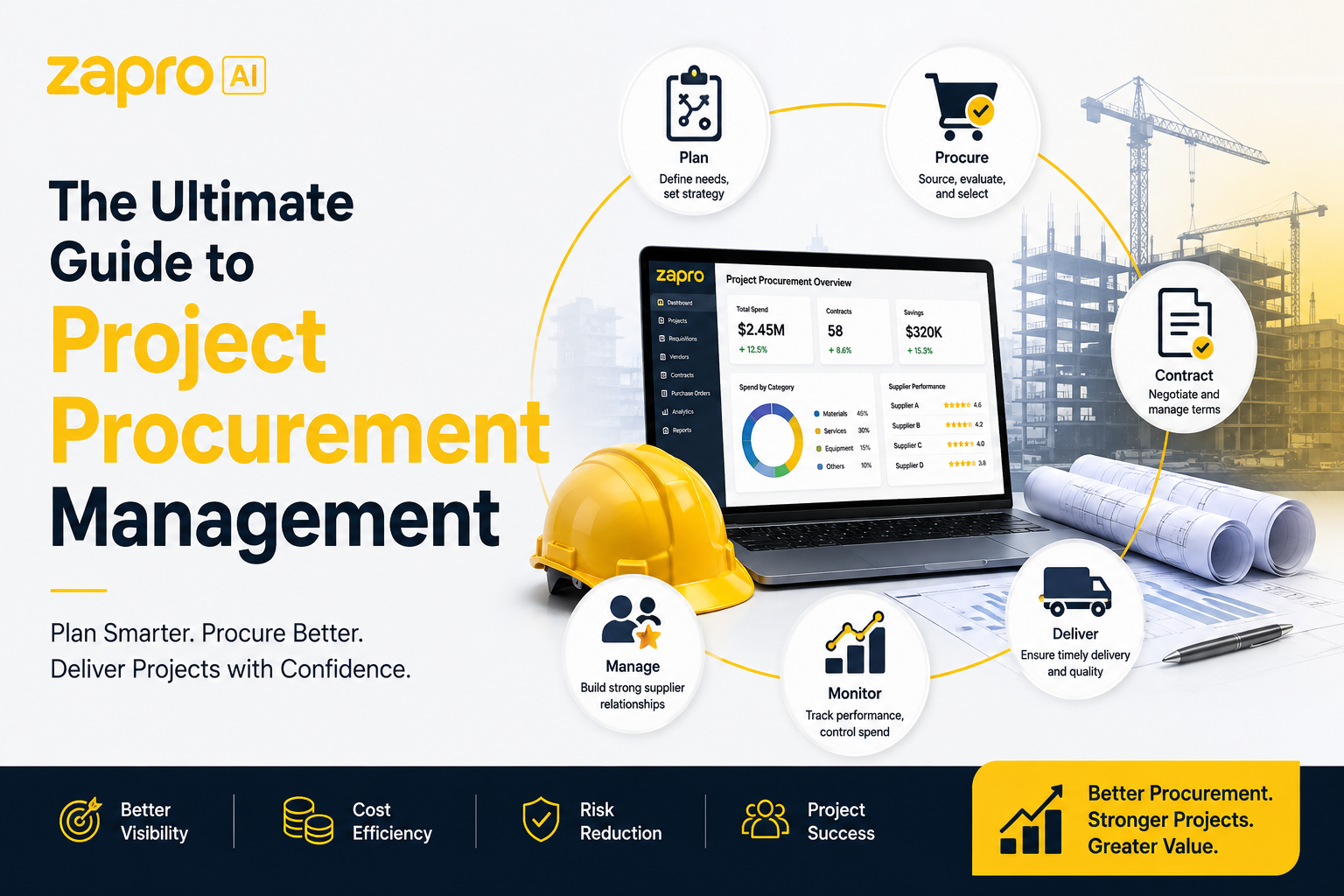
Procurement in project management refers to the full procurement lifecycle in a project. It is the process of acquiring goods, services, or results a project needs from vendors outside the performing team. It covers deciding what to buy, selecting vendors, awarding and administering contracts, and closing them out, all bounded by the project’s fixed scope, budget, and end date.
Key takeaways
- Project procurement buys against a fixed scope and end date, so lead times rather than price usually decide the outcome.
- PMBOK has cut procurement in every edition since 2013: four processes, then three, then none.
- Close Procurements was retired in 2017, but the work moved rather than disappeared.
- The project manager owns the requirement and acceptance. Procurement owns vendor selection and terms. Failures happen at that boundary.
Two questions account for most of the confusion here. What does PMBOK actually say now, after changing three times since 2013? And where does the project manager’s authority end and procurement’s begin?
What is procurement in project management?
Project procurement management is the work of obtaining goods, services, or results a project needs but cannot produce itself. It runs from identifying the need to closing the contract after delivery.
Project procurement vs organisational procurement
Organisational procurement buys continuously and optimises across unknown future volume. A category manager can wait for a better market, pool demand across departments, and build a vendor relationship over years.
Project procurement optimises for a single delivery date. A project manager buying a specialist subcontractor once has no repeat volume to trade with and no time to wait.
The two meet when a project buys through an existing framework agreement, inheriting terms it did not negotiate. That is usually faster and occasionally a poor fit.
Why projects procure differently
Three constraints separate project buying from everything else procurement does.
Fixed scope means the requirement should be knowable before the project goes to market. Where it is not, the contract type has to absorb that uncertainty.
A fixed end date gives every purchase a latest-possible-order date, counted backwards from when the deliverable is needed. Miss it, and no negotiation recovers the schedule.
No repeat volume leaves the project with little leverage of its own. Whatever weight it carries comes from the organisation’s existing relationships, which is one reason to engage procurement early.
The project procurement management processes
PMI has described project procurement as a set of named processes since 2013, and that set has shrunk with each edition.
Plan Procurement Management
Plan Procurement Management decides what the project will buy, how, and when. Its output is the procurement management plan, recording the approach for every externally sourced item.
Two supporting outputs matter as much. The procurement statement of work describes what the vendor must deliver in enough detail to be priced. Source selection criteria are agreed before any bid arrives, which stops evaluation drifting toward a preferred answer.
Conduct Procurements
Conduct Procurements takes the plan to market: issuing bid documents, running clarification rounds, evaluating responses against the agreed criteria, negotiating, and awarding. Whether the project issues an RFI, RFP or RFQ depends on how well the requirement is defined.
The output is a signed agreement and a vendor now sitting on the project schedule as a dependency.
Control Procurements
Control Procurements runs as long as the contract does, covering administration, delivery tracking against contracted dates, changes, receipt, payment, and claims.
Since 2017, it has also absorbed contract closure, which is where the next question comes from.
What happened to Close Procurements
Close Procurements existed as a fourth process in the fifth edition and was removed in the sixth. Its work moved into Control Procurements and into Close Project or Phase, which sits in integration management rather than procurement.
It remains the most-asked question about project procurement, because training material written before 2017 is still in circulation. Anyone taught the four-stage model learned something that has not been current for nearly a decade.
This doesn’t indicate that the work that fell into the category of ‘close procurement’ is no longer part of the process. Contracts still need formal acceptance, final invoices still need reconciling, and vendor performance still needs recording. Only the label moved.
PMBOK 5 vs. 6 vs. 7: what actually changed
Procurement’s place in the PMBOK Guide has moved downward in every edition since 2013.
| Edition | Where procurement sits | Procurement processes | What changed |
| 5th (2013) | Procurement knowledge area | Plan, Conduct, Control, Close Procurements | Four processes with full inputs, tools, and outputs |
| 6th (2017) | Procurement knowledge area | Plan, Conduct, Control Procurements | Close Procurements removed; work moved to Control Procurements and Close Project or Phase |
| 7th (2021) | No knowledge areas; procurement sits inside the performance domains | None in the core guide | Processes no longer prescribed; the 49-process model moved to Process Groups: A Practice Guide |
| 8th (2025–26) | Appendix X4, with Plan Sourcing Strategy in Governance | Plan Sourcing Strategy only | Processes returned, but Conduct and Control Procurements sit outside the core 40 |
The eighth edition is the part most competitor pages have not caught up with. PMI released it on Kindle in November 2025 and in print in January 2026, bringing back roughly 40 processes. Procurement did not come back with them. The sourcing decision stayed in the core as Plan Sourcing Strategy, while the contracting work moved to a dedicated appendix.
The practical reading is that PMI now treats sourcing as project management and contracting as a specialist discipline the project draws on.
One caveat if you are studying. The PMP exam follows the Examination Content Outline rather than the PMBOK Guide directly, and PMI has been aligning it to the eighth edition through 2026. Check PMI’s current guidance rather than assuming the newest edition is what you will be tested on.
Who owns procurement on a project
The friction in project procurement is rarely about process. It is about who decides.
What the project manager is accountable for
The project manager owns the requirement: defining what the project needs precisely enough to be bought, and when it must arrive. They own the schedule dependency, the budget line, and formal acceptance.
They also own the consequence. If a vendor delivers late, the project is late, and no contract clause changes that.
What the procurement function is accountable for
Procurement owns the transaction and the relationship: selecting the contract type, qualifying bidders, running the commercial evaluation, negotiating terms, and administering the contract.
It also owns what the project cannot see: whether a vendor is already under contract elsewhere, whether they passed due diligence, and whether the terms conflict with an existing agreement.
Where the handoff goes wrong
Three failure points account for most handoff failures.
The first is when a requirement can’t be priced; the project then keeps going back to the roundtable for clarifications that weren’t in the schedule, dragging it out and turning it into clarification rounds it didn’t plan for.
The second is a project manager negotiating directly alongside a formal process, which undermines the evaluation and can create commitments nobody intended.
The third is a signed contract nobody on the project reads. That means changes of control, service levels, and acceptance criteria are now in a document the delivery team won’t check.
Procurement across the project lifecycle
Procurement is not a phase. It starts before planning finishes and ends after the last deliverable is accepted.
Initiation: identifying external resource needs
Before the schedule exists, the project needs a rough answer to what it cannot produce internally. Getting this wrong shows up as a missing lead time later.
Planning: make-or-buy analysis and contract type selection
Each externally sourced item gets a make-or-buy decision, a contract type, an evaluation approach, and a date by which the order must be placed. This is where the organisation’s existing procurement process gets mapped onto the project timeline.
Execution: sourcing, evaluating, awarding
Bid documents go out, responses are scored against pre-agreed criteria, and contracts are awarded. Schedule risk includes clarification rounds, which routinely run longer than planned.
Monitoring: contract administration and performance
Delivery is tracked against contracted dates, invoices are matched to receipts, and changes are processed through contract change control rather than informally.
Closure: acceptance, final payment, lessons learned
Deliverables are formally accepted, final invoices reconciled, retention released, and vendor performance recorded for the next project.
When to revisit the decision mid-project
Three triggers justify reopening a settled make-or-buy: the requirement changes materially, the vendor fails to deliver, or the schedule moves enough to change which option arrives in time.
Contract types and how they shift risk
Contract type decides who absorbs the cost when work turns out harder than either party expected.
Fixed-price contracts
The vendor commits to a defined deliverable for a defined price and carries any overrun. Firm fixed price suits fully specified scope. Fixed-price incentive fee shares savings against a target where the vendor has room to perform.
Cost-reimbursable contracts
The buyer reimburses allowable costs and pays a fee on top, carrying the cost risk in every variant. It is the honest choice when scope cannot be defined in advance, and it needs active cost reporting to stay controlled.
Time and materials
The buyer pays agreed rates for hours worked plus materials used, with no commitment to a total. Useful for short or uncertain work, dangerous without a ceiling.
Which contract type fits which project risk profile
| Contract type | Who carries overrun | Use when | Main exposure |
| Firm fixed price | Vendor | Scope is fully specified and stable | Changes priced at a premium once signed |
| Fixed price incentive fee | Shared against a target | Scope is clear but performance can vary | Overhead of settling the incentive |
| Cost plus fixed fee | Buyer | Scope cannot be defined and no vendor will fix a price | Weak cost discipline without audit |
| Cost plus incentive fee | Buyer, shared with vendor | Scope is uncertain but cost performance is measurable | Disputes over allowable cost |
| Time and materials | Buyer | Short, uncertain work or staff augmentation | Unbounded spend without a ceiling |
Where a category is bought repeatedly across projects, standardizing the contract type at category level saves every project manager relitigating it. That is a strategic sourcing decision, not a project one.
How project procurement differs by industry
The processes are the same everywhere. What differs is which constraint dominates.
Construction: long lead times and the critical path
Structural steel, switchgear, and specialist plant carry lead times measured in months. Procurement dates sit on the critical path, so ordering decisions are schedule decisions.
IT and software: licensing, SOWs, and scope creep
Lead times are short but specification risk is high. Most overruns come from statements of work describing an outcome without defining acceptance.
Manufacturing: material lead times and just-in-time
Projects touching a production line inherit the plant’s inventory strategy. Just-in-time leaves no buffer, so one late shipment stops the line.
Professional services: rate cards and deliverable acceptance
Rates are usually pre-agreed, so the risk moves to what counts as done. Without deliverable-based acceptance, a time-based engagement expands to fill the schedule.
Common project procurement failures
Procurement engaged too late in planning
By the time procurement sees the requirement, the schedule is fixed and the lead time no longer fits inside it. This is the most common failure and the cheapest to prevent.
Lead times not modeled into the schedule
Order dates are treated as administrative rather than as schedule activities with dependencies, so nobody notices a slipped order until the delivery date moves.
Scope changes with no contract change control
The project agrees a change verbally, the vendor delivers it, and the invoice arrives with no approved change order behind it.
No vendor performance tracking until closeout
Performance is assessed once, at the end, when nothing can be done and the next project has already picked the same vendor.
Tools that connect procurement to the project schedule
Where PM tools stop and procurement systems start
Project tools track tasks and dates. They do not hold commitments, purchase orders, receipts, or invoices, so committed spend stays invisible until an invoice appears.
That gap is where project budgets quietly overrun. A purchase order raised in month two is real money, but a schedule tool has no field for it.
What to integrate: POs, budgets, commitments, receipts
Four things need to flow between systems: the purchase order and its value, the budget line it consumes, the commitment created at award, and the receipt confirming delivery. With those connected, a project manager sees committed and actual spend against budget without waiting for finance to close the month.
Cycle time matters too, since long requisition-to-pay cycles push cost recognition past the reporting period the project is judged on.
Frequently asked questions
What is procurement in project management?
Procurement in project management is the process of acquiring goods, services, or results from outside the project team. It covers planning what to buy, running the solicitation, awarding and administering contracts, and closing them out within the project’s fixed scope and end date.
What is project procurement management?
Project procurement management is PMI’s name for the same discipline. It was a formal knowledge area through the sixth edition of the PMBOK Guide, covering Plan Procurement Management, Conduct Procurements, and Control Procurements.
What are the processes of project procurement management?
Three, as of the sixth edition: Plan Procurement Management, Conduct Procurements, and Control Procurements. The fifth included a fourth, Close Procurements. The seventh removed the process model from the core guide entirely.
Is close procurements still in PMBOK?
No. Close Procurements was removed in the sixth edition in 2017, and its work moved into Control Procurements and Close Project or Phase. Training material still teaching four processes predates that change.
What is the difference between project management and procurement?
Project management delivers a defined outcome within scope, time, and budget. Procurement acquires what that outcome needs from outside the organization. The project manager owns the requirement and acceptance; procurement owns vendor selection and commercial terms.
Who is responsible for procurement on a project?
Both, at different points. The project manager is accountable for the need, the timing, and acceptance. Procurement is accountable for vendor selection, contract type, negotiation, and administration. Legal, finance, and the sponsor hold specific approvals.
What contract types are used in project procurement?
Three families. Fixed-price contracts place overrun risk on the vendor. Cost-reimbursable contracts place it on the buyer. Time and materials pays agreed rates with no committed total, and needs a not-to-exceed ceiling.
Keep project spend visible from requisition to closeout
Project procurement fails at the seams: a lead time nobody scheduled, a commitment nobody could see, a change nobody priced. Each is a visibility problem before it becomes a cost problem.
Zapro brings requisitions, purchase orders, receipts, and invoices onto one platform, so committed spend appears against the project budget at award rather than when the invoice lands. Approval rules route each request by value and category, and AI agents handle the routing and matching behind every transaction.
Vendor performance is recorded as contracts close, so it reaches the next project instead of being lost at handover, alongside the vendor procurement work either side of the project.
Book a demo to see how commitments, budgets, and receipts stay connected from first requisition to closeout.
Don’t miss our weekly updates
We’ll email you 1-3 times per week—and never share your information.
About the Author

Md. Kafil