Vendor Management
 End-to-End-Procurement
 Strategic Sourcing
 Spend Analytics
 AP-Automation
 Inventory Management
 ERP-Integration
 Blogs
Blogs Procurement Guide
 Ebooks
 News and Media
 Healthcare
 Financial Services
 Technology
 Venture Capitalist
 About Us
 Vendor Management Guide
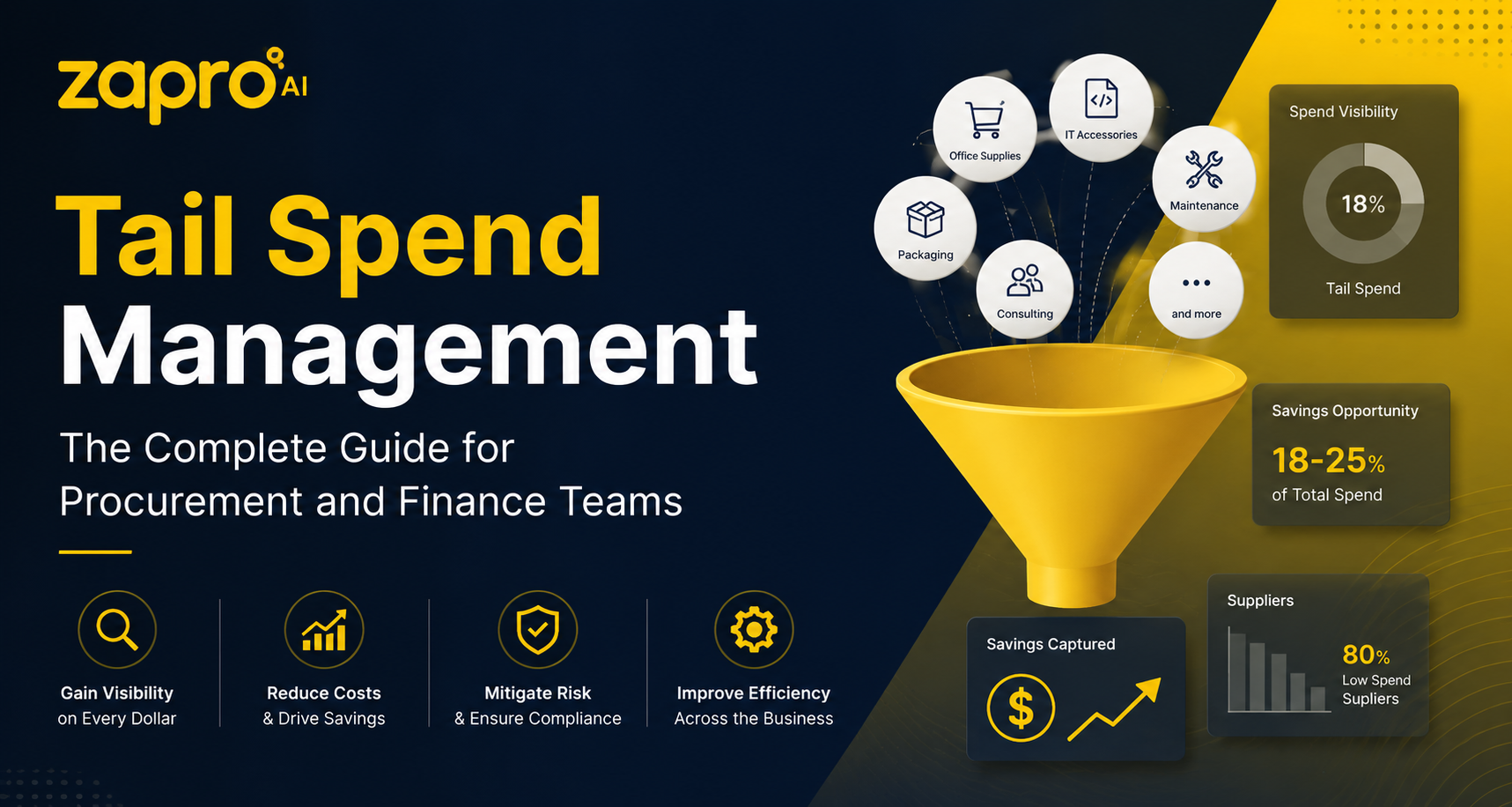
Tail spend is the large number of small, low-value purchases a company makes outside its main vendor contracts. It usually covers about 80% of a company’s vendors but only 20% of its spend. Each purchase looks minor on its own. However, when you look closely, you notice it hides cost, risk, and wasted time.
Key takeaways
- Tail spend is the bottom slice of your spend by value, spread across the largest share of your vendors.
- The 80/20 rule describes the shape of tail spend, but you still have to pick your own cut-off.
- Tail spend and maverick spend are different problems, and mixing them up leads to the wrong fix.
- Processing costs, not unit prices, are often the biggest hidden cost in the tail.
- You control tail spend by routing requests automatically, not by sourcing every small purchase.
Most procurement teams know their top 50 vendors well. They negotiate those contracts, review performance, and track savings. Below that line, there lies a much larger group of vendors that almost remains invisible. That group is your tail, and it contributes to the drainage of money which could have been part of your savings.
What is tail spend?
Tail spend is the part of your purchasing that sits outside managed contracts and structured sourcing. It is made up of small, scattered purchases across a very wide vendor base.
These purchases are easy to miss because each one is small. A $180 software seat, a $900 repair, a $2,000 conference booth. Almost never is a meeting called before making such expenses. Added together across a year, they often run into millions.
The 80/20 rule and why it is only a starting point
The 80/20 rule says a small group of vendors carries most of your spend, and everyone else carries the rest. McKinsey found that the items in the tail make up 80–90% of everything a company buys, while comprising for only the bottom 10–20% of total spend.
The rule is useful because it tells you what shape to expect. It does not tell you where your own line sits. Two companies of the same size can have very different tails depending on how centralized their buying is.
So treat 80/20 as a prompt; don’t take it literally. Use this as a technique, but you may create your own thresholds. Pull your own vendor list, sort it by annual spend, and find where the curve flattens. That flattening point is your real tail, and it might start at 15% of spend or at 30%.
Threshold-based, frequency-based, and category-based definitions
You can draw the line around your tail in three ways. Each one answers a slightly different question, and most teams end up combining two of them.
- Threshold-based: every vendor below a set annual spend figure remains in the tail. A common starting point is any vendor under $50,000 a year. This method is fast and easy to explain to finance.
- Frequency-based: every vendor you buy from fewer than a set number of times a year sits in the tail. This method catches the one-off vendors that a spend threshold can miss.
- Category-based: whole categories with no owner and no contract are often in the tail, regardless of value. This method works well when one team doesn’t have a category manager to supervise the spends.
Pick a single primary method and use a second as a cross-check. Write the definition down, because the number you report next quarter has to mean the same thing it meant this quarter.
Tail spend vs. indirect spend
Indirect spend covers everything you buy that does not go into the product you sell. Tail spend covers everything at the bottom of your spend by value, whatever it is.
The two overlap heavily, and that is why people confuse them. Most tail spend is indirect. But plenty of indirect spend is large and well managed, such as a single enterprise software contract or a national facilities agreement.
The reverse also happens. A manufacturer buying a small run of specialist components has direct spend sitting in the tail. Sorting by value rather than by type keeps the categories honest.
Tail spend vs. maverick spend
Tail spend describes the size and structure of a purchase. Maverick spend describes the behaviour behind it. A purchase can be one, the other, or both.
| Tail spend | Maverick spend | |
| What defines it | Low value, spread across many vendors | Bought outside the agreed process or contract |
| Is it a rule break? | No, it is a structural fact | Yes, by definition |
| Typical cause | Too small to justify sourcing | Process is slow, unclear, or easy to skip |
| What fixes it | Routing, catalogs, consolidation | Policy, thresholds, enforced approvals |
| How you find it | Sort vendors by annual spend | Compare purchases against contracts and POs |
The distinction matters because the fixes are different. Consolidating vendors does nothing about a manager who buys off-contract from a preferred vendor. Tightening approvals does nothing about 900 legitimate small vendors you never negotiated with.
Tail spend examples and categories
Tail spend shows up in the same places in most companies. The categories below account for the bulk of it, and each one lands in the tail for its own reason.
Common tail spend categories
| Category | Typical purchases | Why it lands in the tail |
| Office and facilities | Furniture, cleaning, small repairs, pantry supplies | Bought locally by site, rarely consolidated |
| Software and subscriptions | Single seats, design tools, data feeds | Bought on cards by individual teams |
| Marketing services | Freelancers, event booths, print runs, swag | Campaign-driven and one-off by nature |
| Professional services | One-time legal advice, translation, small consulting | Urgent and specific, so sourcing feels slow |
| Travel and events | Venue hire, catering, ad hoc bookings | Booked by whoever is organizing |
| MRO and spares | Replacement parts, tools, consumables | Needed fast, so price comes second |
| IT hardware | Peripherals, cables, replacement laptops | Small orders placed as needs arise |
Why tail spend management matters
Monitoring tail spend is crucial because the losses due to it have such low visibility that they get overlooked or brushed under the carpet until it has a big enough lump that you start tripping over it.
Missed volume discounts and price variance
When nobody negotiates, everybody pays list price. Worse, different teams pay different list prices for the same thing.
A common pattern looks like this: three offices buy the same laptop model from three resellers at $1,340, $1,410, and $1,520. Nobody is doing anything wrong. There is simply no agreed source and no reference price.
McKinsey puts the savings available in poorly managed tail spend at 5–15% (McKinsey, 2019). On a $5.6 million tail, that is $280,000 to $840,000. Some of that comes from spend aggregation, where you pool similar purchases to earn a better rate.
The invoice processing cost nobody counts
Every tail invoice costs the same to process as a planned one. That is the part that rarely makes it into a business case.
Ardent Partners puts the average cost of processing a single invoice at $9.40, while best-in-class teams do it for $2.78 (Ardent Partners, 2025). APQC’s benchmarking shows an even wider spread, with top performers under $5 per invoice and bottom-quartile teams above $30 (APQC, 2024).
Tail vendors generate a disproportionate share of that volume, and they generate more exceptions too. A one-off vendor is more likely to send an invoice with no PO, a wrong tax field, or a mismatched amount. Every exception pulls a person in.
This is why reducing invoice count often beats reducing unit prices. Consolidating 40 vendors into one does not just improve your rate. It replaces 200 invoices with 12.
Compliance, fraud, and unvetted vendor risk
Vendors in the tail usually skip the checks that core strategic vendors go through. No credit check, no insurance certificate, no signed terms, no security review.
That creates three exposures. You may be buying from a company that cannot deliver. You may be accepting terms nobody read. And you may be paying an account that was never verified.
Small, unmonitored payments are also where invoice fraud tends to land, precisely because they attract the least scrutiny. A vendor nobody recognises sending a modest invoice is the easiest thing in your ledger to approve without thinking.
Procurement team time lost to low-value transactions
Lost procurement time can be classified as one of the costliest losses. A buyer who spends the morning chasing a $600 order is not working on the contract that could save $200,000.
Look at the worked example again. Those 18,000 tail invoices are not just an AP cost. Each one may involve a request, an approval chase, a query, and a payment follow-up.
Freeing that time is usually the strongest internal argument for tail spend management, because it does not depend on a savings forecast anyone can argue with.
A tail spend management framework
Managing tail spend does not mean sourcing every small purchase. It means building a route for small purchases so they handle themselves.
Step 1: Define and segment your tail
Write down your definition and apply it consistently. Choose your threshold, frequency, or category rule, then split the tail into three groups: purchases you can move to an existing contract, purchases you can consolidate, and genuine one-offs. Only the first two are worth sourcing effort.
Step 2: Run a tail spend analysis
Clean your vendor data, remove duplicate vendor records, and classify every transaction to a category. Then look for the patterns that matter: the same item bought from several vendors, the same vendor set up several times, and categories with high volume but no contract. Your existing spend analysis process gives you the method for this.
Step 3: Consolidate vendors and categories
Take each group of similar vendors and pick one or two to keep. Move volume to them, agree a rate, and deactivate the rest in your system. Deactivation is the step teams forget, and it is the one that stops the tail growing back next quarter.
Step 4: Enable guided buying with catalogs and PunchOut
Guided buying means giving people a short, approved list to buy from instead of a blank form. A catalog holds agreed items and prices inside your own system. PunchOut connects your system to a vendor’s website, so a buyer shops there and returns with a pre-priced cart. Both remove the decision that creates tail spend, which is “where do I buy this?”
Step 5: Set p-card policies and thresholds
Purchasing cards are useful for genuine one-offs and dangerous without limits. Set a per-transaction cap, block categories that belong on a contract, and require a receipt and category code at the point of purchase. Review card spend monthly, because card data is the easiest place for a new tail to form.
Step 6: Automate routing and approvals
Route requests by value, category, and vendor status rather than sending everything to the same approver. Low-value purchases from approved catalog vendors should clear without human review. Save approvals for the requests that really need judgment, and the process stops being something people work around.
Step 7: Measure, iterate, and re-baseline quarterly
Track four numbers every quarter: tail spend ratio, active vendor count, invoices per vendor, and percentage of spend bought through catalogs. Compare them to the same quarter last year, not to your target. Tail spend regrows quietly, so a quarterly re-baseline is what keeps the work from unwinding.
A decision tree for routing tail spend requests
This is the logic that turns the framework into regular practice. Apply it to every incoming purchase request, and most of the tail routes itself. Adjust the dollar thresholds to your own size.
Gate 1 — Is there a catalog item or existing contract for this?
- Yes → Buy from the catalog. Auto-approve if it is under your low threshold.
- No → Go to Gate 2.
Gate 2 — Does this vendor or category carry risk? Risk means access to customer data, work on your premises, regulated goods, or anything requiring insurance.
- Yes → Send to full vendor onboarding regardless of value. Value never overrides a risk check.
- No → Go to Gate 3.
Gate 3 — Is the request under $1,000?
- Yes → Go to Gate 4.
- No → Go to Gate 5.
Gate 4 — Is the vendor already approved?
- Yes → Approve on a p-card or standing PO. No sourcing, no quotes.
- No → Redirect the buyer to an approved marketplace or aggregator vendor instead of onboarding a new vendor for one purchase.
Gate 5 — Is the request between $1,000 and $25,000?
- Yes → Require one written quote and manager approval, then raise a PO. Check first whether the category already has a preferred vendor.
- No → Go to Gate 6.
Gate 6 — Is the request over $25,000, or will it repeat annually?
- Yes → This is no longer tail spend. Escalate it into sourcing, run a competitive process, and put it under contract with a named category owner.
Two rules make this tree work in practice. First, the risk gate always outranks the value gate. Second, a repeating purchase leaves the tail even when each instance is small, because twelve $900 orders are a $10,800 contract nobody negotiated.
In-house software vs. tail spend management services
You can manage tail spend with software you run yourself, or you can hand the tail to an outside provider. The right answer depends on whether your problem is capacity or control.
What tail spend management providers actually do
A tail spend management provider takes over the small purchases you do not want to handle. They act as a buying agent, source through their own vendor network, and merge everything into a single invoice to you.
The appeal is immediate. Your vendor count drops sharply, your AP volume falls, and your team stops handling small requests. For a company drowning in one-off purchases with no system to route them, that relief is real.
Providers typically charge a percentage of managed spend or a fixed management fee. Some also earn margin on the goods themselves.
Where outsourcing costs you control
Outsourcing the tail solves the workload and leaves the visibility problem in place. You see one consolidated invoice instead of 200, which is easier to process but harder to analyze.
Three specific trade-offs are worth weighing before signing. You lose the direct vendor relationships, so bringing a category back in-house later means rebuilding them. You may not see item-level pricing, which makes it hard to check whether the margin taken is reasonable. And your spend data now lives partly in someone else’s system, which weakens the analysis you need to prevent the tail regrowing.
Outsourcing also treats the symptom. If the tail exists because your buying process is slow and unclear, sending it elsewhere leaves that process untouched.
What tail spend software should do instead
Software addresses the cause. The goal isn’t to manage the tail more efficiently, but to stop most of it from forming.
A system built for this should do four things:
- Give buyers an obvious route. Catalogs, PunchOut, and a simple request form mean people follow the process because it is faster than going around it.
- Route and approve automatically. Approval rules based on value, category, and vendor status clear routine purchases without a person touching them.
- Match documents without manual checking. Purchase orders, receipts, and invoices should reconcile automatically so tail invoices stop consuming AP time.
- Keep every transaction visible. All spend stays item-level and searchable, so your quarterly re-baseline takes an afternoon rather than a month.
Zapro brings requisitions, purchase orders, receipts, and invoices onto one platform, with AI agents handling the routing and matching work that used to sit with your team. The tail stops being a separate problem and becomes ordinary, tracked spend.
Frequently asked questions about tail spend
What is tail spend in procurement?
Tail spend is the collection of small, low-value purchases spread across a very large number of vendors. It typically covers around 20% of a company’s total spend while involving up to 80% of its vendors. These purchases usually sit outside negotiated contracts and structured sourcing.
What is an example of tail spend?
A single $200 software subscription bought on a company card is a classic example. So are one-off purchases like a $900 office repair, a $1,500 conference booth, or a freelance designer hired for one campaign. Individually small, they add up to millions across a year.
What is the difference between tail spend and indirect spend?
Indirect spend covers everything you buy that does not go into your product, such as software or facilities. Tail spend covers the lowest-value purchases by spend, whatever their type. Most tail spend is indirect, but large indirect contracts are not tail spend.
What is the difference between tail spend and maverick spend?
Tail spend describes purchase size and structure, while maverick spend describes buying outside the agreed process. A small purchase from an approved catalog is tail spend but not maverick. Buying off-contract from an unapproved vendor is maverick, whatever the amount.
How do you calculate tail spend?
Rank every vendor by annual spend, then find where the curve flattens into a long, low line. Divide the spend below that point by your total addressable spend and multiply by 100. Track vendor concentration alongside it, since spend value alone hides the administrative load.
What percentage of spend is tail spend?
Tail spend typically represents 10–20% of total spend while covering 80–90% of purchased items, according to McKinsey (2019). The Hackett Group’s 2025 study places it at around 20% of enterprise spend across 80% of vendors. Your own figure depends on how centralized your buying is.
What is tail spend analysis?
Tail spend analysis is the process of cleaning vendor data, classifying every low-value transaction, and finding patterns worth acting on. It looks for duplicate vendors, the same item bought from several sources, and categories with high transaction volume but no contract in place.
Do you need tail spend management software?
You need it once manual routing stops scaling, usually somewhere past a few hundred active vendors. Software pays for itself through reduced invoice handling rather than unit price savings alone, given an average processing cost of $9.40 per invoice (Ardent Partners, 2025).
Don’t miss our weekly updates
We’ll email you 1-3 times per week—and never share your information.
About the Author

Md. Kafil