

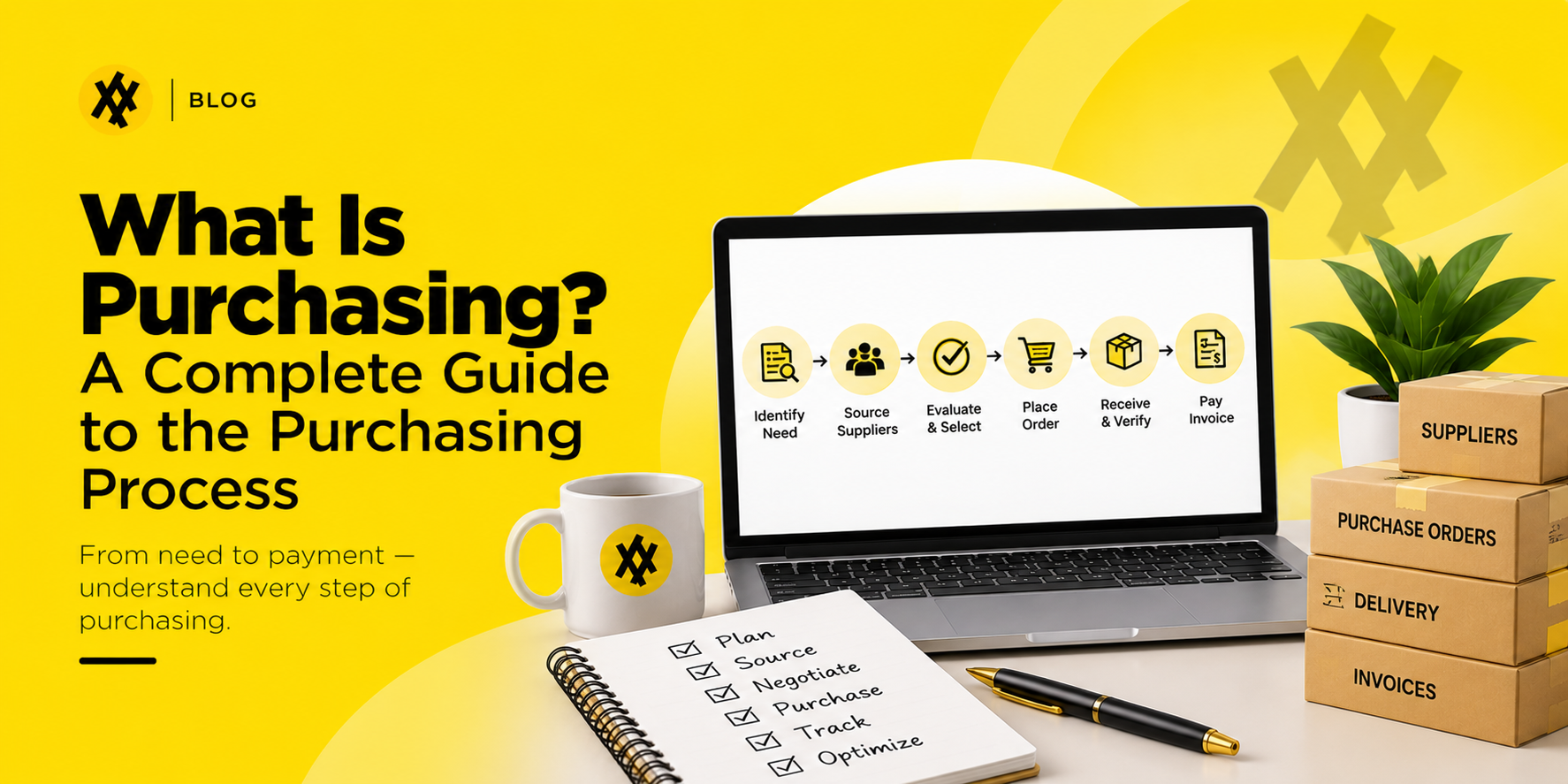
Quick answer: Purchasing is the set of transactional steps a company follows to actually buy goods and services it has already decided to acquire: raising a requisition, issuing a purchase order, receiving the goods, and clearing the invoice for payment. It sits inside procurement, which also covers sourcing, negotiation, and supplier strategy. Purchasing answers “how do we buy this correctly?” Procurement answers “what should we buy, from whom, and on what terms?”
Most finance leaders inherit a purchasing process rather than design one. Someone emails a request, a manager replies “approved,” a card gets used, and the invoice shows up six weeks later with no matching order behind it. Nothing is technically broken. But nobody can say what was committed before the money left, and that gap is where budget overruns, duplicate orders, and audit findings live.
This guide covers what purchasing actually is, the seven steps of the purchasing cycle, the documents involved, how purchasing differs from procurement and sourcing, the roles that own each stage, and the controls that separate a purchasing function that protects margin from one that just processes paperwork.
Purchasing, defined
Purchasing is the operational execution of a buying decision. It begins when an internal need is formally raised and ends when the supplier has been paid and the transaction is recorded against a budget line.
Three things distinguish purchasing from general spending:
- A request is documented before money is committed, not after.
- Someone with budget authority approves it against a defined threshold.
- The commitment, the receipt, and the invoice are matched before payment is released.
Strip out any one of those and you no longer have a purchasing process. You have expenses.
Purchasing vs. procurement vs. sourcing
These three terms get swapped around constantly, and the confusion causes real damage when responsibilities are assigned.
| Function | Core question | Typical activities | Time horizon |
| Sourcing | Who should we buy from? | Market research, RFI/RFP/RFQ, supplier evaluation, negotiation | Months to years |
| Procurement | What do we buy, on what terms, and how do we govern it? | Category strategy, contracting, supplier management, policy, spend analysis | Ongoing |
| Purchasing | How do we execute this specific transaction? | Requisition, approval, PO issue, receipt, invoice match, payment | Days to weeks |
Purchasing is the narrowest of the three and the most repeatable. That is exactly why it automates well. For the broader picture, see the full guide to what procurement is and the breakdown of procurement vs. supply chain management.
The 7 steps of the purchasing process
The sequence below is the standard corporate purchasing cycle. Small companies compress it; regulated industries add review gates. The logic does not change.
1. Need identification
A department identifies something it needs: raw material for a production run, laptops for four new hires, a renewal on a security tool. The need should be tied to a budget line before it goes anywhere else. Requests that arrive without a cost center attached are the single most common cause of downstream approval delays.
2. Purchase requisition
The requester submits a formal internal request: item, quantity, estimated cost, required date, preferred supplier if one exists, and business justification. The requisition is an internal document. It has no legal weight with a supplier and creates no obligation to buy.
This is the control point most companies skip, and it is the one that matters most. A requisition forces the need to be written down before anyone commits money. If you only remember one distinction from this guide, make it the difference between a purchase requisition and a purchase order.
3. Approval routing
The requisition moves to whoever holds authority for that amount and category. A well-designed matrix routes on two variables at once: spend value and spend type. A $2,000 software subscription and a $2,000 shipment of steel should not follow the same path, because one carries data-security and renewal risk that the other does not.
Approval design is where most cycle time is won or lost. Three practical rules:
- Set thresholds high enough that low-value items skip senior review entirely. A CFO approving $300 orders is a governance failure disguised as diligence.
- Route in parallel, not in sequence, when two approvers are independent of each other.
- Give every approver a delegate by default, not on request. Vacation coverage is the most predictable bottleneck in any approval chain.
4. Supplier selection and purchase order issue
If a contract or catalog agreement already exists, the buyer draws from it. If not, the requisition triggers a sourcing event: quotes, comparison, selection. Pre-negotiated catalogs matter here because they remove the decision entirely for routine items, which is why catalog management has an outsized effect on cycle time.
The purchase order is then issued to the supplier. Unlike the requisition, the PO is an external, legally binding offer. Once the supplier accepts it, both parties are committed to the stated quantity, price, delivery date, and terms. The mechanics of drafting, numbering, and tracking POs are covered in the purchase order process guide.
5. Goods receipt
Someone physically confirms what arrived: quantity, condition, specification. This step gets treated as clerical and it is not. The goods receipt note is one of the three documents in the matching process, and a receipt recorded carelessly, or recorded weeks late, is what allows an incorrect invoice to sail through.
Services complicate this. There is no pallet to count when a consultant delivers a report, so services purchasing needs an explicit acceptance step tied to a deliverable or milestone, not a delivery date.
6. Invoice matching
The supplier invoice arrives and is compared against the purchase order and the goods receipt. If the three agree within tolerance, payment is cleared. If they do not, the invoice goes to exception handling.
Two-way matching compares the invoice to the PO only. Three-way matching adds the receipt, which is what actually catches short shipments and quantity inflation. The tradeoff between them is worth understanding before you set your policy. The comparison of 2-way vs. 3-way matching walks through when each is appropriate.
7. Payment and record keeping
Finance releases payment on agreed terms and the transaction closes against the budget. Records are retained for audit and tax purposes. In the United States, the IRS expects businesses to keep supporting documents for purchases as part of their books and records. Its recordkeeping guidance for businesses sets the baseline every purchasing archive should meet.
The full front-to-back flow, including where purchasing hands off to accounts payable, is mapped in the procure-to-pay process guide.
The four documents that carry the process
| Document | Created by | Binding? | What it proves |
| Purchase requisition | Requesting department | No | The need was justified and approved internally |
| Purchase order | Purchasing / buyer | Yes | What was committed, at what price and terms |
| Goods receipt note | Receiving / requester | No | What actually arrived and was accepted |
| Supplier invoice | Supplier | Yes | What the supplier is claiming payment for |
Auditors read these four documents as a chain. When one link is missing, the whole transaction becomes an exception to explain.
Direct vs. indirect purchasing
Direct purchasing covers what goes into the product: components, raw materials, packaging. Volumes are predictable, suppliers are few and strategic, and a stockout stops production. Indirect purchasing covers everything else the business runs on: software, facilities, travel, professional services, office supplies.
The operational difference matters more than the definition. Direct spend is usually well controlled because production planning forces discipline. Indirect spend leaks, because it arrives in hundreds of small transactions from hundreds of suppliers, often without a PO. That is where maverick spend accumulates, and it is where a purchasing process pays for itself fastest. The direct vs. indirect procurement breakdown covers the category strategies for each.
Who owns what
Purchasing fails when ownership is vague, so name it explicitly:
- Requester: defines the need accurately and supplies a budget code. Bad specifications originate here and get expensive later.
- Budget holder / approver: confirms the spend is planned and justified. Accountable for the commitment, not just the click.
- Buyer or purchasing specialist: selects the supplier, applies contract terms, issues the PO, resolves supplier queries.
- Receiver: confirms delivery and condition. In services, confirms acceptance of the deliverable.
- Accounts payable: matches, resolves exceptions, and pays. AP is the last line of defense, not the first.
Larger organizations layer category managers and a center of excellence on top of this. How that scales is covered in the procurement organizational structure guide.
Where purchasing processes break
Five failure patterns show up repeatedly, in companies of every size:
- Invoices with no purchase order behind them. Someone bought first and told finance later. AP now has to reverse-engineer approval after the money is already owed. The fix is policy plus enforcement: no PO, no payment, with a short published list of genuine exceptions.
- Approval chains built for a smaller company. Thresholds set when the business did $20M in revenue are still routing $500 orders to a VP at $200M. Thresholds need an annual review.
- Manual matching. Three documents compared by eye across two systems and an inbox. Errors are inevitable, and the cost is not just the error. It is the hours spent finding it.
- Fragmented supplier data. The same vendor exists three times under three spellings, so nobody can see the total spend or negotiate against it. Consolidating that record is the foundation of supplier lifecycle management.
- Cycle time that nobody measures. If you cannot say how long a requisition takes to become a PO, you cannot improve it. Start measuring before you start automating.
Purchasing KPIs worth tracking
| Metric | What it tells you | Where to look first if it worsens |
| Requisition-to-PO cycle time | Speed of your approval design | Approval matrix, delegate coverage |
| PO coverage (% of spend on a PO) | Whether the process is being followed | Indirect categories, low-value spend |
| Invoice exception rate | Data quality across PO, receipt, invoice | Receiving discipline, catalog pricing |
| First-time match rate | How much manual AP work you are creating | Tolerance settings, supplier data |
| Cost per purchase order | Efficiency of the transactional layer | Volume of manual touches per order |
Track cycle time and PO coverage first. They are the two that move everything else.
When to automate purchasing
Manual purchasing works until roughly the point where any one of these becomes true: more than a few hundred transactions a month, approvers in more than one location, spend spread across more than a hundred suppliers, or an audit that asks for a document you cannot find in ten minutes.
Automation is worth the most where the work is repetitive and rule-based: routing approvals, generating POs from requisitions, matching three documents, flagging duplicates. It is worth the least where judgment is required, like negotiating a strategic supplier contract. Buy accordingly.
Zapro AI handles the transactional layer end to end: requisitions with built-in budget checks, approval routing that adapts to value and category, PO issue, and three-way matching against receipts and invoices, connected to the AP automation side so a purchase does not lose its history the moment it becomes an invoice.
If you want to size the opportunity before committing to a platform, the digital procurement ROI calculator is a reasonable starting point.
Standards and professional guidance
Purchasing practice in the US is shaped by a small number of institutional sources worth knowing. The Institute for Supply Management publishes the professional standards and certifications most US purchasing teams are measured against. Companies selling to or buying on behalf of the federal government work within the Federal Acquisition Regulation, which defines purchasing procedure at a level of detail most private-sector policies quietly borrow from.
Frequently asked questions
Is purchasing the same as procurement?
No. Purchasing is the transactional execution: requisition, order, receipt, payment. Procurement is the wider function that includes sourcing, negotiation, contracting, supplier management, and spend strategy. Every purchase is part of procurement; not every procurement activity involves a purchase.
What is the difference between a purchase requisition and a purchase order?
A requisition is an internal request for permission to buy and creates no obligation. A purchase order is issued to the supplier and becomes legally binding once accepted. The requisition protects your budget; the PO protects your terms.
What are the seven steps of the purchasing process?
Need identification, purchase requisition, approval routing, supplier selection and PO issue, goods receipt, invoice matching, and payment with record keeping.
Why do companies use three-way matching?
Because two documents can agree while the goods never arrived. Matching the invoice against both the purchase order and the goods receipt confirms that what was ordered, what was delivered, and what is being billed are the same thing.
What is maverick spend?
Purchases made outside the approved process: no requisition, no PO, often no contracted supplier. It is most common in indirect categories and it costs money twice: once through unnegotiated pricing, and again through the manual work of cleaning it up in accounts payable.
How long should a purchase order take to approve?
It depends on value and category, but routine low-value orders should clear in under a day. If a $500 catalog item takes a week, the problem is almost never the approver. It is the approval design.
Do small businesses need a formal purchasing process?
Once more than one person can commit company money, yes. It does not need to be elaborate. A documented request, one approver, and a matched invoice covers most of the risk.
Don’t miss our weekly updates
We’ll email you 1-3 times per week—and never share your information.
About the Author

Md. Kafil