Contract Lifecycle Management: The 7 Stages & How to Master Each One
Contract lifecycle management (CLM) is the systematic management of a contract from initial request through drafting, negotiation, approval, execution, obligation tracking, and renewal or termination. CLM software centralizes contracts in a searchable repository, standardizes clause libraries, automates approval routing, tracks obligations and milestones, and alerts on renewal dates — preventing value leakage and missed deadlines.
TL;DR / Key Takeaways:
Contract lifecycle management has seven stages: request, drafting, negotiation, approval, execution, obligation and performance tracking, and renewal or termination.
Most contract value leaks after signature — in unmonitored obligations, unclaimed rebates, and auto-renewals nobody caught.
A central, searchable repository is the foundation: if you cannot find a contract in under a minute, no other CLM capability matters.
Clause libraries and pre-approved templates are the biggest cycle-time lever, because they remove legal from routine drafting.
Renewal alerts should fire 90–120 days before expiry, not 30 — anything later removes your negotiating leverage.
Obligation tracking turns a signed PDF into an operational document with owners, dates, and consequences.
CLM must connect to procurement: contract terms are only enforced if pricing and SLAs flow into the PO and invoice-matching process.
Contract Lifecycle Management (CLM) is no longer just a legal necessity; it’s a strategic asset. This guide walks you through:
What CLM is and why it matters
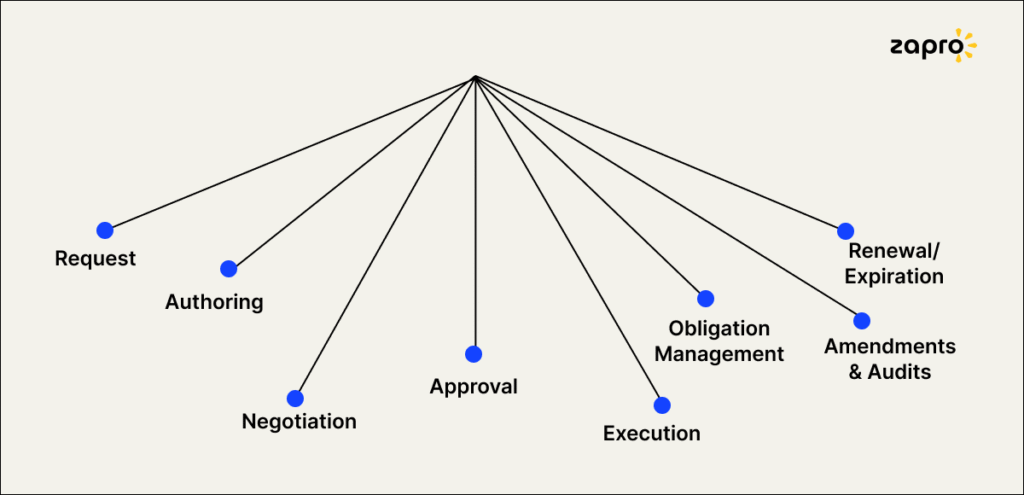
The eight stages of the contract lifecycle
Common pitfalls in manual contract handling
How CLM software mitigates risk and accelerates deals
Use cases of Zapro.ai’s contract management system to streamline every phase
What is Contract Lifecycle Management (CLM)? Definition and Importance
The definition of Contract Lifecycle Management (CLM) is the process of managing agreements through all stages, from initiation to expiration or renewal. A structured CLM process reduces financial and legal risks, enhances efficiency and compliance, and maximizes contract value. This enterprise-wide system provides governance over what is signed and when; across procurement, legal, and finance teams.
The Eight Stages of the Contract Lifecycle
A strong CLM system controls these eight stages in its operation.
1. Request: The need for a contract initiates this stage.
2. Authoring: Writing and preparing contract content.
3. Negotiation: Modifying terms until both parties agree.
4. Approval: Internal and external validation before execution.
5. Execution: Formal signing of the agreement.
6. Obligation Management:Purchase tracking deliverables and commitments.
7. Amendments & Audits: Managing contract updates and reviews.
8. Renewal/Expiration: Deciding whether to extend or terminate the contract.
Stat: Organizations implementing mature CLM systems decrease their cycle times by 50% and achieve 10–15% cost savings.
Using spreadsheets, email threads, and shared drives for contract workflows leads to numerous issues. Common pain points include:
Version-control confusion
Missed renewals or expirations
Hidden contract terms and poor obligation tracking
Legal and compliance exposure
Long negotiation cycles
Difficulty locating relevant documents
Manual contract management is a silent killer of productivity and a breeding ground for risk. Without a systematic approach, businesses are essentially negotiating blind.
Zapro.ai’s contract management system is a unified platform that combines intelligent document authoring, obligation tracking, and automated renewal processes. Its architecture ensures seamless adoption across enterprises without tool fragmentation.
Key Features of Zapro.ai’s Contract Management
Customizable Templates & Clause Library: Ensures compliance and drafting speed
AI-Powered Clause Suggestions: Standardizes language and reduces risk
Central Repository: Secure contract storage with granular access control
Analytics Dashboards: Monitors KPIs, contract health, and renewal forecasts
Obligation Monitoring: Alerts for deadlines and compliance milestones
Case Study: A Leading Tech Firm Reduces Contract Cycle Time by 50% with Zapro.ai
The leading midsize tech organization encountered prolonged drafting and approval procedures that resulted in unsuccessful renewal opportunities. The implementation of Zapro.ai CLM brought the following benefits to the company:
They cut cycle time by 50%
Saved 12% in legal and renewal costs
Improved compliance and improved forecasting for contract renewal.
Calculating ROI of Investing in CLM with Zapro.ai
Implementing CLM software offers measurable ROI:
Lower legal fees from automated workflows
Fewer compliance fines with built‑in alerts
Avoided revenue losses via renewal reminders
More efficient staff workloads and faster negotiations
Some firms report up to $224,000 in savings per 1,200 contracts processed annually.
Use Zapro’s ROI calculator to assess your potential savings at scale.
The system provides an intuitive interface together with strong operational capabilities that benefit all departments
The contract and vendor workflow consolidation at Zapro.ai enables procurement and legal teams to maintain the system of record.
Final Thoughts
Contract Lifecycle Management is a strategic necessity rather than an optional tool. Modern CLM systems streamline workflows, reduce risk, and lower costs while enhancing compliance. Zapro.ai’s automated, AI-driven contract management platform empowers organizations to maximize contract value and boost operational efficiency.
Streamline Every Stage of Your Contracts with Smart CLM Solutions
1. What is the difference between CLM and contract management?
CLM manages the entire lifecycle from creation to renewal while contract management typically focuses on post-signature compliance and obligations.
2. How does CLM software reduce legal risk?
It enforces approved templates, provides automated alerts, tracks obligations, and supports audit trails; significantly minimizing legal exposure.
3. Can CLM help with supplier contract management?
The system connects with procurement platforms to deliver uniform tracking and renewal management and compliance oversight for all supplier contracts.
4. What key features should you look for in CLM software?
The essential features to look for in CLM software include automation tools alongside AI clause assistance together with template collections and customizable workflows and alert systems and integration functionality and analytical capabilities.
5. How does AI enhance modern CLM?
The application of AI technology enhances the processing of clauses and the review of contracts and the detection of risks and negotiation through predictive suggestion functionality. The use of AI leads to around 30% better operational efficiency according to Gartner.
6. What is the average implementation timeframe for a CLM solution?
The majority of organizations need 3 to 6 months to deploy fundamental CLM features yet they can achieve complete enterprise integration within twelve months.
Agreement vs Contract: Key Differences, Examples and What Your Business Needs to Know
In the world of business, we often use the terms “agreement” and “contract” interchangeably during meetings or over coffee. However, when things go south, the difference between agreement and contract becomes a multi-million dollar distinction. Understanding these nuances isn’t just for lawyers; it’s a fundamental skill for any professional managing vendors, employees, or partnerships.
What Is an Agreement?
An agreement is essentially a meeting of the minds. It occurs whenever two or more parties come to a mutual understanding about their respective rights and responsibilities regarding a particular project or outcome. It is a promise or a set of promises that parties make to each other. For an agreement to exist, you generally need two things: an offer and an acceptance. One party proposes an idea or service, and the other agrees to it. Agreements are often based on trust and mutual honor rather than strict legal requirements.
Business landscapes are filled with informal arrangements. These include:
Gentlemen’s Agreements: Relying on the integrity of the parties rather than legal enforcement.
Memorandums of Understanding (MoU): Documenting an intent to work together before a formal deal is struck.
Social Agreements: Informal plans, like agreeing to host a joint networking lunch.
The short answer to whether every agreement is legally binding is no. While all contracts are agreements, not all agreements are contracts. An agreement lacks legal “teeth” if it does not meet specific criteria like consideration or the intent to create a legal bond. If you agree to grab lunch with a vendor and cancel last minute, you’ve broken an agreement, but you haven’t breached a contract.
Regulators are shifting their efforts away from spreading awareness to full-scale enforcement. This is increasingly becoming the standard in 2026 and beyond.
A contract is a specific type of agreement that is legally binding and enforceable by law. It is an agreement that creates a legal obligation for the parties involved. If one side fails to perform, the other side can seek a remedy in a court of law. To turn a simple handshake into a contract agreement, several elements must be present: offer and acceptance, consideration (something of value exchanged), capacity, legality, and mutual assent.
Common examples include Master Service Agreements (MSAs), Statements of Work (SOWs), and Non-Disclosure Agreements (NDAs). These documents explicitly lay out what happens if someone fails to deliver. A contract is enforceable when it provides enough clarity for a judge to determine if a breach occurred. This usually requires the agreement to be in writing and clearly state the “consideration” involved—meaning the price paid for the promise.
Agreement vs Contract — What Is the Core Difference?
The fundamental distinction between an agreement and a contract lies in the concept of legal enforceability. While an agreement is built upon a mutual understanding or a “meeting of the minds” between parties, a contract is a specific type of agreement that the law will recognize and uphold. Essentially, every contract begins as an agreement, but not every agreement reaches the legal status of a contract.
Feature
Agreement
Contract
Legal Enforceability
Generally not legally binding or enforceable in a court of law.
Legally binding and fully enforceable by law.
Definition
A mutual understanding or promise between two or more parties.
An agreement that creates a specific legal obligation.
Core Requirement
Requires only a valid offer and an acceptance.
Requires offer, acceptance, and “consideration” (value exchange).
Consideration
Not required; can be based on a free promise or social favor.
Must involve an exchange of value (money, goods, or services).
Legal Intent
Parties typically do not intend to create a legal bond.
Parties have a clear intention to be legally bound by the terms.
Scope
A broad “umbrella” term covering all types of mutual understandings.
A specific subset of agreements that meet legal criteria.
Remedy for Breach
Usually results in a damaged relationship rather than a legal penalty.
Allows a party to sue for damages or specific performance in court.
Formalism
Often informal, such as a verbal “gentlemen’s agreement”.
Often formal and structured with legal “boilerplate” language.
Documentation
Can be as simple as an email thread or a verbal handshake.
Frequently a detailed written document for evidentiary purposes.
Validity
Based on trust, honor, and the integrity of the parties involved.
Must comply with statutory requirements and legal capacity.
Difference Between Contract and Agreement With Examples
Vendor and Supplier Scenario: If a supplier says, “I’ll try to get those parts to you by Friday,” and you say “Great,” that is an agreement. If you sign a Purchase Order that states, “Delivery by Friday, May 15th, or a 10% penalty applies,” that is a contract.
Employment and Freelance Scenario: An email saying “We’d love to have you help with this project” is an agreement. A signed Independent Contractor Agreement detailing hourly rates, intellectual property rights, and termination clauses is a contract.
Procurement and Purchase Scenario: A verbal “Okay, I’ll buy 500 units” at a trade show is an agreement. A formalized digital contract in a contract management system that tracks delivery milestones and payment terms is a contract.
Service Agreement vs Service Contract: A service agreement might outline the general scope of work, but without a clear payment structure and legal “boilerplate” like indemnification, it may just be a roadmap rather than an enforceable contract.
NDA as an Agreement vs a Contract: An NDA is technically an agreement, but it is written specifically to be a contract, including the “consideration” of sharing trade secrets in exchange for the promise of secrecy.
Start Managing Your Agreements and Contracts the Smart Way with Zapro
What Is a Contract Agreement and How Is It Different?
The term contract agreement is often a redundancy used in casual business language to refer to the document that embodies the final, legally binding version of the mutual understanding. In strict legal theory, you have either an agreement or a contract, but in day-to-day operations, “contract agreement” is widely accepted to mean “the binding written document”.
Difference Between Agreement and Contract in Business Law
Business law views an agreement as the genus (general category) and the contract as the species (specific, enforceable type). If you rely on a non-binding agreement for a critical business function, you may find yourself with no way to recover your money if the other party fails to deliver. Courts look for “The Four Corners” of a contract and generally won’t look at outside “agreements” if a written contract exists that claims to be the “entire agreement”.
Why This Difference Matters for Your Business
Informal agreements lead to “scope creep” and financial risk; without a contract, you have no leverage to demand a refund or performance. Regulators often require formal contracts for data protection (like DPAs) or financial reporting, which simple agreements won’t satisfy. Contracts also provide clarity that helps relationships by establishing known rules, reducing room for arguments that destroy partnerships.
Best Practices for Managing Agreements and Contracts
Standardize Your Templates: Use vetted templates that ensure all contractual elements are present.
Always Get It in Writing: Follow up verbal agreements with a written summary that both parties sign.
Track Renewals and Milestones: Ensure you know when a contract expires.
Use a Contract Management System: Move away from spreadsheets to a digital repository to ensure you never lose a document or miss a deadline.
How Zapro Helps You Manage Agreements and Contracts in One Place
Zapro is designed to handle the entire lifecycle of your documents in a centralized system. It provides a centralized repository with advanced search capabilities, so you no longer have to search through email threads. Zapro also features automated approval workflows to ensure every contract agreement is reviewed by legal and finance before signing, and it sends alerts before auto-renewals.
From the first draft (agreement stage) to the final signature (contract stage), Zapro gives you full visibility into your obligations and risks. By connecting your contracts to your actual spend, Zapro ensures that what you agreed to in the contract is what you are actually paying for in your procurement cycle.
Take Control of Every Agreement and Contract Your Business Signs
Centralize, track, and act on every contract your business signs — all from one intelligent platform built for modern teams.
Intelligent Contract Management: The Complete Guide for 2026
In the fast-moving business landscape of 2026, contracts are no longer static “legal hurdles.” They have become dynamic sources of data. Organizations that still rely on manual tracking are finding themselves buried in paperwork, while those adopting intelligent contract management are using their agreements to drive speed and profitability.
What Is Intelligent Contract Management?
Definition and how it differs from traditional CLM
Intelligent contract management is an AI-native approach to the contract lifecycle. Traditional Contract Lifecycle Management (CLM) acts like a digital filing cabinet—it stores documents and follows basic “if-then” rules.
In contrast, an intelligent system “reads” the content. It understands context, identifies risks, and suggests actions. It moves the process from passive storage to active, data-driven oversight.
The role of AI, NLP, and machine learning in contracts
At the heart of these systems are three key technologies:
Natural Language Processing (NLP): Allows the computer to understand human language, including legal jargon and complex clauses.
Machine Learning (ML): Enables the system to get smarter over time. The more contracts it sees, the better it gets at spotting non-standard terms.
Generative AI: Helps draft new clauses or summarize a 50-page document into five bullet points in seconds.
Who uses intelligent contract management systems
While once reserved for large legal departments, these tools are now essential for Procurement teams (to track vendor SLAs), Sales teams (to close deals faster), and Finance teams (to monitor payment obligations and revenue leakage).
Why Businesses Are Moving to Intelligent Contract Management
The cost of manual contract processes
Manual management is a silent profit killer. Between the hours spent searching for files and the legal fees for basic reviews, companies lose thousands of dollars per contract due to administrative friction.
Compliance gaps and missed obligations
If a contract is sitting in a PDF on a shared drive, no one is watching the deadlines. Intelligent systems prevent the “auto-renewal trap” and ensure that if a vendor promised a 10% discount after year one, you actually receive it.
Scaling contract volumes without scaling headcount
In 2026, business moves at a volume that humans simply can’t keep up with. Intelligent CLM allows a small legal team to manage five times the contract volume by automating the routine “first-pass” reviews.
Core Capabilities of an Intelligent Contract Management Platform
AI-powered contract drafting: Use “smart templates” that pull in the latest compliant language automatically.
Automated clause extraction: The system scans 1,000 legacy contracts and instantly pulls out every “Indemnity” or “Termination” clause for comparison.
Smart search and semantic retrieval: You don’t need to remember a file name. You can search for “contracts with liability caps over $1M,” and the AI finds them instantly.
Obligation tracking: Converts legal text into a digital task list, sending alerts to stakeholders when a deliverable is due.
The Intelligent Contract Lifecycle: From Request to Renewal
Intake and Request: A simple form starts the process, automatically choosing the right template based on the deal type.
AI-assisted Drafting: The AI flags if a counterparty tries to change a “Standard” clause to something “High Risk.”
Execution: Seamless e-signature integration ensures the deal is finalized without printing a single page.
Post-signature Monitoring: The “Intelligent” part continues here, monitoring if the parties are actually doing what they promised.
Renewal or Termination: You get a 90-day heads-up before a contract expires, giving you leverage to renegotiate terms.
Faster Turnaround Times: Deals that used to take weeks now take days because the routine approvals are automated.
Reduced Risk: The contract risk management AI never gets tired and never misses a hidden “gotcha” clause in the fine print.
Strategic Insights: You can finally see your “Contract Portfolio” as a whole. You might discover you’re spending 20% more on a certain service across different departments because the contracts weren’t aligned.
Intelligent Contract Management vs. Traditional CLM
Feature
Traditional CLM
Intelligent CLM
Search
Keyword-based (exact match only)
Semantic (understands meaning)
Risk Detection
Manual review required
Automated flagging of risky terms
Data Entry
Manual tagging and typing
AI-driven metadata extraction
Insights
Basic reports (dates/names)
Predictive analytics and risk scores
How to Implement an Intelligent Contract Management System
1. Assessing your maturity
Don’t try to automate everything at once. Start by identifying where your biggest “pain point” is—is it slow signatures? Or is it losing track of vendor renewals?
2. Choosing the right platform
For SMBs, look for an automated contract management tool that is “out-of-the-box” ready. Enterprises should look for highly integrative platforms like Zapro that can talk to their existing ERP and CRM systems.
3. Change management
The biggest hurdle is often the “we’ve always done it this way” mindset. Show your team how the AI handles the “boring” parts of their job so they can focus on high-value strategy.
Your Contracts Are Smarter With Zapro
Start automating your contract workflows today and eliminate manual errors for good.
1. What is the difference between intelligent contract management and CLM?
Traditional CLM is a storage and workflow tool; Intelligent Contract Management uses AI to actually understand and analyze the content within those workflows.
2. How does AI extract data from contracts?
It uses NLP contract analysis to identify patterns in text. For example, it knows that a date following the words “This agreement shall expire on” is the expiration date, and it maps that to your database automatically.
3. Is intelligent contract management suitable for small businesses?
Absolutely. In 2026, many AI-powered tools are affordable and offer a massive ROI by allowing small teams to operate with the sophistication of a large legal department.
4. How secure is AI contract management with sensitive documents?
Modern AI contract lifecycle management platforms use “Private AI” instances. This means your data is used only for your organization and is never shared with public models (like the free version of ChatGPT) to train other systems.
Cloud Contract Management Software: How It Works & Why Businesses Are Switching
Before, contracts typically spiraled around heavy and rusty filing cabinets. Subsequently, things shifted, and now contracts ended up as digital files on office computers. Again, the world is now shifting. If your group still sticks to files being saved on a specific hard drive or an office server, probably you feel the friction, time and again. Since companies keep going international, and remote work becomes the most common thing, ways of handling legal agreements have to be changed.
Cloud contract management software is a perfect solution to this. It is not just a place for PDFs. It is a whole system, which lives on the web, enabling your group to work collectively, no matter where in the world they are located.
What Is Cloud Contract Management Software?
Simply put, cloud contract management software is a digital assistant that businesses use to produce, sign, and monitor their contracts digitally. This software is not something you would install on your specific office computer. You access it via a web browser. Hence, it is called a “cloud-hosted” solution, wherein the major work and data storage happen on secure, remote servers.
Another expression that covers the same meaning is an online contract management system or cloud-based contract management. Regardless of what it is called, the principle is that your contracts are accessible any time you have an internet connection.
Organizations now consider CLM solutions as core enterprise-level systems for managing business processes, costs, revenue, and risks.
Previously, organizations relied on traditional or all try “on-premise” systems. This required you to invest heavily in servers, hire IT professionals to maintain them, and be physically in the office to access a contract. Working from home and needing to check a vendor agreement would be a dead-end.
By using cloud contract management software, you no longer need a big IT budget and can have a system that is not limited to the office. It provides real-time access and collaboration, a must-have for modern, widely-dispersed teams.
If “how it operates” is on your mind, the most excellent way to explain it would be as a digital lifecycle. Each step unfolds in a central hub that is visible to all your team members.
1. Creation and Templates
The first step is a request. You wouldn’t have to type a contract from scratch when you could use a cloud-stored, pre-approved template. This guarantees that the legal wording is always accurate and up to date.
2. Real-Time Collaboration
This is one of the biggest wins for cloud systems. Multiple people can look at and edit the same document at the same time. You can leave comments for your teammates or ask the legal team for a quick change without ever leaving the platform.
3. Automated Approval Workflows
As soon as the draft is done, the system automatically contacts the appropriate person for the “green light.” In case a contract has been approved for a certain amount, an invoice, even if it is a contract, the system knows to send it to a CFO. No one chases other people via emails anymore.
4. Digital Signatures
There are e-signature capabilities as well as several other options in the software. Digital signatures can be completed in seconds from a mobile phone or laptop. Once the document is signed, it is an official contract and therefore binding in law.
5. Secured Centralized Storage
The result is a fully executed contract that is saved in a protected central location. You don’t have to guess what folder it’s in or whether it got buried in an email chain.
6. Tracking and Alerts
Signing the contract is not the end for the software. It keeps a record of every obligation and deadline. Therefore, the system will send an automatic notification to your inbox 60 days before the contract expires.
Key Capabilities of Cloud Contract Management Software
While every platform is a bit different, the best cloud contract management features focus on making your life easier and your data more secure.
Centralized Cloud Repository: A single “source of truth” for every agreement your company has ever signed.
Real-Time Access: The ability to log in from a home office, a coffee shop, or a different country and see exactly what is happening.
Automated Workflows: Digital rules that move the contract from person to person automatically.
Secure Document Control: You can decide exactly who is allowed to see or edit specific documents, keeping sensitive data safe.
Date Notifications: Automated reminders for renewals, expirations, and payment milestones.
Benefits of Cloud Contract Management Software
What is it that makes so many managers switch sides? Cloud contract management benefits first and foremost impact your financial results and cease to stress your teammates.
1. Access Anytime and Anywhere
The single most significant advantage is flexibility. Since people are working in different time zones, having an online contract management system is the only way to keep things moving. You never have to wait for someone to “get back to the office” to check a contract term.
2. Improved Collaboration
Working in the same digital space means less confusion. Tracebacks and accountabilities become visible. This way, the tiresome questions like “Who made this change?” or “Which is the latest version?” that lead to cutting-off discussions time-wise are avoided.
3. Reduced Costs
Traditional systems are costly. You pay for the hardware, use electricity to run it, and also pay for personnel to repair it. The software provider is responsible for all of these when you use a cloud-based platform. You merely pay a subscription fee, which often is significantly cheaper over time.
4. Enhanced Security and Backups
Security is one of the areas where cloud providers invest heavily, spending millions. Your data gets encrypted and backed up regularly. So even if your office computer breaks or there is a fire in the building, your contracts remain safe in the cloud.
Limitations of Traditional Contract Management Systems
Location Dependence: You cannot work unless you are physically at your desk. This is a big handicap for modern businesses.
Manual Handling: Conventional systems make use of plenty of printing, scanning, and manual filing, resulting in the loss of papers and human errors.
Lack of Real-Time Updates: Two people editing a file on their own computers independently result in two different versions; a nightmare for legal compliance.
High Maintenance: Old systems demand continuous updating and IT support.
Data Loss Risk: A crash of the office server without an ideal backup can lead to permanent loss of contracts.
Why Businesses Are Moving to Cloud-Based Contract Management
Going towards the cloud is not just a trend; it is a thorough change in how business gets done. The move to cloud-based contract management is driven by the need to be very flexible.
With business expansion comes a rise in contracts. Cloud software platforms are “scalable,” meaning they can be just fine with ten contracts or ten thousand without slowing down. Furthermore, they complement a “cloud-first” strategy, where business software (such as email, accounting, and procurement) is integrated via a single ecosystem.
Also, there is the question of speed. Waiting for a week to sign a document in 2026 will not be accepted at all. Cloud systems facilitate deal closing in a matter of minutes, which gives you a significant edge over the competitors who are still sending papers back and forth.
Conclusion
The methods used for contract management continue to evolve. Moving away from static, location-bound folders, we are heading toward flexible, cloud-based environments. Using cloud contract management software allows your team the capability of working from any place while your leaders, on the other hand, get more control than ever before.
Adopting these types of solutions leads to faster processes, better teamwork, and a much tighter hold on your company’s legal health. Your current system might be nostalgic, and you may very recently decide that you should switch to the cloud.
Take Control of Your Contracts Today
Eliminate delays, automate approvals, and manage every contract in one powerful platform.
A web-based tool that allows users to create, signature, and store contracts on secure servers on the internet as opposed to their own computers.
2. How does cloud-based contract management work?
The entire contract life cycle—from drafting, signing to tracking and renewals—is done in a central online hub which anyone can access from wherever they are.
3. What are the benefits of cloud contract management software?
Accessibility backed by high security, less IT cost, work flexibility, and paperless contract signing in shorter time.
4. Is cloud contract management software secure?
Yes It is. While most vendors use very strong encryption and have multiple backup storages, it is typically much safer than storing files on a local computer in the office.
Contract Management Analytics: How to Turn Contract Data into Smarter Business Decisions
For a long time, contracts were just “legal documents” kept locked away in filing cabinets or isolated digital folders. Nowadays, contracts are believed to be valuable data sources. Contract management analytics is the practice of extracting, analyzing, and visualizing contract data to enhance operational efficiency and increase financial growth.
What is Contract Management Analytics?
Contract management analytics is about studying contract data methodically to find trends, check the progress, and identify risks. This may include the use of contract analytics software to understand agreements and extract key data points (expiration dates, payment terms, and liability limits), in other words, transforming unstructured text into practical business intelligence.
Why Contract Management Analytics Matters for Your Business
The hidden cost of poor contract visibility
If you are not able to measure your contracts, you won’t be able to manage them either. Companies without contract data analytics lose track of their signed agreements, which results in “ghost” costs and missed opportunities.
How analytics reduces revenue leakage and value erosion
The revenue leakage means that the company is not enforcing the negotiated terms (e.g. price discounts or penalty clauses for late delivery). Contract performance analytics identifies these loopholes, therefore making sure that the money you negotiated on paper is also in your account.
From reactive to proactive contract monitoring
Rather than becoming a victim of a missed renewal or a compliance violation after the fact, with the help of analytics you will be in control. You can have a “risk heat map” of your entire portfolio at a glance and take care of issues before they become serious problems.
Key Metrics to Track with Contract Management Analytics
Here are some contract-related KPIs that should be your focus to maximize your contract reporting and analytics:
Contract Cycle Time: The time it takes from the initial request to the final signature. High cycle times point to bottlenecks in your legal or approval processes.
Renewal and Expiry Rates: Knowing contract end dates to avoid getting stuck with auto-renewals that you did not want.
Compliance and Obligation Fulfillment: How often do you and your contract partners live up to the specific “promises” made in the contract?
Spend Under Contract vs. Maverick Spend: How much money is being spent outside of negotiated agreements (procurement contract analytics).
Supplier Performance against SLAs: Getting the facts with data if the supplier is truly delivering as per their Service Level Agreements.
By 2027, 50% of organizations will support supplier contract negotiations through AI-enabled contract risk analysis and editing tools
Automated Extraction of Data: Using AI for “tagging” of clauses automatically so that you do not have to type them into a spreadsheet manually.
Risk Evaluation: Giving contracts a numerical risk score based on the detection of “dangerous” clauses (e.g. unlimited liability).
Dashboard for Portfolio-Level: One single screen where you can see all your contracts at once.
Predictive Analytics: Drawing on past data, they will project future spending or risk scenarios.
Integration: The ability to connect effortlessly with your existing CLM, ERP, procurement systems.
How AI Powers Contract Management Analytics
The “Intelligence” that is a part of contract intelligence is the result of highly sophisticated technology that goes further than basic keyword searching:
NLP (Natural Language Processing): The understanding of the system goes to the clause level, not just the keywords. It is capable of differentiating one between “Termination for Convenience” and “Termination for Cause.”
Machine Learning: Learning from your past changes is what the system does. If you always refuse a certain indemnity clause, then over time, the AI contract analytics will be automatically flagging it for you.
Predictive Insights: This is about the contract portfolio analytics which are employed to estimate which vendors are most likely to delay deliveries based on past performance patterns.
What part AI plays at Zapro: Zapro uses these tools and provides immediate intelligence, bringing out insights at an in-depth level that would take a lawyer a human days to find manually.
Contract Analytics Use Cases by Team
Legal Teams: Apply contract risk analytics to quickly locate high-exposure contracts across the enterprise and speed up the review process.
Procurement Teams: Utilize spend visibility to reduce the number of suppliers. For example, if you have five contracts with the same vendor, procurement analytics can help you negotiate one single, better-priced deal.
Finance Teams: With contract spend analytics, you can chart the entire flow of money according to each contract.
Leadership: Contract portfolio analytics are used to make strategic decisions about global expansion or mergers and acquisitions (M&A) based on the company’s contractual commitment.
How to Get Started with Contract Management Analytics
Audit Your Data: Determine where your contracts are kept today (Email? Google Drive? Physical folders?).
Define Your KPIs: What’s your first priority to address? Signature speed? Cost control? Risk mitigation?
Choose the Right Tool:
Look for a tool that can be easily implemented and compatible with your current tech stack.
Step by step how Zapro might work with you: Zapro is intending to be “plug-and-play,” which means you can upload your contracts and get actionable analytics dashboards within hours, not months.
Your contract workflow, finally on autopilot.
From intake to renewal — manage every stage without the manual chaos.
What is the difference between contract analytics and CLM?
CLM (Contract Lifecycle Management) describes the full process of handling a contract from start to finish. On the other hand, Analytics is the insight derived from that process. To put it simply, CLM is the engine and analytics is the dashboard.
How does contract analytics reduce compliance risk?
It will regularly check your entire portfolio to spot any non-compliant language and will provide you awareness of any missing certifications or expired insurance documents before they turn into a legal liability.
Can small businesses benefit from contract management analytics?
Indeed. Actually, small businesses are more exposed to loss due to a single “bad” contract. Analytics offers the “big company” level visibility that a small team requires in order to scale risk-free.
How does Zapro’s contract analytics work?
Zapro employs AI-powered methods for data extraction from PDF contracts to build a structured databank. After that, they use a dashboard to demonstrate the data visually through KPIs such as spend, risk, and renewal timelines which ultimately offer you complete control over your agreements.
The Ultimate Guide to Contract Management Software for Small Business in 2026
The best contract management software for small businesses in 2026 includes Zapro, ContractSafe (best for secure tracking), PandaDoc (best for document creation), and Contractbook (best free entry tier). This guide evaluates seven top-rated solutions by verified G2 ratings, exact market pricing, and operational capabilities to assist growing teams in selecting the right platform.
Key Contract Management Metrics & Benchmarks
Managing corporate agreements through manual methods introduces hidden operational liabilities. The following data highlights the financial and structural impact of automated contract lifecycle management (CLM):
Bottom-Line Revenue Erosion: Poor contract management practices cost organizations an average of 9% of their total annual revenue due to missed deadlines and compliance oversights (World Commerce & Contracting).
Document Visibility Gaps: Recent industry evaluations show that 71% of companies cannot locate at least 10% of their active corporate contracts (IACCM).
Accelerated Velocity: Organizations implementing automated contract workflows experience a 24% increase in deal closure speed by eliminating manual review bottlenecks (Aberdeen Group).
Market Expansion: The global contract lifecycle management software sector expands at a compound annual growth rate (CAGR) of 13.5% through 2030, driven by automated regulatory compliance mandates (Grand View Research).
Take Control of Every Contract — From First Draft to Final Compliance!
The one central system, where businesses can create, organize, approve, sign, and store contracts – that is what contract management software is, in a nutshell. By having agreements scattered through various tools and folders, you won’t be able to access everything quickly – instead, you can find all those documents on one searchable platform where your team can easily get to them.
Each contract has a lifecycle. It starts by preparing the draft, reviewing and approving are the next steps. Finally, the contract is signed, stored, and renewed or closed upon expiration. Without a system in place, managing these stages one by one is a real drain on time and energy, which is why it often leads to chaos that is seen with manual management.
Nowadays, contract management for small businesses is much more convenient and straightforward through the use of software. These tools help you keep track of the progress of each contract, get documents signed in no time, and have alerts for renewals and other important dates. Plus, you get to see a detailed history of who approved or modified a document – a practice important for transparent operations.
Contract management tools are definitely not only for big corporations – quite the opposite! In fact, several of these solutions have specifically been designed for small teams comprising 5 to 500 employees, so they are very affordable, easy to implement, and also easy for non-lawyers to use.
Poor contract management can quietly chip away at your bottom line—costing organizations an average of 9% of their annual revenue.
Contract Management Software vs. E-Signature Tools: The Core Distinction
Organizations frequently confuse dedicated contract management systems with standard electronic signature applications. While standalone e-signature tools function effectively as a digital pen to execute agreements, they lack the deep repository management and analytical reporting capabilities required to oversee a document’s full lifecycle.
Why Small Businesses Need Contract Management Software
The Hidden Cost of Manual Contract Management
Doing contract management manually doesn’t seem impossible when your business is still small. Then you keep your agreements longer and longer, and eventually you reach a point when you can’t keep up anymore you just don’t know where to put everything, so some of your very important documents get lost in email inboxes or shared drives.
When contracts are tough to find, your employees will waste their precious time just by looking for them. And even worse, some contracts might be completely forgotten until a problem occurs. These little inefficiencies can add up and affect the whole organization’s productivity.
Legal and Compliance Risk
Your contracts define your legal relationship with your partners. If you don’t store and handle your contracts properly, you’re exposing yourself to risks of disputes, non-compliance, etc. For instance, missing a critical clause or renewal date may result in automatic contract renewals, or you might be saddled with obligations you hadn’t planned on. Contract management software is there for you to record, document, and have each contract ready for when it is needed.
Time Is Money
Small businesses tend to run with lean staff and each employee juggles several roles. Time lost in searching for contracts and manually tracking approvals is time lost from other critical operations. Automation means the whole contract process is speeded up as contracts naturally flow through the stages of review and approval. This gives your team more time to be out there building relationships, closing deals, and taking the business forward.
Scaling Pains
It won’t be long before contracts are piling up from your first to your hundredth agreement if you’re a growing small business. It’s just not possible to handle the growing number properly without a system specially designed for contract management. Contract management software small businesses can come to your rescue in this area. You get to grow your business without the need to add administrative work along the way.
Key Features to Look for in Contract Management Software for Small Business
When you have different software options on your table, you can look at the thing as a checklist. Write down what you need and then get rid of options that don’t fulfill those needs. The best solutions are those that have practical tools making contract management easy without overburdening small teams with unnecessary complexities.
Contract Repository
This is simply a digital storage location where all contracts are kept together and can be found easily by searching. No more frustration of going through multiple folders or email chains to find the one contract you need.
Template Library
Templates allow businesses to draft their agreements fast and in a uniform manner. Having pre-built templates means less time drafting contracts as well as decreased likelihood of legal issues.
eSignature Integration
This is what enables your contracts to be signed quickly no matter where you or your signatories are located. This saves a lot of time and hassle which would be involved in printing and scanning the documents.
Automated Alerts and Reminders
The system will send out reminders and alerts about renewals dates, expiry deadlines, or when reviews are due. Contract management software ensures that companies do not overlook their contracts.
Approval Workflows
With approval workflows, the right person can receive the contract for approval automatically. Imagine you no longer have to send documents back and forth through long email chains!
Version Control and Audit Trail
Collaboration on contract review is very common and that is why tracking changes is critical. Version control guarantees that at the end of the day everyone is on the same page as to the latest version and most recent edits.
Role Based Access
Not everybody in your company needs to have access to every contract. With role-based permissions, you get to decide who can see, edit, or approve documents.
Reporting and Dashboards
A dashboard gives you a bird’s eye view of the contract life cycle status across the organization. You can make your team see what contracts are still pending, active, or those that need to be renewed.
Integrations
Top-notch solutions do not only stand alone, they connect with your other business tools such as CRM, accounting software, or procurement platforms. This way you are creating a seamless workflow across the business.
Mobile Access
What if your users can even review or sign contracts while not at the office? Mobile access makes this possible and it is a big plus especially for the business owners who travel quite often. Every small business is different so it’s unlikely that all of them need every single feature. Just make sure that the features you go for are those that directly solve your specific problems and fit your volume of contract.
How Much Does Contract Management Software Cost?
One of the first things people think of is the cost of contract management software. There are many factors including pricing model, platform features, etc. that determine the final price.
Common Pricing Models
Most suppliers have several pricing plans to choose from based on company size and use cases.
Monthly per user is the most typical model. Prices range from $15 to $100 per user/month depending on features included. Flat-rate monthly plans are great if you have a small team and want to know the cost upfront. These usually range from $50 to $300 per month. Usage-based pricing means paying for the number of contracts or signatures processed. This is ideal for low contract volume businesses.
Annual subscriptions usually offer the best value for money as you get a significant discount compared to monthly plans – somewhere between 15% and 30%. Some vendors have free plans with limited features. Freelancer and small teams using only a couple of contracts in a month find these scenarios perfect.
Typical Spending for Small Businesses
Individual freelancers and organizations with a single user can operate on a free plan or a basic plan that costs from $0 to $20 monthly.
A small team (up to 10 users) will usually spend between $50 and $200 monthly. A small business which is growing can choose to spend between $200 and $600 monthly, depending on the platform. Zapro is priced to meet the small business budget headache-free while still dance with contract management software.
Top Contract Management Software Companies for Small Business
There are too many contract management software companies on the market. However, most of them fall within just three main categories.
Enterprise Focused Platforms
Large enterprise platforms like Icertis, Conga, and Ironclad provide robust features that are typically only needed by big corporations. These platforms are powerful, but they can be quite expensive and complicated to implement. They are simply too much for most small businesses and will likely require dedicated IT support for operation.
Mid Market Tools
ContractWorks, Concord, and PandaDoc, for instance, fall into this category. These tools strike a pretty nice balance between feature richness and price and can be used by mid-sized organizations quite comfortably. It’s important to note that the feature set of these tools often covers areas that are not necessarily of use to smaller teams and so they may take a bit of time to set up.
SMB First Platforms
There is a new generation of tools which are targeted at small and growing businesses only. They focus on delivering simple, easy to onboard platforms that come with transparent pricing.
Apart from being able to scale, these tools are designed for lean teams who need contract visibility without taking a deep dive into complicated implementation processes. Zapro is a perfect example. The best tools out there for the SMB space are those which are quite straightforward to use, require the minimum amount of effort to get up and running, and which offer clear pricing, no enterprise negotiations have to be done.
How to Choose the Right Contract Management Software for Your Small Business
To pick the best contract management software for your small business, you need to first get a clear picture of your needs and challenges.
The first thing is to determine how many contracts your business handles on average per month. This will help you understand the level of functionality you need. After that, you should list the biggest pain point of your current process. Some companies find it difficult to keep track of renewal dates, others have problems with document approvals, etc.
You should definitely figure out your budget too before you start looking for solutions. With a budget in mind, it will be easier to find the platforms that fit within your price range. Moving on, you have to order your essential features strictly from the point of view of business needs and business value. You will be able to better focus on solutions once you make a distinction between what is absolutely necessary and what are the bonus features.
Last but not least, always make use of a platform trial before making a decision on a platform. Most software vendors are providing free trials or demos. If it is good for a small business, the tool will be intuitive and easy to pick up even during the first 30 minutes.
Contract Management Platform Selection Matrix
The following table evaluates top contract tracking and lifecyle applications using verified market parameters and current data:
Tool Name
Best For
G2 Rating(G2, May 2026)
Starting Price(Verified May 2026)
Free Plan
Standout Feature
Zapro
Integrated procurement
4.7 / 5
$699 / month
No
Ties active supplier agreements directly to live vendor compliance scorecards.
ContractSafe
Secure document search
4.8 / 5
$399 / month
No
Intelligent AI tag extraction paired with intuitive OCR indexing.
PandaDoc
End-to-end sales templates
4.7 / 5
$35 / user / month
No
Dynamic content drag-and-drop builder linked to live quoting variables.
Concord
High-volume negotiation
4.3 / 5
$17 / user / month
No
Real-time concurrent live editing and online collaborative redlining.
Contractbook
SMB data automation
4.7 / 5
Free entry tier
Yes (Up to 3 users)
Automated post-signature data synchronization into external CRM software.
Juro
AI contract automation
4.8 / 5
$165 / month
No
Integrated browser-based contract generation requiring zero external applications.
DocuSign
Straightforward electronic signing
4.5 / 5
$15 / user / month
No
Universally recognized e-signature validation layer offering swift consumer setup.
Operational Playbook: Which Platform Fits Your Business Model?
If you are a lean startup seeking entry-level document visibility at zero cost – Utilize Contractbook to establish baseline storage and tracking utilizing their free entry tier.
If your organization currently utilizes DocuSign but requires advanced metadata tracking – Implement ContractSafe to layer advanced artificial intelligence search matrices over existing digital signature archives.
If your sales division requires integrated document drafting, client quoting, and e-signatures in one module – Leverage PandaDoc or Juro to build clean digital transactions swiftly.
If your procurement workflow requires linking vendor agreements directly with active purchase orders – Deploy Zapro to align incoming invoices, supplier scorecards, and legal terms within a single accounting environment.
If your operations handle complex multi-party redlining across high-volume vendor supply lines – Deploy Concord or Ironclad to track changes safely across external team distributions.
If you require automated legal reviews using conversational artificial intelligence engines – Choose Juro or Ironclad to isolate non-standard liability clauses during contract ingestion steps.
If you run an independent freelancing or consulting operation requiring only basic signature capture – Standardize on DocuSign Essentials to secure verified electronic validation signatures economically.
Zapro Platform Assessment
G2 Rating: 4.7 / 5
Starting Price: $699 / month (Verified May 2026)
Pro: Links contract enforcement directly to accounting ledgers, preventing vendor payments if active compliance milestones are unmet.
Con: Feature architecture is optimized for procurement, making it less ideal for standalone legal teams that do not manage supplier spend.
Best For: Mid-market organizations that want to integrate vendor management, purchase orders, and agreement lifecycles into a single procurement workflow.
Why Zapro Is Built for Small Business Contract Management
Business owners who want a simple contract management solution without overspending on unnecessary features and complicated systems have a good reason to look at Zapro. Zapro provides their customers a way to keep contracts together in one central repository, map out approval steps, and monitor every single contract’s progression. Essentially, small businesses can get a good handle on their contracts without the need for spreadsheets or scattered files.
Another very cool feature is Zapro’s ability to link vendor communication and procurement workflows with contract records. So, you and your team can manage vendor agreements, approvals, and conversations all on one platform.
Easy setup and user-friendliness are at the heart of Zapro as a product. Small businesses are up and running with contract management practically overnight since they do not have to beg, borrow, or steal a dedicated IT team.
If you want to try a no-nonsense way to manage agreements and contract chaos, why not check out what Zapro small business contract management features, today?
Conclusion
Contract management is no longer the plague of just large enterprises. In fact, small businesses are the ones getting exposed to the greatest risks since they usually run with smaller teams and minimal legal resources.
Using a spreadsheet for contact management and turning to email threads to locate agreements may initially work but they quickly become inefficient once your company starts growing. In the end, you may end up losing important contracts, missing critical dates, and spending a whole lot of time trying to find the right documents.
A contract management software small business solution is the right one for your business that helps you keep your contracts secure, automate the approval, track the renewal, and have full visibility over the entire set of agreements. Instead of struggling with scattered documents and manual tracking, small businesses can manage contracts confidently and focus on growth. Stop managing contracts through spreadsheets and disconnected tools. Start building a smarter contract process that supports your business as it grows.
Turn Contract Management from Admin Task to Strategic Advantage
Zapro automates contract management from negotiation to renewal. Secure better terms, reduce costs, and save 10+ hours weekly.
1. What is the best free contract management software for small businesses?
Contractbook offers a highly reliable free tier that supports up to three users. This plan provides small teams with basic document creation, electronic signatures, and cloud storage capabilities. This allows organizations to move away from unorganized email setups and establish structured tracking records before upgrading to more advanced automation packages.
2. How long does contract management software take to set up?
Standard cloud-based contract platforms can be deployed for small-to-mid-sized operations within 1 to 3 weeks. This initial phase involves uploading existing document portfolios, configuring user access rules, and setting up automated alert paths for key contract milestones. Enterprise deployments featuring custom API integrations and multi-department approval flows generally take 2 to 4 months.
3. What is the difference between contract software and an ERP?
Contract software focuses specifically on legal and operational document lifecycles, offering specialized tools for clause editing, automated approval loops, and tracking renewal deadlines. An Enterprise Resource Planning (ERP) platform acts as a centralized database that unifies operations across an entire company, managing broad corporate requirements like payroll, manufacturing, and general ledger financials.
4. Can contract management software integrate with QuickBooks?
Yes. Modern platforms link directly with accounting applications like QuickBooks to connect contract parameters with your financial workflows. This integration allows the system to cross-reference agreement thresholds automatically against incoming bills, helping to prevent billing discrepancies and ensuring that vendor payments align perfectly with negotiated terms.
5. How much does small business contract management software cost per month?
Basic user-based plans start between $15 and $35 per user monthly, making them a practical choice for small, growing teams. Centralized cloud platforms designed to support broader mid-market organizations typically range from $165 to $400 per month, depending on total contract volumes, advanced OCR requirements, and required integration capabilities.
Contract Management App: The Ultimate Buyer’s Guide for 2026
The modern business environment in 2026 is so busy that holding up your work just to come to your desk to look at a contract or to check on a deadline is a thing of the past. With teams spreading out more and more, the call for a good contract management app has been increasing at a great rate.
Contract management used to be all about those big filing cabinets or messy shared drives. However, the latest mobile-first tools help you draw up, negotiate, and sign contracts right from wherever you are. They also make sure that your business is always on top of things, even the contract renewal dates.
What Is a Contract Management App?
A contract management app is software that can be used on a desktop or mobile device that automates the whole process of a contract. While old-fashioned contract management apps might simply be PDF folders, a modern app is like a “digital assistant” that takes care of everything from the first draft to compliance tracking.
Why Businesses Are Moving to Contract Management Apps
The Cost of Managing Contracts Manually
Using spreadsheets and emails leads to the situation when the contract document becomes fragmented. If a contract is deep inside an inbox, the contract manager loses track of the key contract obligations. Statistics show that due to poor contract oversight and missed milestones businesses can lose up to 9% of their total revenue.
Replacing the “Paper Trail”
A dedicated contract tracking app will definitely change your life by converting the mess of the manual method into a perfect contract tracking system. In the past, when a contract was about to expire, the only way to find out was to check the calendar. Now, you get the notifications well before the time comes.
Key Features to Look for in a Contract Management App
Before you buy the best contract management app for your requirements, make sure it has these features that you cannot live without:
Template Library: Quickly prepare new contracts using ready-made, approved templates.
Built-In E-Signature: The integration of signing within the contract management app means no more toggling between different programs.
Automated Renewal Alerts: Be alerted before a contract automatically renews when you don’t need the service anymore.
Mobile Access: Even when away from the office, field staff or executives can sign and approve documents through powerful contract management mobile apps.
AI-Powered Extraction: A good AI-enabled contract management app can “understand” and extract information such as dates, parties, and controversial clauses from your contracts.
Small Business & Freelancers: These should be geared towards convenience, low price, and simple e-signature functions.
Legal & Procurement Teams: Features to emphasize include multi-level approval workflows, clause libraries, and vendor risk management.
Enterprise-Grade CLM Apps: Typically, highly integrated apps that can connect deeply with ERP and CRM systems are used by large-scale organizations.
Best Contract Management Apps in 2026
Best Overall: Zapro – Gives a great experience bridging procurement and contract management with an interface that’s not only intuitive but also mobile-ready.
Best for Small Business: PandaDoc – The simplicity of its document creation and the speed of getting started are two of its positive points.
Best Mobile Experience: Ironclad – Provides a suitable mobile platform for fast-paced legal teams.
Best AI Capabilities: Sirion – Equipped with highly advanced AI for real-time monitoring of contract performance and compliance.
Contract Management App for Small Business: What to Prioritize
If you opt for a contract management app for your small business, remember it shouldn’t come with a steep learning curve. Should you be a smaller team, the following are your priorities:
Fast Setup: To get your first contract uploaded and sent for signature within minutes should be one’s goal.
Self-Service Contracting: Your sales or HR departments should be able to generate standardized agreements without legal consultation for every draft.
Predictable Pricing: Choose those platforms which offer flat-fee structures or “per-user” pricing that is scalable along with your growth.
How to Choose the Right App
Estimate Your Capacity: Are you dealing with 10 contracts a month or 1,000?
Investigate Integrations: Confirm that the app integrates with the tools you already use, such as Salesforce, QuickBooks, or Google Workspace.
Evaluate Security: Seek out SOC 2 compliance and data encryption measures. Since your contracts contain your most sensitive business data, the app has to be highly secure.
Conclusion
A contract management app has ceased to be a tool used by only the tech-savvy or a luxury item it has become the basis for efficiency in 2026. By shifting your contract management to a mobile-first, AI-enhanced method, you close your business up from risk, and you ensure maximum profit from every agreement you sign.
Launch Your Contract Management Framework
Set up Zapro in minutes and take full control of your contracts from day one.
1. What is the best contract management app for small businesses?
Zapro and PandaDoc are two examples which combine the powerful automation features with very short learning curves that make them the best choice for small businesses.
2. What is the difference between a contract app and e-signature software?
While e-signature software such as DocuSign only handles the signing part, a contract management app covers the entire lifecycle: drafting, negotiating, tracking obligations, and managing renewals.
3. Can I sign contracts on a mobile app?
Absolutely. A majority of the latest apps offer the ability to electronically sign your contracts in a secure and legally binding way right from your mobile device.
Contract Compliance Audit: Process, Benefits, Checklist & Best Practices
Business contracts do not end at signing commercial agreements. It will be the test of each party delivering on the terms negotiated that really matters. A lack of business oversight is often when companies find hidden costs, miss their work schedules, and unexpectedly get hit with regulatory liabilities. A contract compliance audit provides a formal way to check that contracts and daily operations are aligned.
What Is a Contract Compliance Audit?
Contract Compliance Audit Definition
Contract compliance audit is the verification of business contracts and operations. This type of audit ensures that both the purchasing organization and the third party partner are meeting their respective legal, financial, and operational commitments outlined in the contract.
Purpose of a Contract Compliance Audit
Contract compliance auditing seeks to safeguard the contract value that procurement teams work hard to negotiate. It finds unrecognized billing errors, traces lost milestones, exposes operational weakness, and enables supplier performance to be assessed in an impartial, data-supported manner.
Contract Compliance Audit vs Financial Audit
Whereas a financial audit overall assesses whether the accounting records of an organization are properly maintained and prepared, a compliance audit specifically examines how well the terms of a contract are adhered to in practice. It involves reviewing detailed transaction records, operational logs, and particular clause requirements.
Contract Compliance Audit vs Vendor Audit
A vendor compliance audit is a comprehensive look into the overall operations of a supplier, including their financial status, and facility safety standards, whereas a contract compliance audit focuses its attention on contractually defined performance and pricing issues, enforcement of legal terms, etc.
Businesses miss out their money by tiny, unnoticed, billing deviations if they do not have proper ways of control. Contract auditing on a regular basis enables an organization to identify overcharges, recover volume discounts, and stop unearned payments, thereby directly protecting profits.
2. Detect Contract Violations Early
Prompt identification of operational or security breaches will help in tracing supplier service deterioration that typically lead to supply chain break down or legal breach.
3. Improve Vendor Accountability
Once providers are aware that their records and transactions are subject to regular auditing, accountability operationally goes up while administrative errors tend to go down.
4. Reduce Legal and Regulatory Risks
Through contract auditing, vendors will be confirmed to be in accordance with data privacy, environmental compliances, and labor standards clauses, whereas failure to do so can result in brand damage, heavy penalties or lawsuits.
5. Strengthen Internal Controls
Besides pointing out sales related issues, internal procedural errors, such as rogue spending off-contract, unauthorized contract variations, weak operational workflows are flagged, too.
6. Improve Operational Efficiency
By monitoring communication gaps and delivery delays that keep happening again and again, audits give a clear indication of where streamlining of contract execution workflows is required.
7. Ensure Contract Value Realization
Just because a contract looks really profitable on paper doesn’t mean much if the operational issues or hidden cost will by and large lead to negative financial outcome of the contract during its course.
Revenue leakage: A firm in charge of logistics simply adds fuel surcharges to the invoices without getting approval, contrary to a contractually sealed freight rate table which consequently leads to unmonitored cost increments.
Duplicate billing: An IT contractor charges twice for the same equipment maintenance task but for two separate departmental cost centers, this is due to a lack of centralized oversight.
Missed rebate recovery: A manufacturing company buys a larger quantity in a year for a key raw material than what is required to get a 5% end-of-year volume rebate but they don’t get it because no one was monitoring the level of purchases.
SLA violations: A customer support outsourcing vendor allows average call waiting time that exceed contract limits for three consecutive months and the customer didn’t pay anything because there was no structured performance review of the vendor.
Types of Contract Compliance Audits
1. Financial Compliance Audits
The primary focus of these financial audits are the accounting records, which are compared to supplier invoices, labor timesheets, and material expense receipts, against the approved pricing structures and payment terms of the contract.
2. Vendor and Supplier Audits
A comprehensive warrant that determines the extent of compliance by major partners with the master service agreements, procurement schedules as well as corporate environmental, social, and governance (ESG) policies.
3. Performance-Based Audits
Operational evaluations to measure the attainments against established performance indicators which may include system uptimes, product defect rates, or completion of project milestones.
4. Regulatory Compliance Audits
These audits ensure third party vendors comply with the legal and industry standards such as SOC 2 data security parameters, HIPAA healthcare protections, or local labor laws.
5. Procurement Contract Audits
Used to analyze purchasing data, confirm master vendor usage by buying teams, and to assess procurement audit program performance both internally and externally.
6. Government Contract Audits
Designed to ensure complete transparency and public sector compliance, with a focus on clear cost allocations and strict adherence to legal pricing caps.
7. Risk-Based Compliance Audits
Focused audits that channel resources towards high-value agreements, complex global supply chains, or vendors handling highly sensitive customer data.
8. Internal Contract Audits
Internal risk teams conduct self-assessments to ensure that internal staff are tracking milestones, managing approvals, and following organizational guidelines.
Common Issues Found During Contract Compliance Audits
Pricing and Billing Errors: Parts-per-parts suppliers applying non-contractual price increases, miscalculating tax items, or using outdated price lists.
Missed Discounts and Rebates: Volume discount thresholds that the business achieved but the vendor never applied or credited.
SLA Non-Compliance: Critical service providers failing to meet response times, uptime goals, or delivery windows without triggering required penalties.
Unauthorized Charges: Invoice delivery, management, or administrative fees added without explicit contractual approval.
Vendor Performance Failures: Continuous item quality degradation, late project completions, or unauthorized reliance on unvetted subcontractors.
Missing Documentation: Missing signed change orders, un-filed delivery receipts, and unrecorded project phase completions.
Renewal and Expiration Risks: Sensitive contracts rolling into expensive auto-renewals or expiring completely due to unmonitored calendar timelines.
Regulatory Violations: Third-party vendors failing on liability insurance policies or security certifications.
Decide which contracts, vendors are to be audited, or specific timeframes to focus on for the auditing. Channel your tools and energy into agreements that have large financial exposure, high operational significance or historical risk factors.
Software as a Service Vendor Review Example: Target those software providers whose user license numbers and support costs have suddenly increased over the last year.
Step 2: Collect Contracts and Supporting Documents
Contract together with related billing sheets, performance scorecards, addendum of work statements, delivery confirmations, etc.
Transport contract audit example: Master freight agreement, physical waybills, customs declarations, and electronic delivery logs.
Step 3: Review Contract Terms and Obligations
Go through contract language thoroughly so as to identify specific provisions relating to payment rates, discount structures, service levels, notice requirements, and termination grounds.
Step 4: Analyze Vendor Performance and Transactions
Historical invoice line items, delivery times, and service records should be cross-checked with the contract requirements figured out during Step 3.
Supplier Agreement Audit Example: Material delivery snap-shots from receiving docks are cross-checked with a contract 48-hour delivery window.
Step 5: Identify Compliance Gaps and Risks
Are there any changes, e.g., overbilling, late operational deadlines, unserved service credits, missing safety certificates, that can be identified?
Step 6: Document Audit Findings
Translate each of the gaps/opportunities using a formal audit reporting format, support findings with verified transaction records and system logs.
Procurement Contract Audit Example: A record of the exact overcharge was presented to the organization due to the failed application of the volume discount tier.
Step 7: Recommend Corrective Actions
It is important to clearly show what should be done over the next steps; for instance, conducting recovery actions for billing overcharges, changing internal procurement procedures, or setting up vendor improvement paths.
Step 8: Implement Ongoing Monitoring
Converting the contract that has been audited into a contract monitoring process model is a way of ensuring that mistakes have been removed completely and terms remain consistent over time.
Using a thorough contract audit checklist can help risk management and procurement teams conduct detailed and systematic examinations of contracts across the entire portfolio:
Contract Repository Verification
Check that the main contract and all amendment documents are remain in a consolidated system.
Follow that electronic contract files completely correspond to the physical or e-signed versions.
Make sure that contracts’ ownership and contacts of key stakeholders are routinely updated.
Obligation Tracking Review
Validate that all work milestones, activities, and the deadline of the contractual obligations were met, completed, and approved.
Evaluate if vendors have submitted progress updates and reports by the specified deadline.
Indicate contract deliverables which are late as well as those yet to be fulfilled.
Invoice and Pricing Validation
Inspect that the price of the items in the invoices matches with the contract’s approved price list.
Check that volume discounts and rebates which are based on different tiers have been calculated correctly.
Be on the lookout for any unauthorized ancillary fees, price increases based on indices that are not approved and duplicate billing.
SLA Monitoring Review
Assess the performance statistics of the partner and contrast with the negotiated SLAs.
Determine if the vendor has been subjected to penalties by the calculation of service credits when performance is below standard.
Check if standards for service restoration and issue resolution were adhered to.
Vendor Documentation Validation
Verify that the insurance certificates, professional licenses, and bonds of the vendor are valid.
Ascertain that the security declarations such as SOC 2 forms were submitted on time.
Inspect if the subcontractor’s approvals and background check conform to contract rules.
Audit Trail Verification
Trace the contract system access logs to identify who has viewed, edited, or approved contract documents.
Confirm that all updates to pricing or clause structures are supported by an established audit trail management path.
Verify that all critical operational sign-offs are sealed with indelible time and user metrics.
Compliance Reporting Review
Confirm that tracking metrics are dependable by reviewing internal compliance scorecards.
Ensure that all past non-compliance incidents were logged, escalated, and resolved according to the policy.
Correlate internal procurement activities with the company’s overall contract governance guides.
Some immediate cost benefits can be achieved by auditing, as it can identify overcharges from the past, recover rebates that were not applied, and also recognize missed service credits.
Improved Risk Management
Periodic auditing heightens the contract risk management profile by detecting supplier insurance lapses, data security gaps, and operational issues early.
Stronger Vendor Relationships
Replacing the vague indicators of vendor performance with precise, objective audit metrics removes the cause of friction in vendor management and builds more dependable, data-driven supplier relationships.
Better Governance and Transparency
By auditing, you create a transparent accountability framework. This ensures that corporate investments, executive sign-offs, and procurement activities are strictly in line with the company policies.
Increased Compliance Visibility
Bringing all the disparate contract data together provides company leaders with a clear, helicopter view of supplier performance as well as risk exposure across the total organization.
Improved Procurement Efficiency
Audits reveal which contract clauses consistently confuse the business operation so procurement teams can improve their template selection.
Enhanced Decision-Making
Historic compliance documents put sourcing executives in a stronger position for renegotiations by showing which suppliers provide real value.
Contract Compliance Audit Best Practices
Standardize Contract Language
Make Contract Clauses Uniform of Language: As cross-contract auditing becomes effortless this way it is advisable that your organization makes use of pre-approved templates and modular clauses.
Conduct Regular Audits
Set up Contract Health Checks on Regular Basis: Instead of one-off examinations, choose to have continuous contract health checks as a part of risk management.
Focus on High-Risk Contracts
Identify High Risk Contracts and Focus on Them: Your available time and energy only go to agreements involving large financial spending, complex supply dependencies, or those handling highly regulated data.
Create Cross-Functional Audit Teams
Cross-Functional Audit Teams: Produce teams that, alongside procurement and legal experts, have financial analysts and IT specialists.
Maintain Detailed Audit Trails
Maintain Comprehensive Audit Trails: Carry out a rigorous audit trail process in your systems so that every contract access, edit, and sign-off is permanently visible.
Automate Compliance Monitoring
Digital Compliance Tracking: Using contemporary technology, monitor active deadlines, milestone steps, and renewal windows in real-time.
Use AI for Contract Analysis
AI for Contract Analysis: Employ machine learning to rapidly go through hundreds of documents, extract key obligations, and uncover hidden compliance risks.
Prioritize Continuous Improvement
Continuous Improvement: Treat every audit report as a learning tool to help your teams update internal controls and draft clearer future contracts.
Reactive vs Proactive Contract Compliance Audits
Feature
Reactive Contract Audit
Proactive Contract Audit
Trigger
In reaction to a crisis, budget spike, or vendor dispute.
Part of a risk control program done on a regular timetable.
Focus
Looking back to assign blame and understanding the cost of a failure.
Examines present situation to uncover potential risks and rectify problems before they develop.
Financial Impact
Concerned with damage control, cost recovery, and dispute resolution.
Concentrated on achieving continuous savings and long-term protection of contract value.
Vendor Dynamic
Usually alleged, often causes a rift between the partners during a dispute.
Transparent and in agreement with the terms of service, setting clear goals with the vendor right from the start.
Which Approach Is Better?
Aside from handling a reactive audit as a means of dealing with sudden operational failure, a proactive approach to compliance management audit program should be the preferred choice. Small pricing or service deviation detected early ensures value is protected and the relationship remains strong before a minor error turns into a major breach of contract.
How AI and Automation Improve Contract Compliance Audits
Thanks to the help of modern technological advancements, the old paper-bound contract review has been transformed into a digital workflow which is agile and highly efficient.
AI-Based Contract Review
AI examines contracts at a rapid rate, extracting contract terms and conditions, key milestones, obligations, liabilities, etc. It can be done without relying on human input.
Automated Risk Detection
History of contract portfolios held up against a set of rules used to uncover where the risks are hidden, e.g. contracts that are lacking standard protection clauses or the terms of insurance that have become outdated.
Invoice and Pricing Validation
When the contracts database is integrated with ERP and accounting software, automation tools can compare suppliers’ invoices against the contracts’ rate sheets in real-time to intercept overcharges before payments are made.
Compliance Alerts and Monitoring
Automation tools are on the lookout for key dates in operations beyond human capabilities, giving reminders of renewal of insurance, the ensuing of the safety check, and the window for termination of the contract.
Predictive Audit Analytics
Upstream supply chain leaders adopt advanced machine learning models of suppliers’ historical performance trends for forecasting risk exposure.
Automated Reporting and Dashboards
Current operational data is pulled in real time by recently developed software to enable production of dynamic reporting dashboards, without the need of manual interventions.
Key Metrics to Track During Contract Compliance Audits
It is essential for companies to monitor the following key indicators of compliance to maintain low risks and high performance:
Contract Compliance Rate: The percentage of contracts that are compliant with all legal, financial, and operational obligations.
Vendor Performance Score: A combined score that evaluates various aspects of supplier performance (quality, delivery, and pricing) in comparison with contract standards.
Audit Recovery Amount: Total money recovered through identifying overcharges, wrong payments, and non-applied volume discounts.
SLA Compliance Rate: A provider’s percentage time with meeting contractually defined performance standards.
Number of Compliance Violations: The occurrence of various contract deviations such as unauthorized billing, unapproved additions, or missed deadlines.
Resolution Time for Audit Findings: The average duration has elapsed before the correction of a non-compliance situation identified in an audit.
Financial Leakage Identified: The sum total of inefficiencies identified through reviews, such as missed savings, unapplied discounts, and unclaimed service credits.
When it comes to cost transparency, inspections play a vital role in checks and balances, at the same time ensuring that contractors stick to pricing rules, labor standards, and project reporting requirements of the public sector.
Procurement and Supply Chain
A procurement-focused review will assess if raw material prices follow contract-mandated rate sheets, evaluate shipping discount tiers, and double-check that purchases from favored vendors go through to curb rogue spending.
Healthcare and Pharma
Results from the audits include uncovering data safety issues (HIPAA), verifying supplier credentials, evaluating medical equipment maintenance records, and reviewing regulatory compliance at a strict level.
SaaS and IT Vendor Contracts
Performance audit covers service availability levels, software license numbers, data encryption measures, and calculation of service credits after an incident of IT outage.
Manufacturing Agreements
Company audits include auditing quality of raw materials, defect rate of components, delivery compliance of small parts, and adherence of suppliers to factory safety rules.
Construction Contracts
Auditors check if materials bought are matched against actual work done, look into sub-contractor insurance certificates, and hold milestone payments as per progress made on site.
Logistics and Freight Contracts
Relevant checks include the upholding of contract limits on fuel surcharges, accessorial fees, and shipping lane costs, besides verifying that time of delivery is consistently attained.
How Often Should Contract Compliance Audits Be Conducted?
Risk-Based Audit Frequency
It is not necessary to conduct a detailed monthly review of every single contract. Instead, the audit schedule should be devised on the basis of a set of criteria including a contract’s value, operational significance, and risk level.
High-Value Contract Audits
For contracts with substantial expenditures or those that pertain to business continuance, it is advisable to conduct ongoing or strictly semi-annual audits.
Regulatory Audit Schedules
Those contracts that entail sensitive user data, healthcare information, or integrated cross-border transactions should be a part of a yearly audit program in order to keep up with the constantly evolving legal landscape.
Continuous Compliance Monitoring
Basic functions such as keeping track of the expiration of insurance and the matching of bill amounts can be conducted round the clock by the means of contemporary automation software thereby allowing your risk teams to concentrate on strategic reviews.
Challenges in Contract Compliance Auditing
Manual Audit Processes
Having manual labor to read lengthy documents, and matching data points in various systems are ineffective, costly and prone to human error.
Decentralized Contract Storage
When various departments store the business agreements in their local hard drives or hidden inside email chains, it is extremely challenging to gather an accurate and complete audit file.
Incomplete Contract Data
No contract addenda, unsigned statements of work, and unrecorded verbal changes cause problems for auditors to establish a clear baseline for performance.
Lack of Ownership
Due to the lack of appointing an internal manager for a contract, there is little to no performance tracking that allows very small compliance errors to be unnoticed.
Limited Visibility Into Vendor Activity
It will be a great challenge to verify complex vendor milestones when a business does not have access to supplier’s raw delivery data or transaction logs.
Changing Regulatory Requirements
There needs to be constant work on updating operations in order to keep old contract terms in line with the fast-paced global regulations on data safety, supply chain transparency, and environmental impact.
Take Control of Your Contracts Today
Set up your compliance workflows in minutes — no technical expertise needed.
Contract compliance audit is a comprehensive and formal review of the financial and operational records of a contract to assess the achievement of the obligations by both parties.
2. Why are contract compliance audits important?
They protect the savings negotiated, recover money lost due to invoicing errors, warn of operational risks at an early stage, ramp up partner accountability, and keep your business safe from regulatory fines.
3. What are the types of contract compliance audits?
The typical categories are financial compliance inspections, performance assessment, vendor reviews, regulatory safety checks, and internal procurement evaluation.
4. How often should a contract compliance audit be conducted?
If a contract is high risk and high spend, then the audit should be done continuously or semi-annually. Standard business contracts are typically reviewed on an annual schedule, whereas low-risk files may be subject to a cyclical plan.
5. What documents are needed for a compliance audit?
Primary signed agreement, all active amendments, statement of work updates, processed invoices, performance scorecards, and written delivery confirmations are the most common ones.
6. What are common findings in compliance audits?
It is quite common for a compliance audit to find instances of incorrect invoice pricing, missed volume discounts, ignored SLA penalties, expired vendor insurance certificates, and unauthorized administrative fees.
7. How can AI improve contract compliance auditing?
The AI makes it feasible to scan through lengthy documents so as to extract key dates, obligations, milestones, as well as cross-reference invoices with contract rates.
8. What industries benefit most from contract compliance audits?
If there is high vendor spending or great regulatory control, then it is mainly the fields of healthcare, procurement, manufacturing, public sector contracting, financial services, and enterprise IT that benefit from contract compliance audits.
9. What is the difference between a vendor audit and a contract compliance audit?
A vendor audit is a general look at a supplier’s financial health and facilities. A contract compliance audit on the other hand is a detailed check on whether the terms in a specific contract are being complied with.
10. What tools help automate contract compliance audits?
Companies have their choice of the top Contract Lifecycle Management (CLM) suites, and compliance monitoring software, as well as dedicated spend analytics tools among the common ones.
Contract Compliance Reporting: Best Practices, Metrics, Audits & Automation Guide
Signing a business contract is just the start; it is an authorization for the two sides to work closely together strategically. Yet, putting in place structured operational oversight is the only way to ensure that both parties will really deliver on their promises. Contract compliance reporting generates the data-backed insights needed to follow up on performance, confirm financial accuracy, and reduce the legal or operational risks inherent in an organization’s whole set of agreements.
What Is Contract Compliance Reporting?
Contract Compliance Reporting Definition
Contract compliance reporting is the structured presentation of data that shows how well all parties to an agreement are fulfilling their specific contract compliance obligations. It translates complex legal language into quantifiable metrics, allowing organizations to verify that milestones are met, pricing rules are respected, and service standards are maintained.
Why Contract Compliance Reporting Matters
Without clear compliance reporting, executed contracts frequently end up stored away in deep folders where their specific terms are forgotten. Regular contract reporting acts as a continuous quality control check, ensuring that the theoretical value negotiated during contract creation is actually delivered during everyday business operations.
Contract Compliance Reporting vs Contract Tracking
While contract tracking and reporting are closely related, contract tracking is the tactical act of logging milestones, dates, and baseline tasks. Compliance reporting is the broader process of aggregating that raw tracking data to identify trends, measure overall vendor performance, and evaluate risk across multiple agreements.
Contract Compliance Reporting vs Auditing
A contract audit is a deep, retrospective investigation into a single agreement or vendor relationship to catch past errors or violations. Compliance reporting, on the other hand, is an ongoing, proactive exercise that provides real-time or scheduled visibility into current performance to catch issues before they turn into major failures.
A large enterprise can easily manage thousands of active agreements at any given time. Comprehensive reporting synthesizes this data, giving stakeholders a clear, organized view of active commitments, delivery milestones, and renewal options.
2. Reduce Legal and Financial Risks
Regularly monitoring contractual commitments prevents unexpected legal issues. It highlights performance drops or missed clauses early, allowing teams to resolve operational bottlenecks before they turn into breach-of-contract lawsuits or costly penalties.
3. Ensure Regulatory Compliance
Many business contracts dictate strict compliance with external laws, such as environmental regulations, data residency rules, or labor standards. Reporting tracks whether your third-party partners are maintaining the required certifications to keep your business safe.
4. Strengthen Vendor Accountability
When suppliers realize their performance is actively monitored and backed by data, accountability improves. Objective reports remove emotion from vendor compliance reporting, replacing vague complaints with clear performance statistics during contract reviews.
5. Improve Audit Readiness
When internal or external auditors demand proof of contract performance, scrambling through email archives creates major operational risk. Structured reporting ensures that approvals, metrics, and compliance histories are indexed and ready for immediate inspection.
6. Support Better Business Decisions
Data-rich reports give procurement teams a clear competitive edge during renegotiations. They reveal exactly which vendors consistently deliver high value on time and which ones create chronic operational strain.
SLA Breach Reporting Failure: A technology company’s primary cloud vendor experiences multiple service outages over a quarter. Because the company lacks active SLA compliance reporting, they fail to claim thousands of dollars in contractually mandated service credits.
Procurement Deviation: An internal department buys specialized manufacturing parts from an off-contract vendor, completely bypassing the volume discounts negotiated in the company’s master supplier agreement.
Pricing Inaccuracies: A logistics partner applies an automatic annual rate increase that directly violates the capped pricing structure agreed upon in their active enterprise contract.
The systematic identification and monitoring of specific promises within an agreement, ensuring that every individual duty is assigned to an internal owner and tracked through to completion.
SLA and Performance Monitoring
The continuous capture of operational performance data to verify that vendors are meeting agreed-upon standards, such as response times, quality ratings, or system availability benchmarks.
Vendor Compliance Monitoring
A macro-level evaluation of third-party suppliers, looking at their overall delivery reliability, billing accuracy, and adherence to corporate codes of conduct through dedicated vendor compliance reporting.
Financial Compliance Reporting
The verification of financial line items, ensuring that invoice amounts strictly match the negotiated pricing tables, rebate thresholds are achieved, and late payment penalties are avoided.
Regulatory Compliance Reporting
Tracking and documenting that all parties adhere to mandated industry regulations, such as healthcare privacy rules, anti-corruption policies, or data protection standards.
Audit Documentation and Evidence Management
The secure collection and linking of supporting materials, such as signed delivery receipts, testing certificates, and inspection logs, directly to the main contract record for audit reporting purposes.
Compliance Dashboards and Analytics
Interactive, visual reporting hubs that aggregate complex data streams to give executive leaders an instantaneous view of compliance levels and risk exposures across the enterprise through compliance dashboards.
By 2027, 50% of organizations will support supplier contract negotiations through AI-enabled contract risk analysis and editing tools
Consolidate all active agreements from scattered hard drives, local servers, and physical filing cabinets into a secure, searchable system.
Procurement Compliance Reporting Example: Bring all local supplier contracts into a unified registry so global spend can be evaluated collectively.
Step 2: Extract Obligations and Clauses
Review long contracts to isolate key deadlines, specific operational milestones, payment schedules, and performance penalties.
SaaS Vendor Agreement Example: Extract precise platform uptime percentages and notice windows for cancellation before auto-renewal dates pass.
Step 3: Define Compliance KPIs
Establish clear, quantitative indicators that measure whether a contract’s terms are being successfully met using compliance KPIs.
Step 4: Track Contract Performance
Gather ongoing operational data from everyday workflows to see how well actual performance matches the contract terms through contract monitoring.
Supplier Compliance Reporting Example: Match shipment delivery timestamps directly against the delivery windows negotiated in the logistics agreement.
Step 5: Identify Non-Compliance Issues
Use your tracking systems to automatically highlight whenever a performance benchmark is missed or an invoice doesn’t match pricing rules.
Procurement Contracts Example: Flag a vendor invoice that charges standard rates instead of applying an earned volume discount.
Step 6: Generate Compliance Reports
Compile your compliance data into structured summaries that communicate performance levels clearly to both internal managers and external partners.
Enterprise SLAs Example: Generate a monthly performance scorecard to show an IT provider exactly where their technical response speeds dropped.
Step 7: Escalate and Resolve Violations
When reports flag an ongoing breach, use predefined internal workflows to notify leadership, issue formal warnings, or claim contract credits.
Step 8: Maintain Continuous Monitoring
Keep your compliance systems active around the clock, updating dashboards automatically as new transactions occur and deadlines approach through automated compliance monitoring.
Key Metrics and KPIs for Contract Compliance Reporting
To keep risks low and value high, organizations should track these primary compliance KPIs:
SLA Compliance Rate: The actual operational performance of a service provider measured directly against their contractual commitments using SLA compliance reporting.
Obligation Fulfillment Rate: The total percentage of contractual tasks completed successfully and on time by a vendor or internal team.
Contract Renewal Compliance: The percentage of contracts intentionally reviewed and modified before hitting auto-renewal deadlines, preventing unwanted cost extensions.
Vendor Performance Metrics: Consolidated quality, accuracy, and punctuality scores used to rank suppliers against each other during review cycles.
Number of Compliance Violations: The frequency of documented contract breaches, unauthorized purchases, or billing errors associated with a specific agreement.
Audit Findings and Resolution Time: The volume of errors found during contract reviews and the average time it takes for teams to correct them.
Missed Deadline Frequency: A leading indicator tracking how often a partner misses progress milestones, signaling that a project is at risk.
Financial Exposure and Revenue Leakage: The total calculated value of lost rebates, uncollected overcharges, or unpaid performance penalties due to unmonitored contract terms using contract analytics.
Types of Contract Compliance Reports
1. Executive Compliance Reports
High-level overviews prepared for corporate leadership that focus heavily on financial performance, total risk concentration, and major contract renewals on the horizon.
2. Vendor Compliance Reports
Detailed, outward-facing scorecards shared with suppliers to show them objective data regarding their delivery history, billing accuracy, and operational quality.
3. Audit and Risk Reports
Retrospective summaries that detail contract changes, document version histories, access logs, and outstanding compliance gaps discovered during a review for clear audit reporting.
4. Financial Compliance Reports
Granular reviews tracking actual spend against contracted budgets, verifying pricing tier accuracy, and monitoring realized savings versus projected values.
5. Procurement Compliance Reports
Internal reviews measuring contract utilization rates to detect and eliminate rogue spending outside of preferred vendor agreements using procurement compliance reporting.
6. Regulatory Compliance Reports
Evidence-focused documents showing that third parties are actively maintaining required industry certifications, data safety standards, or security clearances.
7. SLA Performance Reports
Technical reports that track day-to-day service delivery metrics, such as system availability, resolution speeds, or operational output volumes using SLA compliance reporting.
Contract Compliance Reporting Best Practices
Standardize Contract Data
Enforce uniform naming structures, data fields, and clause types across your entire contract portfolio to make cross-agreement reporting possible.
Use Real-Time Reporting Dashboards
Move away from static spreadsheets and utilize live, dynamic compliance dashboards that update automatically as business happens.
Automate Compliance Monitoring
Use compliance reporting software to track expiration dates, document renewals, and operational milestones, reducing your reliance on manual follow-ups.
Define Clear Ownership
Ensure every active contract has an assigned internal manager who is explicitly responsible for checking performance and resolving errors.
Schedule Regular Compliance Reviews
Build standard compliance checking intervals into your team’s routine rather than waiting for an operational crisis or billing dispute to look at a contract.
Create Role-Based Reporting Views
Tailor your reports to the user. Finance teams need to see budget metrics, legal needs to see liability clauses, and operations needs to see delivery dates.
Maintain Audit Trails
Ensure your systems keep a permanent, unchangeable record of every contract adjustment, approval step, and compliance check performed.
Integrate Legal, Procurement, and Finance Teams
Bridge the gaps between your legal, procurement, and finance workflows so that contract terms directly influence how spending is authorized and checked.
Common Challenges in Contract Compliance Reporting
Siloed Contract Data
When different departments keep agreements on separate local drives or within independent email chains, compiling an accurate enterprise-wide compliance report becomes nearly impossible.
Manual Reporting Processes
Relying entirely on manual data entry, spreadsheet dependency, and complex processes introduces widespread human error, turning reporting into a slow administrative chore.
Lack of Standardized Metrics
If different managers use different criteria to define what makes a vendor “compliant,” your organization cannot generate consistent or fair performance reports.
Poor Visibility Into Obligations
When a business agreement runs 80 pages long, the specific operational duties assigned to each party can easily become lost in dense legal text without active indexing.
Delayed Reporting
Compiling information manually often means that performance reports are generated weeks after an event has passed, causing teams to face reporting delays long after financial damage has occurred.
Regulatory Complexity
As international data laws, environmental standards, and economic sanctions continuously shift, keeping older agreements updated and compliant creates constant operational pressure.
Vendor Data Inconsistencies
Discrepancies between a vendor’s internal performance logs and your own internal tracking records can lead to protracted disputes if you lack an objective, verified data source.
Role of AI and Automation in Contract Compliance Reporting
Modern technology has fundamentally upgraded how businesses protect their contract values. Incorporating smart automation into contract lifecycle management removes manual friction from legal and operational oversight.
AI-Based Obligation Extraction
Artificial intelligence can scan a lengthy legal document in seconds, automatically identifying and isolating payment schedules, delivery dates, liability limits, and performance goals, turning unstructured text into clean data fields.
Automated Compliance Alerts
Instead of manually tracking when a vendor’s insurance certificate is about to expire, automated compliance monitoring systems monitor calendar dates and send out reminders to the vendor automatically well ahead of deadlines.
Predictive Risk Detection
Smart systems can analyze multi-vendor performance histories to detect subtle risk patterns, alerting procurement managers to a supplier’s increasing delays before they cause a complete line stoppage.
Intelligent Reporting Dashboards
Automation tools pull live information directly from your ERP and procurement channels, creating visual, self-updating data summaries that reflect the true compliance status of every contract instantly.
Automated Audit Preparation
By continuously indexing performance proof, contract versions, and approval stamps, compliance tools allow organizations to compile comprehensive, audit-ready data sets with a single click.
Natural Language Reporting and Insights
Advanced AI tools allow users to ask conversational questions about their contract portfolio—such as “Which tech agreements renew next quarter?”—and receive plain-text answers backed by instant data reports through contract analytics.
Contract Compliance Audit and Reporting
What Is a Contract Compliance Audit?
A contract compliance audit is a comprehensive, structured evaluation of a specific agreement to verify that all financial and operational terms were executed exactly as agreed.
How Reporting Supports Audits
Ongoing reporting serves as the foundation for a smooth audit process. Instead of hunting down old invoices and delivery sheets manually, team members can present compiled, continuous compliance history logs to auditors right away.
Steps in the Audit Process
Scope Definition: Identify which vendor relationships, high-value contracts, or specific compliance areas require auditing.
Evidence Collection: Gather all relevant executed documents, processed invoices, performance metrics, and sign-offs.
Discrepancy Analysis: Compare the contract’s explicit instructions against the gathered evidence to spotlight overcharges, late items, or missing documents.
Findings Formulation: Document the verified compliance gaps and calculate any resulting financial losses or liability exposures.
Common Audit Findings
Audits regularly surface errors such as incorrect shipping fees, volume discounts that were never applied, expired certificates of liability insurance, and missing sign-offs on milestone changes.
Corrective Action Planning
Once gaps are documented, teams create a clear action plan to recover lost funds, update vendor settings, or adjust internal procurement rules to stop future errors.
Continuous Compliance Monitoring
After an audit is resolved, the contract is placed back into an automated compliance monitoring loop to ensure the corrected behaviors stick and errors do not repeat.
Industry-Specific Contract Compliance Reporting Use Cases
Healthcare Compliance Reporting
Hospitals and medical groups use specialized tracking to manage Business Associate Agreements (BAAs), verify medical device maintenance compliance, and monitor healthcare provider credentials.
Government Contract Reporting
Organizations working with public entities utilize strict reporting to document adherence to prevailing wage laws, minority-owned business utilization targets, and transparent pricing structures.
Procurement and Supplier Reporting
Supply chain teams leverage procurement compliance reporting to track raw material quality metrics, eliminate off-contract spending, and ensure volume discount tiers are accurately applied by distributors.
SaaS and Technology Contracts
Technology managers rely on performance tracking to monitor subscription user counts, control cloud software expenditures, and verify that software providers meet their technical uptime promises.
Manufacturing and Supply Chain Compliance
Production plants use reporting to measure raw component defect rates, keep tabs on supplier logistics deadlines, and ensure shipping vendors respect specialized cargo handling rules.
Financial Services Compliance Reporting
Banks and investment firms use contract reporting to track strict third-party risk management (TPRM) mandates, audit cloud security protocols, and prove compliance to financial regulators.
Features to Look for in Contract Compliance Reporting Software
When selecting compliance reporting software for your enterprise, look for these core business tools:
Centralized Contract Repository: A single, cloud-based platform that indexes and secures every active business agreement.
Compliance Dashboards: Interactive visual interfaces that highlight upcoming renewals, cost indicators, and vendor performance rankings.
Automated Reporting: The ability to build, schedule, and distribute performance reports to key department leaders automatically.
Audit Trails: A continuous, unalterable system log showing every file view, contract edit, and milestone approval step for clear audit reporting.
Workflow Automation: Digital routing tools that automatically move files and performance checks to the right stakeholders based on custom business rules.
AI Capabilities: Machine learning tools that extract key dates, clauses, and duties from raw contract uploads without manual data entry.
Integration With ERP and Procurement Systems: Seamless connections with your current financial tools to check invoices against contract rates automatically.
Role-Based Access Controls: Comprehensive security settings that limit contract visibility to authorized personnel based on corporate roles.
Contract Compliance Reporting Checklist
This can be done by eliminating storage silos, unifying contract templates, and combining automated reporting tools that make contract terms reflect directly in finance and procurement workflows. Use this practical checklist to ensure your business agreements are managed safely and effectively:
Contracts Centralized: All active contracts are moved out of decentralized repositories and saved in a secure repository.
Obligations Extracted: Core delivery deadlines, payment rules, and performance obligations are identified and indexed.
KPIs Configured: Measurable performance thresholds are set up for every high-value or high-risk vendor relationship.
Alerts Enabled: Proactive reminders are configured for all critical expiration dates and renewal windows.
Dashboards Created: Custom visual dashboards are active to give stakeholders a real-time view of contract health.
Audits Scheduled: A routine schedule for regular contract evaluations and performance reviews is established.
Stakeholders Assigned: Internal owners are officially designated to monitor performance and resolve alerts for each deal.
Take Control of Your Contracts Today
Set up your compliance workflows in minutes — no technical expertise needed.
It is the process of gathering and displaying data to show how well all parties involved in a business contract are meeting their specified financial, legal, and operational duties.
2. Why is contract compliance reporting important?
It prevents financial leakage from billing errors, removes legal risk by tracking regulatory mandates, improves vendor accountability, and ensures you get the full economic value out of every negotiated deal.
3. What metrics should be included in compliance reports?
Reports should highlight the Obligation Fulfillment Rate, SLA Compliance Percentages, Contract Renewal Rates, Vendor Performance Scores, Missed Deadline Frequencies, and calculated Financial Leakage figures.
4. How often should contract compliance reports be generated?
High-value, high-risk contracts should have live dashboards or monthly reports. Standard supplier agreements are typically summarized quarterly, while lower-risk contracts can be reviewed during annual cycles.
5. What is the difference between contract tracking and reporting?
Contract tracking is the day-to-day logging of milestones and dates for individual files. Reporting is the higher-level analysis that aggregates tracking data across multiple contracts to reveal risk patterns and performance trends.
6. How does AI improve contract compliance reporting?
AI removes manual effort by automatically scanning long legal contracts to pull out dates, pricing rules, and deliverables, creating self-updating reporting fields instantly.
7. What industries require compliance reporting the most?
Highly regulated or supply chain-heavy fields rely on it most, including healthcare, financial services, procurement, manufacturing, public sector contracting, and enterprise technology groups.
8. What tools help automate compliance reporting?
Organizations leverage modern contract lifecycle management suites, compliance reporting systems, and integrated spend management platforms to automate their tracking workflows.
9. What is a contract compliance audit?
It is a detailed, retroactive review of an agreement’s performance history to verify that all deliveries, service metrics, and invoice amounts accurately matched the written terms of the contract.
10. How can businesses improve contract compliance visibility?
By eliminating local storage silos, standardizing their contract templates, and using automated reporting tools to connect contract terms directly with their finance and procurement workflows.
When organizations sign a business agreement, they create a roadmap for a professional partnership. However, if nobody monitors whether that roadmap is being followed, the agreement loses its value. Managing a signed document requires operational discipline to ensure every party delivers exactly what they promised.
What Is Contract Compliance Tracking?
Definition of Contract Compliance
Contract compliance is the state of successfully fulfilling every term, condition, clause, and obligation outlined within an executed legal agreement. It means that what was promised on paper matches what is actually happening in day-to-day operations.
What Does Contract Compliance Tracking Mean?
Contract compliance tracking is the continuous process of monitoring, verifying, and reporting on how well all parties adhere to those contractual terms. It transforms static documents into active operational checklists, ensuring that milestones are met, pricing structures are respected, and regulatory mandates are followed.
Contract Compliance vs Contract Management
While contract tracking and management handle the operational lifecycle of a document (such as drafting, negotiating, signing, and archiving), contract compliance management focuses strictly on performance execution after the ink dries. Contract management ensures you have a valid contract; compliance tracking ensures you get the actual value you negotiated for.
Contract Compliance vs Regulatory Compliance
Regulatory compliance involves adhering to external laws, government regulations, and industry standards (like HIPAA, GDPR, or SOC2). Contract compliance is about adhering to the specific commitments made between private parties in a legal contract, though a contract will often mandate regulatory compliance as part of its terms.
Failing to monitor contracts introduces immense vulnerability. Tracking performance prevents costly legal disputes, breach-of-contract lawsuits, and financial penalties by surfacing delivery or operational failures early before they escalate into courtroom battles.
2. Improve Vendor and Supplier Accountability
When vendors know their performance is being measured against specific contract metrics, accountability increases. It removes ambiguity from corporate relationships, replacing guesswork with objective data.
3. Prevent Missed Obligations and Deadlines
A contract filed away in a drawer is a breeding ground for forgotten deadlines. Continuous monitoring ensures that critical operational milestones, product deliveries, and notice periods are flagged well in advance.
4. Improve Audit Readiness
When external regulators or internal auditors request proof of compliance, scrambling through email archives is a major liability. Structured tracking ensures that all performance evidence, certificates, and approvals are organized and instantly accessible.
5. Increase Operational Visibility
Tracking allows executive leaders to see the health of their business partnerships at a glance. It reveals which relationships are driving value and which ones are creating operational bottlenecks.
6. Strengthen Governance and Internal Controls
Clear tracking processes prevent rogue behavior within an organization, such as unauthorized spending, signing agreements without proper legal review, or working with unvetted third parties.
Real-World Business Impacts:
SLA Breaches: A SaaS provider promises 99.9% uptime but suffers repeated outages. Without tracking, the buyer continues paying full price, missing out on contractual service credits.
Missed Renewals: An enterprise software agreement auto-renewals for another three years at a 15% price increase because the termination notice window was entirely forgotten.
Pricing Violations: A logistics vendor bills an automated fuel surcharge that violates the fixed-rate clause negotiated in the master agreement.
Procurement Compliance: A department buys office supplies from an off-contract vendor, completely bypassing the corporate discounts negotiated with the primary supplier.
Vendor Non-Performance: A construction contractor fails to provide mandated weekly safety certifications, exposing the hiring company to immense liability.
By 2027, 50% of organizations will support supplier contract negotiations through AI-enabled contract risk analysis and editing tools
Key Components of an Effective Contract Compliance Tracking Process
1. Centralized Contract Repository
You cannot track what you cannot find. A secure, centralized digital library is the foundation of compliance, ensuring that legal, procurement, and finance teams all access the exact same version of an agreement.
2. Obligation Tracking
This involves breaking down a lengthy legal document into individual, actionable line items (such as “deliver monthly report” or “maintain specific insurance coverage”) and assigning them to specific owners.
3. Milestone and Deadline Monitoring
Time-sensitive commitments require strict calendar oversight. This component ensures that project phases, expiration dates, and cancellation windows are mapped to a clear timeline.
4. Vendor Compliance Monitoring
This involves checking third-party performance against quantitative metrics, ensuring that suppliers meet delivery windows, quality benchmarks, and service levels.
5. Compliance Documentation and Evidence Collection
Tracking requires proof. This component focuses on gathering and linking supporting documents (like certificates of insurance, inspection reports, and invoices) directly to the relevant contract record.
6. Approval Workflows and Audit Trails
A clear digital record must show who reviewed, edited, and approved any changes or milestones within the contract lifecycle, ensuring absolute accountability.
Compliance Reporting Dashboards
Executive leadership teams need visual, real-time summaries that highlight macro-compliance levels, financial spend, and high-risk contract areas across the organization.
This involves verifying that invoices match the negotiated pricing matrix, volume discounts are correctly applied, rebates are claimed, and payment terms (like Net 30) are followed precisely.
Regulatory Compliance
Ensuring that your business partners maintain specific regulatory certifications required by law, such as data residency requirements, environmental standards, or healthcare privacy mandates.
SLA and Performance Compliance
Monitoring operational performance targets, such as system availability for IT vendors, delivery lead times for manufacturing suppliers, or resolution speeds for customer service agencies.
Insurance and Certification Compliance
Tracking whether vendors maintain active general liability, cyber risk, or workers’ compensation insurance policies, including verifying that their certificates are renewed annually.
Procurement and Vendor Compliance
Ensuring that internal teams place orders only through preferred, contracted suppliers to maximize volume discounts and prevent maverick spend.
Data Security and Privacy Compliance
Monitoring how third parties handle corporate and customer data, ensuring they follow mandated encryption protocols, access controls, and background check requirements.
The percentage of contractually mandated tasks successfully completed on time. A low rate across a specific department signals operational bottlenecking or weak vendor management.
Contract Renewal Compliance
The percentage of contracts reviewed, renegotiated, or terminated deliberately rather than allowing them to auto-renew by default. This measures your control over recurring costs.
SLA Compliance Rate
The actual performance of a vendor compared against their promised service levels. For example, tracking whether a hosting provider met its 99.9% uptime commitment over a quarterly cycle.
Vendor Performance Score
A consolidated score combining delivery speed, quality, billing accuracy, and communication, allowing procurement teams to rank suppliers objectively.
Audit Findings and Violations
The total number of discrepancies, overcharges, or missing certifications uncovered during a contract review cycle.
Missed Deadline Frequency
How often an internal team or an external vendor misses a milestone date. Frequent misses indicate that a project timeline or a relationship is at high risk of failure.
Compliance Incident Rate
The number of severe contractual failures that occur over a year, such as data breaches, uninsured vendor operations, or major supply chain disruptions.
When contracts are buried across siloed systems, it is impossible to track obligations. You cannot monitor a commitment if you do not know it exists.
Manual Tracking Processes
Relying on human memory, sticky notes, and fragile spreadsheets to track hundreds of complex contracts inevitably leads to critical details slipping through the cracks.
Siloed Teams and Ownership Confusion
Legal teams understand the words in a contract, procurement understands the costs, and operations understands the delivery. If these groups do not communicate, compliance completely breaks down.
Missed Renewals and Deadlines
Without automated alerts, organizations frequently find themselves locked into unwanted contract extensions or hit with penalties for missing a project deadline.
Inconsistent Reporting
When different departments use different metrics to evaluate compliance, executive leadership cannot get an accurate picture of organizational risk.
Changing Regulatory Requirements
As data privacy, environmental laws, and financial regulations evolve, static contracts signed years ago can quickly become non-compliant without constant review.
Poor Vendor Communication
When expectations and compliance metrics are not communicated clearly to a supplier from day one, misalignments and poor performance are inevitable.
The Cost of Friction: According to industry research, poor contract management and tracking processes can cost companies up to 9% of their annual revenues due to missed savings, unrecovered overcharges, and legal penalties.
Best Practices for Contract Compliance Tracking
Standardize Contract Templates: Use pre-approved, uniform contract language across your business to make tracking obligations consistent and predictable.
Use Automated Compliance Workflows: Replace manual follow-ups with digital routing that automatically sends tasks to the right person when a milestone is reached.
Create Clear Ownership Structures: Ensure every agreement has a designated internal manager listed in the master file to eliminate “ownership confusion.”
Maintain a Single Source of Truth: Ban the practice of storing contract copies on local desktops; enforce a strict policy of saving all finalized agreements in a secure central system.
Conduct Periodic Compliance Reviews: Schedule standard check-ins for high-value contracts to verify that performance and documentation are up to date.
Integrate Teams Early: Connect procurement, finance, and legal workflows so that contract terms directly influence how spending is authorized and invoices are paid.
Use AI for Risk Detection: Leverage technology to automatically scan incoming contracts, identify high-risk clauses, and flag anomalies before signature.
Role of AI and Automation in Contract Compliance Tracking
Modern technology has fundamentally transformed how organizations protect their contract value. Automated contract tracking eliminates the labor-intensive work of reading hundreds of pages of legal text to find a single deadline.
AI-Based Obligation Extraction
Artificial intelligence can instantly read complex legal documents, identifying and pulling out key dates, payment terms, indemnification clauses, and performance milestones, converting regular prose into structured data fields automatically.
Automated Compliance Monitoring
Instead of manually checking if a vendor has submitted their updated insurance document, automated software tracks expiration dates and sends automated emails to the vendor requesting the new certificate without human intervention.
Predictive Risk Identification
Advanced systems can analyze historical vendor data to spot risk trends, flagging a supplier whose delivery delays are increasing before those delays cause a complete supply chain stoppage.
Smart Alerts and Escalations
If a critical milestone alert is ignored by an internal owner, automated workflows can automatically escalate the notification to department leadership to ensure the deadline is met.
AI-Powered Compliance Reporting
Instead of manually compiling data from multiple spreadsheets, automation allows businesses to instantly generate contract compliance reporting metrics that show audit trails, financial performance, and compliance rates across the entire enterprise.
Contract Compliance Tracking Software Features to Look For
When evaluating a contract compliance software solution, ensure it includes these essential operational features:
Feature
Business Value
Centralized Repository
Eliminates silos by storing all active agreements in one secure, searchable database.
Automated Alerts
Prevents missed deadlines and auto-renewal traps through proactive notifications.
Audit Trails
Provides a complete, unchangeable record of every contract edit, approval, and performance check.
Reporting and Dashboards
Gives executives real-time visibility into overall compliance levels and vendor risks.
Workflow Automation
Speeds up business velocity by routing tasks and approvals automatically across teams.
Integration Capabilities
Connect your contracts directly to your ERP, procurement, and accounting software.
Role-Based Access Controls
Secures confidential data by restricting contract visibility based on employee roles.
AI Capabilities
Minimizes manual data entry through automated extraction of clauses and obligations.
Contract Compliance Reporting Best Practices
Executive-Level Reporting
Keep high-level reports clear and focused on financial and legal risk. Executives need to see total contract volume, upcoming high-value renewals, and total financial exposure from non-compliance.
Department-Specific Dashboards
Provide operational managers with actionable views. A procurement manager needs a dashboard focusing on vendor delivery metrics, while a legal manager needs to see active contracts awaiting risk review.
Real-Time Compliance Monitoring
Avoid relying entirely on monthly static PDFs. Use live compliance dashboards that update dynamically as invoices are processed and milestones are approved.
Audit Reporting
Ensure your system can generate clear, structured audit logs that show exactly when a contract was modified, who approved it, and what compliance checks were performed.
Vendor Compliance Reporting
Share performance reports directly with your major suppliers. Showing them objective data regarding their delivery history or SLA compliance makes performance discussions far more productive.
Contract Compliance Audit Process
Preparing for a Compliance Audit
Define the scope of the review. Decide whether you are auditing a specific high-risk vendor, an entire department’s software spend, or checking for regulatory updates like new data privacy rules.
Reviewing Obligations and Documentation
Gather the active contract along with all operational evidence, including paid invoices, delivery receipts, SLA reports, and active insurance certificates.
Identifying Compliance Gaps
Compare the contract requirements against the evidence. Note any instances of overcharging, missed delivery dates, unverified subcontractors, or expired certifications.
Corrective Action Planning
Develop a structured plan to resolve the uncovered gaps. This may involve demanding refunds for pricing errors, requiring a vendor to update their insurance, or updating internal purchase processes.
Post-Audit Monitoring
Track the execution of the corrective action plan to ensure the non-compliance is permanently fixed and does not reappear during the next audit cycle.
Industry Use Cases for Contract Compliance Tracking
Procurement Teams
Procurement units use compliance tracking to ensure that suppliers deliver materials on time, respect negotiated tier pricing, and provide bulk volume rebates automatically.
Legal Teams
Legal departments rely on tracking to monitor risk concentration across the enterprise, ensuring liability limits are respected and standard regulatory clauses are included in every deal.
SaaS Companies
Software firms use tracking to monitor customer subscription limits, manage complex revenue recognition schedules, and track their own vendor spend across a massive cloud environment.
Healthcare Organizations
Hospitals and clinics use strict tracking to manage Business Associate Agreements (BAAs), verify medical equipment maintenance schedules, and monitor physician credentialing compliance.
Financial Services
Banks and investment firms utilize compliance software to manage strict third-party risk management (TPRM) mandates, track data access permissions, and prepare for regulatory audits.
Government Contracts
Organizations working with government entities use tracking to ensure absolute transparency, monitor strict prevailing wage requirements, and maintain comprehensive audit trails to prevent fraud.
Manufacturing and Supply Chain
Factories and logistics teams use tracking to monitor raw material quality standards, enforce on-time delivery metrics, and ensure transport vendors maintain correct environmental controls.
Take Control of Your Contracts Today
Set up your compliance workflows in minutes — no technical expertise needed.
It is the active process of monitoring, verifying, and reporting on how well all parties in an agreement adhere to the specific terms, milestones, pricing structures, and legal obligations within a contract.
2. Why is contract compliance important?
It prevents financial loss from overbilling, eliminates legal risks from missed regulatory clauses, ensures you receive the operational performance you paid for, and keeps your organization audit-ready.
3. What are the biggest contract compliance risks?
The biggest risks include auto-renewal traps that lock companies into unwanted spend, uncollected vendor service credits during SLA breaches, expired insurance policies creating massive liability, and regulatory non-compliance leading to government fines.
4. How do companies monitor contract compliance?
Modern companies transition away from manual spreadsheets and paper records, using dedicated contract tracking software that automates obligation extraction, sets calendar alerts, and builds live compliance dashboards.
5. What KPIs should be tracked in contract compliance?
Key metrics include the Obligation Completion Rate, SLA Compliance Rate, Contract Renewal Compliance, Vendor Performance Scores, and the total volume of Audit Findings or Violations.
6. How often should contract compliance audits be conducted?
High-value, mission-critical contracts should be audited or reviewed at least once a year. Standard agreements can be audited on a rotating biennial schedule or when operational performance metrics show signs of decline.
7. What is the difference between contract management and contract compliance?
Contract management handles the administration of a document throughout its lifecycle (drafting, signing, storing). Contract compliance focuses strictly on verifying that the actual work, payments, and legal duties described inside that document are executed properly.
8. Can AI improve contract compliance tracking?
Yes. AI improves compliance by reading long legal text to automatically extract deadlines, obligations, and risky clauses, eliminating hours of manual data entry and human error.
9. What industries need contract compliance tracking the most?
Highly regulated or supply chain-heavy fields need it most, including healthcare, financial services, procurement, manufacturing, government contracting, and enterprise software companies.
10. What software helps with contract compliance tracking?
Organizations use automated contract compliance platforms and modern Contract Lifecycle Management (CLM) systems to centralize files, monitor milestones, and integrate contract terms directly with financial systems.
 Vendor Management
 End-to-End-Procurement
 Strategic Sourcing
 Spend Analytics
 AP-Automation
 Inventory Management
 ERP-Integration
 Blogs
Blogs Procurement Guide
 Ebooks
 News and Media
 Healthcare
 Financial Services
 Technology
 Venture Capitalist
 About Us
 Vendor Management Guide