

Contract lifecycle management (CLM) is the end-to-end process of managing a contract from initial request and drafting through negotiation, approval, execution, obligation management, renewal, or termination. CLM software centralizes these activities, automates workflows, tracks contractual obligations, and gives legal, procurement, finance, and business teams visibility throughout the contract lifecycle.
TL;DR / Key Takeaways:
- Contract lifecycle management has seven stages: request, drafting, negotiation, approval, execution, obligation and performance tracking, and renewal or termination.
- Most contract value leaks after signature — in unmonitored obligations, unclaimed rebates, and auto-renewals nobody caught.
- A central, searchable repository is the foundation: if you cannot find a contract in under a minute, no other CLM capability matters.
- Clause libraries and pre-approved templates are the biggest cycle-time lever, because they remove legal from routine drafting.
- Renewal alerts should fire 90–120 days before expiry, not 30 — anything later removes your negotiating leverage.
- Obligation tracking turns a signed PDF into an operational document with owners, dates, and consequences.
- CLM must connect to procurement: contract terms are only enforced if pricing and SLAs flow into the PO and invoice-matching process.
Contract Lifecycle Management (CLM) is no longer just a legal necessity; it’s a strategic asset. This guide walks you through:
- What CLM is and why it matters
- The eight stages of the contract lifecycle
- Common pitfalls in manual contract handling
- How CLM software mitigates risk and accelerates deals
- Use cases of Zapro.ai’s contract management system to streamline every phase
What is Contract Lifecycle Management (CLM)? Definition and Importance
The definition of Contract Lifecycle Management (CLM) is the process of managing agreements through all stages, from initiation to expiration or renewal. A structured CLM process reduces financial and legal risks, enhances efficiency and compliance, and maximizes contract value. This enterprise-wide system provides governance over what is signed and when; across procurement, legal, and finance teams.
The Eight Stages of the Contract Lifecycle
How many stages are in contract lifecycle management?
There is no universal stage count. Most CLM frameworks use seven core stages, while some organizations separate activities such as amendments, audits, storage, or obligation management into additional stages. In this guide, we use eight stages to provide a more operational view of the complete lifecycle.
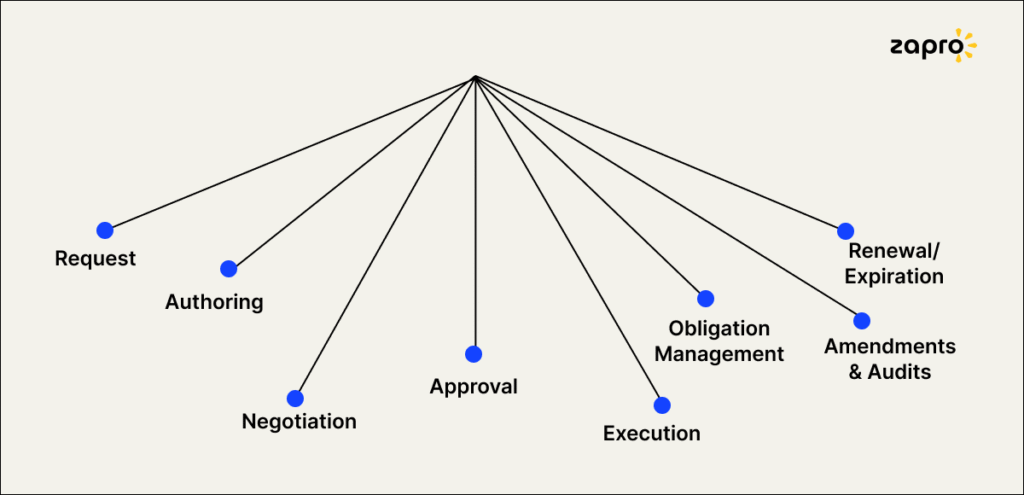
A strong CLM system controls these eight stages in its operation.
1. Request: The need for a contract initiates this stage.
2. Authoring: Writing and preparing contract content.
3. Negotiation: Modifying terms until both parties agree.
4. Approval: Internal and external validation before execution.
5. Execution: Formal signing of the agreement.
6. Obligation Management: Purchase tracking deliverables and commitments.
7. Amendments & Audits: Managing contract updates and reviews.
8. Renewal/Expiration: Deciding whether to extend or terminate the contract.
Stat: Organizations implementing mature CLM systems decrease their cycle times by 50% and achieve 10–15% cost savings.
| Stage | What happens | Key stakeholders | CLM automation |
|---|---|---|---|
| 1. Request & Intake | Business need is submitted | Procurement, Legal | Intake forms |
| 2. Authoring | Contract is drafted | Legal, Procurement | Templates, clause library |
| 3. Negotiation | Terms are negotiated/redlined | Legal, Supplier | Version control, AI review |
| 4. Review & Approval | Contract receives internal approval | Legal, Finance, Procurement | Approval routing |
| 5. Execution | Agreement is signed | Authorized signatories | E-signature |
| 6. Storage & Obligations | Contract and obligations are tracked | Procurement, Finance | Repository, alerts |
| 7. Amendments & Performance | Changes and performance are monitored | Contract owner | Obligation tracking |
| 8. Renewal/Termination | Agreement is renewed or closed | Procurement, Legal | Renewal alerts |
Challenges of Manual Contract Management
Using spreadsheets, email threads, and shared drives for contract workflows leads to numerous issues. Common pain points include:
- Version-control confusion
- Missed renewals or expirations
- Hidden contract terms and poor obligation tracking
- Legal and compliance exposure
- Long negotiation cycles
- Difficulty locating relevant documents

Manual contract management is a silent killer of productivity and a breeding ground for risk. Without a systematic approach, businesses are essentially negotiating blind.
– Mary Jones, legal operations consultant
Contract Lifecycle Management vs. Contract Management
| Contract Management | Contract Lifecycle Management |
|---|---|
| Often focuses on managing agreements | Covers the entire contract lifecycle |
| Can emphasize post-signature activities | Begins before contract creation |
| Repository and compliance | Intake through renewal/termination |
| More operational | Process + technology + governance |
What Is CLM Software?
CLM software is technology used to manage and automate the contract lifecycle, including contract intake, authoring, negotiation, approval, electronic signature, repository management, obligation tracking, compliance and renewal.
Benefits of Implementing CLM Software
Digital CLM delivers transformational value:
- Faster cycle times through templated authoring and automated routing
- Risk reduction & compliance via alerts, audit trails, and centralized control
- Cost savings by avoiding missed renewals and optimizing contract terms
- Better visibility with searchable repositories and real-time dashboards
- Improved stakeholder relationships from clear obligations
- Data-driven decision making through analytics and trend insights
Modern CLM differentiators now include AI and ML for clause extraction and predictive analytics.
Learn about contract lifecycle management software
Zapro.ai CLM Overview
Zapro.ai’s contract management system is a unified platform that combines intelligent document authoring, obligation tracking, and automated renewal processes. Its architecture ensures seamless adoption across enterprises without tool fragmentation. Plans are listed on the Zapro AI pricing page, starting at $699 per month for Spark, with unlimited users included on every tier.
Key Features of Zapro.ai’s Contract Management
- Customizable Templates & Clause Library: Ensures compliance and drafting speed
- AI-Powered Clause Suggestions: Standardizes language and reduces risk
- Automated Approvals & Workflows: Streamlines negotiations and sign-offs
- Central Repository: Secure contract storage with granular access control
- Analytics Dashboards: Monitors KPIs, contract health, and renewal forecasts
- Obligation Monitoring: Alerts for deadlines and compliance milestones
Contract Lifecycle Management Example
A company wants to renew a $250,000 software supplier agreement. Procurement submits a contract request, Legal uses an approved template, both parties negotiate terms, Finance reviews commercial conditions, the authorized executive signs the agreement, and the executed contract is stored centrally. The CLM system then tracks the supplier’s obligations and alerts the contract owner 90 days before renewal.
Case Study: A Leading Tech Firm Reduces Contract Cycle Time by 50% with Zapro.ai
The leading midsize tech organization encountered prolonged drafting and approval procedures that resulted in unsuccessful renewal opportunities. The implementation of Zapro.ai CLM brought the following benefits to the company:
- They cut cycle time by 50%
- Saved 12% in legal and renewal costs
- Improved compliance and improved forecasting for contract renewal.
Who Uses Contract Lifecycle Management?
Create clear entities:
- Legal teams
- Procurement teams
- Finance teams
- Sales teams
- Vendor management teams
- Operations
- Compliance
- Contract owners
Calculating ROI of Investing in CLM with Zapro.ai
Implementing CLM software offers measurable ROI:
- Lower legal fees from automated workflows
- Fewer compliance fines with built‑in alerts
- Avoided revenue losses via renewal reminders
- More efficient staff workloads and faster negotiations
Some firms report up to $224,000 in savings per 1,200 contracts processed annually.
Use Zapro’s ROI calculator to assess your potential savings at scale.
Choosing the Right CLM Software: A Checklist
Make informed decisions by evaluating vendors on:
- Full CLM lifecycle coverage
- Automation capabilities and AI integration
- Integration with ERP, CRM, and other systems
- Template and clause library support
- Renewal alerts, reporting, and dashboards
- Ease of use and scalability
- Vendor management reputation and support
Why Zapro.ai is Your Strategic Partner for Contract Excellence
Zapro.ai stands out because it provides:
- Secure, centralized negotiations, tracking, and obligation monitoring
- The system uses AI-based automation to deliver smart risk prevention through intelligent oversight capabilities.
- The system connects with sourcing procurement and vendor management tools through full integration capabilities.
- The system provides an intuitive interface together with strong operational capabilities that benefit all departments
The contract and vendor workflow consolidation at Zapro.ai enables procurement and legal teams to maintain the system of record.
Final Thoughts
Contract Lifecycle Management is a strategic necessity rather than an optional tool. Modern CLM systems streamline workflows, reduce risk, and lower costs while enhancing compliance. Zapro.ai’s automated, AI-driven contract management platform empowers organizations to maximize contract value and boost operational efficiency. A Zapro AI demo shows how contract requests, approvals, and renewal tracking work together alongside purchasing and invoice matching.
Streamline Every Stage of Your Contracts with Smart CLM Solutions

Frequently Asked Questions (FAQs)
1. What is the difference between CLM and contract management?
CLM manages the entire lifecycle from creation to renewal while contract management typically focuses on post-signature compliance and obligations.
2. How does CLM software reduce legal risk?
It enforces approved templates, provides automated alerts, tracks obligations, and supports audit trails; significantly minimizing legal exposure.
3. Can CLM help with supplier contract management?
The system connects with procurement platforms to deliver uniform tracking and renewal management and compliance oversight for all supplier contracts.
4. What key features should you look for in CLM software?
The essential features to look for in CLM software include automation tools alongside AI clause assistance together with template collections and customizable workflows and alert systems and integration functionality and analytical capabilities.
5. How does AI enhance modern CLM?
The application of AI technology enhances the processing of clauses and the review of contracts and the detection of risks and negotiation through predictive suggestion functionality. The use of AI leads to around 30% better operational efficiency according to Gartner.
6. What is the average implementation timeframe for a CLM solution?
The majority of organizations need 3 to 6 months to deploy fundamental CLM features yet they can achieve complete enterprise integration within twelve months.
7. What is contract lifecycle management and what are its stages?
The cycle runs from request and intake, through drafting from approved templates, negotiation and redlining, internal approval, execution and signature, then into the post-signature stages that matter most: storage in a searchable repository, obligation and milestone tracking, performance monitoring, and renewal or termination decisions. Most value leaks after signature, when obligations go untracked and renewals happen automatically without review. Treating the repository as the start of management rather than the end of the process is the shift that produces results.
Written by: Md. Kafil, Founder & CEO, Zapro
Reviewed by: Procurement/Contract Management subject-matter expert
Last updated: September 2026
This guide was developed for procurement, legal, finance and operations teams managing supplier, commercial and corporate contracts.
Don’t miss our weekly updates
We’ll email you 1-3 times per week—and never share your information.
Simplify Contracts, Maximize Value.
Streamline workflows, cut risks, close deals faster.

About the Author

Md. Kafil


About the Reviewer

Zapro is dedicated to helping businesses of all sizes make informed decisions. We adhere to strict editorial guidelines to ensure that our content meets and maintains our high standards.
Our editorial standards help keep every article accurate, useful, and trustworthy.
Related Blogs
Construction Contract Management Software: 2026 Buyer’s Guide
What Is a Contract Data Management System?