


The best Vertice alternatives are 1. Zip 2. Spendflo 3. Zapro 4. Tropic 5. Ramp 6. Precoro 7. BetterCloud.
The best Vertice alternative depends on the job you bought Vertice for. For SaaS buying with pricing data and negotiation, look at Spendflo and Tropic. For intake and approvals, compare Zip, and for POs with receipts and 3-way matching, Precoro or Zapro. Ramp suits card-led software spend, and BetterCloud suits IT license cleanup.
Vertice competitors: key takeaways
 Zip: Best for companies with many approvers that need one intake front door routing purchases through teams such as legal, IT and finance, priced by quote.
 Spendflo: Best for finance teams that mainly negotiate software renewals, with pricing benchmarks, a Managed Procurement team and a stated 14-day go-live.
 Zapro: Best for mid-market teams that need intake, approvals, contracts with renewal alerts and POs for all spend, from $699 a month. Your ERP or bank still pays suppliers.
 Tropic: Best for SaaS and AI spend with $25B+ in spend data and expert advice, from $3,083 a month priced by employee count.
 Ramp: Best for finance teams that pay software by card and want renewal reminders, starting from a $0 Free plan.
 Precoro: Best for mid-sized companies that need receipts and 3-way matching for goods and services, from $499 a month billed annually.
 BetterCloud: Best for IT teams whose real job is SaaS license cleanup, offboarding and shadow IT, with a $0 Spend Optimization Basic tier.
Vertice alternatives compared
Vertice alternatives fall into three groups. SaaS buying tools with pricing data are Spendflo and Tropic. Procurement and procure-to-pay platforms are Zip, Zapro and Precoro. Spend or IT tools are Ramp and BetterCloud. The table compares who each tool is built for, its key features, ERP integrations, starting price and G2 rating.
| Tool | Best for | Key features | ERP integrations | Starting price | Rating |
|---|---|---|---|---|---|
 Vertice (for reference) | SaaS buying with negotiation and pricing data | Intake, contracts, vendor risk, POs, invoices matched to PO and contract, pricing benchmarks, expert negotiation | NetSuite, Xero, QuickBooks, Sage Intacct, Dynamics 365 Business Central | Intake-to-Procure from $30,000; SaaS Purchasing from $40,000 | G2 4.6 (280) |
| Zip | Complex intake and orchestration | Plain-language intake, review routing, contract repository with renewal alerts, AI RFx, supplier onboarding | SAP S/4HANA, Oracle Fusion, Workday, NetSuite, Business Central, Sage Intacct | Quote; Vendr buyer data median $88,856 a year | G2 4.6 (153) |
| Spendflo | SaaS buying with managed negotiation | Pricing benchmarks, Managed Procurement, intake and approval agents, renewal alerts 60 days out | NetSuite, Sage, Workday Financials; POs through your ERP | Quote only; outcome-based pricing with credits | G2 4.6 (143) |
| Zapro | Mid-market intake-to-pay for all spend | Intake, approvals, RFI/RFP, contracts with renewal alerts, POs, receipts, 2-way and 3-way matching, Jira and ServiceNow tickets to requests | NetSuite, QuickBooks, Sage Intacct, SAP, Oracle, Workday, Dynamics | $699 per month, unlimited users | G2 4.7 (14) |
| Tropic | SaaS and AI spend intelligence | Supplier pricing from $25B+ in spend data, Renewal and Proposal Agents, usage and overlap, expert advice | APIs, MCP and integrations; no ERP named on its pricing page | From $3,083 a month, priced by employees | G2 4.5 (137) |
| Ramp | Card-first spend control | Cards, bill pay, renewal reminders, pricing benchmarks; POs and 3-way matching on the Procurement add-on | QuickBooks, Xero; NetSuite and Sage Intacct on Plus; Workday and Oracle Fusion on Enterprise | Free plan; Plus $15 per user per month plus a platform fee | G2 4.8 (2,576) |
| Precoro | Mid-sized P2P for goods and services | Requests, POs, receipts, 2-way and 3-way matching, Contract Agent, ACH and wire payments | QuickBooks Online, Xero, NetSuite, Sage Intacct, Dynamics 365 Business Central | $499 a month (Core, billed annually) | G2 4.7 (225) |
| BetterCloud | IT teams managing SaaS licenses | License reclaim, shadow IT and AI discovery, onboarding and offboarding, renewal prep with benchmarks | Okta, Google Workspace, Microsoft 365; no ERP named | Spend Optimization Basic $0; Vendr buyer data median $45,062 a year | G2 4.4 (497) |
Find your Vertice alternative
Choose a Vertice alternative by the job you bought it for, who owns software spend, how you want to negotiate and your budget. Vertice sells SaaS buying with expert help, a newer procure-to-pay module and cloud cost tools. Most alternatives cover one of these jobs. Pick the tab that fits, then check why teams leave below.
What you use Vertice for
SpendfloTropicZipZaproPrecoroZaproRampBetterCloudSpendfloWho owns software spend
ZipPrecoroSpendfloTropicBetterCloudRampHow you want to negotiate
SpendfloTropicTropicRampZipBudget
RampBetterCloudPrecoroZaproZipTropicWhy teams leave Vertice, and what fixes it
Teams look at Vertice alternatives for five reasons, all shown on Vertice's own pages. Prices start at $20,000 to $40,000. Goods receipt is still planned. Its pricing data is built for software deals. It bought Vendr in 2026, and it sells a managed service. We read these pages on 11 and 12 November 2026.
What Vertice does well: after the Vendr deal it cites $75B+ in spend data and 250,000+ negotiated contracts. SaaS Purchasing savings are contractually guaranteed, and plans include spend analytics. It syncs with NetSuite, Xero, QuickBooks, Sage Intacct and Dynamics, and is rated 4.6 on G2 from 280 reviews.
What Vertice doesn't cover, and who does
Vertice covers intake, contracts, vendor risk, procure-to-pay, SaaS buying and cloud costs. Its own pages show three gaps. Goods receipt is a planned addition, so there is no 3-way match yet. Its pages describe invoice processing and ERP sync; ask how supplier payments are sent. And plans start at $20,000. The table shows who fills each gap.
| If you need | In Vertice | Alternatives that include it |
|---|---|---|
| Goods receipt and 3-way matching | Invoices match to PO and contract; goods receipt is a planned addition | PrecoroRampZapro |
| Supplier payments | Its pages describe invoice processing, with POs and invoices synced to the ERP | RampPrecoroZip |
| A free or low-cost entry plan | Starting prices of $20,000 to $40,000 per product | RampBetterCloudPrecoro |
The 7 best Vertice alternatives, reviewed
Each review below shows what the tool is built for, its key features, pros, cons, pricing and the buyer it fits. Spendflo and Tropic cover SaaS pricing and negotiation. Zip, Zapro and Precoro cover intake, POs and invoice matching. Ramp covers cards and renewal reminders, and BetterCloud covers SaaS licenses for IT teams.
Zip: best for complex intake and orchestration
Best for Complex intake and orchestration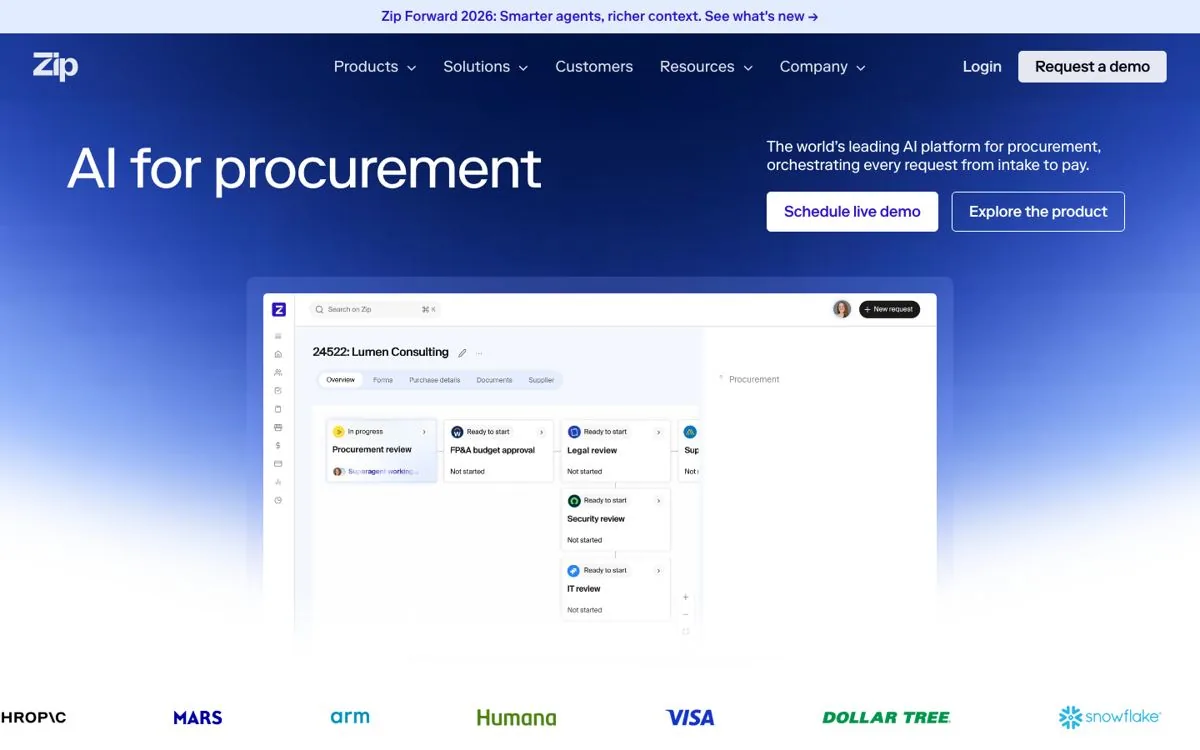
Zip fits companies with many approvers that need one intake front door for every purchase. It turns plain-language requests into completed forms, routes them through teams such as legal, IT and finance, and stores contracts with AI redlines and renewal alerts. Prices are quote only, and Global Payments and vendor cards are add-ons.
Key features 6 features
- Plain-language intake turned into completed request forms
- Approval routing across the teams Zip serves, including legal, IT and finance
- Contract repository with AI redlines and renewal alerts
- RFx generation and weighted supplier scoring
- Supplier onboarding with bank and tax checks
- Connects to SAP S/4HANA, Oracle Fusion, Workday, NetSuite and Coupa
Pros and cons 3 pros, 3 cons
Pros
- Review routing: each request moves through the right teams such as legal, IT and finance steps, so complex purchases stop stalling in email threads
- ERP reach: it connects to SAP S/4HANA, Oracle Fusion, Workday, NetSuite and Business Central, so it fits mixed finance stacks
- Review base: 4.6 on G2 from 153 reviews, a fair sample for judging day-to-day use
Cons
- Quote-only pricing: Vendr buyer data puts the median at $88,856 a year across 78 purchases, so budget for a five-figure contract
- Add-ons: Global Payments, Vendor Cards and App Studio are sold separately, so paying suppliers through Zip costs extra
- Different focus: Zip's AI reviews contracts and drafts RFx, so teams that bought Vertice for SaaS price benchmarks should test that need separately
Pricing
Quote only. Vendr buyer data shows a median of $88,856 a year across 78 purchases, ranging from $27,776 to $220,210.
Best for
Companies with many approvers across teams such as legal, IT and finance that need one front door for every purchase.
Verdict
Verdict: Zip fits when intake and orchestration are why you bought Vertice. Its median price sits well above mid-market tools, and it is not a SaaS pricing service.
Spendflo: best for saaS buying with managed negotiation
Best for SaaS buying with managed negotiation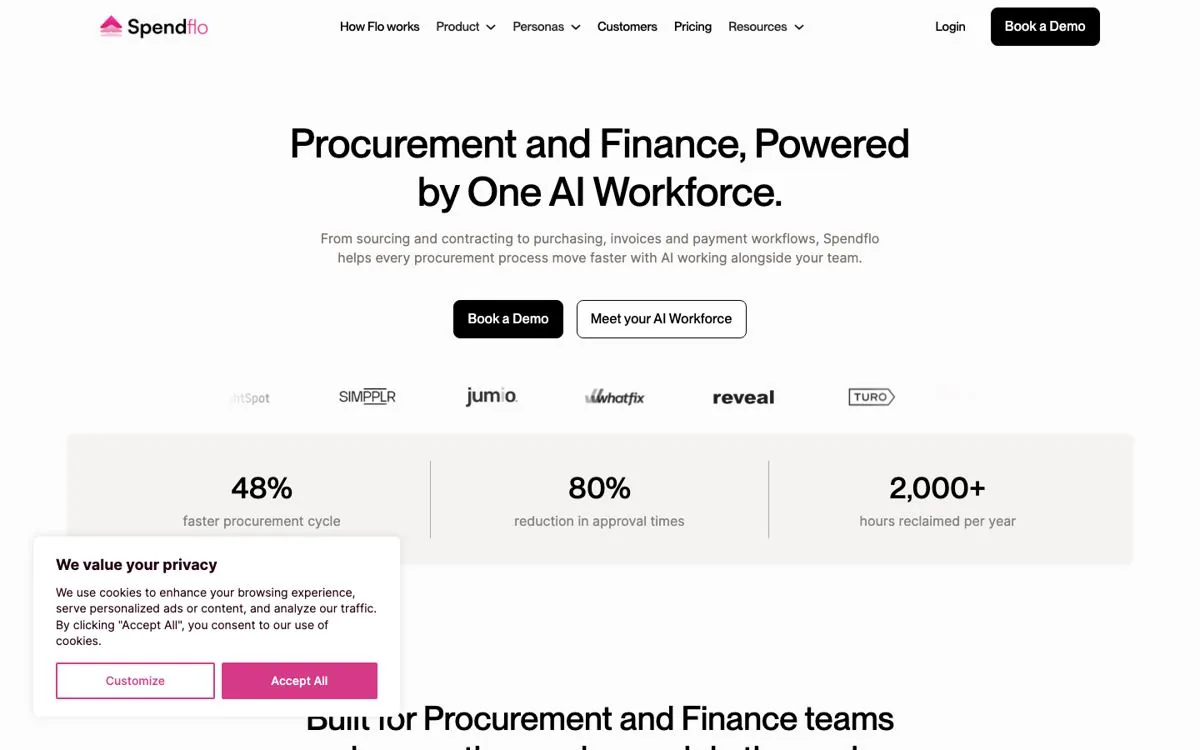
Spendflo fits finance teams whose main Vertice job is buying and renewing software at a fair price. It pairs pricing benchmarks and a Managed Procurement team that negotiates for you with intake and approval agents, contract storage and renewal alerts 60 days out. POs run through your ERP, and several modules are marked Coming Soon.
Key features 5 features
- Pricing benchmarks for software deals
- Managed Procurement negotiation service
- Contract storage with auto-renewal alerts 60 days out
- Usage data from Slack, Salesforce, GitHub, Zoom and more
- Supplier onboarding and third-party risk modules
Pros and cons 2 pros, 3 cons
Pros
- Fast rollout: Spendflo states dedicated onboarding and live in 14 days, so you can test it on a real renewal quickly
- Credit-based pricing: Spendflo describes outcome-based pricing, with credits used only on successful processing and rolled over with no expiry
Cons
- Coming Soon modules: Intake, AP Automation, Budgets and Reporting are marked Coming Soon, so confirm what is live before you sign
- POs through your ERP: Spendflo manages purchase orders via ERP integration, so PO and receipt work stays in your ERP
- Quote only: its pricing page shows the model but no figures, so ask for a written quote at your request volume
Pricing
Quote only. Spendflo describes outcome-based pricing across Grow, Scale and Enterprise plans, with credits that roll over and are used only on successful processing.
Best for
Finance teams whose main Vertice use is negotiating and tracking software renewals.
Verdict
Verdict: Spendflo is a like-for-like option for Vertice's SaaS Purchasing side. Look elsewhere if you need receipts and invoice matching inside the tool.
Zapro: best for mid-market intake-to-pay for all spend
Best for Mid-market intake-to-pay for all spend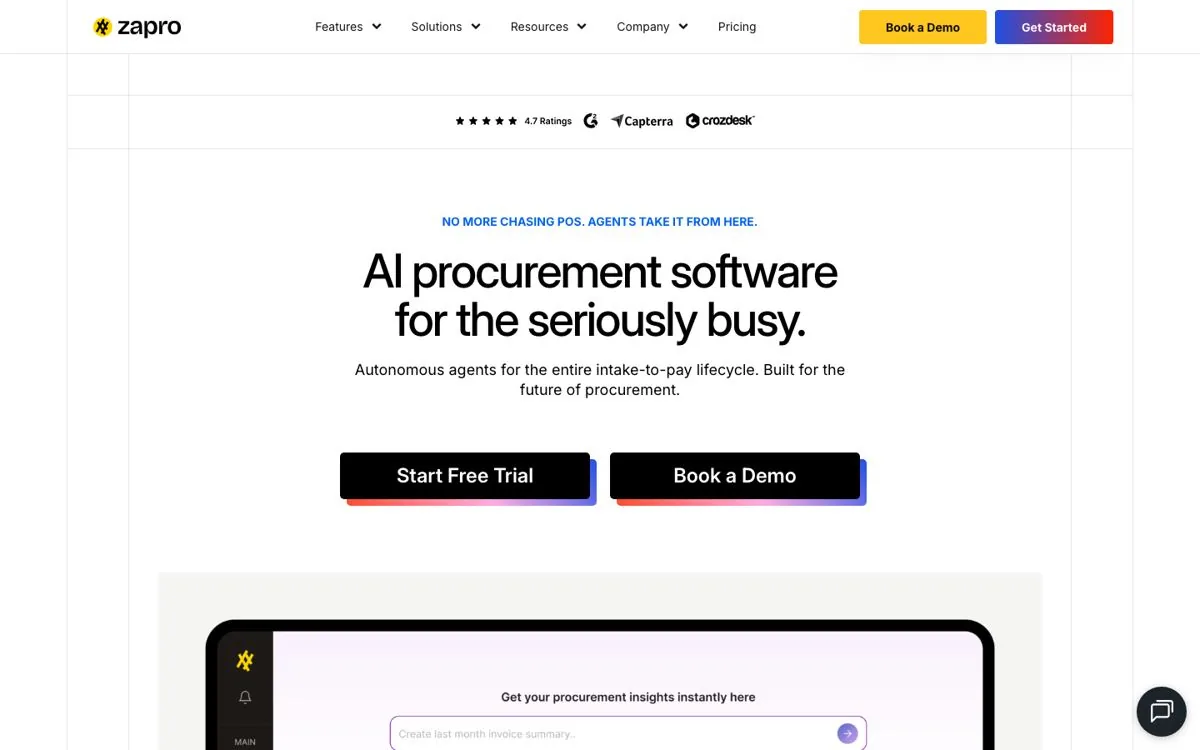
Zapro is a strong Vertice alternative for mid-market teams whose gap is control before the invoice, not SaaS price negotiation. This AI-native procurement software covers intake, approvals, contracts with renewal alerts, POs and invoice matching, with unlimited users. Plans start at $699 a month, and your ERP or bank pays suppliers.
Key features 4 features
- Approvals routed by amount, category or vendor
- Contracts with renewal alerts at 90, 60 and 30 days, plus e-signature
- Jira or ServiceNow tickets turned into purchase requests
- 2-way and 3-way matching with an exception queue (3-way on Growth and up)
Pros and cons 2 pros, 3 cons
Pros
- Unlimited users: every plan includes unlimited users, so occasional requesters and approvers never add to the monthly bill
- Published prices: Spark is $699 a month and Growth $1,999, so you can budget before you talk to sales
Cons
- No SaaS pricing data: it has no software price benchmarks, negotiation team or app discovery, so keep a SaaS tool for that
- No payments: it prepares payment batches, but your ERP or bank sends the money, so payments stay in your current setup
- Vendor caps: Spark covers up to 50 active vendors and Growth up to 500, so teams with many vendors may need a higher tier
Pricing
Spark $699 a month (up to 50 vendors), Growth $1,999 a month (up to 500 vendors), Scale on custom pricing. The pricing page lists 3-way matching and contract authoring in Growth's AI suite.
Best for
Mid-market finance and procurement teams that want intake, POs, contracts and renewals for all spend, with their bank or ERP still paying suppliers.
Verdict
Verdict: Pick Zapro if you bought Vertice for intake, POs or contract renewals across all spend. Keep a SaaS pricing service next to it if software savings are the main job.
Tropic: best for saaS and AI spend intelligence
Best for SaaS and AI spend intelligence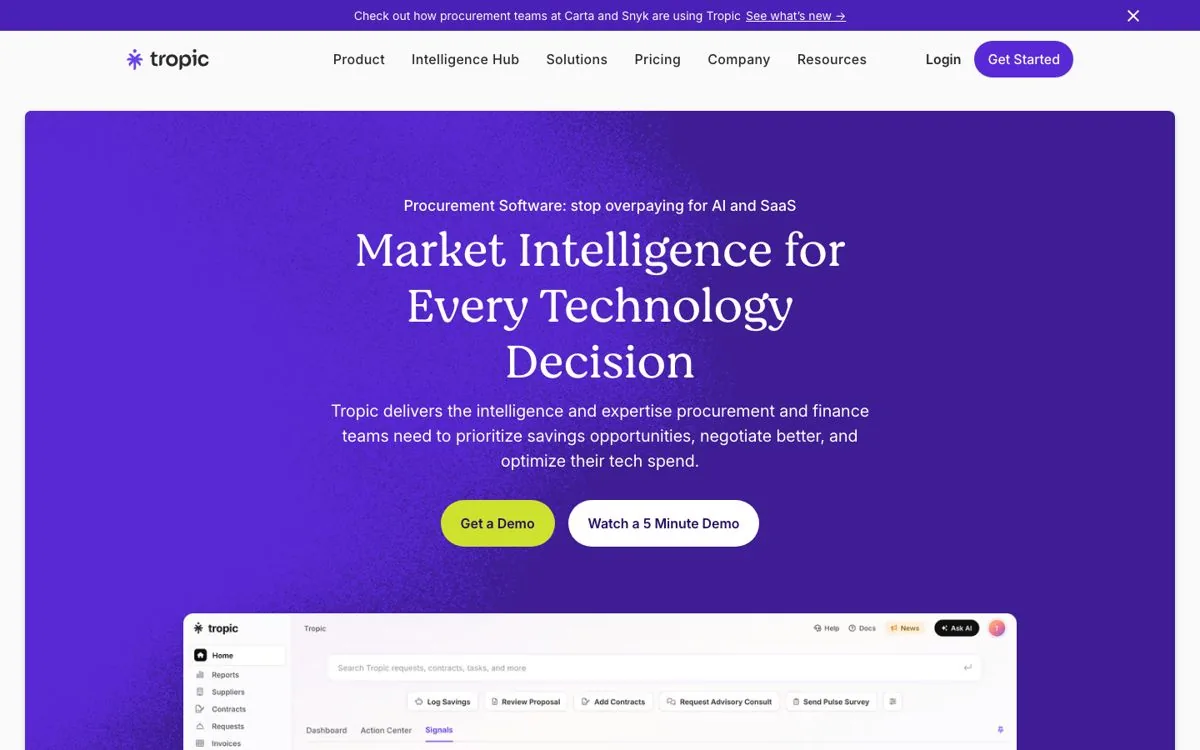
Tropic fits finance teams at software-heavy companies that want SaaS and AI pricing data with experts on call. Its plan includes supplier pricing from $25B+ in spend data, negotiation strategies, Renewal and Proposal Agents and expert advice. Intake and full-service negotiation are add-ons, and it prices by employee count, not per user.
Key features 4 features
- Supplier pricing from $25B+ in spend data
- Renewal Agent and Proposal Agent
- Usage and overlap insights, plus AI cost optimization
- Expert advice, APIs and MCP
Pros and cons 2 pros, 2 cons
Pros
- Published starting price: Tropic lists $3,083 a month on its pricing page, so you can budget before a sales call
- No per-user licenses: pricing is based on employees, so adding more people to the tool does not add seat fees
Cons
- Add-ons: intake and orchestration and full-service negotiation cost extra, so a Vertice-like setup costs more than the base plan
- Software focus: its plan lists pricing intelligence, renewal agents and advisory rather than POs or invoice matching, so it replaces Vertice's SaaS side only
Pricing
From $3,083 a month, priced by employee count with no per-user licenses. Intake and orchestration and full-service negotiation are add-ons.
Best for
Finance teams at software-heavy companies that want SaaS and AI pricing data with experts on call, while leading negotiations themselves.
Verdict
Verdict: Tropic is a like-for-like option for Vertice's SaaS Purchasing. It does not replace Vertice's procure-to-pay module.
Ramp: best for card-first spend control
Best for Card-first spend control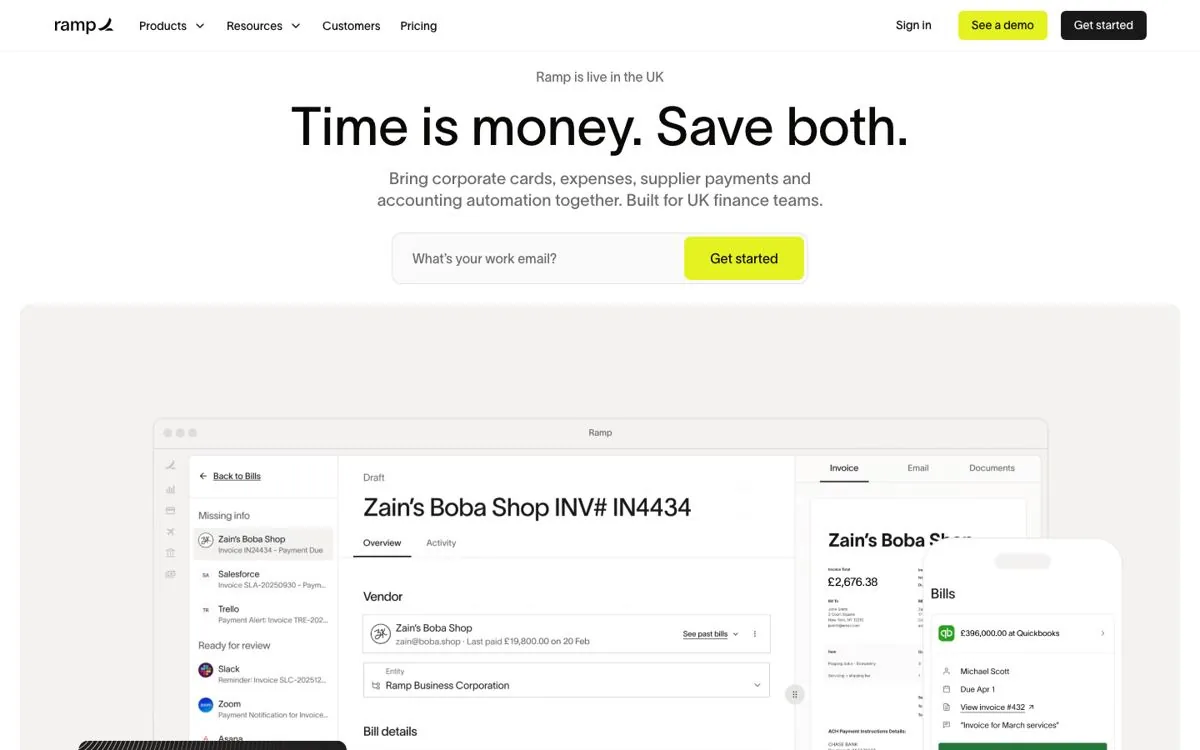
Ramp fits finance teams that pay most software by card and want renewal tracking next to spend control. Its core covers cards, expenses and bill pay, and the Procurement add-on adds POs, 3-way matching and renewal tools. That add-on needs Plus or Enterprise. Weighing Ramp itself? See these Ramp alternatives.
Key features 4 features
- Corporate and vendor cards with limits
- Renewal deadline reminders and pricing benchmarks
- AI agents for vendor research, RFx and security reviews
- POs and 3-way matching on the Procurement add-on
Pros and cons 3 pros, 2 cons
Pros
- $0 entry: the Free plan covers cards, expenses and bill pay at $0 per user, so small teams can start without a contract
- Fast setup: Ramp says most teams are fully operational within a week on Procurement, which shortens the switch
- Review base: 4.8 on G2 from 2,576 reviews, a large sample for judging day-to-day reliability
Cons
- Add-on pricing: the Procurement add-on is custom-priced and needs Plus or Enterprise, so the full procurement set costs more than the Free plan
- Self-serve negotiation: Ramp gives pricing benchmarks and AI renewal advice, so your own team still runs each negotiation
Pricing
Free plan at $0 per user. Plus is $15 per user per month plus a platform fee. Enterprise and the Procurement add-on are custom.
Best for
Finance teams that pay most software by card and want renewal tracking without a separate SaaS tool.
Verdict
Verdict: Ramp suits teams that want spend control and renewal reminders from a $0 plan. Its renewal help is benchmarks and AI recommendations, not a managed negotiation team.
Precoro: best for mid-sized P2P for goods and services
Best for Mid-sized P2P for goods and services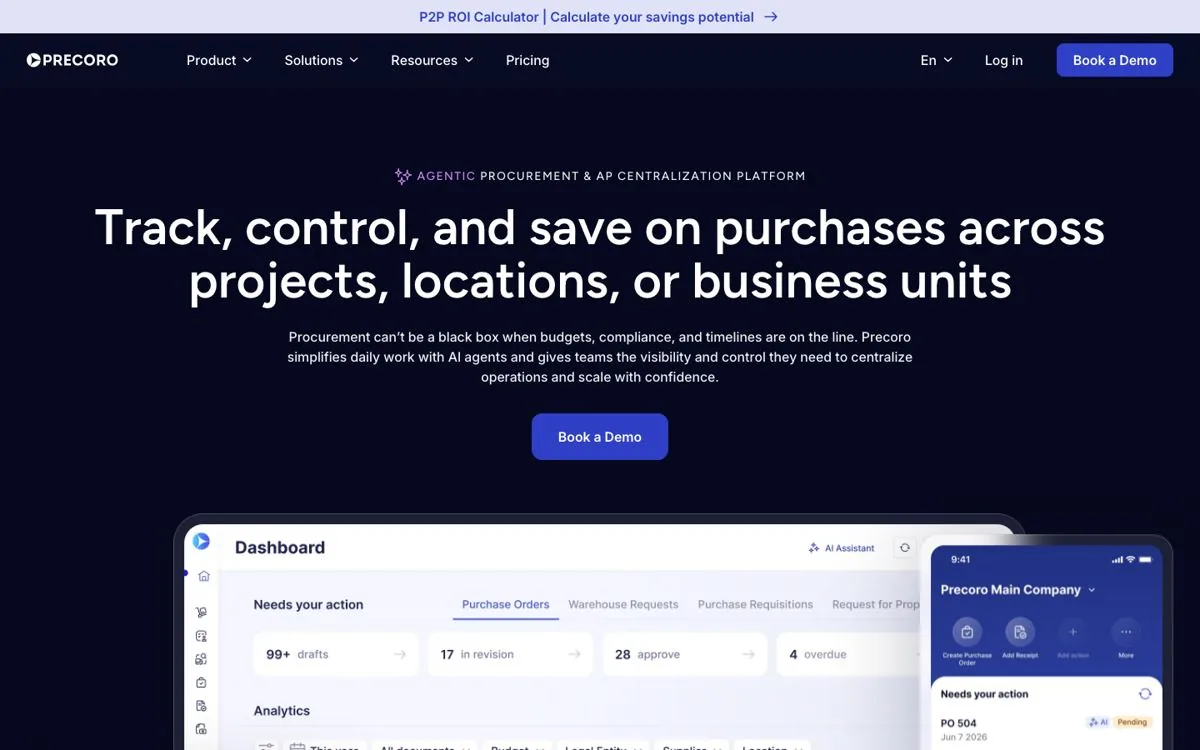
Precoro fits mid-sized companies with many locations or entities that bought Vertice for POs and invoices. It covers requests, approvals, POs, receipts and 2-way and 3-way matching on Core, plus ACH, wire and international payments. AI features, intake management and PunchOut need the Automation plan, and unlimited users come only on Enterprise.
Key features 4 features
- 2-way and 3-way matching on Core
- Receipts with received-versus-ordered tracking
- Contract Agent for terms, renewals and risk alerts
- ACH, wire and international payments
Pros and cons 2 pros, 3 cons
Pros
- Published plans: Core starts at $499 a month and Automation at $999, billed annually, so you can budget before a demo
- Stated go-live: Precoro gives a typical go-live of 2 to 8 weeks with no IT involvement, a short switch for mid-sized teams
Cons
- Renewal help only: the Contract Agent extracts terms and flags renewals, so software price negotiation stays with your own team
- Plan gating: AI features, intake management and PunchOut need the Automation plan, so Core covers less than the headline price suggests
- User limits: unlimited users come only on Enterprise, so many occasional approvers can push you up a tier
Pricing
Core from $499 a month, Automation from $999 a month, Enterprise custom, all billed annually.
Best for
Mid-sized companies that bought Vertice for POs and invoices and want receipts and 3-way matching with published prices.
Verdict
Verdict: Precoro suits procure-to-pay buyers who want published prices and receipts today. Pair it with a SaaS pricing service if renewals are a big share of spend.
BetterCloud: best for IT teams managing SaaS licenses
Best for IT teams managing SaaS licenses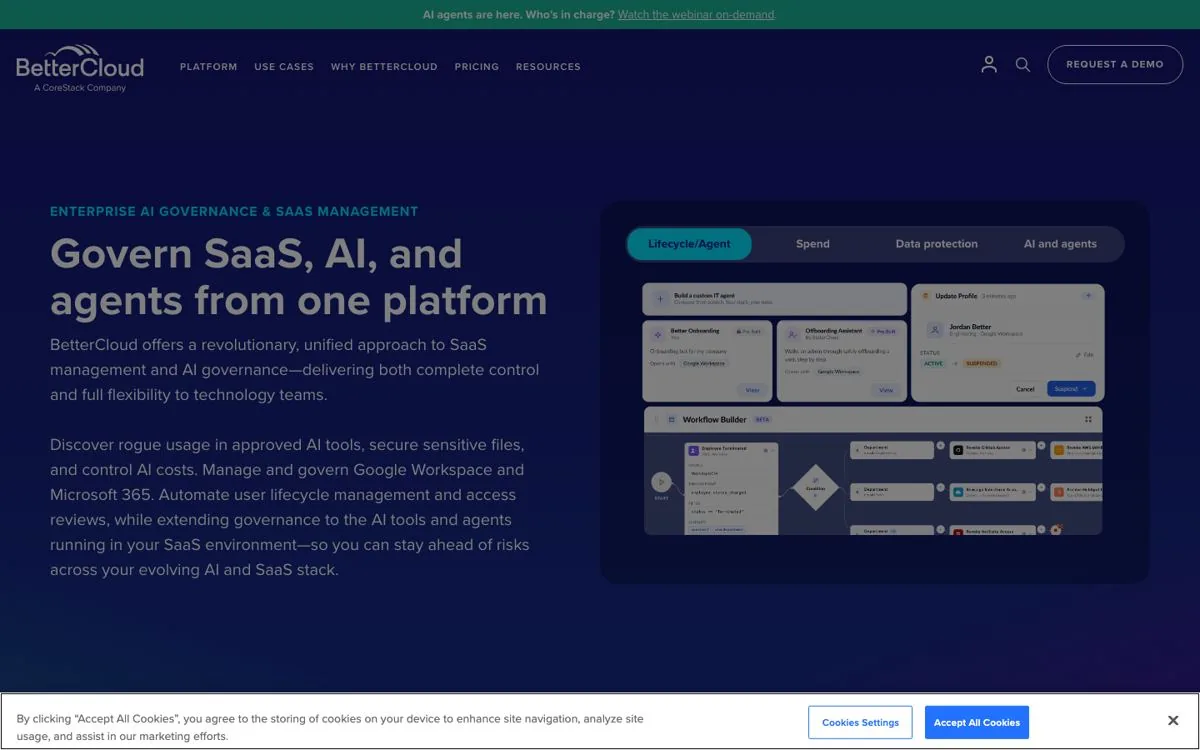
BetterCloud fits IT teams whose software problem is unused licenses, onboarding and offboarding, and shadow IT rather than purchasing. It reclaims licenses, preps renewals with pricing benchmarks and finds shadow IT and shadow AI. CoreStack announced it acquired BetterCloud in March 2026, and its site shows no POs, invoice matching or payments.
Key features 5 features
- SaaS license reclamation and overlap detection
- Renewal prep with pricing benchmarks
- Shadow IT and shadow AI discovery
- User onboarding and offboarding workflows
- App requests with approval steps in Slack or Teams
Pros and cons 2 pros, 2 cons
Pros
- Free tier: Spend Optimization Basic costs $0 a month, so IT can see SaaS spend before buying anything
- Lifecycle automation: no-code onboarding and offboarding workflows tie app access to joiners and leavers, which helps cut license waste
Cons
- No procurement: its site shows no POs, invoice matching or payments, so finance still needs a separate procurement tool
- Quote pricing: paid modules are quoted by licenses, apps and modules, and Vendr buyer data shows a $45,062 median a year
Pricing
Spend Optimization Basic is $0. Other modules are quote only; Vendr buyer data shows a median of $45,062 a year across 196 purchases.
Best for
IT teams whose SaaS problem is unused licenses, offboarding and shadow apps rather than purchasing.
Verdict
Verdict: BetterCloud fits when IT owns software spend. Finance teams will still need a procurement tool for POs and invoices.
Also worth a look: Sastrify calls itself an AI co-pilot for software management. It offers software discovery, seat management, renewal alerts and contract benchmarking for IT, procurement and finance teams, and says it has joined Deel. Omnea covers intake, source-to-contract and procure-to-pay, with chat-based intake in Slack and Teams. Vendr, often listed as a rival, is now part of Vertice.
Vertice alternatives: feature-by-feature comparison
Compare Vertice alternatives on the buying work Vertice handles: intake and approvals, contracts and renewals, pricing data and negotiation, and POs with invoice matching. All seven tools appear, but Ramp is card-led and BetterCloud is an IT tool, so each covers only part of this workflow. Cells show what each vendor's own pages describe.
| Tool | Intake and approvals | Contracts and renewals | Pricing data and negotiation | POs and invoice matching |
|---|---|---|---|---|
| Vertice | No-code request and approval workflows | Contract management; vendor and risk management | $75B+ spend data, expert negotiators, Ana negotiation agent | POs; invoices matched to PO and contract; receipts planned |
| Zip | Plain-language intake routed through teams such as legal, IT and finance | AI repository, playbook redlines and renewal alerts | AI RFx generation with weighted supplier scoring | POs and AI invoice extraction; payments add-on |
| Spendflo | Intake and approval agents, budget checks at request | Contract storage, renewal alerts 60 days out | Pricing benchmarks and Managed Procurement negotiation | PO management via ERP integration; AP agent add-on |
| Zapro | Routed by amount, category or vendor; Jira tickets to requests | Renewal alerts at 90, 60 and 30 days; e-signature | RFI and RFP on every plan; no pricing dataset | POs and receipts; 2-way matching, 3-way on Growth |
| Tropic | Intake and orchestration add-on | Renewal Agent and Proposal Agent | $25B+ spend data; full-service negotiation add-on | No PO or invoice matching module |
| Ramp | AI intake; rules by budget, department or vendor type | Renewal reminders and approvals; CLM integrations | Pricing benchmarks and AI renewal advice | POs and 3-way matching on Procurement add-on |
| Precoro | Guided request forms; intake management on Automation | Contract repository; Contract Agent flags renewals | RFPs via supplier portal on Automation | Receipts; 2-way and 3-way matching on Core |
| BetterCloud | App requests from a catalog in Slack or Teams | Contract uploads and renewal reminders | Renewal prep with pricing benchmarks | No PO or invoice matching module |
How Vertice alternatives charge
Vertice pricing starts at $20,000 to $40,000 per product, per its pricing page, which does not give the billing period. Its alternatives charge by quote (Zip, Spendflo, BetterCloud), by employee count (Tropic), per user plus a platform fee (Ramp) or by flat plan (Precoro, Zapro). Compare Zapro pricing and the rest at your real spend.
| Tool | Pricing model | Starting price |
|---|---|---|
| Vertice | Per product, with starting-from prices | $20,000 (cloud), $30,000 (Intake-to-Procure) |
| Zip | Quote; platform fee plus per-seat pricing, per Vendr | Vendr median $88,856 a year |
| Spendflo | Outcome-based pricing with credits | Quote |
| Zapro | Flat monthly plan by active vendors; unlimited users | $699 per month |
| Tropic | By employee count; no per-user fees | $3,083 per month |
| Ramp | Per user plus platform fee; Procurement add-on | $0 (Free plan) |
| Precoro | Flat plan, billed annually | $499 per month |
| BetterCloud | Quote by licenses, apps and modules | $0 (Spend Optimization Basic) |
Questions to ask any Vertice alternative
Before you choose a Vertice alternative, ask every vendor the same five questions in writing. Which spend types does it cover? Does it match invoices to receipts today? Where does its pricing data come from? What does any savings guarantee cover? What will year two cost? Strong answers are specific, dated and shown live in a demo.
| Question | Why it matters | What a strong answer includes |
|---|---|---|
| Which of our spend types do you cover: SaaS, cloud, goods or services? | Most tools here cover software buying or procurement, not both. | A clear yes or no for each spend type, with the plan named. |
| Do you match invoices against receipts today? | Vertice lists goods receipt as a planned addition. | A live 3-way match in the demo. |
| Where does your pricing data come from, and how fresh is it? | Benchmarks drive renewal savings. | The data source, its size and the update date. |
| What exactly does a savings guarantee cover? | Guarantee terms vary between vendors. | Written terms for how savings are measured and paid. |
| What does year two cost? | Renewal uplifts change the real price. | A written cap on renewal increases. |
Which Vertice alternative should you choose in 2027?
The best Vertice alternative is the one that replaces the job you bought Vertice for. For SaaS negotiation and pricing data, start with Spendflo or Tropic. For intake across teams such as legal, IT and finance, look at Zip. For POs, receipts and 3-way matching across all spend, compare Precoro and Zapro. Ramp suits card spend and BetterCloud suits IT.
A practical shortlist: one SaaS buying tool (Spendflo or Tropic) and one procure-to-pay tool (Precoro or Zapro), since many mid-market teams need both jobs done. Run one real renewal and one real purchase through each, then use a procurement ROI calculator to size the savings.
Frequently asked questions
What is the best alternative to Vertice?
The best alternative to Vertice depends on what you use it for. Spendflo and Tropic replace its SaaS buying and negotiation, Zip its intake and approvals, and Precoro or Zapro its procure-to-pay with receipts and 3-way matching. Ramp suits card-led software spend, and BetterCloud suits IT license cleanup.
Who are Vertice's main competitors?
Vertice's main competitors are Spendflo, Tropic and Sastrify in SaaS buying; Zip, Omnea and Precoro in procurement; and Ramp in card-led spend control. Vendr used to compete with Vertice directly, but Vertice announced it acquired Vendr in June 2026.
How much does Vertice cost?
Vertice pricing starts at $30,000 for Intake-to-Procure, $40,000 for SaaS Purchasing and $20,000 for Cloud Cost Optimization, per its pricing page. The page shows starting-from figures only, and says SaaS Purchasing savings are contractually guaranteed.
What do Vertice reviews say?
Vertice is rated 4.6 out of 5 on G2 from 280 reviews, checked on 12 November 2026. We did not count review themes for this page. Read recent G2 reviews for your own use case, SaaS buying or procure-to-pay, before you add Vertice to a shortlist.
Vertice vs Spendflo: which is better?
Vertice suits teams that want a contractual savings guarantee and a procure-to-pay module next to SaaS buying. Spendflo suits teams that want request-based pricing and a stated 14-day rollout. Both pair SaaS pricing benchmarks with experts who negotiate for you.
Did Vertice buy Vendr?
Yes. Vertice announced it acquired Vendr on 1 June 2026, with terms undisclosed. The combined company cites $75B+ in spend data and 250,000+ negotiated contracts. Vendr customers were told it is business as usual, and Vendr's negotiators joined Vertice's managed services.
What companies like Vertice handle procurement, not just SaaS?
Zip, Precoro and Zapro are companies like Vertice that cover wider procurement, including goods and services. Precoro and Zapro also run receipts and 3-way matching, while Zip focuses on intake and orchestration across teams such as legal, IT and finance.
Procure-to-pay for every kind of spend
See how Zapro handles intake, approvals, contracts, receipts and 3-way matching for a mid-market team, with unlimited users on every plan.
Sources: Vertice pricing; Vertice procure-to-pay; Vertice acquires Vendr; Tropic pricing; Zip buyer data on Vendr; Sastrify.