

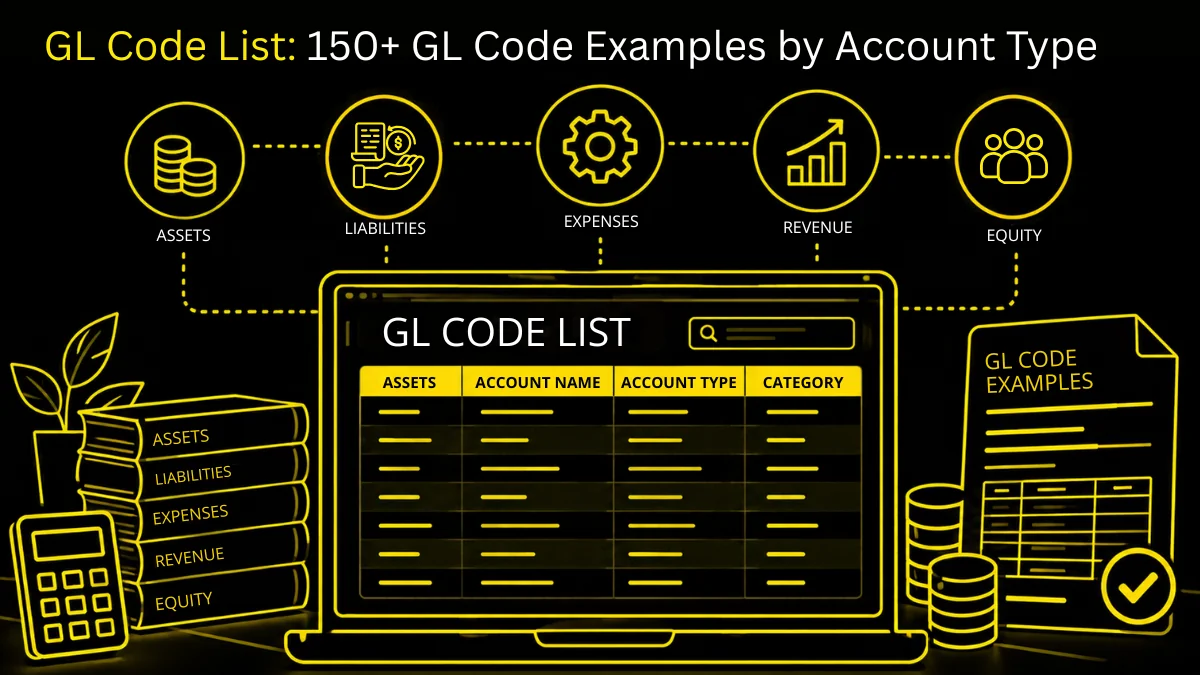
A GL code example is a specific account number paired with what it records, such as 5960 for office supplies or 2000 for trade accounts payable. Numbering follows conventions rather than a standard, so codes are broadly recognisable between companies but never identical. The tables below give more than 150 working examples.
Key takeaways
- Most charts use four digits, with the leading digit signalling the account category.
- Nothing here is a standard. These are conventions, and every business adapts them.
- Leave gaps. A chart numbered consecutively has nowhere to put the account you need next year.
- The same cost sits in different accounts depending on the industry. Hosting is a direct cost for a SaaS business and an overhead for a manufacturer.
- Copy the structure, not the numbers. What matters is that your ranges are consistent and your gaps are deliberate.
Get the free GL Code List Template (.xlsx) — all 150+ codes from this page in an editable spreadsheet, ready to copy and renumber for your own chart.
What a GL code example looks like
A GL code example has two parts: the number, and the account it points to. On its own, 5600 means nothing. Paired with software subscriptions, it becomes usable. For the underlying concept, see what GL codes are.
How to read a composed GL code
Many businesses extend the account number with segments. Reading 5600-200-01 left to right:
- 5600 — the account. Software subscriptions, an operating expense.
- 200 — the department. Marketing.
- 01 — the entity or location. The UK company.
A marketing software subscription bought by the UK entity. The account says what it was, the segments say whose it was and where. Segment count and order vary by system, so treat this as the pattern rather than the format. In procurement, these segments are usually captured on the purchase request, so the context travels with the spend from the start.
Standard GL code list by account type
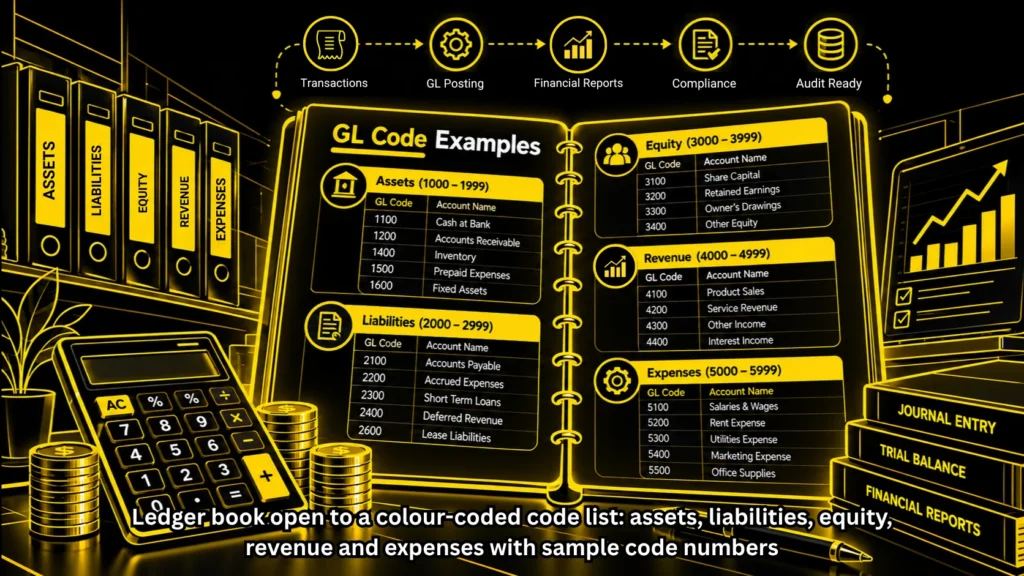
More than 150 codes, grouped by range. Use them as a starting point and renumber to suit your own chart.
1000–1999: Asset GL codes
| Code | Account |
| 1000 | Cash — operating account |
| 1010 | Cash — payroll account |
| 1020 | Cash — savings and reserves |
| 1030 | Petty cash |
| 1040 | Undeposited funds |
| 1100 | Accounts receivable — trade |
| 1110 | Accounts receivable — other |
| 1150 | Allowance for doubtful accounts |
| 1200 | Inventory — raw materials |
| 1210 | Inventory — work in progress |
| 1220 | Inventory — finished goods |
| 1230 | Inventory reserve |
| 1300 | Prepaid expenses |
| 1310 | Prepaid insurance |
| 1320 | Prepaid rent |
| 1330 | Prepaid software subscriptions |
| 1400 | Employee advances |
| 1410 | Deposits paid |
| 1500 | Furniture and fixtures |
| 1510 | Computer equipment |
| 1520 | Machinery and equipment |
| 1530 | Vehicles |
| 1540 | Leasehold improvements |
| 1550 | Land |
| 1560 | Buildings |
| 1600 | Accumulated depreciation — equipment |
| 1610 | Accumulated depreciation — vehicles |
| 1620 | Accumulated depreciation — buildings |
| 1700 | Capitalised software development |
| 1710 | Goodwill |
| 1720 | Trademarks and patents |
| 1730 | Accumulated amortisation |
2000–2999: Liability GL codes
| Code | Account |
| 2000 | Accounts payable — trade |
| 2010 | Accounts payable — accrued |
| 2020 | Accrued expenses |
| 2030 | Accrued payroll |
| 2040 | Accrued bonuses |
| 2050 | Accrued interest |
| 2100 | Credit cards payable |
| 2200 | Sales tax payable |
| 2210 | VAT payable |
| 2220 | VAT recoverable |
| 2230 | Payroll tax payable |
| 2240 | Income tax payable |
| 2300 | Employee deductions payable |
| 2310 | Pension contributions payable |
| 2400 | Deferred revenue — current |
| 2410 | Customer deposits |
| 2420 | Gift cards and credits outstanding |
| 2500 | Notes payable — current |
| 2510 | Current portion of long-term debt |
| 2520 | Lease liability — current |
| 2600 | Notes payable — long term |
| 2610 | Lease liability — non-current |
| 2620 | Deferred revenue — non-current |
| 2630 | Deferred tax liability |
3000–3999: Equity GL codes
| Code | Account |
| 3000 | Common stock / share capital |
| 3010 | Preferred stock |
| 3020 | Additional paid-in capital |
| 3100 | Retained earnings |
| 3110 | Current year earnings |
| 3200 | Owner’s draw / distributions |
| 3300 | Treasury stock |
| 3400 | Accumulated other comprehensive income |
4000–4999: Revenue GL codes
| Code | Account |
| 4000 | Product revenue |
| 4010 | Subscription revenue |
| 4020 | Service revenue |
| 4030 | Licence revenue |
| 4040 | Implementation and onboarding revenue |
| 4050 | Maintenance and support revenue |
| 4100 | Shipping and handling revenue |
| 4200 | Sales discounts |
| 4210 | Sales returns and allowances |
| 4220 | Rebates and volume allowances |
| 4300 | Interest income |
| 4310 | Dividend income |
| 4400 | Rental income |
| 4500 | Royalty income |
| 4900 | Other operating revenue |
| 4910 | Foreign exchange gain — operating |
5000–5999: Expense GL codes
Direct costs sit in the lower half of the range, operating expenses in the upper half.
| Code | Account |
| 5000 | Direct materials |
| 5010 | Direct labour |
| 5020 | Manufacturing overhead |
| 5030 | Subcontracted production |
| 5040 | Freight in |
| 5050 | Packaging materials |
| 5060 | Production scrap and waste |
| 5100 | Hosting and infrastructure |
| 5110 | Third-party licences — cost of sales |
| 5120 | Payment processing fees |
| 5130 | Customer support salaries |
| 5140 | Implementation and delivery services |
| 5150 | Data and content licensing |
| 5400 | Salaries and wages |
| 5410 | Employer payroll taxes |
| 5420 | Health insurance |
| 5430 | Pension contributions |
| 5440 | Bonuses and commissions |
| 5450 | Contractor and temporary labour |
| 5460 | Recruitment fees |
| 5470 | Training and development |
| 5480 | Staff welfare |
| 5500 | Rent |
| 5510 | Utilities |
| 5520 | Building maintenance |
| 5530 | Cleaning and janitorial |
| 5540 | Security services |
| 5550 | Property insurance |
| 5560 | Waste and recycling |
| 5600 | Software subscriptions |
| 5610 | IT hardware — non-capitalised |
| 5620 | Telecommunications |
| 5630 | Internet and connectivity |
| 5640 | IT support services |
| 5650 | Cloud storage and backup |
| 5700 | Marketing and advertising |
| 5710 | Digital advertising |
| 5720 | Events and trade shows |
| 5730 | Print and production |
| 5740 | Public relations |
| 5750 | Market research |
| 5760 | Sponsorships |
| 5800 | Travel — airfare |
| 5810 | Travel — accommodation |
| 5820 | Travel — ground transport |
| 5830 | Meals and entertainment |
| 5840 | Mileage reimbursement |
| 5900 | Legal fees |
| 5910 | Accounting and audit fees |
| 5920 | Consulting fees |
| 5930 | Bank charges |
| 5940 | Business insurance |
| 5950 | Licences and permits |
| 5960 | Office supplies |
| 5970 | Postage and courier |
| 5980 | Subscriptions and memberships |
| 5990 | Bad debt expense |
Many of the expense codes above — office supplies, software subscriptions, professional services — originate as everyday purchases raised through an AI procurement platform before they ever reach the ledger. If you are comparing tools for this, a roundup of the best procurement software shows how different platforms handle coding at the point of purchase.
6000–6999: Other income and expense GL codes
| Code | Account |
| 6000 | Interest expense |
| 6010 | Interest income — non-operating |
| 6100 | Depreciation expense |
| 6110 | Amortisation expense |
| 6200 | Foreign exchange gain or loss |
| 6300 | Gain on disposal of assets |
| 6310 | Loss on disposal of assets |
| 6400 | Impairment charges |
| 6500 | Restructuring costs |
| 6600 | Income tax expense |
| 6610 | Deferred tax expense |
| 6700 | Penalties and fines |
| 6800 | Charitable donations |
| 6900 | Other non-operating income |
GL code examples by industry
The ranges above are common to everyone. What differs is which costs a business treats as direct rather than overhead, and that decision changes the gross margin on the face of the income statement.
Hosting is the clearest case. A SaaS company codes it to cost of sales, because it scales with customers served. A manufacturer codes the same invoice to IT overhead. Same supplier, same amount, different line.
SaaS and technology GL codes
| Code | Account |
| 4010 | Subscription revenue — recurring |
| 4040 | Implementation and onboarding revenue |
| 5100 | Hosting and infrastructure — cost of sales |
| 5110 | Third-party API and data licences |
| 5130 | Customer success salaries |
| 5160 | Payment gateway and merchant fees |
| 1700 | Capitalised software development |
| 2400 | Deferred subscription revenue |
Manufacturing GL codes
| Code | Account |
| 5000 | Direct materials — raw |
| 5015 | Direct labour — production floor |
| 5025 | Factory overhead absorbed |
| 5035 | Tooling and dies |
| 5045 | Inbound freight and duty |
| 5065 | Rework and scrap |
| 1210 | Inventory — work in progress |
| 5075 | Plant maintenance and downtime |
Professional services GL codes
| Code | Account |
| 4020 | Client fee revenue |
| 4025 | Recoverable expenses billed |
| 5140 | Billable consultant salaries |
| 5145 | Subcontracted consultants |
| 5155 | Non-recoverable client expenses |
| 1120 | Unbilled receivables / work in progress |
| 5925 | Professional indemnity insurance |
| 5475 | Certification and CPD |
Healthcare GL codes
| Code | Account |
| 4060 | Patient service revenue |
| 4065 | Insurance and payer reimbursement |
| 4215 | Contractual allowances |
| 5170 | Medical supplies and consumables |
| 5175 | Pharmaceuticals |
| 5180 | Laboratory reagents |
| 5185 | Clinical staff salaries |
| 5945 | Medical malpractice insurance |
Retail and ecommerce GL codes
| Code | Account |
| 4000 | Merchandise sales |
| 4105 | Shipping revenue collected |
| 5085 | Cost of goods sold — merchandise |
| 5090 | Outbound shipping and fulfilment |
| 5095 | Marketplace and platform fees |
| 5195 | Inventory shrinkage |
| 2420 | Gift cards outstanding |
| 4215 | Returns and refunds |
GL account code structure: building your own numbering system
Copying a list is faster than designing one, but the numbering has to fit the business. Four decisions do most of the work.
Choosing your code length and block ranges
Four digits suits most companies and gives a thousand slots per category, which is more than enough. Five or six digits are worth it only when you genuinely need hundreds of accounts within a single category, which usually means a large group or a regulated sector with prescribed reporting. Longer codes are harder to remember and slower to type, and both of those show up as coding errors.
Leaving gaps for future accounts
The most common mistake is numbering consecutively. A chart running 5000, 5001, 5002 has nowhere to put a new account that belongs between two existing ones, so it lands at the end and the logical grouping breaks.
Numbering in tens or hundreds solves it. The list above jumps from 5600 to 5610 precisely so that 5601 through 5609 stay available for related accounts later. Leave larger gaps between groups than within them.
Sub-account and sub-ledger conventions
Related accounts should sit adjacent and share a prefix, so that 5800 to 5840 are all travel and a report can roll them up by range. Subledgers work differently: accounts payable, receivable and fixed assets each hold their detail separately and post a summarised total to one control account in the general ledger. You do not need a GL account per supplier. You need one control account and a subledger behind it.
That supplier-level detail — invoice history, terms, performance — is exactly what an AI Vendor Management platform tracks, leaving the general ledger to hold only the summarised control account balance.
Adding department, location, and project segments
Segments carry the context the account number cannot: who spent it, where, and on what. Each one adds precision and adds a field somebody has to complete correctly. Three or four is workable. Beyond that, requisitioners start guessing, and a guessed segment is worse than no segment because it looks like data.
GL code examples in practice
Coding a software subscription invoice
An annual design tool licence, £4,800, bought by marketing in the UK entity. It codes to 5600-200-01: software subscriptions, marketing, UK. Because it covers twelve months, the portion relating to the next financial year moves to 1330, prepaid software subscriptions, and releases monthly. Coding the whole amount to 5600 in month one overstates this year’s cost and understates next year’s.
Coding a multi-department facilities cost
A cleaning contract of £12,000 covering two floors used by different teams. Split by floor area, sixty per cent to 5530-300-01 and forty per cent to 5530-400-01. What matters is that the basis is recorded somewhere. An allocation nobody can explain six months later will be questioned at audit and repeated wrongly for years.
Coding an intercompany transfer
The UK entity pays a shared licence and recharges half to the German entity. The UK side posts the full cost to 5600-000-01, then credits the recharged half to an intercompany receivable. The German side carries the matching payable. Both legs must reference the same intercompany account pair, because these are eliminated on consolidation, and a mismatch is the single most common reason group consolidation fails to balance.
Free GL code list template
Every code on this page, in an editable spreadsheet: account number, name, category, and a column for your own department and location segments. Copy the sheet, renumber to suit your chart, and delete what you do not use.
Get the GL Code List Template (.xlsx)
Frequently asked questions about GL code examples
What is an example of a GL code?
5960 for office supplies, 2000 for trade accounts payable, or 4010 for subscription revenue. With segments, a full code might read 5960-200-01: office supplies, marketing department, UK entity.
What are the standard GL code ranges?
Conventionally, 1000s for assets, 2000s for liabilities, 3000s for equity, 4000s for revenue, 5000s for expenses, and 6000s for other income and expense. Some charts split expenses across 5000s and 6000s and push other items into the 7000s.
How many digits should a GL code be?
Four is standard and suits most businesses. Five or six only pay off when a single category needs hundreds of accounts, which usually means a large group or a regulated sector.
Do GL codes differ between companies?
Yes. Ranges are broadly shared, but the accounts inside them are built for each business. Two companies in the same industry will have different charts.
What GL code is used for office supplies?
Typically an operating expense account in the 5000s, such as 5960 in the list above. Some charts place it in the 6000s. What matters is consistency within your own chart.
How do I create a GL code list for my business?
Start from the list above, delete what does not apply, and renumber in tens or hundreds so there is room to grow. Agree the ranges with whoever owns the close, then publish it somewhere everyone can reach. See GL coding in accounts payable for how the list gets used day to day.
Stop maintaining your GL code list in a spreadsheet
A chart in a spreadsheet drifts. Someone adds an account without telling anyone, a retired code stays in circulation, and two versions exist with different contents.
Zapro pulls the live chart from your accounting system, so the codes people pick from are the ones that currently exist. Book a demo and we will show you how it works end to end.
Zapro AI is built for finance and procurement teams who want that coding discipline without the manual upkeep of a spreadsheet. If you want to check costs first, Zapro pricing lists the available plans.
Don’t miss our weekly updates
We’ll email you 1-3 times per week—and never share your information.
About the Author

Md. Kafil


About the Reviewer

Zapro is dedicated to helping businesses of all sizes make informed decisions. We adhere to strict editorial guidelines to ensure that our content meets and maintains our high standards.
Our editorial standards help keep every article accurate, useful, and trustworthy.
Related Blogs

Wait! Don't Leave Without This Free Guide
How AI Is Replacing Manual Procurement And What Your Team Should Do Next