Inventory Valuation Methods: FIFO vs LIFO vs Weighted Average Cost
Inventory valuation methods are the accounting approaches used to assign a cost to inventory and to cost of goods sold. The four main methods are FIFO (first in, first out), LIFO (last in, first out), weighted average cost (WAC), and specific identification. The method chosen directly changes reported COGS, gross profit, closing inventory value, and tax liability — especially when prices are rising.
TL;DR / Key Takeaways:
The four inventory valuation methods are FIFO, LIFO, weighted average cost (WAC), and specific identification.
FIFO assumes the oldest stock sells first. In an inflationary period it reports lower COGS, higher profit, and higher tax.
LIFO assumes the newest stock sells first. It reports higher COGS and lower taxable profit when prices rise — but it is prohibited under IFRS and permitted only under US GAAP.
Weighted average cost smooths price volatility by averaging unit cost across all units available, making it the simplest method to administer at scale.
Specific identification tracks the actual cost of each individual item — appropriate only for high-value, uniquely identifiable goods.
The method affects the balance sheet and the P&L simultaneously: closing inventory value and COGS are two sides of the same choice.
Consistency is a reporting requirement — you cannot switch methods to flatter results without disclosure and justification.
Inventory serves as a financial asset while also serving as a strategic management tool and a tax influence. Your inventory valuation choices determine financial performance results and affect both tax requirements and decisions from stakeholders. This detailed guide examines FIFO, LIFO, and Weighted-Average inventory valuation methods to demonstrate their financial statement effects.
This guide helps CFOs, finance directors, accountants, and operations managers develop inventory strategies that support business objectives.
Introduction: What This Guide Covers
In this blog, you’ll learn:
What inventory valuation entails and its significance for businesses.
Learn about FIFO, LIFO, and Weighted-Average together with their operational principles and financial effects.
How each method affects your income statement reporting, balance sheet statements, and your tax reporting requirements.
How Zapro.ai helps streamline valuation for modern inventory strategies.
What is Inventory Valuation?
Inventory valuation is the process that determines the monetary values for all stored goods in a company at any moment. Bookkeeping requires this process since it directly affects the cost of goods sold (COGS), gross profit, net income, and the value of inventory assets on the balance sheet.
The chosen method affects three key elements:
Taxable income
Cash flow
Decision-making on purchasing, production, and pricing strategies
FIFO (First-In, First-Out)
The FIFO system considers the initially purchased items as the first products sold in inventory. The method works best for perishable and time-sensitive products because it mirrors their natural sequence.
Financial Impact:
In times of rising prices, FIFO results in:
Lower COGS
Higher gross profit & net income
Higher ending inventory value
Industry Example: Grocery, pharmaceuticals, food, and beverage
Stats: AICPA surveyed over 70% of the companies worldwide to find that FIFO remains their preferred choice because it matches actual inventory movement patterns.
LIFO (Last-In, First-Out)
Under LIFO inventory management, the most recent inventory purchases are sold before older items. LIFO functions mainly in the U.S. market because it provides tax benefits during inflationary periods.
Financial Impact:
LIFO results in higher COGS while producing lower gross profit and net income, together with lower ending inventory value during periods of increasing costs.
Tax deferral benefits
The use of LIFO is restricted to U.S. GAAP-compliant companies since IFRS does not permit this method.
LIFO can be a powerful tool for tax deferral in inflationary times, but it often misrepresents the physical flow of goods, making it a nuanced choice for financial reporting.
The Weighted-Average Cost Method determines a combined cost value for available-for-sale units and then applies this average to both sold and remaining inventory.
Financial Impact:
Creates consistency in cost reporting
Smooths out price fluctuations
Useful for businesses with interchangeable goods
The method works optimally in manufacturing operations, together with wholesale and electronics businesses that cannot effectively track individual batch expenses.
Impact on Financial Statements: Side-by-Side Comparison
Each financial reporting method produces distinct changes to your company’s essential financial statements.
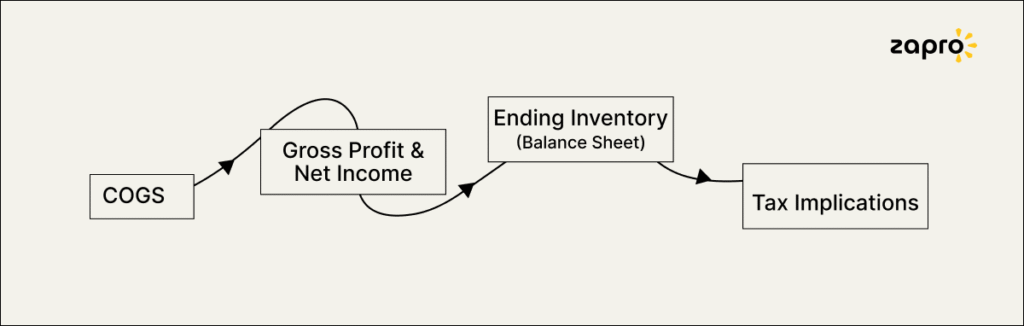
1. Cost of Goods Sold (COGS)
FIFO provides lower COGS in times of inflation, which leads to higher profits.
LIFO leads to higher COGS in inflation, which reduces taxable income.
Weighted-Average provides COGS in the middle range, which results in stable and smooth outcomes.
2. Gross Profit & Net Income
FIFO results in higher profits because of inflation.
LIFO creates reduced profits which provides tax advantages.
Weighted-Average: Balanced profits, less volatile
3. Ending Inventory Value (Balance Sheet)
FIFO: Higher asset value
LIFO: Lower asset value
Weighted-Average: Average asset value
Weighted-Average: Neutral impact, often IFRS-friendly
4. Tax Implications
FIFO May increase tax burden during inflation
LIFO Offers tax shield but is banned under IFRS
Weighted-Average Neutral impact, often IFRS-friendly
Trend Insight: The increasing adoption of IFRS worldwide leads companies to abandon LIFO in favor of FIFO and Weighted-Average for transparent financial reporting and cross-border comparison.
How Zapro.ai Supports Flexible Inventory Valuation & Reporting
Inventory management presents itself as a complex process. The situation becomes worse when businesses handle inventory using outdated systems or manual processes. That’s where Zapro.ai comes in.
With Zapro.ai, businesses can:
Use multiple valuation methods (FIFO, LIFO, Weighted-Average)
Sync inventory costing with general ledger
Generate customizable reports for accurate financial analysis
Ensure audit-ready records and compliance documentation
Case Study: Improved Financial Accuracy with Zapro.ai
Company: AlphaTech Manufacturing
Problem Statement: The company faced recurring cost fluctuations, which resulted in irregular gross margin figures and longer monthly closing processes.
Solution: The company adopted Zapro.ai for finished goods using FIFO and Weighted-Average for raw materials.
Results:
35% improvement in financial reporting accuracy
50% reduction in audit preparation time
Real-time COGS reporting led to better margin decisions
User-friendly dashboards for finance and ops teams
Calculating the ROI of Optimized Inventory Valuation with Zapro.ai
An advanced platform change to Zapro.ai brings actual business benefits to the table:
Better tax planning from accurate cost tracking
More trustworthy financial statements
Faster close cycles and audits
Improved investor confidence
Try the ROI calculator:Zapro.ai ROI Tool
Why Zapro.ai is Your Partner for Precise Inventory Financials
Zapro.ai functions as a financial partner beyond its basic inventory management features. It ensures:
You meet both GAAP and IFRS requirements
You always know the real cost of your stock
Your reporting aligns with strategic and tax goals
Your teams make data-backed decisions
Get in touch with us today!
Final Thoughts:
The selection of inventory valuation methods represents a strategic choice rather than a routine accounting procedure. The selection of proper valuation methods, alongside suitable management tools, remains essential for organizations seeking tax efficiency and financial transparency alongside audit simplicity.
Through Zapro.ai, businesses acquire the adaptability, regulatory compliance, and analytical capabilities needed to convert inventory expenses into competitive business advantages.
1. What is the difference between perpetual and periodic inventory systems?
The perpetual system maintains continuous monitoring of inventory quantities following all purchase and sale transactions. The periodic system conducts physical counts at established periods to update inventory balances and calculate COGS.
2. How do inventory write-downs affect financials?
When inventory market prices drop below purchase costs, a write-down occurs. A decrease in inventory value on the balance sheet occurs through this method while also reducing net income by recording it as an expense on the income statement.
3. Can a company change its inventory valuation method?
A company maintains the power to shift its inventory valuation approach, yet such modifications need thorough evaluation. The method change requires justification along with consistent application throughout all operations. Financial statements require disclosure of the change, and the company might need to revise its past financial reports when necessary.
4. How does inflation impact inventory valuation?
During times of inflation, FIFO produces higher net income while increasing tax obligations but LIFO produces lower net income together with reduced tax liabilities. The Weighted-Average method provides a middle-ground impact.
5. What are the tax implications of FIFO vs. LIFO?
Rising cost environments produce higher COGS and reduced taxable income from LIFO, which leads to lower tax obligations. FIFO leads to elevated taxable income, which increases tax liabilities, but FIFO does not.
6. How does inventory shrinkage affect valuation?
The physical inventory level decreases when organizations experience inventory shrinkage due to damage, theft, and errors. Under periodic systems, COGS calculations automatically include shrinkage because they use beginning and ending inventory amounts. Under a perpetual system, the business reports shrinkage separately through a loss expense.
Supply Chain Disruptions: Causes, Early Signals & Inventory Strategies That Work
Supply chain disruptions are unplanned events — supplier failure, geopolitical conflict, natural disaster, port congestion, demand shocks, or cyber incidents — that interrupt the flow of goods into a business. The core defences are inventory buffers on critical items, dual-sourcing and qualified backup suppliers, real-time inventory and supplier visibility, and supplier risk monitoring that flags exposure before the disruption lands.
TL;DR / Key Takeaways:
Supply chain disruptions come from six recurring sources: supplier financial failure, geopolitical and trade events, natural disasters, logistics and port congestion, demand shocks, and cyber incidents.
You cannot prevent disruption; you can compress the time between disruption and response. That response time is the real resilience metric.
Buffer stock is expensive — apply it selectively to critical, long-lead, single-source items, not across the whole catalog.
Dual-sourcing works only if the backup supplier is already qualified. Qualifying a supplier mid-crisis is too slow.
Geographic concentration hides in plain sight: two ‘different’ suppliers in the same region are one disruption event.
Real-time inventory visibility across locations is what makes redeployment possible instead of emergency reordering.
Continuous supplier risk monitoring (financial health, geography, concentration) turns disruption management from reactive to pre-emptive.
What are supply chain disruptions?
Supply chain disruptions are unexpected events that interrupt the normal flow of goods, information, or finances across the supply chain. These disruptions can have a cascading effect on everything from raw material sourcing to inventory availability, often resulting in delays, increased costs, or lost revenue.
While disruptions have always existed, their frequency and intensity have grown in recent years due to global interconnectedness and rising complexity in supply networks.
Types of supply chain disruptions and their causes
Let’s break down the most common types of disruptions and their underlying causes:
1. Natural disasters
Events like earthquakes, floods, wildfires, and hurricanes can shut down factories, damage infrastructure, or delay transportation routes. These are often sudden and region-specific, yet their impact can ripple globally, especially if critical suppliers are involved.
Root cause: Climate change, geographic concentration of suppliers, lack of backup logistics routes.
2. Geopolitical events
Trade wars, export restrictions, political unrest, and armed conflicts can restrict the movement of goods or raw materials.
The ongoing Russia–Ukraine conflict, for example, triggered widespread shortages in food and metals, exposing over-dependence on certain regions.
Root cause: Overreliance on politically unstable regions, limited supplier diversity.
3. Economic crises
Events such as inflation spikes, currency devaluations, and financial market crashes can disrupt the affordability or accessibility of raw materials, transportation, or credit. For example, surging fuel prices or interest rate hikes can squeeze supply chain budgets.
Root cause: Economic interdependence, limited working capital buffers.
4. Cyberattacks
As supply chains become more digitized, they also become vulnerable to cyber threats. Attacks targeting ERP systems, transportation networks, or supplier portals can halt operations and compromise sensitive data.
Root cause: Weak cybersecurity frameworks, third-party vulnerabilities, lack of IT redundancy.
5. Demand surges or collapses
Sudden spikes in consumer demand (as seen during the COVID-19 pandemic) or steep drops (due to recession fears) can catch supply chains off guard. Both extremes often lead to stock imbalances either stockouts or overstock.
Even if suppliers and manufacturers are operating smoothly, transportation delays can still disrupt delivery timelines. Port congestion, container shortages, driver strikes, or customs delays can all grind inventory movement to a halt.
Root causes: Lean logistics models, lack of redundancy in transport routes, underinvestment in visibility tools.
It does not matter if it is triggered by nature, politics, economics, or technology, disruptions are no longer rare exceptions, but they’re becoming the new norm. And for inventory management teams, the result is often stockouts, overstocks, or excessive buffer stock. That’s why the next step isn’t just reacting faster, but building systems resilient enough to absorb the shock.
How disruptions directly impact inventory management
When a disruption hits, inventory is often where the pain shows up first—and most visibly. Whether it’s empty shelves or bloated warehouses, these symptoms can quickly escalate into operational and financial challenges.
According to the 2023 BCI Supply Chain Resilience Report, 73% of organizations experienced at least one supply chain disruption in the past 12 months, with inventory-related issues ranking among the top consequences.
It’s imperative for us to understand that these aren’t isolated issues, they’re interconnected. A single stockout might lead to lost sales, while an overcorrection can flood your warehouse with inventory you can’t move.
Let’s break down these consequences further.
1. Stockouts and backorders
One of the most immediate effects of supply disruption is the inability to fulfill customer orders. When key components or finished goods are delayed or unavailable, companies face stockouts. This situation often leads to missed sales, customer dissatisfaction, and potential churn.
Why it happens: Delayed supplier shipments, production halts, or blocked transport routes.
2. Excess and obsolete inventory
Disruptions often trigger panic buying or overcompensation further up the supply chain. This leads to the bullwhip effect—small demand changes causing large supply swings. When demand suddenly drops or stabilizes, businesses are left with excess stock that may become obsolete.
Why it matters: Obsolete inventory ties up working capital and requires markdowns to move.
3. Increased holding costs
Holding more safety stock to hedge against uncertainty might help avoid stockouts, but it comes at a price. Storage, insurance, depreciation, and even shrinkage costs all rise with bloated inventories, especially if warehouses aren’t optimized for overflow.
Why it matters: These hidden costs often erode profit margins and strain budgets.
4. Extended lead times and variability
Disruptions make lead times unpredictable. Whether it’s a supplier delay, customs bottleneck, or capacity constraint at a port, these delays create variability in when—and if, inventory arrives. This complicates production planning and customer commitments.
Why it matters: Inconsistent lead times force teams to build buffers, which then leads to excess.
5. Reduced inventory visibility
In many disruptions, it’s not just the movement of goods that gets disrupted, but the flow of information. When systems across suppliers, carriers, and warehouses don’t sync in real-time, visibility into current inventory positions and transit statuses becomes patchy.
Why it matters: Without accurate visibility, decision-making slows down and risks compound.
6. Erosion of forecast accuracy
Most traditional forecasting models rely heavily on historical trends and stable patterns. Disruptions, especially prolonged ones, break those patterns, rendering past data less relevant.
As a result, forecasts become less reliable, leading to overproduction or under-ordering.
Why it matters: Poor forecasts ripple across procurement, production, and fulfillment.
Strategies for building inventory resilience post-disruption
Supply chain disruptions aren’t just a matter of if, they’re a matter of when. That’s why the most successful organizations have shifted focus from reaction to readiness. Inventory resilience isn’t about stockpiling blindly. It’s about creating systems that are flexible, responsive, and intelligent.
As Thomas Group, a renowned supply chain strategist, puts it:“The era of lean inventory at all costs is over. Resilience now demands smart inventory strategies that balance efficiency with the ability to pivot rapidly in the face of disruption.”
So what does smart resilience actually look like in practice?
1. Increase supply chain visibility
You can’t respond to what you can’t see. End-to-end supply chain visibility means having real-time data on inventory positions, supplier statuses, and shipment progress—from source to shelf.
Why it matters: When disruptions occur, fast and informed decisions depend on clear, up-to-date visibility.
How to get there: Use inventory management software with real-time dashboards, IoT integrations, and supplier collaboration features.
2. Diversify suppliers and geographies
Relying on a single supplier—or a single region—can create massive bottlenecks when disruption hits. Diversifying your supplier base across multiple geographies spreads your risk.
Why it matters: If one supplier is offline, you still have options.
How to get there: Build relationships with alternative vendors, implement dual or multi-sourcing strategies, and evaluate supplier performance metrics regularly.
3. Strategic safety stock and buffer inventory
While lean principles discouraged carrying extra inventory, today’s environment calls for calculated buffers, especially for critical SKUs. But it’s not about guessing.
Why it matters: The right buffer helps absorb shocks without bloating storage costs.
How to get there: Use demand variability and lead time analysis to set optimal safety stock levels. Update regularly using dynamic inventory optimization tools.
4. Regionalization and nearshoring
Long, global supply lines introduce too many points of failure. Shifting parts of your supply chain closer to demand centers (regionalization) or domestic locations (nearshoring) can drastically reduce lead time risks.
Why it matters: Shorter, local supply chains are more agile and easier to control during disruptions.
How to get there: Identify which SKUs or product lines are candidates for regional sourcing. Evaluate trade-offs between cost, speed, and resilience.
5. Dynamic inventory optimization
Traditional planning uses static rules, but demand and supply conditions change constantly. A dynamic approach adapts inventory levels in real-time based on demand shifts, supplier reliability, and external signals.
Why it matters: It prevents both stockouts and excess, even when market conditions change rapidly.
How to get there: Leverage AI-driven forecasting and demand sensing to adjust inventory levels proactively.
6. Scenario planning and stress testing
Planning for disruption means asking, what if? Scenario modeling allows teams to simulate various disruption events—like a port shutdown or a 30% demand spike—and see how inventory will respond.
Why it matters: You can identify weak points before they break and build contingency plans in advance.
How to get there: Use digital twins, simulation models, or inventory risk assessment tools to stress test your systems regularly.
The role of technology in mitigating inventory disruptions
Inventory resilience isn’t just about smarter planning, it’s about smarter systems. The disruptions of recent years have made one thing clear: manual methods and siloed spreadsheets can’t keep up with today’s volatile supply chains.
See, modern technology doesn’t just improve efficiency.
It provides the predictive, real-time, and cross-functional capabilities needed to anticipate, absorb, and adapt to disruptions, before they spiral into inventory crises.
Here are five key technologies powering this shift:
1. AI and machine learning for predictive analytics
AI and ML algorithms analyze vast volumes of structured and unstructured data—from weather patterns to social signals—to spot early signs of potential disruption. These models also adapt forecasts dynamically as new data comes in.
How it helps:
Detect risks early (e.g., supplier delays, demand anomalies)
Improve forecast accuracy during demand volatility
Enable real-time decision-making for reordering and replenishment
📈 Trend watch: Predictive analytics is now central to resilient procurement software—with top platforms embedding AI into everything from demand sensing to safety stock optimization.
2. IoT and RFID for real-time tracking
IoT devices and RFID tags provide real-time visibility into inventory location, condition, and movement across the supply chain. From pallets in transit to bin-level counts in warehouses, every unit can now be tracked and monitored.
How it helps:
Monitor goods in motion (e.g., temperature, humidity, tampering)
Reduce lost or misplaced inventory
Trigger automated alerts for delays or anomalies
Bonus: RFID-based systems dramatically reduce the need for manual cycle counts, speeding up audits and improving accuracy.
3. Supply chain control tower solutions
Control towers act as a digital nerve center, integrating data from across your supply chain control tower to provide a single source of truth. These platforms use advanced analytics and visualization to detect disruptions and coordinate cross-functional responses.
How it helps:
Centralized view of inventory, suppliers, and logistics
Scenario modeling to assess mitigation options
Faster coordination across procurement, operations, and finance
Key trend: The rise of AI-powered control towers is reshaping how organizations orchestrate inventory decisions during disruptions.
4. Digital twins for disruption simulation
A digital twin is a virtual replica of your supply chain—including warehouses, supplier routes, and inventory flows. It allows teams to simulate “what if” scenarios (like a port shutdown or supplier outage) and test responses before making real-world decisions.
How it helps:
Run stress tests on inventory systems
Evaluate the impact of various disruption scenarios
Optimize contingency plans proactively
Tip: Digital twins work best when fed with real-time IoT and ERP data—creating a constantly evolving model of your supply network.
5. Blockchain for traceability and trust
Blockchain provides a decentralized, tamper-proof ledger that tracks every transaction across the supply chain, from raw materials to final delivery. It’s especially powerful for industries where provenance, compliance, or authenticity matters.
How it helps:
Improve transparency and trust with suppliers
Enable end-to-end traceability for regulated goods
Reduce disputes and delays tied to documentation gaps
Example: In the food and pharma sectors, blockchain has cut recall times from days to minutes, thanks to instant traceability.
How Zapro.ai builds inventory resilience in disruptive times
Disruption is unpredictable, but your response doesn’t have to be. Zapro.ai is designed to help businesses stay in control of their inventory, even when the supply chain gets rocky. With intelligent automation and real-time visibility, Zapro turns scattered inventory operations into a connected, responsive system.
Cross-functional visibility and collaboration
Zapro connects procurement, finance, and operations on a single platform. Everyone sees the same data, enabling faster, more coordinated decisions when disruptions hit.
Advanced forecasting with built-in disruption awareness
Zapro’s AI-driven forecasting adapts to real-world volatility. It goes beyond historical data, factoring in live signals like supplier delays or demand surges. That means you can shift plans faster when things change.
Real-time inventory visibility across locations
With Zapro, every piece of inventory—no matter the location—is visible in one real-time view. No more chasing spreadsheets or waiting for manual updates. You get full clarity on stock levels, movements, and bottlenecks.
Multi-location inventory management
Managing distributed inventory gets simpler. Zapro lets you control stock across Multi-Location Inventory Management, balance supply, and transfer items intelligently based on demand patterns and lead times.
Supplier performance tracking and risk alerts
Zapro monitors how well your suppliers performing tracking, tracking delivery times, quality, and consistency. If a vendor starts slipping, you’ll know before it affects your inventory.
Automated reorder triggers and safety stock insights
Zapro dynamically adjusts reorder points and safety stock levels using real-time data. It considers changing lead times, seasonal trends, and disruptions so you don’t have to.
Zapro’s features for adaptive inventory management
When the unexpected strikes, static systems fail. But, Zapro.ai is built to adapt.
We have meticulously built Zapro’s features for a world where demand shifts fast, suppliers can fall short, and visibility is non-negotiable.
Dynamic safety stock calculations Zapro adjusts your Dynamic Safety Stock Calculations based on real-time demand, supplier lead times, and risk levels. It ensures you’re holding just enough buffer—no more, no less—even when things are in flux.
Demand sensing that reacts in real time Forget forecasts that age overnight. Zapro uses live sales, weather, and market data to sense demand shifts as they happen. That means quicker adjustments to your stock strategy.
Risk alerts tied to supplier performance If a key supplier starts missing delivery windows or showing quality issues, Zapro flags it instantly. You get notified before a minor slip becomes a major disruption.
Scenario modeling & impact analysis Zapro’s reporting tools let you test “what if scenario planning and impact analysis—like losing a supplier or seeing a regional demand spike. It helps you prepare with data-driven answers, not guesswork.
Multi-tier inventory planning Whether you’re managing stock at one site or across global hubs, Zapro helps you balance and rebalance inventory by region, priority, and criticality—automatically.
Unified reporting for smart decisions Track KPIs, disruption response times, fulfillment rates, and more. Zapro makes it easy to report, act, and improve, all from one platform.
Case study: How Zolo maintained 98% inventory availability during disruption with Zapro.ai
When shipping lanes slowed during a Southeast Asia port closure, fast-growing electronics retailer Zolo faced critical delays in sourcing key components. Lead times jumped 40%, and regional warehouses began flagging shortages.
Using Zapro.ai, Zolo quickly recalibrated its inventory strategy:
Dynamic safety stock buffers were automatically raised for high-demand SKUs.
Supplier performance alerts helped Zolo preemptively shift orders to secondary vendors with better fill rates.
Multi-location visibility enabled smart stock transfers across regions to plug local gaps.
With real-time demand sensing, Zolo prioritized inventory allocation to high-velocity sales channels.
The result?
Despite weeks of upstream chaos, Zolo maintained 98% inventory availability on its top-selling items, with minimal backorders and zero emergency air shipments.
Calculating the ROI of inventory resilience with Zapro.ai
Building resilience isn’t just smart—it pays off. Zapro.ai turns supply chain stability into measurable financial returns by helping you avoid:
Stockouts that result in missed revenue and frustrated customers
Expedited shipping costs triggered by last-minute inventory shortages
Overordering that leads to excess holding costs
Reputational damage from failing to fulfill critical orders
Operational chaos caused by blind spots in supplier performance
Let’s break it down:
Cost Factor
Without Zapro
With Zapro
Lost sales due to stockouts
$250K/yr
$20K/yr
Emergency freight costs
$90K/yr
$15K/yr
Inventory carrying costs
$120K/yr
$80K/yr
Team hours spent firefighting
500+ hrs
100 hrs
According to GEP, every $1 invested in resilience yields $2–$4 in avoided costs. With Zapro.ai’s intelligent inventory controls and supplier insights, the returns multiply.
Use our ROI Calculator to see your personalized savings potential.
Why Zapro.ai is your partner for future-proof inventory management
Zapro.ai isn’t just another procurement tool. It’s your control tower for building adaptive, disruption-proof supply chains, by managing vendor relationships and inventory side by side.
Here’s what sets Zapro apart:
Vendor CRM meets Inventory Intelligence
While most tools focus only on transactions, Zapro helps you build and maintain strong vendor relationships management—just like Salesforce does for customers. It captures every email, call, and note to give full visibility into both collaboration and performance.
From chaos to clarity
Most businesses juggle 15+ tools to handle procurement, risk, communication, and onboarding. Zapro consolidates it all into one seamless platform—reducing complexity, saving time, and giving teams instant context even when staff changes.
Procurement++
Zapro extends beyond procurement. It helps you:
Forecast smarter with real-time demand sensing
Detect supplier risk early and act fast
Maintain optimal inventory across locations
Streamline vendor onboarding and compliance
Cut operational costs by over 30%
The bottom line
With Zapro, you get more than inventory visibility, you get confidence. Confidence that your supply chain can withstand shocks. Confidence that your vendors will deliver. And confidence that your teams won’t waste time chasing down answers.
Ready to build disruption-proof inventory operations?
Supply chain volatility isn’t going away; but with Zapro.ai, you won’t just survive it. You’ll get ahead of it.
From intelligent forecasting to vendor collaboration and risk monitoring, Zapro empowers you to take control of your inventory and stay resilient, no matter what hits the market.
See Zapro.ai in action.
Book a personalized demo and discover how resilient your inventory can really be. Schedule a Demo →
Improve your supplier relationship in just a click!
1. What is the bullwhip effect in inventory management?
The bullwhip effect refers to how small changes in consumer demand can cause increasingly larger fluctuations in inventory and orders up the supply chain. This amplification can lead to overstocking or stockouts, especially during disruptions. Technology-driven forecasting and real-time data sharing can help dampen these swings and improve supply chain stability.
Fluctuating inventory supply chain issues local demand meaning (often characterized by the bullwhip effect)
2. How does demand sensing help during supply chain disruptions?
Demand sensing uses AI and real-time data to detect short-term demand shifts more accurately than traditional forecasting. During disruptions, it helps businesses quickly adjust inventory levels, production schedules, and replenishment plans—minimizing excess stock or shortages.
3. What is dual sourcing, and how does it improve resilience?
Dual sourcing means procuring the same item from two different suppliers. This reduces dependency on a single source and lowers the risk of total supply breakdown if one supplier faces issues. It’s a strategic move to balance cost efficiency with continuity.
4. How can small businesses prepare their inventory for disruptions?
Small businesses can build resilience by:
Identifying critical SKUs and setting strategic safety stock
Using affordable inventory management software
Partnering with reliable, diversified suppliers
Keeping communication transparent across the supply chain Even simple steps like digital reorder alerts can offer significant protection.
5. What role does collaboration play in supply chain resilience?
Collaboration enables better visibility, quicker response times, and shared risk management. When suppliers, logistics partners, and buyers exchange real-time data and align contingency plans, the whole network becomes more agile and prepared to navigate disruptions.
6. How does lead time variability impact safety stock?
Greater variability in lead times means more uncertainty in replenishment, which typically requires holding higher safety stock to avoid stockouts. By tracking supplier performance and using predictive vendor management tools, businesses can minimize lead time unpredictability and optimize their buffer inventory.
The Role of Technology in Modern Inventory Control
Inventory control started with handwritten records and manual counts, suitable for simpler times but highly prone to errors. The arrival of spreadsheets in the 1980s brought more structure but still lacked real-time insights and automation.
As supply chains became more complex, these methods couldn’t keep up. Businesses began adopting systems like IMS and WMS, followed by cloud-based platforms that offered better visibility, scalability, and control.
Today, we’re seeing a shift toward smart, connected technologies that go beyond tracking to optimize every aspect of inventory. But what exactly are these technologies?
Let’s explore the core tools driving modern inventory control.
What are the core technologies driving modern inventory control?
Modern inventory control is powered by a suite of advanced technologies that work together to improve visibility, speed, and accuracy.
Here’s a breakdown of the key tools transforming how businesses manage stock:
Inventory Management Software (IMS/WMS): These platforms serve as the digital backbone of inventory operations—centralizing data, enabling real-time tracking, and streamlining order and stock movements.
Automation (Robotics & AS/RS): Robotic systems and automated storage solutions reduce manual effort, speed up picking and packing, and improve accuracy in high-volume environments. IoT & RFID: Internet-connected sensors and RFID tags provide real-time updates on inventory location, temperature, and handling conditions—critical for industries like pharma and food.
AI & Machine Learning: AI algorithms enable predictive forecasting, detect anomalies, and help optimize stock levels based on demand patterns and historical data.
Data Analytics & Business Intelligence (BI): These tools turn raw data into actionable insights—revealing trends, inefficiencies, and opportunities for optimization across the supply chain.
Cloud Computing: Cloud-based systems offer scalability, remote access, and lower infrastructure costs, making them ideal for growing and distributed businesses.
According to a recent survey by MHI, 89% of supply chain professionals plan to invest in robotics and automation within the next five years, signaling how central these technologies are becoming.
Next up, we’ll look at the tangible benefits companies like yours can unlock by actually adopting these technologies.
Benefits of technology-driven inventory control
Adopting modern inventory technology brings more than just convenience—it delivers measurable business value. Here are the key advantages companies gain:
Optimized stock levels: Intelligent forecasting helps prevent overstocking and stockouts, ensuring better cash flow and customer satisfaction. Improved accuracy: Automation and real-time tracking significantly reduce human error and inventory discrepancies.
Enhanced efficiency: Automated workflows speed up routine tasks like picking, packing, and restocking, freeing up time for higher-value work.
Reduced costs: Lower holding costs, less waste, and reduced manual labor translate into major savings over time.
Greater visibility: Cloud-based platforms and IoT sensors provide a clear, real-time view of inventory across locations.
Increased agility and resilience: With predictive insights and real-time data, businesses can adapt faster to supply chain disruptions and shifting demand.
Next, let’s look at the challenges businesses face when implementing these technologies and how to overcome them.
Challenges in implementing inventory technology
While the benefits of inventory technology are clear, implementation isn’t always smooth. Many organizations face roadblocks that can slow or complicate adoption:
High upfront investment: Advanced systems and automation tools often require significant capital outlay, especially for smaller businesses.
Integration complexities: Aligning new systems with existing ERP, CRM, or legacy tools can lead to delays and technical challenges.
Resistance to change: Employees accustomed to manual processes may be hesitant to embrace new workflows or tools, requiring change management.
Talent gaps: Managing and maintaining tech-driven systems often calls for specialized skills that may be lacking internally.
Cybersecurity concerns: As inventory systems become more connected, they also become more vulnerable to cyber threats if not properly secured.
Despite these challenges, businesses that plan carefully and invest in the right partners can overcome barriers and build more robust inventory operations.
Future trends in inventory technology (2025 and beyond)
Inventory control is evolving fast, thanks to ongoing digital transformation. It’s no longer just about tracking stock—technology is now enabling faster, smarter, and more proactive inventory decisions.
So we searched across the internet and have listed five key trends shaping the future:
1. Digital twins
These are virtual models of physical warehouses that help simulate layouts, test process changes, and optimize operations without disrupting daily activities.
2. Hyper-automation
By combining AI, robotics, and RPA, companies are automating entire workflows—reducing manual tasks, speeding up operations, and minimizing errors.
3. Drone-based inventory counting
Drones equipped with scanners and cameras are making inventory checks faster and less labor-intensive, especially in large or high-rack warehouses.
4. Blockchain for traceability
Blockchain enables secure and transparent tracking of products across the supply chain, improving authenticity, compliance, and accountability.
5. Prescriptive analytics
These tools don’t just forecast demand—they recommend actions in real time, such as adjusting reorder points or redistributing stock to prevent shortages or overstocking.
Smart warehouses powered by IoT, AI, and real-time analytics are no longer a future concept. They’re quickly becoming the new normal.
Next, let’s look at how Zapro.ai helps businesses tap into these innovations today.
How Zapro.ai leverages technology for superior inventory control
Zapro.ai combines the latest in automation, intelligence, and user-centric design to help businesses modernize their inventory processes without complexity.
Here’s how Zapro brings innovation to life:
Real-time tracking: Gain complete visibility into inventory movement across locations, with instant updates on quantities, orders, and SKUs.
Predictive forecasting: AI-driven demand planning helps reduce stockouts, overstocking, and emergency orders—improving efficiency and customer satisfaction.
Automation-ready workflows: Zapro enables rule-based automation for reordering, replenishment, and stock transfers, reducing manual effort and response times.
Data-backed decision-making: Built-in analytics dashboards offer insights into performance, trends, and inefficiencies—so teams can act faster and smarter.
Whether you’re managing a single warehouse or a global supply chain, Zapro empowers teams with the tools they need to stay agile, accurate, and cost-efficient.
Case study: Zolo cuts 28% in inventory overhead using Zapro.ai
Company: Zolo Industry: Consumer Electronics Distribution Challenge: Zolo faced ongoing issues with stock imbalances across its regional warehouses—resulting in overstocking in some locations, frequent stockouts in others, and rising holding costs.
Solution: Zolo implemented Zapro.ai’s inventory control suite, activating real-time visibility, AI-driven demand forecasting, and automated replenishment rules across all five distribution centers.
Impact:
28% reduction in overall inventory overhead
40% boost in order fulfillment accuracy
Stockouts dropped by 65% in just three months
Improved team coordination with centralized, real-time inventory data
Result: With Zapro.ai, Zolo transformed its inventory operations from reactive to predictive. Zapro enabled Zolo to boost efficiency, cut down on wasteful expenditure, and enabled faster, smarter decision-making.
Calculating the ROI of investing in inventory technology with Zapro.ai
Investing in inventory technology isn’t just about modernization but about unlocking operational and financial gains.
Feature
Zapro.ai
Legacy Tools
Unified buying & selling portal
✅ Yes
❌ Buyer-side only
Embedded Amazon Business integration
✅ Deep native access
⚠ Limited PunchOut support
Full AP + AR automation
✅ End-to-end
❌ Needs 3rd party tools
Supplier collaboration
✅ Multi-customer portal
⚠ Basic or siloed
Setup speed & ease of use
✅ Consumer-grade UI
❌ Lengthy, complex deployments
Built-in AI/ML across workflows
✅ Everywhere
⚠ Limited to analytics
Here’s where businesses typically see returns with Zapro:
Reduced carrying costs: Smarter stock levels reduce the capital tied up in unsold inventory.
Minimized stockouts: Better forecasting leads to fewer lost sales and happier customers.
Lower labor expenses: Automation reduces manual processes, freeing up teams for high-impact work.
Improved fulfillment rates: Real-time data helps avoid delays and errors in order processing.
Scalable savings: Cloud-based deployment and modular tools mean you pay only for what you need.
Want to estimate your potential ROI?
Use the Zapro ROI Calculator to see what better inventory control could save you.
Next up: A quick checklist to help you evaluate the right inventory tech partner.
How to Choose the right inventory technology solution?
Before investing in inventory software, here’s a checklist of what to evaluate:
Feature depth: Does it support real-time tracking, forecasting, and automation?
Ease of integration: Can it work with your ERP, accounting, or procurement systems?
Scalability: Will it grow with your business and adapt to multiple warehouses or locations?
User experience: Is the interface intuitive for both warehouse staff and leadership?
Security & compliance: Does it offer strong data protection, especially for cloud deployments?
Support & onboarding: Are implementation and training resources available?
Evaluating vendors against these criteria ensures you’re choosing a future-proof solution not just a short-term fix.
Why Zapro.ai is the future-ready choice for inventory control
Zapro.ai isn’t just another inventory tool—it’s a modern, AI-native platform built to solve the shortcomings of traditional systems.
From unified workflows to intelligent automation, Zapro reimagines inventory management as a connected, intuitive, and insight-driven experience.
Here’s how Zapro stacks up against legacy tools:
What makes Zapro different?
Unified, not fragmented: One platform for buying, selling, tracking, and collaborating.
End-to-end automation: From order to reconciliation, no third-party patchwork needed.
Built-in intelligence: AI/ML is embedded across workflows, not an afterthought.
Quick to adopt: Consumer-grade UI means teams can get started in days, not months.
With Zapro.ai, inventory control isn’t just digitized, it’s transformed into a proactive, value-generating engine.
Ready to take control of your inventory?
Whether you’re looking to eliminate stockouts, automate your workflows, or gain real-time visibility across locations—Zapro.ai gives you the technology edge you need.
1. How does AI specifically help with inventory forecasting?
AI improves forecasting accuracy by analyzing historical sales, seasonality, market trends, and real-time demand signals. Instead of relying on static reorder points, AI models dynamically adjust predictions, helping businesses prevent overstocking or stockouts.
2. What is the difference between WMS and IMS?
A Warehouse Management System (WMS) focuses on optimizing warehouse operations, like picking, packing, and space utilization. An Inventory Management System (IMS) tracks inventory levels, locations, and movement across warehouses, retail, or supply chain nodes. They often work together but serve different scopes.
3. Can RFID technology replace manual inventory counts entirely?
In many environments, yes. RFID can automate real-time tracking and reduce human error, but full replacement depends on infrastructure, cost, and item type. Some manual checks may still be needed for damaged goods or exceptions.
4. How does cloud computing impact inventory management accessibility?
Cloud-based systems allow inventory data to be accessed anytime, from any device, supporting remote teams, multi-location visibility, and real-time decision-making. It also enables easier integration with other tools like ERP or e-commerce platforms.
5. What are the cybersecurity risks in connected inventory systems?
Risks include unauthorized access, data breaches, and ransomware. Securing APIs, enforcing user-level permissions, and choosing vendors with robust encryption and compliance protocols are key to mitigating these threats.
6. How can small businesses afford advanced inventory technology?
Modern solutions like Zapro.ai offer scalable pricing, cloud-based access (no heavy infrastructure), and modular features, making it accessible for small and growing businesses. The ROI from reduced losses and improved efficiency often offsets the upfront investment.
 Vendor Management
 End-to-End-Procurement
 Strategic Sourcing
 Spend Analytics
 AP-Automation
 Inventory Management
 ERP-Integration
 Blogs
Blogs Procurement Guide
 Ebooks
 News and Media
 Healthcare
 Financial Services
 Technology
 Venture Capitalist
 About Us
 Vendor Management Guide