


The best ProcurementExpress alternatives are 1. Precoro 2. Procurify 3. Zapro 4. ProcureDesk 5. Tradogram 6. Order.co 7. Coupa.
The best ProcurementExpress alternative depends on what PO approvals alone no longer cover. Precoro and ProcureDesk add invoice matching at lower published prices, and Procurify adds supplier payments. Tradogram fits tight budgets, Order.co multi-site supply buying, Zapro sourcing and contracts, and Coupa large enterprises.
ProcurementExpress competitors: key takeaways
 Precoro: Best for ProcurementExpress users who need invoice matching sooner. Precoro includes 2-way and 3-way matching on its $499 Core plan, not a $2,550 tier.
 Procurify: Best for growing mid-sized teams that want budget-aware POs, receiving, invoice matching and supplier payments to 190+ countries from one vendor.
 Zapro: Best for mid-market teams that have outgrown PO approvals and need RFI and RFP sourcing, contracts and invoice matching. Plans start at $699 a month with unlimited users, and your bank or ERP still pays suppliers.
 ProcureDesk: Best for small finance teams and nonprofits that buy from 200+ punch-out catalogs and pay US suppliers. Nonprofits get a 15% discount.
 Tradogram: Best for small teams on a tight budget. Essentials starts at $99 a month plus per-user fees, and RFQs and contracts sit on its Premium plan.
 Order.co: Best for multi-site nonprofits and operators that want one cart across 40,000+ suppliers and one consolidated bill.
 Coupa: Best for large enterprises that need sourcing, contracts, procurement and AP in one suite. Plan for a rollout that takes months.
ProcurementExpress alternatives compared
ProcurementExpress alternatives fall into five groups. Precoro, Procurify and ProcureDesk are P2P tools with invoice matching. Tradogram is low-cost buying with RFQs, Zapro adds sourcing and contracts, Order.co covers multi-site supply buying and Coupa is an enterprise suite. The table compares fit, features, ERP links, price and G2 rating.
| Tool | Best for | Key features | ERP integrations | Starting price | Rating |
|---|---|---|---|---|---|
 ProcurementExpress (for reference) | PO approvals with budget checks | Requests, approvals, remaining budget on each PO, 2 CFR 200 checks; Scan & Match on Best | QuickBooks, Sage 50, Sage 200, Sage Intacct; NetSuite and Dynamics on Enterprise | Basic $415/mo for up to $10K managed spend a month | G2 4.7 (61) |
| Precoro | PO approvals plus AP | Requests, POs, 2-way and 3-way matching on Core; RFPs, punch-out and AI capture on Automation | QuickBooks Online and Xero on Core; NetSuite, Sage Intacct, Dynamics 365 Business Central | Core $499/mo, billed yearly | G2 4.7 (225) |
| Procurify | Mid-sized procure-to-pay | Requests, approvals, POs, receiving; AP add-on with 2-way and 3-way matching; payments to 190+ countries | QuickBooks, NetSuite, Sage Intacct, Dynamics 365 Business Central | Quote by Pro users; Vendr buyer data: median $15,000 a year | G2 4.6 (415) |
| Zapro | Mid-market source-to-pay | Intake, approvals, POs, RFI/RFP sourcing, contracts, 2-way and 3-way matching | NetSuite, QuickBooks, Sage Intacct, SAP, Oracle, Workday, Dynamics | $699 per month, unlimited users | G2 4.7 (14) |
| ProcureDesk | Small teams buying supplies | Requests, POs, 200+ punch-out catalogs, 3-way matching with OCR, domestic bill pay | QuickBooks, Xero, Sage Intacct, NetSuite, Dynamics 365; SAP S/4HANA on Enterprise | $830/mo billed yearly (10 users) | G2 4.4 (51) |
| Tradogram | Low-cost purchasing plus RFQs | POs, TradoCart, TradoPay payments to 150+ countries; RFQ, RFP and contracts on Premium | QuickBooks, Xero, NetSuite, Sage, Dynamics 365 Business Central (paid add-on) | Essentials $99/mo plus per-user fees | G2 4.3 (37) |
| Order.co | Multi-site supplies buying | One cart across 40,000+ suppliers, approvals by location, virtual cards, one consolidated bill | QuickBooks Online, NetSuite, Sage Intacct | Custom quote; no pricing page | G2 4.4 (155) |
| Coupa | Enterprise source-to-pay | Sourcing, contracts, procurement, AI invoice capture, 2-way and 3-way matching, payments through partners | SAP, Oracle, NetSuite, Workday, Microsoft Dynamics | Quote; Vendr buyer data: median $94,519 a year | G2 4.2 (571) |
Find your ProcurementExpress alternative
Choose a ProcurementExpress alternative by matching it to what you need next, your organization type, your ERP and your budget. ProcurementExpress covers purchase requests, approvals, POs and budget checks, and its homepage now speaks to human services organizations. Pick the tab that fits your situation, then check why teams leave below.
What you need next
PrecoroProcureDeskTradogramZaproPrecoroZaproProcurifyProcureDeskTradogramOrganization type
ProcureDeskProcurifyOrder.coPrecoroProcurifyZaproCoupaYour ERP
PrecoroProcurifyProcureDeskProcureDeskPrecoroTradogramCoupaProcureDeskZaproPrecoroProcurifyProcureDeskBudget
TradogramPrecoroZaproProcureDeskProcurifyOrder.coCoupaWhy teams leave ProcurementExpress, and what fixes it
Teams look past ProcurementExpress mainly for price, plan limits and scope. Fees rise with managed spend. Invoice matching starts on a $2,550 plan, NetSuite needs Enterprise, and it has no RFQs or contracts. These reasons come from its own pricing page and homepage, checked on 12 November 2026. Each shows a fix and what to test.
What ProcurementExpress does well: the remaining budget sits on each purchase order, where approvers decide. It runs 2 CFR 200 policy checks and SAM.gov screening on every order. It adds Amazon punch-out from the Better plan. It offers a 14-day free trial with full access.
What ProcurementExpress doesn't cover, and who does
ProcurementExpress covers purchase requests, approvals, POs, budget checks and punch-out buying. Its own pricing page and homepage show four gaps. It has no RFQ events and no contract module. Invoice matching starts on the $2,550 Best plan, and NetSuite or Dynamics sync needs Enterprise. The table shows which alternatives fill each gap.
| If you need | In ProcurementExpress | Alternatives that include it |
|---|---|---|
| RFQs with side-by-side supplier quotes | Plans list requests, approvals, POs, budgets and punch-outs, with no RFQ module | TradogramCoupaZapro |
| Contract management with renewal alerts | Plans list no contract module | PrecoroProcurifyCoupaZapro |
| Invoice matching on an entry plan | Scan & Match from Best ($2,550 a month) | PrecoroProcureDesk |
| NetSuite or Dynamics sync below the top tier | NetSuite and Dynamics on Enterprise only, priced by quote | ProcurifyProcureDeskOrder.coZapro |
The 7 best ProcurementExpress alternatives, reviewed
Each review shows what the tool is built for, its key features, pros, cons, pricing and best-fit buyer. Precoro, Procurify and ProcureDesk cover requests, POs and invoice matching. Tradogram adds low-cost RFQs, Zapro adds sourcing and contracts, Order.co covers multi-site supply buying and Coupa covers enterprise source-to-pay.
Precoro: best for PO approvals plus AP
Best for PO approvals plus AP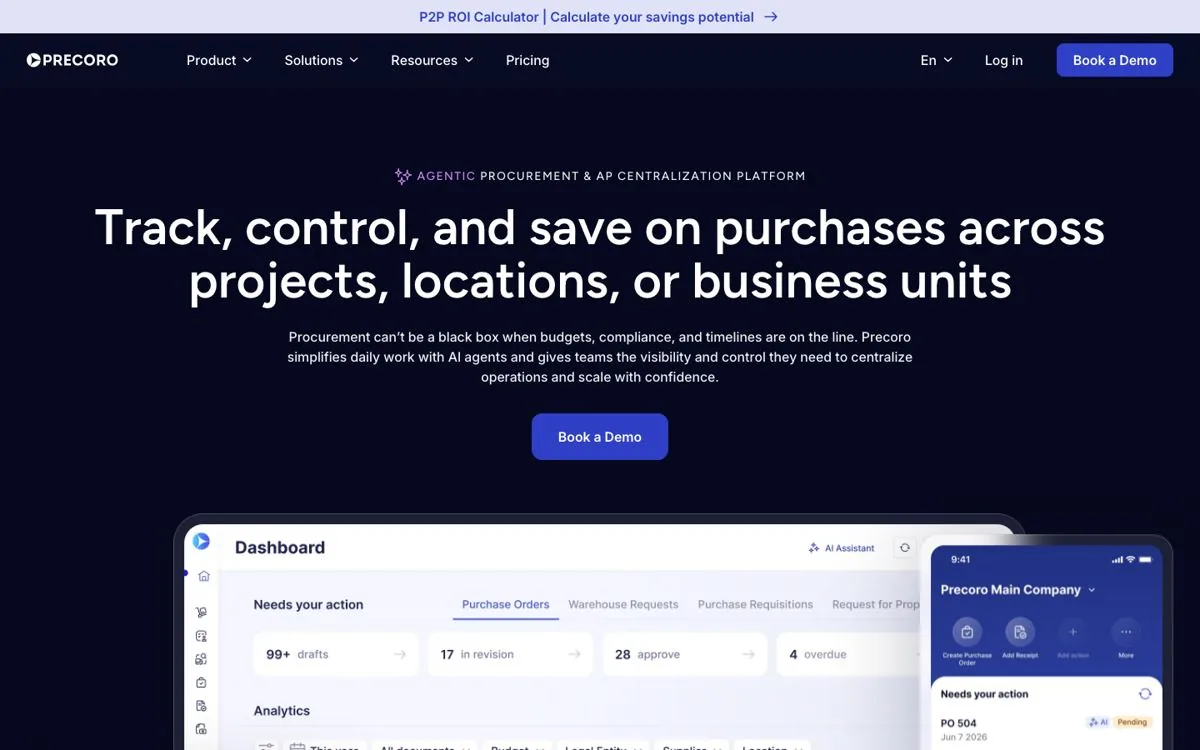
Precoro fits ProcurementExpress users who want the same request-to-PO flow plus invoice matching and payments at a published price. Core starts at $499 a month, billed yearly, and includes 2-way and 3-way matching. Punch-out, AI capture and RFPs start on the $999 Automation plan, and unlimited users come only on Enterprise.
Key features 6 features
- Approval workflows by department, amount or project
- Approvals by email, Slack, Teams or mobile
- 2-way and 3-way matching on every plan
- Budgets by cost center with overspend alerts
- Amazon Business, Staples, Home Depot and Grainger punch-out (Automation plan)
- Payments by ACH, same-day ACH, wire and international transfer
Pros and cons 2 pros, 2 cons
Pros
- Easy exit: no formal contract is required and canceling takes 30 days' notice, which lowers the risk of switching
- Matching on Core: 2-way and 3-way matching come on the $499 plan, while ProcurementExpress keeps Scan & Match for its $2,550 Best plan
Cons
- Plan gating: punch-out, AI capture and RFPs start on the $999 Automation plan, so Amazon buyers pay more than Core
- User limits: unlimited users come only on Enterprise, so ask for the user cap of each tier at your real headcount
Pricing
Core from $499 a month and Automation from $999 a month, billed yearly; Enterprise is custom.
Best for
Mid-sized companies with several sites or entities that want ProcurementExpress-style approvals plus invoice matching and payments at a published price.
Verdict
Verdict: Precoro is a natural step up from ProcurementExpress when invoice matching is the gap. Budget for the Automation plan if Amazon punch-out matters to you.
Procurify: best for mid-sized procure-to-pay
Best for Mid-sized procure-to-pay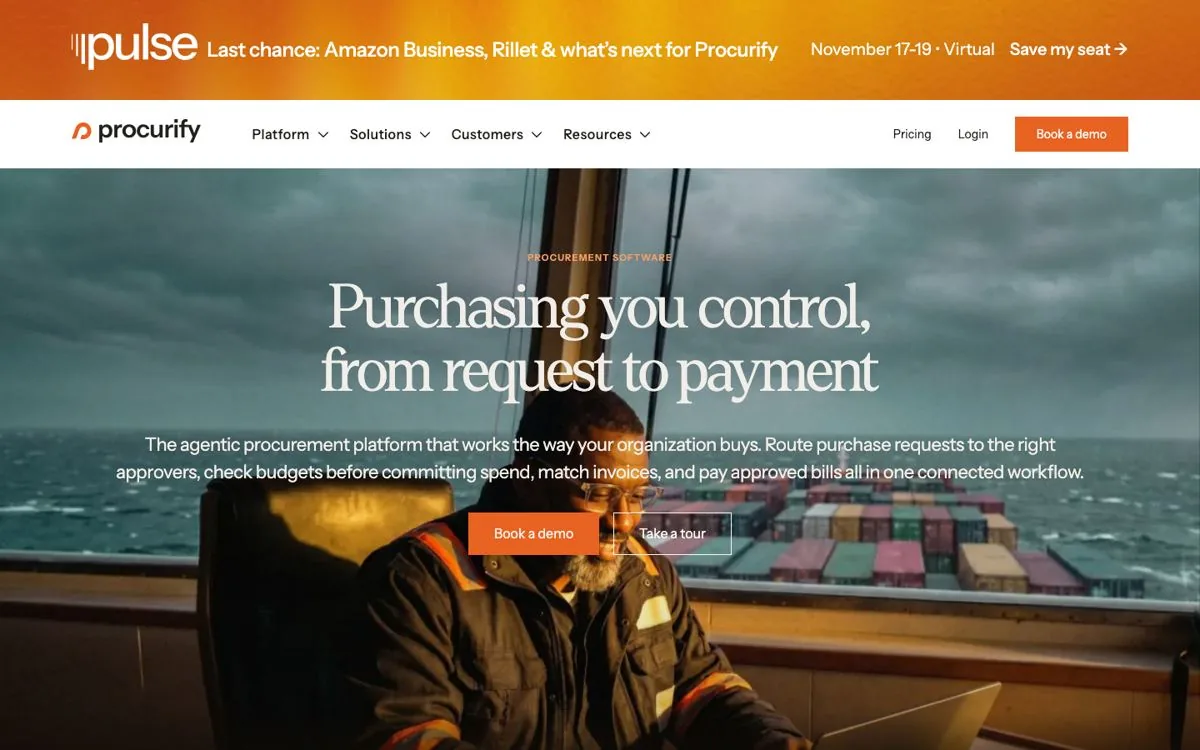
Procurify fits growing mid-sized teams that want budget-aware requests, POs, receiving, invoice matching and supplier payments from one vendor. It shows the remaining budget on each request and pays suppliers in 190+ countries. Every customer starts on the base Purchasing product and adds AP, cards, intake or contracts, each priced by quote.
Key features 4 features
- Approval rules by department, location, account code or amount
- Remaining budget shown on each request
- Automated 2-way and 3-way matching in the AP product
- Punch-outs to Amazon Business, Staples, Home Depot and Grainger
Pros and cons 3 pros, 2 cons
Pros
- Unlimited Basic users: only Pro users drive the quote, so occasional requesters do not add to the cost
- Published rollouts: 4 weeks on Basic, 8 on Standard and 12 for NetSuite, so you can plan the switch with real dates
- Mobile apps: requests, approvals and receiving work on iOS and Android, which helps teams spread across sites
Cons
- Modular quote: AP, cards, Guided Intake and Contracts are priced on top of the base product, so the full set costs more
- No sourcing: its platform page shows no sourcing or RFx events, so teams that run supplier bids need another tool
Pricing
Quote only, built from products, add-ons and Pro users. Vendr buyer data shows a median of $15,000 a year, from $4,210 to $40,000.
Best for
Growing companies with several departments or sites that want budget-aware POs, receiving and supplier payments from one vendor.
Verdict
Verdict: Procurify fits if you want the buying and paying steps in one place. The modular quote makes the full set cost more than the base product.
Zapro: best for mid-market source-to-pay
Best for Mid-market source-to-pay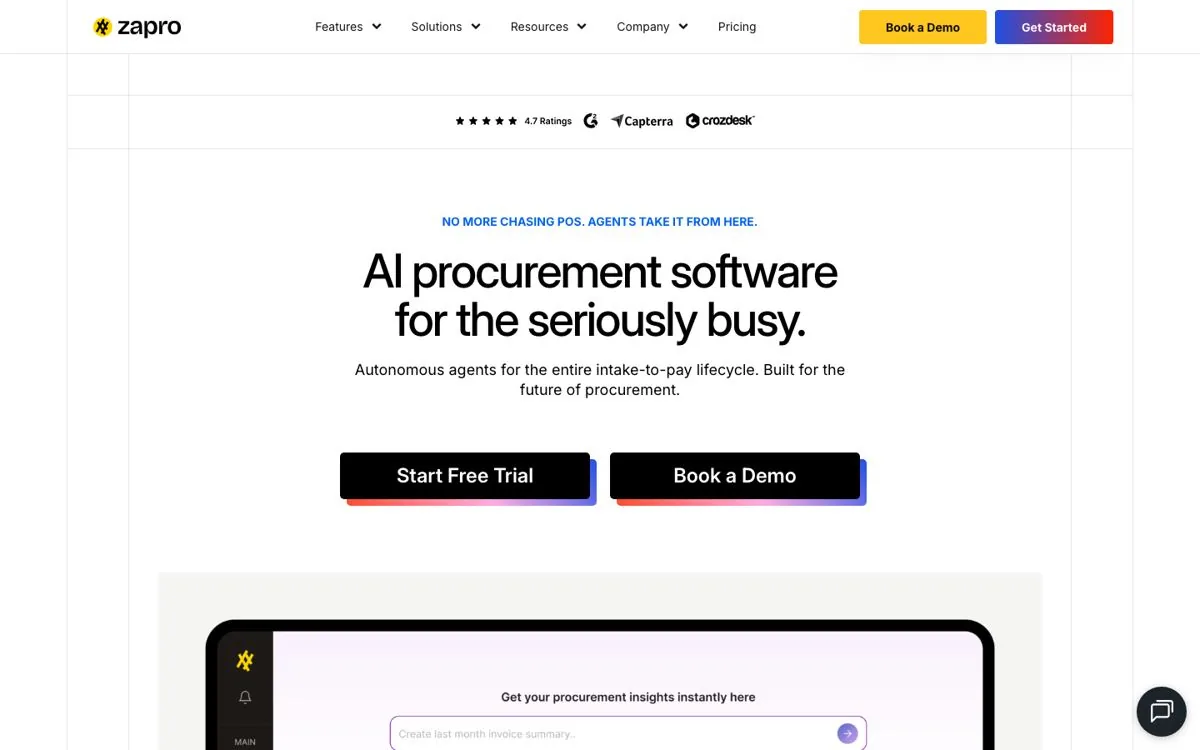
Zapro is a strong ProcurementExpress alternative for mid-market teams whose gap is supplier quotes, contracts and invoice matching. This AI-native procurement software covers intake, approvals, sourcing, contracts, POs and matching, with unlimited users. Plans start at $699 a month. Your bank or ERP pays suppliers.
Key features 3 features
- Approvals routed by amount, category or vendor
- 2-way and 3-way matching with an exception queue (3-way on Growth and up)
- RFI, RFQ and RFP events, plus contracts with renewal alerts
Pros and cons 3 pros, 2 cons
Pros
- Unlimited users: every plan includes unlimited users, so occasional approvers never add to the monthly bill
- Published prices: Spark is $699 a month and Growth $1,999, so you can budget before you talk to sales
- Sourcing on every plan: RFI and RFP events come on Spark, so supplier quotes move out of email without a higher tier
Cons
- No payments: Zapro prepares payment batches, but your bank or ERP sends the money, so supplier payments stay where they run today
- Vendor caps: Spark covers up to 50 active vendors and Growth up to 500, so teams with many suppliers need a higher tier
Pricing
Spark $699 a month (up to 50 vendors), Growth $1,999 a month (up to 500 vendors), Scale on custom pricing, as published on zapro.ai in November 2026. The pricing page lists 3-way matching and contract authoring in the Growth plan's AI suite.
Best for
Mid-market finance and procurement teams that have outgrown PO approvals. They now need supplier quotes, contracts and invoice matching in one place.
Verdict
Verdict: Pick Zapro if PO approvals alone no longer cover how you buy. Stay with ProcurementExpress if 2 CFR 200 checks and SAM.gov screening drive your process.
ProcureDesk: best for small teams buying supplies
Best for Small teams buying supplies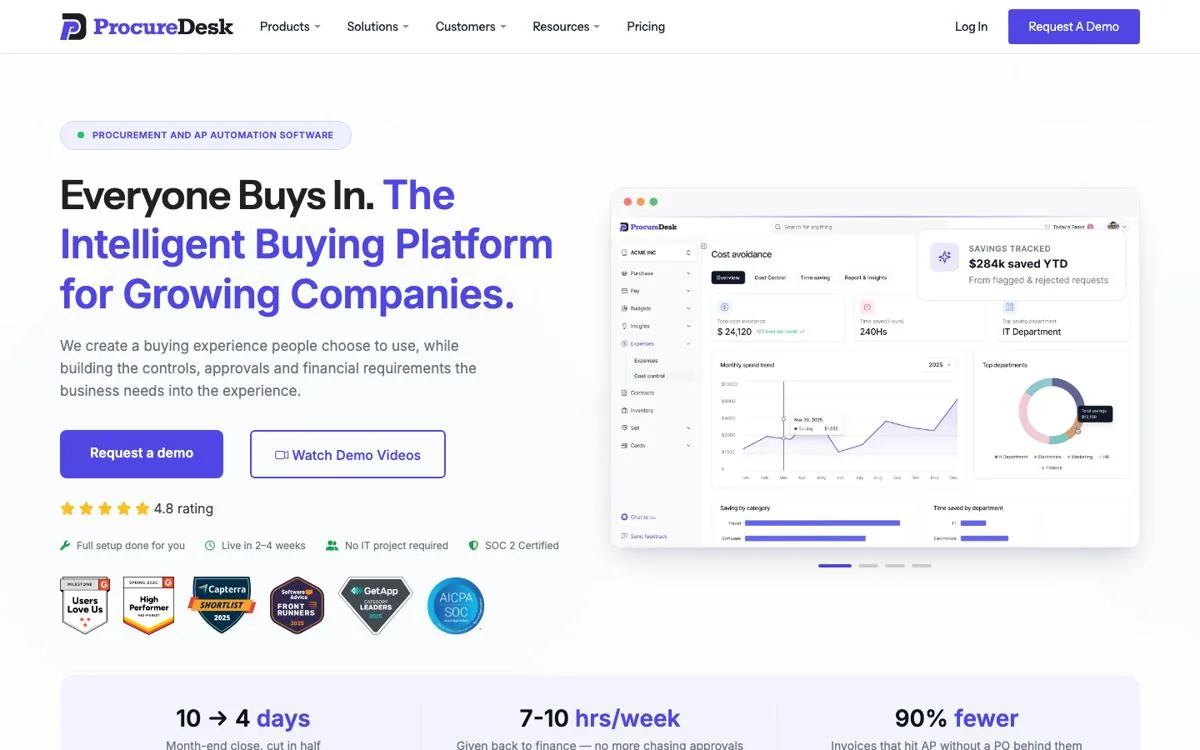
ProcureDesk fits finance teams at growing US companies and nonprofits that buy a lot from catalogs and want domestic bill pay. It lists 200+ punch-out catalogs, 3-way matching with OCR from its Startup plan and payments by ACH, check or virtual card. Plans include 10 or 20 users, then $20 a month for each extra user.
Key features 4 features
- 200+ punch-out catalogs, including Amazon Business and Grainger
- 3-way matching with OCR from the Startup plan
- Bill pay by ACH, check and virtual card
- Supplier onboarding with EIN and W-9 on Growth
Pros and cons 3 pros, 3 cons
Pros
- Nonprofit discount: nonprofits and charter schools get 15% off, which matters for grant-funded teams leaving ProcurementExpress
- Done-for-you setup: ProcureDesk handles the initial setup, so finance teams spend little of their own time on the rollout
- Low-risk start: a 30-day money-back guarantee lets you test the tool on real orders before you commit
Cons
- Domestic payments only: it pays by ACH and check, so international wires stay in your existing payment process
- Contracts add-on: contract management is priced separately on a demo call, so the published plan price leaves it out
- User caps: plans include 10 or 20 users, then $20 a month each, so cost rises as more people request or approve
Pricing
Startup $830 a month billed yearly (10 users), Growth $1,250 a month (20 users), Enterprise custom; extra users $20 a month each.
Best for
Controllers at US companies and nonprofits that want punch-out buying, 3-way matching and domestic bill pay. ProcureDesk frames its plans for teams under 100 to 250 employees.
Verdict
Verdict: ProcureDesk fits small teams that buy supplies and pay US vendors. Look elsewhere if you pay suppliers abroad.
Tradogram: best for low-cost purchasing plus RFQs
Best for Low-cost purchasing plus RFQs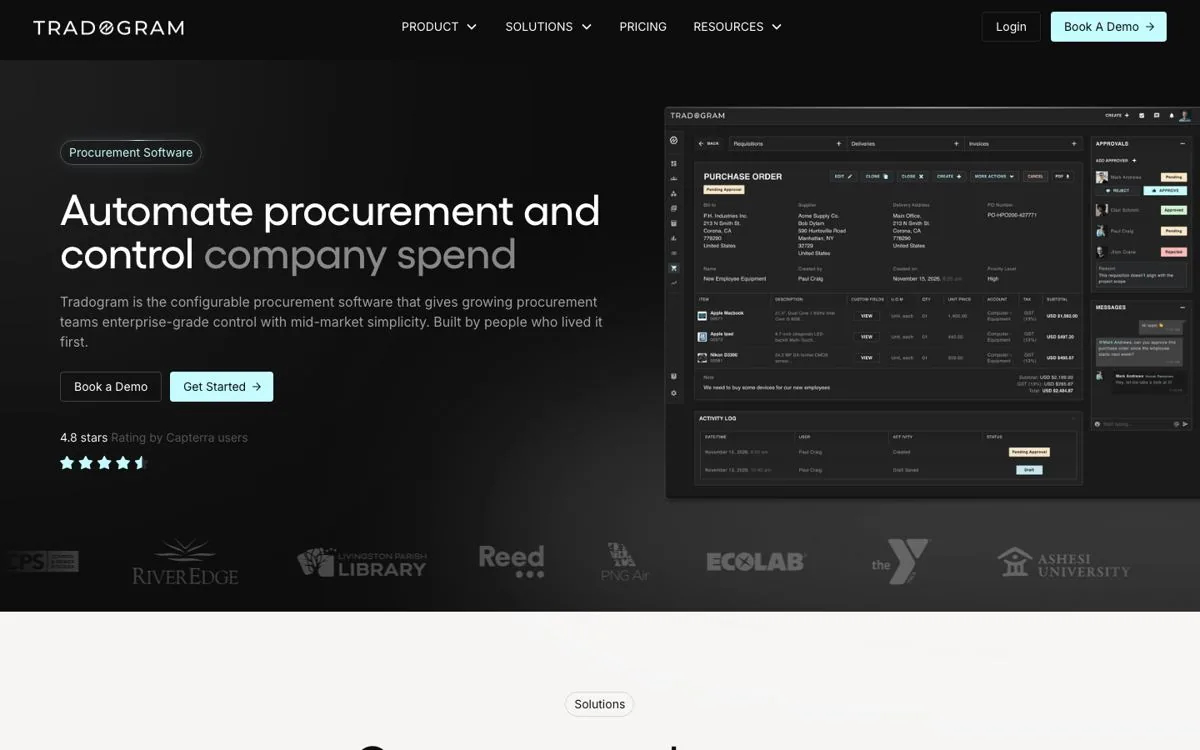
Tradogram fits small purchasing teams that want POs and supplier payments at a low entry price. Essentials costs $99 a month plus a per-user fee and includes TradoPay payments to 150+ countries. Requisitions, RFx, receiving, budgets and contracts sit on Premium, which starts at 20 users.
Key features 5 features
- POs from approved requests, online carts or scanned quotes (TradoScan AI)
- TradoPay supplier payments, including cross-border to 150+ countries
- RFQ and RFP with weighted scoring on Premium
- AI invoice capture and three-way matching
- Self-serve supplier onboarding with performance scorecards
Pros and cons 2 pros, 3 cons
Pros
- Low entry price: Essentials is $99 a month, or $950.40 a year, so small teams can start without a large commitment
- TradoCart: carts from Amazon, Costco, Home Depot and 25+ vendors become POs without punch-out setup, which speeds up online buying
Cons
- Paid add-ons: ERP integrations, SSO, API and punch-out cost extra on every plan, so the real price sits above $99
- Premium gating: requisitions, RFx, budgets and contracts sit on Premium, which starts at 20 users, so very small teams may miss them
- Separate user fees: the per-user fee is quoted separately, so ask for a written quote at your headcount
Pricing
Essentials $99 a month or $950.40 a year plus a per-user fee; Premium (20+ users) and Scale (unlimited users) are quoted; add-ons are extra.
Best for
Small purchasing teams that want RFQs, contracts and supplier payments on a tight budget and can accept paid add-ons for integrations.
Verdict
Verdict: Tradogram has the lowest entry price here. Add up the add-ons before you compare it with Precoro.
Order.co: best for multi-site supplies buying
Best for Multi-site supplies buying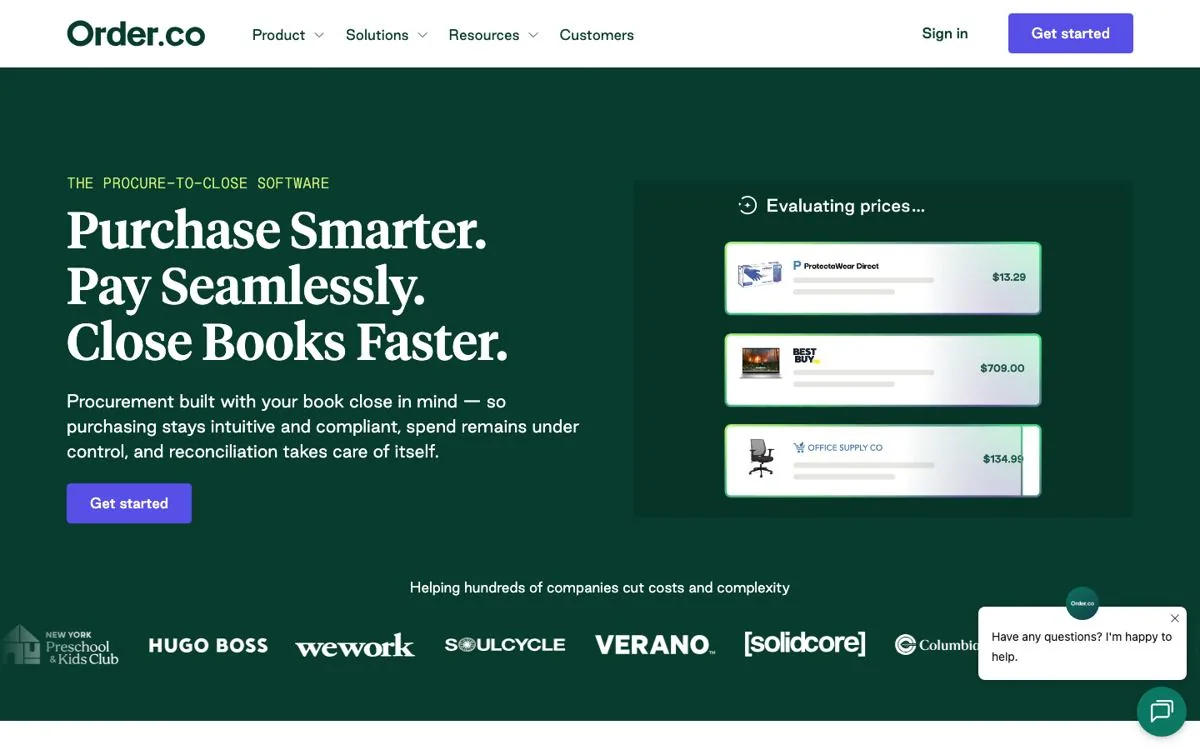
Order.co fits multi-site teams that buy the same operating supplies across many locations. Buyers order from one cart across their own vendors and a network of 40,000+ suppliers. Order.co then pays the vendors and sends one consolidated bill, a different model from ProcurementExpress's request, approval and PO flow.
Key features 4 features
- One cart across vendors for office, janitorial and food service supplies
- Approvals and budgets by location, cost center, role or spend threshold
- Line-level GL coding on every order
- Vendor-locked virtual cards
Pros and cons 2 pros, 3 cons
Pros
- One bill: Order.co pays vendors and sends one consolidated bill, so AP handles one invoice instead of dozens of supplier bills
- Stated rollout: 4 to 6 weeks for core processes, ERP connections and catalogs, so you can plan the cutover with real dates
Cons
- Supplies focus: it is built for operating supplies, so services, software and grant workflows get little depth
- No public pricing: there is no pricing page, so you cannot compare cost with published plans before a demo
- No RFx: it offers AI Sourcing that suggests cheaper vendors for the same items, but no RFx events
Pricing
Custom quote; Order.co has no pricing page.
Best for
Multi-site nonprofits, clinics, schools and restaurant groups that buy the same supplies across many locations and vendors.
Verdict
Verdict: Order.co removes many vendor bills for supply-heavy teams. Look elsewhere for services, sourcing or grant workflows.
Coupa: best for enterprise source-to-pay
Best for Enterprise source-to-pay
Coupa fits large enterprises that need full source-to-pay: procurement, sourcing, contracts, AP and payments in one suite. Rollouts take months and usually run through implementation partners. Vendr buyer data shows a median contract of $94,519 a year. That is far above ProcurementExpress's published plans, so check the fit first.
Key features 6 features
- Sourcing and advanced sourcing optimization
- Contract repository enforced at the time of purchase
- Real-time budget check before approval
- AI invoice capture with 2-way and 3-way matching
- Payments and virtual cards through payment partners
- Open Buy and Amazon Business buying
Pros and cons 1 pros, 3 cons
Pros
- Broad suite: sourcing, contracts, procurement, AP and payments sit in one platform, which suits large teams that want one vendor
Cons
- Long rollouts: implementations take months and often run through partners, so plan for consulting fees and internal time
- Module pricing: each part of the suite is sold separately with no public prices, so cost climbs as you add modules
- High cost: Vendr buyer data puts the median deal at $94,519 a year, before any partner fees
Pricing
Quote only, by module. Vendr buyer data shows a median of $94,519 a year across 128 purchases, from $20,804 to $331,084.
Best for
Large enterprises with global entities that have outgrown mid-market purchasing tools and can staff a rollout that runs for months.
Verdict
Verdict: Coupa fits when you need full source-to-pay across many entities. For teams that mostly need PO approvals, the cost and rollout outweigh the extra depth.
Also worth a look: Prokuria, if sourcing is the main gap. It runs RFPs, RFQs and reverse auctions, with supplier onboarding and a contract repository. It connects to an ERP through its REST API or partners. Kissflow suits IT-led teams that want low-code approval workflows around an ERP that already runs AP and payments.
ProcurementExpress alternatives: feature-by-feature comparison
Compare ProcurementExpress alternatives on the purchasing work you do every day. That means requests and POs, approvals and budgets, invoice capture and matching, sourcing and contracts, and supplier payments. All seven alternatives cover part of this flow, so the grid includes each one, with ProcurementExpress first as the baseline.
| Tool | Requests and POs | Approvals and budgets | Invoice capture and matching | Sourcing and contracts | Supplier payments |
|---|---|---|---|---|---|
| ProcurementExpress | Requests and POs; Amazon punch-out from Better | Remaining budget on the PO; 2 CFR 200 checks | Scan & Match from Best ($2,550/mo) | No sourcing or contract module | No payment module on its plans |
| Precoro | Requests to POs; blanket, recurring and service orders | No-code routing; budgets by cost center | 2-way and 3-way on Core; AI capture on Automation | RFPs on Automation; contract repository with a Contract Agent | ACH, same-day ACH, wire and international transfers |
| Procurify | Order requests and POs in the base product | By department, location, account code or amount | AP add-on; 2-way and 3-way matching | Contracts add-on; no sourcing events | ACH, check, wire; payments to 190+ countries |
| Zapro | Intake, catalog, Amazon Business punch-out, request to PO | Routed by amount, category or vendor | OCR capture; 2-way matching, 3-way on Growth | RFI and RFP on every plan; contract authoring on Growth | Prepares the payment batch; your ERP or bank pays |
| ProcureDesk | Requests, POs and blanket POs on every plan | All plans; budget tracking and alerts | 3-way match with OCR from Startup | Contracts add-on; no sourcing events | Domestic ACH, check and virtual card |
| Tradogram | POs on all plans; requisitions on Premium | By amount, department, GL code or project | AI invoice capture and automated three-way matching | RFQ, RFP and contracts on Premium | TradoPay, cross-border to 150+ countries |
| Order.co | One cart across vendors; requisitions become POs | By location, cost center, role or spend threshold | Invoice filled from your orders; line-level GL coding | AI Sourcing suggests cheaper vendors; no RFx | Order.co pays vendors and sends one bill |
| Coupa | Guided intake and POs | Email and mobile, with a budget check | Any-format capture; 2-way and 3-way matching | Sourcing and a central contract repository | Payments and virtual cards through partners |
How ProcurementExpress alternatives charge
ProcurementExpress pricing is a monthly fee tied to the spend you manage through it. It runs from $415 on Basic to $2,550 on Best. Precoro, Tradogram and ProcureDesk publish plan prices, while Procurify, Order.co and Coupa quote. Flat plans by active vendor count are another model, such as Zapro pricing.
| Tool | Pricing model | Starting price |
|---|---|---|
| ProcurementExpress | Monthly fee by managed spend; not per user | $415 per month (Basic) |
| Precoro | Plan subscription with user limits, billed yearly | $499 per month |
| Procurify | Quote, by modules and Pro users | Vendr median $15,000 a year |
| Zapro | Flat monthly plan by active vendors; unlimited users | $699 per month |
| ProcureDesk | Platform fee with users included, plus $20 per extra user | $830 per month |
| Tradogram | Plan fee plus per-user pricing and add-ons | $99 per month |
| Order.co | Custom quote; no pricing page | Custom quote |
| Coupa | Quote, by module | Vendr median $94,519 a year |
Questions to ask any ProcurementExpress alternative
Before you choose a ProcurementExpress alternative, ask every vendor the same five questions in writing. Does the price change with the spend you route? Which plan includes invoice matching? Can it show budget checks on a request? Can you edit an approved PO and keep the audit trail? Does it support grant rules? Strong answers name the plan.
| Question | Why it matters | What a strong answer includes |
|---|---|---|
| Does the price change with the spend we route through it? | ProcurementExpress tiers rise with managed spend. | A written price that stays flat as spend grows, or the exact tiers. |
| Which plan includes invoice matching? | Matching is a top-tier feature at ProcurementExpress. | The plan named, with 2-way and 3-way matching against purchase orders shown live. |
| Can you show budget checks on a request? | Budget checks are why many teams chose ProcurementExpress. | Remaining budget shown to the requester and the approver. |
| Can we edit an approved PO and keep the audit trail? | Changes after approval cause billing confusion. | A live edit with the change history kept. |
| Do you support grant rules such as 2 CFR 200? | Grant-funded nonprofits need it for audits. | Named controls, such as SAM.gov checks and audit exports. |
Which ProcurementExpress alternative should you choose in 2027?
Choose the ProcurementExpress alternative that covers what PO approvals alone no longer do. For invoice matching at a lower tier, start with Precoro or ProcureDesk. For supplier payments, look at Procurify or Tradogram. For supplier quotes and contracts, Zapro or Tradogram fit; Order.co suits multi-site supply buying and Coupa large enterprises.
A practical shortlist for a growing team: Precoro, ProcureDesk and Zapro. Size the savings first with our procurement ROI calculator. Then run the same request, PO and invoice through each one in the trial or demo. Time each step.
Frequently asked questions
What is the best alternative to ProcurementExpress?
Precoro fits most teams that want invoice matching sooner, with 2-way and 3-way matching from $499 a month. ProcureDesk suits small teams buying from catalogs, Procurify teams that want supplier payments, and Zapro teams that need sourcing and contracts.
What are the top procurement platforms for teams leaving ProcurementExpress?
Precoro, Procurify and ProcureDesk are the usual mid-sized picks, with request-to-PO flows and invoice matching. Tradogram fits tight budgets, Order.co multi-site supply buying, Zapro sourcing and contracts, and Coupa large enterprises that need full source-to-pay.
Who are ProcurementExpress's main competitors?
ProcurementExpress's main competitors are Precoro, Procurify, ProcureDesk, Tradogram, Order.co, Coupa and Zapro. Larger groups also compare Kissflow, which builds low-code approval workflows around an ERP. Some look at Prokuria, which focuses on sourcing events and supplier management.
How much does ProcurementExpress cost?
ProcurementExpress pricing starts at $415 a month on Basic, for up to $10K of managed spend a month. Better is $900, Best is $2,550 and Enterprise is a custom quote. A 14-day free trial gives full access, and 501(c)(3) pricing is available through sales.
What do ProcurementExpress reviews say?
ProcurementExpress rates 4.7 out of 5 on G2 from 61 reviews, checked on 12 November 2026. Its own pages stress the budget shown on each purchase order and Amazon punch-out from the Better plan. They also stress audit-ready PO and invoice records for grant-funded teams.
Is there cheaper purchase order software than ProcurementExpress?
Yes. Tradogram Essentials costs $99 a month plus a per-user fee. Precoro Core costs $499 a month and includes 2-way and 3-way matching. ProcurementExpress keeps that job, Scan & Match, for its $2,550 Best plan. Compare each at your real user count.
Which procurement express alternatives suit nonprofits?
ProcureDesk offers a 15% discount for nonprofits and charter schools. Procurify and Order.co both list nonprofits among the industries they serve. ProcurementExpress itself runs 2 CFR 200 checks and SAM.gov screening, so ask each alternative to show its grant controls.
Go beyond PO approvals
See how Zapro handles requests, approvals, supplier quotes, contracts and 3-way matching for a mid-market team, with unlimited users on every plan.
Sources: ProcurementExpress pricing; ProcurementExpress on G2; Precoro pricing; ProcureDesk pricing; Tradogram pricing; Procurify on Vendr; Coupa on Vendr.